fbpx

November 25, 2022

Comments on Torah Portion Toldot – Breaking, Becoming Free


Breaking – Free

Thoughts on Torah portion Toldot 2022 (adapted from earlier versions)


Polonius, in Shakespeare’s Hamlet, is presented as sincere (the sincerity of the shallow), but also as an insufferably garrulous and “tedious old fool.”  The character of Polonius is the one who says the words,


“This above all: to thine own self be true / And it must follow, as the night the day / Thou canst not then be false to any man.”


Polonius (as brilliantly drawn by Shakespeare) uses this adage to cap a series of proverbs that he pontificates to his son Laertes, as the latter is heading back to his studies. I can’t remember an actor playing Laertes, but I can imagine him rolling his eyes as Polonius preens before the audience.


The adage, in the mouth of Polonius, is dripping with savage irony.


I’ll unpack the irony with questions:  Who knows one’s self enough to be true to it? Who can claim true self-knowledge?  I have a theory: Most of us don’t know ourselves, unless and until our mettle has been sorely tested, and even then it is just a small step.


You might gain knowledge of self if you do the assiduous and painful work that, according to Socrates, makes life worth living.  Hard work with no visible payoff.


To which self be true?  The self that is seeking its own interests, while masquerading in fancy pious subterfuges?  Or the self of day-to-day prevarications, lest we admit to ourselves who we are.


I would not have us ask these questions of the brilliantly drawn character of Polonius, a caricature reminding me of those who parade themselves around as “woke” – a person who doesn’t seem to have access to anything but slogans, aphorisms and untested thoughts.


Here’s a question that might have awakened Mr. Polonius from his “woke” stupor (had he not been knifed): What if, in a given moment, the only way you can be true to yourself is to con another person?


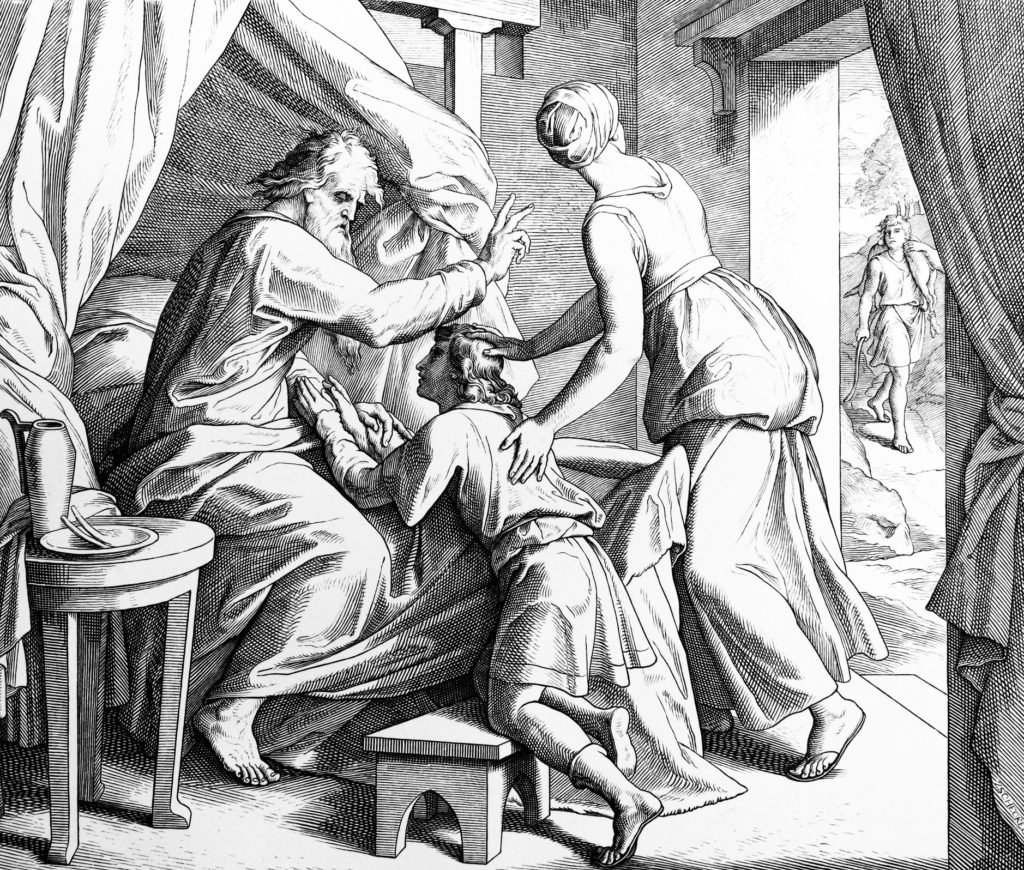
This is the dilemma of Jacob in our Torah portion, brilliantly discussed by Avivah Zornberg in her book on Genesis. This Torah portion presents yet another cutting narrative of the existentialist quandary:  Who am I? How did I get here? What am I supposed to do?


Put more precisely:  How do I know what to do when I don’t know who I am? Or when all I am sure of is that I gain the confidence of others to get my way?


The acute existentialist quandaries in Genesis, of Noah, of Abraham, of Sarah, Hagar (and even of God) seem to converge in the character of Jacob. Zornberg emphasizes Jacob’s starting place as being an “ish tam” – a pure, simple, blameless, innocent man, a dweller of tents. If you sit alone in your tent, untouched by the outside world, refusing to look inward, sure, you can remain innocent.  You are only conning yourself. “Tent” here, then, is a metaphor, referring to a purposeful shutting out of the world of suffering, even your own.


(Sometimes when I read a book on ethics, the author presents some quandary where if you intentionally kill one person you can save five others. I want to ask the author, “Did this ever happen to you or someone you know? Have you ever killed someone to save someone?  Did you ever watch somebody die? Did you maybe then officiate at the funeral of the innocent person you killed to save others?”  I think those artificial ethical quandaries are vulgar, written by professors who “dwell in tents.”)


Zornberg writes, “The disintegrated, alienated and distraught consciousness . . . represents a higher mode of freedom than that of the ‘honest soul’ . . . ” (The Beginning of Desire, p. 154).  Jacob symbolizes this freedom by his becoming someone other than who he has been, because the moment requires it. Not just that he disguises himself as his brother, but more –  that in disguising himself, in having agreed to disguise himself for a higher purpose, he merges on to Highway 61, driving into a world of ambiguity where the clear moral road seems to end, where a former identity has to be left behind.


If Jacob will become equal to what the moment demands, he has to abandon “ish tam” – the blameless, innocent dweller of tents. When people say, “It wasn’t morally right for Jacob to deceive his father and steal the birthright from his brother,” the response is, “That’s exactly the point of the story.”  It is called a moral dilemma. Maybe it asks of you:  How far will you go to do what must be done?


The ego-self seeks continuity, that you will live life in a linear way. What you will think, feel, say and do tomorrow will link pretty evenly with what you thought, felt, said and did yesterday. You don’t change your mind and you don’t change your stride. You stay inside your tent.


Something happens – a curve ball, a swerve that leaves you with the realization that ‘what you will become’ is at stake.


What you do now will shape everything that happens next.


I sometimes counsel people in those situations, and I see it. The momentary flash in someone’s eyes where they feel a moral flicker and that the way forward is open. I detect that moment of terrifying freedom, where, at least for a moment, the will to do what is required is greater than the habit to listen to a voice of fear, of pettiness, of self-righteousness, a voice of avoidance.


You can feel regret when you realize you could have done something differently, something truer and more right. Regret for not having done the right thing leads to a certain kind of heartbreak – heartbreak from the knowledge of what you could have done, could have been. You live repairing that moment.


I can never predict who will live toward the future and who will die tied to the past. In the one second flash in the eyes of wondering – “Can I do this?” “Can I become other than how I have been?” – we find the existential crisis. Can I break – free?


When Jacob put on the mask, another mask fell away. Jacob went from being an “ish tam,” a “whole man,” to an “ish shavur,” a “fragmented man,” fragmented by the wisdom that is required for hard choices. And there’s nothing more precious before God than a broken heart.


Comments on Torah Portion Toldot – Breaking, Becoming Free Read More »
New Book on Tragedy Asks, “Why God Why?”

One sunny Sunday morning in 1986, Rabbi Gershon Schusterman was driving to his home in Long Beach, California when he received an alarming phone call from his wife, Rochel Leah. She told him she wasn’t feeling well, and he knew from the tone of her voice that it was serious. He rushed home and took her to the emergency room right away.

Gershon Schusterman

Schusterman sat in the lobby of the ER, saying Tehillim and praying to God that his wife was going to be fine. After an hour, he saw the doctor heading towards him.

“We did everything we could,” the doctor said. “But your wife didn’t make it.”

Schusterman thought: Rochel Leah was only 36 years old. How could she have suddenly passed away? She wasn’t sick. They had 11 children together, including 16-month-old twins. She was a beloved teacher at the day school where he was the director. How was he going to break the news to his children? How was he going to explain this to his community? And how was he going to move forward?

His next thought was, “why?” Even though he was a rabbi who had consoled many people who experienced tragedy, now that it was happening to him, he didn’t know how to react.

“I respected God and didn’t compromise my observance, but in my heart, I distanced myself from Him,” said Schusterman. “I had a grudge against God. I guess one can say I gave Him the cold shoulder.”

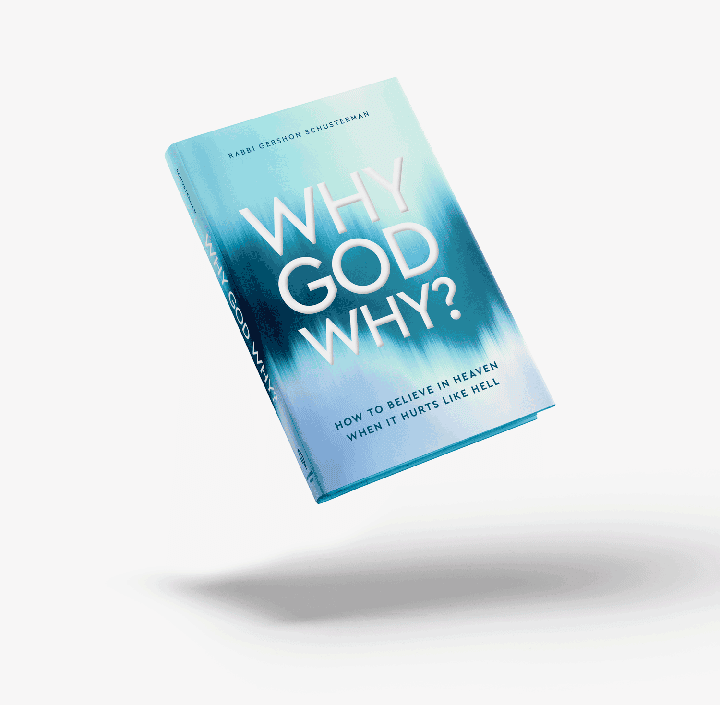
To process his emotions and help his community at the same time, a few months after Rochel Leah’s death, Schusterman taught a seven-week class on the topic, “Do bad things happen to good people?” In it were the seeds for his new book, “Why God Why? How to Believe in Heaven When it Hurts Like Hell,” which details his own traumatic experience and explores Judaism’s teachings surrounding tragedy.

The book does not attempt to give a definitive answer as to why there is suffering in the world. That would be presumptuous and ludicrous, Schusterman says. Rather, it offers a number of different perspectives from the Torah in which the reader may be able to find comfort. There are chapters on what evil really is, how tragedy can refine us, the afterlife, whether or not suffering is a test of faith and the Holocaust.

There is also a chapter on if it’s OK to be angry with God. In the immediate aftermath of his wife’s passing, Schusterman was in sink-or-swim mode trying to take care of his family, work and look after his community. He didn’t have time to process his emotions or examine his relationship with God.

“I resisted allowing myself to be angry at God,” he writes. “Rather, I was in deep shock and pain, bewildered by the new and intensely challenging circumstances suddenly thrust upon me and my family. I didn’t have the emotional language to articulate my feelings at that time. But as I imagine you have experienced, when you don’t express important, urgent feelings, they eat away at you and wreak havoc.”

Two years after Rochel Leah died, Schusterman got remarried to his current wife, Chana Rachel. A few years after that, they were on vacation in Israel when he broke down in the middle of Jerusalem. Finally, all his feelings were coming to the surface. He couldn’t suppress them anymore.

“My wife asked me how I was doing, and I was suddenly got dizzy and felt the world spinning around me,” he said. “I was experiencing an intense psychic pain. My mind flashed through all those events of the past few years.”

Schusterman realized he needed to contend with his feelings, so he spent part of the rest of his two-week-long trip going to intensive therapy for two hours a day.

“I didn’t grieve adequately,” he said. “And I had unfinished business with God.”

While Schusterman said he felt distanced from God after his wife’s passing, feeling a range of emotions, including anger, is completely normal in light of such loss. According to the rabbi, the Talmud states that a person is not held accountable for things he says against God in anger after he experiences a tragedy.

“God has broad shoulders,” he said. “He doesn’t reject a person who speaks out of line during a crisis. When that person calms down, God will take him back lovingly.”

Along with touching upon anger, in “Why God Why?” Schusterman discusses the ideas about God that Rabbi Harold Kushner described in his book, “When Bad Things Happen to Good People.” While Kushner believed that evil was not in God’s control―and we could let God off the hook for it―Schusterman writes that this is not inherently a Jewish idea.

“Jews believe that God is firmly in control of every corner of the universe, and, as hard as that may be to understand, bad things can happen to decent people,” he says. “In a way, it’s a simpler course to throw up one’s hands and say, ‘There are forces beyond God’s purview, and those forces are to blame for whatever unfortunate or evil things happens in the world.’ God’s role would then be that of the Sympathizer and Comforter-in- Chief Who sits on the sidelines. But again, that’s not a Jewish approach.”

“Jews believe that God is firmly in control of every corner of the universe, and, as hard as that may be to understand, bad things can happen to decent people.”
– Gershon Schusterman

Schusterman also explains how tragedy can make us better people and bring positivity into the world. In one poignant passage, he includes a story from a Viktor Frankl book: A mother is wearing a bracelet made of nine baby teeth all mounted in gold, and her doctor asks her what they represent. The teeth are of her nine children who died in the Holocaust, she says. The doctor asks her how she copes with that reality, and she states that she operates an orphanage.

In his own life, Schusterman became much more empathetic to people who had experienced something tragic.

“Until this tragedy happened to me, I had gone to many shiva homes and said the right things but, I have to admit, it was superficial because I couldn’t feel what they were feeling,” he said. “When I experienced it myself, I knew what they were going through. Chazal say that ‘words that come from the heart enter the heart.’”

The Jewish approaches Schusterman details in “Why God Why?” are that we do not, and cannot know God’s ultimate “mind,” as He is the Creator and we are creatures of His creation. Jews believe in an afterlife, one where souls reunite with God, as well as the recycling of souls that need to come back to the world and complete their mission before they can be at one with God.

Whether someone is currently mourning the loss of a loved one or hasn’t healed from old wounds, Schusterman believes his book can help them handle their pain and process what happened to them. It can teach them that while we can’t avoid pain, we do not have to suffer.

“I hope people find comfort and consolation after they read my book and learn how to engage with God,” he said. “The worst relationship a Jew can have with God is an apathetic one. By engaging in a time of crisis, there is an opening for a deeper relationship with God.”

“Why God Why? How to Believe in Heaven When it Hurts Like Hell is available for purchase on Amazon.com.

New Book on Tragedy Asks, “Why God Why?” Read More »

Jacob and Antisemitism

Joseph Official, the 13th-century author of the polemical work Sefer HaMekaneh, met a Capuchin friar on the road to Paris.  The friar said to him: Jacob your father was a thief, and no greater extractor of usury was there; for one plate of lentils which was worth half a coin, he acquired the birthright which was worth a thousand coins.

One would expect the friar, who is a devout Christian, to be respectful of Jacob, who is a biblical hero. However, the opposite is true. Christian criticism of “Jewish” characters in the Tanakh was not uncommon in the Middle Ages; Rabbi Isaac Arama in Spain reports similar criticisms two hundred years later. And throughout history, antisemites have always found a way to reconcile their reverence for the Bible with their loathing of the Jews. Susannah Heschel, in her book “Aryan Jesus,” writes about the furtive efforts of pro-Nazi theologians to erase the Jewish elements from Christianity. They organized what was called “The Institute for the Study and Eradication of Jewish Influence on German Church Life,” with the quixotic task of adapting a Nazified theology to a religion started by Jews. Walter Grundmann actually wanted to remove the “Old Testament” from the Bible, seeing it as anti-Christian. Jesus, he claimed, because he was a Galilean, was not actually a Jew; and because of this, Jesus does battle with the Old Testament Pharisees, whose views are the opposite of his own. Other institute professors theorized that contemporary Jews are imposters, and not the same as the Jews of the “Old Testament.” And even today, both the white supremacist Christian Identity movement and the radical Black Hebrew Israelites, (whose message has been popularized by Kyrie Irving), claim that the Jews are not the people of the Bible. This brazen act of identity theft allows them to simultaneously love the Bible and hate the Jews.

Yet the question remains; How is it that Jacob is so unethical? At two critical moments, he acts treacherously toward his brother. When Esau is returning from a day of hunting and is extremely hungry, Jacob takes advantage of the situation; he refuses Esau food until he agrees to exchange his birthright for a bowl of lentils.  Later, when Isaac plans on bestowing the familial blessing on Esau, Jacob, at the instigation of his mother, deceives his blind father and steals his brother’s blessings.

Esau exclaims after the theft of the blessings: “(my brother) is rightly named Jacob (‘Yaakov’), for he has deceived me (‘vaya’akveni’) these two times: he took away my birthright, and now he has taken away my blessing.” In this bitter jibe, Esau says that Jacob’s very name predicts that he will be a shyster.  And it is difficult for the reader to dismiss Esau’s words. How can it be that our hero, our patriarch, acts in such an immoral fashion?

In response to this and other similar questions, two interpretative responses emerge. In rabbinic literature, many passages tend to whitewash the flaws of biblical characters. Rabbi Tzvi Hirsch Chajes points out that this is part of a general tendency to exaggerate the good traits of the pious and the negative traits of the wicked. When the contrast in the Biblical picture is heightened, the lessons derived are far more black and white; we are left with a simpler picture of good guys and bad guys. In these sorts of interpretations, Jacob’s ethical failings are rationalized and defended.

Rashi’s comment to the verse where Jacob lies to his father Isaac and says “I am Esau, your firstborn son” is an excellent example of this type of interpretation. Rashi explains that Jacob actually didn’t lie; he had a different type of punctuation in mind, and intended it to mean “I am he that brings food to you, and (aside from that,) Esau is your first-born.”

Similar explanations defend Jacob’s actions at the sale of the birthright. Ibn Ezra explains that Esau is more than willing to give up the right of the firstborn; he’s a hunter who is in constant danger and is unsure how long he’ll even live. (Ibn Ezra adds that Isaac was not a wealthy man, so there would be little of value left in the estate anyway.) Esau has no interest in a meager inheritance that might arrive in the remote future.

At the same time, another type of interpretation emerges in Rabbinic and Medieval literature. They follow what they see as the straightforward understanding of the text, and don’t romanticize the actions of Biblical heroes. For example, Rabbi Joseph Bechor Shor emphasizes the heartlessness of Jacob’s negotiating stance. In his reading of the text,  Esau is truly near death, having spent days in the field hunting. At this moment of vulnerability, Jacob said to Esau: if I don’t feed you, you will die, and I’ll inherit all the rights of the firstborn; so in order that I don’t lose out by saving your life, you must promise to sign over the rights of the firstborn to me.

Similarly, multiple commentaries, from the Midrashim onward, point out how Jacob is punished, measure for measure, by the deceptions of others. He wants to marry Rachel, but his father-in-law Laban switches sisters on him, much like Jacob did with his father. Later, Jacob’s own sons will deceive him, (also, while using a goat,) when they fake Joseph’s death. One Midrash, (Bereishit Rabba 67:4,) goes so far as to say that the frightening decree of Haman in Megilat Esther is punishment for the pain that Jacob caused Esau. The Tanakh itself emphasizes Jacob’s culpability.

Today, there remains a debate about which style of interpretation to adopt. All too often, people tend to choose black-and-white interpretations; Jacob is either a hero or a villain. In reality, Jacob’s early deceptions arise from a complicated mix of jealousy, idealism, and ambition, mixed together with loyalty to his mother. Esau is not a worthy successor to Abraham’s spiritual legacy, and Jacob and his mother Rebecca both know it. That crisis leads to these desperate deceptions.

Jacob ultimately is a wrestler, whose character continues to develop as he struggles with his circumstances and choices. Wherever he turns, his moral failures haunt him. The blessing he steals turn out to be worthless, and he lives a life of exile and difficulty. Ultimately, Jacob reconciles with Esau. And at the end of his life, Jacob blesses all of his children, including them together in one legacy. Jacob isn’t a saint in his youth, but his road to reconciliation and transformation is inspirational. It is in his struggles that Jacob becomes the patriarch that we admire.

Contemporary Jewish readers can read Jacob’s story carefully and critically, and give their own interpretation of the text. But when Joseph Official responds to the Capuchin friar, he doesn’t have that luxury. In this case, Joseph Official, (and the Rashbam), say that Jacob actually paid full price to Esau; the lentils are merely part of a meal served to celebrate the transaction.

This is not a unique explanation; in other passages, the Rashbam often offers unusual apologetic explanations as well. He is well aware of Christian polemics using the Tanakh, and at one point explains that his interpretation “effectively silences the heretics (i.e., Christians)…” Anti-Jewish polemics is almost certainly why the Rashbam makes the remarkable claim that the brothers did not sell Joseph, but rather the Midianites stole him out of the pit while the brothers, unaware, were eating lunch. Clearly, Jews were being denigrated as people who would sell their own brother into slavery, and the Rashbam was looking for a way to respond.

I read these apologetic interpretations with a mixture of amazement and sadness. They are exceptionally brilliant re-readings of the text, worthy of the rabbis who composed them. At the same time, it is heartbreaking to realize that the Rashbam, who is ordinarily meticulous in offering the simple reading of the text, had to deviate from his own standards in Biblical interpretation. He felt it was more important to confront the Christian polemicists who mocked the Jews.

Simply put, the antisemitism of others affected how the Rashbam wrote his commentary. And that is exceptionally sad.

This brings me full circle to today’s antisemitism. On social media, celebrities push the ugliest antisemitic conspiracies, bringing them mainstream. And it is more than just words. There is a very short distance from Black Hebrew Israelite rhetoric to the attacks on Hasidic Jews in Brooklyn.

Today’s proliferation of antisemitism is profoundly troubling; but what worries me even more is what antisemitism does to Jews. Spiteful attacks on Jews, Judaism, and the Jewish homeland change the way we think; and like the Rashbam, nasty rhetoric rings in our ears. In his time, the Rashbam turned to protect Jacob, and did too good a job; but today’s young Jews will, more often than not, run from Jacob and hide their Jewish identity.

Rabbi Angela Buchdahl of Central Synagogue began her Rosh Hashanah sermon this year with the following anecdote:

One of my most engaged students at Central started law school this fall and was happy that campus Hillel invited her to Shabbat dinner her first week. But soon a text chat began circulating among Jewish students:


“I’m not sure I want to go,” one said. “I might get canceled.” Another wrote, “I think I’ll go, but there’s no way I’m putting my name on any sign-in list, or appearing in any photos.”


My student decided to go to the dinner…When it came time for a group picture, however, several left the room.


One student concluded, “I’m never going back to that again.” In his view, it seemed any association with something Jewish was inherently problematic. My student stayed for the picture. But she wondered out loud with me if she would later pay a price for it.

Buchdahl mentions that a 2021 Brandeis Center survey of Jewish students in two fraternities found that 50% of students hide their Jewish identity while on campus. As she puts it: Half our kids are hiding.


This is the greatest tragedy of antisemitism: what it does to the Jewish soul. As young people decide to become crypto-Jews, hiding in plain sight, we must grapple with this thought: now it is our birthright that is being stolen.

We cannot let that happen.


Rabbi Chaim Steinmetz is the Senior Rabbi of Congregation Kehilath Jeshurun in New York.

Jacob and Antisemitism Read More »

We Must Beware of the Normalization of Antisemitism

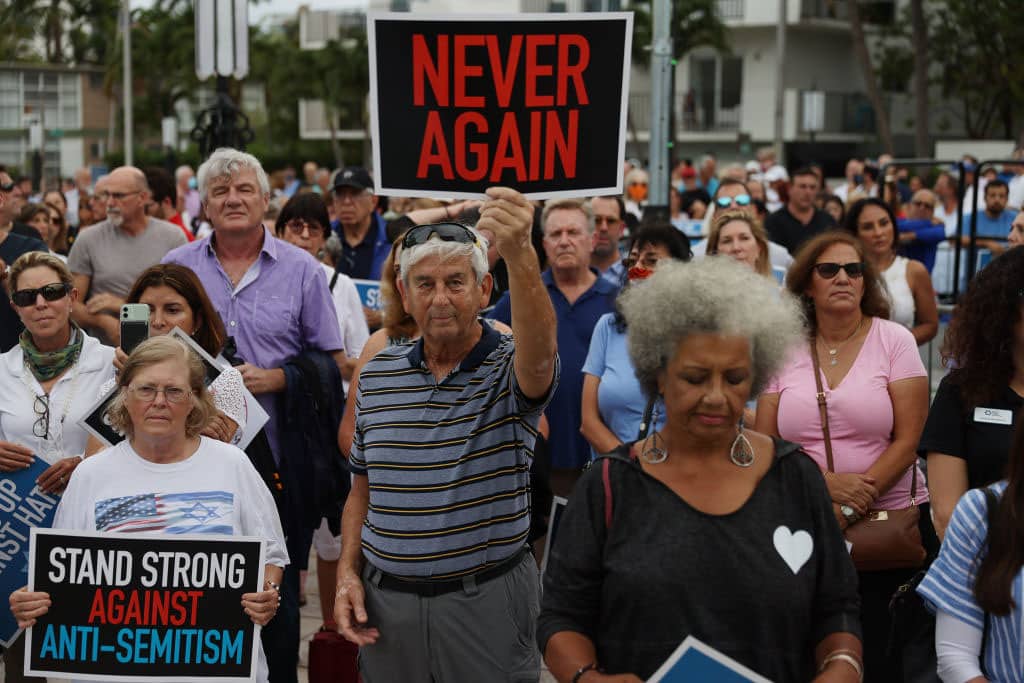
Twenty years ago, the phrase “Never Again” still meant something, at least in the United States. Yet awareness of the Holocaust and the six million European Jews murdered—the culmination of 2,000 years of brutality toward the stateless Jewish people—has fallen in the youngest generations of Americans. A 2018 survey by the Conference on Jewish Material Claims Against Germany found that 31 percent of Americans, and 41 percent of millennial and Gen Z respondents, believe that two million or fewer Jews were killed in the Holocaust; 41 percent of Americans, and 66 percent of millennials, cannot say what Auschwitz was. No fewer than 11 percent of U.S. Millennial and Gen Z respondents believe Jews caused the Holocaust, including 19 percent of the 18-39-year-old subsample from the State of New York. Something has certainly gone wrong when an American public education doesn’t provide this basic historical literacy.

Is it any coincidence that the Anti-Defamation League (ADL) reported an all-time high of 2,107 anti-Jewish hate crimes in 2020? This figure then increased by 34 percent to a mind-blowing new high of 2,717 incidents of assault, harassment and vandalism reported to ADL in 2021—more than seven such incidents per day. One study found that based on data from 2018, Jews per capita were by far the targeted group in the U.S. most likely to suffer most from hate crimes. That’s 2.7 times more likely than Blacks and 2.2 times more likely than Muslims. Yet often the villains who commit these crimes go entirely unpunished, with one shocking scoop finding that “[o]f the hundreds of hate crimes committed against Jews in [New York City] since 2018, many of them documented on camera, only a single perpetrator has served even one day in prison.”

If violent crime against Jews has no discernible deterrent, can anyone really feign surprise that ugly speech toward Jews is increasingly normalized in certain quarters? Many took note when Kanye West, now calling himself Ye, one of the country’s most popular musical artists, went on a weeks-long social media attack on Jews generally, among other things threatening to “go death con 3 on Jewish people,” while saying it was not antisemitic for him to say so because “black people are actually Jew also.” Of course, lowbrow antisemites have embraced this amplification of their hateful rhetoric, as a banner reading “Kanye is right about the Jews” was hung over a busy Los Angeles freeway. That same message was mysteriously displayed on an electronic video board at TIAA Bank Field in Jacksonville, Florida, following a college football game between the University of Florida and the University of Georgia. More recently, a Jewish cemetery in suburban Chicago was vandalized on November 14 as swastikas and the misspelled phrase “Kanye was Rite” were spray-painted on Jewish tombstones.

This would be troubling enough without the support that West and his hateful message have received from more highly placed and celebrated figures. Tucker Carlson, the most-watched cable news host in U.S. history, gave West a primetime interview that was heavily edited to conceal more antisemitic claims from the artist, including that the Jewish holiday of Hanukkah involves “financial engineering” and that “the 12 lost tribes of Judah, the blood of Christ, [are] who the people known as the race Black really are.” The Washington Post reported that “Carlson mostly nodded along with Ye’s commentary [with] no obvious effort to question Ye’s assertions.” Notably, Carlson himself has indulged in the antisemitic “Great Replacement” theory, a claim originating from neo-Nazis that alleges a Jewish conspiracy to replace America’s white majority with groups from other countries by promoting immigration and interracial marriage. West was briefly removed from Twitter, but returned days later to support the Brooklyn Nets’ Kyrie Irving’s promotion of a film that accuses Jews of worshipping Satan, masterminding the trans-Atlantic slave trade, and controlling the media and other industries—literally quoting from the famous antisemitic hoax “The Protocols of the Elders of Zion,” a forgery of Tsarist Russia’s secret police that purports to describe the Jewish plan for global domination.

West’s claims were further legitimized by famed comedian Dave Chappelle in a “Saturday Night Live” (“SNL”) monologue, wherein he alluded to tropes of Jewish secrecy and illicit power, saying: “I’ve been to Hollywood … It’s a lot of Jews. Like a lot.” Chappelle continued: “you could maybe adopt the delusion that Jews run show business. It’s not a crazy thing to think. But it’s a crazy thing to say out loud in a climate like this.” ADL head Jonathan Greenblatt tweeted that it was “disturbing to see [“SNL”] not just normalize but popularize #antisemitism.”

Why are Jewish sensitivities denied or diminished at almost every turn? Why does our trauma trigger applause? As Yair Rosenberg put it in The Atlantic, “[t]he problem … is that as anti-Semitism and related conspiracy theories become more normalized in our discourse, laughing about them becomes harder, because you never know who might not get the joke.”

Why are Jewish sensitivities denied or diminished at almost every turn? Why does our trauma trigger applause?

But perhaps it’s also the difficulty to understand antisemitism for what it is; it’s not racism, but a different sort of hatred. As Hannah Arendt clearly described it, antisemitism, unlike other forms of bigotry, does not seek to enslave the Jewish people, instead “antisemitism’s end goal is genocide.”

There are many vectors for the rising anti-Jewish hate in America, including far-right neo-Nazis, white supremacist far-left anti-Israel voices, radical Islamists, and increasingly high rates of antisemitic views among some racial minority groups.

It has long been argued that manifestations of anti-Jewish hate are a “canary in the coal mine” indicating that tolerance and democracy itself are in severe distress. Now is the time for leaders from all sectors of American society to stand shoulder-to-shoulder in solidarity with Jews and against hateful speech and violence, wherever they originate.

If society, Heaven forbid, crosses a tipping point into mass violence against Jews, history shows that it will not stop with them. While the present wave of intolerance promises catastrophe to the American Jewish community if left unchecked, it is a dire threat to us all.


Mazzig has been named among the top 50 LGBTQ+ influencers and as one of Algemeiner’s top 100 people positively influencing Jewish life. His award-winning articles have been published by The Los Angeles Times, Newsweek, NBC News, Haaretz, The Forward, The Jewish Chronicle, The International Business Times and more. He serves as a senior fellow at the Tel Aviv Institute and is the host of the podcast Fresh Look.

We Must Beware of the Normalization of Antisemitism Read More »

75 Years Later: Anti-Zionism Is Antisemitism

The rise of high-profile antisemitic comments by Kanye West and Kyrie Irving have left the U.S. Jewish community shaken. It caught us off guard and we were blindsided by the reality that anyone would spout such hateful rhetoric or, worse, that hundreds of thousands of people could agree with these views. And yet, as evidenced by the “Kanye is right about the Jews” banner hanging over LA’s 405 freeway, or the audience laughter in response to Dave Chappelle’s “SNL” monologue, these hateful sentiments are not only being made by outliers.

We’re late on addressing antisemitism because we inherently believe it can be defeated or that once challenged, hateful belief systems wash away like spray painted swastikas on headstones. Unfortunately, antisemitism has attacked the heart of the Jewish community, spawning hateful rhetoric and denial of our existence. And in its quiet swaying and propaganda indoctrination, antisemitism has caused the global Jewish community to split into factions instead of remaining united as one people.

Today’s antisemitism most often takes the form of anti-Zionism that denies Israel’s right to exist. November 29, 2022 marks the 75th anniversary of the United Nations vote, which affirmed Israel’s right to exist in a movement to ensure a safe haven for Jews for all time. In this way, Israel is the insurance policy for Jews worldwide. No matter what happens in the places we live, we are always welcome in Israel. If Israel had existed before World War II, the Holocaust might not have happened or the total scale of death and destruction could have been reduced, as European Jews would have had a safe, protected haven.

Israel is not without its problems, just like many developed countries. It struggles to navigate the labyrinth of national security versus equality, discrimination, changing political tides and coming to terms with what many would consider a very messy history.

And yet, on a global scale, Israel is held to a more rigid standard. When Israel is criticized, too many members of the Jewish community, blind to this antisemitic anti-Zionism, have joined the calls.

This begs the question, why are so many critical of Israel? Why is recognizing Israel’s right to exist 75 years later conditional on whether this fledgling country has “figured it out”? Jews have been living in this part of the world for more than 3,000 years. So why is it the Jews who are singled out and told they shouldn’t be allowed to live in their ancestral homeland? They are demonized for defending their rights and receive seemingly sharper criticism than other countries, even those who have played a role in European colonialism.

Further, Israel receives no praise or acknowledgment for the steps it takes to care for non-citizens within its borders. It treats Palestinians in Israeli hospitals and gives them the same standard of world-class care that Jews receive. Israel supplies the Arabs in Gaza with electricity, even as Hamas shells the Israeli power plant in Ashkelon. Israel shared the Mediterranean gas fields that it discovered with Lebanon. It is a flourishing democracy with Arab political parties that formed part of its current government. Further, Israel welcomes anyone who identifies as LGBTQ, and in doing so is an outlier in the Middle East.

When criticism and demonization of Israel is far harsher than the criticism of other countries’ faults, this is antisemitic. When criticism is denigration of Israel’s right to exist where simultaneously one does not denigrate the right to exist of other religious or ethnic groups in a land of their own, this is antisemitic. And when criticism delegitimizes Israel’s government and its people where one does not similarly criticize other nations for their shortcomings—this unique treatment of Israel is antisemitic.

Sadly, antisemitism will never go away. But if we unite and find common ground that Israel deserves the right to exist, we may be able to drown out anti-Zionism. In 2023, we must accept and denounce the existence of antisemitism, be vigilant of its current anti-Zionist form, and present a united global Jewish front to combat it.


Mike Leven is a business executive and visionary philanthropist. Inspired by Warren Buffett’s and Bill Gates’ Giving Pledge, Mike co-founded the Jewish Future Pledge to carry on his family’s commitment to Judaism. Mr. Leven currently serves on the boards of The Marcus Foundation, AEPi Fraternity Foundation, Birthright Israel Foundation, Board of Advisors of Prager University, HERSHA Hospitality Trust, and Independent Women’s Voice.

75 Years Later: Anti-Zionism Is Antisemitism Read More »

Jewish Groups Condemn Jerusalem Bombings

Jewish groups have issued statements condemning the two bombings in Jerusalem on the morning of November 23 that resulted in the death of a 16-year-old Yeshiva student and 22 others.

The bombings occurred at two separate bus stops, one at Givat Shaul and the other at Ramot Junction, per The Times of Israel. The murdered victim has been identified as Israeli-Canadian Aryeh Schupak. Israeli authorities are searching for terrorists behind the bombings; Hamas has not claimed responsibility for the bombings but have praised them. United States Ambassador to Israel Tom Nides tweeted that two of those injured were U.S. citizens. “As we head into Thanksgiving, I am grateful that they will recover,” Nides wrote. “I pray for a peaceful holiday in the U.S., Jerusalem, or wherever you may be celebrating.”

“We strongly condemn these appalling terror attacks in Jerusalem,” the Anti-Defamation League tweeted. “We send our deepest condolences to the family of 16-year-old Aryeh Schupak z”l and pray for a speedy recovery to all those injured.”

The American Jewish Committee (AJC) also tweeted, “AJC condemns this morning’s twin terrorist bombings in Jerusalem, in which a [16]-year-old Canadian yeshiva student was killed, in the strongest possible terms. We stand with Israel against terror, mourn for the victim’s family, and pray for a swift recovery of the injured.”

The World Jewish Congress tweeted, “16-year-old Aryeh [Schupak] was killed this morning in a terror bombing on a bus in Jerusalem. He was on the way to the yeshiva where he studied, taking the same route as he did every day. Terror is unforgivable. May his memory be a blessing.”

StandWithUs Israel Executive Director Michael Dickson tweeted, “Too often, young people are casualties and are injured in the Israeli-Arab conflict. But let’s be clear. Israel *never* targets Palestinian kids. Palestinian terrorists *deliberately target* kids. Today they achieved their grisly goal again: murdering an Israeli 16 year old.”

The Simon Wiesenthal Center tweeted that they are “beyond words of condolences. Will there be consequences for the Palestinian Authority rewards for the murderers and families with their pay-to-slay Jews policy?” In a separate tweet, the Wiesenthal Center argued that “the Palestinians will NEVER stop terrorism unless and until the world and especially donor nations demand that they do. Europeans’ silence convince the PA and Hamas that terrorism pays.”

Additionally, the Wiesenthal Center noted that the United Arab Emirates Israeli embassy had issued a tweet condemning the bombings, which the Wiesenthal Center “speaks volumes … so does the silence of Europe and much of the world.”

Peter Stando, spokesperson for the European Union’s (EU) external affairs, tweeted that the EU “strongly condemns latest terrorist attacks in Jerusalem. The EU is worried about the dangerous escalation of violence in and occupied Palestinian territory.” Human rights lawyer Arsen Ostrovsky, who heads the International Legal Forum, to reply that the EU needs to “stop shielding the Palestinians. Call them out. Stop the Pay to Slay salaries!”

Jewish Groups Condemn Jerusalem Bombings Read More »

CUNY Prof Alleges Being Targeted in Retaliatory Investigation After Calling for Removal of BDS Supporter from DEI Search Committee

City University of New York’s (CUNY) Kingsborough Community College Professor Jeffrey Lax is alleging that the university is investigating him in retaliation for Lax calling for a Boycott, Divestment and Sanctions (BDS) supporter to be removed from a search committee.

In August, Jewish News Syndicate (JNS) had reported that Kingsborough assembled a search committee to hire a Diversity, Equity and Inclusion (DEI) assistant dean, whose purview includes dealing with instances of antisemitism on campus. The JNS report noted that a member of the committee included someone who has signed onto public pro-BDS petitions and that the committee doesn’t have any Jewish members on it. The day after the JNS report was published, Lax, who at that time served on the college’s Personnel and Budget Committee, filed a complaint against Kingsborough President Claudia Schrader over the matter, alleging that it was symptomatic of a hostile environment against Zionist Jews on campus. Later that month, Lax resigned from the committee.

Lax tweeted out a picture of a letter on which he was copied saying that CUNY would be investigating a complaint filed by the BDS supporter on the DEI search committee and that the investigation would be overseen by an independent firm. The investigation would be completed by January 2023 at the latest. The email did not specify what exactly was being investigated.

Lax told the Journal that while he has not been told that he is under investigation, the fact that he was copied at the bottom of the letter suggests that he is the target of the investigation. “That’s how it works, the respondent is sent a copy of the letter,” Lax said. “It’s very obvious I’m being investigated. They’re doing it in the most cryptic of ways.” Lax has asked Kingsborough what he’s being investigated for but has yet to receive a response.

“The worst thing I did was call her [the BDS supporter] antisemitic,” Lax said, “which I stand by 100 percent … anyone who signs a BDS petition is antisemitic and should not be on DEI search committees for antisemitism officers.”

As for Lax’s complaint, CUNY had tapped their chief diversity officer, Saly Abd Alla, to oversee it, which Lax rejected because Abd Alla used to work as the civil rights director for the Council on American-Islamic Relations’ (CAIR) Minnesota affiliate. JNS reported that Lax had criticized CUNY’s decision to tap Abd Alla for the investigation because of Abd Alla’s work for an “openly anti-Zionist organization.” CUNY agreed in September to pull Abd Alla from the investigation.

“This whole situation is corrupt,” Lax told the Journal. “They’re separating the investigations. They’re having someone else investigate my case from her case. They arise from the same set of facts and circumstances. To have two people do it is because they don’t want her investigator to see what led to her investigation, which is my original complaint. And the reason that they don’t want to do that is so obvious: because it’s so obviously retaliatory. You can’t investigate me for complaining about antisemitism, and that’s what they’re doing.”

A spokesperson for CUNY told the Journal that the university “does not comment on confidential personnel matters.”

CUNY Prof Alleges Being Targeted in Retaliatory Investigation After Calling for Removal of BDS Supporter from DEI Search Committee Read More »

Kanye Reportedly Seen with White Nationalist Nick Fuentes

Footage emerged of rapper Kanye West with an individual appearing to be Nick Fuentes, who has been labeled as a white nationalist by the Department of Justice.

The Twitter account “Right Wing Watch” posted a video to Twitter showing West walking out of a Miami airport on November 22 with two men by his side, one of whom was purportedly Fuentes.

Politico reporter Meredith McGraw tweeted that a source told her that West and Fuentes were meeting with former President Donald Trump at Mar-a-Lago; New York Times reporter Maggie Haberman tweeted that West and Fuentes both had dinner with Trump. Trump said in a statement to Axios that “our dinner meeting was intended to be Kanye and me only, but he arrived with a guest whom I had never met and knew nothing about.”

According to Canary Mission, Fuentes questioned the official figure that six million Jews were murdered during the Holocaust in an October 2019 Twitter video. Fuentes compared the Nazi gas chambers to cookies in an oven, and asked if you could bake six million cookies in 15 different ovens in five years. “The math doesn’t quite seem to add up there. I don’t think you’d result in 6 million, maybe 200 to 300,000 cookies.” Fuentes later defended his remarks as a “funny joke.” In February, Representatives Marjorie Taylor Greene (R-GA) and Paul Gosar (R-AZ) spoke at a conference hosted by Fuentes.

“Nick Fuentes is an outright neo Nazi, with plenty of recent remarks like this one aimed at whipping up hate towards Jews,” Daily Beast reporter Will Sommer tweeted. “Now he’s being embraced by one of the biggest celebs in the country and, reportedly, Trumpworld.”

USA Today reporter Will Carless similarly tweeted, “For those who don’t know, Fuentes is the young leader of a far-right white nationalist movement called the ‘Groypers.’ He’s a noted anti-Semite and bigot who is (for now) banned from Twitter and other platforms. Hate likes company, I guess.”

https://twitter.com/willcarless/status/1595551299805671424?s=20&t=aUKwQcwYf9tfELFIeaQ5dQ

“Anyone who is surprised to see Kanye hanging out with Nick Fuentes doesn’t understand the Antisemitic messages of either one,” Kiryas Joel School District Superintendent Joel M. Petlin tweeted. “It’s shameful that Antisemitism has become Kanye’s new brand, just as it has always been Nick’s brand.”

This article has been updated.

Kanye Reportedly Seen with White Nationalist Nick Fuentes Read More »