One of the ironies of Rosh Hashanah is that we’re supposed to look inward during a holiday when we’re looking outward at the biggest synagogue crowds of the year. For many communities, Rosh Hashanah is a kind of coming out where the great majority of Jews find their way to a temple. The challenge has always been to find moments of quiet contemplation during an especially noisy time of year.
The last two years have turned this upside down. Isolated by the pandemic, we’ve stayed away from crowds and were forced to look inward. In many ways, we overdosed on contemplation. So, if there’s anything we need this year, it’s those big Rosh Hashanah crowds to help us break out of our isolation, reconnect with our communities and encounter other voices.
If there’s anything we need this year, it’s those big Rosh Hashanah crowds to help us break out of our isolation, reconnect with our communities and encounter other voices.
That’s why we chose to feature Shai Agnon’s “Days of Awe” for our cover story, written by Agnon expert Rabbi Daniel Bouskila. The book is an encounter with a multitude of voices; it infuses our Rosh Hashanah experience with the wisdom of crowds — in this case, a deeply spiritual and thoughtful crowd.
The book, in essence, is a tribute to the liveliness of Jewish diversity.
“The first time I opened ‘Days of Awe,’” Bouskila writes, “I felt as if I entered a room where a fascinating array of classical Jewish sources were having a lively conversation about Rosh Hashanah.
“Talmudic rabbis, medieval Kabbalists, Sephardic philosophers, Hasidic rebbes and Halakhic scholars all seemed to be sitting around the same table. They came from different places and lived at different times, but the creative manner in which Agnon arranged them brought them to life in an interactive dialogue that transcended time and geography.”
In the book, more than three hundred texts, selected from the vast storehouse of Jewish literature from ancient to modern times, are arranged to follow the order of the synagogue service for the High Holy Days.
“Words that were originally spoken hundreds of years apart poetically flowed into one another,” Bouskila writes. “They shared ideas about Rosh Hashanah’s unique customs, its prayers, the power of repentance, the sounds of the shofar and the symbolism of the Book of Life. When reading their words, I was transported into their world. I could hear their voices. It was as if Agnon invited me into a timeless and ongoing Beit Midrash about the High Holidays.”
I love the phrase “transported into their world” because it’s so relevant to our times. As many of us still reel from the pandemic, we’re being challenged to transport ourselves into other worlds — the worlds of people we haven’t seen in a long time, the worlds of communities we’ve seen mostly on Zoom.
Because our social, in-person contacts have been so limited the past two years, another irony of pandemic-era Rosh Hashanah is that we haven’t had as many reasons to ask for forgiveness, a core purpose of the holiday.
That just means we need to think harder about the people we may have hurt or the mistakes we may have made. Perhaps the very act of reconnecting with people and communities, face to face, will help us do that.
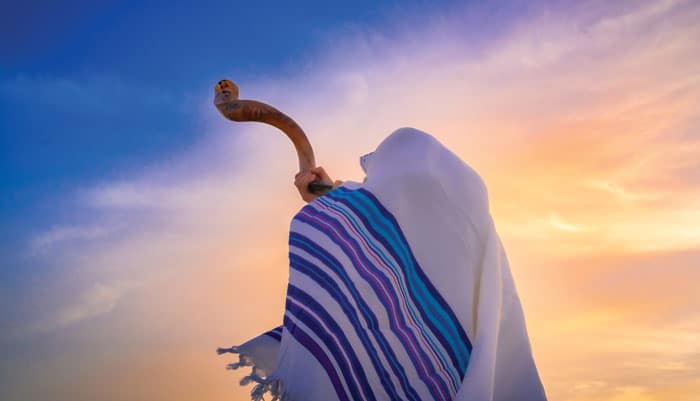
The call of the shofar will also help.
As Bouskila writes, “‘Days of Awe’ also taught me that the shofar is endowed with a deeper meaning and message. For Maimonides, the shofar blasts awaken our souls and stir us toward improving our actions.”
Awakening our souls is one of those esoteric phrases that can mean different things to different people. For me, it means waking up to the presence of others and connecting with their souls, in a spirit ofhumility rather than judgment.
Of course, it’s hard to do all that soulful work on Zoom.
This is why 5783 offers us a test like no other. Are we ready to fully reengage with those we haven’t seen in so long? Are we ready to hear other voices? Are we ready for the noise of community?
By transporting us to a place of holiness and diversity, Agnon’s “Days of Awe” prepares us to reengage. His book is a communal table of awe, a space where different voices and stories come together to move our souls, help us look outward and inward, and usher in a better version of ourselves.
It happens every year: I stand in a synagogue, hold a prayer book and proceed to hit myself a bit too hard on the chest with one hand, rolled into a fist.
Actually, what I practice closely resembles self-flagellation. To be honest, if I could strike my chest and simultaneously hit myself over the head like an irate chimpanzee, I would.
So this year, in the spirit of personal growth, I decided to do a little homework and reexamine my personal obsession with self-punishment.
It turns out that I have a slight misinterpretation of what it means to fear G-d, ask for divine forgiveness and stand in healthy awe of the power of the High Holy Days.
But first, a confession: I suffer from a form of generalized anxiety that constantly renders me afraid of everything and everyone, especially G-d. Yes, I have anxiety and I’m a more observant Jew. I also hail from the Middle East, and some Mizrahi and Sephardic Jews are prone to infusing religious practice with fear and, sometimes, downright superstition.
And here’s the best part: There’s a lot of tragic comedy at the intersection of religious observance and anxiety.
For example, when I was a child, my mother, who has more existential anxiety than anyone I know, constantly reminded my sister and me to kiss the mezuzah on the doorpost before leaving the house, even if we were going to check the mailbox. Like many other Middle Eastern Jews I’ve met, my mother assigns a protective power to the mezuzah that probably doesn’t exist, but it’s hard to unlearn decades of ingrained thoughts and practices.
As an adult, I’ve been known to kiss a mezuzah up to three times because the first time, the kiss didn’t “feel right” and the second time, I was thinking bad thoughts. I usually got it right by the third kiss. I can’t imagine how compulsive this seemed to onlookers.
The confluence of anxiety and religious observance is real, and some of us are driven to compulsion by our own anxiousness: Just ask any Sephardic woman who’s ever prayed while kneading dough for Shabbat challah and forgotten to include someone’s name; if she forgot to pray that her youngest daughter be married, she’ll knead, pray and punch down that ball of dough until the challah itself begs her to stop such a beating.
It’s important to note that anxiousness is on a continuum; some people have diagnosable anxiety disorders. Others don’t, but may still experience a range of anxiety. But anyone who lives with anxiety knows that it’s extremely painful. And let’s face it, some of the messages and imagery of the High Holy Days can magnify this anxiety and fear. Personally, I experience the height of anxiety during the description of the closing of the Gates of Mercy (the final Neilah prayer) at the culmination of Yom Kippur.
There I am, starving, exhausted and overwhelmed by dread at the thought of two pristine, golden gates slamming shut in my face because Yom Kippur is ending and I fear I haven’t earned G-d’s forgiveness.
My mother and I belong to a group of Jews I like to call “The Anxious and the Pious.” We’re similar to “The Young and the Restless,” only haggard and more restless.
And we hold a deeply irrational notion of G-d as always angry, always punitive and holding a metaphoric lightning bolt over our heads.
I asked Rabbi Dov Heller, a Los Angeles-based licensed Marriage and Family Therapist, how often he treats Jews who are viscerally afraid of G-d. “It’s quite common,” he said, “and certain cultures are more prone to it.”
This brings me to the little piece of wisdom that has made me reexamine my relationship with self-punishment: All of this fear and anxiety can stunt my growth. “It’s unhealthy,” said Heller. “Fear of G-d should never be crippling or cause anxiety, and fear, when misused, can be paralyzing. That’s not at all what G-d wants.”
Heller’s got a serious point. His sage words remind me of Søren Kierkegaard’s observation, “Anxiety is the dizziness of freedom.” Kierkegaard actually referred to anxiety as a “hereditary sin,” which reminds me that I need to call my mother.
I asked Heller if there’s a middle ground between over-enthusiastic chest (and head) beating and living life as if no one is even watching. “The right fear of a G-d is a motivator,” he said. “It produces positive actions, requires real focus and brings out the best in the person.”
But Heller’s the first to admit that for many, the High Holy Days are wrongly associated with punishment. Some relate to Rosh Hashanah and Yom Kippur with a Christmas-song mindset: G-d is making a list, checking it twice and, in my mind at least, planning his wrath against whoever’s been naughty. “That’s not the Jewish Rosh Hashanah at all,” said Heller. “The ‘lightning bolt’ G-d isn’t Judaism; it’s Greek mythology.”
And yet, one question remains: Why does the Torah have so many terrifying references to divine rewards and punishments, based on good or bad actions? Moses actually tells the Jewish people that they’ll inflict curses upon themselves for straying from G-d’s laws. One example is the list of numerous rewards and curses in Parasha Re’eh. And our most recent Parasha, Ki Tavo, is so rife with blessings and curses that each year, I take a few sips of whiskey before reading it. Sometimes, I wonder if Moses had any family members with acute anxiety.
One basic interpretation of the lists of blessings and curses, said Heller, is that G-d is telling us that there are consequences for our actions, just as there are consequences in the natural world (for example, if you don’t brush your teeth, you’ll get cavities). “The same applies in the spiritual world,” he said. “If we don’t live appropriately, according to how G-d understands what is good for us, there will be consequences. Not punishments, but consequences.”
This is truly soothing. And knowing there are consequences in life is healthy. Heller noted that with children, consequences instill responsibility, while punishments instill fear and control.
And then, he uttered one statement that blew apart everything I had internalized for decades: “G-d doesn’t punish us,” Heller said. “It’s the sin that causes consequences.” For example, speaking lashon hara, or slander against someone, causes a ripple effect of negative consequences that’s hard to quantify.
I finally understand. All of the mistakes that we’ve made this past year aren’t going to result in tit-for-tat, quantifiable punishments. Instead, our mistakes have accumulated into a form of spiritual plaque, whether in our mouths or in our hearts.
Heller advises us to view Rosh Hashanah as a day of judgment through the lens of parenting: There’s a healthy way for parents to judge their children.
Heller advises us to view Rosh Hashanah as a day of judgment through the lens of parenting: There’s a healthy way for parents to judge their children: Who are their friends? What are they eating? Are they choosing kindness over cruelty? Parents judge — they ask such questions because they love and care about their children, and want them to live a good life. That is also the judgment of Rosh Hashanah.
Our High Holy Days prayers constantly remind us that G-d, rather than throwing lightning bolts, is the “King who desires life.” As Heller reminded me, we blow a shofar because G-d is reminding us that life is precious and we have so much potential. “Don’t waste it,” said Heller. “That’s what parents say to their children as well.”
A few weeks ago, I read a Facebook post from Rabbi Lori Shapiro, founder of the Open Temple in Venice Beach, that I hope to never forget. She wrote: “Do we strike our chests for the Viduii as an act of punishment fearing retribution? Or are we shattering our hearts’ shells to awaken an outpouring of compassion? High Holy Days are a time to unleash loving self-awareness and experience its contagion. Love is the most viral of any of earth’s viruses.”
From self-punishment to self-awareness: worth reflecting on as we beat ourselves up.
Shana Tova u’Metukah.
Tabby Refael is an award-winning LA-based writer, speaker and civic action activist. Follow her on Twitter @TabbyRefael
Some of my most precious memories are of the days in preschool when my toddlers learnt the beautiful minhagim associated with Rosh Hashana. They would come home with projects festooned with apples and pomegranates, bees and shofars.
They would come home singing “Dip the apples in the honey, make a bracha loud and clear. L’shana tova u’metuka. Have a happy, sweet new year!”
My children are grown up now — my son is married, my youngest is a freshman at Shalhevet — and only a few of those adorable projects are saved (note to preschool teachers: anything with child’s photo is always treasured). But the imperative to create beautiful, lasting memories for my children and my nephews and nieces is strong.
Thankfully, the framework of the Rosh Hashana simanim make it easy to create a memorable table. There is the novelty of the round challah, the crispy apples, the ruby red jewels of pomegranate, the creamy sweetness of a fresh date, the impressive snakelike length of the lubia (extra long green beans) and the soft bites of squash. There is pride in reciting the tongue-twisting Yehi Ratzons, our supplications to our G-d and the G-d of our fathers, for a sweet new year, that our good deeds be proclaimed in our favor and that we may be full of mitzvot.
—Sharon
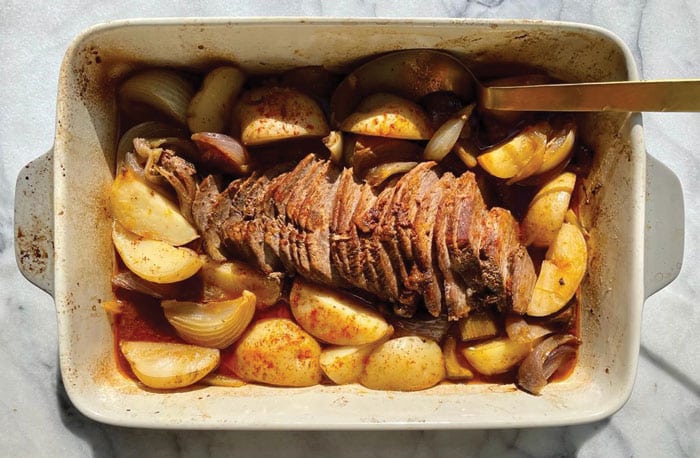
Perfect Brisket
Brisket is so Jewish that even we Sephardim love it!
We present our Sephardic Spice Girls take on an old classic. Perfect for your Rosh Hashana table or for a meal in the Sukkah.
Our version is slightly more exotic — Silan and sumac add a depth, as well as sweet and sour notes.
The technique is easy — no searing, just roast the meat low and slow. And those potatoes!! Dare we say they are even tastier than the meat!?!
– Sharon
Sweet and Sour Sauce 3 tablespoons tomato paste
3 tablespoons silan (date honey)
2 tablespoons Dijon mustard
2 tablespoons red wine vinegar
2 teaspoons sweet paprika
2 teaspoons ground sumac
2 teaspoons kosher salt
1 teaspoon ground black pepper
Whisk all the ingredients in a bowl to create a smooth sauce.
1 3-4 lb brisket
3 tablespoons avocado or olive oil
10 medium Yukon gold potatoes, washed and chopped in quarters
2 teaspoons kosher salt
2 red onions, sliced
2 stalks celery, cut into 2-inch pieces
8 cloves garlic, coarsely chopped
2 cups chicken broth or water
Preheat oven to 300°F.
Place brisket in a large oven-proof baking dish.
Drizzle oil over the brisket.
Arrange potatoes around the brisket and sprinkle with kosher salt.
Add onions, celery and garlic on top of the potatoes, then pour chicken broth over the vegetables.
Spoon the sauce over the brisket.
Cover tightly and roast in the oven, about 3 hours until fork tender.
Remove baking dish from oven and let cool.
Remove meat from the dish and carve into thin slices.
Pour juices over the meat, cover tightly and return to oven to reheat 30 to 40 minutes before serving.
Chraime
Chraime
By now you know how much we love our Friday night Moroccan fish. It’s a must on our tables.
Since returning from my trip to Israel this summer, I’ve started making chraime, a spicy fish stew that originated in Libya. The name chraime comes from the arabic word “hot” and is traditionally eaten by Jews on erev Shabbat, Rosh Hashana and Passover. Super popular in Israel, chraime is served at the humblest beyti (home cooking) restaurants as well as the the hippest, high-end establishments.
The best thing about this Sephardic fish dish is that while the ingredient list is short, it packs incredible flavor. This recipe works with any firm white fish or salmon. The flavor is mild, but you can go really spicy by adding fresh jalapeños. Or just serve with harissa on the side.
Chraime utilizes a very simple cooking technique called poaching, ensuring a tender fish. We make a flavorful, very well-seasoned broth in a deep skillet and place the fish in the liquid. The broth barely reaches the top of the fillets and the sauce simmers until the the fish is firm and opaque.
It’s just perfect for dipping with your Rosh Hashana challah.
—Rachel
2 pounds white flesh fish fillets, cut into
2-inch-wide pieces, skin on
1/3 cup olive oil
3 tablespoons paprika
1 tablespoon ground cumin
1 tablespoon ground caraway seeds
10 garlic cloves, 3 cloves finely chopped,
7 left whole
2 teaspoons salt
1 teaspoon black or white pepper
4 tablespoons tomato paste
2 – 4 dry peppers
1 ½ cups boiling water
1 lemon, juiced or 1 preserved lemon,
chopped
Clean fish and pat dry, then set aside.
In a large skillet, warm olive oil over medium heat.
Add all the spices and the chopped garlic. Saute for 3 to 4 minutes, until spices are fragrant.
Add the tomato paste and dry peppers and continue to sauté for a minute or two.
Add the boiling water and stir well to thin out the tomato paste.
Add the lemon juice or preserved lemon, cover tightly and simmer sauce over low heat for 10 minutes.
Place fish in a single layer in the skillet. Spoon a generous amount of sauce over each piece of fish and give the skillet a little shake.
Cover and simmer for 10 to 15 minutes, depending on the thickness of the fish.Tips
If sauce is too thick, add a little water.
For extra spice, add 1/2 jalapeno pepper or 1 teaspoon chili flakes.
Sauce can be prepared several days ahead and reheated.
Cook fish the day you are serving for freshest flavor.
Sauce is also suitable for cooking fish balls.
Leftover fish can be served at room temperature with salads and dips for an easy lunch option.
Sharon Gomperts and Rachel Emquies Sheff have been friends since high school. The Sephardic Spice Girls project has grown from their collaboration on events for the Sephardic Educational Center in Jerusalem. Follow them on Instagram @sephardicspicegirls and on Facebook at Sephardic Spice SEC Food. Website sephardicspicegirls.com/full-recipes
With the High Holy days about to start, Temple Beth Am, one of the larger Conservative synagogues in Los Angeles, is coming mask-to-mask with reality, and so far, the news is encouraging.
“It is premature to say we are back to normal, but we are making strides toward normalcy,” said Executive Director Sheryl Goldman. While the number of members driven away by COVID left many shuls empty, Beth Am seems to be making an impressive recovery.
“We feel fortunate to only have lost about 9% of our [900] members” since the pandemic struck, Senior Rabbi Adam Kligfeld said. He attributes the relatively light hit “partially to luck, partially to decisions we have made and also because of the coherence and resiliency of our community.”
Like a champion fighter, Beth Am did not stay on the mat when people disappeared. They recouped half of their member losses last year and expect most of the rest to return over the High Holy Days.
The bounce back has been gradual but steady. In 2020, only members were permitted to attend High Holy Day services. Last year, members were allowed to purchase an unlimited number of guest tickets – but none were available to the general public. This year, Beth Am is wide open, and tickets are available to everyone. There are no proof of vaccination or masking requirements.
The “great majority” of people who left have returned, Goldman said. “There still likely will be a couple percent of our membership who have enjoyed the remote experience of synagogue, or for whom dues are a financial burden. They have many options, like logging in on Shabbat or [feeling like] they no longer need the community.”
Kligfeld took a longer perspective when asked how close the La Cienega Boulevard synagogue is to returning to pre-pandemic mode. “I don’t think there is any such thing as returning to any time in the past,” he said. “But even if there had not been a pandemic, our lives, our community, our worship and our sense of what synagogues are about would be very different in ways we could not imagine.”
Responding to the question of whether one crucial decision was a game-changer, Kligfeld identified a middle path. “I can’t identify a particular pixel that might have tilted us on the fulcrum,” he said. “We tried to make decisions about COVID policy on the wide part of the bell curve.” Striding toward a centrist position, the rabbi said, “I never wanted to be the first or the last to open or to close. We did what other communities did, bringing together a cross-section of medical professionals who all admitted to us that they were giving educated guesses as well. Everyone was a novice in this.”
The rabbi said the synagogue attempted to clearly communicate policies “without giving too much of the thinking behind the policies. Paradoxically, the more thinking behind policies that you give, the more pushback you will get.”
Goldman said the most significant sign of normalcy making a comeback occurred on the second Shabbat this month. Beth Am drew its largest crowds since before COVID. About 100 participated in its popular Library Minyan, a large crowd filled the Torah Club for pre- and post-b’nai mitzvah students, and another 100 adults filed upstairs for a Ha Ma’alot service, where all sit in a circle to sing and meditate. In the afternoon, there was a Mincha bar mitzvah followed by a family celebration in the ballroom.
Like old times, but it also reflected new times, since some kept their masks on and some chose to maintain a distance.
In the early days of the COVID lockdown, it was hard to imagine such a crowded, upbeat scene happening again in a shul.“That Shabbat was a reminder that we need this, we miss this,” Goldman said. “We look forward to more weeks like that in the new year.”
For the High Holy Days of 2020, no synagogue leader knew what to expect. Small crowds, yes. But how small? Across the sprawling Mid-City campus of Beth Am, “we were addressing COVID concerns for the first time,” Goldman said. “Our community is fortunate enough to have outdoor worship space. So for the holidays, we set up a very large tent. We capped our attendance at 100 participants per service.”
In normal Septembers, Beth Am’s High Holy Day attendance would reach 1,500 persons across its various venues.Today, they offer multiple options with different clergy and various styles of davening, Goldman said. “For the first COVID year, we had one service for the entire community. Those who wished would select a service that was their first choice on Rosh Hashanah and Yom Kippur. We set up seats based on the number of people in each household. So there were pods of two, three, four, six individual seats, all six feet apart.”
Davening outdoors, everyone was masked. The clergy could be seen through plexiglass separators that, Goldman said, may or may not have been meaningful. “We were following the Health Department guidance, and we were on calls weekly,” Goldman said. “I, as executive director, as well as the clergy here, were on calls with colleagues, and experts, in 2020.”
Communal relations was a crucial tool for Kligfeld, especially during the darkest days of COVID. “We worked very hard at reaching out to every individual member of the community as frequently as we could during the pandemic,” he said.
Finally, there is the online dimension, with all its advantages and disadvantages. “I learned that the reach of what we do here, what we teach and try to share goes beyond people who formally have joined the synagogue,” Kligfeld said. “We now have members in Canada, Maryland and Texas.”
“As extraordinary as technology is, it is no replacement for human interaction and touch. It makes me scared for, and dubious of, the coming technological inventions — the way virtual reality is going to try and replace presence.”– Rabbi Adam Kligfeld.
There is, he acknowledges, a dark side to technology — a warning for the present and future.“As extraordinary as technology is, it is no replacement for human interaction and touch,” Kligfeld said.“It makes me scared for, and dubious of, the coming technological inventions – the way virtual reality is going to try and replace presence.
“I am sad,” said Kligfeld, “because there will be less incentive for people to be together.”
The High Holy Days are a time for family and friends to come together for prayer, celebration and contemplation.
“As Jews, we have two new years, secular and religious, [so] I call Rosh Hashanah the new year of the heart,” Susan Barocas, a writer, cook, speaker and teacher told the Journal. “More than around January 1, I feel it’s a time to really think about who and where I am, how I want to improve myself [and] where I hope to be going.”
Barocas, who, along with Ladino singer Sarah Aroeste, is producing “SaVOR: A Sephardic Music & Food Experience” (launching January 2023), also feels the lovely anticipation of lots of cooking and gathering with others.
“I love doing the Yehi Ratzon Sephardic seder for Rosh Hashanah with its symbolic foods and making traditional dishes, including prasa kon tomat (leek with tomato) and apyo (celeriac with carrots, lemon and dill),” Barocas said. “Sopa de ajo fills all my senses and feeds my body and soul.”
Many would agree: no Jewish meal is complete without a nice bowl of soup.
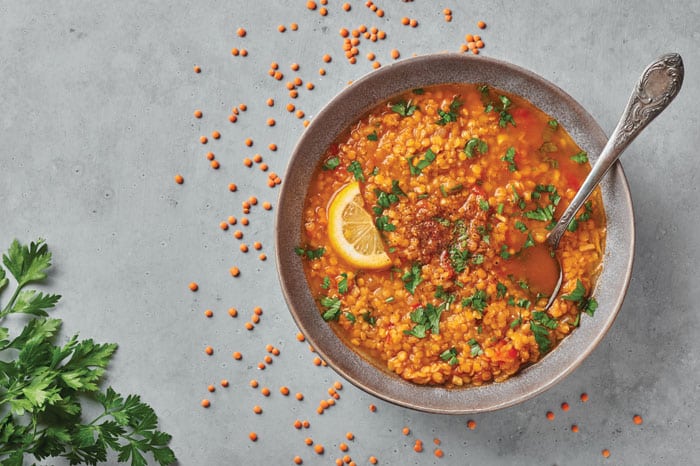
Sopa de Ajo
Susan Barocas’ Sopa de Ajo (Garlic Chicken Soup)
3 medium leeks (about 1 1/2 pounds)
10 ounces (about 6 cups loosely packed)
cleaned fresh spinach, baby spinach or
chard
3 heads (about 25 cloves) garlic, peeled
and sliced thinly lengthwise
5 tablespoons olive oil, divided
12 cups chicken broth, homemade or
store-bought
3 bay leaves
1/2 cup uncooked long-grain white rice
or 1/2 cup brown rice par-cooked until
soft but firm
Wedges of fresh lemon
Trim off the root end and remove 1 or 2 tough outer layers of each leek. Cut off just the darkest green top parts, remove the lighter green inside part and slice it and the rest of each leek into 1/4-inch rings. (Wash the trimmed parts and save for soup stock.) Place the leek pieces in a strainer and wash under cold water, using your hands to separate the rings of leek and stir to get all the dirt off. If the leeks are particularly dirty, set the strainer of leeks in a bowl of cool water for a few minutes, pull out without stirring up the water and rinse again. Shake off water and set aside to drain well.
Chop well-washed spinach or chard into about 2-inch pieces, dicing any thicker stems into small pieces.
In a large, heavy-bottomed soup pot, heat 2 tablespoons olive oil over medium heat. Set aside about 1 cup of clean sliced leeks. Add the rest of the leeks to the hot oil, being careful in case any water left splatters. Turn the heat down to medium low and sauté the leeks until softened, about 12 to 15 minutes, stirring occasionally and not letting them brown. Stir sliced garlic into the leeks and cook until fragrant, about 2 to 3 minutes, stirring a couple time so the garlic doesn’t brown.
Add the broth and bay leaves. Turn heat to medium high and bring to a boil. When the soup is boiling, stir in the rice. Let come back to a boil, then turn heat down to simmer and cover. Let simmer for about 20 minutes, stirring occasionally, until rice is soft and flavors are blended.
While the soup simmers, heat the remaining 3 tablespoons oil in a sauté pan over medium heat. Add the reserved cup of leeks and cook until they turn crispy and golden, about 10 to 12 minutes. Set aside leeks in oil.
Take the bay leaves out of the soup, then stir in the chopped spinach or chard. Bring the soup back to a simmer and let cook just until the greens are soft, about 10 minutes for spinach, 15 minutes for chard. Taste and add salt and pepper as desired. To serve, garnish each bowl with the crispy leeks, a drizzle of leek oil and a wedge of lemon.
“While everyone usually sticks by the old standby of chicken soup at their holiday table, there’s no reason why your vegetarian guests can’t also enjoy a pre-entree soup,” Danny Corsun, founder of the Culinary Judaics Academy (CJA), told the Journal.
Corsun loves to make something that provides a vegetarian source of protein and is filling at the same time.
“This earthy lentil soup offers a heart healthy protein, veggies and tons of flavor, not to mention actual biblical significance, as it was lentils that Jacob used to trade for his brother Esau’s birthright,” Corsun said. “So, take that chicken soup!”
Culinary Judaics Academy’s Vegetarian Lentil Soup
2 tablespoons olive oil
1 cup finely chopped onion
1 cup carrots, large diced
1 cup finely chopped celery
2 medium-large cloves of garlic, minced
2 teaspoons kosher salt
Pepper to taste
1 pound rinsed lentils (either red or green
work great)
1 (14.5 ounce) can crushed tomatoes
2 quarts of vegetable stock
1 teaspoon ground coriander
1 teaspoon ground toasted cumin
1 Bay leaf
3 cups rinsed and thinly sliced spinach
Place the olive oil into a large soup pot and set over medium heat. Once hot, add the onion, carrot, celery, salt and pepper and sweat until the onions are translucent, approximately 3-5 minutes. Add in garlic and sauté for another 1 minute or until soft (make sure you do not burn the garlic as it will result in a bitter flavor).
Once the leek mixture is ready, mix in the lentils, toasting them for about a minute. Then, add the tomatoes, stock, coriander, cumin, bay leaf and stir to combine. Increase the heat to high and bring just to a boil. Reduce the heat to low, cover and cook at a low simmer until the lentils are tender, approximately 30 minutes.
Remove bay leaf and then, using a stick blender, puree to your preferred consistency. If the soup is too thick, you may add another cup of stock. As to how much to blend, CJA likes it on the rustic side with some whole veggies here and there. Once blended, add in spinach and stir. Taste for seasoning and then serve immediately with some yummy challah for dipping/dunking.
Be prepared, you may have some chicken soup folks opting out when given this option.
It was a Rosh Hashanah like no other. It was the Rosh Hashanah when I felt as if I held a “Book of Life” in my hands. On that day, for the very first time, I opened S.Y. Agnon’s beautiful High Holy Days book “Yamim Noraim — Days of Awe.”
Eighteen years ago, just one week prior to that same Rosh Hashanah, I started my journey into the literary world of Nobel laureate S.Y. Agnon. I had just turned forty, a birthday traditionally marked as the age when one may start studying Kabbalah. I opted for Agnon’s books instead. After reading a few short stories, I called Professor Arnold Band, my beloved teacher from UCLA and one of the world’s foremost scholars in Agnon’s writings.
“I want to start reading Agnon. Where should I begin?” I asked Professor Band.
“Next week is Rosh Hashanah” he replied, “so start by bringing Agnon’s book ‘Yamim Noraim’ (‘Days of Awe’) with you to shul. Keep it by your side throughout services. It’s what Agnon would want you to do.”
I followed Professor Band’s advice, and having Agnon’s “Days of Awe” by my side elevated my Rosh Hashanah experience to another level.
The first time I opened “Days of Awe” that day, I felt as if I entered a room where a fascinating array of classical Jewish sources were having a lively conversation about Rosh Hashanah.
The first time I opened “Days of Awe” that day, I felt as if I entered a room where a fascinating array of classical Jewish sources were having a lively conversation about Rosh Hashanah. Talmudic rabbis, medieval Kabbalists, Sephardic philosophers, Hasidic rebbes and Halakhic scholars all seemed to be sitting around the same table. They came from different places and lived at different times, but the creative manner in which Agnon arranged them brought them to life in an interactive dialogue that transcended time and geography. Words that were originally spoken hundreds of years apart poetically flowed into one another. They shared ideas about Rosh Hashanah’s unique customs, its prayers, the power of repentance, the sounds of the shofar and the symbolism of the Book of Life. When reading their words, I was transported into their world. I could hear their voices. It was as if Agnon had invited me into a timeless and ongoing Beit Midrash about the High Holy Days.
Many refer to “Days of Awe” as an anthology edited by Agnon, but I don’t think that paints an accurate picture. It’s much more than just an anthology. In “Days of Awe,” Agnon’s artistic talent is not expressed in conceiving a plot or inventing imagined characters. Using his masterful storytelling skills, Agnon composed “Days of Awe” by creatively arranging a treasure trove of Jewish sources about the High Holy Days, letting them tell us the epic story of Rosh Hashanah and Yom Kippur.
One of the first reviews of “Days of Awe” was written like a letter to Agnon, praising him for fostering Jewish unity through his book: “All of the sources in this book are like good neighbors to one another, one united family. You successfully bound them within one book and breathed life into all of them as one unified soul.”
“Days of Awe” is not Sephardi or Ashkenazi, Hasidic or Mitnagdic, Halakhic or philosophical. It’s all of those voices together, and many more, joined in harmony by Agnon’s literary magic.
Indeed, “Days of Awe” is not Sephardi or Ashkenazi, Hasidic or Mitnagdic, Halakhic or philosophical. It’s all of those voices together, and many more, joined in harmony by Agnon’s literary magic. On Rosh Hashanah we pray to become “Agudah Achat”—one unified body. In “Days of Awe,” Agnon fulfilled that prayer for us, even if only in a book.
First edition
On my first Rosh Hashanah with “Days of Awe,” its deepest impact came during my most physically and emotionally challenging moment of the day: the blowing of the shofar. It’s always a lonely experience blowing the shofar. You’re all alone and on your own, with everyone else just listening. I usually spend the moments beforehand meditating on fulfilling the mitzvah properly, and doing breathing exercises.
But that year, I spent those moments reading Agnon’s selections about the shofar. My entire experience was transformed. I scratched my pre-shofar remarks and instead shared with the congregation the beautiful passages in “Days of Awe,” where Agnon’s “characters” discuss both the story and deeper purpose of the shofar blasts.
The Sephardic Rabbi David Abudraham links the shofar to Rosh Hashanah as the anniversary of creation, and the blasts resemble a royal ceremony when we celebrate God’s sovereignty over the universe.
The Talmudic Rabbi Abahu takes us back to the first-ever shofar blowing, when Abraham blew the ram’s horn in place of sacrificing his son.
The Hasidic Rabbi Levi Yitzchak of Berdichev speaks passionately about the shofar blasts as a reenactment of the shofar the Jewish people heard upon receiving God’s Torah at Mount Sinai.
In storytelling worthy of Agnon’s Nobel Prize, these three rabbis told me that the shofar’s different notes tell us various stories.
“Days of Awe” also taught me that the shofar is endowed with a deeper meaning and message.
For Maimonides, the shofar blasts awaken our souls and stir us toward improving our actions.
Ancient philosopher Philo of Alexandria contrasts musical horns as instruments of war vs. the shofar as an instrument of peace.
Chabad Hasidism founder Rav Shneur Zalman of Liadi emphasizes that the shape of the shofar must be bent, as it resembles a person bent in prayer before God.
When I blew the shofar that day, the long regal blasts (Tekiah) took us back to the six days of creation, the broken notes (Shevarim) appropriately sent us to the Akedah, and the staccato notes (Truah) transported us to the trembling aura of Mount Sinai. As we journeyed through these epic moments, I also felt the blasts pierce our souls in the Maimonidean sense, and inspired by Philo and Rav Shneur Zalman of Liadi, the shofar became our vehicle of prayer for world peace.
Among many other things, Agnon’s book is a soulful tribute to the wonders of Jewish diversity.
“Days of Awe” magically turned my shofar into a musical storytelling instrument, where multiple Jewish voices harmoniously opened our hearts to an uplifting shofar experience. Among many other things, Agnon’s book is a soulful tribute to the wonders of Jewish diversity.
What motivated Agnon to create this book, and who was its intended audience? Why did Professor Band tell me that having “Days of Awe” by my side on Rosh Hashanah is what Agnon would want me to do?
Agnon tells a poetic story from his childhood, when at the tender age of four, his father and grandfather walked him to what may have been his first-ever High Holiday service. “The heavens radiated a sense of purity, quiet filled the earth, and all of the streets were clean,” Agnon lovingly recounts.
Dressed in his special holiday clothes, the curious young Agnon approached what he calls the “House of Prayer” (Beit Ha-Tefillah). He looked through the window and was astonished by the sight of everyone dressed in white, wrapped in prayer shawls adorned with silver crowns. A warm light radiated throughout the room, and the young boy who “was not yet able to contemplate deep ideas” nonetheless felt that this House of Prayer permeated an aura of sacred beauty.
The sight of worshippers engaged in heartfelt prayer, along with the sweet sounds of their voices chanting liturgical poems, mesmerized the young lad. Nothing else in the world mattered: “It seemed as if the ground I walked upon and the streets I passed through, and indeed the world in its entirety, were nothing but a corridor leading me to this house.”
The young Agnon loved everyone and everything he saw in the House of Prayer, and hoped this magical scene would never come to an end.
But alas, it did come to an end. Something suddenly changed in the House of Prayer, and the young lad was saddened by what he saw. “My soul suddenly felt wrinkled,” he recounts, “and I burst out crying.”
What happened that caused him to cry?
“The congregants shattered their pleasant appearance,” recalls Agnon, “as well as the appearance of the House of Prayer and of the day itself.”
The sweet sounds of prayers and chanting abruptly gave way to the noise of idle chatter. The same people who were praying so beautifully took a break and began chatting. What Agnon had called the “House of Prayer” (Beit Ha-Tefillah) suddenly became the less spiritual “House of Gathering” (Beit Ha-Knesset).
“My heart was heavy over this, and I burst out into tears.”
This experience was embedded in Agnon’s heart for many years. Growing up, he witnessed this scene again and again, and the same feelings overtook him.
As a learned Jew with a deep sense of piety, Agnon was determined to come up with a creative solution that would inspire a deeper, more meaningful and more fulfilling experience for Jews on the High Holy Days. The wholeness he wanted for every Jew mirrors the search for wholeness in his own invented characters.
“I wondered,” asked Agnon, “is there nothing other than the prayers and liturgical poems through which the Jewish people can connect to God on the High Holidays?”
“I wondered,” asked Agnon, “is there nothing other than the prayers and liturgical poems through which the Jewish people can connect to God on the High Holy Days?”
In other words, can those moments when the prayer services seem long or when we close the Machzor and step out into the lobby for a breather also be endowed with meaning?
Year after year, Agnon prepared for the High Holy Days by looking through various books from the Jewish tradition, pulling out the gems as pieces to study on Rosh Hashanah and Yom Kippur. It dawned on him that these gems of wisdom would make a great book that could help address the phenomenon that brought him to tears when he was four.
He put pen to paper, and after two-and-a-half years of labor, Agnon gave birth to “Days of Awe.” He called it “a new book filled with ancient wisdom,” and said “it’s a book to be read [in synagogue] in-between prayers.” As Professor Band told me, Agnon wants us to take this book to shul. The Machzor helps facilitate a spiritual talk with God, while “Days of Awe” helps stimulate a meaningful conversation with our fellow congregants.
The circumstances under which Agnon created “Days of Awe” infuses it with deeper meaning. He first started working on it in 1935, two years after Hitler came to power.
“I wrote this book during troubled years” said Agnon, “when our violent enemies stood up to destroy us.”
This was painful for Agnon, for while he now made his home in Jerusalem, he was born and raised in Europe. In many ways, his heart was still in his birthplace of Buczacz, where he first experienced High Holy Day prayers with his father and grandfather.
As the winds of war raged in Europe, violent Arab riots plagued the streets of Jerusalem, including in the Talpiot neighborhood where Agnon lived.
“While working on this book, there were many times at night when I was forced to turn off my lamp and lay down on the floor, so as to avoid stray bullets that flew by my house” recalls Agnon. “Thankfully, God granted me life so that I can do my work and complete my labor.”
The troubled circumstances in Europe and Jerusalem were “Yamim Noraim” for the Jewish people. In modern Hebrew, the word “nora” also means awful, and typical of the multiple meanings in Agnon’s story titles, Agnon may have had these awful events in mind when naming this book “Yamim Noraim.” More than just a collection of sources, “Days of Awe” is an offering from the depths, mi’ma’amakim, of Agnon’s soul.
“Thank God, many Jews around the world now read my book on Rosh Hashanah and Yom Kippur” wrote Agnon.
As a writer, he was a Nobel laureate, but as a Jew on Rosh Hashanah and Yom Kippur, S.Y. Agnon remained that four-year-old boy who gazed with astonishment into the House of Prayer.
In his Nobel Prize address, Agnon mentioned only three of his own books by name. One of them was “Days of Awe,” because the High Holy Days held a special place in his heart. As a writer, he was a Nobel laureate, but as a Jew on Rosh Hashanah and Yom Kippur, S.Y. Agnon remained that four-year-old boy who gazed with astonishment into the House of Prayer.
Shanah Tovah.
Rabbi Daniel Bouskila is the director of the Sephardic Educational Center and the rabbi of the Westwood Village Synagogue. In the spirit of Agnon’s “Days of Awe,” he proudly works with both Sephardic and Ashkenazic communities.
“The High Holy Days are such an important, spiritual, traditional and cultural time,” musician Deborah Stokol told the Journal. “It’s a time of reflection and to honor the past while taking stock of who you are and building a future you want to live in and be a better, more moral part of each day.”

Stokol, who is a composer, performer and storyteller, as well as an educator, decided to take a sabbatical from teaching to invest in her future … and to spend more time with what speaks most to her heart: music and composition.
“I love music intrinsically as an absolute thing, separate from teaching,” she said. “So, while it is related to my teaching, it precedes it, and it is still going separately, I want to keep making more Jewish music. I feel like I’m only starting.”
Stokol calls her style of the music “medieval jazz.” It’s a fusion of different types of music styles including jazz, classical, folk, Jewish (Middle-Eastern, Sephardic and Eastern-European) and Vaudevillian.
Since the start of the pandemic, she has recorded three self-produced albums, an EP of solo piano pieces and 41 singles (covers and originals). Stokol’s second album, “Bard,” was about literature, sacred text and the oral tradition. The companion album, “Old Wives’ Tales,” which has 18 original songs (for chai), came out over the summer. They can be downloaded at https://www.deborahstokol.com/shop.
“The album explores themes of empowerment, stories of women from myth and legend, mortality, time and storytelling’s relationship to them all, Judaism and femininity, narrative and love,” she said.
Stokol composed, wrote, sang, produced, mixed, mastered, and played harp, mandolin, piano, drum and guitar on her albums. She also worked with musicians from around the world. She also does the graphic designing.
“On one level, the music that I sing to a Jewish prayer or text in Hebrew, secular or otherwise, coheres with those ideas because it’s intrinsically Jewish,” Stokol said.
On a deeper level, Stokol said her music seeks to honor her heritage. For instance, two of her songs are interpretations of the “Avinu Malkeinu” and another is her melody to the words of the “Lecha Dodi.”She put music to the words of Song of Songs, the Book of Ruth and other sacred texts.
Stokol’s “Tiny Joys” puts her music to the words of Hebrew-language poet Ra’hel Bluwstein. “I am singing it as a female bard,” she said. “Jewish women have always been such a fundamental part of the tradition, but only recently do I feel like we are beginning to acknowledge that in a widespread and public way.”
Judaism has always been an important part of Stokol’s life. Her mother, an Argentinian Jew, and her dad, a South African Jew, met on the East Coast of the United States before marrying and moving out west. Stokol went to Temple Emanuel Day School until she was 12.“I was completely immersed in a Jewish life,”she said.
Her relationship with music goes back to childhood. She started playing piano at the age of six, and by the time she was 11, she wrote music to go with the poems and stories she read.
She grew up speaking Spanish at home, double-majored in English and music at UC Berkeley and earned a graduate degree in Journalism from University of Southern California. She worked as a reporter for four years before becoming a full-time high school English, creative writing and journalism teacher for 12 years.
Whenever they would study a passage where Stokol had written music, she thought, “Most people do like music,” she said. “Let me bring it in and see if it’s another point of entry for students who don’t necessarily resonate with the text.”
Stokol used her passion for music as a way to inspire her students. “I would bring in my harp and play songs I had written to or about passages from the text, so students could experience the reading in different ways,” she said.
She would also ask them to choose a passage and make their own projects. “They could either do stick figures, a journal entry or a dance — it didn’t have to be music,” she said. “They don’t have to be artists. I think when people take ownership of anything … it takes on a whole new importance.”
The music Stokol sings to and about is often in the bardic tradition: “The Iliad,” “The Odyssey,” “Beowulf,” “Gilgamesh.” The epic stories consider themes of life, death, memory and the power of storytelling.
“The High Holy Days are about the cycle of death and rebirth, of endings and beginnings.”
– Deborah Stokol
“The High Holy Days are about the cycle of death and rebirth, of endings and beginnings,” she said. “There are the ‘tiny joys’ of honey cake, apples and honey and pomegranate seeds, of course, but there’s the greater understanding that you are part of a family, community and history. By continuing those things, they remain.”
When I was 8 years old, I found a book about childhood eating that a family member had sent to my mom. Inside, there was a note: “Hopefully this helps Kylie with her weight problem.”
Before this, I didn’t know I was overweight. But from that moment on, I had a keen awareness that I was a fat kid.
Pretty soon, I started getting bullied at school and summer camp. I would obsessively check my weight on the scale and look at my stomach in the mirror several times a day. I wondered why I wasn’t skinny and beautiful like my mom and sisters. And instead of eating healthy, I did the opposite: I overate.
I turned to eating for excitement and for comfort. If I was celebrating, I’d have a slice of cake. If I was sad, I’d have a slice of cake. If it was a Tuesday – or a Wednesday, Thursday or Friday for that matter – I’d have a slice of cake.
I would eat until I was beyond full. I would eat until I felt sick. I was punishing myself for being overweight, but I didn’t know how to stop eating so much.
Now that I’m an adult, I’m still trying to conquer my struggle with overeating. One time of year that it’s a real challenge is the High Holy Days. It’s when we have periods of extreme eating, like Rosh Hashanah, followed by all-out fasting, like Tzom Gedaliah and Yom Kippur.
I eat too much on Rosh Hashanah because I’m worried I’ll be hungry on the fast days. Or, if I’m at someone’s house and I haven’t been there before, I eat a lot during the first course because I don’t know what they’ll be serving for the second. I get worried there won’t be enough food (there always is, of course).
If I’m not comfortable being myself at someone’s table, I eat and eat and eat so I don’t have to talk and accidentally embarrass myself.
On top of all this, it’s a mitzvah to consume certain things on the holiday, like meat and wine and the customary seder food. Plus, Jewish women are the best cooks in the world, and they serve up large portions of their delicious delicacies. How can I resist?
Many people I’ve talked to in my community struggle with overeating on Shabbat, on the holidays and in everyday life. Many of our customs revolve around food, and we often have an unhealthy way of looking at it. From matchmakers who tell young women to lose weight to find a man to mothers who say they need “to take a walk to burn all these calories off” after a meal, we don’t have the best relationship with our bodies and what’s on our plates.
Women especially have a hard time seeing themselves for the beautiful mothers, wives and caretakers they are; they only see what’s the outside, which is a few extra pounds from all the living they’ve been doing.
During Rosh Hashanah and the rest of the holidays, I urge you to be gentle on yourself. If you want to eat a slice of honey cake, there’s nothing wrong with that. If you end up having too much chicken or meat, it’s perfectly understandable why. The Jewish holidays are a short period of time where we tend to eat much more than usual. It doesn’t have to be the new norm if you don’t want it to be.
Trust me: When you constantly beat yourself up, you’re only going to treat your body worse and worse. It’s a vicious cycle. I know; I’ve been through it many times. The only time in my life I was able to conquer my overeating is when I ate what made my body feel good. I felt better than ever before. The number on the scale didn’t affect me at all. How I look didn’t matter. It was how my new way of eating made me feel that made the difference.
The High Holy Days are a time to connect with Hashem and to feed your soul. If you feed your body a little too much at the same time, don’t worry: It’s a new year.
The High Holy Days are a time to connect with Hashem and to feed your soul. If you feed your body a little too much at the same time, don’t worry: It’s a new year. You can start fresh. You can determine what feels good for you, and go into 5783 with a new outlook, a new beginning and a new appreciation for yourself.
I’m thinking a lot about the reading for the second day of Rosh Hashanah, which centers on Avraham bringing Yitzchak up to the point of sacrifice. In school and beyond, we are told that this is appropriate for Rosh Hashanah because it shows that Avraham was so loyal to G-d, that even when asked to do something as horrific and abhorrent as sacrifice a child, Avraham put aside his own feelings and understanding and obeyed Hashem’s request. The Rosh Hashanah tie-in is that we should learn from this example and take it upon ourselves to be more G-d fearing and more obedient in the coming year. And the implication is that maybe, by taking on such a commitment, we can tip the scales of judgement and earn ourselves a better decree.
I consider myself to be a person of faith — deep faith. Deep enough that I don’t remember a time when I’ve questioned G-d’s existence or the love. And I’ve always had a problem with this interpretation of the Akeida. I can’t actually imagine that Avraham believed he was being asked to kill his son. Obviously it looks that way to us, reading the account. But we need to read the story from Avraham’s point of view. Avraham already had a long, personal, intimate relationship with G-d and had experienced multiple blessings and miracles. Every one of these experiences had revealed G-d to be kind and protective. In modern parlance, G-d always had Avraham’s back. It seems incongruent then for Avraham to believe the worst was happening, although this is what we often read into the narrative.
G-d indeed tells Avraham to take his beloved son and get to a mountain where he will be offered as a sacrifice. Significantly, in the parts of the text in which sacrificial procedures are discussed, the Torah includes specific words to instruct the slaughter; here there is no mention of actual killing, only offering. After three days in the mountains, Avraham sees the place G-d intends for the offering to take place. Notably, Avraham tells his companions that he and his son will go to that place, worship, and return. While Rashi explains this as a prophecy, we might also read the promise of return as an indication that Avraham knows in his heart that the worst is not what’s going to happen.
It’s also possible that Avraham’s understanding of Hashem’s ways told him to just go along with the process, that somehow whatever he is fearing will not actually come to pass.
Avraham and Yitzchak set off with kindling wood and a knife. When Yitzchak asks his father where is the lamb to sacrifice, Avraham answers that G-d will provide the lamb. Upon arrival, Avraham builds an altar, lays down the wood, and then binds Yitzchak to it. This part is obviously problematic for the everyday person to comprehend. The sages teach that Avraham was prepared to kill Yitzchak in service to Hashem. But it’s also possible that Avraham’s understanding of Hashem’s ways told him to just go along with the process, that somehow whatever he is fearing will not actually come to pass.
When the knife is raised in Avraham’s hand, a heavenly voice calls out to Avraham, directing him not to continue. He is told not to lay a hand on Yitzchak, because now it is known he is a G-d fearing man. At this point, the ram is revealed in the thicket and sacrificed in place of Yitzchak, and we blow the shofar in remembrance. Returning to the heavenly voice, the Hebrew word for fear of G-d is “yirah.” This word has the same root (shoresh) as the w8ord for sight “roeh.” We could therefore read the heavenly voice as saying, “Now it is known you are a G-d SEEING man.” In other words, the heavenly voice is saying “OK, we can stop the experiment at this point; you’ve shown that you can push past your darkest fears and take actions that seem to be unthinkable, because your vision of G-d’s ultimate goodness is so clear.”
In those moments, rather than believe those fears, we have the choice, like Avraham, to slow down, take things step by step, and trust the love.
Not only is such a reading easier (for me) to reconcile with everything I know both of Avraham and of Hashem, but also it offers a beautiful instruction for Rosh Hashanah. So often in our daily lives and especially in personal relationships, something comes up that links immediately to our deepest fears. In those moments, rather than believe those fears, we have the choice, like Avraham, to slow down, take things step by step, and trust the love. If we can do that, even once, we have the chance to be people who see rather than fear. That type of connection is what I pray for on Rosh Hashanah.
Denise Berger is a writer, thinker and social justice advocate.
In the past year that ends this weekend, leading to Rosh Hashanah, “no significant deepening of any of the acute challenges facing the Jewish people was observed. All the same, no progress was registered toward overcoming these challenges”. These are the opening words of the in-depth analysis, “The Jewish People in 2022: Challenges of Governance, Culture, and Polarization” – one of many chapters in the 2022 Annual Assessment by the Jewish People Policy Institute (JPPI).

And it raises an almost philosophical question, or maybe – I think this might be the case – a psychological question: What do we call a year in which no catastrophe occurred, but also no breakthrough toward a better future? Would you call it a good year because no news is good news? Do you call it a bad year because no news is bad news? This is a question of philosophy: If you’re more conservative, the status quo could be what you want, if you’re progressive you’d want, well, progress. This is question of psychology: are you a pessimist, and hence pleased with no change for worse, or an optimist, and hence somewhat disappointed by a year of little improvement?
Of course, to say that the year ending was a year of no change is problematic to begin with: Developments in the geopolitical, economic, and social arenas did affect the Jewish people and overshadowed internal Jewish trends. The war in Ukraine posed the challenge of absorbing refugees, including Jewish immigrants, in Israel. Political instability has necessitated yet another round of Israeli elections, the fifth in four years, while political polarization in the United States continues to intensify. Antisemitism around the world, and on social media, is very much present.
Studies of Jewish communities in a number of different countries have identified continued erosion in Jewish institutional membership, a phenomenon connected with a general trend toward secularization and detachment from any recognizably “religious” identity. Economic crisis, as well as a lack of consensus regarding means and methods, makes it difficult to expand investments in strengthening Jewish identity, while a sociopolitical crisis sharpens disputes among Jews that take control of the agenda.
So why do we say that “no significant deepening of any of the acute challenges” occurred? That’s because most of what happened to Jews this year is old news. Political instability in Israel? Old news. There’s a reason why we call the coming November election the fifth election. Erosion of membership in Jewish institutions? Even older news. Antisemitism? Sadly, even this relatively new reemergence of hatred is becoming routine. If this is a disease – and it is – it begins to feel like a chronic disease. In recent years, the fight against antisemitism has attained increasing awareness and support. It is the focus of conferences, and legislative initiatives. Even so, some reports have declared the effort to eradicate antisemitism a “failure.” As the JPPI report concludes: “The return of antisemitism could become a long-term fixture of global discourse, while the ability of Jewish communities and Israel to influence it is limited.”
You want to know why this year was not one that marked a watershed moment for the Jewish people? Consider the Jewish birthrate. It is low around the world except in Israel and among Orthodox Jews. So, no change. Consider interfaith marriages and their consequences. No change. The share of Diaspora Jews who observe Jewish traditions (Passover Seders, kosher homes, and the like) continues to fall. Consider Iran. It is still an unresolved challenge, highlighted this week by its leader’s Holocaust denial (“There are some signs that it happened. If so, they should allow it to be investigated and researched,” said Iranian President Ebrahim Raisi, an honorable guest at the UN General Assembly). Consider the Israeli-Palestinian conflict. It is still there. It is still a simmering problem.
Consider the rise in the share of the ultra-Orthodox in the Jewish population. No change in this trend, and no change toward a more serious effort to grapple with the challenges it poses. “The ultra-Orthodox community’s growing dominance could exacerbate societal tensions, and/or bring about gradual change in the character and composition of Israeli society, manifesting in a regression in education and employment levels”, the report says.
A hundred years ago, or two hundred years ago, if Jews were allowed to have undisturbed life, it was usually all they could expect. Today, we want more. We want Jews not just to survive but also to thrive.
Are you disappointed by this lack of progress toward finding remedies to these challenges? If you are, that’s a good sign. A hundred years ago, or two hundred years ago, if Jews were allowed to have undisturbed life, it was usually all they could expect. Today, we want more. We want Jews not just to survive but also to thrive. We expect them to thrive. To have that, we must see progress. And while Jews can’t control the trends that rock the world, we can, and should, strive to tackle the internal challenges that cloud our future.
Shana Tova.
Something I wrote in Hebrew
Following the decision of more ministers to leave the political arena, I explained that while the specific politicians are not necessarily important, the message they are sending is important:
Facing the future, this picture is a painful reminder of what might not be worth doing. The current government ends in a crash. It was a creative attempt to build a stable structure from glue and straw, and collapsed quickly, destroying the promising careers of many senior politicians. This means that such creativity is dangerous for the aspiring politicians who are involved in it. This is important, as the reality reflected in the polls, even this week, is that no government will be feasible without similar creativity. But you can bet that this time it’d be more difficult to find politicians that would risk their careers to join such adventure.
A week’s numbers
Before Rosh Hashanah of last year we asked Israelis about possible scenarios for the coming year. Here’s something they got wrong (we did have a conflict in Gaza) and something they got right (Iran is close, but not yet there). The numbers by political ideology.
A reader’s response:
David Feldman writes: “Maybe it’s time for Israel to stop talking about ‘the most moral army in the world’. It could be true, but as a PR slogan it doesn’t sound good – I think too apologetic”.
My response: I might agree, must think about it a bit more.
Shmuel Rosner is senior political editor. For more analysis of Israeli and international politics, visit Rosner’s Domain at jewishjournal.com/rosnersdomain.