fbpx

July 22, 2022

Russia Calls for Jewish Agency to Leave the Country

Russia’s Justice Ministry filed a lawsuit on July 21 officially calling for the Jewish Agency to be dissolved.

Earlier in July, the ministry issued a series of demands to the agency that would reportedly be difficult for the agency to follow; The Jerusalem Post has reported that the Russian ministry is alleging that the agency unlawfully collected personal data on Russian citizens, though the Post noted that it’s not unusual for organizations like the agency to “collect information about people who apply for aliyah or who participate in their activities.”

Israel will be sending a delegation to Moscow next week in response to Russia’s escalation on the matter, The Times of Israel reported. 

“The Jewish community in Russia is deeply connected to Israel and its importance comes up in every diplomatic conversation with the Russian leadership,” Israeli Prime Minister Yair Lapid said in a statement. “We will continue to act through diplomatic channels so the important work of the Jewish Agency is not impeded.”

Stop Antisemitism tweeted that there are around “half a million” Jews in Russia, and dissolving the agency “will hold Russia’s Jewish population hostage.” “This is a calculated move by Putin, retaliation for Israel’s stance on the Ukraine War,” Stop Antisemitism added. “Pogroms and horrifying antisemitism has been at the root of Russian, Russian Empire, and the former Soviet Union) society for hundreds of years. A true system of apartheid was in place, with the amount of Jews allowed to study in Universities, work in certain fields, live in certain areas put under severely limited quotas. Thankfully the Jewish Agency has successfully rescued approx. 1 million Jews from the former Soviet Union in the 20th century.”

The Simon Wiesenthal Center tweeted, “The world will learn soon if Russia defaults to its Soviet Era anti-Israel and #Antisemitic policies. We can only hope that isn’t where the Russian government is heading.”

Russia Calls for Jewish Agency to Leave the Country Read More »

God at the Intersection of Violence and Honesty

We are so repulsed by violence that our instinct is to call for its eradication. We cry out for “no more war” as if that were even possible. When we see another mass shooting, we pray for the day when they will no longer exist.

This is a human response—when we witness something we both hate and fear, it’s natural to plead for “No more!” In the same way that we expect zero violence in our own lives, we ask for the same in our larger world.

Deep down, of course, we know that violence is both disgusting and impossible to eradicate. It is a sad but integral part of the human condition.

The Torah has a complicated relationship with violence.

Writing about the Torah portion Matot, which chronicles deadly violence against the Midianites, Matthew Schultz wonders: “What does our liberation from bondage even mean if it has not liberated us from violence?”

The Torah’s answer, he writes, is “less than clear, and perhaps less than comforting as well.”

The Torah acknowledges that violence pollutes us, as when it asserts that the slaying of the Midianites contaminated its perpetrators:

“You shall then stay outside the camp seven days; every one among you or among your captives who has slain a person or touched a corpse shall cleanse himself on the third and seventh days.” (Numbers 31:19)

However, Schultz writes, violence “is not universally condemned by God.”

He cites the Torah portion which “goes on to give laws concerning how to adjudicate cases of murder and manslaughter, introducing the concept of a ‘refuge city’ to which a manslayer, who incurred his guilt only unwittingly, may live free from the threat of vengeance from the kin of the person whom he slayed.”

This casts the initial act of violence against the Midianites, “whether read as a righteous act of vengeance or as a psychologically inflected act of rage, in a new light. Violence, the text seems to be saying, is a part of life—something to be managed rather than extinguished.”

Shultz asks: Is this a satisfying message, an uplifting one?

For his family, with whom he studied the Torah portion, the answer to both questions was no.

I can’t help thinking that deep down, having “unrealistic” children who want to eradicate all violence must put a smile on God’s face.

This is understandable. Accepting violence as a part of life is not a truth we want to embrace, especially when the Almighty God comes across as an accomplice. Maybe violence is such a dirty word some of us don’t want it to pollute the Creator Himself.

But the message that violence is a part of life, that it is something to be managed rather than extinguished, has something going for it. “It is honest,” Shultz concludes, “and for this reason, perhaps it has something to teach.”

Indeed, the hard truth is the messy message of an honest God. But I can’t help thinking that deep down, having “unrealistic” children who want to eradicate all violence must put a smile on God’s face.

Shabbat shalom.

God at the Intersection of Violence and Honesty Read More »

Recounting a Year of Cancer in a New Book

At the beginning of the COVID pandemic, as the world was locking down to deal with a mysterious, new disease, writer Helen Epstein was diagnosed with endometrial cancer, a cancer that begins in the uterus and has affected 600,000 American women. 

For a year, she went through surgery, chemotherapy and radiation treatment, and reflects on these experiences in her new book, “Getting Through It: My Year of Cancer During COVID.” In it, she describes how she navigated treatment with the help of her husband, and combines research with memoir to tell her story. 

“When I was diagnosed with gynecologic cancer, I looked for a good book to orient me and couldn’t find one,” Epstein said to the Journal. “Gilda Radner wrote her memoir in the 1980s and her treatment was outdated. The movie ‘Wit’ was so terrifying I couldn’t watch it. So, since I’m a veteran journalist, I decided to write my own book.”

Photo by Laura Epstein

Epstein, who also wrote the non-fiction trilogy “Children of the Holocaust,” started teaching journalism at New York University in 1974, becoming the first woman in her department to be awarded tenure. As a journalist, she’s been published in the Sunday New York Times, the Washington Post, the Jerusalem Post and New York Magazine.

“Getting Through It” gives the reader a detailed and personal, step-by-step look at what led up to Epstein’s diagnosis and what cancer treatment is really like. She talks about her husband’s infertility early on their marriage and the two miscarriages that bonded them (eventually, they would go on to have two sons). Reflecting on one of the first appointments with her oncologist, Epstein writes about the pain she experienced during a biopsy.

“For years I had been having mammograms and Pap smears and colonoscopies without much drama. I found them uncomfortable, sometimes awkward, often invasive, but they did not leave me feeling shattered. Endometrial biopsies do. Because an endometrial biopsy is so brief – only two or three minutes long – most American doctors do not offer general sedation for the procedure. But however short, this biopsy is excruciating.”

During her tumultuous journey with cancer, Epstein, who describes herself as a secular Jew, said she gained strength because of her parents’ experiences during the Shoah.

“Both my parents were Holocaust survivors from Czechoslovakia. They both were the sole survivors of their families. I was especially close to my mother and knew her story very well. I had a great model for survival.” – Helen Epstein

“Both my parents were Holocaust survivors from Czechoslovakia. They both were the sole survivors of their families. I was especially close to my mother and knew her story very well. I had a great model for survival.”

One of the valuable lessons Epstein learned was how important it was for her to figure out what she needed, and to have a reliable partner by her side in the process.

“You need to decide what’s best for you, have a partner who backs you up and tune out the noise.” – Helen Epstein

“Cancer brings out the worst in some people,” she said. “I heard impassioned arguments for doing exactly what my doctors said, as well as impassioned arguments against all of western medicine. You need to decide what’s best for you, have a partner who backs you up and tune out the noise.”

Epstein dedicated the book to other women who went through the same illness to help them feel less alone in their struggles.

“Some women prefer to keep it private,” she writes. “Some want to know only what their doctors tell them. Others go online to learn everything they can. Many, like the women who got in touch with me after they heard I had endometrial cancer, want to hear how another woman got through treatment and came out standing. This book is for all of them.”

After going through treatment and writing the book, Epstein is doing well. She has some residual neuropathy in her toes from the chemo, but said it’s not a big problem. She’s also working on a new book about friendship, which is something she said she “learned a lot more about during cancer.”

Epstein’s experience was frightening and difficult, but some positivity is coming from it: she is giving other people who are dealing with similar circumstances hope.

“[I want my readers to see] the perspective that thousands of other people like you have been through cancer treatment and, however rough it gets, you will get through it,” she said. “I take the reader through a tunnel that includes surgery, chemo, radiation and two mini-strokes and here I am… If I can [be here], you can too.”

Recounting a Year of Cancer in a New Book Read More »

Kosher Cholov Yisroel Ice Cream Truck Opens in LA

Nothing inspires joy like the chirpy music from an ice cream truck on a sweltering summer day. This mobile beacon of happiness brings with it refreshing, sweet treats that appeal to all ages. 

And now everybody can enjoy kosher ice cream on-the-go, thanks to La Creme Dairy’s kosher ice cream truck, which serves Cholov Yisroel ice cream in La Brea, Pico-Robertson and the Valley. 

The truck offers soft serve vanilla, chocolate and swirl, along with toppings including rainbow sprinkles. Also on the menu are pareve bars, like watermelon sorbet and ice cream bars, such as strawberry, caramel swirl and vanilla dipped in chocolate. 

“Ice cream is something most people like,” owner Chaim Fyzakov said. “And it makes people really happy.”

Chaim and his wife Mariasha started La Creme Dairy three years ago, when they noticed the need for local, fresh, Cholov Yisroel milk in the Los Angeles area. They are currently between locations for their dairy and creamery, so starting a Cholov Yisroel ice cream truck made sense. 

“We were driving in the car with our kids, and my [7-year-old] daughter was like, ‘You should drive an ice cream truck,’” Mariasha Fyzakov told the Journal. “And we’re like, ‘That’s not a bad idea.’”

Chaim added, “We were doing milk, iced cappuccino, heavy cream, all the different fluid milks. Now we are taking the fluid milk and turning it into frozen milk that tastes good.”

Mariasha manages things behind the scenes, and Chaim drives the truck.

The joy for the Fyzakovs is giving observant children the experience of buying treats from an ice cream truck.

Cholov Yisroel, which literally means Jewish milk, is milk held to a higher kosher standard. According to Chaim, a rabbi on site makes sure the milk is coming from a healthy cow, that it’s being processed on kosher equipment and there are no non-kosher ingredients. 

“The same thing applies to ice cream,” he said.“We want to make sure all the ingredients that we use for this are up to standards. It’s kosherized.”

Chaim grew up in Denver, and the ice cream truck would always come on Saturday, during Shabbos. Then, after Chaim became Cholov Yisroel, the truck started coming during the weekdays. And he still couldn’t enjoy ice cream.

“Maybe, deep down, I wanted to do this is because it’s something I didn’t have as a child.” – Chaim Fyzakov

“Maybe, deep down, I wanted to do this is because it’s something I didn’t have as a child,” he said. 

“For the Orthodox Jewish community that keeps Cholov Yisroel, seeing an ice cream truck drive around your area and you can’t ever buy from it, there’s always disappointment,” Mariasha said. 

Thrilled to give this experience to their kids and other families, she brings their children (ages 7, 4 and 2) to the truck nearly every day. 

Ice cream lovers can find La Creme’s location through their WhatsApp status, Instagram (@la_creme_dairy) or the good old-fashioned phone (619-386-6027); customers message them, and they send back a flyer.

“Every day we’re somewhere else,” Mariasha said. “We make our schedule depending on where the events [like camps or birthday parties] are. We will then find a location close by, like a street corner. So if the camp’s in Pico, then we will stay in Pico.” 

The Fyzakovs started the truck in June and plan to continue for the rest of the summer; they like the idea that it’s something special for this time of year. They serve an estimated 300 to 500 people every day.

“A lot of people think they are just for kids, but I have 70-year-olds coming in for extra sprinkles,” Chaim said.

Mariasha got a call the other day, inquiring about prices for an event. “I asked how many kids. They said, ‘No kids. Actually, we’re an old age home.’”

Chaim thinks there’s maybe a “sprinkling” (pun intended) of other Jewish communities around North America that have Cholov Yisroel ice cream trucks, so it’s a novel thing.

“LA being the second biggest city in America and probably right after New York in terms of Jewish population, I thought it would be fitting to do it,” he said. “And I also get non-Jews who come up to the truck.”

“It makes me feel like we’re doing something good,” Mariasha said. “We’ve got people waiting for us and texting us and really wanting more.”

Kosher Cholov Yisroel Ice Cream Truck Opens in LA Read More »

State Budget to Support Jewish Camps, Holocaust Initiatives

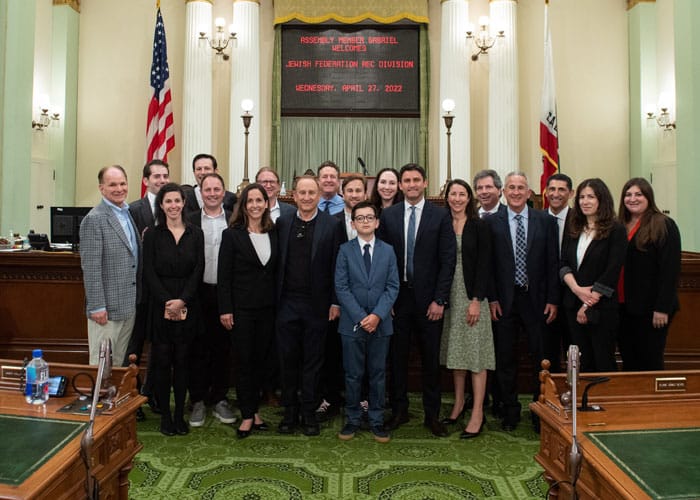
Due to the advocacy efforts of the Jewish Federation of Greater Los Angeles and L.A. Federation partners, California Gov. Gavin Newsom’s recently signed state budget for 2022-2023 allocates more than $132 million to help fund issues affecting California’s Jewish community.

“It is safe to say this $132 million will impact the entire Jewish community.”
– Rachel Zaiden

“It is safe to say this $132 million will impact the entire Jewish community,” L.A. Federation Civic Engagement Director Rachel Zaiden told the Journal in a recent phone interview.

The L.A. Federation worked with the California Legislative Jewish Caucus, a group of Jewish and Jewish-supporting elected officials in the California legislature, to secure $40 million for rebuilding six California summer camps affected by devastating wildfires in recent years. The camps are both Jewish and non-Jewish.

“The California Legislative Jewish Caucus was the main driver and force for this,” Zaiden said. “So we are really grateful for their partnership.”

The Jewish camps that will receive funds are Wilshire Boulevard Temple Camps in Malibu; the Shalom Institute in Malibu; and the Union of Reform Judaism’s Camp Newman in Santa Rosa. 

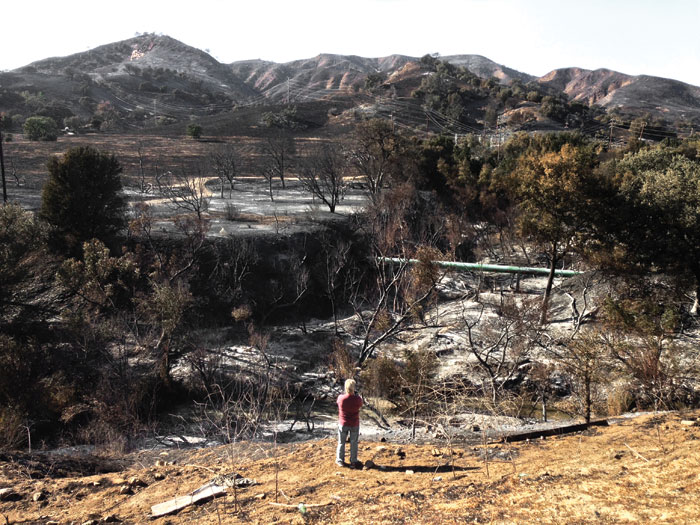
The devastating effects of the Woolsey Fire in 2018. Gary Bush/Getty Images

The Woolsey Fire in 2018 devastated Wilshire Boulevard Temple (WBT) Camps as well as the Shalom Institute. The massive wildfire destroyed nearly all of the structures at WBT’s Camp Hess Kramer and Gindling Hilltop Camp, and it wiped out 95% of the Shalom Institute’s JCA Shalom campus. 

“Had our state not been ravaged by drought and wildfire we would not be in this position,” Zaiden said.

“Had our state not been ravaged by drought and wildfire we would not be in this position,” Zaiden said.

In a statement, Shalom Institute Executive Director Bill Kaplan said he was grateful for the state’s support and the Federation’s work on his camp’s behalf. 

“This new funding from the State of California has put us one big step towards turning our ashes from the Woolsey Fire into blossoms,” he said. “With tremendous gratitude, the Shalom Institute community thanks the Jewish Federation of Greater Los Angeles and the Jewish Caucus for all their support and efforts to secure these funds not only for us, but for five other camps destroyed in wildfires over the last five years.” 

The recent allocations from the state will help with rebuilding, Douglas Lynn, executive director at Wilshire Boulevard Temple Camps and Conference Center, said. 

 “The recognition from the State of California of the invaluable work camps do to help children, teens and even adults learn, grow and become better people is reflected in this financial support,” he said.

Signed by Newsom on June 30, the $308 billion state budget goes beyond supporting Jewish and non-Jewish camps. It allocates $50 million for the state’s nonprofit security grant program; $1.4 million to staff and fund the Governor’s Council on Holocaust and Genocide Education; $1.8 million to staff and fund the Commission on the State of Hate; $36 million for the California Holocaust Survivor Assistance Program, which is administered by Jewish Family Service agencies to support the aging survivor population; and $3 million for the renovation of the JFCS Holocaust Center in San Francisco.

The work of many partners made securing these funds possible, according to the Federation. 

“From the Federation’s standpoint, the idea that we could convene this broader coalition says where we want to go in the community – that we make an impact not just in the Jewish community but among the broader, diverse citizens of the state,” Zaiden said. “This was the first time we have been able to do that in a meaningful way.”

State Budget to Support Jewish Camps, Holocaust Initiatives Read More »

Spertus Graduates, ETTA Appoints COO, Magen David Adom Unveils New Center

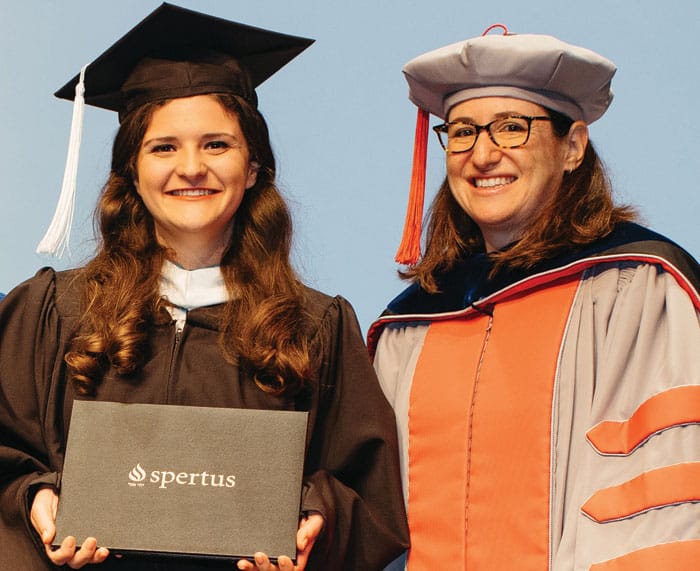
Four Los Angeles residents recently graduated from a prestigious Master’s program at the Chicago-based Spertus Institute for Jewish Learning and Leadership. 

The students earned their Master of Arts (MA) in Jewish Professional Studies, completing a creative capacity-building program for Jewish community executives designed to advance their careers and strengthen the organizations they serve.

Club Z’s Jen Weintraub (left) with Spertus Dean and Chief Academic Officer Keren Fraiman. Photo by Maggie Russo

The students are: Josh Steinberg, director of operations at Swipe Out Hunger; Lori Tessel, former executive vice president of the Jewish Federation of Greater Los Angeles; Jen Weintraub, regional manager for teen Zionist organization Club Z; and Aya Shechter, advisory council member at Council of Young Jewish Presidents. 

They joined thousands of other Spertus alumni who have advanced Jewish organizations and communities around the world with Spertus-acquired knowledge and skills. Three of the Los Angeles graduates participated in a recent ceremony in Chicago.

“It is wonderful to gather together for this special occasion, with guests joining us in person and tuning in from around the world,” Spertus President and CEO Dean Bell said at the event. “Graduation provides an opportunity to celebrate graduates’ academic and professional achievements—and also to recognize the proud colleagues, fans, friends, and loved ones who supported them along the way.”

Echoing the Spertus leader’s sentiments, Steinberg said: “By combining theory and practice, the program provided tools I can apply directly to my work.”


ETTA, a leading service provider to individuals with intellectual and developmental disabilities, announced that Scott Saliman has rejoined the organization’s leadership team as its COO, effective July 1.

“I am honored to rejoin ETTA’s leadership team as COO,” Saliman said. “ETTA has been a trailblazer for the disabilities community, transforming the lives of clients, families, and volunteers for nearly three decades. I look forward to bringing my experience to ETTA as it expands its services and continues to work to create a more compassionate and inclusive community.”

An expert in nonprofit and financial management, Saliman has an extensive history with ETTA and the Jewish communities of Los Angeles. He served in various capacities at ETTA, including CFO, COO, and senior advisor, from 2004-2015. During his tenure, he ensured ETTA’s long-term strategic and financial sustainability and developed successful, client-focused day-to-day operations. 

He returns to ETTA after running treasury operations for The RAND Corporation, a leading global non-partisan public policy research non-profit organization.

“We are thrilled for Scott’s return as COO of ETTA,” ETTA CEO Michael Held said. “Scott’s industry knowledge, finance and operating experience, leadership skills, and familiarity with ETTA will be a tremendous asset in growing our organization as the premier service provider for people with disabilities on the West Coast.”


Michael Dreyer and Anoosheh Bostani of the Alfred E Mann Family Foundation, a key supporter of the new Magen David Adom Marcus Blood Services Center in Israel. Courtesy of the Alfred E Mann Family Foundation

Magen David Adom (MDA), Israel’s paramedic and Red Cross service, recently unveiled its brand new MDA Marcus National Blood Services Center in Israel, a subterranean, shielded national blood center in Ramla, Israel. 

The dedication ceremony of the center was held May 2 event in Israel, with Israeli leaders and American donors in attendance. 

Key supporters of the $135 million center, designed to protect Israel’s blood reserves from missile, chemical and biological attacks, included American Friends of Magen David Adom, the U.S.-based fundraising affiliate of MDA, as well as the Alfred E. Mann Family Foundation.

The Alfred E. Mann Family Foundation, a Valencia, California-based grantmaking organization, was a significant donor to the project, sponsoring the upper lobby of the six-floor center.

“The Marcus Center is a testament to Israel’s dedication to its citizens and we are thankful to have an organization whose mission is to help people affected by disasters,” Alfred E. Mann Family Foundation President Michael Dreyer and Foundation Treasurer and Secretary Anoosheh Bostani said in a joint statement. “There can be no greater service than serving people in need. The Alfred E. Mann Family Foundation is proud to be supporting the Marcus Center in its mission to save lives.”

Spertus Graduates, ETTA Appoints COO, Magen David Adom Unveils New Center Read More »