fbpx

July 13, 2022

New Book Deconstructs Cultural Boycott Against Israel

A new book artfully explains how the Boycott, Divestment and Sanctions (BDS) movement has infected the entertainment industry and turned art into a political cudgel––and how to fight back against it.

In her May 2022 book “Artists Under Fire: The BDS War Against Celebrities, Jews, and Israel,” Lana Melman, who heads the Liberate Art organization, which opposes cultural boycotts of Israel, exposes the tactics used by those who boycott Israel. Melman begins by recounting the controversy over Scarlett Johansson and SodaStream in 2014, in which BDS activists accused the actress of “being complicit in crimes against humanity” since SodaStream operated in the West Bank. Johansson had also been an ambassador for Oxfam, a British charity working to end poverty worldwide, until the international nonprofit announced underneath Johansson’s bio on their website that they were against all trade with Israeli settlements. Johansson stood firm and ended her years-long relationship with Oxfam, and Oxfam was worse off for it.

The Johansson-SodaStream incident is a microcosm of how BDS operates in the cultural sphere, Melman writes, noting that the cultural boycotters are attempting to “browbeat them into submission” by exploiting “the desire of artists to avoid public shaming.” The cultural boycotters’ specific tactics include statements geared toward artists’ professional and charitable work, open letters that are actually pressure statements disguised as a “personal plea,” and turning artists’ songs into propaganda videos. “Using the song ‘Rockin’ in the Free World,’ BDS proponents intercut clips of Neil Young’s performances with still images and videos depicting war scenes, and a concrete wall (to reiterate: only about 5 percent of the security barrier is concrete) among other charged visuals to insinuate that if he performed in Israel, he was supporting an apartheid state and therefore not ‘Rockin’ in the Free World,’” Melman writes. The boycotters will also accuse minority artists of “betraying their community” if they perform in Israel

To older, more established artists, such tactics are unlikely to work. But the boycotters have had more success in their intimidation efforts of younger artists like Lorde and Lana Del Rey, who caved in the face of BDS pressure and canceled their scheduled concerts in Israel. Demi Lovato apologized for visiting Israel and posting photos from her trip to social media after enduring BDS backlash online. “Younger artists tend to be more sensitive to social media conversations in general,” Melman writes. “They have experienced firsthand the power and importance of this medium. Young artists like Lorde and Demi Lovato who have weathered fewer life storms, are more likely to fold under pressure.”

Melman also names and shames the most notorious boycotters––who she calls “BDS Zealots”—including Danny Glover, the late Alan Rickman and Alice Walker of David Icke-infamy. But her most scathing criticism is toward Roger Waters, the former Pink Floyd bassist and frontman. Dubbing him “The Man Behind the Curtain,” Melman dedicates an entire chapter in her book to delving into Waters’ journey into becoming an Israel-hater. “Extreme politics is in his blood,” Melman writes. “Both his parents were Communists and supported far-left causes. His father, who died when Waters was a baby (fighting Nazis as he likes to say) sympathized with Arabs during skirmishes with the Jews when he taught in Jerusalem between 1936 and 1938.” Ironically, it was Waters who found himself on the receiving end of BDS backlash when he performed in Israel in 2006; that backlash prompted him to meet with BDS Co-Founder Omar Barghouti and visit the West Bank. Eventually, Waters became closer with Barghouti, the United Nations Reliefs and Works Agency for Palestinian Refugees (UNRWA) and other “Israel detractors” that turned him into one of the more well-known figures in the BDS movement.

Waters tends to have a pattern when he attempts to pressure artists into cancelling upcoming performances in Israel, notes Melman. “He expresses his admiration for their professional work and compliments them on their social justice causes before excoriating Israel and offering up what appears to be a thinly veiled threat to their reputation,” she writes. “Waters’ private pleas then degrade into personal attacks on public pages because, like Glenn Close in Fatal Attraction, Roger Waters will not be ignored.” As an example, Melman pointed to Waters’ private request to Alan Parsons to cancel his 2015 show in Israel; Waters had opened his message to Parsons by reminiscing about how Parsons had worked as “the tall engineer” on Pink Floyd’s breakthrough album “Dark Side of the Moon” before asking him to cancel the show. When Parsons rejected the request, Waters posted their private correspondence to Facebook despite Parsons’ request that it be kept private. “Few artists cave under Waters’s bullying and pressure to cancel,” Melman writes. “Some fight back, while most thankfully ignore his noise.”

All in all, Melman does a masterful job in succinctly summarizing the history of the Israeli-Palestinian conflict––and how the Palestinians have constantly rejected Israel’s overtures for peace––while discussing the various classic blood libels against Jews and how BDS accusations that Israel murdering Palestinian children and engaging in Holocaust inversion are simply modern-day twists of those blood libels. And she does so with humor and wit while highlighting the importance of the issue, as artists help control our society’s civil discourse.

Melman concludes her book on a positive note, pointing out that there are plenty of famous names––include Jay Leno, Bill Maher and Michael Douglas––who avidly support the Jewish state and the number of artists who cancel performances in Israel due to BDS pressure are small. But that’s all the more reason for Israel supporters to stand up and start going on offense rather being “almost exclusively defensive,” Melman writes, calling for supporters of Israel and the Jewish people to hold artists accountable when they engage in antisemitic hate speech.

As for Waters, Melman suggests people mock him “because it will bug him.”

New Book Deconstructs Cultural Boycott Against Israel Read More »

America the Beautiful, Where Have You Gone?

As an adolescent I loved everything American. I listened to American Rock and Roll; Elvis, Dion, Buddy Holly, Neil Sedaka and Leslie Gore. I loved the Motown music by the Four Tops, The Temptations, The Supremes and Mary Wells. The best movies came from the U.S.A. Think of “Casablanca”, “Rebel Without a Cause”, “Twelve Angry Men”, “The Ten Commandments”, or “Blackboard Jungle”. I grew up watching American TV. Ed Sullivan, Bonanza, Bugs Bunny, The Dick Van Dyke Show and I love Lucy were some of my favourite programs.  I was fascinated with American automobiles from the 1950’s and 60’s with their two-tone paint, large chrome grills and wide white wall tires.

My parents often took me to Plattsburgh, New York, a lazy little U.S. border town on the shore of Lake Champlain, and about an hour’s drive from my home in Montréal. We would go to Grand Union for groceries. Well just the cereal aisle alone was enough to make a young boy cry with joy. There were so many different brands and boxes that I had only seen on Saturday morning cartoon shows, Trix, Kix, Coco Puffs and so many more. My mother always bought a jar of U-Bet chocolate syrup with a soda fountain pump, a product called Twist that was a mixture of peanut butter and jelly in a single container, those little sandwiched Nabisco crackers made with “cheese” and peanut butter, and these crazy drinking straws that had some kind of powder in them that would magically turn regular milk to chocolate milk.

When I was twelve years old, my dad took me to New York City. We stayed at the Statler Hilton in Manhattan. We went to the Carnegie Deli where I had my first Pastrami sandwich, the size of a compact car. We went to the Empire State building, Macy’s department store, and the Central Park Zoo. We had lunch at the Automat and dinner at the once famous Lindy’s. Between the sites, the sounds and the food, I was overwhelmed with awe from this remarkable city.

My love of all things American extended into my adult life. I often thought of moving to Florida or Vermont and opening a small business there. Many of my friends moved to New York, California, Texas or Florida and they all seemed to be successful and content with their new lives.

I viewed the United States with rose-tinted glasses. I understood that people of color were often victims of prejudice and hate. I didn’t really understand the involvement of the United States in the Vietnam War, especially having met several “draft-dodgers” who escaped to Canada. As I grew up, I started to notice differences between our two countries that weighed in favour of my own nation.

Let us all work together, Americans and Canadians, to find the right balance between unbridled personal freedom and the safety, protection and the right to a peaceful existence for all our citizens.

Why does the “richest country on earth” not have universal medicine? Why is gun ownership such an important right? Why are there so many mass shootings at schools, universities and shopping malls? Why are American colleges so expensive? How do injured individuals end up suing and winning enormous sums of money, when it is their own negligence that caused them to be hurt in the first place? Why are public schools so terrible, downtowns so run down and drug overdoses so common? And lastly, who made the President of the United States the “leader of the free world”?

I am not sure when it happened, probably a gradual degradation of society brought to fruition by a combination of events, tragedies and scandals. The British music invasion, the Vietnam War, the gradual take-over of the American car market by Japanese imports, the Watergate scandal, “reality” television, the Columbine shootings, police brutality aimed at African Americans, and finally, the election of a president whose actions and speeches served to divide, rather than unite this great country.

Today’s America is more hype than content. The rich get richer, while the homeless population continues to grow. A plan by a former president to introduce universal health care was rejected by many Americans and the final outcome was just a small slice of the original proposal. American values, especially for many of those who lean to the right, encompasses unlimited individual freedom with little regard for the effects on their fellow citizens. On the other side, left-leaning individuals tend to support a “woke” movement that scrutinizes every action and speech to ensure that no identifiable group is even slightly criticized regardless of the context.  The current “leader of the free world” appears to be asleep at the wheel.

I don’t want to be labelled as an individual who hates America. In fact I love to travel in the U.S. I have many close friends and family who live in America and who represent all sides of the political spectrum. It has saddened me to see the anger and hate that has been generated by both sides and propagated through biased news reporting and unverified social media platforms.

But most of all, I don’t want Americans messing with my own country. Recent protests in Canadian cities by citizens who were fed up with Canada’s harsher COVID-19 health restrictions were rumoured to be financed and supported by American right-wing groups. If this is in fact true, I urge Americans to please mind their own business.

No politician is perfect, neither are the policies and laws of most nations. Canada too, has its share of homelessness, random shootings, poverty and racism. While there is less flag waving and we tend to win fewer Olympic medals, we are still proud of our country. Canadian freedom to me balances individual liberties with communal limits. This means when the free actions of one group or individual are injurious to another, that activity cannot be boundless. No one really knew what COVID-19 could do. Canadian politicians decided to be more cautious, preventing citizens from taking part in group activities, shutting down some venues and invoking plans and incentives for getting most people vaccinated. It may take several years to evaluate whether or not these policies truly benefitted the population at large.

To see our beautiful capital of Ottawa taken over by a group of rebellious truck drivers and their supporters last winter made me both sad and angry. To a much smaller degree, it reminded me of the brazen attempt of some American citizens to invade their own seat of government on January 6, 2021. That’s an image I hope I never see in my country.

Both Canadians and Americans have a choice, the choice to elect a democratic government, to expect that their elected officials will make policies and laws that benefit society, to freely criticize these individuals when they disagree with these policies, and to vote them out or impeach them if they violate the public trust.

Let us all work together, Americans and Canadians, to find the right balance between unbridled personal freedom and the safety, protection and the right to a peaceful existence for all our citizens.


Paul J. Starr is a recently retired systems analyst who has lived his entire life in Montréal, Canada. On Sunday mornings he is “living the dream,” hosting a two-hour Internet radio show featuring music from the 50s and 60s called “Judy’s Diner.”

America the Beautiful, Where Have You Gone? Read More »

Staying SAFE while TRAVELING

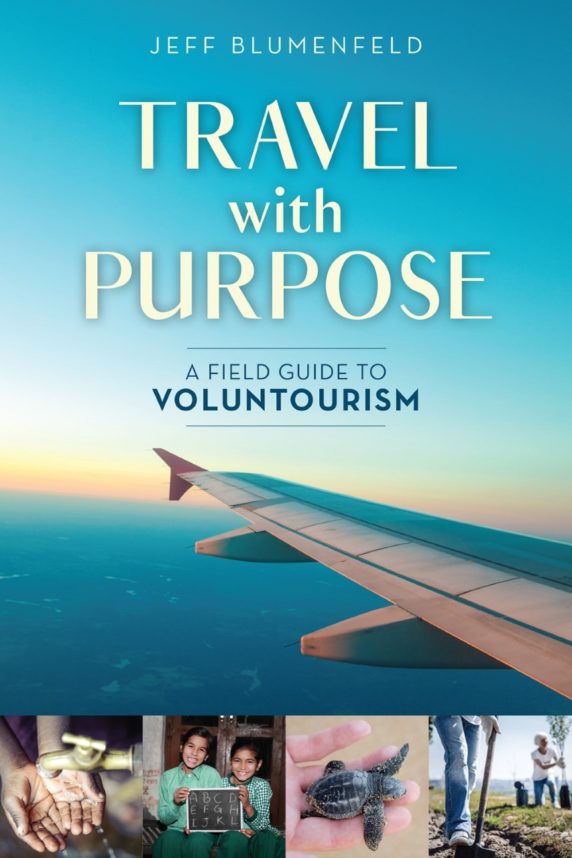
Jeff Blumenfeld shares an excerpt from his book, Travel With Purpose: Inspiring Stories of Everyday People Who  Travel the World to Make a Difference … And How You Can Too, how you can stay safe while traveling:

Stay Safe Out There

Excerpted from “Travel With Purpose: A Field Guide to Voluntourism” (Rowman & Littlefield 2019), travelwithpurposebook.com

By its very definition, voluntourism often takes you to places far off the grid, far from reliable medical services, and far from the safe sanitation and food handling practices you’ve come to expect in the U.S.

Don’t I know it. During my last trip to Nepal I was a good boy: drank only bottled water, used Purell hand sanitizer by the gallon, and ate only food that was hot, hot, hot – cooked completely through and through. But I let my guard down.

During literally the last hour in Nepal, at the Kathmandu Tribhuvan International Airport, I convinced myself that the fruit plate in the VIP Executive Lounge could be trusted. Big mistake. In about 20 hours, during the final flight from New York to Denver, digestive distress kicked in, alleviated only once I arrived home and downed some DiaResQ, a natural diarrhea relief aid made with bovine (cow) colostrum. Sounds awful, but it worked. Eating that last snack in Nepal was a rookie move on my part as I realize during my eighth trip to the tiny airplane lavatory. Too much information. Ok, let’s move on.

There are certain measures I employ that have worked well for me and might also be appropriate for you.

•            Depending on the destination, 22 to 64% of travelers report some illness – generally they’re mild and self-limited, such as diarrhea, respiratory infections, and skin disorders. But some travelers return to their own countries with preventable life-threatening infections, according to the New England Journal of Medicine.[i] Consult with a medical professional prior to departure, and ensure that your inoculations are current.

Before my first trip to Nepal I became a human pincushion after I decided to get trued up after years of lapsed vaccinations. Your needs may be different, for sure. For me, it took doses of Tdap, Typhoid, hepatitis A and B, meningococcal meningitis, poliovirus and a good old flu shot before I was ready to face the world.

Travel health precautions are available from the Centers for Disease Control (CDC),[ii] and World Health Organization (WHO).[iii] Additional information on vaccines in the form of Vaccine Information Statements (VIS), is available for download.[iv]

•           Whether traveling with a tour operator, or alone, eat foods that are fully cooked and served hot. Stay away from the salads and tuna fish sandwiches and that tea house cheese plate dotted with house flies that were previously dancing the Alley Cat on some yak dung.

•            Drink beverages that have been bottled and sealed, and forget the ice. While you’re at it, squeeze the bottle first to make sure it hasn’t been resealed (remember the scene from the 2009 Academy Awards Best Picture, Slumdog Millionaire, where a water bottle is refilled and the cap was super-glued for resale?). Carbonated beverages are much safer than non-carbonated – flat water drinks can be diluted with local tap water.

•            Fruits and vegetables are always questionable, unless you wash and peel them personally.

•            Don’t let your guard down in the bathroom. That means rinse toothbrushes only in bottled water and no singing in the shower lest tap water gets into your mouth. Practice for a week before you leave home. It is incredibly easy to slip up and find yourself using tap water out of force of habit.

•            Hand sanitizer is your best friend. Use it frequently and avoid putting your hands anywhere near your eyes or mouth. Let that hangnail wait for a proper pair of nail clippers.

•            Pack some energy bars for sustenance if you arrive late, the restaurants are closed, and Oreos are your only choice in the hotel vending machine. I especially like Bobo’s Oat Bars,[v] which, according to its website, is an artisan hand-baked alternative to the over-cluttered snack bar aisle riddled with over-engineered bars made with unrecognizable ingredients. It’s best to take a hard pass on those snacks.

•            Now for something fairly cringey: check for bedbugs. You can thank me later. The Environmental Protection Agency (EPA) advises that bedbugs can be found around the bed, they can be found near the piping, seams and tags of the mattress and box spring, and in cracks on the bed frame and headboard. They can also be hiding in the seams of chairs and couches, between cushions, and in the folds of curtains. These are nasty buggers.

Look for rusty or reddish stains on bed sheets or mattresses caused by bed bugs being crushed, dark spots about the size of a period pencil point, eggs and eggshells, which are tiny (about 1 millimeter or about the size of a period on this page), pale yellow skins that nymphs shed as they grow larger, and live bed bugs themselves.[vi]

•            Make a mental note of what to grab in case of earthquake or fire. It happened to me in southern California. I grabbed my laptop, pants, shoes, and wallet; other guests in the lobby were shivering barefoot in their tighty whities. False alarm, but still.

•            Before you leave, set up an international package for your smartphone, or buy a local SIM card so that if you have to use your phone in an emergency, the call  doesn’t cost dozens of dollars.

•            Carry an inventory of the contents of your checked luggage. That way, it will be easier to file a claim afterwards.

•            Avoid looking too prosperous; leave the real Rolex home and buy a $20 Timex instead. Keep money in three different places on your body and create a throw-down wallet – something with a few dollars that looks like you’re handing over your real wallet in case of trouble.

•            Be situationally aware. Stay alert and forego the use of personal headphones when you’re walking about. Avoid wearing flashy jewelry and designer clothes. Kathmandu, the capital of Nepal, is a city with a myriad of hazards. There are wild dogs, five lanes of traffic on two-lane streets, a rat’s nest of wires hanging from utility poles, open conduits in the sidewalk, and strange locals approaching you to strike up chatty conversations or seeking money for “baby milk” or similar. It pays to know what’s going on around you.

BUY TRAVEL WITH PURPOSE


[i] David O. Freedman, M.D., Lin H. Chen, M.D., and Phyllis E. Kozarsky, M.D., “Medical Considerations before International Travel,” The New England Journal of Medicine, July 21, 2016,  https://www.nejm.org/doi/full/10.1056/NEJMra1508815

[ii] Centers for Disease Control and Prevention, Vaccines & Immunizations, accessed May 28, 2018, www.CDC.gov/vaccines

[iii] World Health Organization, “World Health Statistics,” accessed May 28, 2018, http://www.who.int

[iv] Centers for Disease Control, “Vaccine Information Statements (VISs),” accessed May 28, 2018, https://www.cdc.gov/vaccines/hcp/vis/index.html

[v] Bobos, accessed May 28, 2018, https://eatbobos.com/

[vi] U.S. Environmental Protection Agency, How to Find Bed Bugs”, EPA.com accessed Jan. 17, 2018, https://www.epa.gov/bedbugs/how-find-bed-bugs

ABOUT JEFF BLUMENFELD:

Jeff Blumenfeld is founder and president of Blumenfeld and Associates PR, LLC, a public relations and adventure marketing agency based in Boulder, Colorado. In 2013 and 2017 he served as communications director for Dooley Intermed International’s “Gift of Sight” Expedition to Nepal ­– an effort to deliver badly needed quality eye care to 700 impoverished villagers.   In 2020 he won the Iceland Exploration Museum  Leif Erickson Award for History.

I met Jeff at the 2022 Scuba Show

Staying SAFE while TRAVELING Read More »

Biden’s Israel Agenda

President Joe Biden published an opinion piece in the Washington Post last weekend in which he outlined his goals for his visit to the Middle East. Titled “Why I’m going to Saudi Arabia,” the article does not mention Israel until the twelfth paragraph, after Biden references Iraq, Yemen, Iran, Saudi Arabia (as well as Russia, Ukraine, ISIS, and the Islamic State). Biden does briefly allude to last year’s war with Gaza, but his list of goals for the Middle East does not include any mention of a lasting peace between Israel and the Palestinians.

It’s clear that Biden’s stop in Israel on this trip is merely the undercard: the main event will be his time in Saudi Arabia. By next week, we’ll have a better sense of what the American president was able to accomplish during his time in the region. But because this column was written just before Biden began his travels, it’s seems like a good opportunity to examine the political landscape that exists in Israel at the time of his arrival.

With the exception of Donald Trump, who strongly advocated for Bibi Netanyahu’s reelection as prime minister, American presidents have historically avoided taking sides in Israeli campaigns. But while Biden will not formally endorse interim prime minister Yair Lapid before this fall’s election, the practical effect of his days in Israel will have been an immense boost to Lapid’s election prospects. In the interest of fairness, Biden’s schedule also includes a meeting with Netanyahu. But the White House has barely bothered to disguise its “anyone but Bibi” approach to Israeli politics, and Biden will do everything he can before that country’s voters go to the polls on November 1 to elevate Lapid.

That’s why the Biden Administration has been so careful not to pressure either Lapid or his predecessor Naftali Bennett to take any steps toward reconciliation with the Palestinians that might upset Israeli voters on the eve of that election (although Lapid did hold a phone conversation last week with Palestinian Authority President Mahmoud Abbas, the first time Israeli and Palestinian leaders have talked directly in several years). But the United States has not reopened the Palestinian mission in Washington or its consulate for the Palestinians in Jerusalem, nor has the U.S. State Department reversed Trump’s position that Israel’s West Bank settlements are not a violation of international law or lifted the classification of the Palestinian Liberation Organization as a terrorist group.

Biden has no intention of allowing Lapid to appear either to be weak on security matters or to have done anything to harm the relationship between the two countries. 

Any such steps would provide Netanyahu with an opening to attack the Lapid-led coalition as compromising Israel’s security and allow the former prime minister to criticize Lapid for losing influence with the United States. Biden has no intention of allowing Lapid to appear either to be weak on security matters or to have done anything to harm the relationship between the two countries. As a result, Biden’s schedule was designed to specifically highlight the close coordination between the Israeli and American militaries, with an itinerary that included a tour of the Iron Dome missile defense battery, Israel’s laser defense rocket defense system and other security-related sites. Biden also believes that stronger ties between Israel and other countries in the region will provide much greater levels of protection for the Jewish state, and so underscoring those collaborative efforts also strengthen Lapid’s standing.

Biden has provided support to the Palestinians, restoring more than $500 million in aid that had been cut off by Trump and committing to even more financial support on this trip. But the Palestinian leaders are deeply frustrated that Biden appears to be in no hurry to move toward the two-state solution that he has long endorsed. Their dissatisfaction is of even greater political benefit to Lapid.

Next week, we’ll discuss Biden’s visit to Saudi Arabia and his efforts to strengthen the anti-Iran alliance that he believes is the key to broader cooperation between Israel and its neighbors. But barring an unexpected surprise during his time in Israel, it’s safe to assume that Biden will accomplish his most important goal for that visit — by lending his visibility and credibility to Lapid’s re-election campaign.


Dan Schnur is a Professor at the University of California – Berkeley, USC and Pepperdine. Join Dan for his weekly webinar “Politics in the Time of Coronavirus” (www/lawac.org) on Tuesdays at 5 PM.

Biden’s Israel Agenda Read More »

Why Shul?

The following was delivered as a speech at Temple Beth Am’s annual gala on May 18.

How does one sum up the essence of two very strange years?

We started it at home.  We learned something new called “Zoom.” We struggled with technology in every aspect of our lives.  

There were elements of this pivot that were unquestionably positive, especially at first.  Many of us had never spent so much time at home.  We could stay in our pajamas all day. We wore sweats 24/7.  We baked bread. We watched Netflix. In the quest to stay isolated and therefore healthy, we discovered a new calm — never leaving our houses.

At Temple Beth Am, we made a very quick transition to remote access for services.  The job of synagogue president, pretty much from Sinai to the beginning of the pandemic, requires physical presence each week in services, to do announcements and give the B’nai Mitzvah gifts.

It was pretty darn seductive to do none of that, to wander vaguely from my bed to my couch on a Saturday morning, and passively watch the clergy lead and chant services for us, online.  And do nothing.  

But like most things seductive, or passive, it was also unsatisfying.  And, over time, increasingly unsettling.  

What does it mean to interact with community solely online?  In times of crisis, it is necessary, of course.  But over time, it’s lacking.  Missing something. And increasingly dystopian.

Early on, we understood that the unavoidable shift to remote access meant so much more to the course of our lives than a short-term solution to a pandemic emergency.  It raised fundamental questions not only about the role of synagogue in our life, but its intersection with the nature of home itself.  

Our synagogue leadership was deeply aware of the transformative nature of the moment.  So last August, at about the halfway mark of my term, we convened a one-day retreat to explore that question.  What is our essence — who are we?

It wasn’t a surprise what we came up with.  

Community. But what is that?  What does that mean?  In fact, across the synagogue world, that seems to be the $64,000 question.

These are days of generally declining synagogue membership, merging communities and lots of hand wringing in the Jewish press over the future of synagogues.  So at this, the end of my two-year term as president, I’ll offer my own observation in response to the big question: What does “community” mean? What does it mean to us, at Temple Beth Am?  What is the value of a traditional synagogue to a 21st century life?  

First, I’ll suggest to you what community isn’t. We’re told sometimes that what we really need to do to make synagogues thrive is to make them more fun.  Look — Las Vegas is fun. Baseball is fun.  Galas are fun.  But if fun is what we’re looking for, and we certainly do need lots of that, synagogues will rarely compete — no matter how many poker nights, movie nights or concerts we try to put on.  

We all — children and adults alike — need something far more fundamental and grounding than a simple good time.  We call that community. And synagogue life, at its best, provides it.  

Synagogues provide identity: We learn (no, we feel) how we, personally, fit vertically into a 2,000-year narrative that has brought us all the way from the Land of Israel right up to this day.  We learn how we fit horizontally into a people that spans the globe, belonging to a people that will welcome us into any similar synagogue tucked into every corner of the globe.  

That’s identity.

Synagogue life provides inspiration.  Through the repetitive practice of synagogue attendance, we cannot help but absorb the moral and ethical lessons that form the core of the Jewish story.  There are moments — whether as a child, a teen, or an adult — where something that the rabbi says in a sermon, or a passage from a book, or something a teacher says, strikes us in just the right way, and makes us feel something close to inspiration.

That’s worth the price of admission any Shabbat morning.

Synagogue life provides a break.  A pause.  We all say we crave a couple hours off the spinning wheel of life, every now and then.  Our tradition, somehow, fully anticipated that 21st century need two millennia ago. At 8 am on a Saturday I am never — ever — motivated to roll out of bed and pop on over for Shacharit.  But by 1 pm, I am almost always happy I did — and feeling spiritually refreshed as well.  Sometimes from a moment in the service, but also almost always from an interaction with a fellow congregant.

Synagogue life provides a break.  A pause.  We all say we crave a couple hours off the spinning wheel of life, every now and then.  Our tradition, somehow, fully anticipated that 21st century need two millennia ago. 

There’s more. Synagogue involvement elevates us to be our better selves. It supports us when we falter. As the parents of twins, we emblazoned on the benchers that we provided at Maya’s and Jonah’s B’nai Mitzvah: “Tovim Ha’Shnaim Min Ha’Echad. Ki im yi-folu haechad, yakim et ha-chaver.”  “Two are better than one. If they should fall, one can raise the other.” 

That, in a nutshell, is the tagline, if you will, that we tried to instill in our children about the wisdom of Jewish communal life.

Synagogue life is comfortably repetitive. It’s not flashy, and it’s decidedly unsexy in a Tik Toc digital age way.  And, to be totally honest, it takes work. For each member. It takes effort to build community, and the best way I found to do it was to get involved.  To serve on committees.  To lend expertise, whatever that might be.  

And we all need to be way, way better at welcoming all who wish to live this life, to find a meaningful way into it.  And to continue to do so across that increasingly divisive political line.

That’s all hard to market.  Sacrifice always is.

But if all goes right, and if you embrace that culture of service, you find a cocooning sense of belonging that is as fundamental to human satisfaction as food or drink.  It’s the opposite of the fun of Las Vegas. It’s about giving, not taking. What happens at shul doesn’t stay at shul.  In fact, if you’re lucky, it travels with you forever.  It becomes part of who you are, and defines you.  Shul attachment lends us a quiet contentment and satisfaction that stays with us, always.   

What happens at shul doesn’t stay at shul.  In fact, if you’re lucky, it travels with you forever.

And that, at the end of the day, was what felt so jarring, so unsettling, so dystopian about the atomized “homes” that we were forced to use as remote sanctuaries beginning in March 2020.  They provided comfort, but were devoid of the social color that community lends to our lives.  They ensured safety, but lacked the almost equally important unpredictable vagaries of human interaction.  This is the essence of the human experience and, for me, it gets me through the week.

There’s a reason that we all devote endless hours to the maintenance of our homes — doing the laundry, hassling with the finances, renovating rooms, and hosting guests.  Because it’s worth it.  It’s inconceivable not to have the refuge of a house.  It’s what it means to have a home.  

I think that’s the same reason that synagogue leaders spend the time they do on the maintenance of their communal home.  Because that’s what it is.  It’s fundamental to who we are. 

It’s home.


Stuart Tochner concluded his two-year term as president of Temple Beth Am on July 1.

Why Shul? Read More »

American Jews Must Demand Accountability After Disruption of Bar and Bat Mitzvah Ceremonies at Kotel

I just arrived in Israel for a visit with my family after a three-year absence as a result of the COVID-19 pandemic. Perhaps even more than usual, it is a blessing to be here, in our homeland.

On the long journey from Los Angeles, I read one of the most disturbing articles about Israel I’ve ever encountered (which is saying quite a lot, considering the tragic stories of terror and loss that are too often a part of the Israeli news cycle). The article describes an incident that occurred last week at the Kotel, in the designated egalitarian worship space known as Ezrat Yisrael.

Ezrat Yisrael is a section specifically set aside for families who wish to pray near the Kotel in an egalitarian setting. In this one place, in accordance with an agreement sanctioned by the Israeli government, both men and women can chant Torah, put on a tallit, and wear t’fillin. Parents, siblings, and grandparents of all genders can stand side by side, watching with pride as the next generation places its link in the chain of tradition. Such behavior, so natural and even ordinary for us, is not allowed at the Kotel proper, which is under the control of the ultra-Orthodox rabbinate. This compromise gives the Israeli Conservative Movement (known as the Masorti movement) control of Ezrat Yisrael.

Three families visiting from the United States were each celebrating a bar or bat mitzvah ceremony for one of their children. Last Thursday, they had arrived at Ezrat Yisrael early in the morning to beat the Jerusalem heat.

A group of several dozen ultra-Orthodox men and boys came to Ezrat Yisrael specifically to disrupt these beautiful b’nai mitzvah ceremonies, ceremonies which they consider to be an affront to their religious sensibilities since women are included as full participants. They interrupted the worship in ways that are simply painful to read about: They ripped up the families’ prayer books, with one young man caught on film using a torn page from a Conservative siddur to wipe his nose. They shouted names at the worshippers, going so far as to call them animals, heretics, Reformim (Reform Jews, even though these three ceremonies were all conducted by Conservative rabbis) and Nazis, even though the grandfather of one of the children is a Holocaust survivor.

Imagine the pain of the families who had traveled a great distance for this sacred moment only to see it ruined. Imagine the trauma felt by the young adults (children really, age 12 or 13), who had prepared for months to read from the Torah for the first time in the holy city of Jerusalem, only to watch this horror unfold.

Over the years, I have had the privilege of officiating at dozens of b’nai mitzvah ceremonies at Ezrat Yisrael. Thankfully, I’ve never experienced anything like this, but I have seen this hatred firsthand when I attended worship at the Kotel proper on Rosh Chodesh (the New Month) over the years with Nashot Ha’Kotel (Women of the Wall), sometimes with my wife and daughters.  

Over the years, I have had the privilege of officiating at dozens of b’nai mitzvah ceremonies at Ezrat Yisrael. Thankfully, I’ve never experienced anything like this.

Deborah Lipstadt, the United States Special Envoy for Monitoring and Combating Antisemitism, is in Israel this week and commented: “Let us make no mistake, had such a hateful incident—such incitement—happened in any other country, there’d be little hesitation in labeling it antisemitism.”

This type of intra-religious hatred (Jews hating other Jews for denominational, ideological, ethnic, or racial reasons) is, sadly, nothing new. The rabbis of the Talmud called it sinat chinam (hatred without a cause) and blamed it for the destruction of the Second Temple in 70 C.E. Although the destruction happened almost two millennia ago, it is timely now as we enter the period known as the Three Weeks, the time when we recall those tragic events liturgically. It begins on the 17th day of the current Hebrew month of Tamuz, which this year corresponds to July 17.

We have an obligation, I think, to pay special attention to these moments and to respond. We need to raise our voices collectively and demand that those in positions of authority be held accountable, especially the heads of yeshivot in Israel where these young men are trained, who are paid in part by government funds. We need to demand that the Kotel agreement be codified into law in the next Knesset. We also need, in our local communities, to ensure that there is active communication between the leadership of the various movements, local synagogues and clergy.

According to tradition, sinat chinam led not only to the destruction of a building—the Second Temple—but also to the destruction of lives. Tens of thousands of our ancestors died, according to our sages, because of our own pettiness and hatred.

Make no mistake: If incidents like these aren’t stopped, there will—God forbid—be bloodshed. As we enter the period of the Three Weeks, let us commit ourselves all the more to what some call ahavat sinam (“senseless love”), mutual concern and love that flows freely not necessarily because we know each other so well or spend so much time with one another, but simply because we are family, part of Am Yisrael, a stiff-necked people who share a common history and a common destiny—and a deep love for Eretz Yisrael, the land of Israel.


Rabbi Yoshi Zweiback is the Senior Rabbi of Stephen Wise Temple in Los Angeles, California.

American Jews Must Demand Accountability After Disruption of Bar and Bat Mitzvah Ceremonies at Kotel Read More »

Jewish Studies Professors Join Jewish Studies Zionist Network to Fight Anti-Zionist Activism on Campus

In May of 2021, over 200 scholars of Jewish and Israel studies, many teaching at prestigious universities, signed a letter responding to Israel’s recent operation in the Gaza Strip. The statement decried Israel’s foundations of “settler colonialism” and “Jewish supremacy,” placed the vast majority of blame on Israel for conflict in the region, and then cautioned against labeling economic and academic boycotts of Israel “antisemitic.” 

Jarrod Tanny, Associate Professor of Jewish History at the University of North Carolina, Wilmington, argues that the statement was the antithesis of all that the academy is meant to stand for. The letter replaced scholarship with activism, he says. It failed to empirically characterize the realities of the Middle East. It also placed the Boycott, Divest, and Sanctions (BDS) Movement  under the umbrella of “academic freedom,” what he calls another egregious mistake. As Professor Menachem Kellner, Chair of the Philosophy and Jewish Thought Department at Salem College, writes, “The concept of academic freedom is meant to enable academics to research and teach evidence-based truths in the fields in which they are competent. It is not meant to protect academics who introduce their personal politics into their research and teaching in order to browbeat their students and foment an atmosphere of prejudice and hate designed to silence rational inquiry.” 

But the controversial letter, signed by some of his friends and colleagues, was not the only incident that has unnerved Professor Tanny. 

Professor Tanny was once a member of the “Jewish Studies Activist Network” (JSAN), a community of Jewish academics opposed to the Trump Administration’s agenda and the rise of extremism in America. He became disillusioned when he alerted the group to a recent incident where a left-wing, anti-Israel organization harassed a group of Jews marching in an LGBT Pride Parade, only to have his concerns fall on deaf ears. Tanny hypothesizes that JSAN was unwilling to speak out because the antagonizers were not the “right kind of antisemite.” Some members claimed the anti-Israel organization was only “attacking Zionists, not Jews.”  

I reached out to Professor Tanny to discuss this persistent problem of anti-Zionist activism on college campuses, which seems to only get worse. A resolution to boycott Israel, a Jewish student being bullied, another effort to pull funding from Jewish organizations, have become regular occurences. There are occasional moments of reassurance when sensible faculty members do indeed confront antisemitic language circulating in their departments, but they are usually upstaged by Jewish professionals chastising Israel and failing to condemn antisemitism when it does not come from a white supremacist. 

“Many have pointed out the fact that anti-Zionist activism on campus is by and large faculty-driven,” Professor Tanny says. “Such activism requires the presence of a number of vocal, anti-Zionist professors to truly radicalize the student body.”

The social pressure to conform to Israel-hatred is not just a problem for Jewish students, but Jewish faculty as well. The pressure is so strong that many will either join the crusade to label Zionism racism to strengthen their progressive bona fides, or will at least become ambivalent to the issue, thinking it best not to place oneself in controversy.  

The social pressure to conform to Israel-hatred is not just a problem for Jewish students, but Jewish faculty as well.

“There are many of us (Jewish studies academics) who believe that the anti-Zionism being propagated on college campuses is a serious problem and that it’s leading to the marginalization of Jewish students. But the Jewish studies professors who may be ‘closeted Zionists’ … don’t want to speak out, if they are still expecting their career to advance. They are genuinely worried that their politics will be held against them. What if they submit an article to a journal, and among the peer reviewers are this cohort of radical anti-Zionist professors?”

We discussed the symbiotic relationship between anti-Zionism on the quad and anti-Zionism in the teacher’s lounge. Activists denouncing what some outrageously call Israel’s “genocide” of the Palestinians feel emboldened by professors who are willing to, if not support their agitation outright, then at least justify it, especially if they are Jewish and can use their Jewishness as a shield against accusations of antisemitism.

These disturbing trends inspired Professor Tanny to launch the Jewish Studies Zionist Network (JSZN), a new initiative of scholars and educators in the field of Jewish studies who believe “that Zionism is a legitimate movement for the national self-determination of the Jewish people in their ancestral homeland.” 

With over 150 signatories, including notable academics including Dr. Gerald Steinberg of Bar-Ilan University and Dr. Gil Troy at McGill, the network seeks “to defend the legitimacy of Israel in the academy, to fight attacks against Israel that are motivated by ideological rather than scholarly pursuits, to foster an environment where multiple perspectives and approaches are welcomed and encouraged, and to ensure that a ‘safe space’ exists on college campuses for Jewish, Zionist faculty and students.” 

The goal of JSZN is noble. The question is whether it will be effective. Millions of dollars and countless initiatives have been raised by the Jewish community to find solutions to this problem, yet so far, things are only getting worse. On this, Professor Tanny is a realist. He understands that the anti-Zionist movement is well organized, well-funded and well-strategized with decades of malicious propaganda under its belt. 

But there is strength in numbers. By growing the number of signatories to new statements affirming the Jewish people’s right to a state of their own even during conflict, amplifying the work of academics who recognize the legitimacy of Jewish self-determination, and creating an online presence where scholars can refute biased research, the JSZN hopes to become another crucial voice in the demand for an even playing field when discussing Israel on campus. Consequently, Jewish students experiencing antisemitism will have a professor’s desk to come to for support, and Jewish professors will have the confidence to stand up to their respective departments when other groups unify to attack Israel. 

“At the very least, I wanted to get together with many Jewish studies scholars who are not afraid to say, publicly, that they are Zionists, and that they are not afraid. Hopefully we can promote scholarship that will further the understanding of what Israel means to the Jewish people, how politics operate in Israel, the history of Israel, and the history of how we’ve gotten to where we are today.” 

One goal of JSZN seems to be community. Rather than embark on a campaign to challenge anti-Israel speakers or organize pro-Israel rallies on campus, the network strives to be an intellectual support system for Jews all over the country. “If we ever are in a position like we were in last May,” says Tanny, “where the entire academy essentially gangs up on Israel and its supporters in the Diaspora, I can assure you, anti-Zionist Jewish studies professors will not be speaking on behalf of all of us. I will assure you, the Jewish Studies Zionist Network will be ready for that. We are here, and you will notice us.” 

Despite passionately believing in this project, Professor Tanny acknowledges its contradictions. We discussed the delegitimization of academic institutions in this country, most commonly blamed on the introduction of activism into the classroom, and how if one seeks to defend the foundations of liberal education — impartiality, teaching students how to think rather than what to think — the pursuit of a “safe space” for Zionist students and staff as written among the goals of the JSZN may raise eyebrows. I asked him if the thinking behind the concept of a safe space — the heightened sensitivity, leftism, and political correctness on campus — contributes to the environment he seeks to combat, and therefore, if an initiative like JSZN can be counterproductive.  

“If the trends continue the way they are,” he answers, “where every identity group has a place to feel empowered and protected, and the Jewish people on campus, who use Zionism to express their peoplehood, are left out of this, it will lead to the marginalization of Jews. It will lead to non-Jews telling Jews who they are, and what they can be. If this is the playing field we have to engage in, then yes we need to do it.” 

I look forward to seeing the endeavors of the Jewish Studies Zionist Network, and I hope more academics will sign its mission statement. We must have confident Jews in the academy who are not afraid to challenge hegemony and scholarly malpractice. My strongest hope is that a renewed sense of pride, of dignity, and certainty in Israel’s right to exist among the professors will trickle down to the students as well.

If you are a Jewish Studies professor and would like to learn more about the Jewish Studies Zionist Network or sign the statement, please visit https://www.jsznetwork.org/about.html.


Blake Flayton is New Media Director and columnist for the Jewish Journal.

Jewish Studies Professors Join Jewish Studies Zionist Network to Fight Anti-Zionist Activism on Campus Read More »