fbpx

July 8, 2022

Politics and the Parah Adumah

The Midrash states that the commandment of Parah Adumah is the ultimate religious mystery, and its reasons are unknowable. The commandment outlines a purification ritual for those who come in contact with a dead body. A red heifer, or Parah Adumah, is sacrificed on the Mount of Olives, and then burnt on a pyre. The ashes are mixed with water and sprinkled on those who were impure.

The Parah Adumah ritual is confusing for several reasons. It is a sacrifice that is performed outside of the Temple, something that elsewhere the Torah explicitly forbids. And while the ashes of the Parah Adumah purify those who were impure, paradoxically, those who handle the ashes are themselves rendered impure. The Midrash says that even the wisest of all men, King Solomon, said about this commandment, “I thought I was wise enough, yet it was distant from my understanding.” Even Solomon couldn’t comprehend the purpose of the Parah Adumah. The term used by the Talmud for commandments without any reasons, a chok, is taken directly from our Torah reading.

Whether or not the commandments have reasons has been debated by Jewish thinkers for over 2,000 years. Christine Hayes, in her book “What’s Divine About Divine Law,” explains that these debates arose when Jews first confronted Hellenistic culture. In the Greek world, the idea of natural law, a universal, rational understanding of what is right and what is wrong, was accepted; what would be considered divine morality could be understood by one’s intellect. This perspective challenged Jews to think about how to understand the Torah, most of whose commandments were offered as divine fiats without any stated reasons. Some, like Philo, sought to integrate the Greek understanding of divine law into the Torah, and find logical reasons for all the commandments; this project of searching for taamei hamitzvot, the reasons for the commandments, has continued to this day. The rabbis of the Talmud and Midrash held multiple points of view on this question. Some rabbis take the same approach as Philo, but many passages in Talmud and Midrash reject the idea that commandments have reasons. Even ostensibly ethical commandments are seen as purely a reflection of God’s will; one passage in the Talmud says it is improper to consider the commandment to send the mother bird away before taking her eggs, as a reflection of divine mercy, because all of God’s commandments are exclusively divine decrees. Another passage in the Talmud that was particularly influential in medieval philosophy creates a division between two types of commandments: There are mishpatim, ethical laws that one would arrive at rationally on one’s own, much like natural law. And there are chukim, divine decrees without any explanation; the Talmud says that regarding chukim, God declares, “I decreed these statutes, and you have no right to question them.”

In medieval philosophy, Saadia Gaon accepts this distinction between chukim and mishpatim, which he calls “revealed” and “rational” laws. The Rambam strongly disagrees and insists that every commandment is rational. God would only act in accordance with wisdom; he explains that “our Sages generally do not think that such precepts have no cause whatever and serve no purpose, for this would lead us to assume that God’s actions are purposeless.” The Rambam devotes nearly a quarter of his “Guide for the Perplexed” to taamei hamitzvot, and he enumerates reasons for every commandment, even ones that seem strange and obscure.

But in the modern era, the Rambam’s understanding of taamei hamitzvot was rejected by many Jewish thinkers. By offering philosophical, historical, and even medical reasons for the commandments, the Rambam opened a religious Pandora’s box: If the reason was no longer relevant, perhaps the commandment could be ignored? For this reason, Rabbi Samson Raphael Hirsch harshly criticizes the Rambam’s taamei hamitzvot, because they paved the way for the Reform movement. He writes:

If, for instance, the sole purpose of the prohibition of labor on the Sabbath was to enable men to rest and recover from the toils of the week, if the Sabbath means only the cessation of corporeal activity in order that the mind may be active; and who could doubt it, since both Moses (i.e, Moses Maimonides and Moses Mendelssohn) interpret it thus, and the Christian Sunday agrees with their conception, who must not consider it mere pettiness and pedantic absurdity to fill an entire folio with the investigation of the question, what particular actions are forbidden, and what permitted on the Sabbath day? How singular, to declare the writing of two letters, perhaps an intellectual occupation, a deadly sin, while judging leniently many acts involving great physical exertion, and freeing from penalty all purposeless destruction!

Hirsch bemoans the fact that the Rambam’s philosophical interpretations of the mitzvot undermine the practice of halakhah; in actuality, the Shabbat is much more than a mere day of rest. By explaining the commandments, the Rambam ended up undermining them.

Rabbi Joseph B. Soloveitchik takes this critique a step further. He too uses the Rambam’s reason for Shabbat as an example. He writes that if the purpose of Shabbat is merely “hedonic,” to rest, then “the Sabbath idea is dispossessed of its breadth and warmth. And if the Sabbath is to be seen only against the background of mundane social justice and similar ideals, the intrinsic quality of the Sabbath is transformed into something alien. It serves merely as a means to the realization of a ‘higher’ end.” Soloveitchik explains that reasons for the commandments offered by the Rambam often explain a religious norm by an ethical precept, turning religion into the maidservant of ethics. Rabbi Soloveitchik’s fundamental criticism is that the Rambam’s taamei hamitzvot subordinate the Torah to other disciplines, putting Torah second.

Both Rabbis Hirsch and Soloveitchik emphasize the need for the Torah to be treated as an independent, transcendent discipline. This call is particularly significant, considering that it comes from two thinkers who were associated with movements of Torah Umadda and Torah im Derech Eretz, who saw engagement with general knowledge as a religious obligation; yet they remain steadfast in refusing to reduce Torah to a vehicle for external disciplines.

And this is precisely the importance of chok: to remind us not to use divine revelation in the service of other ends. We must approach the commandments with humility, and not assume they are there to serve our own personal needs.

We must approach the commandments with humility, and not assume they are there to serve our own personal needs.

Sadly, in contemporary times, many treat the Torah as a textbook of non-Torah subjects; readers scour religious texts to find lessons of psychology, leadership, finance, and even medicine. My objection is not to specific insights. For example, one must consider the psychological aspects within the narratives of Bereishit; not to do so would overlook important insights. But when the psychological perspective becomes the primary mode of engaging a text, the spiritual power of the Torah is lost. A grand gesture of faith can be reduced to an unusual father-son dynamic, and the Torah then becomes a collection of interesting case studies. The Torah should not become “a spade with which to dig,” a way to obtain useful information that the reader finds gratifying.

The Torah is most often conscripted in the service of politics. Every hot button issue inspires articles about how the Torah supports one viewpoint or another. Written in the style of a lawyer’s brief, these articles of political-Torah lack nuance and scholarly insight. Undoubtedly, the advocates of politicizing Torah have laudable goals: They want to ensure that the Torah is “relevant,” and that we “bring Torah values into the public square.” But in reality, the opposite occurs; the Torah ends up being the footnote to political passions, and all that matters is whether the Torah supports one’s favorite causes.

Bringing religion into politics will ultimately diminish faith. Perhaps Abraham Lincoln said it best. When told by an aide that “God was on the side of the Union,” Lincoln supposedly responded: “Sir, my concern is not whether God is on our side; my greatest concern is to be on God’s side.” One must never confuse subjective interests with divine imperatives, but this inversion of values is what happens when religion becomes subordinate to politics. The lesson of the chukim is to avoid pulling God over to our side, and instead approach the Torah with humility and openness.


Rabbi Chaim Steinmetz is the Senior Rabbi of Congregation Kehilath Jeshurun in New York.

Politics and the Parah Adumah Read More »

Palestinian Terror Group and Iranian State TV Channel Back Mapping Project, ADL Report Says

A new report from the Anti-Defamation League (ADL) states the Popular Front for the Liberation of Palestine (PFLP) terror group and the Iranian state-run Press TV are among those that are backing the controversial “Mapping Project.”

The July 7 ADL report describes The Mapping Project as “an antisemitic website that calls for the ‘dismantling’ of organizations key to the infrastructure of the Massachusetts Jewish community.” The report notes that on June 24, the PFLP issued a statement endorsing the project as being necessary to “expose supporters of the Zionist entity.” The PFLP, which the State Department has designated as a terror organization, “is responsible for several airplane hijackings as well as numerous terror attacks against Israeli civilians in Israel and the West Bank, including a bombing in 2019 that killed 17-year-old Israeli Rina Shnerb, and a 2014 attack in a Jerusalem synagogue that killed four.”

Press TV, which the ADL report described as “the Iranian regime’s primary propaganda tool” that “has long featured antisemitic voices and content,” published a June 26 column “that was deeply sympathetic to the Mapping Project.” The column lauded the project as “a path-breaking initiative” fomenting “tremors in the power corridors of the US as well as the pro-Israel lobbies in the country.” The column also quotes various pro-Palestinian activists praising the project and criticizes the BDS [Boycott, Divestment and Sanctions] National Committee for distancing themselves from the project.

“Expressions of support for PFLP and willingness to work with Press TV on the part of some U.S.-based anti-Israel activists represents, at best, their utter disregard for the PFLP’s history of violence and for Press TV’s history of state-sponsored dissemination of antisemitic propaganda,” the ADL report stated. “But in some cases, anti-Zionist activists support, or at least excuse, the violence perpetrated by PFLP.” The report proceeds to list various instances of pro-Palestinian activists promoting the PFLP and appearing on Press TV.

The ADL report was published the same day as a Jerusalem Post story highlighting a social media post by the Jisr Collective media group––which the Post describes as an anti-Israel organization––lambasting the BNC National Committee over their letter to BDS Boston. The letter, which was first obtained by the Journal, told them to disassociate from The Mapping Project or remove the BDS name from their chapter. Jisr accused the BNC of capitulating to “liberal Zionist” groups like J Street and alleged that the BNC was being hypocritical for including The Council of National and Islamic Forces in its organization. The council includes Hamas, the PFLP and Islamic Jihad, so Jisr argued that the BNC’s unwillingness “to allow affiliates abroad to collaborate with groups that support the use of violence” was evidence of hypocrisy. “BNC is a danger to Palestinians and the liberation movement,” Jisr declared. Jisr’s post “has become popular with a faction of organizations and activists that have publicly supported The Mapping Project,” according to the Post.

BDS Boston continues to support the project; on June 22, the affiliate issued a statement calling the project “an important source of information and a useful organizing tool.” BDS Boston has also retweeted several organizations expressing support for The Mapping Project, including Samidoun and the Palestinian Youth Movement, both of which were cited in the ADL report as organizations that have been supportive of the PFLP.

Palestinian Terror Group and Iranian State TV Channel Back Mapping Project, ADL Report Says Read More »

Fantastical Children’s Book Explains Disappearing Socks

At some point in all our lives, we lose a sock. It usually happens when we do the laundry. A sock gets lost in the washer or dryer, or falls behind the machines perhaps. Maybe we don’t put our laundry away, and our socks get lost in the mess. It drives some of us crazy, because now our socks are going to be mismatched. 

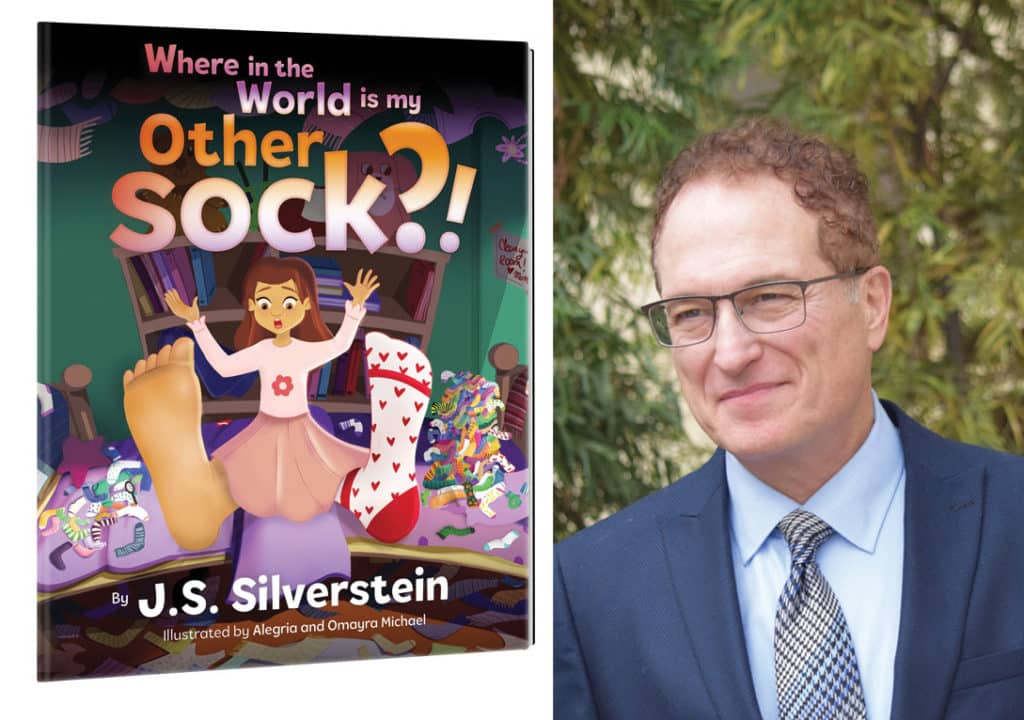
This everyday problem was the inspiration for J.S. Silverstein’s new children’s book, “Where in the World Is My Other Sock?!” The book follows Priscilla Poppins, a little girl who keeps losing her socks. 

“[I wasn’t] able to find the other matching sock nearly every day when I was dressing,” said Silverstein, who lives in Los Angeles with his family. “But even in my early morning blur, I realized it was a regular occurrence. When I spoke of this to friends and colleagues, I discovered it was nearly universal. So I decided to write a whimsical story, and chose a children’s book as the vehicle.”

“I decided to write a whimsical story, and chose a children’s book as the vehicle.”
– J.S. Silverstein

In the book, it turns out that little creatures called Sockheads are stealing Priscilla’s socks and wearing them on, well, their heads. The moral of the story – which is told in rhymes – is to always clean your room, or else the Sockheads will steal your socks. 

“So later that night, while lying in bed, the Sockheads appeared, and here’s what they said: ‘We go searching for messes, all over the place. From inside your house, to deep outer space!’” the book reads. 

In the end, Priscilla learns, “Now I know that those guys will come back here again. So I’ll clean up my mess, that’s where I’ll begin!” 

In real life, misplacing socks is not some great adventure for Silverstein. “I frequently lose my socks, but I am only apprised of a loss when just one is missing,” he said. “When both members of a pair are lost, I have no way of knowing. I once tried using only one-colored socks, but that was so boring.”

However, with his book, he’s elevating a mundane occurrence that happens to all of us.

“Children’s books allow for fantastical narratives,” he said. “I let my imagination run free, and this book came out.”

“Where in the World Is My Other Sock?!” is Silverstein’s second children’s book. His first was called “Sara n’ Dippity” and was about a little girl named Sara meets a hapless young duck named Dippity, and together, they fulfill a purpose greater than themselves.  

Silverstein worked with his two sons on his book for over two years. He was inspired by other popular children’s books when coming up with his own story.

“‘Mike Mulligan’s Steam Shovel,’” and ‘The Little Engine That Could’ are both early inspirations,” he said. “They offer insights into finding resolutions with a positive outlook.”

Interestingly, Silverstein is in fact related to another popular author named Silverstein. “But more significantly, I am a direct descendant of two Chassidic masters, both of whom were famous storytellers: the Baal Shem Tov, and Rabbi Levi from Berdichev,” he said. 

“Where in the World Is My Other Sock?!” is available in paperback and as an e-book. With his second book, Silverstein hopes that he will spark the imagination of his readers, both children and adults alike.  

“Children love to stretch their imaginations, even more than adults, the latter of whom have become accustomed to a more rigid reality,” he said. “Pushing the limits of reality into fantasy, with a few comedic sprinkles, serves to tickle the imagination and hopefully inspire the younger audience – along with their parents – to more frequently employ their own.” 

You can purchase “Where in the World Is My Other Sock?!” on Amazon.

Fantastical Children’s Book Explains Disappearing Socks Read More »

The Kosher Burger Joint: A Kosher In-N-Out Burger

Order at the kiosk, receive a text, grab your burger and dig in. That’s how simple The Kosher Burger Joint in Pico-Robertson is. At its grand opening on June 1, free burgers were given to the first 100 customers. 

Primarily targeting 18 to 20-year-olds, Israeli couple Uzi and Gal Waizman hope the restaurant becomes the hot spot for affordable yet high-quality kosher fast food. With high-tech self-order kiosks at the entrance, indoor and outdoor high-top table seating and Israeli and American music playing day in and day out, The Kosher Burger Joint welcomes all. 

“[We wanted] to bring something new to the community, something that’s more trendy, more fun, more poppin’” Gal said. “It’s something [you] can afford, but it’s also something [you] can enjoy.”

Like In-N-Out Burger, The Kosher Burger Joint values speed, quality and affordability. “In-N-Out is a huge trend in the non-kosher world, especially in LA,” Gal said. “It’s very convenient, it’s very cheap and it gives you that fast-food craving that you want [in the moment] … That’s kind of what we’re going for.”

Uzi added, “If the non-kosher food industry can do something very cheap and [succeed], maybe we can do it for the kosher community.”

“If the non-kosher food industry can do something very cheap and [succeed], maybe we can do it for the kosher community.” – Uzi Waizman

The menu is just as straightforward as the name of the restaurant and how it operates. Simplicity and ease are what the owners want to promote. From the smash and super smash burgers, made from 100% grass-fed beef, to the chicken sandwiches, sloppy joes and hand-cut fries, The Kosher Burger Joint satisfies every craving — but won’t put you over the edge. 

“The burgers are lighter,” Gal said. “The point is that you can come in between work, grab a burger and fries and you’re still good to go. You’re not exploding and wanting to go to sleep after.”

The smash burgers can be ordered with a single patty and slice of non-dairy cheese for $9, a double patty and two slices of non-dairy cheese for $11 or a triple patty and three slices of non-dairy cheese for $13. The house-made cheese ingredients include coconut milk, tapioca flour, a mix of vegetables and more. 

To take your burger to the next level, opt for a super smash burger, such as the Wild Wild West, Chicky Licky, Mamma’s Boy, Honey Bunny, Mr. President or Grilled Cheeze. The Wild Wild West, one of the most popular burgers, consists of a double smashed beef patty, Cajun onion rings, lettuce, tomato, grilled onions, pink sauce and ranch dressing. Or, you can get fried chicken with buffalo sauce, coleslaw and pickles, also known as the Chicky Licky. The Mamma’s Boy consists of a smashed beef patty topped with sloppy joe, fried egg, pink sauce, lettuce, tomato and grilled onions. 

“When you take a bite out of [the Mamma’s Boy], it reminds you of mom’s homemade cooking,” Gal said. “It’s very comforting and soft. We’ve already had [multiple] people take a bite and say, ‘OK, now I know why it’s called Mamma’s Boy.’” 

If you want to order the owner’s choice, get the Mr. President, which is just sloppy joe with BBQ sauce, mayonnaise and smoked onions. “It’s always very soft and juicy,” Uzi said. “You can never go wrong [with a sloppy joe].” 

And listen to Uzi when he said, “You don’t want to take the cheese off.” The owner knows best. 

“We [make the burgers] with the cheese because this is the whole idea of a smash burger,” he said. “[It’s] when you smash the meat [strongly] on a very, very hot flat top and then [add] the cheese. [This] melts all the fat in the patty and makes the beef crunchy.” 

Dine-in at The Kosher Burger Joint for an American Israeli fast-food experience, order at the kiosk to-go or head to the website for online ordering and delivery. 

“We’re trying to build our own ecosystem without Postmates, DoorDash, Grubhub,” Uzi said. “[We want] everything to be [managed] through our website. We want to do a lot of promotions … raffles, free burgers, [merchandise],” he added. 

*All of the meat served at The Kosher Burger Joint is Shechita Lubavitch and Beit Yosef.

The Kosher Burger Joint: A Kosher In-N-Out Burger Read More »

The Roklen Resilience Center Provides Therapy and Protection in Sderot

Sderot, a city in Israel with 30,000 residents and one of the 10 fastest growing areas in the country, is located only one mile from the Gaza border. When rockets are flying from Gaza into Israel, the people of Sderot are often targets. They have to think fast and find shelter within 15 seconds when the missile alert sirens sound.

Having to flee to a bomb shelter is both disruptive and traumatizing. Now, to address these difficulties of life in Sderot, Los Angeles based philanthropists and husband and wife Evan and Sandra Roklen have dedicated state-of-the-art therapeutic facilities to the town. 

Named the Roklen Resilience Center and built with the support of Jewish National Fund-USA, the two-story building, which also acts as a bomb shelter, offers therapeutic services for children in Sderot. This means that children from the town – 70% of whom experience symptoms of post-traumatic stress disorder (PTSD) – can continue to get the care they need even when the missile alarms are sounding.

“We hope it helps the children in this region deal with the realities of living [there],” said Sandra. “[And we hope] that it helps them cope with the ongoing possibility of having missiles and sirens coming at them at any moment.”

“We hope it helps the children in this region deal with the realities of living [there].”
– Sandra Roklen

The Israeli government and leading professionals created resilience centers so that communities could deal with ongoing trauma, according to Yoel Rosby, Jewish National Fund-USA’s project manager in Israel. 

“The Roklen Resilience Center in Sderot is operated by an incredible and selfless staff of true heroes who have shared their knowledge and experience with those working with Ukrainian refugees among others,” he said. “None of it would have been possible without the Roklens’ commitment and involvement.”

Before they decided to get involved in Sderot, Sandra and Evan toured around different communities in what’s called the Gaza Envelope, populated areas that are within 5 miles of the Gaza border and susceptible to attacks. The couple saw shrapnel from missiles in the fields and on the farms. 

“This is Israel’s frontier, and the people living in Sderot and the surrounding areas need and deserve support and care to help make their lives as normal as those who walk along the beaches in Tel Aviv,” said Evan. 

Sandra, who was born in Israel, said, “Being there and seeing with my own eyes Sderot’s proximity to the border was a turning point for me and deepened my understanding of their situation.”

The Roklens have been involved with JNF-USA for 10 years, and Evan, who lived on a kibbutz after college, is part of the Housing Development Fund Task Force, which helps families buy their first homes in Israel’s north and south. 

The couple learned about the Resilience Center when the Mayor of Sderot, Alon Davidi, visited LA. 

“When [he] met with us, and explained that they needed [a center] and why, it really spoke to us very deeply,” said Evan. “The children in this area suffer because of something beyond their or their parents’ control. We realized that these communities can’t thrive if we don’t provide a safe and nurturing environment.”

After visiting the new Resilience Center this past spring and participating in a ribbon cutting ceremony with Davidi, the Roklens were excited about the future of the center, as well as the impact it will have on the city of Sderot.

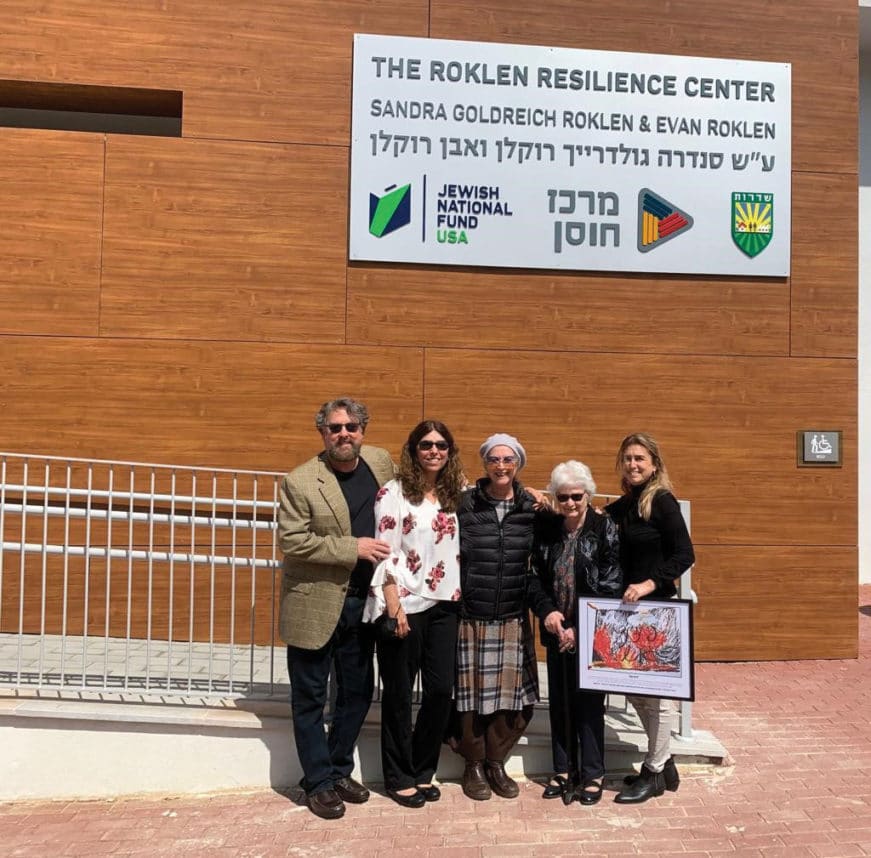
Evan and Sandra Roklen (left) in front of the Roklen Resilience Center Photo courtesy JNF-USA

“We were both shocked and amazed at how beautiful and spacious it is and how a two-story bomb shelter doesn’t have to look like a bomb shelter at all,” Sandra said. “We’ve never seen anything like it. It really looks like a beautiful building and not like a bomb shelter.”

The Roklen Resilience Center Provides Therapy and Protection in Sderot Read More »