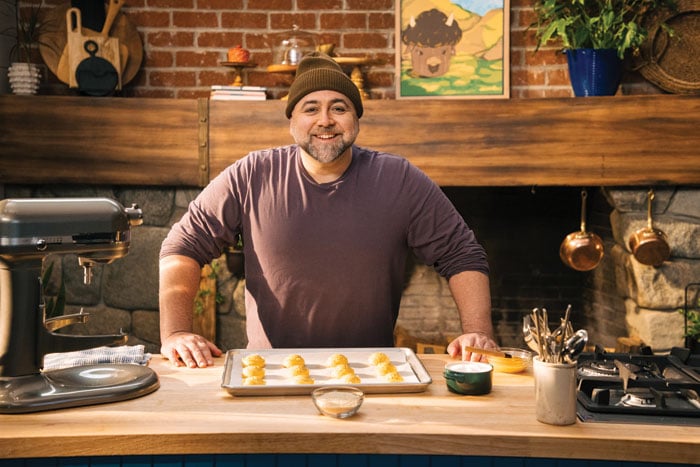
“I feel like everybody’s always really surprised when they learn I can cook,” chef, artist, entrepreneur and TV personality Duff Goldman said. “I’ve been working at restaurants since I was 14.”
Duff’s first major foray into television was on the hit Food Network show “Ace of Cakes,” which took place in his famous Baltimore bakery, Charm City Cakes. He now lives in Topanga, and has starred in other shows on Food Network including “Cake Masters,” the “Baking Championship” series and “Duff Takes The Cake.”
In his new Food Network show, “Ace of Taste,” he gets back to cooking basics, hosting a show like the ones he used to love watching as a kid. When Goldman was four, his mother caught him in the kitchen with a meat cleaver. He had been watching “Chef Tell.”
Like Goldman, the tone of “Ace of Taste” is homey and user-friendly. The chef’s love of cooking and baking shines through.
“I do lots of competition shows and travel shows, but I’ve never been able to do [one] in the kitchen, behind the counter, explaining the food that I cook,” he said.
Goldman said that with competition cooking shows, there’s not enough time to really delve into how to cook the dishes.
“What’s nice about the way that I cook and try to convey information is I try to do it in [simple] English,” he said. “Put some of this in there, put some of that in there, stir it around, let it cook for a while. You’re good.”
Goldman’s cooking style is hearty, and he makes family-friendly food.Plus, there’s plenty of Jewish influence.
Growing up, Goldman would spend plenty of time with his mother, grandmother and great-grandmother in the kitchen. His mom’s specialty is brisket — watch for a potential “brisket-off” between mother and son in season two. He gets his baking sense from his great-grandmother, who has apple strudel, babka and baklava recipes. Goldman’s version of the baklava is in the “Bake Sale” episode of “Ace of Taste.”
“A lot of [her recipes] are a little Sephardic, which is weird, ‘cause like she’s a hundred percent Eastern European,” he said. “Like the way that she makes strudel, for example, is not like they’re doing in Eastern Europe. She takes these apples and cooks them down to like a marmalade [that’s] really, really thick.”
Goldman caramelizes the apples a little bit, reduces the sauce and keeps stirring until it’s golden. “It’s delicious,” he said. “But that’s not how you’re supposed to make [an Austrian] strudel.”
As Jews, we do a lot of stews, Goldman added.
Our cooking comes from Warsaw, Vienna, Germany, Poland. It comes from regions where you cook for 12 people in a two-bedroom apartment.” – Duff Goldman
“We make it really good, but it’s [urban] peasant food,” he said. “Our cooking comes from Warsaw, Vienna, Germany, Poland. It comes from regions where you cook for 12 people in a two-bedroom apartment.”
Goldman’s Jewishness goes beyond food.
“The culture of tzedakah really stuck with me,” Goldman said. “And also the importance that [Jews] put on education.”
It’s not just about going to school and getting good grades; it’s about learning and really understanding things. Goldman tells people who are going to culinary school: Don’t try to get straight A’s. It doesn’t matter. If you understand what you’re doing, you’ll get straight A’s anyway. And, when you find something fascinating, learn everything you can.
“The nice thing about cooking is that there is always something to learn.” – Duff Goldman
“The nice thing about cooking is that there is always something to learn,” he said. “There’s so much to do and see and try and perfect. The other nice thing about it is that it’ll never get boring, because there’s always more to learn and you’re always getting better at it.”
Goldman said he’s still working on a cheesecake recipe and has “two cookies that are exactly the way I want them to be.”
Goldman, who describes his upbringing as “American Jew,” built an 8’ by 4’ wood table in his kitchen.
“Everything’s going to happen here,” he said. “Homework’s going to happen here, projects are going to happen here, cooking happens here, discussions happen here. It’s the center of [the] house, and that’s a very Jewish thing.” ■
Moments after his first victory on the UFC roster, Israeli fighter Natan Levy stood in the center of the octagon and spoke not only about his keys to victory, but also made a heartfelt announcement to the audience.
“I also want to say this week was remembrance day for the Holocaust, I would take a minute of silence for every victim we had, but it would take 11 ½ years. I think the broadcast would end before that,” Levy said while out of breath. “So I will sell my fight kit, the profits will go to Holocaust victims who made it and are still alive today.”
Levy’s fans will have the opportunity to bid on his fight gear — presumably his trunks and gloves — which typically would be sentimental mementos fighters would want to keep after their first UFC win.
But for Levy, bringing attention to the thousands of Holocaust survivors around the world who are living in poverty was first and foremost on his mind.
For Levy, bringing attention to the thousands of Holocaust survivors around the world who are living in poverty was first and foremost on his mind.
“You know what [Holocaust victims] went through was horrible, some of them have survived it and are still here today,” Levy said at the post-fight press conference. “And whatever we can do to support [Holocaust victims] and bring attention to [them], there are many causes that are worthwhile, for me this is the cause that I see right now … the Holocaust survivors are very old and they’re not gonna be here forever to tell their story and to remember those who are not here.”
Up to one-third of Israel’s 165,000 Holocaust survivors live in poverty according to a PBS report on The Center of Organizations of Holocaust Survivors in Israel, a survivors advocacy group.
This comes on the heels of reports of Holocaust survivors living in Ukraine who have once again been subjected to the horrors of war. The New York Times reported the experiences of some Holocaust survivors in Ukraine who are seeking refuge in Germany, over 70 years after being persecuted.
Amid all of the violence taking place in Ukraine, stories of Holocaust survivors can get lost in the media coverage, which is why prominent names such as Levy are taking their spotlight and shifting it to the cause.
And Levy’s spotlight seems to only be growing with his first win as a fighter on the UFC roster.
The April 30th fight took place at the UFC Apex just outside of Las Vegas in Henderson, Nevada. Levy’s matchup with Mike Breeden began just after 2:00 pm local time, which was just after midnight the next day in Israel. The late hour didn’t stop Levy’s fans and family back in Israel from watching the fight live, with many of them posting videos of enthusiastic watch parties on social media.
Though he now resides in Las Vegas, this week Levy and his wife traveled back to Israel to celebrate the victory.
Though he now resides in Las Vegas, this week Levy and his wife traveled back to Israel to celebrate the victory.
“It feels amazing to go back home with the biggest win of my career,” Levy told the Journal. “I’m really happy I get to celebrate and spend time with my family and close friends I haven’t seen in so long.”
It won’t all be celebrations, as Levy continues his daily training. His commitment and skill paid off as his victory over Mike Breeden didn’t come easy. The fight went the distance (three five-minute rounds), with Levy’s left-handed counter punches being his most valuable weapon of choice. The ESPN television commentators described the Levy-Breeden fight as tough but “absolutely sensational.”
The moment after the third and final round ended, Levy and Breeden embraced in an exhausted yet respectful hug. In a unanimous decision, Levy was declared the victor over Mike Breeden (29-28, 29-28, 30-27)
There’s no word yet on Levy’s next UFC fight. Details on how to bid on his fight kit to benefit Holocaust survivors will be announced on Levy’s social media accounts.
When comedian and Jewish Journal columnist Mark Schiff wanted to start his new podcast, he had one thing in mind: don’t make it contentious. Keep it funny, lighthearted and, at its core, full of great stories.
It’s a shift from much of the content we hear today, which includes lots of “gotcha” moments, arguing and anger. Schiff’s podcast, “You Don’t Know Schiff,” is different.
“No one is getting hurt,” said Schiff. “There is no badmouthing people, no in-your-face politics. We have a nice friendly chat about our guest’s life. It’s the opposite of everything out there now where they yell and scream. This really is a very warm place.”
Mark Schiff with George Wallace and Dave Chapelle
Co-hosted by fellow comedian Lowell Benjamin, “You Don’t Know Schiff” features Schiff and Benjamin speaking with comics, artists and other interesting personalities they’ve met over the years including Kevin Nealon from “Weeds” and “Saturday Night Live,” Paul Reiser, the star of “Mad About You” and standup comedians Wendy Liebman and George Wallace. Future episodes include Jerry Seinfeld – whom Schiff opens for on the road – Susie Essman from “Curb Your Enthusiasm” and “The 40-Year-Old Virgin” director Judd Apatow.
On the show, people get deep when talking about their life stories. One guest, voiceover actor extraordinaire Maurice LaMarche, discussed his father’s murder.
“Maurice met with the Dalai Lama about letting go of the anger and hate he had towards the guy who killed his father,” said Schiff. “It’s a very powerful story and Maurice tells it very well.”
Another guest, artist Joey Feldman, described what it was like living in a TV box on the street when he was homeless. “Now, he’s one of the most successful artists around,” said Schiff.
Another guest, artist Joey Feldman, described what it was like living in a TV box on the street when he was homeless.
“Now, he’s one of the most successful artists around,” said Schiff.
Schiff and Benjamin don’t refrain from talking about comedians’ number one concern these days: getting canceled. Or, in recent days, getting physically attacked as well.
“We just did an episode with George Wallace about Will Smith smacking Chris Rock and Dave Chappelle being attacked on stage,” said Schiff. “There is some talk about cancel culture. We don’t shy away from it.”
While it may appear, on the outside, that the successful guests on the podcast haven’t faced many challenges, listeners get to know the truth behind what they see on TV or the stage.
“When you see Paul Reiser starring in his own show you think he’s had all these breaks,” said Benjamin. “Then, you hear his story and it’s like he’s this normal guy. We also try to get some advice to give our listeners. We want people to learn that they can do anything they want.”
Schiff, a veteran comedian who had many appearances on “The Tonight Show with Jay Leno” and “Late Night with David Letterman,” resisted starting a podcast for a long time. But when he met Benjamin’s wife, Cathy Heller of the popular “Don’t Keep Your Day Job” podcast, she convinced him to do it.
“People told me that I’m pretty good at interviewing people, but I never really had much interest in doing it until I met Cathy and Lowell,” Schiff said. “Lowell and I started talking and he’s an incredibly funny guy. I said, ‘Why don’t we do one together?’”
Lowell said he jokes that “I have the second most successful podcast in my house.”
When people listen to “You Don’t Know Schiff” – which is free on Apple Podcasts or wherever podcasts are available – Schiff and Benjamin hope that they walk away with a good feeling.
“We have lighthearted but substantive discussions,” said Benjamin. “We want it to be a real conversation where you get to know about someone as a person. And, we want to share positive and inspirational stories.”
Many of us have a disconnect in our lives: we claim to seek happiness, but we can’t stop looking at the last thing that will make us happy — the news, especially the bad news.
One argument for watching negative news is that if we see bad things happen to other people, it’ll make us feel better about our own lives. Another argument is that we want to feel important and connected, and being engaged with current events helps reduce our sense of isolation.
Also, if you believe passionately in a cause, such as abortion rights, climate change or the wellbeing of Israel, watching the news keeps you involved with the things you care most about.
If you’re a right-winger who watches Fox News or a left-winger who watches MSNBC, the news will give you temporary satisfaction, like a favorite flavor of ice cream. But that’s a sugar high, not happiness.
But regardless of why we watch the news, the conclusion is the same — it doesn’t do much for our happiness. If you’re a right-winger who watches Fox News or a left-winger who watches MSNBC, the news will give you temporary satisfaction, like a favorite flavor of ice cream. But that’s a sugar high, not happiness.
More often than not, instead of making us happy the news riles us up. Big tech giants like Facebook and Google have figured out that the more outrage they feed us, the longer we’ll be engaged, and the more advertising they’ll sell.
Watching the news also feeds our need for belonging. In the same way that I’m a diehard Lakers fan, loyal Democrats or Republicans enjoy belonging to their respective teams, especially if they support their values. The snarky sword fights between the two camps on social media only add drama and excitement to this tribal impulse.
But they don’t add happiness.
For that, we have to borrow from a whole other tribe — the artist tribe.
Have you noticed how artists are rarely obsessed with the news? Most artists share this one empowering trait: they seek their happiness not from exterior events but from their own actions. We can all become artists of our lives.
Have you noticed how artists are rarely obsessed with the news? Whether they’re musicians, filmmakers, painters, comedians, writers, etc., artists are generally obsessed with their art. Most artists share this one empowering trait: they seek their happiness not from exterior events but from their own actions. For an artist who can create a great painting in a few hours, an activity like watching the news feels like a waste of time. They know how much more joy and fulfillment they’ll get from working on their art.
I felt that vibe the other night at the Israel Film Festival. The writers, producers and actors whom I met were all swimming in the same bubble — their art. That’s what turned them on. What’s going on in the outside world matters less than what’s going on in their world. They’d rather make news than watch it.
I say this ironically as someone whose life revolves around the news. Because of my profession, I don’t just follow the news — I live in it. It’s my obligation to deliver it fairly and accurately, and publish thoughtful commentary and analyses. The part of the business that does bring me happiness is when I feel I’ve written something that readers enjoy — again, because it comes from a personal action.
We all have access to that happiness.
In the same way that artists focus on their own actions for fulfilment, we can become artists of our own lives. What actions bring you joy? Is it a simple coffee with a friend, something you create in a studio or a kitchen, smelling the fresh dew on a morning hike, visiting a grandparent, planting a garden, assisting the needy, writing a poem, attending or teaching a class, discovering a new book or film, reading with your kid, singing at a Shabbat table?
None of those things have anything to do with the news. They have nothing to do with who you’ll vote for in November or what the Supreme Court will decide or who will win the war in Ukraine or whether the Iran deal will go through. As crucial as all those issues are, it is what’s going on in our own little worlds that has the most impact on our happiness. Politicians know that, which may be why they keep promising the moon, even if they can’t deliver.
We all have our reasons to watch the news and stay engaged with the big issues of our time. But as we continue to do that, let’s remember that is not where we will find our true happiness.
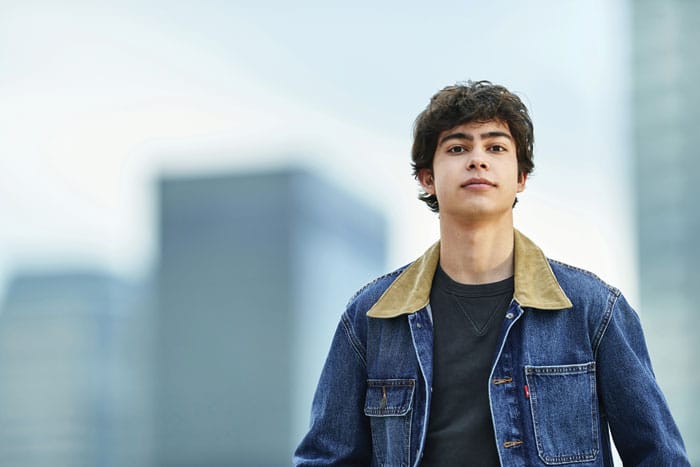
Zach Gottlieb, a local teenager, loved spending time with his grandfather, Selvyn. They played basketball and attended Lakers games together, and relished the sun-kissed playfulness of Southern California during many trips along the coast, enjoying everything the beach had to offer. For Zach, who was raised by a single mother, Selvyn was the closest he’d ever known to a father.
In March 2020, on the first day of remote learning forced by the COVID-19 pandemic, Zach’s mother interrupted his virtual history class to tell him that his beloved grandfather, who had been sick, was deteriorating. Zach immediately logged off Zoom to be by Selvyn’s side, where he held his hand and talked to him. That evening, Zach lost his grandfather to heart failure.
For the then-fourteen-year-old, the sadness was overwhelming. But there was something else. Concerned whether COVID-19 would wreak havoc on children’s mental health, adults around the world were asking teens to open up about their emotions, sadness and anxiety. Parents were advised to speak with their teens; teens were told to open up to their parents.But for Zach, in the wake of his grandather’s death, there seemed to be little room for emotional openness.
In truth, Zach wasn’t okay. The pain of losing his grandfather was as ubiquitous as it was palpable. To make matters worse, Zach, a sociable teen, couldn’t see any of his friends due to the pandemic. When he would tell adults that he missed his grandfather, the response was almost always the same: We know, but you have to be strong.
Instead of being a comfort, the call to strength only made Zach feel like a failure, leaving him to ask if something was wrong with him if he was struggling to be strong.
It seemed that in response to every challenge he faced that year, whether beginning high school on Zoom, being isolated from friends, or losing his grandfather, Zach was urged to be strong. But instead of being a comfort, the call to strength only made Zach feel like a failure, leaving him to ask if something was wrong with him if he was struggling to be strong.
“I’ve been getting those messages to be strong and to just get through it my whole life,” Zach, who now is 16 and a high school sophomore, told the Journal. “And those messages proved the point that mental health is a thing that men in our culture shouldn’t really talk about. It was a big wake-up call.” Zach knew he wanted to talk about a lot of issues, but he felt “a little ashamed.” Still, he said, “I knew that not doing it would be worse for me. I have the right to feel what I feel, and I was able to work past it.”
Zach took a closer look at the environments he knew best, including the basketball court (he’s an avid player), and realized that boys were not only expected, but also told blatantly to “brush off” everything from injuries to fear and sadness. He began to wonder if boys (and teens in general) could be seen as brave, rather than weak, for talking about their struggles. “As interest in mental health grew during the pandemic,” he said, “the media encouraged teens to talk about it, but I didn’t feel we had that space. I want our generation to be emotionally literate.”
A year later, in summer 2021, he took out his phone, logged onto Instagram, and created an account called “Talk with Zach.” With that account, Zach hoped he could reach out to fellow teens and let them know it was okay to talk about their pains and to ask questions. He wasn’t sure how Talk with Zach would be received. And then, the feedback poured in.
Talk with Zach (TWZ) became more than a Gen-Z community; it became a movement, as teens from around the world began sending Zach anonymous questions (via Google forms) and posts. Less than a year after it was created, TWZ has engaged over 100,000 teens in 12 countries and 41 cities.
Talk with Zach (TWZ) became more than a Gen-Z community; it became a movement, as teens from around the world began sending Zach anonymous questions (via Google forms) and posts. Less than a year after it was created, TWZ has engaged over 100,000 teens in 12 countries and 41 cities. TWZ has received questions and posts from five continents (with the exception of Africa and Antarctica), and from countries including China, France, India, Argentina, Spain, the United Kingdom and Canada, as well as countries in the Middle East. In many cases, Zach and his team have had to use Google Translate to understand and respond to teens’ questions. And teen engagement, according to Zach, has been split relatively evenly between males and females.
TWZ’s motto is simple, but sage: “We can’t change what we don’t talk about.”
The TWZ approach is simple: Zach takes to Instagram (and TikTok) and creates videos in which he responds to teen questions or engages in conversation with an expert. In one video, Zach spoke with Jonathan B. Singer, Associate Professor of social work at Loyola University in Chicago, about suicide. Teens join TWZ Instagram live videos (some share experiences while others ask for advice). The topics are vital for most teens and include addiction, anxiety, the impact of COVID-19 and academic stress. Zach has posted videos on how to help a friend who is depressed and how to prevent overthinking. On the TWZ website, he explicitly states, “Ask me anything … really.” TWZ’s motto is simple, but sage: “We can’t change what we don’t talk about.”
On Instagram, Zach responds with a combination of carefully-researched information as well as his own thoughts. The website also features blogs by fellow teens, with topics such as “Are Grades for Me or My Dad?” written by a ninth-grader in Dallas and “Instagram vs. My Body,” by an eleventh- grader in Portland. On the website, Zach is clear about his own limitations: “Remember that I’m just a teen who thinks we should talk more, not an expert, and you should always go to a qualified adult if you have concerns about something in your life,” he writes.
Some of the topics that teens have pitched to Zach, also known as “Things you asked to deal with,” inspired videos titled “How to Deal with Rejection” and “Mental Health and Instagram.” One of the most meaningful videos for Zach was devoted to talking about toxic masculinity, which he attributed to pushing him to “be strong” after his grandfather’s death.
“What if there was strength in vulnerability? What if there was bravery in the kind of honesty we don’t really post on social media?”
On the TWZ website, Zach admits that after losing Selvyn, he “began to wonder if we needed to examine our definition of ‘strong.’ Not just for boys, but for all of us. What if there was strength in vulnerability? What if there was bravery in the kind of honesty we don’t really post on social media?”
In September 2021, he penned an online essay for Time Magazine titled “It’s Time for Boys to Talk about Emotional Health.” In it, he asked, “What if our generation took the lead in expanding our understanding of emotional health as something not reserved for some genders, but as something essential for every single one of us?”
Once, another teen asked Zach about the length of grief. He took to his phone to respond that grief doesn’t always end and that a person can grieve but still move forward. “I have no idea if my post helped that person,” he wrote in Time, “but I know this: Just saying it out loud helped me. And that’s the whole point. I definitely don’t have all the answers, but at least I’m comfortable talking about it.”
Ambassadors for Change
“TWZ is more influential than a big corporation because it’s teens talking to other teens,” said Natalia Fishkin, 16. “If they see someone they can relate to, it’s easier to listen to what they have to say.” Fishkin, a sophomore in Los Angeles, is one of over 25 teen “ambassadors” volunteering with TWZ. As part of her duties, Fishkin often makes videos for TWZ on Instagram. “I have loved sharing ways to improve your mental well-being,” she said. “Through comments on posts or by coming up to me in person, teens have said they’ve benefited from TWZ by getting helpful coping mechanisms and starting the conversation of the importance of balanced mental health.”
The greatest value of TWZ is in its teen-to-teen model. “For many teens, hearing from other people like them can be one of the most powerful ways to learn how to deal with different issues,” said Owen Grossman, an LA-based teen ambassador on the TWZ editorial team, which pitches and researches content, writes and edits blogs posts and conducts interviews. For Grossman, helping teens talk about mental health is deeply personal. “Working with TWZ gives me the platform to advocate for issues that I really care about (specifically LGBTQ+ rights and its intersection with mental health),” he said. “I wanted the real-world experience and opportunity to make real change. Zach is really on top of everything and I admire how he created and grew TWZ — I wanted to work with him.”
TWZ teen ambassadors conduct weekly meetings on Zoom (topics include planning, adding new content and research). Along with other team members, Zach checks emails from teens worldwide who ask questions and seek advice. The TWZ website includes a large button that actively encourages teens to “Become an Ambassador.”
Talk with Zach is one of several viral platforms that offers crucial peer-to-peer conversations (as opposed to teens speaking with adults). Another is the vital Teen Talk App, launched by Jewish Big Brothers Big Sisters of Los Angeles. In partnership with the Los Angeles Jewish Teen Initiative, also known as LAJTI (a project of The Jewish Federation of Greater Los Angeles), Jewish Big Brothers Big Sisters trains volunteer Teen Advisors how to respond to mental health-related posts from teens ages 13-19. It’s a free, safe and anonymous way for teens to request support from their own peers (and users can post 24 hours a day, seven days a week). Licensed mental health professionals supervise the trained Teen Advisors during app hours, from 5-10 p.m. PT nightly. Topics range from a first panic attack to painful breakups and suicidal ideation.
At UCLA, the Semel Institute for Neuroscience and Human Behavior launched the UCLA Peers Clinic that allows adolescents to connect on many topics ranging from dating to careers. There are telehealth options that connect peers to young adults, adolescents and even preschoolers. The program even offers Bullyproofing Boot Camps. The Peers program offers social skills intervention while also teaching youth how to respond to conflict and rejection. Parental participation is required, as parents must attend separate sessions simultaneously. The program is dedicated to helping adolescents make and keep friends.
And then, there’s Sources of Strength, which is dedicated to preventing only one thing: suicide. It is one of the first suicide prevention programs that uses Peer Leaders to create what it calls “protective factors” to reduce and prevent youth suicide. Like Talk With Zach, Sources of Strengths uses the power of peer social networks. According to its website, Sources of Strength “moves beyond a singular focus on risk factors by utilizing an upstream approach for youth suicide prevention. This upstream model strengthens multiple sources of support (protective factors) around young individuals so that when times get hard they have strengths to rely on.”
The peer-to-peer model is especially important. By modeling vulnerability and openness himself, Zach has given thousands of teens permission to talk, question and respond. And TWZ meets teens where they are already: on social media.
According to The American Academy of Child and Adolescent Psychiatry, a whopping 90 percent of teens ages 13-17 have used social media. A 2018 Pew survey found that 95 percent of teens had access to a smartphone; 45 percent said they were online “almost constantly.” While benefits of social media use include staying connected with peers as well as having a platform on which to express themselves, there are also dangerous risks to youth activity on social media, including cyberbullying, interference with daily functions and exposure to harmful content (and harmful people).
And in a social media world that explicitly leaves teens feeling inadequate (think models posting fabulous photos or even a group of teens posting photos of themselves at parties, to the exclusion of others), social media is generally not a space for teens to feel good about themselves.
On social media, teens are reminded that if they do not overachieve in every area, whether academic pursuits, physical appearance or social skills, they’re failures.
On social media, teens are reminded that if they do not overachieve in every area, whether academic pursuits, physical appearance or social skills, they’re failures. To make matters worse, teens are expressing unprecedented levels of loneliness and disconnection, due to a combination of lack of time, COVID hibernation and the fact that texting and social media have replaced in-person social interactions that are crucial for development.
That’s where TWZ offers an antidote to the damage of isolation, shaming and other risks of social media: by offering teens a space to feel less alone and stigmatized, and part of a caring community. As more and more adults have taken notice of teens’ mental health, various organizations and corporations have invited Zach to speak at conferences and as part of panels to offer a window into the important world of Gen-Z.
The Teen and the Survivor
In 2020, during the height of the pandemic, Los Angeles-based Henry Slucki, a then-85-year-old Holocaust survivor who was born in France, received a call from a teenager, asking him if he wanted to talk. The call came from Zach, who is a volunteer for The Righteous Conversations Project, a collaboration between Holocaust survivors and teens that was launched in 2011 by Remember Us (the Holocaust Bnai Mitzvah Project). “Henry told me that he was an optimist, not in a naive way, but in the sense that he believed we are more resilient than we often know,” said Zach. It was Slucki who introduced him to Viktor Frankl’s groundbreaking book, “Man’s Search for Meaning,” and to the idea that we have ultimate control over our thoughts and attitudes.
“Before my conversations with Henry, I had seen the atrocities of the Holocaust as a tragic historical event, but now I saw how relevant Henry’s experience was to the world my generation was living in too,” said Zach.
Zach and Henry have spoken on a digital panel together about antisemitism, and Zach previously moderated a Holocaust-related event for The Righteous Conversations Project. He also became president of the teen board for Remember Us, which invites children preparing for their bar/bat mitzvah to connect, whether through a mitzvah b’shem (mitzvah in the name of someone) or a speech at the bimah, with the memory of a child lost during the Holocaust. As teen board president, Zach helps plan events to raise awareness about the Holocaust and to combat hate and prejudice.
“He [Zach] wanted to know my story and had a lot of questions,” said Slucki, who holds a Ph.D. in experimental psychology and who, for 56 years, taught at the USC School of Medicine, teaching behavioral science to medical students and health professionals. “For 56 years at USC, I considered myself an educator,” he said. “There’s something in it for me when I explain things to people who don’t know or understand.”
Zach’s questions, according to Slucki, directed most of their conversations. “It’s important when people hear biographical things and ask, ‘How did you feel about that? What happened next?’ From the experience of a Holocaust survivor, we might have a different answer than others,” said Slucki. A year into their weekly conversations, Zach learned that Slucki’s wife was ill. “It was during these conversations that I felt I could be helpful to Henry, not because there was anything I could do to change his situation, but because I could just be there for him, consistently, each week,” said Zach. “From my experience with Henry, I learned about the importance of being present and how healing human connection can be — even between people who started out as strangers, seven decades apart in age.”
The two have talked about hope and grief, family, friends and politics. They have shared opinions on books, movies and hobbies, and even discussed career paths. “In many ways, I was reminded of the conversations I used to have with my grandfather,” said Zach, “and while my job was to comfort Henry, often it felt like he was the one comforting me.”
Slucki has also delighted in the opportunity. “We talk about Zach’s life,” he said. “The most bizarre thing about this whole situation is that we’ve been talking for two years, we live about a mile-and-a-half from each other, and we’ve never met in person [due to COVID-19 precautions].”
Zach believes that Slucki has modeled for him how to be an “optimist-activist.” For his part, Slucki is confident that he will continue to serve as a speaker and participate in The Righteous Conversations Project for years. “My parents, Rachel and Saul, were always upbeat and optimistic, even under the most stressful situations,” he said. “My mother lived to 100; my dad to 97; I’m not going anywhere soon.”
“In 2017, Eva Suissa (daughter of Journal editor-in-chief), a Shalhevet senior and Remember Us Teen Board President, envisioned an initiative she named Holding Hands, which had an extraordinary ripple until now and to Zach even though they never crossed paths,” said Samara Hutman, Director of Remember Us. Holding Hands paired teens and survivors in monthly gatherings to build “joyful and generative relationships,” according to Hutman. In 20I9, Suissa passed the torch to another teen, Tess Levy, and the following year, to Charlie Nevins. Even during the height of the pandemic, teens helped enrich the lives of local survivors by sending a loud message: You are not forgotten. Nevins created a film festival that featured over 30 Righteous Conversation Project films for the community.
Zach and Slucki’s connection has been a source of nachat (pride) for Remember Us leaders.
“When we put out the call for teen volunteer to be paired with an elder for a weekly check in, the very first email I got was from Zach,” said Hutman. “Every week, like clockwork, I got a call from Zach. He said ‘just checking in,’ but I heard one of the most poignant and powerful Jewish proclamations; I heard Hineni [‘Here I Am’].”
“And now just look at where this inspiration has taken him. Hineni. He is here.”– Samara Hutman
Hutman knew to pair Zach with Henry, who has participated in the Righteous Conversations Project for nearly 13 years. “I knew they would find a deep connection because of how they both walked through the world,” she said. “And the rest is history. Zach showed up. Virtually, safely, with care and with heart. And he connected with Henry and opened himself up to being inspired, taught and moved by Henry’s wisdom and life experience. And now just look at where this inspiration has taken him. Hineni. He is here.”
Creating a New Culture for Teens
“What Zach is doing is helping children heal, and to realize that what they’re experiencing is normal and nothing to be ashamed about,” said Dr. Adam Dorsay, a San Jose-based psychologist who was recently featured in a TWZ Instagram video. “Zach has recognized at a very young age that a precursor for courage is actually vulnerability — with others, but also with ourselves. And he’s providing early intervention so someone doesn’t come into my office in three decades and has been holding everything in.”
Dorsay previously worked with teenagers and observed that in the adults he treats today, “the inner teen is still alive and hurting; certain parts have calcified.” When he speaks with parents of teens, the concerns often point to one area: technology.
“I can only attribute greater anxiety and depression than before in teens to technology — cyberbullying and a 24-hour news cycle that only says ‘things are bad.’ That’s the soundtrack of these children’s lives. It’s like constantly having to ask flight attendants, ‘Are we safe?’” said Dorsay.
Some “misled” adults, according to Dorsay, complain that children are exhibiting more weakness today than in the past. “Actually, it’s not that,” he said, “but all children are hearing is that the world is being turned upside down. How much time are they spending in nature and doing other normal, natural things? Instead, they’re glued to their devices, hearing about other kids presenting the best parts of their world.” The results of this shift, said Dorsay, are rising to the surface in the form of drug abuse, eating disorders and mutilation and self-harm.
“Our brains haven’t changed in 35,000 years or more, but our surroundings have changed dramatically in the last 20 years,” observed Dorsay. “In the last 15 years, there have been over a dozen upgrades to an iPhone; in the last 35,000 years, our brains have been unchanged.”
The Social Entrepreneur
“I’ve been working with some nonprofits and realized that certain kinds of companies have a lot of influence on teens and help shape what they value,” said Zach. He discovered MadHappy, an online clothing retailer that launched in 2017 and has mental health embedded in its brand. In 2022, the company launched The Madhappy Foundation, a non-profit organization devoted to moving mental health forward. The brand is popular with teens, prompting Zach to collaborate with them on promotions at their former pop-up store on Melrose Boulevard in L.A. and to appear in some of their social media promotions. Zach will participate in a Question-and-Answer session this upcoming fall with MadHappy founders at the opening party of the permanent L.A. store. The event will be for teens only. “We’ll talk about our mutual goal of opening up conversations around mental health for Gen Z,” said Zach, anticipating a sold-out event.
Zach is undaunted about reaching out to some of the biggest and well-known corporations in the world in order to magnify TWZ and teen mental health as a truly global movement. Recently, he reached out to an executive at Nike. After speaking together on Zoom, she invited Zach to Nike’s L.A. headquarters this June to speak with a marketing team about how to reach Gen Z in a way that de-stigmatizes mental health awareness.
TWZ is helping to open an entirely new conversation about teens’ own agency and choices when it comes to mental health, and American leaders have taken notice. Zach has been invited to the U.S. Surgeon General’s Youth Mental Health Summit, which will be held in person this fall. “One thing the Surgeon General’s team and I believe is important is connection,” he said. “Many teens feel disconnected in the ways that matter, and I know that connection will be a big theme in our work together.”
Last December, in a rare move, U.S. Surgeon General Vivek H. Murthy declared a “youth mental health crisis” in America. “Recent national surveys of young people have shown alarming increases in the prevalence of certain mental health challenges — in 2019, one in three high school students and half of female students reported persistent feelings of sadness or hopelessness, an overall increase of 40% from 2009,” Murthy wrote in the advisory. Among ages 10 to 24 years old, suicide rates have increased by 57% between 2007 and 2018. In 2020, it was estimated there were more than 6,600 suicides in the same age group.
Clearly, more teens need to be included in adult conversations about youth mental health. Next month, Zach will speak in person at the Aspen Ideas Festival, hosted by the Aspen Institute. He will discuss the potential of technology to help teens connect (using the TWZ teen community on Instagram as a powerful example).
The media has taken notice as well. TWZ has been featured in TODAY, Katie Couric Media, The Huffington Post and Challenge Success. TWZ now boasts a merchandising (“merch”) line on its website, and a portion of earnings will go to mental health charities that help under-resourced communities access better mental health practices. “I have my own merch so that teens can feel proud and spread the message, which I think also reduces stigma when other teens are wearing it,” said Zach. The apparel includes the TWZ motto: “We can’t change what we don’t talk about.”
The Imperative of Creating Healthy Habits
Zach credits Judaism as a major influence on his activism and compassionate leadership. He serves as co-president of a BBYO (a Jewish teen movement) chapter for the Pacific West region for IKAR, a Jewish congregation and spiritual community founded by Rabbi Sharon Brous. He helps plan bi-weekly meetings, brainstorms event ideas that connect other BBYO chapters in the region, and also handles organizations responsibilities for the chapter.
“The idea of tikkun olam (repairing the world) has really influenced my work because I’m attempting to change the culture and make the world a better place in which we can talk about these issues,” said Zach. “Also, the aspect of community in Judaism is central and has taught me a lot.”
“Being Jewish is an important part of my identity, because it dictates my life in terms of community and who I am.”
His favorite Jewish holidays are Rosh Hashanah and Hanukkah. “That’s when I reflect,” he said. Each Shabbat, Zach and his mother say prayers over wine and bread, and Zach receives a blessing for children. “Being Jewish is an important part of my identity, because it dictates my life in terms of community and who I am,” he said.
Courtesy talkwithzachofficial.com
Between the demands of school (he just concluded AP exams), TWZ and extracurricular commitments, Zach, like any other teen, admits to sometimes feeling overloaded. “I used to play basketball, work out, do photography, filmmaking and hang out with my friends more,” he admitted. “Now, the main thing is just planning up my time. It’s difficult, I’m up really late at night, but it’s important to have a schedule, and to try not to procrastinate.” His favorite school subjects include Science, History, Math, English and Humanities. When asked about future plans for TWZ, his namesake, once he ceases to be a teenager, Zach was optimistic and, as always, action-oriented. “I’m going to pass it on to another teen, and it’ll keep getting passed down,” he said. “We can keep the name and I’ll oversee it from afar.”
Ultimately, Zach and teens like him around the world are a testament to Aristotle’s ancient observation that “Good habits formed at youth make all the difference.”
In contemplating how he applies his own mental health advice to himself, Zach understands the value of moderation. “I’m a regular teen,” he said, “and there needs to be a balance between talking about emotions and finding other outlets, like hanging out with friends, listening to music and working out. But some things are a short-term approach, because you definitely need to address your feelings. When I’m having a bad day, I’ll cool off a little, then reflect when I’m in a better headspace.”
In October 2000, the musical “Les Dix Commandements” opened in Paris and became an instant hit. Within five years, more than three million Europeans saw the spectacular production, created by French filmmaker Élie Chouraqui, known for the film “O Jerusalem,” with music by famed French composer Pascal Obispo and costumes designed by Sonia Rykiel.
One can’t help but wonder how the story of a rescued Hebrew baby who grew up to free his people from 400 years of slavery in Egypt would go over so well in Europe. I was pondering this question as the American adaptation — “The Ten Commandments: The Musical” — was about to premiere in New York City. David Serero, acclaimed opera singer, actor, and director, had fallen in love with the musical when it opened in France. Born in Paris to a Moroccan-Jewish family, Serero decided — why not? — to bring it to the United States, where he would play the lead role.
“Imagine playing a Prophet!” Serero told the Journal. “That doesn’t happen every day.” No it doesn’t, especially one as legendary and complex as Moses. “I’m grateful to Daniel Lévi, the original French Moses, who taught me so much when I went to study the part with him.”
But Serero had a journey of his own ahead of him. It wasn’t just a matter of translation and adaptation to English. “There were no dialogues at all in the original production. I asked Élie Chouraqui to create dialogue to Americanize the show, and I added my own dialogue as well,” says Serero. “It was also essential to make the show work without all the vast sets and decors, as they played the original show in stadiums the equivalent of Madison Square Garden, not in off-Broadway theaters.”
“The Ten Commandments: The Musical” premiered on May 8 at the Center for Jewish History, a little-known jewel that houses the YIVO Institute for Jewish Research and the Yeshiva University Museum, among others. Part of the answer to my question came in the first scene, when Jochebed (Melissa Lubars) gently places her newborn son in a papyrus basket along the Nile River in an attempt to save him, singing “I Choose to Abandon” with Bithia (Lisa Monde).
“Only singing can fully express the emotions of a mother who is forced to abandon her child to the Nile River in order to save him,” says Serero. “We sing what we can’t act and act what we can’t sing.”
And then there was the entrance of the Hebrew slaves. Joshua (Cale Rausch) beautifully sings “The Maximum Pain (La Peine Maximum)”:
But why should we all kneel down?
I want to live standing with pride, with pride.
Since our love is unreachable today,
And our new dream, too high.
To be freed, someday.
But may God forgive,
If just to be only a man —
Well this is, my maximum pain.
What better way to capture the intensity of raw emotion than through music and song? It’s the power of art, especially music, to touch the soul, transcend differences, and inspire the best—empathy, kindness, decency—in each of us.
What better way to capture the intensity of raw emotion than through music and song? It’s the power of art, especially music, to touch the soul, transcend differences, and inspire the best — empathy, kindness, decency —in each of us.
“That was the whole concept of this musical — to ‘humanize’ these biblical characters,” says Serero, a baritone who captured Moses’s complexity brilliantly. The epic 1956 film, “The Ten Commandments,” remains a masterpiece. But I watched the animated musical “The Prince of Egypt” endlessly with my son, and one verse would always stick in my head: “There can be miracles when you believe.” Music resonates.
As the play unfolded, a fuller answer to my question emerged. The story of Exodus presents universal truths: freedom vs. bondage, good vs. evil, dignity vs. subordination. Even though the term “universal truth” is not trendy right now (everything is considered relative or subjective), that doesn’t lessen its own eternal truth.
For Judeans, the story also offers some untrendy truths about idol worship and false gods. Sometimes just one person, inspired by faith, can make others understand the danger of conformity. But we first need to find the strength within. “The Exodus from Egypt occurs in every human being, in every era, in every day,” said Rebbe Nachman of Breslov.
Each of us has a role as well in writing the next chapter of Judean history. For Serero, who recently directed the documentary “The United States of Elie Tahari,” it is taking the musical to theaters across the United States, Israel, Australia, London —and Dubai.
“Chouraqui wanted to illustrate the love of two brothers who are separated only because of differences based on ethnicity and religion.”– David Serero
Indeed, the production has somewhat of a surprise ending. Rather than despise each other, Moses and Ramses focus on their brotherhood. “Chouraqui wanted to illustrate the love of two brothers who are separated only because of differences based on ethnicity and religion,” says Serero.
Perhaps it was Laurie Cumbo, NYC’s new commissioner of the Department of Cultural Affairs, who summed it up best. “I would love for every child in the city of New York to see this,” she told the audience after a performance. “We have to continue to tell stories from history of inspiration, courage, and overcoming adversity. The power each of us has to overcome challenges — to believe in ourselves. To believe in a higher power.”
I have no doubt that everyone who heard her now has a little more faith that the city of New York will overcome its current challenges. The power of art, the power of faith, the power of each of us to believe in ourselves enough to make a positive impact: “One person can alter the universe,” Rebbe Nachman also said.
“This story is 5,000 years old, and yet it’s the most modern one as well,” says Serero. “It promotes a universal message, and anyone in the world can identify with it.”
Karen Lehrman Bloch is editor in chief of White Rose Magazine.
“What’s the matter?” my mother asked one morning during my sophomore year of high school.
“Nothing,” I responded. “My chest hurts a little, but I’ll go to school.”
“It must be your heart again!” she cried.
“Maybe. I’ll just run some laps in P.E. Maybe that will help.”
“No laps! No school!” she said.
Bingo.
For years, I had watched my mother, a lovable hypochondriac, convince herself that she had heart problems. When it came time for me, like some teens, to find a way to skip school, I went right to the heart of the matter. Since I shared half of my mother’s genes, I figured she would believe I had cardiac problems as well. After all, we were cut from the same mold. But I was moldier.
Not surprisingly, my mother believed me. My pathetic performance, complete with holding my chest and squinting my eyes, were on par with Marlon Brando’s last scene in “The Godfather.” In hindsight, I believe I spent more time in the cardiologist’s office than in the classroom during sophomore year.
And no matter how many times the doctor assured my mother I was fine, she never believed him. I knew I could count on her combination of anxiety and hypochondria.
Here’s the strange part: I was mostly a straight ‘A’ student (more on that later) and even enrolled in AP (Advanced Placement) classes. I had good friends and fulfilling extracurriculars, especially my beloved journalism class. I didn’t mean to miss school so often, and I certainly never meant to mimic teens who had actual heart problems. But when I was a sixteen-year-old at Beverly Hills High School, I was suffering from acute depression. I just didn’t know it. And neither did anyone else.
In America, mental health wasn’t even on the list of survival necessities for my refugee parents. Was I basically safe? Yes — Middle Eastern dictators were 7,000 miles away.
In America, mental health wasn’t even on the list of survival necessities for my refugee parents. Was I basically safe? Yes — Middle Eastern dictators were 7,000 miles away. Did I have enough clothes? Yes, depending on how often we visited Ross Dress for Less. Was I well-fed? Moderately, once I discovered I could eat right out of half-opened cans of Chef Boyardee ravioli.
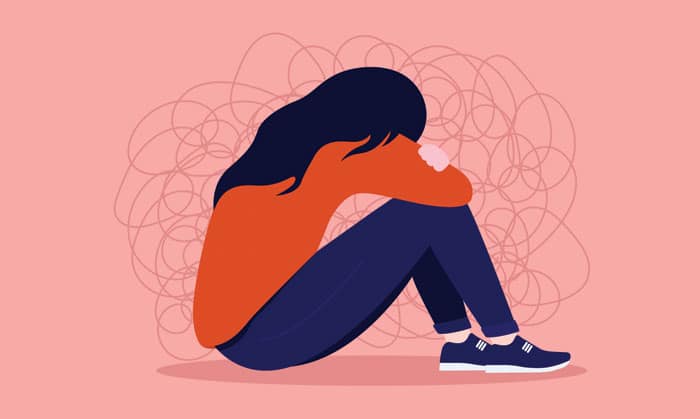
Still, something was wrong. By sophomore year, I couldn’t muster the bandwidth to even get out of bed. I wasn’t tired from too little sleep; I actually couldn’t bring myself to pull off the covers, leave the bed and face the day.
That year, my sister moved out of our apartment and into a college dormitory. It was painful. It was traumatic. And it was unimaginable.
I should mention that she moved three miles away, to UCLA. But when you’re as tight-knit and Persian as my family, it seemed like she had moved to Beirut.
To make things worse, for the first time in my life as a student, I was close to failing a class because it started at an excruciating 7 a.m., exactly the time I was clinging to the covers each morning. I had always conflated my identity, and worse, my worth, with academic achievement. If I received my first ‘F,’ I feared my entire being would unravel and I would even lose friends.
My parents chalked up my incessantly morose moods to normal teenage angst. For them, it was impossible to live in America and be depressed. America — with its freedoms and glorious opportunities — was supposed to offer a built-in prevention system against any form of depression.
One day, my guidance counselor called my mother and expressed concern over my absences. Usually, the kids who missed so much school were also failing classes across the board or loitering around town with others during school hours. Why was the overachieving journalism aficionado missing so much class?
I was assigned a counselor-in-training from The Maple Center (now known as Maple Counseling), which offers low-cost mental health services for thousands in Los Angeles. But it didn’t help. I only pathologized myself by thinking that there really must have been something wrong with me if I needed to talk to someone.
But there was a silver lining, and it was a major one: I struggled with depression in 1999, five years before Facebook, seven years before Twitter, 11 years before Instagram and a whopping 17 years before TikTok was created. Today, I consider my social-media-free childhood the most important blessing of my adolescence. In fact, it’s actually on par with having escaped Iran. Let me explain.
I have a lot of affection for Beverly Hills High School — it was truly an extraordinary institution and I loved several inimitable teachers who taught there. But it wasn’t exactly a place to go to feel good about yourself.
Every morning, the parade of fabulous cars, driven by kids not old enough to vote, made its way onto campus. The closest I ever came to my own means of transportation was riding the shopping carts at the local Rite-Aid on Canon Drive. And nothing could have prepared me for the fashion scene. Here were teens who wore actual Armani shirts; I had an impressive collection of fake Calvin Klein T-shirts from peddlers in downtown LA.
Was everyone at ‘Beverly’ like this? Of course not. But I didn’t have my eyes on everyone; I was laser-focused on the cream of the crop. And the cream was shopping at MAC cosmetics while I was shuffling through dollar stores, in search of $1 eyeshadow.
During school hours, I was inundated with evidence of my own inadequacy, from kids who could afford individual tutors to help them master the Pre-SATs to girls who were so beautiful that I almost wanted to poke them to make sure they were real. But once school ended, I was free of the constant reminders of how I fell short. I could go home, watch TV, do homework, and eat my Chef Boyardee in peace (until my mother grabbed it and handed me a plate of herbed meatballs with Persian rice).
I didn’t know which of my friends were ‘hanging out’ together without me; I didn’t know what my peers looked like while on vacation (I didn’t even know who was on vacation); and best of all, if anyone was giving me a hard time at school, I didn’t have to interact with him or her again until the next day. For the generation that followed me, social media took all of that away.
That’s why I’m stating with unequivocal certainty: If social media had existed when I was in high school, I would have had a mental breakdown. I know there are many others who will agree with me.
Rather than condemning today’s teens, I have love and, yes, sympathy, for them. That’s why I loved profiling 16-year-old Zach Gottlieb. Once you read the story, you’ll know why I wish Zach and others like him had existed when I was in high school.
And that’s precisely why, rather than condemning today’s teens, I have love and yes, sympathy, for them. That’s why I loved profiling 16-year-old Zach Gottlieb, the subject of this week’s cover story. Once you read the story, you’ll know why I wish Zach and others like him had existed when I was in high school.
Eventually, my depression subsided by junior year, but the darkness, as I call it, that I experienced as a sophomore shamed and scared me for a long time. I was lucky enough to make it through to the other side. But there were many who didn’t. Their stories remain the ones that left me with a true heartache.
Tabby Refael is a Los Angeles-based writer, speaker, and civic action activist. Follow her on Twitter @TabbyRefael
Il Bronzino’s magnificent portrait of Marie de Medici hangs in the Uffizi Gallery in Florence, Italy. As a 12- year-old girl, I stood in front of this painting of a young woman. The famous Mannerist artist immortalized her with luminous ivory skin, large blue eyes, sensuous coral lips and a striking widows peak. Befitting her status as the daughter of the Grand Duke of Tuscany Francisco Medici, jewels adorn her headband and her black gown. She wears stunning pearl drop earrings and a double strand necklace studded with pearls.
The enthusiastic young tour guide tells us that Marie has been betrothed to King Henry IV of France to be his second wife. He needs her large dowry to pay off his substantial debts. When she arrives in France, Marie is unimpressed by the crude, rustic cuisine of the royal court (think a lot of roasted meats). So she imports Florentine chefs. Whenever she is feeling unwell, the chefs stew oranges with sugar. When the French servants rush around to serve her the jam, they say “Mar malade!” Marie is sick. The tour guide tells her enraptured audience that this is how the word marmalade enters the English language and I’ve been telling that story for 40 years.
This week, Rachel decided that she would like to make marmalade. When I did a little research, I discovered that while it’s a nice story, marmalade has nothing to do with Marie de Medici.
Historians agree that the name for citrus preserves comes from the Portuguese word marmelada. Marmela is the Portuguese word for quince, a high pectin fruit which is too sour and bitter to eat raw, but perfect as a jam. Seville oranges are also sour and bitter and high in pectin and perfect for preserving. There are records that Portuguese quince marmalada was gifted to Henry VIII. When Seville oranges made their appearance on British shores in the sixteenth century, orange marmalade became a staple of British cuisine. And marmalade became synonymous with citrus preserves.
Every year, the Brits import thousands of tons of Seville oranges from Spain to make marmalade to eat on toast for their breakfast. —Sharon
The bittersweet and citrusy flavor of marmalade instantly transports me to my childhood in Morocco and to this day, oranges and orange blossom water are a mainstay in my kitchen.
The bittersweet and citrusy flavor of marmalade instantly transports me to my childhood in Morocco and to this day, oranges and orange blossom water are a mainstay in my kitchen. Every Shabbat, I serve a salad of sliced oranges and dried salty black olives. A favorite dessert is orange slices steeped in a sugary orange blossom syrup. I love to brew a tea with fresh orange blossoms and lemon verbena. Orange Dulce (dried orange peel preserved in syrup) are a favorite at teatime and a must at festive holiday meals.
The piece de resistance in the marmalade menu is the cake called Plato Montado for Spanish Moroccans and Le Pie for French North Africans. Imagine many layers of sponge cake that have been soaked in orange blossom water and rum, layered with orange marmalade and marzipan, then layered withchocolate. The exterior of the cake is meringue and it is decorated with tiny edible silver balls. This is the special cake that is served at a Henna or an engagement party. It is hard to imagine the amount of work that this cake entails. Every year, my mother would serve this magnificent cake for our birthdays. I don’t know how she did it, but she made it look effortless.
It turns out that I buy a lot of marmalade because my mother’s standard breakfast is a slice of homemade gluten-free almond bread with butter and marmalade and a large mug of green tea.
But recently I was on Pinterest and stumbled on a very simple homemade marmalade recipe.
The last time I made marmalade, it was a whole day fiasco involving hours of simmering on the stovetop. There was a lot of panicking that it wouldn’t thicken, which resulted in adding more and more sugar.
This time I made it in my instant pot, which was truly life-changing. The combination of pressure cooking and slow cooking meant that the preserves were ready in an hour. While Seville oranges are typically used in marmalade, I used locally sourced organic California grown Valencia oranges. The aroma in my home was intoxicating and the resulting marmalade was incredibly thick and delicious.
We hope you will try this no-fuss recipe with its simple ingredients. – Rachel
Marmalade recipe
2 pounds organic oranges (about 8 small oranges)
5 cups granulated sugar
1 cup water
STEP 1:
Remove all stickers and stems and wash the fruit.
Fill a large bowl with water and add 3 tablespoons of white or apple cider vinegar. Add oranges and let soak for 15 minutes.
Drain and dry oranges, then using a very sharp knife, mandolin or food processor, cut oranges as thinly as possible. (Cuts can vary in size and can be long and short.)
STEP2:
Add the oranges and juice to the Inner Pot of the Instant Pot.
Place the pot inside the Instant Pot and add the water.
Close the lid and press Pressure Cook Mode to HIGH for 10 minutes. After the timer goes off, allow the Instant Pot to release naturally.
STEP 3:
Open lid and set Instant Pot to Sauté Mode and set for 25 minutes on NORMAL mode. Add the sugar and stir well.
Cook for 20-22 minutes, continuously stirring to ensure that the sugar doesn’t burn on the bottom.
If you have a candy thermometer, when the temperature rises to 220°F, the preserves are ready.
Remove inner pot and place on the counter to cool. (Do not leave inside Instant Pot as it will continue to cook and the bottom will burn.) The marmalade will continue to thicken as it cools.
Place in prepared sterilized mason jars.
STERILIZING MASON JARS:
Fill a large pot of water and bring to a boil. Place glass jars and lids into the water and boil for 15 minutes.
Remove the jars and lids from the pot and dry.
When the marmalade has cooled, fill the jars and store in the refrigerator.
Rachel Sheff and Sharon Gomperts have been friends since high school. They love cooking and sharing recipes. They have collaborated on Sephardic Educational Center projects and community cooking classes. Find recipe video clips and recipes on Instagram SEPHARDIC SPICE GIRLS and Facebook SEPHARDIC SPICE SEC FOOD.
Growing up In Miami, Florida,Rabbi Lisa Berney was always involved in her Jewish community. She went to Jewish day school at her family’s Reform synagogue, had Shabbat dinner at home every Friday night, attended Jewish summer camp and joined youth groups.
“I was in a thriving Jewish community,” she said. “My world was a very Jewish one.”
Berney, who is associate rabbi and director of lifelong learning at Leo Baeck Temple in Los Angeles, knows how important it is to for kids to become engaged with their Judaism from a young age. It’s what inspired her to be part of the community and, ultimately, to become a rabbi.
Though she thought she wanted to work as a children’s rights lawyer, she decided in college to double major in Jewish studies. Then, she attended the Hebrew Union College-Jewish Institute of Religion, where she received ordination. During her time there, she was a student chaplain at Children’s Hospital of Los Angeles.
“I chose to be at Children’s Hospital because I’m really interested in being there for children and for the whole family,” she said.
It was at the hospital that Berney learned the power of listening and being there for people. In one of the toughest moments, she was called into work in the middle of the night after a two-year-old had died from drowning.
“The mom wouldn’t let go of her child, even though it had been hours since the child had died,” she said. “There are no words in those moments. So often, words aren’t necessary. What the mom needed was another soul to be present with her during this moment of unimaginable loss and let her know, physically and cosmically, that she is not alone.”
Loneliness, and being alone, are two themes that come up time and time again in Berney’s life and work.
Loneliness, and being alone, are two themes that come up time and time again in Berney’s life and work. When she was a child, she noticed just how much that people in her community were there for her, her family and one another. They made sure that nobody felt alone.
“We can live in a pretty transactional and lonely world and, for me, the answer to that is we create real community where we journey with one another and watch out for one another over and over again,” she said.
Berney serves people of all ages in her community at Leo Baeck, which has 600 families, but her specialty is working with kids and teens.
“I think children are the most creative, kind and hopeful parts of our community,” she said.
In the learning programs at the Sanford Ragins Religious School, which is for kindergarten through twelfth graders, Berney interacts with young kids as well as teens.
Along with teaching about the Torah, the rabbi gives teens the time to talk about what’s going on in their lives, as well as express their authentic selves.
“This work is about creating spaces where you can just be you,” she said. “Not your filtered you. The teens feel like they have to be this perfectly curated version of themselves. At our school, they can be their whole selves, and we love them unconditionally.”
Berney doesn’t shy away from talking about tough topics with the teens such as issues with parents, friends and body image. She also helps create programs where children and teens can learn from real-world experience, including a program where eighth and ninth graders are going to Arizona to learn about the immigration crisis.
“All of these different experiences help them think about who they want to be in the world,” she said. “They think, ‘What matters to me? What grounds me?’”
To get the entire family involved in Jewish life, Berney and her colleagues at Leo Baeck put together Friday night services, which the kids sometimes lead.
“Two working parents choose, on a Friday night, to schlep to temple with their kids and do Shabbat together as a family,” she said. “That’s a big choice for them. We give them conversations to talk about on the way home. We underestimate what a big deal it is when people are choosing synagogue life at this point.”
For Berney, the Jewish teaching that sticks out the most is, “It is not good for man to be alone.” In her work, she’s always trying to show her congregants that they are never alone.
“There is this deep yearning within all of us to be in deep relationships with each other,” she said. “It’s how we do our best work, fulfill our unique purposes, feel seen and loved by one another and move this world forward.”
Fast Takes with Lisa Berney
Jewish Journal: What’s your favorite Jewish food?
Lisa Berney: Chocolate babka or bagels. Any carbohydrate really.
JJ: What would you do if you weren’t a rabbi?
LB: I’d want to be the orthopedic surgeon for the Miami Heat.
JJ: What do you do on your day off?
LB: My husband [Rabbi Joshua Knobel] and I try to take a hike together or spend time with our two girls. We do something as a family.
JJ: What was your favorite childhood book?
LB: “A Wrinkle in Time.” I loved the strong female characters in this really cool imaginary world.