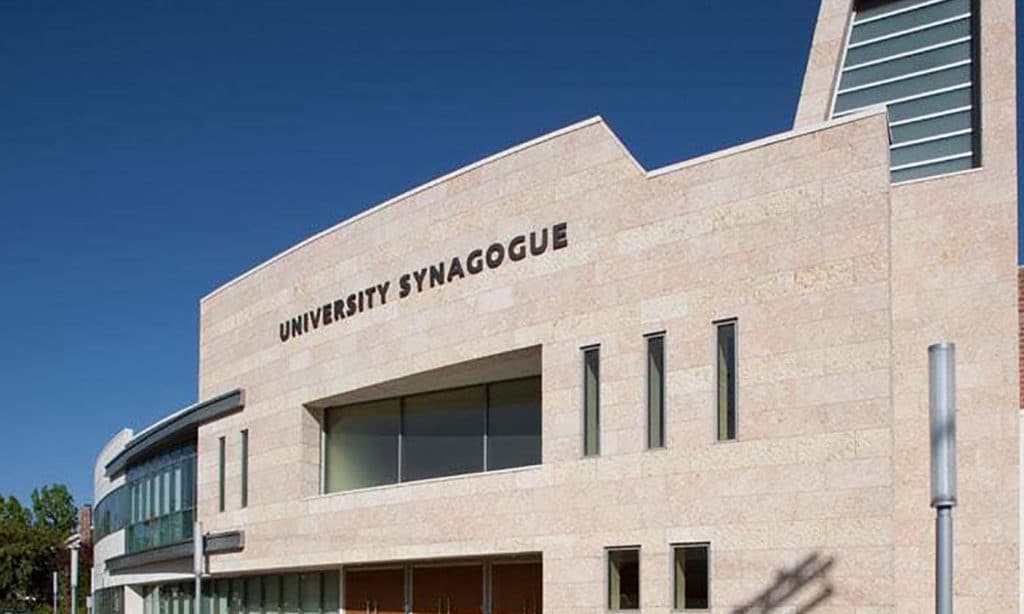
Wilshire Boulevard Temple announced this week a significant plan to renovate its University Campus (formerly University Synagogue) after receiving a $13 million gift from philanthropists Lynda and Stewart Resnick, owners of The Wonderful Company and longtime members of the congregation.
The gift will establish the Wilshire Boulevard Temple Lynda and Stewart Resnick Campus and the Wilshire Boulevard Temple Lynda and Stewart Resnick Early Childhood Center. Work is set to begin this summer, with construction slated to be completed in time for the 2023 high holidays, synagogue officials said.
“This incredibly generous gift from Lynda and Stewart will move our vision into reality and allow us to create a more vibrant and creative future for the Jewish community on the westside of Los Angeles,” said Rabbi Steve Leder, the Temple’s senior rabbinical leader. “Los Angeles is home to the second largest Jewish community in America, and this commitment by the Resnicks will help us engage our community in new and important ways.”
The mid-century modern synagogue located in Brentwood will receive a sweeping restoration to include public spaces for worship and celebration, as well as an updated early childhood center, religious school, and suite of teen and adult classrooms. Wilshire Boulevard Temple recently completed major renovations to the Audrey Irmas Pavilion at its Glazer Campus in Koreatown.
“[This gift] will enable us to continue inspiring children and their parents, along with people of all ages with the wisdom, power and beauty of Torah, prayer, learning, singing, celebrating and helping others,” said Rabbi Leder. “All of that is possible anywhere, but even more so now in our Temple thanks to the generosity and vision that are at Lynda and Stewart’s core.”
Rabbi Leder said that the Resnicks’ cornerstone gift reflects their longstanding support of the Jewish community and their roots in the Wilshire Boulevard Temple congregation.
The Resnicks own The Wonderful Company, which produces and distributes brands such as Fiji Water, Wonderful Pistachios, Wonderful Almonds and POM Wonderful, and have a long track record of giving back.
“We have always believed philanthropy must start close to home and that Tikkun Olam begins in one’s own community,” said the Resnicks in a statement. “Wilshire Boulevard Temple has been a welcoming home to our family for a generation and we are proud to support the establishment of a space that will provide that same sense for families in West Los Angeles for generations to come.”
As of April 2022, Wilshire Boulevard Temple has raised $19.5 million of the $35 million needed for the project, according to Rabbi Leder. Funds have come from a host of donors in addition to the Resnicks.
The Karsh Family Foundation donated $2.5 million, plus an additional $500,000 through a matching grant, to name the Karsh Family Social Services Center West. The Bram and Elaine Goldsmith Charitable Trust committed $2.5 million to name the Bram and Elaine Goldsmith Religious School, and the Trudy Mandel Louis Charitable Trust will provide $1 million to renovate the temple’s stain glass installations.
Originally founded in 1862, Wilshire Boulevard Temple has grown into one of Southern California’s largest and most influential congregations. It provides worship, adult programs, life cycle events, volunteer and social action opportunities, early childhood, elementary, and religious schools, as well as cultural and educational events at its campuses in Koreatown, West Los Angeles and Brentwood.
The Washington Post is under fire for revealing the name of the person behind the anonymous “Libs of TikTok” Twitter account and pointing out that she is an Orthodox Jew.
The Post published a story on April 19 unveiling the popular Twitter account as being run by a woman who is a real estate salesperson at one point based in New York. The report describes Libs of TikTok as an account that shares TikTok videos “primarily from LGBTQ+ people, often including incendiary framing aiming to generate outrage” that “has emerged as a powerful force on the Internet” with “a direct correlation between the recent push in legislation and rhetoric directly targeting the LGBTQ+ community.” The report later mentions that prior to the creation of the account, the woman had another Twitter account where “she also claimed to be proudly Orthodox Jewish” in March 2021.
Some on Twitter took umbrage with the mention. “Why was it crucial for [Post reporter] @TaylorLorenz to mention the creator of ‘Libs of TikTok’ was an Orthodox Jew?” Stop Antisemitism tweeted. Lorenz is the author of the April 19 Post report. “Violent antisemitic attacks, especially in [New York City], are skyrocketing. This does nothing but give an already bias[ed] lunatic more ammo to attack Jews!” They also stated they are “highly disappointed” with Post Technology Editor Christina Passariello for approving of the mention.
Why was it crucial for @TaylorLorenz to mention the creator of ‘Libs of TikTok’ was an Orthodox Jew?
Violent antisemitic attacks, especially in NYC, are skyrocketing. This does nothing but give an already bias lunatic more ammo to attack Jews!
Conservative columnist Bethany Mandel, who is also the editor of the “Heroes of Liberty” children’s book series, tweeted that the Post is “absolute straight trash” for mentioning that the account they’re “painting as bigoted is run by an Orthodox Jew.” “By specifically identifying @libsoftiktok is an Orthodox Jew at a time when hatred and violence against us is at an all-time high, Lorenz is putting her safety in even more jeopardy,” Mandel added. “And she knows it.”
Taylor makes a point to note that the account she’s painting as bigoted is run by an Orthodox Jew. WaPo is absolute straight trash for running this. https://t.co/oKTRAZUn4Gpic.twitter.com/XjcG5jw83Y
There’s a whole other layer to this doxxing. By specifically identifying @libsoftiktok is an Orthodox Jew at a time when hatred and violence against us is at an all-time high, Lorenz is putting her safety in even more jeopardy. And she knows it.
Joel M. Petlin, Superintendent of the Kiryas Joel School District, highlighted a tweet showing that in the Post’s comments section someone had written that Libs of TikTok is “a Jew Hitler would be proud of” as an example of “why the religious affiliation of the subject of an article shouldn’t be used, unless it’s germane to the story. In the #libsoftiktok story, it most certainly was not.” “Shame on Taylor & WaPo for adding fuel to the fire of Antisemitism.”
This is why the religious affiliation of the subject of an article shouldn't be used, unless it's germane to the story. In the #libsoftiktok story, it most certainly was not.
Christina Pushaw, Republican Governor Ron DeSantis’ Press Secretary, highlighted a screenshot of Post Columnist Megan McArdle tweeting that because the woman behind Libs of TikTok is an Orthodox Jew, “the fallout of having her name revealed will be pretty minimal.” “[Jeff Bezos] Post content creators do not have a problem with revealing the personal information and workplace of a private citizen, as long as she is an Orthodox Jew,” Pushaw tweeted. “What kind of twisted logic is this?” Bezos is the owner of The Washington Post. McArdle later tweeted that what she meant was that she approves “of people being cancellation-proof. I am generally opposed to cancellation on principle. I view this as a strength of the orthodox community, not a weakness.” Pushaw replied to McArdle that “it is a strength of the orthodox community. But it’s wrong that your employer, an influential newspaper, would publish a story unmasking this person — and identifying her religion, where it’s not at all relevant to the story. Opens her up to being targeted by antisemites.”
Interestingly, LibsofTikTok appears to be Orthodox, and to work at a realty that caters to the Orthodox, so I'm guessing the fallout of having her name revealed is going to be pretty minimal.
Bezos Post content creators do not have a problem with revealing the personal information and workplace of a private citizen, as long as she is an Orthodox Jew. What kind of twisted logic is this? https://t.co/GQnzCsQcgc
— Christina Pushaw 🐊 🇺🇸 (@ChristinaPushaw) April 19, 2022
Okay, now I apparently need to make this clearer, because Twitchy has decided this was anti-semitic: I approve of people being cancellation-proof. I am generally opposed to cancellation on principle. I view this as a strength of the orthodox community, not a weakness. https://t.co/oWOgH1OFt2
It is a strength of the orthodox community. But it’s wrong that your employer, an influential newspaper, would publish a story unmasking this person — and identifying her religion, where it’s not at all relevant to the story. Opens her up to being targeted by antisemites.
— Christina Pushaw 🐊 🇺🇸 (@ChristinaPushaw) April 19, 2022
In response to the Journal’s request for comment, Post Senior Managing Editor Cameron Barr defended Lorenz, calling her “an accomplished and diligent journalist whose reporting methods comport entirely with The Washington Post’s professional standards” and that the identity of the Libs of TikTok creator “has had significant impact on public discourse and her identity had become public knowledge on social media. We did not publish or link to any details about her personal life.” This appeared to be the same statement that the Post posted to their Twitter account about Lorenz’s report; Libs of TikTok accused them of lying, tweeting that “they included a link with personal information which they later removed because they knew what they were doing was abhorrent.”
LIES. They included a link with personal information which they later removed because they knew what they were doing was abhorrent. https://t.co/4305uuU8EX
The Post report accused the person behind Libs of TikTok of having past Twitter accounts of promoting “election fraud conspiracies and using QAnon-related language” and providing a “play-by-play account claiming to be on the ground” during January 6. It went on to claim that Libs of TikTok has promoted “anti-LGBTQ content” and is “directly impacting legislation” because Pushaw has said the account has informed “her views on the state’s restrictive legislation that bands discussion of sexuality or gender identity in kindergarten through third grade, described by critics as the ‘don’t say gay’ bill.” Pushaw has argued that Libs of TikTok is being targeted for sharing videos of “degenerate progressives” who “have sexually explicit conversations with minors.”
Here’s why private citizen @libsoftiktok incurred the wrath of WaPo’s Taylor Lorenz:
– Degenerate progressives posted public videos about how they have sexually explicit conversations with minors – LibsofTikTok reposted those videos – Degenerates faced professional consequences
— Christina Pushaw 🐊 🇺🇸 (@ChristinaPushaw) April 19, 2022
Mediaite has reported that the Post and Lorenz are also being accused of doxxing the woman behind Libs of TikTok, pointing to allegations that Lorenz attempted to contact the woman’s relatives by knocking on their doors. Lorenz and her defenders have argued that she was engaging in common reporting tactics and that the Libs of TikTok account is “high profile” and that the woman behind the account has made “public appearances in the media.”
The New York Post reported that critics of Lorenz have accused her of hypocrisy, pointing to an MSNBC segment that aired earlier in the month in which Lorenz tearfully recounted how “online harassment targeting her and her family caused her to experience ‘severe PTSD’ and contemplate suicide in the recent past.” Lorenz responded to The New York Post report by sharing a screenshot of a story accusing the outlet of doxxing a first responder’s OnlyFans account. In response to Stanford Internet Observatory’s Alex Stamos saying to Lorenz that she has “eloquently spoken of your own experiences here and you should extend that empathy to somebody you disagree with, if only to maintain some credibility on the topic,” Lorenz replied: “My reporting here doesn’t negate anything I’ve said about online harassment or right wing smear campaigns, those things are what Libs of TT drives, and part of what makes it newsworthy.”
Congregations reeling from pandemic-induced membership decline. Rabbis resigning pulpits in droves. Seminary enrollment plummeting.
These are the headlines proclaiming a crisis in synagogue life. To be sure, these are serious challenges. But, decrying the death of synagogues is going to be the death of synagogues.
These headlines do not tell the whole story. There are congregations that are thriving, growing and serving their sacred communities. How? What are the principles and practices that contribute to this success?
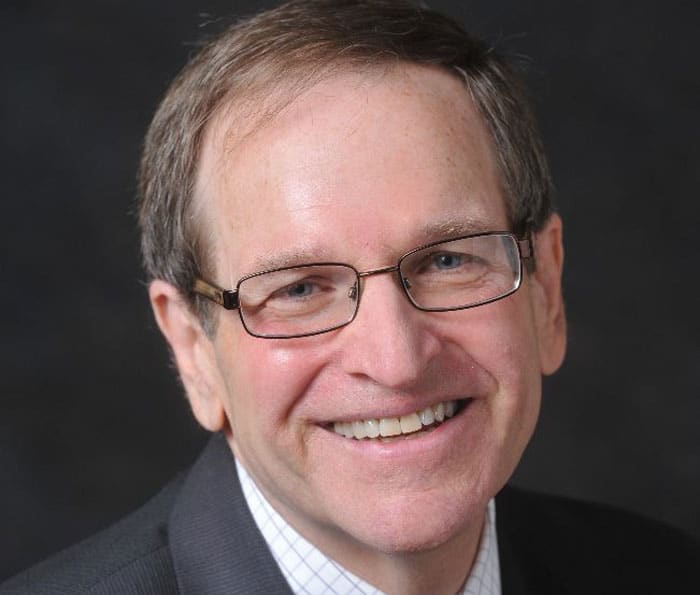
Dr. Ron Wolfson
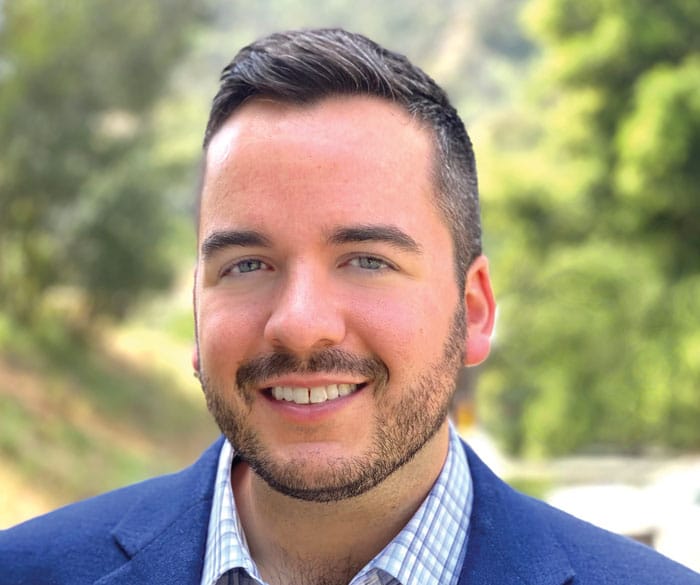
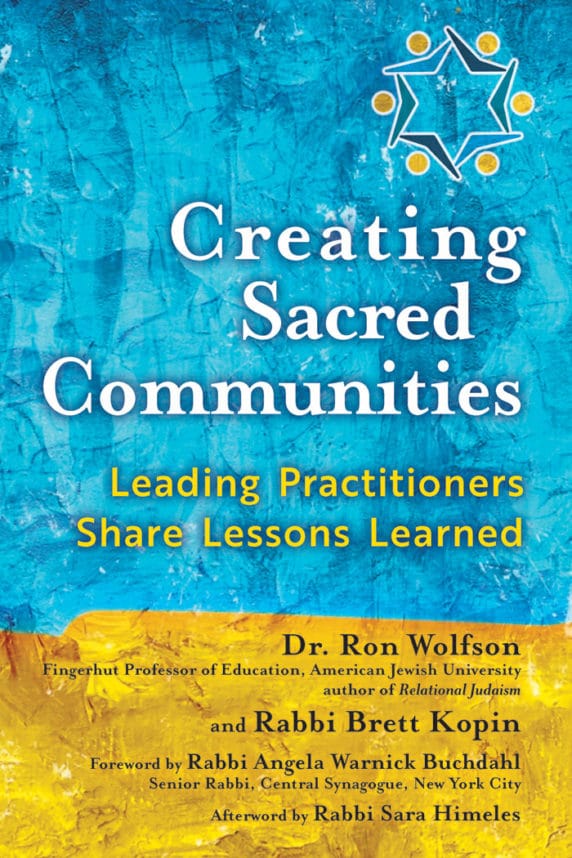
These are the questions we — Dr. Ron Wolfson, professor, and Rabbi Brett Kopin, rabbinical school student at the time—asked 14 rabbis, cantors, executive directors and lay leaders of cutting-edge communities from across North America — and one famous pastor— in the annual “Creating Sacred Communities” seminar for senior students in the Ziegler School of Rabbinical Studies at American Jewish University in Los Angeles in the Spring of 2021. We captured their answers in our new book, “Creating Sacred Communities: Leading Practitioners Share Lessons Learned.”
Rabbi Brett Kopin
The collection of presentations is a rare peek into a senior rabbinical school seminar, called by many a “master class” in how to lead a twenty-first-century congregation. Since the sessions were held on Zoom, we recorded and edited the transcripts. Early readers report feeling transported into the classroom, as if these outstanding leaders were speaking directly to them. Here is just a taste of the many insights from these outstanding crafters of sacred community.
“It’s all about relationships.” Three tiers of engagement are central to creating a sacred community: linking people to the totality of Jewish living; building relationships between the clergy, the staff and lay leaders and the members and guests; and connecting members with each other.
Welcoming Ambience
“It’s all about relationships.” Class begins with a deep dive into Relational Judaism, the organizing principle of the seminar. Three tiers of engagement are central to creating a sacred community: linking people to the totality of Jewish living; building relationships between the clergy, the staff and lay leaders and the members and guests; and connecting members with each other. This begins with creating a welcoming ambience in the community, a radical hospitality that infuses every gathering, embracing the lessons learned in Genesis from Abraham and Sarah’s welcoming tent: running to greet guests, under-promising and over-delivering, and ensuring the entire team is committed to building a culture in which every human being is treated as the b’tzelem Elohim, the image of God, that they are.
Welcoming Worship
Rabbi Angela Warnick Buchdahl, the first Asian-American to be ordained as a cantor and a rabbi, now serves as senior rabbi of Central Synagogue in New York City, one of the few synagogues in the world with a membership waiting list and tens of thousands of online participants in prayer services and other programming. She shares how she crafts a welcoming worship experience since beginning her pulpit career as a hazzan:
“Worship has to be an authentic experience for the clergy and the congregation.” – Rabbi Angela Warnick Buchdahl
The way we think about worship overall is that we have multiple gateways. We’re speaking to the multiple needs and the multiple identities that people are bringing into the space when they come to us. Sometimes you want to hear it in Hebrew and although you might not even understand what it means, it’s reaching something deep. Sometimes we’ll sing something in English because it just hits right when you pray for healing in your native tongue [she’s referring to the well-known “Mi Shebeirach” melody by Debbie Friedman]. We believe in genuine embodied prayer. Among our clergy, we are actually praying on the bimah (pulpit) when we’re up there. It makes me very sad to sometimes hear colleagues say they have to go somewhere else to pray, not in their own synagogue, because they’re not praying. I can’t imagine that there can be an experience for others if there is not even one for those who are praying. Worship has to be an authentic experience for the clergy and the congregation.
As a rabbinical student, Rabbi Josh Warshawsky had already gained a strong reputation as an entrepreneurial spiritual leader and talented songwriter. Today, Josh travels to synagogues all over the country sharing his music, building relationships with diverse communities, and searching for innovative ways to refresh classic prayer experiences:
Every time you approach the prayer book, it’s the same every single time; the words are always the same. They’re right there, they’ve been the same for hundreds of years in the exact same order. We have to find one way that the moment can be novel and can be new and meaningful. Maybe that’s a new melody. Maybe that’s something new that you see in the text. Maybe that’s learning about a different way to understand one of the words. Maybe that’s even just you, coming into this text today as opposed to coming to it yesterday. The way that you approach it, hopefully, will be different today than it was yesterday, but only if we set an intention for that to be the case. For me, that’s what I try to think about whenever I’m crafting worship. How can there be at least one moment in this experience that feels different from the way you’ve done it before?
Welcoming Membership
After Adat Ari El in North Hollywood, California adopted a “sustainable dues” model of revenue generation, Rabbi Jonathan Bernhard invited lapsed members to return to the community and pay the suggested “sustainable” rate, or “a gift from the heart.” Incredibly, eighty families returned to the congregation. Rabbi Bernhard reflects:
We Jews in the liberal community do not prioritize synagogue life enough. For religion to work, it needs to be your one, two, or three. Otherwise, it’s not that you don’t care, it’s just that you care about other things more that take priority and take your time and energy. And while I have been blessed with a lot of congregants for whom it is one, two, or three, the number of people for whom it’s more like seven, eight, nine, or 15 is getting bigger. That’s why the sustainable financial funding model is so important; it lowers the barrier of engagement and raises the possibility that more people will think of their commitment to religious life as one, two, or three.
Rabbi Sharon Brous, founder/senior rabbi and Melissa Balaban, founder/CEO, of IKAR in Los Angeles reveal the “secret sauce” of their success is lowering the bar for entry and raising the bar for engagement.
Rabbi Sharon Brous, founder/senior rabbi and Melissa Balaban, founder/CEO, of IKAR in Los Angeles reveal the “secret sauce” of their success is lowering the bar for entry and raising the bar for engagement. They describe how new members are challenged with expectations beyond dues. Melissa puts it like this: “You can come to IKAR forever for free, but if you’re going to join, we will ask you to make four commitments—a justice commitment, a volunteer community commitment, a learning commitment, and a tzedakah/financial commitment.”
This Jewish Emergent Network sacred community created 18 years ago with seven people in a living room now counts 1,100 households, gaining 200 “IKAR from AFAR” members during the pandemic. Rabbi Brous adds:
We’re trying to make it so that everybody can feel at home here. But at the same time, we need it to be challenging and meaningful and demanding in ways that I think a lot of Jewish places shy away from. We’re asking: what would it mean if we actually ask something of people? What if we said: “To be in this space, there’s something that we’re hoping you’ll give us.” We’re doing these new member house parties with people from Chile and Japan and London and San Diego, and I’m saying, “You could have gotten IKAR for free!” But what they want is not just access to services … they want to be part of something that feels purpose-driven, a place that feels like their voice matters, like they are connected to other people standing on the same side of history.
Connecting People with Each Other
“Purpose-driven” is the watchword of Pastor Rick Warren, the founder of Southern California’s Saddleback Church, one of the world’s most successful megachurches, attracting 30,000 attendees every week in twenty locations across the globe. In the book, Pastor Rick tells the rabbis to “say something in shul [he used that word] on Shabbat that they can use in their real lives on Monday.” Pastor Rick structures the church around six levels of deepening spiritual commitment and engagement, explained as six concentric circles, where one moves from the outer circle (the least committed) to the smallest inner circle representing the deepest level of commitment. He teaches that the secret to growing larger is by being smaller, engaging people in small groups meeting in their homes, 7,000 of which serve their sacred community. “These small groups are the heartbeat of our congregation and they are spread out across Southern California — from Malibu to San Diego.”
Rabbi Lydia Medwin at The Temple in Atlanta and Rabbi Nicole Auerbach at Central Synagogue in New York City took Saddleback’s small group model and adapted it for synagogue life in their book, “The Relational Judaism Handbook,” co-authored with Dr. Ron Wolfson. Rabbi Lydia explains: “Small groups are the most basic form of community. At The Temple, we wanted to create a culture where small groups were the natural outcome of any good idea, because that’s where people are seen and heard best and loved best. Our friends at Saddleback Church always ask, ‘Are you a community with small groups … or a community of small groups?’”
The director of media relations for Chabad-Lubavitch International, Rabbi Motti Seligson, answers questions about Chabad’s success in building sacred communities throughout the world, led by shluchim (emissaries) and their families. When asked why the Rebbe sent rabbis to a community for life, he tells our young rabbis: “A shlichut is a mission … it’s not about you. It’s about the people you’re serving and the community you’re serving, and you become part of the community. It becomes your family, and you don’t move from family to family.”
The Relational Rabbi
Rabbi Ed Feinstein of Valley Beth Shalom in Los Angeles shocked our seminar:
People are going to tell you that being a great rabbi is about speaking well. It is not. The greater skill of the rabbi is how you listen. People who are able to really listen are people who make great rabbis. Listening gives you a clue about the deeper meaning of the moment and what needs to be said. The Seder asks us to think of ourselves as a community of ex-slaves. If you thought that way, how would you walk the world differently? What would you see that you couldn’t see otherwise? How would you respond to the world? Every ancient culture thought slaves were the lowest forms of life. If you were a child of a slave, you were nothing. And we walk around going, “I’m proud of this.” Why? What does it do for us? That’s the question. What does it do for me? This is the question we have to be answering all the time. The wicked child at the Seder asks, “What does this mean to you?” His question goes right to the heart: Why does the Passover story matter? Why is this Seder ritual so important to you?
“People are going to tell you that being a great rabbi is about speaking well. It is not. The greater skill of the rabbi is how you listen.“
– Rabbi Ed Feinstein
When Rabbi Dan Moskovitz came to the pulpit at Temple Sholom in Vancouver, Canada, he read 30-40 names on the yahrzeit memorial list every Friday night. New in town, he knew none of these people. So, he carved out several hours in his week to call the family members remembering their loved one. “Hi, this is Rabbi Dan. I see it’s your mother’s yahrzeit coming up. Please tell me a story about her.” He reports that to this day, he is still pulling social capital from those conversations. In seven years, this relational rabbi has grown the congregation by 40%.
Clergy/Lay Leadership
Norman Levine, past-president of Valley Beth Shalom, counsels the rabbinic students about the relationship between lay leadership and the clergy, beginning with the role of synagogue president:
My job is not to be a rabbi; my job is to support the rabbis by providing the resources to do their jobs. I am there to “take a bullet” for the rabbis, to have their back. And, no one in the shul wants to talk to Norm Levine; but everyone wants to talk to the synagogue president. So, I stand at the entry of the sanctuary greeting everyone and I invite people to schmooze with me at the Kiddush lunch.”
Janice Kaminer-Reznik, a dynamic lay leader, tells the story of her partnership with Rabbi Harold Schulweis, of blessed memory, in creating the social justice initiative, Jewish World Watch:
Rabbi Schulweis was a moral visionary. He was not afraid to speak his mind or to admonish people to wake up to their responsibility. He called me one day and told me, “I’m going to be bringing something up at the High Holy Days, and I want you to be listening really closely because I want you to take the ball and run with it.” I asked him what he would be proposing. He told me, “It relates to a place called Darfur.” I had never heard of Darfur; this was in 2004, toward the beginning of the Darfur genocide. And I responded, “Well, I’m listening, I’m listening.” And I did. Especially compelling to me was when he talked about our silence in the face of atrocity … I recognize the power that Rabbi Schulweis lent to this cause. He was really healthy for the first seven or eight years of Jewish World Watch and extremely engaged with us. He didn’t have to plan anything; all he had to do was say “yes” … and he always said “yes.”
Engaging the Next Generation
Rabbi Mike Uram, former head of University of Pennsylvania Hillel and the current Chief Vision and Education Officer for Pardes North America, describes how to begin thinking about engaging young professionals:
The first thing to say about creating sacred communities is that we have to end this notion of “the Jewish community.” I hear this all the time from people in the organized Jewish world. This language is actually really dangerous. The truth is that there is not really one Jewish community. That language creates a false binary choice: You’re either in the community or outside the community. The trends are shifting from macro to micro, from ‘one size fits all’ to “customization.” I was really proud of the mission statement of Penn Hillel: “Create the relationships, the experiences and the communities for college students” — not programs, but experiences, and not community but communities. We created an autonomous, separately branded engagement effort to reach hundreds of Jewish students who would never consider coming to the Hillel building. Some synagogues are doing this.
A Culture of Meaning
Dr. Bruce Powell, expert consultant to Jewish day schools throughout North America and co-author of “Raising A+ Human Beings” reveals how schools can raise their students to be A+ human beings:
My mentor, a man by the name of Shlomo Bardin, was speaking to the faculty club at Columbia University in 1930 and said, “American education is too much about measuring and not enough about meaning.” This became the guiding piece of my educational philosophy as I grew up, and it also became the underpinnings of this notion of creating a culture in a place, whether it’s a synagogue or a camp, a company or a school — it doesn’t matter. All the principles are the same: We have to be more about meaning than we are about measuring. I tell my incoming students: “You can be an A+ human being, even if you’re not an A student in every subject.” The notion that every human being is created b’tzelem Elohim (image of God) now is for real. What is your gift? Our job as educators, your job as rabbis, in running a culture is to help each person find his or her gift.
Rabbi Sara Himeles, a fellow classmate, writes in her Afterword to our book:
In his brilliant remarks to our class, Rabbi Ed Feinstein underscored that teshuvah is a critical component of any sacred community. As rabbis, Jewish educators, and leaders, we can model this and set the tone for our communities and classrooms by openly sharing the ways we forgive ourselves and others. We can publicize and celebrate acts of compassion and kindness, an important way to encourage and guide our sacred communities.
It is time to return to the fundamental building blocks of sacred community.
It is time to stop the hand-wringing and renew the work of creating compelling and engaging sacred communities offering a path to meaning, purpose, belonging and blessing. It is time to return to the fundamental building blocks of sacred community. Let’s put people first before programs. People will come to synagogues for programs, but they will stay for relationships. For congregational leaders, the lessons we learned in “Creating Sacred Communities” chart an exciting and positive way forward.
Dr. Ron Wolfson is the Fingerhut Professor of Education at American Jewish University, President of the Kripke Institute, and co-author of “The Relational Judaism Handbook.” “Creating Sacred Communities: Leading Practitioners Share Lessons Learned” is available at http://creatingsacredcommunities.com/
Rabbi Brett Kopin received rabbinic ordination from the Ziegler School of Rabbinic Studies in 2021. He is the co-screenwriter of the award-winning animated film “The Tattooed Torah” (https://www.thetattooedtorah.com). He currently serves as a Jewish Educator at Milken Community School in Los Angeles.
During the last century, energy has played a decisive role in the political-military struggles that emerged in the Middle East. It was in February 1944 when the head of the US Petroleum Reserves Corporation, Everette Lee DeGolyer, pronounced that “the center of gravity of world oil production is shifting to the Middle East.”
In 2022, we have two related centers of gravity for energy production, and they both threaten the West: Russia and Iran. In the case of Russia, the European dependence on Russian gas has undermined the West’s ability to isolate Vladimir Putin for his savage invasion of Ukraine. In the case of Iran, under the guise of a flawed nuclear deal, the West is preparing to remove sanctions on the world’s #1 sponsor of terror and a major oil producer.
If there is one lesson the West should have learned in 2022, it is the danger of relying on rogue states for something as fundamental as energy. The Ukraine crisis in particular has illustrated just how vitally important the diversification of the sources of European gas has become and the urgency of finding alternatives to Russian gas, if only to reduce Moscow’s leverage over Europe and the NATO alliance.
A pivotal moment in reducing that leverage began to emerge in 2009, with the discovery of immense reserves of natural gas off Israel’s coast that reached 381 trillion cubic feet of gas or roughly 5 percent of the world’s gas reserves. This came at a time when European energy consumption was becoming increasingly reliant on natural gas and less dependent upon oil and coal.
Experts who looked at Israel’s offshore geology have concluded with certainty that much more gas was present. It only required further investment to extract it. After the discovery of the immense Leviathan gas field with 18 trillion cubic feet of gas, a team of MIT geologists, who analyzed the Levant basin, reached the conclusion that there were six more Leviathans within Israel’s territorial waters that could reach 108 trillion cubic feet of gas if proven.
After the discovery of the immense Leviathan gas field with 18 trillion cubic feet of gas, a team of MIT geologists concluded that there were six more Leviathans within Israel’s territorial waters.
The new discoveries near Israel and Cyprus were made by Noble Energy, a Houston-based American firm that was relatively small in comparison with the major energy corporations in the US. An undersea pipeline was envisioned to transport the gas to the European market across the Mediterranean at a distance of 1180 miles, from Israel to Cyprus and Greece. The European Union got behind the idea of the Mediterranean pipeline.
Moving gas into Europe along the ocean floor for hundreds of miles was not unprecedented. By comparison the two Nord Stream undersea pipelines carrying Russian gas under the Baltic Sea to Germany were 764 miles. The new plan for the Mediterranean route included extending what came to be known as the EastMed pipeline from Greece to Southern Italy. This way Israeli gas would reach Europe. The EU designated the pipeline a project of common interest (PCI) which entitled it to many bureaucratic benefits.
An agreement covering the proposed EastMed pipeline was signed in 2020 by Israel, Cyprus and Greece. The completion of the pipeline in 2025 and the export of Eastern Mediterranean gas to European markets would serve the European Union’s interest in diversifying its sources of natural gas, which was highly reliant on gas imported from the Russian Federation. Some 40 per cent of the EU’s natural gas supplies were under Moscow’s control.
An agreement covering the proposed EastMed pipeline was signed in 2020 by Israel, Cyprus and Greece… Unfortunately, the Biden administration withdrew its support for the pipeline in January 2022 for reasons that are not entirely clear.
What was needed were much larger investors in Eastern Mediterranean gas. To that end, the American energy giant, CHEVRON (Standard Oil of California) stepped up and completed its acquisition of Noble Energy in October 2020. Everything was set for a new EastMed gas pipeline to Europe that would be connected to a trusted ally like Israel.
Unfortunately, the Biden administration withdrew its support for the EastMed pipeline in January 2022 for reasons that are not entirely clear. As the crisis over Ukraine escalated in 2022, forward movement on the EastMed pipeline could have given the West needed leverage for the diplomatic struggle with Moscow. Now that leverage, instead of being under the sea, is up in the air.
Over the years, because of Western complacence, Russia has systematically brought Germany under its influence in the area of natural gas. It nominated the former chancellor of Germany, Gerhard Schroder, to serve on the board of Gazprom, the Russian state gas company from 2005 onward. An important alternative to Russian gas could have been nuclear power which produced about one quarter of Germany’s electricity back in 2011.
But after the Fukushima nuclear accident in Japan, Chancellor Merkel began closing down Germany’s nuclear reactors; there were seventeen reactors in 2011, but now there are only three. Thus, Germany’s dependence on imported gas has only grown and today, Germany has emerged as the single largest customer for Russian gas in Europe, with 23% of its total gas exports going to Germany, alone.
In 2018, at least 70% of Russia’s natural gas exports were delivered to EU member states. But they were not equally dependent on Russia for more than 50% of their gas imports; by comparison, eleven EU states only needed Russian gas for less than 10% of their consumption.
These numbers are important. The impact of a Russian gas cutoff or reduction of supply will vary with the degree of dependence of the European state in question. Similarly, the policies they will advocate for dealing with Russian gas will depend on the extent to which that gas affects their economy. Even with their differences, the EU Foreign Policy Chief, Josep Borrell, was able to voice a united policy for Europe, in January, 2022, based on his view that “we must reduce our dependency on Russian energy.” In the course of the year, it became clearer that Russian gas sales were helping President Putin pay for his war in Eastern Europe against Ukraine.
Coming up with a solution to the Russian gas question for Europe also has an Israeli angle. The new Israeli government headed by Prime Minister Naftali Bennett, modified Israeli energy policy; it halted the granting of licenses for natural gas exploration for one year while it devoted its efforts to work on renewable energy, like solar power and wind power.
Whatever the excuses that were offered by the Israeli Ministry of Energy, there was an increasing risk of their jeopardizing one of the great economic opportunities of the State of Israel in decades.
With the postponement of Israel’s gas pipeline to Europe, Israeli gas is still used for its Middle Eastern partners, particularly Egypt and Jordan. With the anticipated improvement of Israeli ties to Turkey, Ankara could emerge as an export hub for Israeli gas in the future. Gas will be a critical factor in the international politics of the Middle East, but not in the way originally expected when Israel’s Mediterranean deposits were first discovered.
Clearly there is a joint interest across the Western alliance to increase the supply of natural gas to the West as a whole. Increased supplies of gas would help drive down its price just as many states are suffering from unprecedented increases in the price of gas and oil. Failing to complete the EastMed pipeline would be a strategic blunder that will only exacerbate the energy crisis at a time when it has already escalated with the outbreak of a major European war.
Whether it’s reducing Western dependence on Russian gas or Iranian oil, the West is way overdue for a course correction.
Ambassador Gold is the President of the Jerusalem Center for Public Affairs. He served as the Director-General of Israel’s Ministry of Foreign Affairs and as its Ambassador to the United Nations.
Mike Binder is one amazing guy. He’s a multi-talented comedian, actor, writer, director, and documentarian. And he’s as down-to-earth as they come. He’s a stand-up comedian turned movie-maker and has written and directed films like the heartwarming “Indian Summer,” the touching and funny “The Upside of Anger,” directed the cult classic “Blankman”, and created, wrote and directed the successful HBO series “The Mind of the Married Man,” wrote, directed and produced Showtime’s wonderful five-part documentary series “The Comedy Store,” and is working on his second Bill Burr comedy special.
An old friend of Mark’s, Mike talks with the guys in a very open and honest conversation about his early years in comedy, how tough it is to get movies made, the art of learning from mistakes, finding sobriety, and the hardship of the recent losses (and warm memories) of good friends Bob Saget and Gilbert Gottfried. Mike shares some great stories about seeing Richard Pryor as a young kid, his little-brother type relationship with Jay Leno as he was starting out, additional scoop about the Comedy Store, and much more!
Comedy fans MUST check out Mike’s new website and Substack, invaluable resources on what’s going on in the world of comedy: https://standupworld.com/



 The way we think about worship overall is that we have multiple gateways. We’re speaking to the multiple needs and the multiple identities that people are bringing into the space when they come to us. Sometimes you want to hear it in Hebrew and although you might not even understand what it means, it’s reaching something deep. Sometimes we’ll sing something in English because it just hits right when you pray for healing in your native tongue [she’s referring to the well-known “Mi Shebeirach” melody by Debbie Friedman]. We believe in genuine embodied prayer. Among our clergy, we are actually praying on the bimah (pulpit) when we’re up there. It makes me very sad to sometimes hear colleagues say they have to go somewhere else to pray, not in their own synagogue, because they’re not praying. I can’t imagine that there can be an experience for others if there is not even one for those who are praying. Worship has to be an authentic experience for the clergy and the congregation.