fbpx

April 12, 2022

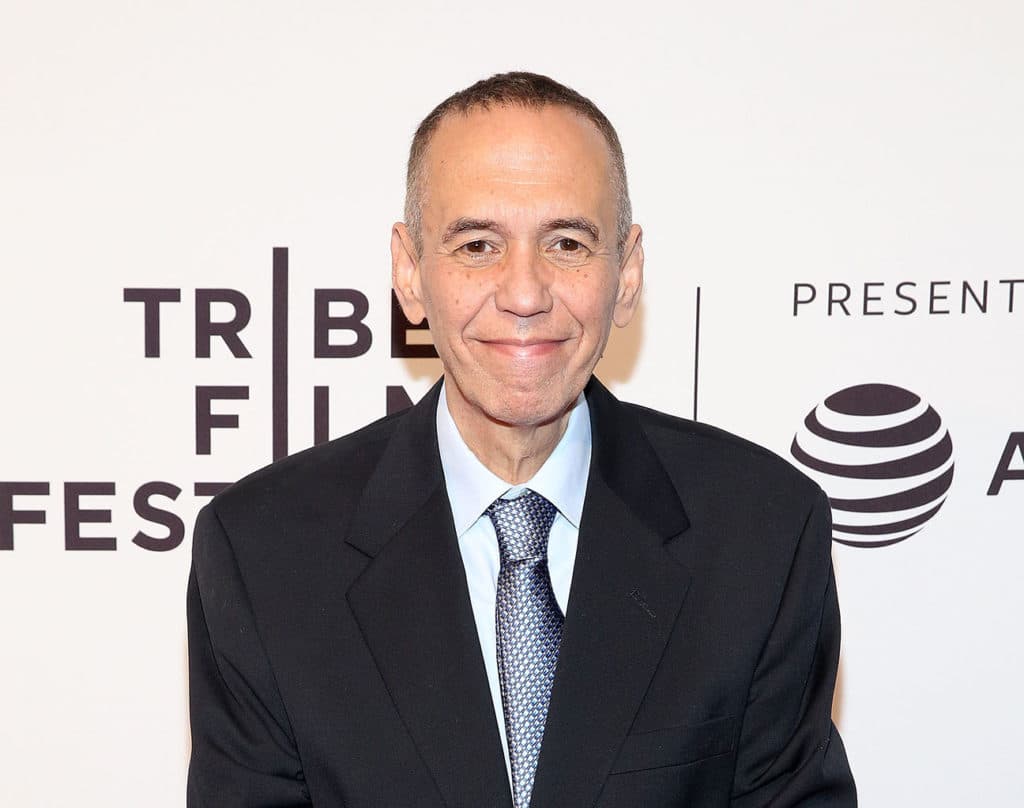
Comedian Gilbert Gottfried Dies at 67

Comedian Gilbert Gottfried, known for both his raunchy humor and voiceovers in childrens’ cartoons, has passed away at 67.

His passing was confirmed in a post on his Twitter account from his family saying, “We are heartbroken to announce the passing of our beloved Gilbert Gottfried after a long illness. In addition to being the most iconic voice in comedy, Gilbert was a wonderful husband, brother, friend and father to his two young children. Although today is a sad day for all of us, please keep laughing as loud as possible in Gilbert’s honor.”

TMZ is reporting that his representative Glenn Schwartz said Gottfried, “died from a heart abnormality called Ventricular Tachycardia due to Myotonic Dystrophy type II.”

Gottfried’s comedy was often marked by subjects that were equal parts brilliant and putrid. His irreverence, self-depreciation and taboo-straddling approach to comedy were all part of an illustrious career in show business that spanned over 40 years.

Born in Brooklyn in 1955, Gottfried was raised with his sisters Arlene and Karen in Crown Heights. His parents owned a hardware store on Coney Island. He attended Jewish summer camp, and by age 15 was performing standup comedy. 

His irreverence, self-depreciation and taboo-straddling approach to comedy were all part of an illustrious career in show business that spanned over 40 years.

During his early years writing comedy, Gottfried made ends meet by working in an assembly line that made anti-burglary kits and worked in the concession stands of Broadway theaters.

His first break into show business came when producers at MTV saw him perform at one of the Catch a Rising Star clubs in New York City. They hired Gottfried to perform short comedy bits to air between music videos on the newly-created cable network.

“All the top executives at MTV got together and they were saying, ‘Hey, I’ve got an idea: How about we play all of the music that everybody hates!” Gottfried said in the bit.

He was a castmember on “Saturday Night Live” for 12 episodes in its sixth season. In 1984, he appeared in the box office smash hit “Beverly Hills Cop II” as an accountant in a scene where he and Eddie Murphy ad-libbed nearly every line.

He also appeared in the “Problem Child” film series and “Look Who’s Talking Too” before landing a role that would forever endear him to younger audiences. Gottfried did the voice of the bird Iago in the film “Aladdin,” and would continue to do so in several subsequent television iterations of the franchise. He would go onto have voice roles in numerous animated television shows for the remainder of his life, including “SpongeBob Square Pants,” “The Ren & Stimpy Show” and “Family Guy.”

While children might recognize his voice from cartoons, their parents certainly know Gottfried for his mastery of tasteless humor.

One of his most notable moments occurred mere weeks after the attacks of September 11, 2001. Gottfried was performing at the New York Friars Roast of Hugh Hefner when he made the first notable attempt at a 9/11 joke. The crowd turned on him, and Gottfried savored the moment by doing an Aristocrats joke, which was objectively filthy and highly controversial. At the same time, his boldness endeared him even more to his fellow comedians.

“That’s the way my mind works. I wanted to basically address the elephant in the room,” Gottfried said of the moment in his 2017 documentary “Gilbert” (which is available to stream on PeacockTV).

“I think the Aristocrats sort of catapulted Gilbert into a world where blue comedy was considered artistic,” comedian Jeff Ross said in the documentary.

The respect Gottfried garnered from his fellow comedians throughout his career earned him the title, “the comedian’s comedian” for his ability to make comedians laugh.

Magician Penn Jillette wrote in his book, “God, No!” that he and Gottfried consoled each other with dark humor after their mothers died in the same short timespan.

“Gilbert and I did those jokes just to each other,” Jillette wrote. “Horrible, unfunny, gross, hateful jokes for hours and hours, just laughing and laughing at the pain and suffering of life.”

Jillette also included Gottfried’s Aristocrats joke in his documentary with Paul Provenza, “The Aristocrats.”

Gottfried would have a consistent calendar of television appearances. He was a regular on the television series “Hollywood Squares” and “The Apprentice,” and had numerous spots on the late night talk show circuit. He also worked several years as the voice of the Aflac Insurance Company’s talking duck in television commercials. But after a Twitter joke about the tsunami in Japan was deemed too inappropriate for a spokesman, the company fired him.

In recent years, Gottfried was on the reality series “Celebrity Wife Swap,” performed in almost all of the Comedy Central roasts and took revenge on Adolf Hitler by portraying him in Netflix’s World War II episode of “Historical Roasts.”

He released a 2011 memoir, “Rubber Balls and Liquor”—you can hear his voice in your head with every sentence as you read. Gottfried also recorded videos of himself reading sexually explicit excerpts from the book “Fifty Shades of Grey.”

Since 2014, Gottfried has hosted his own horror film podcast called, “Gilbert Gottfried’s Amazing Colossal Podcast!”

Gottfried was massively successful at selling video greetings to fans on the Cameo platform—where patrons pay to have celebrities give personalized greetings. Gottfried’s clips averaged about 90 seconds long and cost $150 each. He was one of the top earners, reportedly making six figures per month. His biggest annual haul would be in the lead up to Father’s Day—if you followed comedians on social media, you would be inundated with targeted advertisements for giving the gift of Gilbert for Father’s Day.

While lending his voice and comedy to a variety of avenues in show business through the years, Gottfried continued to tour the world performing standup comedy to sold out crowds.

He is survived by his wife of 15 years, Dara Kravitz, their two children, who are ages 12 and 14 and his sister Karen.

Comedian Gilbert Gottfried Dies at 67 Read More »

The Fifth Question: How Do You Make the Perfect Charoset?

Charoset is one of the stars of the Passover Seder. A sweet, paste-like mixture of fruits and nuts, representing mortar, charoset is combined with maror (bitter herbs) between two matzot to make a Hillel sandwich during the Seder. This significant side can be enjoyed on matzah throughout the meal … and throughout Passover. There are plenty of variations on charoset, as well as ideas on how to create it.

This leads to the lesser-known fifth question: “How do you make the perfect charoset?”

“Let me just start by saying I don’t really like charoset; I love it!” Chef Jeff Frymer told the Journal. “It’s not only about the taste, though taste is crucial to be sure. It’s the culinary playground the dish presents.”

Frymer, a Licensed Marriage and Family Therapist in private practice and Certified Inner Bonding facilitator, spends his off time on a catamaran, where he’s invited to guest chef.

He specializes in working with neurodiverse individuals and families and is married to Elaine Hall, founder and artistic director of The Miracle Project, a non-profit, inclusive theater and film program. 

Frymer’s love of cooking began at an early age when he watched Graham Kerr and Julia Child. He learned to flip crepes with his mom at the age of nine, and prepare chopped liver and gefilte fish with his grandmother.

“Every year on Passover I am made keenly aware that I am the first born,” Frymer said. “So of course, if G-d went out of his way to spare me, I’d better put some effort into this life I’ve been given. Like every Jewish holiday, that effort always involves food. And in my family, not just food, but great food.” 

Since Frymer’s taste tends to be on the savory side, when a friend asked him to make the charoset for a pre-pandemic Seder, he took the challenge. He starts with many of the typical charoset ingredients, but makes adjustments to his taste. And he prefers to use organic and farmer’s market ingredients.

“Cooking, for me, is informed by the ingredients, and the alchemy is informed by my senses – not only the way things taste and smell, but also texture and aesthetic,” he said. “The dish should first draw diners in through their olfactory senses, entice them by its visual appeal and then delightfully land on their palate in a complex burst of flavor.“

Chef Jeff’s Charoset

1. In a bowl, mix together two green and two fuji apples (chop 1/3 of apples fine and 2/3 into larger chunks); walnuts (pan roasted till fragrant, as one would do pine nuts, and then crumbled a bit by hand); one cup raisins (medley of varieties for taste, texture, and presentation); one cup dried apricots (sulphur free) and 1/2 cup candied ginger. Drizzle juice from one lemon with teaspoon-ish of honey over apple and fruit mix (to preserve the color) and set aside.

2. Reduce 1/2 cup wine/pomegranate juice by about half the volume of liquid, approximately 20 minutes with medium heat.  Add fruit mixture and stir occasionally till liquid is mostly absorbed, about 10 additional minutes. Everyone’s stoves and cookware are different so just take care not to burn.

3. Once you have it tasting where you want it, add half the fruit and nut mixture and to the liquid and simmer, stirring occasionally, for about 10 to 15 minutes. Pour out into a strainer and reserve the liquid. Once cool, toss everything together and make adjustments to taste if necessary with reserved reduction, lemon juice, cinnamon, honey and salt.

“I tend to make more than I think is enough as always, but somehow there never seems to be leftovers.” – Jeff Frymer

“I tend to make more than I think is enough as always, but somehow there never seems to be leftovers,” Frymer said.

***

Samantha Ferraro, author of “The Weeknight Mediterranean Kitchen” and founder of The Little Ferraro Kitchen, grew up with Passover Seders influenced by both her mother’s Sephardic and father’s Ashkenazi roots. 

“Even though the holidays were celebrated similarly, the foods that we ate were different,” she said. “On my father’s side, we would have an elaborate Seder full of matzah ball soup [and]read the four questions, and my cousins and I [would] scurry around the house to try and find the afikoman. On my mom’s [Sephardic] side, we would happily enjoy fried matzah donuts called Bimeulos that we would dip in simple syrup.” 

Ferraro said there’s nothing like her mother’s classic charoset that she grew up on. “She kept it chunky with chopped apples, walnuts, tart cranberries and a good splash of red wine, just to bring everything together,” Ferraro told the Journal. “I have very fond memories of scooping up the red-stained charoset on matzah crackers and eating it very happily – though, that could have also been the wine talking.”

For charoset variations, Ferraro takes inspiration from the places she has lived and the cultures she admires. For instance, her tropical charoset, which has chopped pineapple, mango, macadamia nuts and shredded coconut, was inspired from growing up in Hawaii. 

“The beautiful thing about Jewish cuisine is that it is ever-evolving and molding to the environment and people in it,” Ferarro said. “So whatever charoset you choose to make, have fun with the flavors and textures, different nuts or seasonal produce.” 

Clockwise from center, Tropical Charoset, Persian Charoset and Tex-Mex Charoset (Photo courtesy of Samantha Ferraro)

Passover Charoset Three Ways from The Little Ferraro Kitchen

Tropical Charoset
1 cup diced pineapple
1 cup cubed dragon fruit or sub papaya
¾ cup cubed mango
¼ cup ground macadamia nuts
¼ cup shredded coconut

Add all ingredients to a bowl and stir to combine.

Persian Charoset
3 dried figs
3 pitted dates
6 dried apricots
2 tablespoons golden raisins
1 teaspoon pomegranate molasses
2 tablespoons roughly chopped
pistachios + more for garnish
2 tablespoons roughly chopped almonds
½ teaspoon cinnamon
¼ teaspoon cardamom
2 tablespoons fruit juice just in case
mixture is too dry
Dried rose petals for garnish (optional)

Add all ingredients to a food processor and blend until evenly incorporated. If you don’t have a food processor, you can chop all the ingredients finely and stir to combine.

Tex-Mex Charoset
1 avocado pitted and cubed
1 orange peeled and chopped into
small cubes
Juice of 1 lime
2 tablespoons ground almonds or
ground pepitas
½ jalapeno seeded and finely diced
(optional for heat)
½ teaspoon tajin spice or substitute
lime zest + ½ tsp. chili powder
Salt to taste

Combine all ingredients in a bowl and stir to combine.

Notes: The Persian charoset uses dried fruit and can be made into truffle balls as well. The other fresh charoset are best served within two days, or the texture changes a bit

The Fifth Question: How Do You Make the Perfect Charoset? Read More »

Satirical Semite: The Right to Freed Speech

It is in celebration of Passover, the festival of freedom, that we can enjoy the free speech that is afforded to every American. I grew up in a country where the most recent version of anything resembling a constitution is the Magna Carta of June 15, 1215, which is why it is such a privilege to breathe the liberated air of the USA. The First Amendment is alive and well, stating that Congress should not establish a law “abridging the freedom of speech, or of the press.” Hallelujah! As an American visa-holder it seems like Pesach is the perfect place to state my mind without fear of retribution or repercussions. Here goes. Let us celebrate the first amendment and the right to free █████.

As an American visa-holder it seems like Pesach is the perfect place to state my mind without fear of retribution or repercussions.

First, let’s address Congress. The ███████ party can be controversial. Their continued criticism of the ████████ party may be justified but they have gone too far. Why would anyone vote for █████ █████, ███ ████ or ██████ ██████? When ███ █████ promised that they would support the rights of █████████, nobody expected that we would quickly see ███ █████ overrun with ████ ███████, ████ █████████ and failed actors.

As for the Oscars ceremony, it was very clear that █████ ████ was in the wrong, and ████ █████ was in the right. That should settle the matter. 

The beauty of a free press is that you can make outrageous and provocative statements like saying “████ █████████ ███████ ████████ █████is really a man,” and that the moon landing █████ ████████, ██ ██ ██ ███ ████ ███ █████ ████ ████████. 

We can freely make predictions about the 2022 midterm elections when every one of the 435 seats in Congress will be contested, along with 35 of the 100 Senate seats. The █████ party deserves to win, and should win, and anyone who disagrees is a █████ █████ and a █████..  We only need to look at their track record over the last 50 years to see that they █████████ █████████. 

As for the laptop belonging to █████████, it is obvious that ██████████████████████████████████████████████████████████████████████████████████████████████████████████████████████████████ Instead of a PC, █████ should have bought a MacBook.  

Another thing I love about America, in addition to free speech, is that gas is so cheap compared to England. It costs £80 (£105) to fill up my car in London, but only $80 (£61) in Los Angeles. What a winner!! 

The elephant in the room is Vladimir Putin. In 1985 the Russian premier Mikhail Gorbachev spearheaded the dual policies of Glasnost (openness) and Perestroika (reconstruction), which gave Soviet citizens the freedom to speak openly. Putin has reversed Soviet progress, but only as far back as April 3, 1922, when Joseph Stalin was appointed General Secretary of the Communist Party. As an anti-war pro-Ukraine 20-year-old Moscow resident said just three days ago, ███████████████ █████ █████ ███████████████ ███████████████ ███████████████ █████ █████. It had Putin quaking in his jackboots.  

Sometimes you have to stand up for what you believe in. On Passover the liberation of the Children of Israel only happened because Moses was willing to confront the evil Pharaoh on several occasions. Pharaoh’s method of canceling somebody was to send a complete military force. Fortunately we had God on our side, and His method of cancellation was to send 10 plagues. If you’re going to do it, do it in style. 

As for the █████  probe, January 6, 2020 and █████ gate, we can safely say that █████ █████ █████ █████ . I’m sure you would agree!!

Stay liberated, speak freely, and have a very Happy Passover.


Marcus J Freed is an actor, filmmaker and Jewish educator. www.marcusjfreed.com and on social @marcusjfreed

Satirical Semite: The Right to Freed Speech Read More »

Mayim Bialik on “As They Made Us,” Her New Film and Directorial Debut

Mayim Bialik didn’t set out to write her new film “As They Made Us.” Instead, it happened naturally.

Seven years ago this Pesach, Bialik’s father Barry passed away. In following Jewish tradition, she mourned him for an entire year, and after that time ended, the words started flowing out of her.

“I felt compelled to write about some of the images, memories and feelings that came up,” she said. “I never intended to make a movie.”

Bialik, who had never written a script before, kept what she wrote to herself for a while before deciding to show it to some friends. 

“I finally shared it with people closest to me and they enjoyed it and encouraged me to keep going,” she said. 

When she showed it to her agency, she assumed they would find an experienced screenwriter to take over. However, they wanted to use her script. And then, she thought they’d find a director for the film. But they hoped she would do it instead. 

“I’ve been bossy and meticulous my whole life and I think I found a job, directing, where those things are helpful,” she said. “I was raised by school teachers turned documentary filmmakers, and I saw a lot of cinema and art and I had an eye for it. Together, with cinematographer David Feeney-Mosier, we crafted a story that felt incredibly universal.”

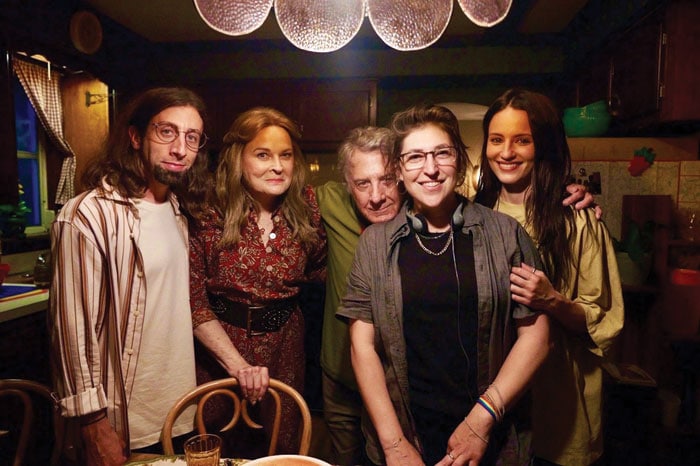
Bialik drew inspiration from her own life when writing the film. It follows Abigail (Dianna Agron), a divorcee with two young boys who is coping with her father’s imminent death and her mother’s reluctance to come to terms with it. Dustin Hoffman plays her father, Eugene, and Candice Bergen plays her mother, Barbara. Simon Helberg, Bialik’s co-star on “The Big Bang Theory,” was tapped for the role of Nathan, Abigail’s estranged brother. 

“Candice was unbelievable, and Dustin was a consummate professional,” said Bialik. “He loved being on the set, and both he and Candice loved having me direct them. I felt more intimidated to direct Simon because he’s my friend and someone I love so much. It was really a surreal experience.”  

Bialik tells the family story in “As They Made Us” with present-day scenes as well as flashbacks. Both Eugene and Barbara suffer from mental illness, and there are plenty of raw, dysfunctional moments, as when Eugene strikes Nathan, ultimately causing him to withdraw from the family. 

“I decided when I wrote this as a commitment to myself and my family that I wouldn’t go scene by scene and say this did or didn’t happen,” she said. “It’s not an autobiography. These characters behave in many ways that my family didn’t.”

Rather than saying exactly what happened, Bialik uses her experiences as a springboard for discussing mental illness and families.

“It’s based on my life, and the lives of anyone growing up with mental illness or addiction who wants to be allowed to talk about it.” – Mayim Bialik 

“It’s based on my life, and the lives of anyone growing up with mental illness or addiction who wants to be allowed to talk about it,” she said. “I grew up in a house with a lot of chaos, mental illness and challenges, but also with humor and connection.”

Bialik has always been interested in mental health. She’s been going to therapy since she was a teenager, and she earned her Ph.D. in neuroscience from UCLA. She hosts a podcast called “Mayim Bialik’s Breakdown,” where she talks with fellow celebrities about mental health and emotional wellbeing. 

“I’ve been on a constant journey,” she said. “I get to explore it with the person I’m in partnership with, Jonathan Cohen, on our podcast, which is incredible and cathartic.” 

“As They Made Us” is unflinchingly honest and realistic, showing just how people react to difficult life circumstances like family dysfunction and the death of a loved one. 

In a particularly heartbreaking scene, which takes place right after Eugene’s funeral, Barbara is gossiping about everyone who showed up. Abigail scolds her, and Barbara defends herself. 

“How dare you speak to a mourner like that, Abigail,” Barbara says.

“I’m mourning too,” Abigail replies.

“Yes, but you’re not his wife,” Barbara says. “There’s a difference.”

Bialik said that the rawness is intentional.

“I wanted a movie that was emotionally honest,” she said. “There are some really ugly things in this movie. We cover death, breakups, people not being able to manage divorce, aging parents and cringe moments with parents. There isn’t a moment that I hid.”

“As They Made Us” is also deeply Jewish. In one scene, Abigail recites the Shema with her children, and during the funeral, the rabbi helps Abigail and Barbara fulfill the ritual of kriah, the tearing of the clothing as part of the mourning process. 

“There is this notion about traditional Judaism that it threads through your life even when things are chaotic,” said Bialik. “There are some beautiful aspects of the Jewish traditions of death and mourning. These traditions, which are thousands of years old, are powerful and evocative.” 

The movie takes place during Hanukkah – so there are menorahs throughout Abigail’s home – and she wears a Magen David necklace. 

“I loved using Dianna’s Hebrew and singing,” said Bialik. “A lot of people know her from ‘Glee.” She was recently in ‘Shiva Baby,’ playing a non-Jewish character, but she is Jewish.” 

Abigail is also a writer working on a cover story for Modern Jew magazine, which may look familiar to readers of the Jewish Journal. 

“It’s based on the Jewish Journal,” said Bialik. “I showed my production designer the Jewish Journal, and there was a little nod to how badly I always wanted to be on the cover of it. My mom was always telling me I should have been on the cover.” 

While filming the movie, Bialik would host Shabbat for her crew.

“There were many Jewish members of the crew, many of whom had never done Shabbat,” she said. “They were really happy to participate, and it was a nice pause during a crazy week. It was really beautiful.” 

As for what’s next, Bialik has been promoting the movie, which came out on April 8 in select theaters as well as all the streaming services. She looks forward to wrapping up shooting on her show “Call Me Kat,” continuing to host “Jeopardy” through May and going to Israel this summer.

“I have family on a kibbutz and in other places that are more controversial,” she said. “I love the Kotel. I’m a Jerusalem person for sure.”

If her father were alive and could see the movie, Bialik said he would carefully analyze it; he was a filmmaker himself, after all.

“He was my greatest critic,” she said. “I think he’d probably like it visually because he was very artsy. He’d go scene by scene and tell me what was wrong with it, and that’s totally fine.”

Since “As They Made Us” is so relatable, Bialik is confident that viewers will see themselves – and their family life – reflected in it.

“It’s about finding redemptive aspects even when people are difficult and complicated.”
– Mayim Bialik  

 “I think everyone will have a connection with the film depending on what their home life and family is like,” she said. “It’s about finding redemptive aspects even when people are difficult and complicated.” 

“As They Made Us” is now in theaters and available for rental or for purchase wherever you watch films.

Mayim Bialik on “As They Made Us,” Her New Film and Directorial Debut Read More »

Gil Troy Interviews Dennis Prager on His New “Rational Haggadah”

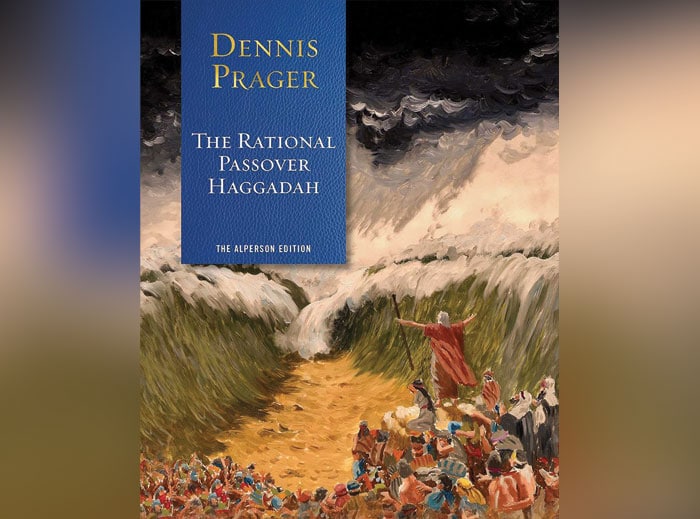
Gil Troy:  I am fascinated by your decision (with your Bible too), to use the word rational … on one level, I get it, the message is that this tradition is reasonable and relevant — and in a world that is too dismissive of our ancient yet still timely teachings, I get it. But in both your introduction to “The Rational Bible” and throughout the “Rational Haggadah,” you keep coming back to the b-word, belief … So, doesn’t using the word “rational” undermine your important messaging about belief, about taking a leap of faith along with a more thoughtful deep dive into the logic and reason shaping both the Bible and the Haggadah?

Dennis Prager: “Belief” is not synonymous with “irrational.” Beliefs can be rational or irrational. If you believe your car speaks to you, that is irrational. If you believe your spouse cheated on you because various behaviors on his or her part led you to that belief, that belief may be quite rational.

My beliefs are rooted in reason. For example, I do not know God exists, but reason alone leads me to believe He does. God’s existence is not provable, but not provable is not the same as not rational. My attitude is best expressed by the title of a book written by the late British Jewish theologian, Rabbi Louis Jacobs: “We Have Reason to Believe.” The title means two things: there are reasons to believe and God gave us reason in order to use it to come to belief.

GT: You write in explaining Magid: that “Nations that do not tell their story to each succeeding generation will eventually have no succeeding generation to whom to tell their story.” I couldn’t agree more . . .  and, I would add two words which I know you meant “Nations that do not tell their story with pride.” I know you work very hard on this issue, fighting the self-hatred that is corroding both American pride and Jewish pride, and most particularly American Jewish pride. I just want to give you an opportunity to jump off of your excellent work on this issue to drive that message home.

DP: Those two words are worthy of adding — especially when one can honestly tell the story of one’s people with pride. Of course, one should tell the whole story, not just the good parts. For both Jews and Americans, thankfully, one can tell the whole truth with pride, despite the flaws — such as slavery and racism in American history, and, in Jewish history, the disproportionate role Jews played in promoting communism, the greatest mass murder ideology of the modern world.

GT: As I was reading “The Rational Haggadah,” I was reading it through three lenses: One, the lens of today . . . second, the lens of other Dennis Prager books I have read over the decades . . . and third, the lens of every other Haggadah I (and you) have read. How has your reading of the Haggadah changed over the years? What do you think you added this time that you wouldn’t have thought of – or felt compelled to spell out – ten years ago, thirty years ago, one hundred years ago?

“One reason I wrote this Haggadah was to stimulate new and deeper discussions. I wouldn’t have thought to do that thirty years ago.”

DP: By midlife, I realized that I and the others at the Seder table were saying pretty much the same things we said in previous years — despite the fact that I have shared Seders with particularly knowledgeable and deep Jews. So one reason I wrote this Haggadah was to stimulate new and deeper discussions. I wouldn’t have thought to do that thirty years ago. Also, I have accumulated insights over a lifetime of Seders that I didn’t have earlier. For example, why is there no “good” son among the four sons? There is a “bad” son, but there is no “good” son. The answer I offer is meant to be life changing.

GT. Mah Nishtanah? Why is this Haggadah different from all other Haggadot?

“It is filled with important discussions — such as, ‘If God took the Jews out of Egypt, why didn’t He take the Jews out of Europe?’ And Why is there no ‘good’ son among the four sons?”

DP: For many reasons. First, it explains almost everything in terms accessible to any participant. Second, it makes just about everything relevant. Third, it is filled with important discussions — such as, “If God took the Jews out of Egypt, why didn’t He take the Jews out of Europe?”

GT: What is your favorite addition or twist that you provided? What do you most want readers of this new Haggadah to appreciate?

DP: The two I have cited — why there is no “good” son and why God didn’t God take the Jews out of Europe — are two of my favorites. In addition, I think that my listing of the Principles of the Jewish Faith — seventeen of them — is, alone, worth the price of the book. It will force every person at the table to consider what he or she actually believes about God, Judaism, religion in general, and the afterlife, among other major matters.

GT: What is your favorite part of the Seder/Haggadah in general?

DP: As a child, it was being with relatives, some of whom I only saw once a year and “stealing” the afikoman. For returning the afikoman, my grandfather gave me the two most important material gifts of my youth — a shortwave radio to hear broadcasts from all over the world and a portable typewriter.

As an adult, I have come to appreciate the discussions my friends and I have engaged in — from theological insights to recalling childhood memories. And I love the songs that end the Seder.

GT: Over your lifetime, what has been the most important lesson you have wanted people to learn about Pesach and the Seder?

“Ritual and memory are the keys to national and religious survival.”

DP: That ritual and memory are the keys to national and religious survival and that God is central to Judaism (hence, Moses’s name appears only once in the entire Haggadah). Or, to put simply, no God, no Judaism.

GT: What can we learn that will be most useful as a tikkun in society in general, or in our own lives.

DP: Goodness cannot be achieved without wisdom. In fact, good intentions without wisdom frequently lead to evil. So, you can’t “repair the world” (tikkun olam) without wisdom.


Professor Gil Troy is the author of nine books on Presidential History including “Why Moderates Make the Best Presidents: From George Washington to Barack Obama.” His latest book, written with Natan Sharansky is “Never Alone: Prison, Politics, and My People.” Follow him on Twitter @GilTroy

Gil Troy Interviews Dennis Prager on His New “Rational Haggadah” Read More »

NJ Man Arrested for Stabbing, Ramming Two Orthodox Jews

A man was arrested on April 8 for stabbing and ramming his car into two Orthodox Jews, as well as ramming his car into a non-Jewish person in Lakewood, NJ.

The man, identified as 27-year-old Dion Marsh, allegedly stole a vehicle and used it to ram the two victims and also stabbed another victim in the chest. He is being charged with three counts of attempted murder, carjacking and bias intimidation.

The two Orthodox Jewish victims are in critical but stable condition and the non-Jewish victim is in serious condition; the Jewish victims’ names are Tzvi Aryeh ben Rivka Leah and Moshe Yigal ben Brunyah, according to Agudath Israel of America.

The Anti-Defamation League (ADL) said in a statement that Marsh is believed to have spouted antisemitic remarks after he was arrested. Prosecutor Bradley D. Billhimer said that one of the charges Marsh faces is a bias intimidation charge over “statements he made to detectives after his arrest.”

“We are grateful to federal and local law enforcement for their swift response in apprehending the suspect and bringing charges that include bias intimidation,” ADL NY/NJ Regional Director Scott Richman said. “I am personally horrified at the cruelty with which the suspect allegedly conducted himself. More needs to be done proactively to prevent violence against the Jewish community, and in particular visibly identifiable Jews in Ocean County and across our region. We recommit ourselves and our organization to working with government, educational institutions, interfaith and intergroup partners and law enforcement in order to achieve this goal. Jews should not be afraid to freely go about their business without living in fear that they will be targeted for violence. The past few years have seen far too many assaults against Jews.”

New Jersey Governor Phil Murphy, a Democrat, said in a statement, “The safety of our communities, and notably our communities of faith, is not only a paramount concern but among my highest priorities. We will continue to partner with all who share this commitment so no resident ever needs to live in fear.”

Billhimer also said in a statement that Marsh allegedly committed the crimes during the day and early evening and acted alone. “I’m grateful for the collaborative efforts of every police officer and detective that worked swiftly to identify Marsh and bring him into custody without further injury to anyone,” he added. “A tremendous job by all involved.”

ADL CEO Jonathan Greenblatt tweeted, “We need more than platitudes or protection to fight this antisemitism — we need proactive solutions.”

NJ Man Arrested for Stabbing, Ramming Two Orthodox Jews Read More »

Redemption and the Birth of a Nation: Finding Lasting Change with the Forging of a New Identity

As we celebrate the holiday of redemption this week, there is much we can learn from the generation that left Mitzrayim after two centuries of oppression and slavery about the true meaning of redemption. You may recall that the generation that left Mitzrayim—those who directly witnessed the miracles of the plagues and sea—was not the same generation that entered the Land of Israel. After the cheit of the Meraglim, the Midrash tells us that each year over the 40 years spent wandering in the desert, the generation that left Egypt dug their own graves each year on Tisha B’av, and did not enter the Promised Land. The commentaries Ibn Ezra and Nechama Liebowitz elucidate that although the Exodus brought forth the birth of the new nation of Am Yisrael, the “generation of the Wilderness” was unable to fully let go of their identity as slaves even after leaving Egypt. Without a new, expanded identity, lasting change was not possible, and they never experienced what it means to truly be free. 

Many of us strive to make lasting change in our daily lives, whether it be in our relationships, our physical bodies, our finances or our happiness and mental states. What we may not realize is that in order to create lasting change in any of these areas, there needs to be an identity shift, or a new expanded identity.

If we believe we are something, that belief of who we are will color our behavior for the rest of our lives. 

Unfortunately, behaviors and goals alone are not enough to make change permanent because the strongest force in the human personality is the need to stay consistent with how we define ourselves.  For example, if we have a goal to lose weight but we see ourselves as someone who is overweight, our identity will triumph every time, even if it is an identity that does not serves us. If we believe we are something, that belief of who we are will color our behavior for the rest of our lives. 

The month of Nissan, during which Pesach falls, is commonly referred to as the month of redemption. In the Gemara we read, “In Nissan they were redeemed, in Nissan they will be redeemed” (Rosh Hashanah 11a).  And yet, despite the wonderous miracles witnessed by the redeemed Jews in Mitzrayim and during the Exodus itself, their intense faith is proven to be transient. Twentieth-century biblical scholar Nechama Liebowitz explains that their skepticism—the residuals of their two-hundred-year identity as slaves—imprison them even as they are on the brink of freedom. The “generation of the Wilderness” suffered from a slave-complex cultivated during centuries of Egyptian bondage: having lived their entire lives as slaves to their Egyptian masters, the Jewish people could not see beyond this and were imprisoned by their subconscious subservience, despite no longer being physically enslaved in Egypt.

The pesukim relate that upon seeing Pharoah and his chariots in pursuit, the Jewish people froze in fear and cried out to Moshe, “Was it for want of graves in Egypt that you brought us to die in the wilderness? What have you done to us, taking us out of Egypt? Is this not the very thing we told you in Egypt, saying, ‘Let us be, and we will serve the Egyptians, for it is better for us to serve the Egyptians than to die in the wilderness’?” (Shemos 14:11-12). In his commentary on these verses, Ibn Ezra explains that the reason a group of 600,000 young and strong men shrank back in fear of their pursuers was because they were psychologically incapable of defending themselves against the very people who had been their owners and masters for centuries. The Jews were stuck in their “slave mentality,” just as we may be stuck with our identities.

Ibn Ezra’s psychological insight extends beyond this one interaction with the Egyptians. The Wilderness generations’ slave-mentality influences their wanderings in the desert, preventing them from fighting against the Egyptians and Amalek, as well as causing them to complain constantly for food and water and, commit the sin of the meraglim (spies), barring them from entering Eretz Yisrael. This was not a generation with the willpower needed to fight against the Canaanim and conquer the land of Israel. For this reason, Ibn Ezra states, the current generation would die during their 40-year wanderings in the desert, during which time a new generation, one that was not born into slavery and therefore free from the psychological bondage of slavery, would be raised and ready to conquer the land of Canaan.

In order for the generation of the Wilderness to have been able to enter the land of Israel, a paradigm shift of identity from slavery to freedom was needed. Unfortunately, despite their strong emunah in G-d, which enabled them to follow Moshe into the desert, and their desire to enter the promised Land, the Wilderness generation was ultimately unable to escape their slave identity. They were forever imprisoned by it, despite being physically freed from their Egyptian slave owners.

We each hold identities and beliefs that inhibit us from making lasting change.

The lesson of the generation of the Wilderness still applies today. We each hold identities and beliefs that inhibit us from making lasting change. By investigating them this Pesach, we can forge new identities that will set us free and bring us the quality of life we desire. Personally, I have shaped, formed and expanded many new identities for myself, including my identity as a single mother. My identity has shifted from believing that a good mother must be a martyr (which does not serve us!) to believing and identifying that a good mother means being a (role)model. 

There is a price we pay for living to satisfy who we believe we “should be.” For the Wilderness generation, the cost of being locked into their slave identity was dying in the desert. It is easy to blame external circumstances, such as COVID-19, change or uncertainty, challenging relationships, work and more for our struggles. But ultimately, it is up to us to create a new identity and belief for ourselves, set increased standards and create rituals to protect our new identities so that we can become who we believe we really are. 


Alanna Apfel lives in Los Angeles and is the founder of and patient advocate at AA Insurance Advocacy, helping patients negotiate with insurance plans for reimbursement on their out of pocket therapy mental health expenses. Alanna can be reached at aainsuranceadvocate@gmail.com.

Redemption and the Birth of a Nation: Finding Lasting Change with the Forging of a New Identity Read More »

From Slavery to Freedom: Keeping Israel at the Seder Table

The Seder is the ultimate Jewish celebration of freedom. We sit (or recline) with our families and friends around the table recounting the story, as if each of us was a slave who witnessed the terrible plagues and then suddenly, at midnight, marched upright with clenched fists and unleavened bread on our backs, out of Egypt.  

Different generations and communities celebrate the Seder according to their own customs and interpretations, adding references to the embodiment of Pharaoh as the main tormentor of the Jews of that time. After the Holocaust and the rebirth of Israel, these events were interpreted as a strong parallel to the transition from slavery to freedom. 

In recent years, as those memories faded, some politically liberal Jews have shifted the emphasis from the core Jewish experience, first in Egypt and then in subsequent generations, to a universalist version embracing the downtrodden of the world. I first encountered this as a student in Berkeley in 1969, in the form of a “Freedom Haggadah,” which sought to draw comparisons between the events of the exodus and the burning political issues of the day in America—specifically civil rights (as it was known then) and the women’s liberation movement. Egypt, Israelites and slavery were still part of the text, but were no longer the primary or only focus. Armed with my copy of that Haggadah, I went home for our non-liberal particularist family seders.

In the decades since, successors to these activists of the 1960s moved the emphasis further away from Jewish history, culture and identity and towards universalism in the form of identifying with all victims, many real, and but also some that are imagined. (Today’s edition would focus on the war against Ukraine, with Putin in the role of Pharaoh.) 

In the progressive versions of the Haggadah that I have seen, the traditional four cups of wine are reinterpreted—with no mention of the traditional symbolism of the fourth cup, associated with God’s promise to bring the Israelites to the land of Abraham, Isaac and Jacob (Exodus 6:8). Leaving Egypt was never considered an end in itself, but rather the first step in a complex process of redemption, via Sinai and the commandments, and ending with the arrival (forty years later) in the Land of Israel. 

By deliberately disconnecting the two, the revisionists are deleting this core dimension. In their political spin, this cup, in a paraphrase of the others, is supposed to represent “a world where no one is held in slavery … a world without sweatshop laborers, where all workers are able to make a fair wage” (“A Haggadah for Justice – Truah”). The particularism of Jewish existence—the Promised Land and Land of Israel—are censored out of existence. 

Similarly, in every generation for 2000 years in exile and Diaspora, our ancestors ended the seder by singing “Next year in Jerusalem.” But in another manifestation of intersectionality and self-assimilation, this statement and all mention of Jerusalem and Jewish self-determination are erased from progressive seders. This is part of the wider assault on Jewish history and identity, in which Zionism is presented as a form of “colonialism” and, according to the NGO industry and the United Nations, “apartheid.” To the degree that Israel is presented at all in these versions of the Haggadah, it is through this hostile and distorted filter, envisioned not as the homeland of the Jewish people, but rather as a country of “all its inhabitants”—the catch-phrase for dismantling the Jewish state. Far from the celebration of Jewish freedom and deliverance from oppression, the intersectional Haggadah highlights the need for “grappling with the realities of Jewish power, Palestine solidarity, and the sense of Jewish complicity with Palestinian suffering and white supremacy.”

Like the wicked child in the Haggadah, the radical universalists and inter-sectionalists are excluding themselves, their lost and uninformed followers, and their children from the Jewish community.  

Like the wicked child in the Haggadah, the radical universalists and inter-sectionalists are excluding themselves, their lost and uninformed followers, and their children from the Jewish community.  

These distortions and interpretations go far beyond the student-led “Freedom Haggadah” of 50 years ago. The earlier versions added universal concerns without erasing the traditional Jewish interpretations and themes, including the celebration of our freedom in the Land of Israel, and the right of the Jewish people to determine our own destiny. 

Just as the exodus from Egypt necessarily led to the arrival in the Land of Israel, the founders of Zionism understood that to escape from the oppression of the diaspora, the Jewish people must be anchored in our homeland.

In contrast, the marginal Jews and anti-Zionists of today are marching backwards from freedom into a world of assimilation and slavery.

In contrast, the marginal Jews and anti-Zionists of today are marching backwards from freedom into a world of assimilation and slavery. By prohibiting all particularism, and specifically attacking the centrality of Israel to the Jewish people, they are tearing down our identity. 

For generations upon generations, the texts and collective rituals of the Passover seder were primary expressions of Jewish continuity and the everlasting yearning for our own freedom, which every family taught to their children. This continuity is the essence of our identity as a people and a nation, and the key to our survival. 

Next year in Jerusalem. 

Gerald Steinberg is emeritus Professor of Political Science at Bar Ilan University and president of NGO Monitor. His latest book is “Menachem Begin and the Israel-Egypt Peace Process: Between Ideology and Political Realism” (Indiana University Press). 

From Slavery to Freedom: Keeping Israel at the Seder Table Read More »

you-dont-know-schiff

Maurice LaMarche – Part One

You know and love Maurice LaMarche. Even if you didn’t know you do! Maurice is the wildly talented, voice actor, comedian and impressionist who has voiced some of the most beloved animated characters of our time. He is the voice behind The Brain in “Pinky and The Brain,” Dr. Egon Spengler from “The Real Ghostbusters,” dozens of characters on the show “Futurama” (including Kif Kroker and Calculon), and he’s the voice for scores of other TV shows, movies, and commercials.

We get to know the man behind the voices in this wonderful two-part conversation with Maurice as he talks with Mark and Lowell about growing up in Canada, trying to overcome social anxiety as a child by experimenting with voices, his start in comedy including opening on the road for Rodney Dangerfield. Maurice talks about his family and some of the tremendous personal loss he’s experienced.  And he shares an uplifting story about life-changing guidance he received during a chance encounter with the Dalai Lama.

Follow Maurice:
https://twitter.com/mauricelamarche/
https://www.instagram.com/maurice_lamarche/

Your hosts:
Mark Schiff
https://markschiff.com
https://twitter.com/markschiff
https://instagram.com/markschiff1

Lowell Benjamin
https://twitter.com/lowellcbenjamin
https://instagram.com/lowellcbenjamin

Check out Mark’s book
“I Killed: True Stories of the Road from America’s Top Comics”
https://www.amazon.com/Killed-True-Stories-Americas-Comics-ebook/dp/B0024NP5DI


Maurice LaMarche – Part One Read More »