fbpx

February 14, 2022

Jewish Westerns and Peddler Power

America has never quite known how to differentiate Jews from the other “huddled masses” who found refuge in the United States. And there has been so much mixed-messaging.

Are Jews a persecuted minority—occasionally victims of mass murder—to be pitied? Or are they a special breed of Caucasians—the whitest of white—imbued with infinite resources of ingenuity, acumen and craftiness that enable them to better leverage their privilege?

Contrasting and interchangeable images: a timid people wrapped in prayer shawls, too weak to push their pushcarts, helplessly awaiting the next pogrom; or super white people who furtively run the show and oppress the unfortunate?

The recent dustup over Whoopi Goldberg’s astonishing ignorance about how the Holocaust was, in actuality, a race war between the Master Race and Jewish sub humans, is an example of this confusion over Jewish power. Somehow, Whoopi managed to miss all those books, documentaries, survivor testimonies, TV shows and movies, all detailing how, and why, two out of three European Jews disappeared between 1938 and1945.

Brainwashed by Critical Race dogma, Whoopi felt compelled to remind her co-hosts and TV audience that the Holocaust was merely two groups of white people—Nazis and Jews—who didn’t like each other. The Holocaust was a mere spat among equals, “inhumanity” that took a wrong turn. After all, crimes committed by white people against one another are not racially motivated and not especially tragic, either.

How did such warped thinking permeate the American consciousness? Our Founding Fathers would be surprised by this more sinister and less benevolent perception of Jews.

Before America’s founding, a Polish-Jewish immigrant from Philadelphia, Haym Solomon, was among the Sons of Liberty prepared to take arms against King George III. Solomon was not a marksman with a musket, however. He was a financier, a wizard in raising funds and selling bills of exchange.

George Washington always acknowledged that without this American version of Solomonian wisdom, the Battle of Yorktown in 1781 would have been lost and America would have remained a British Colony. The Continental Army had completely run out of money, and General Washington once more turned to Solomon for assistance.

How’s that for a new twist on Jewish bankers—not sinister, but the epitome of patriotism.

By 1790, when Washington, then President of a new nation, wrote his Letter to the Hebrew Congregations of Newport, Rhode Island, he forgot neither Solomon, nor the vulnerability of Jews who sought safe harbor in America. Reassuringly, he wrote the “Government of the United States, which gives to bigotry no sanction, to persecution no assistance,” welcomes them.

America had nothing to fear from Jews. If anything, Jews who found themselves in the wrong neighborhoods had much to worry about. For them, being white didn’t come with special powers.

If anything, Jews who found themselves in the wrong neighborhoods had much to worry about. For them, being white didn’t come with special powers.

A stereotype emerged about Jews traveling across the frontier—passive peddlers practicing their faith, maintaining their values in the unlikeliest of places. How does one find a minyan among all that Manifest Destiny? Yet, not everyone was doomed to tenement eternity and urban squalor. Some went west, to the vastness of America, not on wagon trains for a life as cowboys, but as simple, slow-moving peddlers, not unlike the origin stories of Levi Strauss and Neiman Marcus.

The typecasting of Jews on the frontier puts the lie to the cushy, exploitative lives of privileged Jewish-Americans. In popular culture, Jews were forever outsiders longing for guardian angels and skeptical that they could ever assimilate among white Americans. The melting pot, after all, made for a largely unkosher stew.

Jews never figured into the binary, white- or black-hatted roles now favored by Hollywood and TV networks. The plots called for Jewish characters to be walk-ons, and never leads. The Golden Age of TV, for instance, had no stories of Jews as ranchers, rustlers, outlaws or sheriffs. Jewish families did not eke out a hardscrabble existence on the open range.

Many of the cowboy westerns on TV, the classics of the genre, produced at least one obligatory Jewish episode. Middle America and Main Street saw Jews depicted as nakedly defenseless. College students could learn something from those episodes. If nothing else: it will give woke professors strokes. Impoverished Jews, so clearly a minority people, yet so obviously distinct from the dominant culture of white America?

Despite all the intersectional sleight of hand that has falsely libeled Jews as oppressors at home and land-grabbers in the Middle East, it might be that the most minute of minorities, the object of such longstanding historical vilification, are vulnerable, still.

In a 1962 episode of “Rawhide,” co-starring a young Clint Eastwood, a Jewish peddler hondels with Indians to avoid a range war over cattle, and then marries an Indian! Wait, there’s more: Cowboys are served knishes and shout “mazel tov!” “Bonanza,” in 1963, introduced a Jewish father, also a peddler, and his daughter, observing Shabbat in the Sierras. (Two of the four co-stars of the series, Lorne Greene and Michael Landon, were actually Jewish, but not while portraying the fictional Cartwrights.) In 1967, “The Big Valley” depicts Milton Berle as a benighted but sly sheep herder. “Gunsmoke” aired an episode in 1973 featuring a young Richard Dreyfuss as the son of a law-abiding Jewish father who wants to take revenge against those who murdered his brother.

Each episode parallels a similar depiction of Jews in the West: itinerate peddlers, moving slowly in small wagons, living honest and faithful lives. Failed farmers. All at some point forced to confront ruffians in the most lawless and hostile of settings.

Each episode parallels a similar depiction of Jews in the West: itinerate peddlers, moving slowly in small wagons, living honest and faithful lives.

“Go West, landsmen, but the frontier is no place for anyone who abides by the ‘thou shall not kill’ commandment and who insists on keeping kosher.”

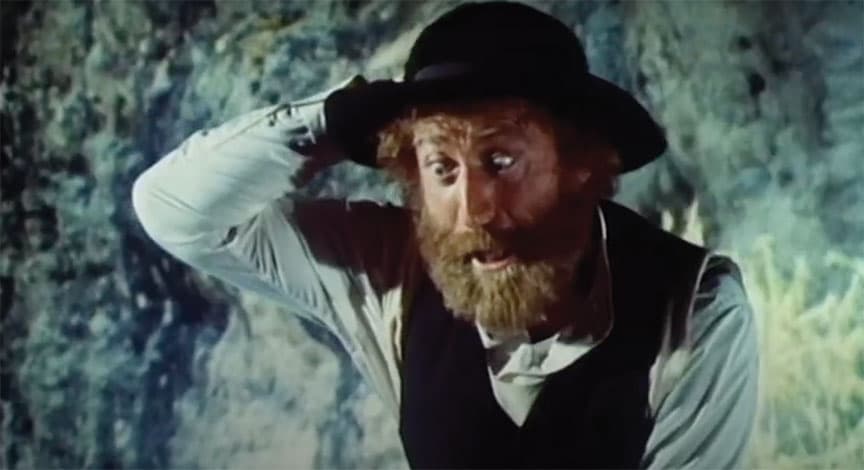
More comedically, but covering the same ground, there’s the film, “The Frisco Kid” (1979), starring Gene Wilder as a Polish rabbi trying to make it across America to lead a congregation in San Francisco, and Harrison Ford, as the worldly cowboy who gets him there. So, too, in the South during the Depression in the first season of “The Waltons” (1972), a Jewish professor and his family escape Hitler, yet still feel unsafe in rural Virginia.

There are strong American messages throughout. Living in fear, like Jews, is not the American way. And refusing to carry a gun, and to use it when necessary, is often a tragic mistake. After all, God is never written into the scene to protect his or her people—whether it be in Dodge or on the Ponderosa. The impulse of Jewish powerlessness, the aversion to fight back, is the cornerstone of each plot.

These are America’s super men, prone to their own versions of violence, Shylocks on the prowl, among the privileged and never the victim?

Something for Whoopi Goldberg to wonder.


Thane Rosenbaum is a novelist, essayist, law professor and Distinguished University Professor at Touro College, where he directs the Forum on Life, Culture & Society. He is the legal analyst for CBS News Radio. His most recent book is titled “Saving Free Speech … From Itself.”

Jewish Westerns and Peddler Power Read More »

Is It Time to Revisit “Love Your Neighbor as Yourself”?

One of the most accepted truths of the Jewish tradition, and of the world at large, is to “love your neighbor as yourself.” And since today is Valentine’s Day, the day of love, what better time to revisit the oldest saying about love?

We’ve been hearing this “love your neighbor” saying for so long it rarely dawns on us that it may be overlooking something. For example, what if I hate myself? What if I’m depressed and abuse myself? What if, deep down, the confident, self-loving front I show the world is covering up feelings of self-loathing?

Is that the kind of love I should show my neighbor?

For better or worse, self-hatred— and the emotional ills attached to it– is so prevalent throughout our society that treating it has become a billion-dollar industry. And yet, we keep promoting the golden rule, which assumes that because we put our own interests first, we must love ourselves.

As natural as that may sound, reality and psychology often tell a different story.

Even the ultimate self-lovers, the narcissists, are not what they seem. A recent study reported by BBC indicates that “unlike Narcissus staring at himself reflecting in the pool, many narcissists actually aren’t in love with themselves after all. Quite the opposite, in fact.”

Much of the time, the study showed, “a narcissist’s behavior isn’t driven by self-love – rather, self-hatred… narcissistic behavior like flexing on social media might come from low self-esteem and a constant need for self-validation.”

The point is this: We shouldn’t assume that people love themselves more than they love their neighbors. Many people, in fact, treat neighbors far better than they treat themselves. It’s a lot easier to be respectful and polite with those who don’t remind us of our inner demons.

Many people treat neighbors far better than they treat themselves. It’s a lot easier to be respectful and polite with those who don’t remind us of our inner demons.

I remember speaking to a therapist once about how some people are more courteous with strangers they encounter during the day than they are with their spouse. It’s the old idea that “familiarity brings contempt.” That same principle can apply to individuals. Self-loathers, after all, are only too familiar with the traits they hate about themselves.

If some of what I’m suggesting here rings true, the real question becomes: How do we increase our self-love so that we have more of it to give to others?

For the millions who don’t love themselves, but who show impeccable courtesy with the outside world, maybe we ought to flip the golden rule: “Love yourself as your neighbors.” Start by being as courteous and respectful with yourself as you are with strangers.

And then, you’ll be more likely to be courteous with your loved ones. In the world of love, courtesy is just as important as a dozen roses.

Happy Valentine’s Day.


Is It Time to Revisit “Love Your Neighbor as Yourself”? Read More »

Sephardic Jew, Coptic Christian to Launch Middle East Talk Show

A Sephardic Jew and Egyptian Coptic Christian, both of whom are female, are launching a Middle East talk show.

The hosts are going to be Adela Cojab, who is currently studying at Yeshiva University’s Cardozo School of Law, and Mariam Wahba, Associate Director of Advocacy at the Middle East Christian engagement organization The Philos Project, in the “American-ish Show: Daughters of the Diaspora.” Cojab, whose complaint against her alma mater, New York University, resulted in a groundbreaking settlement, told the Journal in a phone interview that she and Wahba connected through mutual friends and met for lunch. “The more we talked the more we realized we had so much in common and how little we knew about the other,” Cojab said. “I really knew nothing about Coptic Egyptians, I really didn’t know much about Christians in the Middle East in general. She knew about Jews from the Middle East … it was like a new world. We realized our cultures are so similar, our experiences are very similar, our communities are very similar. The conversation lasted hours and hours and hours, and we just felt like we had good stories, good conversations that other people should hear.” Cojab is of Syrian and Lebanese descent.

The show, which will be broadcasted on Instagram TV and found on YouTube and Spotify, will be 25 minutes long and they have already recorded three episodes. The focus will be on Middle East policy and will feature various experts as guests to discuss the matter but will also address faith, love, identity and culture. “We don’t want it to have just a specific religion focus or focus on being female or focus on being an immigrant,” Cojab said. “We do realize that we share is having this broad international view of things and we both have contacts that are experts on this that inform our worldviews, so it’s also about being able to share that with the audience and making it digestible.” 

She added that the primary demographic they’re aiming to reach is those between ages 16-30. “We want young people to hear this from us,” Cojab said, pointing out that most people get their news from infographics that don’t provide much research and information. “We’re not going to be a news source, but we are going to be talking about contemporary issues, touching on what’s going on in Turkey, what’s going on in Iran … we also get to learn from each other. I’ve never heard the point of view from a Christian in the Middle East about these issues.”

Outside of the Middle East, the show will discuss standards of body image and marriage as well as mental health and security. “We both come from countries that are not safe, and the comfort of being in the U.S. and not having to deal with the security issues and safety issues and how it’s just second-nature for an American to just walk on the streets and let their kids walk on the streets or let their kids walk on the streets is something that they take for granted,” Cojab said. “In a way, we value things about America and we can talk about America in a way that Americans can’t because they’re so blind to it.”

She added: “If I can have everyone just hear one thing that I have to say, it’s that it’s time to get out of the Jewish echo chamber and talking to people like us because we think that we’re alone and that we’re on our own on a lot of these issues, but the more we talk to people that have other experiences, the more we realize we’re not all that different.”

The first episode will be launched on February 20.


View this post on Instagram


A post shared by American-ish Show (@americanishshow)


View this post on Instagram


A post shared by American-ish Show (@americanishshow)

Sephardic Jew, Coptic Christian to Launch Middle East Talk Show Read More »

Israeli-Arab, Israeli-American Couple Launch Middle East News Show

An Israeli Arab Christian and Israeli-American couple launched a Middle East news show on February 2.

The show, called “Headlines with the Haddads,” features Israeli-Arab activist Yoseph Haddad and Social Lite Creative CEO Emily Schrader discussing the latest news in the Middle East while also playing off their real-life relationship; the two are engaged to be married later in 2022.


Their first episode features an interview with Ellie Cohanim, the former Deputy Special Envoy to Monitor and Combat Antisemitism, and Haddad, who was originally born in Nazareth, criticizing Amnesty International’s February 1 report alleging that Israel engages in apartheid. Their second episode, which will air on February 16, will feature Jason Greenblatt, the former Middle East advisor to then-President Donald Trump.

New episodes will air on Wednesdays on Instagram and YouTube and will be around 20-30 minutes long.

“We see that the media often gives an incomplete picture of what’s happening in Israel, and additionally, many in the West don’t understand the impact of events in the region and how it affects them,” Schrader said in a statement. “It’s time to change that.”

Haddad also said in a statement: “It’s critical that we raise awareness about the entire Israeli society, which of course includes both Arab and Jews, and help present the broader picture of Israel in a better way. Who better to talk about these issues than an Israeli Arab like myself?”

Israeli-Arab, Israeli-American Couple Launch Middle East News Show Read More »

THANK YOU NAEJ Awards! I am a 2x Finalist

Thank you for all of your support! I am a two-time finalist for the 14th annual 2021 National Arts and Entertainment Journalism (NAEJ) Awards!

Please find my two nominated stories below. Thank you to the Los Angeles Press Club and Diana Ljungaeus, Executive Director!

F18. Commentary Diversity/Gender

* Lisa Niver, Jewish Journal, “The Gift of Kindness: 2020, COVID and Chanukah

https://jewishjournal.com/commentary/324344/the-gift-of-kindness-2020-covid-and-chanukah/

* Sydney Love, Alta Journal, “California’s White Wine Problem”

* Sandro Monetti, Hollywood International Filmmaker Magazine, “Geena Davis – Gamechanger”

* Keenan Norris, Alta Journal, “One Coyote”

* Malina Saval, Variety, “Too Jewish For Hollywood: As Antisemitism Soars, Hollywood Should Address Its Enduring Hypocrisy In Hyperbolic Caricatures of Jews”

I8. Commentary Analysis/Trend — Film

* Lisa Niver, Thrive Global, “Building Life Again After Loss: Sliding Doors, Braver Than You Think and My Wife Said You May Want to Marry Me

* Kate Aurthur, Variety, “What It’s Like to See ‘Tenet’ in a Movie Theater”

* Kate Bove, Eric Mueller and Patricia Puentes, Ask Media Group, “Disney Has a Queerbaiting Problem: Ask’s Editors Break Down How It Harms the LGBTQ+ Community”

* Ashley Lee, Los Angeles Times, “Theater is Hollywood’s talent incubator. It’s time Hollywood stepped up to save it”

* Manori Ravindran, Variety, “What It’s Like Attending a Film Festival During COVID-19”

LOS ANGELES, CALIFORNIA – OCTOBER 16: BJ Korros and guest attend the Los Angeles Press Club’s 63rd Annual Journalism Awards Dinner at Millennium Biltmore Hotel Los Angeles on October 16, 2021 in Los Angeles, California. (Photo by Robin L Marshall/Getty Images)

Lisa Niver has won many awards! From 2017 to 2022, in the Southern California Journalism Awards and National Arts and Entertainment Journalism Awards, she has won five times and been a finalist nineteen times for a variety of broadcast, print and digital categories.

More about Lisa Niver: https://lisaniver.com/awards/

THANK YOU NAEJ Awards! I am a 2x Finalist Read More »