fbpx

January 26, 2022

Why Was There No Warp Speed for Therapeutics?

Nearly two years into a massive, multibillion-dollar public health campaign to combat the deadly COVID-19 virus, deaths in the U.S. are still climbing. With the death count already at over 860,000, a Jan. 19 report in the Associated Press warns that “50,000 to 300,000 more Americans could die by the time the [Omicron] wave subsides in mid-March.”

How is this possible? How could deaths continue to rise after 208 million Americans got fully vaccinated? If you listen to the mainstream media and the public health establishment, all roads and solutions lead to vaccination. If only more people were vaccinated or got booster shots, the mantra goes, we could finally tame this monster.

But this ignores a hugely important weapon in combating the virus—therapeutics. If the vaccine is a gate that tries to keep the virus at bay, therapeutics are the precision weapons that kill it once it enters. By so blatantly favoring one weapon over the other, we ended up fighting a lethal virus with one hand tied behind our back.

By so blatantly favoring one weapon over the other, we ended up fighting a lethal virus with one hand tied behind our back.

When Congress investigates our response to the pandemic, this ought to be the first question: Why was there no Operation Warp Speed for therapeutics, just as there was for vaccines?

This question is crucial for the obvious reason that countless lives could have been saved, but also because a warp speed initiative for therapeutics might have minimized the relentless lockdowns and mandates that have devastated and divided our country, not to mention triggered a mental health crisis and forced millions of school children to isolate at home in front of computer screens. 

A lot may have changed in two years as we’ve learned more about the virus and its variants, but this truth hasn’t changed: We should have treated therapeutics a lot more seriously from the very beginning. Why didn’t we? Congress must get to the bottom of this, but there are things we already know.

For starters, we know the elephant in the room: drug companies make more money with vaccines. That’s just a fact. Whereas vaccines aim for 100 percent of a population and have repeat doses, therapeutics aim only for those who get sick. According to Nature magazine, global sales of COVID vaccines were expected to top $50 billion in 2021. It’s no surprise, then, that the warp speed initiative for vaccines was so speedy—the drug companies had a major financial incentive.

The elephant in the room is that drug companies make more money with vaccines. That’s just a fact.

We also know that the hyperfocus on vaccines had serious repercussions. Because vaccines prioritize mass protection over treatment, we were urged to protect ourselves at all cost. This created a climate of fear, making us more willing to accept any public measure or mandate we believed would protect us. Eventually, it made us resentful of anyone who didn’t share our beliefs.

Therapeutics nurture caution but not paranoia. You know that even if you get infected, there is a treatment. In recent months, as the health establishment has tried to catch up, more and more doctors have been using different sorts of therapeutics to help treat COVID, using the best data available. Unfortunately, without a massive, concerted and credible effort behind them, therapeutics are still seen as the stepchild to vaccines.

This is tragic, because with millions of lives at stake around the world, therapeutics deserve to be at least equal partners. While vaccine efficacy can wane with time, as we’re seeing now with COVID vaccines, therapeutics are precision weapons that have no such limitation.

Furthermore, even assuming we can vaccinate 100 percent of the U.S. population with a vaccine that is 90 percent effective, in a country of 330 million that still leaves up to 33 million people in potential danger. If vaccines can’t help them, what weapon can? Yes, therapeutics.

The vaccine train has been so loud that many therapeutics have become a sideshow and the object of ridicule, associated with conspiracy quacks. This is unfortunate, given that therapeutics have been a lifeblood of modern medicine, successfully treating such lethal diseases as AIDS and Hepatitis C.

Mario Tama/Getty Images

Ironically, back in July 2020, the Washington Post reported that “Operation Warp Speed is pushing for COVID-19 therapeutics by early fall.” As Janet Woodcock, who was leading the therapeutics effort under Operation Warp Speed, explained: “Some people may not respond to vaccines and some may not get vaccinated, so we are always going to need therapeutics.”

Unlike vaccines, Woodcock said, “therapeutics have to be developed against multiple facets of the infection, including antiviral treatments that target the virus and medication that quells the out-of-control immune storm that causes the most severe illness.”

It’s been 18 months since that announcement. What happened to the operation? What slowed the warp speed? Did special interests get in the way? Since Congress is the body that approves funding, it is imperative that it find answers to these questions.

Taxpayers deserve to know why only 1% of the $1.9 trillion in last March’s COVID relief cash went for treatments. 

Taxpayers, for example, deserve to know why only 1% of the $1.9 trillion in last March’s COVID relief cash went for treatments, as reported by The Wall Street Journal on Jan. 12 in an editorial titled, “Biden’s Operation Snail Speed on Covid Therapies.”

“About as much money was given last year to New York’s financially ailing transit system as the Administration spent procuring Covid therapies,” the Journal reported. “The result: A persistent treatment shortage and countless preventable deaths.”

Because of the “snail speed” that has plagued COVID therapeutics from the start, efforts to catch up have been painfully inadequate. The Biden Administration recently ordered another 600,000 doses of GlaxoSmithKline and Vir Biotechnology’s monoclonal antibody. But the problem, as the Journal notes, is that “these treatments will probably arrive after the Omicron Covid variant crests. Why didn’t it order more treatments sooner?”

This lack of urgency is a recurring theme. The Administration waited until November to order 10 million courses of Pfizer’s Paxlovid after trial data showed it reduced hospitalizations by nearly 90%. Again, the problem, as the Journal notes, is that “manufacturing the pills takes six to eight months so supply has been very limited. Had the Administration ordered more treatments sooner, more would have been available this winter.”

Not surprisingly, a report in The Washington Post on Jan. 24 noted that “several doctors and hospitals have noted that some of the Covid treatments, including the Pfizer pill and sotrovimad, are in short supply.”

According to a prominent epidemiologist I spoke to, Pfizer had Paxlovid sitting on the shelf for years. It only started studying it and applying for Emergency Use Authorization after it saw its vaccine sales decline because of waning efficacy and the unlikeliness of selling 4 or 5 boosters. Congress should investigate and, if that is accurate, ask: Why didn’t Pfizer bring Paxlovid to market in 2020 and why didn’t our task forces push them to do so?
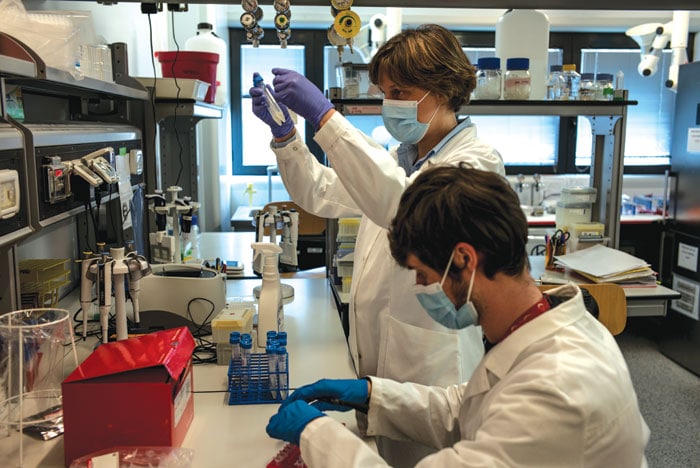
Researchers work in Monoclonal Antibody Discovery Lab at TLS Foundation on February 22, 2021 in Siena, Italy. (Photo by Gianluca Panella/Getty Images)

In short, even if you’re radically in favor of vaccines, it’s hard to dispute that our leaders have failed us royally when it comes to delivering on therapeutics. This lack of urgency with an indispensable tool has led not only to needless deaths, but to the undermining of COVID therapeutics in general. Bring up a therapeutic on social media these days and you’re likely to be called a conspiracy nut job from the far right.

I’ve spoken to enough epidemiologists to recognize that several of the early studies touting the benefits of one therapeutic or another had holes in them. Some were sketchy; others more reliable. But that’s precisely the point: Had we brought the same urgency and resources to therapeutics that we brought to vaccines, therapeutics would have been embraced as legitimate life-savers rather than a source of ridicule.

Few people know that there are clinical trial networks ready to jump on studies to provide reliable data on treatment efficacy. In 2017, for example, Michigan Medicine launched a comprehensive network to improve patient outcomes from emergency conditions. The point is that the infrastructure and clinical networks are there. Had our government provided significant resources to immediately activate these networks at the beginning of the pandemic, reliable data on COVID therapeutics would have come at warp speed. Now, two years and 860,000 deaths later, we’re scrambling to catch up, hoping no one will notice.

The price of this neglect has been immense, both in lives lost and in the devastation caused by lockdowns. The massive school closures are Exhibit A.

The price of this neglect has been immense, both in lives lost and in the devastation caused by lockdowns. The massive school closures are Exhibit A.

New York Magazine’s progressive commentator, Jonathan Chait, acknowledged on Jan. 17 that closing schools “did little to contain the pandemic” and that it’s time progressives come to terms with the fact that mass school closures were “catastrophic.”

An editorial in the BMJ, a British weekly peer-reviewed medical trade journal, concluded in early 2021 that “Children have least to gain and most to lose from school closures. This pandemic has seen an unprecedented intergenerational transfer of harm and costs from elderly socioeconomically privileged people to disadvantaged children. The UN convention on the rights of the child and the duty on the government to respect, protect and fulfill those rights have largely been overlooked.”

It shouldn’t surprise us that school closures have resulted in an unprecedented mental health crisis for young people. As far back as February of 2021, Axios reported that “Hospitals have seen a significant increase in mental health emergencies among children, and federal officials have acknowledged that prolonged school closures have deprived students of both formal services and simple human interaction.”

Hollywood High Teachers Assistant Yolanda Franco conducts class remotely on September 08, 2020 in Los Angeles, California
(Photo by Rodin Eckenroth/Getty Images)

Even the United Nations Educational, Scientific and Cultural Organization (UNESCO) has taken up the issue of prolonged school closures, noting: “School closures carry high social and economic costs for people across communities. Their impact however is particularly severe for the most vulnerable and marginalized boys and girls and their families. The resulting disruptions exacerbate already existing disparities within the education system but also in other aspects of their lives.”

There is a direct link between the mass closures and the emphasis on vaccines at the expense of therapeutics. Because vaccines aim for mass inoculation, anything that falls short triggers mass anxiety. This makes it easier to impose draconian measures like mandates and closures.

Therapeutics aim for precision, which makes mass closures a much tougher sell. If you catch it, you can be treated. Imagine what a difference widely available and effective therapeutics would have made over the past two years in the overcrowded emergency rooms dealing with hundreds of thousands of infected people. Would we have needed all these devastating lockdowns and divisive mandates?

Imagine what a difference widely available and effective therapeutics would have made over the past two years in the overcrowded emergency rooms dealing with hundreds of thousands of infected people.

I say all this as a big fan of vaccines. The key benefit of COVID vaccines is that they mitigate damages in case one gets infected. That is indeed what happened to me after I tested positive for Omicron in December— I felt congested for a few days and it was gone. Along with millions of others, the vaccines became our seat belts and air bags when we crashed with the virus.

But just as I appreciate the value of vaccines, I also recognize their limitations. Because vaccine success relies so much on mass acceptance, it was always unrealistic to expect such unanimity in a free country, especially with a public health bureaucracy with such low credibility.

We also know that evidence of the vaccines’ side effects was consistently downplayed or suppressed, both by the legacy media and the health establishment. Given the mainstream obsession with jabbing everyone, this suppression of unwelcome news should surprise no one.

Needless to say, I’m fully aware that the majority of severe COVID patients have been unvaccinated. But while it’s easy to castigate those patients for not getting the shots, the real culprit is our health establishment that failed to deliver the therapeutics that would have treated those unvaccinated patients.

On a societal note, the widespread emphasis on vaccines has divided our nation. Whereas precision treatments treat everyone equally—whoever gets the virus gets the treatment—vaccines split the population in two—the jabs and the jabs not. This has exacerbated the political polarization already plaguing our country.

Looking back, it’s clear that our leaders made a series of missteps in their handling of the pandemic, as James Meigs succinctly summarized in Commentary:

“At a time when we needed our officials to respond nimbly to a rapidly evolving threat, our health agencies proved slow and inflexible. When it came to providing workable tests for the virus, speeding up deliveries of protective equipment, or simply communicating clearly and honestly with the nation, our public-health establishment failed. It wasn’t just a matter of moving too slowly. At times, our health bureaucrats actively obstructed doctors, researchers, private companies, and others trying to fight the pandemic. They even tried to limit the range of permissible scientific discussions about COVID-19, shutting down inquiries into the origins of the virus and debates about how it spreads.”

Take all those missteps, however, and they still don’t equal the singular meta failure to invest massively and urgently in precision therapeutics.

It should never have been about being “pro-vaccine” or “anti-vaccine” or being “pro-vaccine” or “pro-therapeutics.” It should always have been about an equal partnership between the two. That would have lessened the acrimony spreading throughout our country.

In the end, perhaps the most tragic aspect of our war against COVID is simply that we abandoned common sense. Beating the virus always required a one-two punch, not a one punch. As powerful as vaccines are, they needed the partnership of powerful therapeutics to win the war. We haven’t stopped paying the price for this tragic miscalculation.

It should never have been about being “pro-vaccine” or “anti-vaccine” or being “pro-vaccine” or “pro-therapeutics.” It should always have been about an equal partnership between the two. In addition to saving lives, that would certainly have lessened the acrimony spreading throughout our country.

Many of us have forgotten that in his 2015 State of the Union address, President Barack Obama launched the Precision Medicine Initiative, for “health care tailored to you.” The goal was “to give medical professionals the resources they need to target the specific treatments of the illnesses we encounter, further develop our scientific and medical research, and keep our families healthier.”

Congress must ask: “What happened to the Precision Medicine Initiative? Where was the precision in our fight against COVID? And why has it taken so long to get approval for therapeutics?”

Books will be written about this epic breakdown in the years and decades ahead. Through in-depth and bipartisan investigative reporting, we will learn more about bureaucratic incompetence, conflicts of interests and the price we and our children have paid for this colossal failure.

But we can’t wait for those books. COVID is still killing people, and it may have more lethal variants in store. The need for effective therapeutics is as urgent as ever, especially since we’re seeing evidence of the waning efficacy of vaccines.

In the face of our historic failure to deliver on life-saving therapeutics in the same way we delivered on vaccines, all roads now lead to Congress. If our elected representatives launched a Commission of Inquiry after the 9/11 disaster that killed 3,000 Americans, they must launch an even more urgent inquiry about a disaster that is on track to kill a million Americans.

As 2,000 of our fellow Americans die each day, as fear continues to paralyze and divide our nation, as our mental health crisis accelerates and as we desperately try to catch up to deliver vital treatments, this is one investigation that merits warp speed.

Why Was There No Warp Speed for Therapeutics? Read More »

david suissa shanni suissa podcast

What’s the Biggest Mistake we Made with COVID?


Why was there no Warp Speed for therapeutics? Is there a vaccine for antisemitism? Can we return to a happy middle after all this woke overcorrection? And where can you find a kosher tailgate party? Tune in for another lively episode of Conversations with Shanni.

Follow David Suissa on FacebookTwitter and Instagram & Shanni Suissa on InstagramTwitter and TikTok


You can check out Shanni’s new show here!
example one
example two
example two

What’s the Biggest Mistake we Made with COVID? Read More »

Supreme Court Justice Stephen Breyer to Retire

Supreme Court Justice Stephen Breyer is planning to retire this year, according to multiple news reports.

Breyer, 83, reportedly informed President Joe Biden about his retirement plans, although he was not planning to announce his retirement on January 26, according to Fox News anchor Shannon Bream. The Supreme Court has yet to issue an official statement on the matter.

It is believed that Breyer will retire in June, after the latest round of Supreme Court cases are finished, according to National Public Radio (NPR). “His decision to remain for another year was likely due in large part to the major issues the court was about to confront—abortion, guns, separation of church and state, and potentially affirmative action,” the NPR report stated. “These are all matters that he has strong feelings about.”

Biden vowed during the 2020 presidential campaign to nominate a Black woman to the Supreme Court; White House Press Secretary Jen Psaki said in a January 26 press briefing that Biden “stands by” that pledge. Biden said during a January 26 event that he would discuss the matter at a later time. The frontrunners are believed to be Washington, D.C. Circuit Court of Appeals Judge Ketanji Brown Jackson, 51, and California Supreme Court Justice Leondra Kruger, according to NPR. Another potential candidate is South Carolina District Court Judge J. Michelle Childs, Politico reported.

Senate Majority Leader Charles Schumer (D-NY) said in a statement, “President Biden’s nominee will receive a prompt hearing in the Senate Judiciary Committee, and will be considered and confirmed by the full United States Senate with all deliberate speed.”

Breyer was appointed in 1994 by then-President Bill Clinton to replace Justice Harry Blackmun. Prior to that, he served as chief justice of the First Circuit Court of Appeals and was an assistant prosecutor in the Watergate investigation, according to Encyclopedia Britannica. Jewish Telegraphic Agency’s Ron Kampeas noted that Breyer’s retirement would leave Elena Kagan as the last Jewish justice on the Supreme Court.

Supreme Court Justice Stephen Breyer to Retire Read More »

History Lessons: America’s New Antisemitism Begins with Cultural Erasure of American Jews

The world properly acknowledged the recent 77th anniversary of the liberation of Auschwitz, when American and allied forces liberated surviving Jewish prisoners from one of the most savage and massive killing machines of the Holocaust that murdered and erased the lives and voices of 1.1 million Jews.

Today, American culture is erasing, in a much subtler way, the voices of many Jewish Americans.

The Academy Museum in Hollywood opened recently, but what was missing, as Rolling Stone observed, was any reference to the Jewish artists fleeing Nazi Germany who would go on to  build from scratch the multibillion dollar world-dominating film industry we know today as Hollywood.

Industry giants including Jack Warner, founder of Warner Brothers, and Carl Laemmle, founder of Universal Studios, were both excluded from the museum.

Instead, exhibits focus on artists such as Ethiopian filmmaker Haile Gerima and Japanese animator Hayao Miyazaki who, while certainly accomplished, were foremost celebrated for their work as members of and portraying multiple marginalized identities.

Members of the academy reportedly admitted they had lobbied to showcase “nonwhite” cinema and downplay “white contributions.” But in the drive to represent diversity and inclusion, Hollywood’s Jewish bedrock was erased.

Haim Saban, renowned media mogul and Jewish philanthropist, noted the stark erasure of Jewish contributions to Hollywood, and with a $50 million stake in the museum, made his observations known.

The museum is now reconsidering what at best is an oversight or what is more likely an inversion of Jews as a persecuted minority into a white privileged class.

This is at a time when antisemitism and hate crimes against Jews are increasingly prevalent in the U.S. Recently, a British jihadist terrorist held four Jewish worshippers hostage in a Texas Synagogue in Colleyville during Shabbat services as the livestream audience looked on.

After an 11-hour standoff, and 200 law enforcement officers had assembled, the rabbi led the hostages’ bid for freedom, distracting the terrorist with a chair and saving his congregants and escaping to safety. The terrorist was killed by agents who then secured the scene.

While this attack shook American Jewry and those who stand with them, it wasn’t until later that the FBI and President Biden called the incident an “act of terror” and a “hate crime” against Jews.

Instead of breathing a sigh of relief, the country must recognize antisemitism in America is steadily ratcheting upward.

Instead of breathing a sigh of relief, the country must recognize antisemitism in America is steadily ratcheting upward.

As a Muslim woman committed to combating radical Islam, also known as Islamism, I research contemporary antisemitism, particularly Islamist antisemitism. At times some in the U.S. have lionized, even glamorized the Islamist antisemite, failing to recognize Islamist antisemitism as a strategy.

Not all Muslims are Islamists but all Islamists are indeed Muslim. This hierarchy of victimhood overlooks many Jews who are themselves of Arab origin. Current framing recasts them as whites, overlooking that a Jewish person is part of a persecuted religious minority group.

Minnesota Democratic Congresswoman Ilhan Omar’s infamous remark, “It’s all about the Benjamins,” was blatantly antisemitic. Omar and Michigan Democratic Rep. Rachida Tlaib are supporters of the Palestinian-led Boycott, Divestment and Sanctions movement. Omar had even stated “Israel has hypnotized the world,” prompting Republican Liz Cheney, then Chairwoman of the House Republican Conference, to urge Democrats to expel Omar from the House Foreign Affairs Committee. It was a move echoed by the Republican Jewish Committee.

Why does this matter?

Both the Director of the FBI Christopher Wray and Jill Sanborn, Executive Assistant Director of the National Security Branch of the FBI, referred to the recent perpetrator of the Coleyville hostage incident and to the difficulty of identifying lone actors, with “fewer dots to connect.”

This ignores the reality that antisemitism is at a 45-year high in America. New York Police Department data shows anti-Jewish hate crimes increased 51% in 2021—with the total number of attacks nearly equaling anti-Asian and anti-gay male hate crimes combined.

American Jewish communities have been forced to deploy armed security since the October 2018 Pittsburgh attack on the Tree of Life Synagogue where 11 Jews were killed, as well as the April 2019 Poway attack in California where one Jewish woman was killed.

Jews are facing antisemitism from three directions.

First, from the Far Right, neo-Nazis, White Supremacists and ultra-nationalists form a brand of antisemitism that gets widespread coverage in the liberal media.

Antisemitism also comes from the Left, with rising woke neo-orthodoxy driving some Diversity, Equity and Inclusion (DEI) efforts to erase Jews as minorities.

But antisemitism also comes from the Left, with rising woke neo-orthodoxy driving some Diversity, Equity and Inclusion (DEI) efforts to erase Jews as minorities. The Heritage Foundation recently published the Diversity Delusion report on DEI officers in America’s premiere academic institutions, detailing extraordinary levels of antisemitism expressed by leading DEI officers at the nation’s leading universities.

Because of fears of being labeled Islamophobic, the vehicle of Islamist antisemitism is in play. Islamism, masquerading as the great monotheism of Islam, is an artificial 20th-century totalitarian ideology that steals the language and metaphors of Islam but holds at its core a cosmic enmity with all matters pertaining to Jewry, Judaism, Zionism and Israel.

Because of fears of being labeled Islamophobic, the vehicle of Islamist antisemitism is in play.

This fanaticism drove “Lady Al Qaedah” to whom the Colleyville hostage taker referred. Bizarrely, due to the deterrent of Islamophobia, media referred to her as a “Pakistani neuroscientist” rather than federally convicted terrorist.

While the family of the Colleyville terrorist has said he was mentally disturbed, and the FBI has since corrected its initial denial that antisemitism was a motive in the act, there is no denying the iconic symbol of religious Jews at worship as a target of lethal antisemitism.

The hostage taker’s targeting of Jews at worship, his desire to speak to and seek the release of one of the most iconic female jihadist terrorists ever convicted, and his articulated desire to meet his death suggest he was exposed to, and indoctrinated by, jihadist ideology, which appeals to the disenfranchised.

As if all that weren’t bad enough, the pandemic has become a vehicle for digital antisemitism for some who claim vaccination and virus conspiracy theories.

As if all that weren’t bad enough, the pandemic has become a vehicle for digital antisemitism for some who claim vaccination and virus conspiracy theories, suggesting that the pandemic is part of a “Jewish plot,” with vaccination developments enriching Jews.

Digital antisemitism is rapidly gaining new adherents. Recent reports reveal all nine major social media platforms, including YouTube, Twitter, Instagram and TikTok, not only carry antisemitism but rapidly propagate it.

Antisemitism is traveling at speeds not seen in recent years and mutating at a rapid rate. The attempt to erase Jews is repeating itself. Sadly, we have seen this movie before.


Qanta A. Ahmed MD is a Member of the Committee Combatting Contemporary Antisemitism at the USC Shoah Foundation and Senior Fellow at the Independent Women’s Forum.


History Lessons: America’s New Antisemitism Begins with Cultural Erasure of American Jews Read More »

Rabbi Karen Fox, One of the First Woman Rabbis

In 1978, Rabbi Karen Fox became the fifth woman rabbi in the United States. Thanks to influential leaders like Rabbi Sally Jane Priesand, the country’s first woman rabbi, as well as other rabbis she’d worked with at a Jewish summer camp, Fox realized that she too could get ordained. 

“The rabbis at the camp looked like they were having a good time doing meaningful work,” she said. “This interested me because I liked the integration of studying and talking with people.”

Fox, the daughter of Holocaust survivors, grew up in Orange County, California. Her parents helped start Temple Beth Tikvah in Fullerton, and Fox got involved with the Reform youth movement as a kid. She went to Camp Swig and Camp Hess Kramer and later worked at Swig for several summers. In 1973, she started learning at Hebrew Union College-Jewish Institute of Religion.   

Once she graduated and became ordained, she served as the New Jersey regional director for the Union of American Hebrew Congregations.

“I went out to a lot of synagogues, and people had never met a woman rabbi before.”

“I went out to a lot of synagogues, and people had never met a woman rabbi before,” Fox said. “Often I was the first woman they met who taught Torah and led discussions and tefillah.”

At first, being a rabbi was both difficult and fulfilling. “It was certainly challenging, and there were moments when it was quite terrific,” she said. “I could marry people, or escort people after death and comfort them. But it was not an easy path.”

Following her position as regional director, Fox was appointed as the first woman rabbi to serve at Wilshire Boulevard Temple. It was a position she held for 25 years until she officially retired from the synagogue in 2015. While at Wilshire, she was the director at Camp Hess Kramer, and was honored with the title of “Legend” of the Wilshire Boulevard Temple camps. 

Though her community appreciated her, Fox still faced some roadblocks because of her gender. There was one family who didn’t want to come near her; the parents called her the “girl rabbi,” she said. However, years down the line, when the son got married, he called Fox, and she officiated the wedding.

“People didn’t necessarily want me to be the rabbi to conduct their family member’s funeral,” she said. “My mentor was Rabbi Harvey J. Fields, the senior rabbi at Wilshire at the time, and he said that I was the only rabbi who was available. I had good support from the professional staff there.”

Fox acknowledged that it simply took time for some members of the community to adjust. “They could see that I was able to express a relationship with God, care for them and communicate Jewish values,” she said. “They saw that I was a rabbi just like all the rabbis who had come before me.”

Fox, who is also a licensed California marriage and family psychotherapist, always had to balance her rabbinical duties with her role as a mom to two sons. 

“I needed to have quality time with my own family as well as my congregants,” she said. “I was very lucky to have been with a synagogue that had Kabbalat Shabbat very early, at 6 p.m., so I could be home for dinner by 7:30 and have those experiences with my kids. When their kids are small, women have to balance the energy they have for work, which takes focus, concentration, study and attention to people and details. At the same time, they have a family at home. My husband [Michael Rosen] was a great rabbinic spouse and he was also involved in the synagogue.”  

Today, Fox is a grandmother to four grandkids. She teaches two courses to rabbinical students at Hebrew Union College, including a class on professional ethics, and counsels clergy like rabbis, cantors and ministers. 

“I did a support group for rabbis who were balancing being parents and full-time rabbinic leaders during the pandemic,” she said. “They could feel like they weren’t the only ones trying to be a rabbi and balance being a parent during a very dark time.”

Along with Rabbi Priesand, another woman who inspired Fox to follow her dreams was her Great Aunt Charlotte. Charlotte was a Holocaust survivor who went to The Sorbonne in the 1920s and became a psychologist. Fox said, “My great aunt told me that if she could become a therapist and study in the 1920s, then I could become a rabbi.”

Fast Takes With Karen Fox

Jewish Journal: What book is on your nightstand right now?

Karen Fox: “Sapiens” by Yuval Noah Harari. It just sits there. I read a chapter and then I put it down. Too depressing. 

JJ: What’s your favorite Jewish food?

KF: Latkes, but they have to be very thin and crispy. My mother made them much better than I do. 

JJ: I know you like to ride bikes. What kind of bike do you have? 

KF: I have a regular road bike. The year I retired from Wilshire, I did a weeklong ride to benefit the Israel Movement for Progressive Judaism. It started in the Golan and ended near Tel Aviv. 

JJ: What do you like best about being a grandmother?

KF: Oh, hugs. My grandkids live far away. I have one in New York and three in Vienna, so I really look forward to those hugs. 

Rabbi Karen Fox, One of the First Woman Rabbis Read More »

An Interview With My Iranian Mother

I’ve tackled some serious, if not downright depressing topics in recent weeks, including two columns on the state of crime in Los Angeles and the horrifying hostage incident in Colleyville, TX. Now, it’s time to focus on a topic that always lightens the mood: my mother. 

Last week, my mother celebrated her birthday, motivating me to interview her and to dedicate this column to the woman with whom I continue to share ties that bind, and yes, sometimes gag.

My mother, Flora, is an elitist from Tehran who insists that she’s not an elitist. It should be noted that three minutes into our phone interview, a fight erupted when I asked her to briefly describe her childhood and she proceeded to specify exactly what foods were rationed in Iran during World War II. 

My mother, Flora, is an elitist from Tehran who insists that she’s not an elitist. It should be noted that three minutes into our phone interview, a fight erupted when I asked her to briefly describe her childhood and she proceeded to specify exactly what foods were rationed in Iran during World War II (she wasn’t even born yet). I was stressed because I only had 30 minutes to speak. But for me, my mother had all the time in the world. 

The following is a condensed version of that interview, which was conducted in various annoyed tones of Persian. 

Tabby Refael: What was one of the hardest aspects of your childhood?

Mother Flora: My mother really exploited me because I was the only daughter in a family of six sons. On Fridays, I would wash dishes, sauté eggplants, onions and tomatoes (separately), sweep the floors, clean the bathrooms and do everything in preparation for Shabbat. I spent a lot of time alone in a dark basement, cleaning dozens and dozens of dishes.

TR: That’s terrible. How old were you?

MR: About four, I’d say. 

TR: Four? Now I feel bad for complaining that you used to force me to descale a giant, dead trout when I was eight. 

MR: Don’t worry, I started you on dishes when you were six. 

TR: What did you want to be when you grew up?

MR: I really liked the police — their hats and clothes.

TR: You would have made an excellent police officer. No one possesses your unique interrogation skills. 

MR: What are you suggesting?

TR: Nothing. Absolutely nothing. What was it like to live under a king and a queen (the Shah and Empress Farah) before the 1979 revolution?

MR: [swoons]: I loved the Shah. He liked Jews. And I loved Farah. She helped a lot of communities and visited many rural villages. She would actually bake bread with villagers.

TR: Did you ever imagine that Iran would change into a fanatic Muslim theocracy?

MR: I never thought Iran would change, but your father knew. He always said that the Shah was creating too many enemies and that Iran would fall to the Islamists. 

TR: What was it like to live through the Iranian Revolution, one of the most critical upheavals of the twentieth century?

MR: I was pregnant with your older sister, and there were constant demonstrations in the streets. They were terrifying, and each time I heard them, I experienced bad contractions. Those demonstrations really damaged me. Fanatic women even poured into the streets and yelled at other women to cover their hair. After the revolution, everything changed. The Islamists ruined our lives and our country. 

TR: Do you remember the first time you wore the mandatory headscarf (hijab)?

MR: My father had had cataract surgery, and I visited him wearing the headscarf. He couldn’t believe his eyes, and not because of the cataracts. I used to wear miniskirts during the time of the Shah. But as bad as I felt for myself, I felt worse for you and your sister. You were actually forced to wear the maghnaeh, a thick, black hood [in the 1980s]. You both arrived home from school dripping with sweat, faces red and downtrodden. Did you know that there was a teacher at your school who secretly taught you Hebrew? 

TR: Incredibly, I had forgotten. Do you believe that you lived a harder life in Iran than your mother?

MR: Yes, only after the revolution. But do you want to know something truly sad? You and your sister lived a harder life in Iran than even I did. 

TR: Where do you call “home”?

MR: If the mullahs leave, home is Iran. But I’m safer here. Now, my home is in America. But I’m so scared of things like crime in this country. And I’m scared of terrorists here. I’m scared of entering a synagogue. From the day we came to America until today, I’ve been scared. That reminds me: When you go grocery shopping, always use the check-out line that’s farthest from the door, in case of armed gunmen.

TR: Do you remember your first visit to Israel?

MR: Of course. I was 21 and working for Iran Air, which gave me free tickets. I visited all of the tombs of the patriarchs and matriarchs. I became obsessed with the song, “Yerushalayim Shel Zahav” (“Jerusalem of Gold”). But I really melted for those Israeli soldiers. I would follow one around and shout, “Ghorboonet beram!” (“May I be sacrificed for you”). Oh, those muscles. Have you seen their muscles?

TR: I seem to have a vague recollection, but never mind about my hobbies. 

MR: What hobbies?

TR: Please just let me ask you another question.

MR: You want to know what is my biggest problem with America? In Iran, all of the children respected their parents, because in school, it was constantly emphasized to respect parents and elders. Here, in America, I don’t think I get enough respect. That’s just the truth.

TR: You remind me of Rodney Dangerfield, if he was a disgruntled Iranian mother.

MR: Who? Anyway, do you want to know about my favorite Iranian cities? My favorite was Tehran because the Shah lived there, as did many Jews. But I really loved the northern cities, especially Ramsar.  

TR: Isn’t that city radioactive? 

MR: So is Los Angeles. 

TR: Fair enough. Tell me about your identity. Do you consider yourself Iranian, first and foremost?

“I’m Jewish first, then Iranian, then American. But lately, my biggest identity has been that of an old woman.” – Tabby’s mother

MR: I’m Jewish first, then Iranian, then American. But lately, my biggest identity has been that of an old woman.

TR: You’re still young and vibrant. Would you ever live in Iran again, if the regime collapsed?

MR: Your father is too settled here. He never thinks of going back. But I wish to return to Iran, if only to visit. I know we’ve created our lives here in America. But if I visit Iran again, once I get off of the plane, I’m going to kiss Iranian soil. And visit all of those gorgeous northern towns in Iran. Do you have any more questions for me? I have to turn off the rice. 

TR: Just one. Why do you always call dad a hillbilly?

MR: I never called him a hillbilly. 

TR: You called him one last week. He’s so well-read; he has a degree in polymer science. Is it because he wasn’t born in Tehran?

MR: I don’t remember ever calling him a hillbilly. The only hillbillies, it’s said, are some of the people who live in those beautiful, small northern towns in Iran. 

Happy Birthday, Mother.


Tabby Refael is a Los Angeles-based writer, speaker and civic action advocate. Follow her on Twitter @RefaelTabby

An Interview With My Iranian Mother Read More »

My Kosher Tailgate Ritual

There’s not much that can make me schlep on the 405 South on Sunday afternoons amidst the traffic pileup from the weekly invasion of local beaches. Except, of course, to go see my beloved Rams.

First, there’s the adrenalin rush of being inside the most spectacular stadium in the country, SOFI Stadium.  Second, I get to hang out with my son, whether he likes it or not. And last, but certainly not least, I get to experience a taste of Pico-Robertson right there on the parking lot, surrounded by representatives of virtually every other ethnic neighborhood of the southland.

I’m talking, of course, about the great American tradition of tailgate parties, where rabid football fans come hours earlier to indulge in that other great American tradition– the outdoor barbeque.

What is extra special about SOFI tailgate parties, however, is that even if you’re strictly kosher, there is one grill for you, thanks to my fellow Rams diehard fan Jeff Fishman.

“It’s been an evolution for us over the past five years…we started with cheap domestic beer and kosher hot dogs,” says Fishman, a modern Orthodox Jew who lives in Pico-Robertson. “We now offer an assortment of craft beer, spiked sparkling waters, rugelach from Schwartz’s, fresh marinated steak and burgers from Beverly Hills Kosher and gourmet sausages from Jeff’s.”

Fishman, a lifelong Angelino, grew up going to Rams games with his father in the 1970’s. “We had tailgate envy,” he says, especially during the 25 years after the Rams left Los Angeles. Five years ago, after his beloved Rams moved back from St Louis, he gathered his friends and colleagues, purchased season tickets and the tailgate tradition began. Now it has become a Sunday ritual, just like many other Jewish rituals. Fishman calls it our “large outdoor Kiddush, where we celebrate being together, kibbitzing and meeting fellow fans from all walks of life.”

There’s nothing like sports and food to bring people together, especially when the food is kosher delicious, and especially when the home team is winning.

Regular attendees include family members, friends from Shalhevet High School, as well as colleagues and co-workers. “I start midweek organizing every detail,” he says. “And, they all participate in making it special with all sorts of other goodies and surprises.”

The whole scene is quite festive and spectacular. Imagine a multi-ethnic kaleidoscope of thousands of fans dressed in Rams regalia in a huge parking area with music blaring in multiple languages. Big screen televisions are rigged in the trunks of cars and, right next to the screens, the culinary heroes of the day: the barbeques, with the aroma of various grilled meats permeating through the air. 

Fishman fondly recalls an Orthodox tailgate experience like no other. “On a Sunday game in October during Sukkot, my son Jonathan and I packed our palm fronds in the car,” he says. “When we arrived in our spot, Jonathan politely asked the man next to us if we could extend our fronds over his roof as well.  He graciously agreed on one condition– he wanted to sit in our Sukkah and enjoy a kosher hot dog.  It is these experiences with fellow fans from other cultures that makes it all so special.”

In fact, Fishman and his group often mingle over to other tailgates to play beer pong and corn hole, even “throwing the football around the parking lot with newfound friends.”

It may be hard to imagine Jeff, founder of JSF Financial, taking time out of a hectic work week to stand over a mini-gas grill slinging burgers and hot dogs.  His longtime friend, Julie Monkarsh Gadinsky, says “Jeff is in his happy place behind that grill and it is a treat to see.  He hosts with such generosity and graciousness.”

“The greatest part,” Jeff says, “is that we are amongst a vast array of people who are all friendly, happy to be there and looking to have a great day with America’s favorite pastime of tailgating at a football game.”

There’s nothing like sports and food to bring people together, especially when the food is kosher delicious, and especially when the home team is winning. Go Rams.


Sandra Heller is the owner of Compassionate Senior Solutions, an advocacy and senior living placement company. Her website is compassionateseniorsolutions.com

My Kosher Tailgate Ritual Read More »

UC Regents Members Call UCLA Asian American Studies Dept. Statement Accusing Israel of “Yellow-Washing” “Inappropriate”

University of California (UC) Board of Regents members Jonathan Sures and Sherry Lansing called the UCLA Asian-American Studies (AAS) Department’s May 2021 statement accusing Israel of “yellow-washing” as being “inappropriate” during a January 18 meeting.

The AAS statement, titled “Statement of Solidarity with Palestine,” alleged that “the Israeli military’s policing of the apartheid wall dividing Jerusalem and isolating the West Bank has influenced the U.S.’s own brutal border security policies along the U.S.-Mexico border; and how Israel has too often upheld its support of Asian and Asian American individuals as proof of multicultural democracy, over and against the ethnic cleansing of Palestine via a process of ‘yellow-washing.’” The statement was released during the Israel-Hamas conflict at the time.

Sures said during the January 18 meeting regarding the AAS statement: “I don’t think it’s appropriate that people are allowed to use university websites to make political statements. So I’m wondering, are we going to address it? I think it’s wrong. I think it is a violation of policy.” He asked if the regents should look into forming a working group “to define the policy so we know where we stand on this particular issue.” Lansing echoed Sures’ concerns. “We do have a policy on antisemitism… and I think this violates that.”

Cecilia Estolano, Chair of the Board Regents, said that the concerns have been noted and that it will be discussed as a possible agenda item in a future meeting.

Three UCLA professors, all of whom are members of the Faculty Committee for Academic Integrity, had spoken out during the meeting against the statement. Chancellor Professor of Computer Science Judea Pearl, who is also the president of the Daniel Pearl Foundation and National Academy of Sciences member, said that he was revulsed by the AAS statement because it “violates campus norms of discourse, and amounts to character assassination of many students and faculty whose identity is bonded to Israel.” Pearl called on the regents to issue a statement saying that “for many Jews, Israel is an important part of their identity, hence, anti-Zionism as well as other forms of identity-based discrimination have no place at the University of California.” Additionally, the statement should encourage “academic collaboration with Israel which, to many, has served as a role model of nation building, scientific innovation, liberal and democratic values.”

The other UCLA professors who spoke out about it during the meeting, Distinguished Professor of Chemical and Biomolecular Engineering at UCLA Yoram Cohen and Computer Science Professor Leonard Kleinrock, both said they were appalled at the department’s statement because it implies that they, as pro-Israel American Jews, are supporters of “racial apartheid and worse.” “I regularly collaborate with my Israeli colleagues in Israel on advanced computer technology, yet the AAS statement uses the good name of UCLA to admonish and denigrate such cooperation,” Kleinrock said. “It is just such commentary that inflames the kind of events we saw in Colleyville Texas this weekend.”

Cohen, who is also the current Chair of the Faculty Executive Committee at the Henry Samueli School of Engineering and Applied Science and former Director of the UCLA Nazarian Center for Israel Studies, also said that the AAS Department’s use of the UCLA website to spread its message was in violation of both state law and department policy. “By their broadcasted fabricated view of history, the UCLA Asian-American Studies Department, by implication, has now labeled me, an American Jew born in Israel, along with my UCLA Israeli and Jewish academic colleagues and students as members of a society engaged in ‘settler colonialism, racial apartheid, and occupation,’” Cohen said. “This form of Anti-Zionism is in fact an intolerable form of Antisemitism. Therefore, I implore the Regents to consider the implications of the improper conduct by the UCLA Asian-American Studies Department and proactively ensure that UC Departments adhere to UC and State of California policies and codes.”

Two other UCLA professors, Anthropology Professor Joseph Manson and Business Administration Professor Daniel Mitchell, also gave similar comments during the January 19 public comment session. Manson said “that several UC departments have recently issued statements condemning the State of Israel” that are “are crude propaganda, and chock full of falsehoods.” “Individual faculty members are of course free to spout whatever malicious nonsense they wish, but it’s morally unacceptable for departments to do so in the names of all their members,” he said. Mitchell said, “There are potential legal issues based on nationality and religious discrimination since the statement is saying to anyone thinking of enrolling in a course or applying for a staff or faculty position, that they are not welcome if they disagree.

So far, the statement remains online and the campus has not taken action to remove it.”

A university spokesperson said in a statement to the Journal, “We acknowledge and respect the views of our university community, including those expressed at last week’s meeting. As an institution that values equity, diversity and inclusion, UCLA is committed to academic freedom as well as the proper use of university resources.”

The AAS Department did not immediately respond to the Journal’s request for comment.


UC Regents Members Call UCLA Asian American Studies Dept. Statement Accusing Israel of “Yellow-Washing” “Inappropriate” Read More »

RFK Jr. Apologizes for Anne Frank Reference During Anti-Vaxx Mandate Rally

Robert F. Kennedy Jr. issued an apology after making a reference to Anne Frank during a January 23 rally in Washington, D.C. against COVID-19 vaccine mandates, The Hill reported.

At the rally, Kennedy, 68, argued that the mandates are part of “turnkey totalitarianism” in which politicians and bureaucrats are using “technological mechanisms for control.” “Even in Hitler’s Germany, you could cross the Alps into Switzerland. You could hide in an attic like Anne Frank did,” he said. “I visited in 1962 East Germany with my father [Robert F. Kennedy], and met people who had climbed the [Berlin Wall] and escaped. Many died, truly, but it was possible. Today, the mechanisms are being put in place so none of us can run and none of us can hide.” Kennedy went on to claim that “low-orbit satellites” would be used to track people.

Kennedy’s wife, Cheryl Hines, was among those who criticized him for his remarks.

“My husband’s reference to Anne Frank at a mandate rally in D.C. was reprehensible and insensitive,” the “Curb Your Enthusiasm” actress wrote. “The atrocities that millions endured during the Holocaust should never be compared to anyone or anything. His opinions are not a reflection of my own.”

https://twitter.com/CherylHines/status/1486002123280199684?s=20

The Auschwitz Memorial Museum and Anti-Defamation League CEO Jonathan Greenblatt had also denounced the Anne Frank comment, as the museum called it an example of “intellectual decay” and Greenblatt tweeted that the analogy was “deeply inaccurate, deeply offensive and deeply troubling.”

Kennedy tweeted on January 25, “I apologize for my reference to Anne Frank, especially to families that suffered the Holocaust horrors. My intention was to use examples of past barbarism to show the perils from new technologies of control. To the extent my remarks caused hurt, I am truly and deeply sorry.”

Reactions to his apology were mixed.

“Good on @RobertKennedyJr for this apology,” Kentucky Chabad of Bluegrass Co-Director Rabbi Shlomo Litvin, who also chairs the Kentucky Jewish Council, tweeted. “The juxtaposition of US health policies and the genocide of 6 million Jewish men women and children is a false comparison. I appreciate you trying to make the hurt right. The error of the comparison should be acknowledged as well.”

Writer Kimberly Ross, by contrast, argued that Kennedy’s apology wasn’t genuine because it’s part of his “brand.” As evidence, she shared a screenshot of a 2015 Guardian article about how Kennedy apologized for referencing the Holocaust when arguing that autism is linked to vaccines.

RFK Jr. Apologizes for Anne Frank Reference During Anti-Vaxx Mandate Rally Read More »