Before the fifteenth of Shevat
a tree was crying: “I can’t talk!”
I should feel sorry for it, but
it should have cried, “I cannot walk!”
Yet strangely this tree turned out able
to talk when it was Tu B’Shevat,
but, chopped down, it became a table,
which made sure that its mouth was shut.
The table could not speak, you see,
although they made it from the wood
they got from that poor chopped-down tree
which so disturbed the neighborhood.
The table hoped that it might walk,
because they’d given it four legs,
but each was stiffer than a stalk,
afraid to move, as if on eggs.
Should the tree have spoken? No!
It’s very wrong for any tree
to talk. A tree’s supposed to grow
in silence. Surely you agree.
What this sad tree tale thus may mean
may sound to you a bit absurd.
Like children, all trees should be seen,
and just like children, not be heard.
At least, that’s what they used to say
to me when young, and what I’m told
by my own children every day,
no scolding them
since I am old.
Gershon Hepner is a poet who has written over 25,000 poems on subjects ranging from music to literature, politics to Torah. He grew up in England and moved to Los Angeles in 1976. Using his varied interests and experiences, he has authored dozens of papers in medical and academic journals, and authored “Legal Friction: Law, Narrative, and Identity Politics in Biblical Israel.” He can be reached at gershonhepner@gmail.com.
Lungs expand when offered air.
Little sacks collapse with exhalation,
then revive and swell with each inspiration.
Breathing is like love,
the air creates space where none had existed before.
With the core’s churning pressure,
the dried, fragile crust of this
swirling, living planet
erupts with new magma.
Warm, radiant, pushing.
When given half a chance
the lava creates new land where none had existed before.
And with the advance of time, in the endless and ancient
waltz of life and death,
peril and opportunity,
new forms of life, and insistent generations
create fern-covered hills,
ponds pulsing with creatures of all kinds.
Life creates new footing where none had existed before.
And so it is tonight.
I find myself dancing with my daughter,
just arrived from her Huppah.
I gaze into her eyes as if for the first time,
we see each other bejeweled through the refracted light of our shared tears.
And smiles.
She is radiant, kind, masterful, strong and sweet.
I thought I loved her before,
so how is it possible that I am discovering new pockets of love,
new spaces in my heart creating an expanse of adoration
that had not existed before?
is there no limit?
Does love simply flow and grow and flow
forever?
Rabbi Bradley Shavit Artson is the Abner & Roslyn Goldstine Dean’s Chair and professor of philosophy at the Ziegler School of Rabbinic Studies.
The most surprising thing that happened at our recent Sephardic Spice Girl cooking demonstration at Beth Jacob Congregation?
The reaction to our Winter Harvest Squash Soup!
We were worried that the audience was getting hungry and restless, so we sent out cups of soup. We saw everyone taking seconds.
When we asked for questions, everyone wanted to know what was in the soup and how we made it.
We were taken aback by the excited reaction because our Squash Soup is so simple to make.
But in fairness to the crowd, every mouthful of this soup is rather deliciously decadent.
The real secret is that it only tastes decadent. This soup is really, really healthy. It contains lots of bright orange vegetables—butternut squash, sweet potatoes and carrots—that are high in beta-carotene, potassium and fiber. The parsnip adds a spicy, licorice flavor and the white squash adds another layer of subtle creaminess.
Sweet and nutty, this rich, creamy soup has the smooth, airy texture of soufflé.
This soup is vegan, paleo-friendly and low-calorie, as well.
This soup is very similar to a family recipe that goes back generations, a soup that my mother cooked for decades and that we still eat every Friday night.
Rachel’s Turn:
This soup is very similar to a family recipe that goes back generations, a soup that my mother cooked for decades and that we still eat every Friday night. My mother’s soup includes tomatoes and a few other other veggies and is less sweet than this soup. But this soup is pure comfort and I love having a big pot of it in the fridge. After a long day, I’ll heat up a bowl with a huge handful of organic baby spinach for an easy no fuss dinner.
Sharon’s Turn:
The first step in this recipe is to roast lots of veggies until they are tender and caramelized. So, quick confession, when nobody in my house would eat the leftover roasted vegetables from dinner, I turned them into soup. I got out the immersion blender, added some liquid and voila, some yummy soup. Now it’s a family favorite (and nobody’s the wiser about my repurposing the leftovers!)
We hope you try this cozy, nutritious and scrumptious soup. You’ll understand why all those ladies went crazy for our soup!
A votre sante. To your good health!
Winter Squash Soup
3 tablespoons avocado or vegetable oil
1 medium butternut squash,
peeled, seeded and diced
4 large sweet potatoes, peeled and diced
6 medium carrots, peeled and diced
2 parsnips, peeled and diced
2 teaspoons brown sugar
1 teaspoon garlic powder
1 teaspoon turmeric
1 teaspoon cinnamon
1 teaspoon kosher salt
1/2 teaspoon freshly ground black pepper
2 tablespoons avocado oil
1 large onion, finely chopped
4 white squash or zucchini, cubed
12 cups vegetable broth or water
Preheat oven to 400°F.
Grease a large baking sheet with oil and arrange butternut squash, sweet potato, carrots and parsnip in a single layer on the tray.
Sprinkle with sugar, spices, salt and pepper.
Bake for 25-30 minutes or until fork tender.
Heat oil in a large pot over medium heat, then add onion and sauté for 10 minutes until translucent.
Add white squash and sauté for 10 minutes.
Remove pot from heat and add roasted vegetables and 1 cup of broth and blend all the ingredients using an immersion blender.
Place pot over low heat, add remaining liquid and stir well until soup is a smooth consistency. Taste soup and add salt and pepper, if desired.
Cover pot and simmer for 20-25 minutes
Sharon Gomperts and Rachel Emquies Sheff have been friends since high school. They love cooking and sharing recipes. They have collaborated on Sephardic Educational Center projects and community cooking classes. Follow them on Instagram @sephardicspicegirls and on Facebook at Sephardic Spice SEC Food. Website: sephardicspicegirls.com/full-recipes
When a worldwide lockdown takes you away from something you love, what do you do? Simple. You find a way to do it anyway. And, if you can uplift others in the process, that’s even better.
That’s exactly what the Jewish Women’s Repertory Company (JWRC) did with “Songs from Home,” 12 music videos they released over the last two years that are designed to inspire and bring the community together virtually.
JWRC, which Margy Horowitz and Linda Freedman founded in February 2005, offers Jewish women opportunities to sing, dance and act for all-female audiences. In non-COVID-times they produce one full-length musical and one cabaret show each year. More than 150 women from Orthodox, Conservative and Reform backgrounds have performed with the group.
In March 2020, they were about to start auditions for their next performance when COVID hit. “Everyone was kind of like, what do we do now?” Horowitz told the Journal. “We love making music together and singing together and harmonizing together.”
Horowitz explained how a tradition she started at her synagogue, B’nai David-Judea in Pico-Robertson, led to the group’s community COVID initiative. Back in 2016, for her daughter Julia’s bat mitzvah, Horowitz gathered friends from JWRC to sing to Julia as she approached the bima for her aliyah. The boys at the synagogue had a choir to call them during their bar mitzvahs, so Horowitz decided the girls should, too. Other parents approached Horowitz, asking the group to sing for their daughters.
The first weekend of the lockdown, when a bat mitzvah scheduled for that Shabbat had been cancelled, Horowitz called up Reyna Zack, JWRC’s vice president of communications, to see how they could create a virtual aliyah.
They got the idea to do a video on Thursday, gathered six or seven women from the shul and had a video done by Friday.
Horowitz, along with Zack, who she calls her “co-conspirator” in the virtual music project, figured the group could perform a virtual song since they couldn’t put on an actual show.
The first Song from Home was “Seize the Day” from the musical “Newsies.”
“We put it up online,” Horowitz said. “People in the community were so happy to see it.”
Since COVID was not going away, and they knew it would be a while before they could sing together in person, Horowitz and Zack decided they would keep producing Songs from Home. It’s an intricate process that they’ve both enjoyed.
“Reyna and I pick a song together [and] rearrange it for [a] four-part harmony,” Horowitz, who is a piano teacher and trained musician, said. “A lot of scores are written for soprano, alto, tenor [and] bass, but we have to create our own versions because we’re all female.”
Horowitz and Zack record and send the tracks to the women who are participating, which is usually 20 to 25 women who are divided into four groups. The performers record and send in their vocals. They also record themselves on video singing along with their parts. Horowitz and Zack, who combine all the parts into a cohesive video, have become experts in video production.
“It’s been really fun,” Horowitz said. “I hope that we’ve done something that has given a little bit of strength to the community. [We’re saying], ‘Don’t give up, keep going. We’re going to keep making music; just stick with us and we’ll be back.”
JWRC is now in rehearsals for their next musical, “Something Rotten,” which they hope to be able perform at the Nate Holden Performing Arts Center at the end of March. They are also working on their thirteenth Song from Home, which is “Brush Up Your Shakespeare” from “Kiss Me Kate,” since that ties into the show.
JWRC’s goal is to have fun performing while raising money for worthwhile charities. A portion of the proceeds from JWRC’s shows goes to JFS Hope, a program of Jewish Family Service of Los Angeles.
JWRC’s goal is to have fun performing while raising money for worthwhile charities. A portion of the proceeds from JWRC’s shows goes to JFS Hope, a program of Jewish Family Service of Los Angeles. They even produced a virtual benefit concert last March, where they created 20 song videos, shared via livestream.
“The idea originally was to start a company where women would have a chance to display their talents for the community in a kosher environment for [the] Orthodox,” Horowitz said. One of the other reasons was philanthropy.
“We are performing as women to help other women in need,” she said. “It’s a way for us to show solidarity with women in general. And it’s a fun way to express [ourselves].”
Don’t tell actor Martin Kove that he plays the villain in the Netflix series, “Cobra Kai.” In his view, his character, Sensei John Kreese, is merely “misunderstood.”
While his portrayal of Kreese in the original “Karate Kid” movies may have seemed like a clear antagonist in a “good guys vs. bad guys” setup, the continuation of the franchise as “Cobra Kai” has him playing a character who is quite complicated—neither completely good nor irredeemably bad.
After 50 years in show business, Kove is best known for his role as Kreese, a Vietnam veteran with a lust for control, a talent for leading youth and a mind full of haunting memories. Unlike his character, Kove had quite an enriching childhood.
Adopted into a conservative Jewish home in the Crown Heights section of Brooklyn, Kove was an only child. Film and television were ever-present for his parents. Once a month, the family would go see spectacles such as “King of Kings,” “Ben Hur,” and “The Ten Commandments” in theaters in Manhattan and Long Island, and at home, they’d often watch Western shows. Kove’s parents would give him toy guns to emulate his favorite films with his friends.
“I would supply everybody on Union Street with air rifles and Fanner 50s and all this stuff because I was spoiled and my parents were buying me all these fun guns,” he told the Journal. “We’d go outside and run around the streets and have fun.”
Martin Kove and son Jesse at the Hole in the Wall Ranch in Kaycee, Wyoming.
Kove’s mother was a bookkeeper and his father worked in a hardware store. His parents were “frightened people,” he said, who had grown up in the Depression era, but they also were encouraging of their son. Little Marty’s imagination would run wild after watching so many “horse operas” on television.
Kove’s life forever changed when he took his first role in a fourth-grade school play called, “The Golden Goose.”
“I’ll never forget that,” he said. “That’s when I got that feeling that you get on stage that this is for me.”
Kove’s exposure to acting and Western films and television as a youth set him on a path that he’s still on today.
His own journey from New York to the wild West started half a century ago, when he earned his first film roles. Having grown up in the concrete jungle of the East Coast, he remembered the awe of being in the full-color presence of the mountains, dirt and chaparrals. Up until then, he had only seen Western terrain in the films and television he adored.
He vividly remembered the first time he drove through the wilderness with that childlike imagination as an actor. The year was 1974, and 28-year-old Kove was driving from Los Angeles to Tucson to film a movie called “White Line Fever” starring Slim Pickens. In a Mercedes 190 SL convertible with the top down, he recalled listening to an 8-track of music by Mantovani.
“It was the closest thing that I could find to Ennio Morricone,” Kove said. Morricone scored over 400 films, including some of the most iconic scores to quintessential Western films such as “The Good, the Bad and the Ugly” and “Once Upon a Time in the West.”
“Driving through Death Valley, blasting Mantovani’s ‘101 Strings,’ trying to get into my Italian Western mood and seeing all those monoliths and hills, I felt like I was in Monument Valley doing a John Ford picture,” he said. Ford directed movies like “Stagecoach” and “The Grapes of Wrath.” Kove has an encyclopedic knowledge of the Western genre.
The scenery and sounds of Western film had such a lasting impact on Kove’s approach to acting throughout his career that after season two of “Cobra Kai” wrapped in 2019, he took showrunners Jon Hurwitz, Hayden Schlossberg and Josh Heald to the Autry Museum of the American West for a concert showcasing Ennio Morricone’s music. He wanted to treat the writers to experiencing the movie music that puts him in the zone.
According to Kove, in the first half of the 20th century, one-third of all cinema was Westerns, and the influence is still apparent today. During his first appearance on “Cobra Kai,” the guitar music accompanying the scene channeled the intimidating, rugged sounds from a spaghetti Western.
Reflecting on how young film audiences have changed over time, Kove said they are more sophisticated than ever before.
“They’ve got to see intelligent entertainment. But character-driven pieces like ‘Cobra Kai’ and ‘Karate Kid,’ as much action as there was, as much ‘white hats versus black hats’ as they are, they’re [intelligence]-driven with intelligent problems, especially ‘Cobra Kai.’”
Kove is intent on keeping the love and lessons of the genre alive, both at work and at home. He’s thrilled that one of his twin children, Jesse, is growing out his beard to act in a dream role in an upcoming Western film. And between filming projects, Kove loves playing with his four-year old grandchild on his 11-acre ranch near Nashville.
At 75, he is still that excited kid galloping in his living room in Crown Heights. And year round, he stays in top physical shape as he and Jesse spend several hours a week with their own strength sensei, trainer Nino Puell.
Kove will also be joined by Jesse and twin sister Rachel in a new podcast they are launching this week on the PodcastOne network, “Cobra Koves.” The podcast will feature the father and his grown kids breaking down episodes and talking about pop culture, bullying and personal development, according to the podcast’s trailer.
It’s not lost on Kove for a moment that he gets to bring his enthusiasm for old time Westerns into a modern-day television show that, in the first two weeks after its season four premiere, was viewed over 200 million hours on Netflix.
It’s not lost on Kove for a moment that he gets to bring his enthusiasm for old time Westerns into a modern-day television show that, in the first two weeks after its season four premiere, was viewed forover 200 million hours on Netflix.
“[There’s] this phenomenon,” he said. “The adults want to have their kids watch this classic movie that they grew up with called ‘Karate Kid,’ and the kids say, ‘No daddy, you gotta watch this series ‘Cobra Kai!’ And then the parents watch it. And then all of a sudden, they tell the kids, ‘Now you can watch ‘Karate Kid,’ because it’s really as exciting as the series.’”n
In 1931, Grzegorz Pawłowski was born into an Orthodox Jewish family in Zamosc, Poland. When he was eight years old, he was placed in a ghetto. The Nazis took his father into forced labor and he was never seen again. His mother and sisters were subsequently murdered.
Pawłowski ended up in a Roman Catholic orphanage, which saved his life. When he got older, he became ordained as a priest and immigrated to Israel, where he worked with Roman Catholic communities for more than three decades.
When Pawłowski went back to the mass grave where his family was buried in Izbica, Poland, he left a plaque that stated, “I abandoned my family in order to save my life at the time of the Shoah/They came to take us for extermination/My life I saved and have consecrated it to the service of God and humanity.”
Over 10 years ago, Rabbi Shalom Malul, dean of AMIT’s Yeshiva High School Ashdod in Israel, noticed the plaque while on a school trip to Poland.
“I was exposed to [Pawłowski’s] story, and when I returned to Israel I was very, very curious and I wanted to meet him,” said Malul. “I got ahold of his phone number and called him.”
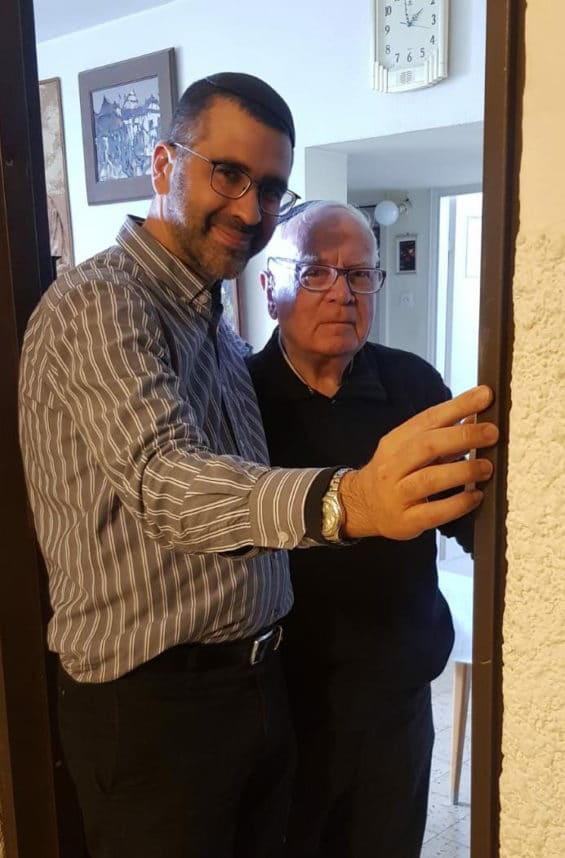
Rabbi Shalom Malul installs a mezuzah with Gzregorz Pawlowski
He found that the priest lived only 30 minutes away from AMIT’s Yeshiva High School Ashdod. He connected with Pawłowski, and the two became friends. Pawłowski, who was Jaffa’s Polish Catholic priest, gave talks to AMIT students learning about the Holocaust, and Malul took care of him in his later years.
This past fall, when Pawłowski passed away, teens from the high school, along with Malul, traveled to Poland so that Pawłowski could have a Jewish burial, which was his final wish. While Malul offered to help Pawłowski, whose birth name was Yaakov Tzvi Hirsch Griner, return to Judaism, the priest said he couldn’t because he felt gratitude towards the Church for saving his life.
“He told the Church that on the day of his death, he would return to Judaism and have a Jewish funeral, with the Kaddish prayer, and be buried in a Jewish cemetery.”
— Rabbi Shalom Malul
“He told the Church that on the day of his death, he would return to Judaism and have a Jewish funeral, with the Kaddish prayer, and be buried in a Jewish cemetery,” said Malul. “He told them, ‘I will disconnect from Christianity totally upon my death.’”
The students traveled to the funeral so that there would be a minyan during the burial and it would be possible to recite Kaddish. Yossi Sheinfeld, a donor, attended the funeral and gave the money so the students could go as well.
“We arrived there and there were some 300 Christians at the cemetery, and we were altogether 15 Jews, who just managed to make the minyan,” said Malul. “If I hadn’t gone there along with seven other people—we were a group of eight all together—there would not have been a minyan.”
The funeral was complicated, because the Church planned on giving Pawłowski a Christian funeral.
The funeral was complicated, because the Church planned on giving Pawłowski a Christian funeral. They didn’t think there would be much of a Jewish presence there. When Malul and his students arrived, the Church representatives were very surprised. He said they both spoke with mutual respect to one another and allowed Malul to hold a Jewish funeral.
“If we hadn’t spoken to them in a pleasant, respectful and peaceful manner, it is possible that it would have ended up being a confrontation and they may have insisted on having a Christian funeral,” he said. “But the mutual respect, our conversation and the peaceful way we discussed the matter caused the priests who were there to discuss it among themselves and then to agree and let us hold a Jewish funeral.”
According to AMIT’s president, Audrey Axelrod Trachtman, members of the organization “walk the talk,” which is why Malul and his students packed up on short notice and flew to Poland.
“It’s not enough to talk about the value of all Jews being responsible for one another,” she said. “We need to do it. So, this was one meaningful way we were able to show how seriously AMIT takes this value of connections and community in everything we do.”
She continued, “The fact that [these students] were able to perform such a tremendous mitzvah on such a world stage strengthened their own confidence and sense of self.”
Malul felt compelled to attend for a variety of reasons.
“Yaakov Tzvi Hirsch Griner was a Holocaust survivor whom I loved and cared for very much and felt very close to,” he said. “It was important to me to attend his funeral as a friend. And it meant more than just being there for a friend. As a Holocaust survivor, he had no family, no children. So of course, personally, I wanted to fly there, from my own pocket, to take part in his funeral.”
Even though Pawłowski was not a practicing Jew, Malul said that the community can learn powerful lessons from how he ultimately returned to his culture and religion.
“Even though he was in a high position in the Church, [he said] publicly at the end, ‘A Jew remains a Jew. I am a Jew, even though I am a high-ranking priest in Poland and in the Church in Jaffo, but my heart is Jewish, and a Jew never leaves his Judaism, no matter what he went through in his life. And in the end, he requests to reconcile and return to the Jewish people that he loves and misses so much.’ It is a tremendous moral lesson that he chose to return to the Jewish people. He chose to say to the entire world, ‘I am a Jew.’ He wasn’t embarrassed to say this to anyone. It is incredible bravery, and in my eyes, he is a great hero.”
Does it help the fight against antisemitism to show the haters your fears? In the wake of the latest attack in Colleyville, David and Shanni discuss the world’s reactions and the pros and cons of dealing with this ancient disease. And of course, COVID and Curb make an appearance.
The suspected killer of UCLA graduate student Brianna Kupfer was arrested on the morning of January 19.
The Los Angeles Police Department (LAPD) tweeted that the suspect, 31-year-old Shawn Laval Smith, was arrested in Pasadena “in the area of Fair Oaks and Colorado Blvd.” “We would like to thank the public, the media and our partners at Pasadena [Police Department] for their support in apprehending the suspect,” they added.
We can confirm, Shawn Laval Smith, the suspect responsible for the murder of Brianna Kupfer is in custody, after being located and detained by Pasadena PD around 11:50am this morning in the area of Fair Oaks and Colorado Blvd.
Kupfer was stabbed to death on January 13 while working at the Croft House furniture store in the Hancock Park area; she was working alone at the time and texted a friend that the suspect gave her “a bad vibe,” according to LAPD Lt. John Radke. The friend did not see that text right away. Kupfer’s father, Todd, told Fox News that Kupfer wasn’t supposed to be working and that it was abnormal for an employee to be working alone at the store. Police believe the attack was random.
Smith has had several prior arrests in South Carolina, North Carolina and California as far as back as 2010, Fox Los Angeles reported. His most recent arrest was in October 2020 in a misdemeanor case; he was released on $1,000 bail but it was not immediately clear what the outcome of that case was.
Todd told Fox News that Kupfer was “a great model, she was very, very caring … she really is the role model. I’m so proud of what she had accomplished.”
A vigil will be held for Kupfer in front of the Croft House store on January 20 at 1:30 p.m.
What is the purpose of a legal system? What does it exist for? This is a question worth pondering, as we consider the possibility of Israel’s former Prime Minister, Benjamin Netanyahu, walking away with a plea bargain in his corruption trial. If you haven’t heard, that’s an option on which Israel was fixated, for good reason, in the past week. The Attorney General finishes his term at the end of the month, and that’s the tight timeframe to close a quick and dramatic deal. The terms are pretty much known: conviction for misdemeanors, no prison, and Netanyahu leaving the public arena for at least seven years, and likely forever.
It’s an option to which an almost uniform chorus of commentators, writers and activists reacted with strong disapproval. A top lawyer said it was against the public interest. Former PM Ehud Barak said it will be a disgrace. A Netanyahu supporter began raising donations so that Netanyahu will not have to fold. A journalist cried that the damage will be “catastrophic.” A legal analyst announced that it would be illegal. “This is a failure,” warned a veteran TV anchor. This would be a “terrible” deal, her colleague warned.
A large and uniform choir. A loud chorus. The public (see graph) is also displeased.
Then again, what is the purpose of the justice system? Let’s start with what is certainly not its purpose: to satisfy the lust of journalists, commentators and observers for a good story with a dramatic ending. True, if this was literature, a long trial, ending in a verdict, acquittal or conviction, would be the way to go. True, as citizens we would be more fulfilled if there is an exclamation point at the end of this saga—the possibility of calling the defendant “guilty!” or the judge “evil!” or the attorney “negligent!” or the prosecution “brave!” or something like that.
The purpose of a justice system is not to satisfy our desire for a good narrative. Its purpose is to serve a society that is subject to its laws and institutions.
But the purpose of a justice system is not to satisfy our desire for a good narrative. Its purpose is to serve a society that is subject to its laws and institutions. Its purpose is to solve problems, without creating even larger problems. One way to serve society is to convince everybody that justice has been done. And the opponents of the deal are correct: If Netanyahu signs a plea deal, there will be no such sense. We will never know whether the prosecution underestimated or exaggerated Netanyahu’s supposed sins. We will never know if Netanyahu was charged because he was guilty or because he was annoying.
If there is a plea deal (and as I write this column on Monday, we still don’t know how this drama ends), a sudden quiet will follow. Strange silence. Like an abruptly halted thriller.
Hey, what’s going on? Does the protagonist defeat the aliens, or is the planet destroyed?
Neither. A deal was reached. The screenwriter and director decided to stop here.
Hey, but we stood in line, paid for tickets, bit our nails!
Sorry, the screenwriter and director decided to stop. And please do not forget your jackets on the way out.
What is the purpose of a justice system? The purpose of Netanyahu’s trial is twofold: to prevent him from continuing a corrupt activity (assuming he is guilty), and to deter the next corrupt politician. The plea bargain under discussion will solve the first problem, as it includes the mandatory absence from public life. So, the question still unresolved is the one of deterrence, and that’s a question that should be debated calmly.
Those outraged at the possibility of a plea deal put the credibility of the justice system at the forefront of their concerns. They argue that a deal is going to prove Netanyahu’s claim, that the goal of the trial was political to begin with—to keep him away. They argue that if there is a deal, the public may be under the impression that there really was not enough proof for conviction. They argue that if there is a deal, Netanyahu will be able to evade the punishment he deserves.
These are not empty claims. Such damages may indeed materialize. But they are partial claims. In addition to them, one must also consider the damages that may materialize if there is no plea deal: the public and social tensions surrounding the trial; Netanyahu’s ability to abuse his power, as opposition leader and still a potential prime minister; the ongoing paralysis of the political system. It is easy to explain what is wrong with the possibility of a plea bargain, but it’s unserious to do it while forgetting to explain what could go wrong with the counter option.
Does all this mean that a plea bargain is necessarily the only reasonable way out? No, that’s not what it means. But it does mean there is no reason for a uniform chorus (with very few exceptions). There is no reason to assume that those working to promote a plea bargain are idiots.
Most importantly, there is no reason to morally delegitimize those who support a bargain. Support for it is not support of “corrupt leaders,” nor for “the rule of the elites.” Support for it is a merely a compromise, albeit a lukewarm compromise. It is hard to sell because no one comes out of it satisfied. And yet, a compromise is often the right choice.
Something I wrote in Hebrew
The armed terrorist attack in a synagogue in Texas did not end peacefully. Repeat: did not end in peace. It is true that the hostages were released unharmed, and the kidnapper did not leave the scene alive. It is also true that the security forces functioned well. But let there be no doubt: This Sabbath drama did not end without casualties. The casualties are us. The attack will resonate in very many synagogues for a very long time. At best, it will only affect the conduct of Jews in America. They will be a little more careful, and may think twice, before going to a synagogue. At worst, it will spawn copycats and recurring events. So relative to what might have happened, the incident ended fine. But to say it had “ended without harm” would be a great exaggeration.
A week’s numbers
The public, right and left, opposes a plea bargain for Netanyahu.
A reader’s response:
Dina Azulai wrote: “Next time you write about the Chief Rabbi, please explain why we still need two of them, are we not one people?”
Shmuel Rosner is senior political editor. For more analysis of Israeli and international politics, visit Rosner’s Domain at jewishjournal.com/rosnersdomain.