Who’s panicking about Omicron and who isn’t? Why did Curb not play up COVID? Are European shows better than American shows? Is there such a thing as an amazing frozen pizza? Are cops going easier on the smaller stuff? That and much more on this new episode of “Conversations with Shanni.”
The Egyptians embittered, Hebrew wayemareru, the lives
of Israelites, which were, however, sweetened by their wives,
their mirrors showing them, the midrash says, how lovely they all were,
which made the husbands consummate the love their wives would stir
in them by showing them in mirrors the astonishing reflection
of their fair images that they beheld, relieving the dejection
they all had suffered, being by the tyrant Pharaoh loathed.
By love renewed, bedazzled by these images, they became betrothed
to one another, lying under trees just like the one in Eden,
and multiplied their seed like Johnny Appleseed, their lady-seedin’
displeasing Pharaoh who’d forgotten, fully, Joseph who’d once saved
his country. He all Israelites except the Levites first enslaved,
and then tried to exterminate, but failed, since the reflection
of mirror images of wives and husbands led to the conception
of babies for the Hebrew nation, mirror-maror sweetened,
as if they, Eve- and Adam-like, unsinfully re-Edened,
midrashically updating the two Adams, Adam Two
transforming Adam One’s first image to reflect a Torah Jew.
This may explain why we all add on seder nights haroset
to our maror, quite unembarrassed when with sweetness we emboss it,
recalling how in Egypt we with mirror images distorted
our bitterness and, by Hashem transformed, decrees of Pharaoh thwarted.
Exod. 1:14 states:
יד וַיְמָרְרוּ אֶת-חַיֵּיהֶם בַּעֲבֹדָה קָשָׁה, בְּחֹמֶר וּבִלְבֵנִים, וּבְכָל-עֲבֹדָה, בַּשָּׂדֶה–אֵת, כָּל-עֲבֹדָתָם, אֲשֶׁר-עָבְדוּ בָהֶם, בְּפָרֶךְ. 14 And they made their lives bitter with hard service, in mortar and in brick, and in all manner of service in the field; in all their service, wherein they made them serve with rigor.
Wayemareru et hayeyhem. They made their lives bitter-sweet with mirrors!
Rachel Adelman’s article in thetorah.com, “A Copper Laver Made from Women’s Mirrors: Who were these women and what were these mirrors used for? Reconstructing the narrative: the historical-critical method vs. midrash,” inspired, but is not responsible for, the bilingual maror-mirror wordplay on which this poem is based.
Gershon Hepner is a poet who has written over 25,000 poems on subjects ranging from music to literature, politics to Torah. He grew up in England and moved to Los Angeles in 1976. Using his varied interests and experiences, he has authored dozens of papers in medical and academic journals, and authored “Legal Friction: Law, Narrative, and Identity Politics in Biblical Israel.” He can be reached at gershonhepner@gmail.com.
Politicians are often asked to expressly condemn Nazis, and to pro-actively disassociate from any groups that might have Nazi sympathies. Usually this is not a problem, because everyone across the political spectrum worthy of support agrees with the idea that Nazis are bad.
Apparently though, for a mega-conglomerate like Amazon, committing to that idea still remains a task unworthy of serious investment.
Amazon’s official policy guidelines include an “Offensive Content” warning, which gives the website the right to remove any:
Content that contains derogatory comments, hate speech, or threats specifically targeting any group or individuals; [or]
Content that promotes hate speech, incites racial or gender hatred, or promotes groups or organizations that support such beliefs.”
Why then, in 2022, is Amazon still “the world’s largest purveyor of original Nazi propaganda films”? Why are movies that glorify Hitler’s words and ideas readily available to watch, with nary a trigger warning or disclaimer in sight?
It is not because Amazon is unaware of the problem. In 2018, the Partnership for Working Families and the Action Center on Race & the Economy released a joint report entitled “Delivering Hate: How Amazon’s Platforms Are Used to Spread White Supremacy, Anti-Semitism, and Islamophobia, and How Amazon Can Stop It.” The report looked at Amazon’s unprecedented and unparalleled reach and influence in the U.S. online shopping market, and examined how its various platforms and services provide a number of channels through which hate groups can generate revenue, propagate their ideas, and grow their movements through new recruits. Among other things, the report found that Amazon enables the celebration of ideologies that promote hate and violence by allowing the sale of hate symbols and imagery on its site (including products targeted at children); and facilitates the spread of hate ideologies, by publishing propaganda materials, including Nazi materials.
Among other things, the report found that Amazon enables the celebration of ideologies that promote hate and violence by allowing the sale of hate symbols and imagery on its site (including products targeted at children); and facilitates the spread of hate ideologies, by publishing propaganda materials, including Nazi materials.
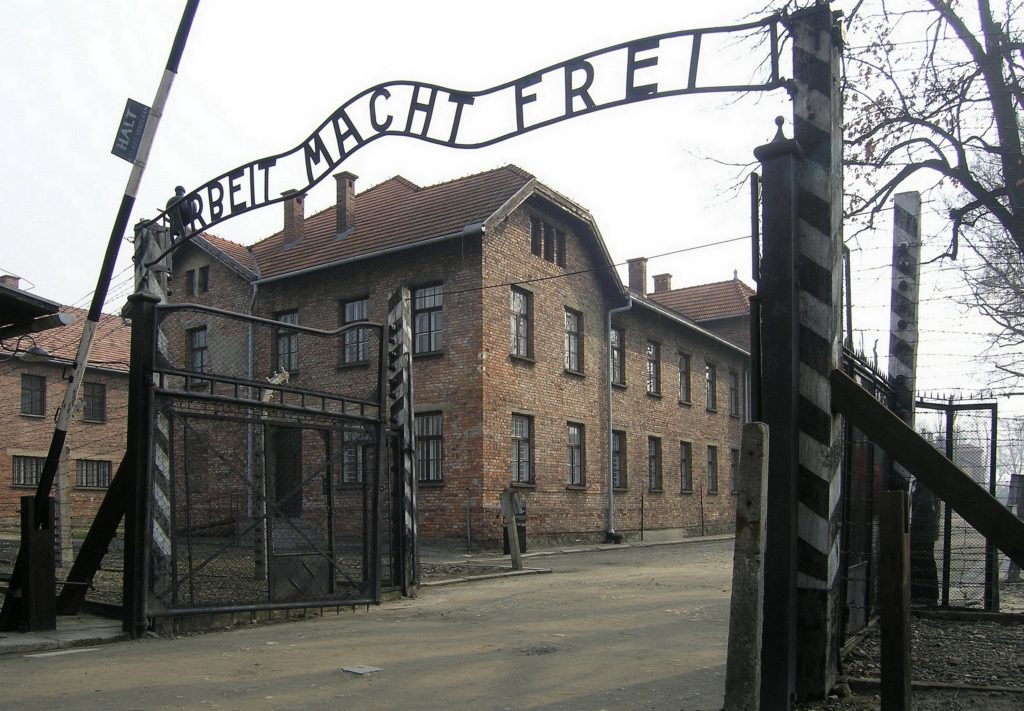
These findings caused enough of a stir that Minnesota Rep. Keith Ellison sent a letter to Amazon CEO Jeff Bezos asking “whether Amazon is committed to ceasing the sale of all products that promote hateful and racist ideologies.” Amazon responded by removing the items listed in the letter. In their response Amazon also noted that they “have developed sophisticated, automated tools that use machine learning to scan listings on Amazon, automatically removing listings found to be in violation of our policies, before we are ever notified by an external party. These automated tools are supplemented by teams of investigators that conduct manual, human review of our listings on a regular basis.” But apparently, those tools and investigators still have not learned to identify Nazi propaganda. In 2019, only after a wave of criticism, Amazon removed holiday ornaments featuring the Nazi concentration camp Auschwitz.
In 2020, The Auschwitz-Birkenau Memorial and Museum and the Holocaust Education Trust had to jointly call on Amazon to stop selling “The Poisonous Mushroom,” an illustrated children’s book with an antisemitic caricature on the cover. This particular book, which was used as evidence of crimes against humanity at the Nuremberg trials, was designed to brainwash children into hating and fearing Jews; it likens them to the devil, “warns” about how difficult they can be to identify (like poisonous mushrooms), and describes the dangers Jews allegedly pose to the children themselves and to society in general. Amazon responded by removing that book.
Just last year, the Nathan Cummings Foundation, a Jewish organization focused on social justice, introduced a shareholder proposal asking for a comprehensive report on Amazon’s “efforts to address hate speech and the sale or promotion of offensive products throughout its businesses.” Amazon responded by asking federal regulators to block that proposal, among others.
There is of course an argument to be made that a private marketplace like Amazon should not police the content of the ideas it makes available. Indeed, they have the First Amendment right to publish or not to publish anything they want. But having decided that they will actively regulate hate speech and remove what they find to be societally dangerous, in the quest for equality, consistency is key. There should be bare minimums for what we can all agree is dangerous and offensive, and the danger of promoting Nazi propaganda is real.
In 1978, after a fatal school shotting in Lansing, Michigan, police searched the teen killer’s bedroom and found a cache of Nazi propaganda, including a diary that the boy had titled “My Struggle,” after Hilter’s “Mein Kampf.” Just two days before he shot his classmate, the boy wrote: “I almost abandoned Hitler last night—out of being pushed too far by my colleagues. I almost went to school without my Nazi pin in my jacket. But luckily again I had a burst of courage and never again will I think about abandoning Mein Fuhrer and Nazism.” A little over a month ago a 15-year-old boy opened fire at a Michigan school, killing four students and injuring others. After the fact, people came forward to say that the warning signs were everywhere; among other things, the boy was obsessed with Nazi propaganda, which he kept in plain sight in his room. Who knows where he got it from, and while I am not implying that he got it from Amazon, it is also true that the vast majority of online shoppers in the United States do begin their product searches on Amazon.com, and so Amazon must be more careful and more proactive in taking down these dangerous materials before they have to be told to do so.
As the joint report found, whether they intend to or not, Amazon has enabled hate organizations and ideologues to spread their ideas, generate resources, and find new adherents—all while taking a cut of the revenue. Now another nonprofit organization, Americans Against Antisemitism, led by former Democratic New York State Assemblyman Dov Hikind, is leading a campaign to have, at the very least, over 30 films that glorify Nazism removed from Amazon’s platforms. It is high time that Amazon invested some of that revenue back into updating their hate tools. And, if they don’t have the time, they should immediately partner with an organization like Hikind’s that is ready and willing to help.
After all, how hard should it be to disassociate from Nazis?
Every week my daughter welcomes Shabbat with a group of survivors as part of her participation on the Holocaust Museum LA’s teen advisory board. Ten survivors and five high school students gather on Zoom Friday afternoons to talk about their week, share stories of their lives, and light the Shabbat candles. She often joins the Zoom call in our kitchen while I’m braiding the dough for our family challah and so I sometimes get to be part of the conversation.
Throughout the pandemic, the voices of these survivors have given our entire family hope. No matter how dark our situation has been, their stories have provided a much-needed perspective. At the beginning of the pandemic, during the stay-at-home orders, one of the survivors reminded us that it wasn’t nearly as bad as being a hidden child during the war. When there were shortages of toilet paper and flour, we knew from their first-hand experiences that it could be much, much worse.
Throughout the pandemic, the voices of these survivors have given our entire family hope.
It’s hard sometimes to achieve this sense of perspective — and the strength and even gratitude that often comes with it — through the stories of another. Knowing that another person has been through far greater challenges doesn’t always make the one you’re going through any easier.
Mel Brooks famously taught that tragedy is when I cut my finger; comedy is when you fall into an open sewer. It’s a dark commentary on the challenge of true empathy. I experience the world through the prism of the self. Hearing or reading about the pain of another is never quite the same as cutting my own finger. We cannot ever fully escape our own perspective or fully understand the experience of another. For some, tragedy during the pandemic has meant not finding toilet paper at the market or experiencing the pain and frustration of a canceled prom or family vacation. For others, it has meant serious illness, the loss of income or a business, or even the death of a loved one. Still, knowing that others around the world are experiencing far worse doesn’t always make us feel any better about our own misery. We are, ultimately, incapable of fully transcending the self.
And yet in last week’s Torah portion we’re asked to do just that. We are told that every year in the springtime we are to commemorate our going forth from Egypt by refraining from eating leavened bread for seven days. We are commanded throughout the generations to explain to our children the purpose of this practice: “It is because of what the ETERNAL did for me when I went free from Egypt” (Exodus 13:8).
But there was only one generation of our ancestors who experienced this going forth from slavery to freedom. All those who came later—including of course our grandparents, parents, and us—are instructed to say those words knowing full well that we ourselves weren’t literally freed from Egyptian bondage.
The rabbis of the Mishnah, writing a thousand years later, take this commandment one step further:
“In each and every generation a person must view himself as though he personally left Egypt … Therefore we are obligated to thank, praise, glorify, extol, exalt, honor, bless, revere, and laud the One who performed for our ancestors and for us all these miracles: God took us out from slavery to freedom, from sorrow to joy, from mourning to a Festival, from darkness to a great light, and from enslavement to redemption” (Mishnah Pesachim 10:5).
Knowing that once, long ago, those who came before us were slaves to Pharaoh in Egypt and that we today, despite the many very real challenges we face, are relatively free is reason enough to give thanks and praise to God for the many blessings we experience each day. We have collectively if not personally gone from slavery to freedom, from sorrow to joy, from darkness to light and therefore day by day we give thanks for the miracle of our very existence.
While it’s not possible to fully know the experience of another, we can gain a sense of perspective and benefit significantly through an awareness of the struggles of others, particularly through stories of their perseverance. Hearing the calm voices of those survivors reminding the teenagers (and each other and me as well) that as bad as this moment is, we’ve been through far worse, gives me hope and strength.
We have gone from sorrow to joy before and we shall do so again. With grit, determination, and, yes, perspective gained at times through the eyes of another, we will go from mourning all that we have lost to celebration, from darkness to an or gadol: to a very great light.
Rabbi Yoshi Zweiback is the Senior Rabbi of Stephen Wise Temple in Los Angeles, California.
The word parliament originates from the French “parler,” meaning “to talk.” Pondering it is a good way to capture in a nutshell the whole brouhaha over the use of Arabic in the Knesset. Does “to talk” mean “to speak” or “to converse”? Is the purpose of the parliament a dialogue, a debate, an exchange of opinions and messages – or is it about one speaking on behalf of one’s constituency, without regard to what other members of parliament say? This is something to think about as we consider MK Walid Taha’s Arabic speech in the Knesset last week. A speech that spawned a debate.
Here is a summary of the events. During a debate over a bill, the sponsors, all Arab from the Islamist Ra’am party, a coalition member, were left alone in the Knesset plenum with their Arab adversaries, members of the Joint List. They began discussing the bill in Arabic. When the time to vote came and the plenum was full with members of all other parties, MK Walid Taha, the sponsor, still presented it in Arabic.
An uproar ensued. A Likud MK shouted: “Two Arabs are talking among themselves, making fun of us. What do you think, that it is your village here?”. MK Ofir Akunis, also of Likud, said: “The only thing missing is replacing the Israeli flag with the Palestinian flag. Then they will mark a complete takeover.”
A public debate was ignited. Some argued “this is the Knesset of Israel, whose language is Hebrew,” and some respond “even Arabs are allowed to speak their language.” As if these two facts cannot coexist.
So, is there a problem with an Arabic speech in the Knesset? This question can be answered on three levels: The formal level – is it allowed; the practical level – is it desirable; the social level – is it polite. The formal level is the simplest: a Knesset member is allowed to speak in any language he chooses as long as no other decision has been made. So we better move on to the question of whether it is desirable.
This is a slightly more complicated question, because it does not have a single “yes” or “no” answer. It is and it isn’t. Why is it desirable? because it allows Knesset members to express themselves in their mother tongue. Because it is good to be reminded that Israel is a diverse country. Because it conveys legitimacy to the minority and its language. Because it allows the minority audience to listen to the speaker in his language.
But there is also a downside to having MK’s speaking a language other than Hebrew from the podium. Why? Because it is important that everyone understands what is said in the Knesset. Because Israel has an interest to strengthen Hebrew as the state language (a common language is the key to a shared sense of destiny). Because the use of incomprehensible language arouses suspicion, lest it be intended to convey messages that the rest of the public will not understand. Suspicion is a dangerous thing, especially for a minority. The Arab minority in Israel occasionally claims, somewhat justifiably, that the Jewish majority is too hasty to suspect it of ill will. A speech in Arabic does not defuse such suspicion, it contributes to it.
Finally, there is the question of the French “parler.” Is it the goal of the Knesset to have a dialogue, or does it accept an atmosphere in which MKs shut themselves off each in his or her own bubble? Here, we can make the transition from the question of desirability to the one of politeness. Of course, I must consider the possibility that the expectation from MKs to be polite may seem delusional to some readers. But I’m in favor of setting a bar of high expectations.
So, is it polite to speak in the Knesset in Arabic, or Russian, or French, or Amharic, or any other language that not everyone understands? On this question, I propose a practical test with four rules.
If you want the Knesset to engage in a dialogue, it is necessary to make sure that everyone understands what everyone says.
Rule One: Do not speak a language that is not understood if there is no translation. If you want the Knesset to engage in a dialogue, and not just in a speech for the sake of speaking, it is necessary to make sure that everyone understands what everyone says (Taha did not have a translator).
Rule Two: Do not speak a language that other MKs cannot understand unless there is a special and powerful reason to do it. What reason could that be? For example, if there’s a speaker who is not fluent in Hebrew (most Arab MKs speak better Hebrew than their Jewish peers). Another special reason can be a need to make a symbolic gesture (say, a speech in Amharic on the occasion of the holiday Sigd). Or the use of another language can be a kind of provocative statement: say, an Arab MK who wants to speak in Arabic in protest of the Nationality Law. But this last example leads to a third rule.
Rule Three: Do not use language that is not understood as a provocation in and of itself. So, not as in “I’ll speak a language you do not understand to upset you”. If there is no strong reason, then it is impolite, and reduces the chance for a dialogue.
Rule Four: Having set the bar high for speaking in a language other than Hebrew from the podium, it is necessary to add another high bar – for the way other MK’s respond to such occasion. Not every speech in an incomprehensible language should be turned into a culture war. We can call this rule the “let’s all calm down” rule. MK Taha spoke Arabic. He spoke Arabic without a particularly strong reason and without worrying about the fact that other MKs cannot understand him. What he did what a mistake and still does not justify a rude attack. Suffice it to say to him, “hey, that was impolite, we too want to understand what you have to say. “
Because we really do.
Something I wrote in Hebrew
I found a cure to COVID (or maybe to COVID anxiety):
The question of whether lessons for the future can be learned from history has never been decided, and it is doubtful whether it will be decided soon. What can undoubtedly be deduced from history is a sense of proportion as we look at present events. For anyone who thinks that current pandemic is an unbearable, cruel event, that it will leave behind a generation of young people whose lives have been ruined, or something of that sort, I’d recommend a short diet of history books. Is it difficult for you? Here’s the cure. A passage from Dan Jones’ book, Powers and Thrones, describing what John of Ephesus saw on his travels in the sixth century: “In town after town, the sick and suffering staggered through the streets, their bellies swollen and eyes bloodshot, pus leaking from their mouths. Grand houses in which entire families and their servants had died stood silent, every room occupied by corpses. Contorted bodies lay unburied, their midriffs rotting and bursting in the heat of the day, the flesh half-eaten by hungry dogs”. The reading is not always joyful, but it certainly puts the COVID in the right historical context.
A week’s numbers
Israel’s Democracy Institute issued its annual Democracy Report. It refers, among many other things, to what we discuss on the left hand column.
A reader’s response:
David Lee Hoffman did not appreciate my call from last week that the Chief Rabbi ought to get fired: “I’d be agreeable to giving the government the power to fire a Chief Rabbi whenever it is displeased with the way he’s doing his job, so long as the government was given the same power with respect to Supreme Court justices”.
Shmuel Rosner is senior political editor. For more analysis of Israeli and international politics, visit Rosner’s Domain at jewishjournal.com/rosnersdomain.
I am tired of Covid. I know you are too. But here we are, dealing with a fourth wave of coronavirus, and beginning to wonder if we’re going to work our way all the way through the Greek alphabet and ultimately get to an Omega variant sometime this year or next.
At least for those of us who are vaccinated and boosted, each new outbreak is somewhat less disruptive than the one before. The fact that Omicron is so transmittable has left hospitals, grocery stores and other employers scrambling for workers. But the impact of this newest strain has been much more of an annoying inconvenience than a dangerous threat.
When COVID first hit, and our knowledge of the virus and our protections from it were so limited, the first priority was to preserve public health even at immense economic and societal cost. For two years, the crux of the political debate has been about how best to balance those dueling considerations, although the balance has gradually shifted toward reopening.
We have barely any clue as to the long-term psychological harm these young people suffered from their protracted isolation.
But as the nation’s public schools begin classes again after the holiday break, students and their parents are finding themselves at the center of what may become a brutal political fight over whether and how schools should be operating in this latest iteration of the pandemic. We are just beginning to understand the extent of the learning loss that occurred when students were limited to online classes over the last two years — and the even greater damage suffered by children from minority and lower-income communities. We have barely any clue as to the long-term psychological harm these young people suffered from their protracted isolation and desocialization while their schools were closed.
The Republicans’ upset victory in the Virginia governor’s race last fall demonstrated the parental dissatisfaction toward prolonged school closures, and Democrats from Joe Biden on down have scrambled to encourage their teachers’ union allies to return to the classroom. But the rapid spread of Omicron over winter break has undermined that strategy, and it now appears that growing union resistance to school reopening will have immense educational and political impact.
One New Jersey labor leader recently cast the familiar health versus economy debate in especially stark terms when he said “I’d see the entire city of Newark unemployed before I allowed one single teacher’s aide to die needlessly.”
Any death is a tragedy that we should make great effort to avoid, but such an absolute standard would require the criminalization of cars, airplanes, pharmaceuticals (and possibly electricity, ladders and fatty foods). In reality, we make these tradeoffs every day, balancing what we believe to be some level of acceptable risk in exchange for both necessities and conveniences in our daily lives. It wouldn’t be possible to hold in-person classes under such criteria – ever.
A more measured assessment was offered in the Bay Area, where respected Santa Clara County Public Health Director Sara Cody issued a joint statement with the county’s office of education urging schools to stay open.
“We need to find ways to coexist and live with COVID,” Cody said. “We’ve learned that in-person education is what (students) need and remote learning doesn’t support their mental health, emotional health, and academic well-being nearly the way that in-person learning does.”
To his credit, Governor Gavin Newsom successfully pressured the powerful California Teachers Association into a commitment last month to keep the state’s public schools open. But such agreements are often tenuous, and there is already evidence of teacher sick-outs and other efforts to temporarily suspend classroom instruction. And testing shortages, rising caseloads and lack of qualified substitute teachers make it likely that these trends will spread quickly just as parents are preparing to send their children back to school.
Newsom, Biden and other Democratic leaders have benefited tremendously from their relationship with teachers’ unions over the years. But while still protecting the health of their constituents, they will need to find a way to prod their labor allies into a more balanced approach. That balancing act won’t be easy — and it carries extremely high stakes for children and politicians alike.
Dan Schnur is a Professor at the University of California – Berkeley, USC and Pepperdine. Join Dan for his weekly webinar “Politics in the Time of Coronavirus” (www/lawac.org) on Tuesdays at 5 PM.
Author and speaker Daniel Friedman shares transformative wisdom from our Sages, as well as surprising research from his doctoral thesis on American Christian attitudes toward Israel.
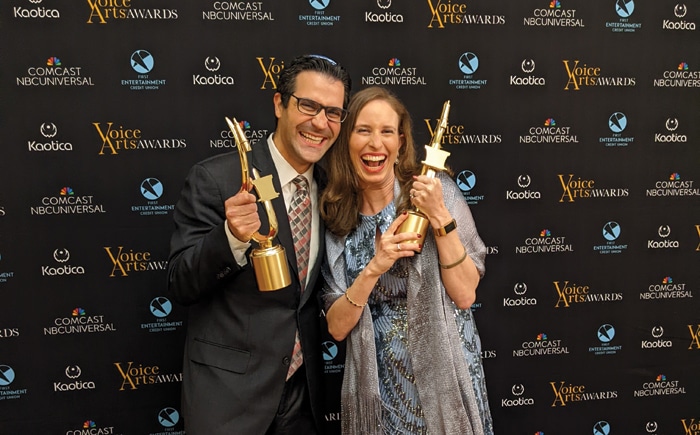
On December 19, 2021, in a ceremony at the Guggenheim Museum in New York, Elliot “Eli” Schiff took home two Society of Voice Arts and Sciences (SOVAS) Voice Arts awards for his voiceover work.
“I know the joke about Jews in showbiz and all that,” a yarmulke-wearing Schiff said as he accepted the first award. ”But I’m an Orthodox Jew, it’s rare to even get an opportunity … I just wanted to say how much I appreciate this community for being so open and loving… Thank you so so much.”
The Journal caught up with Schiff, 38, via Zoom at his home studio in Teaneck, New Jersey. Schiff lived in the Pico-Robertson neighborhood of Los Angeles for about 14 years., but last June, Schiff and his family — wife, cartoonist/creative director Chari Pere, and three young children, Jakey, 9, Bailey, 6 1/2, and Serina, 2 1/2 — moved back East.
Raised Modern Orthodox in Woodmere, NY, Schiff felt like a performer from a young age.“I feel like because we were modern, we did go to movies and watch TV and things like that,” Schiff said. “My dad would always kind of make funny voices when I was a kid … and my mom was artistic. She made us these Ninja Turtle shirts that we wore … until they all fell apart. And my family was always interested in the arts.”
Schiff remembers going with his family to see “Once Upon a Mattress” with Sarah Jessica Parker in New York. They had seats close to the stage, and the nine-year-old Schiff felt like the narrator was talking directly to him. That was the spark.
“It made us almost feel like we’re part of the show,” Schiff said. “It was one of those moments that really impacted me to be like, ‘Oh, you really can have this relationship … with the audience around you. “I was like, ‘I want to be able to do something like that.’”
Schiff studied at Yeshiva University and acted in the school plays. After graduation, he worked in accounting for two years. But the acting bug never left him.
After a visit to LA in 2007, Schiff was determined to move there and give acting a shot.
After a visit to LA in 2007, Schiff was determined to move there and give acting a shot. He quit his job (after they tried transferring him to Boston). Although his parents were concerned his observances might fall by the wayside, Schiff was committed to both being an actor and Shabbat observant.
Schiff worked an assortment of jobs while studying acting. His friend Chari Pere came to visit in 2009. They started dating soon afterward, and married in 2010After the birth of their son Jakey in 2012, Schiff and Pere had a conversation about his career. “She asked me, “‘What do you really want to do?’” Schiff recalled.
On-camera work didn’t feel like a good fit, especially with Schiff’s restrictions (he would “book himself” out, so he was unavailable to work on Shabbat and Jewish holidays). Auditions involved a lot of driving and waiting. “It could be a three-hour ordeal for a five-minute audition,” he said.
Voiceover work made sense. There’s flexibility in timing. For instance, a Friday audition tape isn’t due until Monday, so he could work on it on Sunday.
Voiceover work, however, made sense. There’s flexibility in timing. For instance, a Friday audition tape isn’t due until Monday, so he could work on it on Sunday.
“I really do love doing voiceover work,” he said. “I had taken classes when I first moved out there, but I didn’t really fully pursue it…. And so I was like, you know what, I’m going to really double down on this.”
After years of study and odd jobs, Schiff dove full-time into voiceover in June 2017. He has worked in many genres of voiceover, including Commercials (Google, Uber, Arco, Aha sparkling water), Promo (DisneyXD, Disney Jr.), Video Games (“Genshin Impact,” “Final Fantasy Brave Exvius,” “Trials of Mana,” “Afterparty”), Audio Description (“Succession,” “The White Lotus,” “Growing Up Animal”), eLearning, audiobooks and more.
Schiff hopes to continue on this “trajectory” and is excited for what the future may bring.
“Growing up, the nice thing about going to religious schools was that it did allow for, uh, the creative expression [while being able to] keep Shabbos. I was able to do theater in high school [and] college.
“At a certain point, people were just like, ‘Well, you’re out of college now. …. You can’t really continue doing this. It’s not really a line of work for somebody who is Orthodox.’ And I just kept wondering, “Why not?
Schiff has a message for those in high school or college, considering a similar path: “If [acting is] something you love and you really want to commit.… it’s not easy, but it’s possible.”
Julian Emanuel Zelizer is a professor of political history and an author in the United States at Princeton University. Zelizer has authored or co-authored several books about American political history; his focuses of study are the second half of the 20th century and the 21st century.
Indiana Republican State Senator Scott Baldwin issued an apology on January 6 for saying that teachers should be “impartial” on Nazism.
The Indianapolis Star and Washington Post reported that Baldwin’s remarks came during a January 5 committee hearing about the education bill SB 167. Matt Bockenfeld, a history and ethnic studies teacher, said during the hearing that while he agrees with the bill banning teachers from expressing their opinions on political issues, he was concerned that the bill would require him to be neutral when teaching Nazism and fascism. “We’re neutral on political issues of the day,” Bockenfeld said. “We don’t stand up and say who we voted for or anything like that. But we’re not neutral on Nazism. We take a stand in the classroom against it, and it matters that we do.”
Baldwin, who filed the bill, responded by saying that “I have no problem with the education system providing instruction on the existence of those isms,” referencing Nazism, fascism and Marxism. “I believe that we’ve gone too far when we take a position on those isms … We need to be impartial.” He added teachers should simply “provide the facts.”
In a statement to the Star, Baldwin said the bill is meant for teachers to be neutral in regard to “political affiliation” and that he’ll ensure the bill will be limited to that intent. “In my comments during committee, I was thinking more about the big picture and trying to say that we should not tell kids what to think about politics,” he said. “Nazism, Marxism and fascism are a stain on our world history and should be regarded as such, and I failed to adequately articulate that in my comments during the meeting. I believe that kids should learn about these horrible events in history so that we don’t experience them again in humanity.”
Baldwin elaborated further in a statement to the Post that he “sincerely” regrets not making it clear that teachers should condemn Nazism, fascism and Marxism and apologized. “I said Wednesday that we need to listen and be open to changes that can improve the bill, and we are working on amendments to that end.”
Anti-Defamation League (ADL) Midwest denounced Baldwin’s remarks in a statement. “The Nazis were responsible for the deaths of 11 million people, including 6 millions Jews,” they said. “Senator Baldwin’s apology doesn’t change the deep harms of using ‘impartiality’ or ‘neutrality’ as tools to sanitize history. This is part of the continued efforts by some to try and rewrite history and characterize extremism, racism and genocide as somehow legitimate. That is dangerous and despicable. It should be loudly rejected.”
Indiana Sen. Scott Baldwin's apology doesn't change the deep harms of using "impartiality" or "neutrality" as tools to sanitize history. https://t.co/1LMn3gbOlS Our full statement here: pic.twitter.com/4fsYnF8rho
The Simon Wiesenthal Center tweeted, “If this is what confused adults are saying, our nation’s children must be confused about what exactly they should be learning about Nazism and Fascism—that they are EVIL. We must never teach our children to be ‘impartial’ about evil.”
If this is what confused adults are saying, our nation’s children must be confused about what exactly they should be learning about Nazism and Fascism—that they are EVIL. We must never teach our children to be ‘impartial’ about evil. https://t.co/ss7n7KM122
SB 167, according to the Star, is “seen as a response to critical race theory,” also known as CRT. Journal Editor-At-Large Monica Osborne wrote in a March op-ed that many proponents of CRT, “a full-fledged school of literary criticism—a way of reading not just literature and film in classrooms but also everything that we come into contact with in the world,” believe that “racism is not something that happens between people on an individual level. It’s structural. It undergirds every single one of our institutions going back to and preceding the founding of America. This means that even if the majority of individuals are not racists, the effects of racism will continue to be seen because they are embedded in everyday life.” Critics of CRT argue that it is a “revival of segregation” and “an attack on free speech, a movement that keeps shifting the goal posts for what is acceptable and discovering new marginalized groups to protect and new words to render inappropriate,” per Osborne.
SB 167 would “would require schools to develop curriculum committees that include parents, to review all education materials, and develop portals containing materials, texts and lesson plans to allow parents to review everything taught in the classroom” and “remove an exemption to laws about distributing material harmful to minors for schools and public libraries,” the Star reported. The bill also bars teachers “from teaching a variety of concepts related to sex, race, ethnicity, religion, color, national origin, or political affiliation is inherently superior or inferior,” according to the Star.