fbpx

January 4, 2022

Solidarity, My Dear Watson

On Monday, actress Emma Watson reposted a call for solidarity with Palestine on Instagram. The post, which came only days after the terrorist group Hamas fired two deadly rockets at the Tel Aviv coastline, was widely condemned by Jewish and pro-Israel groups as antisemitic.

Perhaps the statement was reflective of a callous indifference to Jewish people’s safety. Or perhaps Ms. Watson is trying to send a much more complicated and desperately needed message to the pro-Palestinian movement about what real solidarity actually means: rejecting the lies and violence of Hamas in favor of better alternatives. The clues are right there for the deducing.

As part of her post Watson included a poem from Sara Ahmed:

Solidarity does not assume that our
struggles are the same struggles, or that
our pain is the same pain, or that our
hope is for the same future. Solidarity
involves commitment, and work, as
well as the recognition that even if we
do not have the same feelings, or the
same lives, or the same bodies, we do
live on common ground.

There is nothing wrong with those sentiments, and everything right about expressing solidarity with the Palestinian people, who have long suffered under cruel and incompetent leadership. Solidarity with the Palestinian people does not, and should not, automatically mean that Israel should not exist, or that attacks against the Jewish state should not be taken seriously. In fact, solidarity with the Palestinian people does and should include everything that Ahmed’s poem calls for.

Solidarity with the Palestinian people does not, and should not, automatically mean that Israel should not exist, or that attacks against the Jewish state should not be taken seriously.

Real solidarity with the Palestinian people begins with the recognition that, regardless of what Hamas and some on the far left have tried to convince those who don’t know any better, the struggles in the Middle East are not the same as the civil rights struggles here in the U.S, or elsewhere.

For example, the conflict in Israel is not, and never has been, about race, and when powerful people pretend that it is just to score some progressive political points, they create new enemies where there could have been allies. This particularly tortured “simplification” ignores the inconvenient fact that the majority of Israeli Jews are not white, and are physically indistinguishable from their Arab neighbors. Nevertheless, it has led impressionable people to hate Israel (and by proxy Jews) for no reason, and has even contributed to the exclusion/alienation of some pro-Israel voices from the greater Black Lives Matter movement. It has also increased support for the Boycott, Divestment, and Sanctions (BDS) movement against Israel, which lets foreign activists feel good about themselves while stunting the actual peace process and demonstrably hurting Palestinians.

Nor is the pain felt on both sides of this conflict comparable to the pain felt during the struggle against apartheid in South Africa. Forget that Israeli Arabs serve in the highest levels of every branch of government; by definition apartheid involves an institutionalized regime of systematic oppression by one racial group over another committed with the intention of maintainingthat regime. Israel treats all of its citizens, including its Arab citizens, equally before the law. But even if Israel did treat Arabs differently (they don’t), there cannot be apartheid when one side keeps trying (over 30 times!) to offer plans for peace. Still, the allegation of apartheid gets irresponsibly repeated over and over again until it becomes a de facto justification for the launch of violence against innocents.

For example, the conflict in Israel is not, and never has been, about race, and when powerful people pretend that it is just to score some progressive political points, they create new enemies where there could have been allies.

Both of these faulty comparisons were on full display last May, the last time Hamas shot missiles at the citizens of Israel, threatening the lives of its Arabs and Jews, men, women and children alike. Unfortunately, at that time a large number of people who bought into the underlying lies made the mistake of thinking that solidarity with the Palestinian people meant implicitly supporting the terrorist attacks.

That is why Watson’s post is so important now; in the days after a Hamas attack once again threatens the relative peace and stability of the region, Ahmed’s poem reminds us that real solidarity with the Palestinian people means standing up and rejecting those who use lies and faulty metaphors to enlist others in their never-ending quest for bloody violence, in favor of supporting the real leaders who are committed to actually doing the work of finding (and living on) common ground.

The end of Ahmed’s poem is reminiscent of the end of the speech that MK Mansour Abbas, head of the Islamist Ra’am party, gave at the Knesset podium before his swearing in this summer. He said that “we come from different nations, different religions, and different sectors. There is one thing that connects all citizens of Israel and that is citizenship.” Abbas has repeatedly reiterated that Israel was born a Jewish state, and will remain so, while focusing on his desire to further the interests of his Arab constituents through increased cooperation with the Jewish people on the ground in the country of their shared citizenship.

Those are the sentiments of a statesman worthy of solidarity, and worthy of remembering whenever Hamas’ ugly alternative rears its head. Maybe that is the message that Watson meant to highlight. Hopefully she will clarify, but if not, we can give her the benefit of the doubt when a conclusion is this elementary.

Solidarity, My Dear Watson Read More »
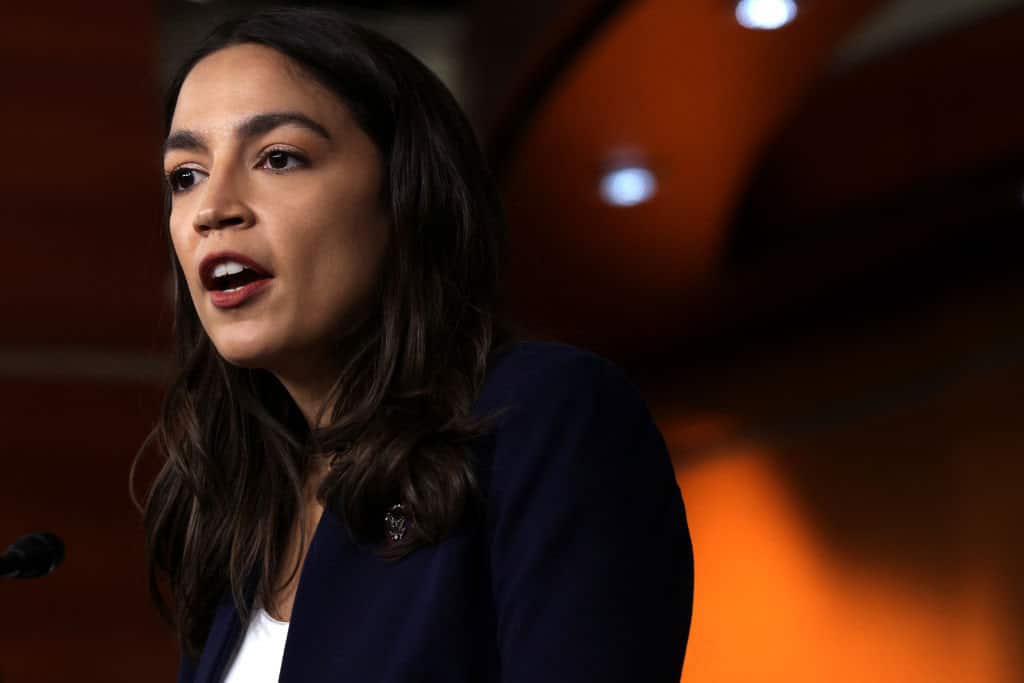
AOC Staffer Calls Israel “Racist European Ethnostate”

A legislative assistant staffer for Representative Alexandria Ocasio-Cortez (D-NY) is under fire over a social media post calling Israel a “racist European ethnostate.”

Fox News reported that the staffer, Hussain Altamimi, posted an Instagram story on December 24 featuring an image from an account called “Let’s Talk Palestine” stating that “Israeli apartheid” is “about whether you’re Jewish or non-Jewish.” It went on to call Israel “an exclusive ethnostate.” Altamimi wrote in the story: “Israel is a racist European ethnostate built on stolen land from its indigenous population!” Altamimi was hired by Ocasio-Cortez’s office in November, per Fox News.

Various Jewish and pro-Israel Twitter accounts criticized Altamimi and Ocasio-Cortez.

“New beginnings? No @aoc – your legislative assistant just repackaged old hate + old lies about the incredibly diverse Jewish people,” the Simon Wiesenthal Center tweeted. “Shameful. Does he speak for you? America deserves an honest answer.”


Siamak Kordestani, West Coast Director of the European Leadership Network, tweeted that Altamimi’s remarks are “wrong for many reasons, and it erases Mizrahi Jews like me. A majority of Jewish Israelis are descendents of 850,000 Jews violently expelled from Arab countries.”

Stop Antisemitism also tweeted that Altamimi’s comments invoked “disgusting white supremacist type tropes against the world’s sole Jewish nation” and asked Ocasio-Cortez “how is someone like this employed by you?!”

Zionist Organization of America (ZOA) President Morton Klein tweeted that Hamimi’s remarks “just viciously & falsely condemned Israel. ZOA demands AOC fire him immediately. It’s the Palestinian Authority that’s a racist terrorist dictatorship which states no Jews will be allowed to live in their entity and pays Arabs to murder Jews.”

Fox News reported that Ocasio-Cortez’s office declined to comment on their inquiry. Her office did not respond to the Journal’s request for comment as of this writing.


AOC Staffer Calls Israel “Racist European Ethnostate” Read More »

NY Orthodox Jewish Man Assaulted

A 26-year-old Orthodox Jewish man was struck in the head on January 2 in the Brooklyn area of New York City, The Algemeiner reported.

A spokesperson from the New York City Police Department (NYPD) told the Journal that two assailants followed the victim, chasing him before hitting him with “an unknown object,” causing a head laceration. The assailants fled in a black sedan and the victim went to an urgent care. Williamsburg News tweeted that the victim was attacked “with sticks to the head.”

The NYPD Hate Crimes Task Force is currently investigating the matter.

New York Governor Kathy Hochul, a Democrat, tweeted that the attack “horrified” her. “Every New Yorker should be able to live in our state without fear of hate or violence,” she wrote, adding that state police would be assisting the NYPD in the investigation.

Brooklyn District Attorney Eric Gonzalez similarly condemned the attack as a “despicable act of violence,” tweeting that his “Hate Crimes Bureau is working closely with @NYPDHateCrimes to find the perpetrators.”

Anti-Defamation League New York / New Jersey Regional Director Scott Richman said in a statement to the Journal, “We are deeply troubled by yet another apparent unprovoked attack on a Jewish individual in New York—this time, a brutal violent assault on a Hasidic man in Williamsburg. We are monitoring this case closely and welcome the investigation by the NYPD Hate Crimes Task Force. If deemed bias-motivated, this would be the 7th antisemitic attack in almost as many weeks on a Jewish person in Brooklyn. This trend is unacceptable. Everyone must speak up and demand an end to this hatred. We cannot allow antisemitism to become normalized.”

NY Orthodox Jewish Man Assaulted Read More »

In 2022, the Jewish People Need a National Resolution

In thinking about a column for the new year, I was intrigued with the idea of national resolutions, in addition to individual ones. Can an American commit to elevating their nation’s health with as much passion as elevating the health of their body?

I like the concept of national resolutions, and I also like the concept of Jewish nationhood and peoplehood—the kind of borderless connection that inextricably links an ultra-Orthodox Jew in Azerbaijan with a totally assimilated Jew in Peru. Is it possible for Jews, who can’t seem to agree on anything, to strive for national resolutions as one people? Probably not, given that the first argument would revolve around when to actually make resolutions—in the fall (Rosh Hashanah) or in the winter (Gregorian New Year). Do millions of Jews not even view themselves as part of a greater people, shunning such a belief as a ghettoizing relic of the past? Yes, and that’s a bona fide tragedy. 

I see Jews a different way: I often view us through the lenses of our enemies. Can an Islamic Jihad terrorist in the West Bank tell the difference between a secular Jew in Tel Aviv and a traditional one in Haifa? Does an armed white supremacist make sure he’s targeting an Orthodox synagogue as opposed to a Conservative one? Does he actually sit at his computer and Google “Orthodox synagogues near me”? And 20 years ago, didn’t Hezbollah leader Hassan Nasrallah declare, “If Jews all gather in Israel, it will save us the trouble of going after them worldwide”? I remember the exact moment when Nasrallah stated those stupidly transparent words in 2002. I was serving at the Israeli Consulate in Los Angeles and none of us could believe that the terrorist leader had publicly admitted such a hideous truth.

For me, one of the most important Jewish resolutions for 2022 is this one: We need to diversify our outrage policy.

Yes, Americans need national resolutions, and American Jews are as American as anyone else. But Am Yisrael, the peoplehood of Jews worldwide, needs its own resolutions. There are many resolutions to be made, depending whom you ask. But for me, one of the most important Jewish resolutions for 2022 is this one: We need to diversify our outrage policy. 

A few years ago, I met a young Jewish woman who told me she hadn’t talked to her father in a year and a half because he had not only voted for Trump, but also emailed other family members and encouraged them to do the same. In effect, she was so outraged that she canceled her father. One Jewish friend whom I had known for decades announced on Facebook that he not only was defriending anyone who wasn’t expressing support for the Black Lives Matter movement, but that he would also be calling out these people and ensuring that everyone knew about their “blatant racism,” in his words. I was frustrated by these two individuals for many reasons, including the fact that they never seemed to express any views on antisemitism. On the day that John Timothy Earnest attacked the Chabad of Poway in 2019, killing Lori Gilbert-Kaye and injuring others, both of the aforementioned individuals posted about efforts to cancel a few male celebrities who had made inappropriate advances toward women.

Is sounding the alarm on sexual harassment critical? Of course. But I wish many more Jews would diversify their outrage policies and also go after antisemites. Imagine if we put as much effort into getting an antisemite isolated as we do for someone who denies climate change. Imagine if 10,000 young Israeli Jews, most of them secular, all posted at once about another genocidal tweet by Iran’s antisemitic Supreme Leader Ayatollah Ali Khamenei, and all 10,000 of them reported this murderous fanatic on Twitter the same morning.

Why can’t an atheist Jew in one part of Brooklyn send outraged emails to her elected officials about attacks against Haredi Jews in another part of Brooklyn? I’m sure it happens, but not on a mass level. 

And why haven’t millions of Jewish college students around the world—not just in the U.S.—demanded that the University of Southern California (USC) take immediate action against someone like Yasmeen Mashayekh, a 21-year-old civil engineering student who tweeted about wanting to “kill every motherf—ing Zionist”? The best part of this story is that Mashayekh serves as a diversity, equity and inclusion senator for the Viterbi Graduate Student Assn. For some reason, she didn’t think it was a problem to promote equity and inclusion while also hoping to annihilate a few Zionists here and there. That’s how despised and disposable Jewish lives have been rendered today.

Wouldn’t it be nice if, just once, a celebrity worried about backlash over a tweet that undermined Israel?

How I would have loved to have seen hundreds of thousands of Jews ask for more nuance from “Harry Potter” star Emma Watson, who, this week, posted on Instagram about solidarity with the “Free Palestine” movement, rather than peace between Palestinians and Jews. Wouldn’t it be nice if, just once, a celebrity worried about backlash over a tweet that undermined Israel, fearing that millions of Jews would take her to task over her bias? For all the power antisemites claim Jews exert over the world, Jews are truly the least feared people I know (the might of the Israel Defense Forces not included)

We need greater resolve and to shout news of antisemitism from the figurative rooftops of all media, including social media. Otherwise, it’s akin to making a resolution to focus on trimming the fat in your thighs, when your entire body is up against a systemic disease. For Jews, antisemitism is that systemic disease. 

Of course, there are many more resolutions Jews worldwide should consider, including rebuilding and infusing life into our Jewish spaces, such as synagogues that have been eviscerated by the pandemic, and wearing our Jewish identities, regardless of our observance level, with a certain in-your-face pride. Both calls to action have been the focus of recent Jewish Journal cover stories. But here’s the thing about Jews working together to take down antisemites and those who literally put our lives at risk by demonizing anyone labeled a Zionist: It actually has the power to unite us. Isn’t that a resolution worth keeping?


Tabby Refael is a Los Angeles-based writer, speaker, and civic action activist. Follow her on Twitter @RefaelTabby

In 2022, the Jewish People Need a National Resolution Read More »

“Super Bob Einstein Movie” is a Hilarious, Uplifting Documentary

A new HBO documentary about the late Bob Einstein is a fantastic crash course through his career as a master of deadpan and physical comedy. It’s not mopey nor is it much of a memorial piece about a life cut too short—it’s a funny 75-minute tribute to the comedian.

“The Super Bob Einstein Movie” features memories and interviews with Einstein’s brother Albert Brooks, as well as David Letterman, Jerry Seinfeld, Sarah Silverman, Jimmy Kimmel and many other comedy royals.

Although Einstein passed away in 2019 at the age of 76 from cancer, he worked nearly right up until the end. His most recent well-known role was as the recurring character Marty Funkhouser on seasons four through nine of “Curb Your Enthusiasm.”

During Einstein’s later years, he also befriended filmmaker Danny Gold (“Vice News”). Gold decided to make the documentary as a pandemic project to capture the life and career of his late friend—but in a way that he hopes Einstein would have been proud of.

“I really wanted to capture his spirit, the way he was, sort of the kind of irreverent edgy, deadpan person,” Gold told the Journal. “I wanted to bring that spirit into the movie. And then in interviewing all the great people in the movie, these are great comedic minds—it became self-evident their admiration for his comedy.”

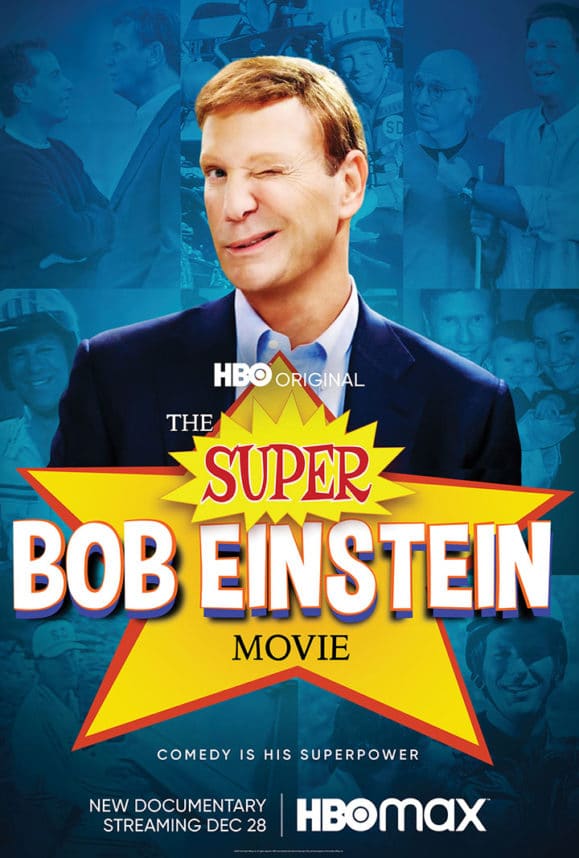
Film poster for “The Super Bob Einstein Movie.” (Photograph courtesy of HBO)

The documentary starts the viewer from Einstein’s early life as a showbiz kid in Beverly Hills, with his brothers Cliff and Albert, along with their comedian father and singer mother. 

It then dives into Einstein’s first foray onto TV in 1967, to his many appearances on “The Smothers Brothers Comedy Hour.” Much of the documentary, however, showcases the best of Einstein’s character “Super Dave Osborne”—the accident-prone Evel Knievel-spoof stuntman with deadpan confidence. He became a fixture on the late night talk show circuit with many appearances as Super Dave from Johnny Carson, to David Letterman and Jimmy Kimmel.

“I dare you to find a better deadpan person than Bob,” Gold said. “His whole style, when he would go on Letterman or Kimmel or Carson, and he would sit there with the longest wind up, the longest setup to a very funny punchline, but he had the power, he controlled it.”

Viewers of the documentary will find themselves not just laughing at Einstein’s antics and punchlines, but laughing with the interviewees on screen. You get to laugh with Steve Martin, Larry David, Susie Essman and many others watching an Einstein/Super Dave clip and react to it contemporaneously in the moment. It’s not just them recalling memories to the camera, it’s them reliving the memories on the spot.

Gold emphasizes that “Bob was always about the funny” and describes the film as not a documentary but a “movie that was funny with documentary overtones.”

A summation of Bob’s career can’t be done on paper, you have to see it to feel the genuine hilarity. It’s difficult to convey how side-splitting it is to see Einstein stare bullets through Jerry Seinfeld while they’re getting coffee, or witness Super Dave sitting atop a car that’s a little too tall for entering a vehicular tunnel —no verbal or written description can do justice to Einstein’s brilliance.  

A summation of Bob’s career can’t be done on paper, you have to see it to feel the genuine hilarity.

“Being a comedian and not trying to be funny is a very special gift,” Jerry Seinfeld says in the film. Many times, it seems as if the comedians are riffing with their memories of Einstein.

“I think he’d get a kick out of knowing that I have to sit here and do this, knowing that I really don’t want to,” Larry David says in the film about giving a testimonial.

The film also shows how Einstein brought comedy into his life when the camera wasn’t rolling: vulgar with his comedy pals, insistent with producers, and affectionate to his family as a husband, brother, father and grandfather. The most touching parts of the film were the testimonials of his grandchildren.

“We called him Papa Super because he was ‘Super Dave Osborne’ and we thought he was always like a superhero!” Einstein’s granddaughter Zoe Dale recalled. “There was always a funny aspect to life when you were with him…there was always a way to make the day better, there was always a joke that could brighten our days.”

“The Super Bob Einstein Movie” can be streamed on HBO Max.

“Super Bob Einstein Movie” is a Hilarious, Uplifting Documentary Read More »

From Tragedy Came a Music Festival Now in its 25th Year

The phrase “may their memory be for a blessing” is on the mind of Dr. Rosemary Cohen every day. The mother and grandmother has endured unfathomable tragedy on the route to starting the Liana & Ruben Cohen Music Festival, an event that’s become a staple of the childrens’ music scene in Los Angeles. 

“We came to this conclusion that doing music competitions and concerts will be a way to remember her, but mostly to do good [for] other students,” Rosemary said about starting the music festival in 1997 in memory of her daughter, Liana.  

On January 23, The Liana & Ruben Cohen Music Festival will be held for the twenty-fifth time. The festival serves to encourage children to take up music, participate in a competition and give them the exciting opportunity to perform for enthusiastic audiences at majestic theaters.

The festival used to just be named for Liana. In 1992, Liana was only 18 years old when she died in a horrific accident where a drunk driver hit the car containing her and her entire family. And then in July of 2021, Liana’s surviving brother Ruben died in a tragic plane crash at age 46, leaving behind two daughters and an extended family all too familiar with sudden tragic loss. Rosemary’s husband lost a brother in the 1980s when he was taken hostage and killed in Lebanon as well.

“I really want to bring something good out of the sadness, and Liana was a very good pianist.”
— Dr. Rosemary Cohen

“I really want to bring something good out of the sadness, and Liana was a very good pianist,” Rosemary told the Journal. “That’s why we started the competition. And this year, I added Ruben because he was also a good violinist and they used to play together.”

In the wake of Liana’s death nearly 30 years ago, Rosemary and her family decided against suing the drunk driver. But the thing that stuck with her the most is that when questioned by police, the young driver said that he was bored, so he drank and drove to go drink some more.

“Boredom.”

The pain of saying that word still echoes in Rosemary’s voice as she cited the one-word reason her daughter’s life ended so suddenly. 

“There are so many people who are stressed [or] afraid, and it’s not a reason to go to drink,” Rosemary said. “There’s no reason to go on drugs. I always told my children that listening to a very good piece of music—classical music for me—can be the best drug to heal.”

Ruben Cohen at 5 years old, performing a Szeryng violin concerto in Paris, France.

Rosemary seeks solace in painting, writing and taking positive action. Over the years, as a doctor of sociology, she has written books about her life experience and painted the music competition certificates herself.

One of the enduring reasons for the festival’s lasting legacy is what Rosemary believes are the benefits of getting young people involved in the arts.

“Performing in front of the public gives the child self-confidence, as it requires courage to face strangers and to share a part of themselves in the process,” Rosemary said. “Also, playing with an accompanist teaches the child to respect others, as [they] have to watch and follow the accompanist in order to create music together. So we see that discipline, hard work, respect and so many other advantages are the results of learning to play an instrument.”

One former participant in the festival, pianist Gaby Sipen, attributed the trajectory of her career in music directly to the competition.

“My whole life journey, I would say, would kind of actually go back to that,” Sipen said of the festival, having first participated in 2003. “And since I was eight years old, I participated in every single Liana Cohen competition every year up until high school.” 

Sipen went on to win many prestigious piano competitions while she was a student at Valley Torah High School and in college at UCLA. Now, at age 26, she is a teaching assistant at a neuroscience lab at UCLA, and is also applying and auditioning for masters programs in piano. 

This year, the festival will take place in two parts. First, there’s a competition for Jewish children on January 23 at Milken Community School. The winners will perform a concert on February 3rd.

Then, there’s the “open” competition on March 6 at Temple Beth Am, where anyone can compete. The winners of the open competition will be given the honor of performing on March 20 at Zipper Hall at the Colburn School of Performing Arts in downtown L.A.

Competition winners at the Liana Cohen Music Festival in 2020. (Photo: Liana Cohen Foundation)

The two competitions of the festival are emblematic of Rosemary’s journey to Los Angeles: competitive, enriching and worldly. Although Judaism plays an enormous part of Rosemary’s life, she was born in Iran to a Christian Armenian family. While studying sociology in France, she met her Jewish husband and eventually had four children with him. She wasn’t able to convert to Judaism in France, so when her family immigrated to the United States in 1985, she converted and they officially got married. Rosemary proudly points out that their four children were each holding a pole of the chuppah on that special day. She always wants to find ways to engage and inspire children.

When asked about what Rosemary’s work has meant to so many children like her who have been involved in the festival over the last quarter century, Sipen can only reflect in awe. 

“To go through something like [losing two children] and not just to come out of it standing, but to create something so beautiful and so long-lasting that will have an impact on other people is just incredible,” Sipen said. “You can see the pain in her eyes. And obviously I cannot imagine, I don’t wish that on anyone, but just the fact that she keeps going and she keeps creating, she is so committed to having this legacy go on. It’s incredible.” 

Another former participant, cellist Shoshanah Israilevich, looked back at how much the festival meant to her career in music.

“Each year, we were greeted by Rosemary’s beaming smile ready to welcome us into the synagogue where the competitions were,” Israilevich said. Like Sipen, she also started performing at the festival at age eight. “Now, being a cellist studying classical music at a conservatory, I can without a doubt say that the festival helped me grow immensely as a performer as I learned to work hard for the awards I received, and my confidence as a musician grew the more I performed. [The festival] allowed me to hone my skills in an environment where I felt encouraged to become the musician I am today.”

Applications for the festival are available now at www.lianacohen.org

From Tragedy Came a Music Festival Now in its 25th Year Read More »

His Candle Will Burn Eternal

Beloved family, beloved friends:

More than a century ago, the story goes, a boy with polio was abandoned at an orphanage in Nebraska.

He had to be carried up and down the stairs by the other boys. When asked if this was hard, one of the boys doing the carrying answered: “He ain’t heavy. He’s my brother.”

That line became a famous ballad, sung by Neil Diamond and The Hollies in the 1970s. And, decades later, a variation of it would arise spontaneously in my mind after Sheldon was struck with painful neuropathy and had to lean on me when he walked:

“He ain’t heavy. He’s my husband!”

It felt effortless, because I was so proud and fulfilled to be not just his wife, the mother of his children and his partner in business and philanthropy — but also his helpmate …

… or, as Sheldon liked to say: the wind beneath his wings.

How strange it is that the heaviness I did not feel back then has, since his passing, been with me each and every day.

It is the heaviness of a great absence — of a great man, greatly missed.

It is the heaviness of a broken heart.

Beloved family, beloved friends:

A Yahrzeit is meant to bring some closure.

It marks the passing of a year — that universal, unignorable landmark in time — since the passing of our loved one. The cycle of four seasons. An orbit of the Earth around the sun.

A Yahrzeit is meant to bring some distance.

It finds us a year older while the person we mourn remains forever the same age. It finds us borne up or burdened, made wiser or worn down by experiences he or she will never know.

As a committed Jew, as a believer in the sacred traditions of Israel, I embrace this first Yahrzeit for Sheldon — the love of my life, my soul-mate.

But, I confess, it brings me little closure or distance.

Sheldon was so full of passion and compassion, so abounding in dreams and diligence. He squeezed dozens of lifetimes and careers into his 87 and a half years. Someone who burns that bright cannot but leave an afterglow when he is gone.

And, indeed, Sheldon lives on: in the children and grandchildren who are so reminiscent of him; in the philanthropic projects that bear his name; in the industries and city skylines that he created or reshaped; in the gratitude of the countless people who benefited from his leadership and largess.

Hardly a day goes by without me receiving a letter from strangers, recalling the kindnesses Sheldon did for them.

Hardly a day goes by without me asking out loud “What would Sheldon do?” regarding an important decision.

For a year, now, Sheldon has not leaned on me. Indeed, the roles are reversed. Wherever I go, whatever I do, I imagine myself leaning on him — for advice, for encouragement, for the sharing of the most intimate memories.

Why would anyone want closure on that kind of love? Why would anyone want distance from such a fusion of two hearts and minds?

Why would anyone want closure on that kind of love? Why would anyone want distance from such a fusion of two hearts and minds?

Beloved family, beloved friends:

We came here to commemorate Sheldon. To say Kaddish on the Mount of Olives, where he lies among the saints and statesmen of Zion. To light memorial candles symbolizing his eternal spirit.

But we are also mindful of God’s instruction in the Bible: “I have set before you life and death, the blessing and the curse. Therefore, choose life!”

I have long quoted this line to comfort those who have suffered bereavement.

And, over the past year, I have recited it to myself daily.

Now, this first Yahrzeit — and, by coincidence, the new Gregorian year — is the time to make that choice.

I choose to emerge and embrace life anew.

The children and grandchildren that Sheldon so cherished are growing in maturity, and I intend to be there for them all, in my fullest and my best.

And I will do this — we will all do this — in the knowledge that it is what Sheldon would have wanted. That he is with us, his memory illuminating and warming our lives like a candle that will never go out.

Thank you.


Dr. Miriam Adelson, a physician, medical researcher and philanthropist, is the widow of Sheldon Adelson. Originally published in the Las Vegas Review-Journal.

His Candle Will Burn Eternal Read More »

Two Dead in Israeli Military Helicopter Crash

Two members of the Israeli military died in a Navy helicopter crash on January 3, while a third was wounded.

The crash took place during a training exercise and occurred off the coast of Haifa. The deceased have been identified as Lt. Col. Erez Sachyani, 38, and Major Chen Fogel, 27. The third person in the crash, a naval officer, has not yet been publicly identified but was released from the ICU in Rambam Medical Center on January 4 and is currently in good condition, according to The Times of Israel (TOI).

The Israeli Air Force is investigating the incident and all training flights have been suspended. The crash is not believed to have been caused by an attack.

 “This is a difficult day for Israel,” Israeli Prime Minister Naftali Bennett said in a statement, per TOI. “We lost two sons, two pilots, some of our best, in an accident at sea. I share in the grief of the families for the loss of Lt. Col. Erez Sachyani and Maj. Chen Fogel, men who gave their lives for Israel’s security, day after day, night after night.”

United States Ambassador to Israel Tom Nides shared his condolences in a tweet. “May their memories be a blessing,” he wrote.

Two Dead in Israeli Military Helicopter Crash Read More »