
fbpx

December 24, 2021

Annual Christmas Talk – First Century Judaism and the Rise of Christianity


Annual “Christmas Talk” Shabbat Shemot 2021

Our motto, at one time, used to be “Moving Tradition Forward.”  One of the oldest traditions of our synagogue is my annual “Christmas Sermon” and I try to move forward our discussion of Christianity every year.

In all the spaces from which we rented, from our inception in December 1993 until 2008, there was always a Christmas tree in the room. At our first service, we were in a church on the Shabbat before Christmas, replete with a beautiful Christmas tree. I made a decision to speak to the topic instead of past it, for a few reasons. First, most Jews have only a caricature understanding of Christian faith. As I have taught over the years, I have constantly heard well-meaning people say less than thoughtful things about Christianity. Since Jews often times think about Christianity and sometimes have a lot to say on the topic, it is well that we think in an informed way and speak accurately.

Secondly, we are blessed to have many Christians in our community (usually, thought not always, through intermarriage), and all of us have family members and friends who are Christian.  We have a large number of Jews by Choice at Ohr HaTorah, perhaps up to a third or more of our membership. The topic of Christianity, therefore, must be treated with care and thoughtfulness.

Third, and probably most deeply, my own spiritual path has been shaped by my readings of Christian thinkers. For example, all I knew about Martin Luther before I began college was that he led the Reformation and that he was anti-Jewish. That was just about all a Jew needed to know, where I came from. Then, I was assigned to read Luther in my “History of Christian Thought” class. I was touched to the bone when I read Luther on grace. I had really never thought about this religious concept. “Grace,” I thought, was a Christian idea, therefore we Jews should stay away. We should focus on “justice” instead.

Once I studied this idea in Luther and other Christian sources, I realized that “grace” (chen in Hebrew), was all over the Bible, Rabbinic Literature and the Siddur (prayerbook). I realized I had to work out a theory of grace from a Jewish perspective. That process of thinking about grace gave shape to my experience of God and I grew as a person immensely.

As my studies progressed, and I read Paul Tillich, Rudolph Bultmann, Karl Barth, Helmut Gollwitzer, and a host of other Christian thinkers, I realized that reading Christian thinkers made me think about Judaism with new questions, with a new set of eyes. My studies in Christianity have been transformative in how I see Judaism, because those studies made me look at things that were obvious in hindsight, but that I never noticed before. I am a better Jew because of those studies. Each year, I want to share some of those riches with you.

This year I want to focus on two things:  How a Jewish apocalyptic preacher from 1st century Judea became the foundation of one of the world’s great religions, and, if we have time, why the resurrection of Jesus became such a key theme in early and subsequent Christian thought.

My study and teaching of Christianity match the way I study and teach Judaism.  I do not take the text as the literal word of God. I am always interested in the origins of texts, how texts become “scripture,” and how theology develops over time. This approach is of course diametrically opposite of the approach taken by evangelical Christians of their religion and the Orthodox Jewish understanding of Judaism.

Once we put issues of a literal reading of the text and theological conformity aside, we can ask questions of meaning, the deeper message contained in any text and belief system. From this perspective, every religion responds to the human condition and has its own way of addressing the human condition. The “meaning path” will guide my discussion of Christianity.


Rabbi Finley

Annual Christmas Talk – First Century Judaism and the Rise of Christianity Read More »

Moshe and the Road Less Traveled

Screenwriters are drawn to an unusual aspect of Moshe’s story: that the future liberator of the Jews was raised in the house of Pharaoh. Movies like “The Ten Commandments” and the “Prince of Egypt” invent backstories to describe Moshe’s childhood, and fill in the details that are missing in the text. Moshe is cast as the step-sibling of the Pharaoh he would later battle; and these movie scripts offer a vivid picture of childhood friendships and jealousies, romantic rivalries and bitter squabbles. American cinema has written an entire soap opera for Moshe’s life, which reaches its crescendo when Moshe returns home to the palace and demands from his estranged step-family: “Let my people go.”

The paradox of Moshe in Pharaoh’s house also caught the attention of traditional commentaries. But they are interested in why this absurd turn of events ever occurred, and why God chose to bring this about. For one accustomed to seeing the workings of providence within the text, Moshe being raised in Pharaoh’s house is truly a riddle.
Several responses are offered. Rabbinic literature highlights the irony that the great Pharaoh will ultimately be taken down by the baby sitting on his lap. Various texts in the Talmud tell of a nervous Pharaoh, obsessed with destroying a future Jewish savior. Following his astrologers’ advice that this savior can be vanquished by water, he orders every Jewish boy to be thrown into the river. Yet this desperate decree actually brings Moshe to Pharaoh’s doorstep. Moshe’s very presence in the palace mocks Pharaoh’s carefully maintained image of being an all-powerful human deity. Instead, Pharaoh comes off as a frightened, bumbling man who provides a luxurious upbringing for his future nemesis.

Avraham ibn Ezra offers two insights, both tied to the concept of leadership. He explains that had Moshe been raised among the Jews, they would not have feared him; he would have been too familiar and comfortable to exercise full authority over them. Ibn Ezra offers another idea, which focuses on what Moshe learned from Pharaoh’s example. Ibn Ezra asserts that the Jews in Egypt had a slave mentality, and anyone raised among them would be too cowardly to confront Pharaoh. Being raised in Pharaoh’s house would train Moshe to have an “exalted soul,” to be strong and confident. Moshe is learning a leadership style from Pharaoh that he could not learn in his own community.

Ibn Ezra’s explanation is troubling, because according to his view, God brings Moshe to Pharaoh’s house to be more like Pharaoh. But who would want to emulate the leadership of Pharaoh? Pharaoh’s autocratic administration and slavery are clearly connected, because elevating one man into a demigod dehumanizes everyone else. If anything, it would seem to me that the Torah is offering the opposite message: Moshe’s leadership skills came not from imitating Pharaoh, but in defying him.

If anything, it would seem to me that the Torah is offering the opposite message: Moshe’s leadership skills came not from imitating Pharaoh, but in defying him.

It is remarkable that Moshe became a spiritual giant; most others would have been seduced by the power and privilege of Pharaoh’s palace. It would have surprised no one if Moshe had stayed loyal to the royal family that cared for him, and turned his back on his Jewish brethren. Our social context has a profound influence on who we are; Maimonides says it is such a potent force, that if one is living among “evildoers and sinners,” they should uproot themselves and leave home to “dwell in caves, or cliffs, or deserts.” Yet Moshe manages to transcend his background, and even at a young age is a rival of Pharaoh’s despotic, depraved empire.

Moshe’s choice to rebel against Pharaoh is truly the road less traveled; most people prefer to follow the crowd and listen to the leader. This is a sobering thought for anyone who strives to live an upright life; perhaps our moral achievements are simply the product of luck. We are who we are because we had positive role models, and had those circumstances been different, we might be very different people. Thomas Nagel, in his essay “Moral Luck,” reminds us that “what we do is also limited by the opportunities and choices with which we are faced, and these are largely determined by factors beyond our control. Someone who was an officer in a concentration camp might have led a quiet and harmless life if the Nazis had never come to power in Germany. And someone who led a quiet and harmless life in Argentina might have become an officer in a concentration camp if he had not left Germany for business reasons in 1930.”

People generally live conventional lives. For the ordinary citizen of Nazi Germany, antisemitism was socially expected, and murder was accepted. And for those who followed Hitler uncritically, it was easy to follow orders. Joachim von Ribbentrop, Hitler’s Minister of Foreign Affairs, defended himself in the Nuremberg Trials by saying: “I was always loyal to Hitler, carried through his orders, differed frequently in opinion from him, had serious disputes with him, repeatedly tendered my resignation, but when Hitler gave an order, I always carried out his instructions in accordance with the principles of our authoritarian state.” Von Ribbentrop’s argument is an example of the “Nuremberg Defense,” the argument that the Nazi defendants should be excused for their crimes because they were the law of the land. This defense is the legal equivalent of invoking moral luck, with the defendants in Nuremberg arguing that they should be exonerated because they were doing what was expected of them.

But not everyone followed the crowd. A remarkable few defied the Nazis, and refused to sell their souls. There were rescuers like Schindler, Wallenberg and Sugihara, both famous and unknown, who defied the evil Pharaoh’s edict. They followed Moshe on the road less traveled, and were willing to pursue justice and integrity when everyone else had turned their backs.

Moshe begins his career with the ultimate act of independence, by listening to his conscience instead of his contemporaries. His ability to safeguard his soul while being raised in Pharaoh’s house is remarkable. But the Torah demands more of all humanity; and the point of the story is that all of us can be Moshe.


Rabbi Chaim Steinmetz is the Senior Rabbi of Congregation Kehilath Jeshurun in New York.

Moshe and the Road Less Traveled Read More »

About Georgina

Everyday I walk to the edge of the continent.

I pass by a mysterious house on a beautiful street, named after the daughter of the founder of the magical city of Santa Monica. Her name was Georgina.

I wonder what it was like — to have a street named after you, near some orange groves in a sparsely populated city by the ocean. I envision her dad, getting off a horse.

“Honey, I have some exciting news. I’m going to name a street after you.”

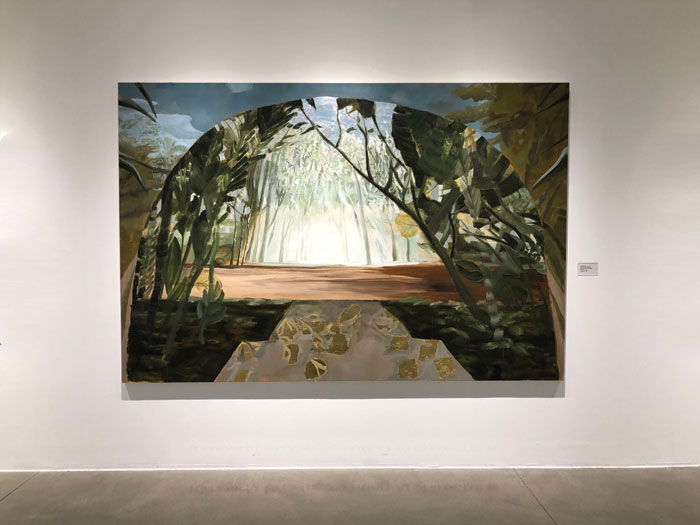
I’ve seen the house in every possible light. It has a round archway on the entry with large banana plants framing it like bangs or servants ready to greet you.

At dusk the doorway looks gold. A few years ago, I painted it. Of course, I named it “Georgina.”

Georgina Oil on Linen 2018. Kimberly Brooks

“Georgina” was presented in a 2017 exhibition called Brazen and, of course, she made the cover of the postcard.

I slipped her in my purse and wrote a note on the back, thinking, I must tell the owners of the mysterious house. Maybe they’ll come to the opening.

I knocked. No one answered. I waited. I knocked again and then slipped it under the door, hoping that maybe I’ll meet him or her or them at the opening reception.

When I turned around, I found myself standing underneath the hood of the curved entryway. The sun was bright and the street dramatically changed in appearance. The sun dappled the steps in shimmering gold. The light was a hot and bright. The plants became black in contrast and the interior walls held another place and time altogether. It was a kind of miracle.

I had to paint that too.

What should I call it? I struggled with the name. I took an anthology of poems by Emily Dickinson off the shelf and pointed to a single line at random.

“G-d Does it Every Day.”

Perfect.


Kimberly Brooks is a contemporary American artist and author. Her work integrates landscape, figuration and abstraction to address subjects of history, memory and identity. Her work has been exhibited and featured internationality. Her exhibition at the Museum of Art and History is up until Dec. 26.

About Georgina Read More »

Brother and Sister Cross Country Runners Qualify for National Championships

Lev Marer, 12, a seventh grade student at Kadima Day School in West Hills, and his older sister Batya, 14, an eighth grader at Abraham Joshua Heschel School in Northridge, have both qualified to be at the national championships for cross country. 

The Marer siblings run for United Track Club in Agoura Hills. Lev’s team, comprised of 11 to 12-year-old boys, placed first in their age group at the Amateur Athletic Union (AAU) Cross Country National Championship on December 4. Batya beat her own personal record for the 4K by 40 seconds.

Batya Marer / Photo courtesy of Melissa Gorlick Marer

“It was really a team effort and following the better experienced runners on our team pushed me to do better,” Lev told the Journal “I did not want to disappoint the team and my friends. It all comes down to how well we have been training.”

Batya added, “It is important to be part of a team, to work together. The adrenaline rush during running and at the finish line is rewarding.” 

Melissa Gorlick Marer, Lev and Batya’s mother, told the Journal the siblings run four times per week for a total of 12 to 16 miles at meets in Agoura Hills, Simi Valley and surrounding areas. They only just began running in August of 2020. 

“This was a wonderful outlet for Lev and Batya to be out in the fresh air, to exercise and socialize with their friends,” she said. “This intense training helps them to persevere in all aspects of their lives.”

When running, Lev said, “I feel free. The process is all about me and my thoughts. I like the physical rush of doing well.”

Batya experiences something similar. “I feel healthy and good after a run,” she said. “It is a sense of accomplishment.”

Lev Marer / Photo courtesy of Melissa Gorlick Marer

Lev and Batya’s athletic ability and determination seem to be genetic; Melissa  ran cross country and track in high school and earned a letterman jacket, and her father, David, was a Korean War vet “who taught them the values of family, persistence, Judaism, going the extra mile and hard work,” she said. “They continued [their] Jewish education, largely in part because that was Saba David’s final wish.”

Melissa believes that because of what Lev and Batya have learned about the Jewish value of caring for others, they’ve excelled on their respective teams. 

Melissa believes that because of what Lev and Batya have learned about the Jewish value of caring for others, they’ve excelled on their respective teams. “Judaism teaches us to try our best and to be kind to one another,” she said. “This ties into being part of the team and looking out for their friends and teammates.”

While Lev has discovered how important it is to set personal goals and believe in his ability to do better from cross country, Batya is focusing on pushing herself harder each time she runs. In the future, she envisions she’ll be able to “achieve milestones that I have never achieved.” 

Lev looks forward to continuing with cross country and hopefully excelling in it. “Regardless, it will be a solid platform to be building on for whatever comes next,” he said. “Doing well in running with a team will transfer [to] many other areas. This type of activity is what helps make champions.”

Brother and Sister Cross Country Runners Qualify for National Championships Read More »

Two Kosher Chefs Debut New Online Cooking Shows

Kosher.com, a site that features thousands of kosher recipes, has recently debuted two new shows: “Rosh Chodesh Club” featuring Gabe Garcia, Head Chef of Tierra Sur, and “Breaking Bread” with Danielle Renov, a cookbook author with Ashkenazi and Sephardic roots living in Israel. 

Viewers can check into “Rosh Chodesh Club” every month to cook recipes in real time with Garcia, a Southern California native whose cooking has helped Tierra Sur become one of the top-rated restaurants in Ventura County. He takes his audience through every step of the process with his recipes, and so far, has taught how to make fall roasted squash salad and lamb samosas with pea mint sauce.

Gabe Garcia

“By creating a real-time show, the viewers get to see every detail of how I create a dish,” Garcia said. “Every thought, every little tip and trick that would normally get left in the editing room, every step—nothing is left out. This is a master class for people that really want to improve their skills in the kitchen and understand flavors and pairings, not just about how to do one very specific recipe.”

To ensure that viewers are ready to cook once the show is posted, Garcia encourages them to prep beforehand. He also explains how to pair food with wine, since Tierra Sur is located at the headquarters of Herzog Wine Cellars. The series is for all kinds of chefs, no matter what their skill level.

While Garcia is not Jewish and doesn’t keep kosher, he brings his palate to Tierra Sur to try to find kosher approximations of dishes that he enjoyed when he was growing up or that he’s had at other restaurants in the non-kosher world. 

“I love being able to do that,” he said. “When one of our kosher clients says to me that they’ve never tasted anything like what they’ve just eaten, or when they try something that we’ve created that would normally not be available to them because of kosher guidelines—but we’ve created a kosher substitute that is almost identical—and love it, those are some of my greatest joys as a chef.”

On “Breaking Bread,” Renov, who has over 81,000 followers on Instagram, sits down to cook and eat with interesting Israeli personalities. In one episode, she makes green shakshuka with Rudy Rochman, an activist who was detained in Nigeria this past summer while filming a documentary on the Jewish community there. Another episode showcases Sapir Barak, who cooks Shabbat dinners for up to 50 people each week in her home in Tel Aviv. She and Renov make beef tataki, (marinated, thinly sliced beef).

“Israel is a melting pot of all different types of people,” said Renov. “They come from all over the world with their own unique cultures, customs and cuisine, and I wanted to help tell their stories through the food we cook together.”

Renov has noticed that the world of kosher food is becoming increasingly forward thinking, and chefs are exploring much more than the traditional Jewish cuisines nowadays.

Renov has noticed that the world of kosher food is becoming increasingly forward thinking, and chefs are exploring much more than the traditional Jewish cuisines nowadays.

“Sometimes the limitations we live with push us creatively,” said Renov. “I think the kosher world has been experiencing a renaissance of sorts when it comes to innovative and creative ways to cook and eat.”

Both Renov and Garcia see the spiritual value in kosher cooking as well. While Renov said that eating and making kosher food represents her dedication to her religious lifestyle, according to Garcia, it elevates food to an almost sacred level. 

“There’s a huge focus on the process the food takes from its origins to the plate, a process that often ensures you’re getting some of the cleanest and freshest ingredients available,” he said. “While the trend of ‘You are what you eat’ has only been something that’s recently become fashionable in the culinary world, that sentiment has been a guiding principle of kosher food for thousands of years.”

Stuffed Squash from Gabe Garcia
Serves 10

4 small butternut squash
4 small acorn or delicata squash
1 lb. ground veal
1 onion, diced
¼ cup slivered almonds
¼ cup dried cranberries
3 green onions
½ tbsp. thyme
½ tbsp. chopped rosemary
2 – 3 cups cooked mixed or plain rice
¼ cup white wine
1 cup red wine vinegar
1 cup honey
10 sage leaves
1/3 cup fried shallots

  • Cut the delicata or acorn squash in half and scoop out the seeds.
  • Cut the seed cavity of the butternut squash off and scoop out the seeds, and then peel off the skin.
  • Peel the top of the butternut and dice into ¼ inch cubes and save for later.
  • Season the squash “cups” with salt, pepper and olive oil and roast in a 375*F oven, cut side up, for 15 to 18 minutes until tender but the shape is not lost.
  • In a pan, sauté the ground vealuntil brown.
  • Add the onions and cook until tender.
  • Add 2 cups of the cubed butternut squash and continue to sauté for 2 to 3 minutes.
  • Stir in the cranberries and almonds.
  • Add the rice, rosemary and thyme.
  • Deglaze with the white wine.
  • Continue stirring until the wine has cooked off.
  • Remove from the flame and season with salt and pepper. Set aside.
  • Place ¼ cup of oil in a small pot over medium heat Add the sage leaves, fry until crisp and drain on a paper towel.
  • Mix the honey and vinegar in a second small pot. Cook over medium heat until reduced by half.
  • To assemble, fill the cups with the meat mixture.
  • Top with the fried shallots, sage and some extra almond slivers.
  • Drizzle with vinegar honey sauce.

Two Kosher Chefs Debut New Online Cooking Shows Read More »

Four “G” Words We Need in 2022

With toxic polarization infecting the national discourse, the new year presents a timely opportunity to improve the quality of our conversations, especially when communicating with people with whom we disagree. We can do this by reflecting more on the following four “G” words: gratitude, good faith, generosity, and God.
Many people associate gratitude with religious ritual. The Jewish tradition, for example, requires daily expressions of gratitude such as reciting each morning modei ani  (Hebrew for “I am grateful”).  Specific blessings of thanks also are said both before and after meals and snacks. In addition, traditional Jews say a foundational prayer three times a day known as the Amidah, which contains the same prayer of thanksgiving.

But gratitude extends beyond religious practice. It also manifests in mindfulness, an attribute with universal appeal today. Mindfulness enhances self-awareness, which causes us to pay more attention to how we engage with others. This leads to more effective, positive communication.  

Acting in mutual good faith is the second “G” that can elevate the quality of our discourse. I once disagreed with a colleague about a work-related matter. But it meant a great deal to me when he remarked that despite our difference of opinion, he always knew I was coming from a place of good faith. This observation taught me the valuable lesson that conflict resolution is much easier if we acknowledge that those with different viewpoints can still be acting in good faith.  

In contrast, our present social climate encourages people to assume bad faith on the part of those with whom we disagree.  We are accustomed to demonizing individuals with different perspectives, a tendency exacerbated by the news, social media and the overwhelming pull of our “soundbite” culture.  Too often we rush to judgment rather than engaging in thoughtful discussion of difficult issues that are rarely one-sided.  Discourse would be markedly improved if more people made an affirmative effort to act in good faith and to assume good faith on the part of people whose viewpoints differ from our own. 

Generosity is the third “G” word that can foster a healthier discourse. In this context, I am referring especially to emotional generosity. Recently, the University of Austin was established with the goal of resisting the political and ideological asymmetry characteristic of so many institutions of higher learning. In calling for a culture of trust, openness and grace within the Academy, founding president Pano Kanelos emphasized the importance of emotional generosity. 

 As an academic, I see a real need for the type of educational reset Kanelos envisions. An environment that encourages people to display emotional generosity will encourage open discourse. True dialogue can only occur when people understand that mistakes are an essential part of the learning process and have confidence that they will be forgiven.

Finally, conversations about God can enhance our ability to engage with others. I realize that God is a freighted concept for many people. But meaningful conversations about distinct conceptions of a higher power can create close bonds and deep friendships.  I learned this as a religion major in college through the many conversations I had with my Christian classmates. 

God-talk also facilitates positive communication aside from religion. Although religious people often think about God in Biblical terms, many others maintain a more fluid, but no less personally meaningful, perspective. Most views of God have the potential to reaffirm that as individuals, we are not the center of the world. This spiritually driven focus on “the other” can furnish a path toward human engagement rather than estrangement.

We can control our words and our actions. By elevating how we relate to others, by decreasing polarized discourse, we can help repair the world.

We live in challenging times.  The global pandemic continues to be a reminder of how little control we often have over our environment. But thank God we can control our words and our actions. By elevating how we relate to others, by decreasing polarized discourse, we can help repair the world.


Roberta Rosenthal Kwall is the Raymond P. Niro Professor at DePaul University College of Law and the author of “Remix Judaism: Preserving Tradition in a Diverse World” (updated edition forthcoming).

Four “G” Words We Need in 2022 Read More »

“The Genius Under the Table” Shows a Child’s Perspective on Surviving the USSR

One day, when Eugene Yelchin was just a child, his parents were discussing whether or not Mikhail Baryshnikov would defect from the Soviet Union, where they lived. Suddenly, their neighbor Blinov, a KGB informer, revealed that he was eavesdropping in on the conversation, and implied that he was going to report Yelchin’s parents to the authorities. 

“I was scared myself,” Yelchin writes in his new book, “The Genius Under the Table: Growing Up Behind the Iron Curtain.”  “What if Blinov sent us all to prison? Something had to be done, but what?”

In an attempt to ease the tension, Yelchin made a Baryshnikov-style leap across the kitchen floor – only to slip, accidentally splash his mom head to toe with dirty water and get yelled at by his father. 

In his new memoir for young adults, author and illustrator Yelchin channels his childlike self to describe what it was like growing up in Cold War Russia. He purposely doesn’t include analysis about the times or insights he learned when he got older.
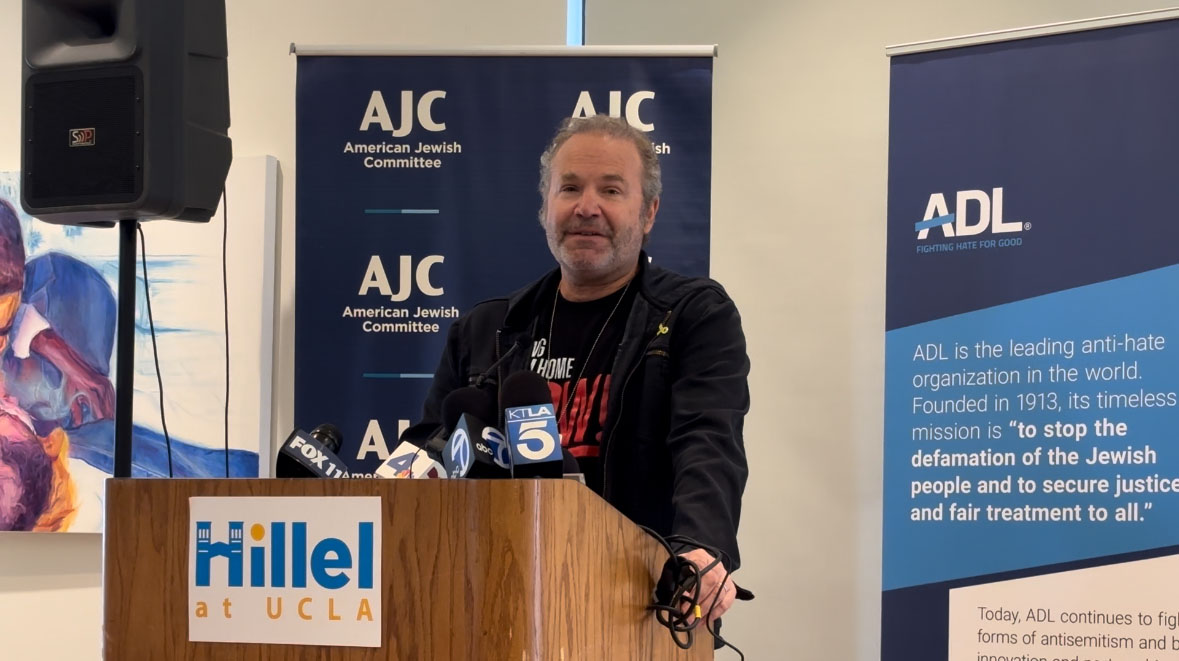
“The book is written in the first person of a young boy figuring out confusing social and ideological structures of his family and his country.”—Eugene Yelchin

“The book is written in the first person of a young boy figuring out confusing social and ideological structures of his family and his country,” he told the Journal. “No explanations from the present are given so that the young readers are figuring out that complicated world along with the protagonist.”

“The Genius Under the Table” is a heartbreaking, yet amusing, exploration of what life was really like as a child, citizen and Jew in the Soviet Union. Despite the turmoil that Yelchin and his family went through, the book, which includes exaggerated caricatures of his story’s subjects, is also hopeful. 

Like everyone around him, Yelchin was constantly scared of the government. “In our lives, the KGB was ever-present and terrifying, even though as a boy I did not know yet the full extent of the violence that the KGB was capable of,” he said. “My parents would never tell my brother and me of the atrocities that the secret police had committed against the people of our country, or what happened to some members of our family during the Stalinist purges. It was safer for my parents to reveal nothing to us.”

Things were made worse by the fact that Yelchin, who also wrote the novel “Breaking Stalin’s Nose,” came from a Jewish family. His great-grandparents died during the German occupation, his grandfather was a Moscow engineer who was likely executed during Stalin’s 1928 engineers purge, his grandmother endured numerous pogroms and his parents survived the antisemitic purge of 1948-1953. 

Yelchin’s schoolmates beat him up daily, his neighbors called him a Yid, a swastika was occasionally chalked on his family’s door and a slogan appeared on the courtyard wall of his building that read, “Beat Jews, save Mother Russia.” 

“The worst of all,” he said, “was the effect that the state-sponsored antisemitism had left on the Russian-Jewish identity of my family: my father changing his first and middle Jewish names to Russian ones, my mother proudly declaring that my brother and my father didn’t look Jewish (she and I did), as well as a feeling of shame and inadequacy I felt as a kid, wishing to be like everyone else—an impossible goal for a Jewish boy with artistic leanings.”

Even though life in the USSR was difficult, Yelchin found a way to positively spin his experiences. He concludes the book by writing that while he saw fear in the eyes of his family members and strangers he passed in the streets every day, there were also “eyes that shone with curiosity and passion, eyes starved for something more than our drab existence. I had seen such eyes in lines waiting for Baryshnikov to dance, and I had seen such eyes in our libraries, our theaters, our museums and our concert halls. Those curious and passionate eyes made me happy. Yes, in spite of everything, I was happy.”

When people read his book, Yelchin, who now lives with his family in Topanga, wants them to learn how important it is to become politically involved.

“In the dictatorship, we were dependent on the whim of the dictator,” he said. “In a democracy, we depend on the strength, honesty and clear-sightedness of the elected officials. If reading ‘The Genius Under the Table’ will move some of my readers a little closer to becoming active and fearless defenders of our democracy, I will be extremely gratified.”

“The Genius Under the Table” Shows a Child’s Perspective on Surviving the USSR Read More »