fbpx

December 17, 2021

Trump: American Jews “Don’t Like Israel Or Don’t Care About Israel”

Former President Donald Trump said in an interview with Israeli journalist Barak Raviv that American Jews “either don’t like Israel or don’t care about Israel.”

The interview, parts of which were played on a December 17 edition of the “Unholy: Two Jews on the news” podcast, featured Trump telling Raviv: “There’s people in this country that are Jewish [who] no longer love Israel. I’ll tell you the evangelical Christians love Israel more than the Jews of this country. It used to be that Israel had absolute power over Congress, and today I think it’s the exact opposite. And I think [former President Barack] Obama and [President Joe] Biden did that.

“And yet in the election, they still get a lot of votes from Jewish people, which tells you that the Jewish people––and I’ve said this for a long time––the Jewish people in the United States either don’t like Israel or don’t care about Israel,” he added. “I mean, you look at The New York Times, The New York Times hates Israel. Hates them. And they’re Jewish people who run The New York Times, I mean the Sulzberger family.”

The Anti-Defamation League (ADL) and American Jewish Committee (AJC) criticized Trump’s remarks.

“Once again, former President Trump has linked his lack of strong support among most US Jews to their feelings about Israel and used classic #antisemitic stereotypes about Israeli and Jewish control of Congress and the press to bolster his argument,” ADL CEO Jonathan Greenblatt tweeted. “It’s sad that once again we have to restate this point, but the vast majority of American Jews support and have some type of connection to Israel, regardless of which political candidate they vote for.

“Let me be clear: insinuating that Israel or the Jews control Congress or the media is antisemitic, plain and simple. Unfortunately, this is not the first time he has made these offensive remarks.” In an October 29 radio interview, Trump said that “Israel had such power, and rightfully over Congress, and now it doesn’t.”

The American Jewish Committee tweeted, “Why is Mr. Trump once again fueling dangerous stereotypes about Jews? His past support for Israel doesn’t give him license to traffic in radioactive antisemitic tropes — or peddle unfounded conclusions about the unbreakable ties that bind American Jews to Israel. Enough!”

Former Congressional staffer Boris Ryvkin defended Trump in a Twitter thread. “Israel is a solidly center-right to right wing country, and seems to be getting more right with each passing year,” he wrote. “[Former Israeli Prime Minister Benjamin] Netanyahu was barely ousted from power [because] of Netanyahu rather than his policy positions which are broadly popular and the Israeli consensus.”

He added: “American Jews, by contrast, have veered ever more to the political left — a process which Trump helped to hasten. Their views on Israel and what it should do would be squarely on the fringe of Israeli politics today. They either don’t understand that or don’t much care.” Ryvkin argued that Trump’s policies on Israel were “fully aligned with the Israeli mainstream, but out of step with the American Jewish mainstream. He apparently thought the two were on the same page and expected some gratitude from the latter. He just didn’t get it.”


Trump: American Jews “Don’t Like Israel Or Don’t Care About Israel” Read More »

The Struggle for the Blessing – Torah Portion Va-Yechi 2021


The Struggle for the Blessing

Torah Portion VaYechi 2021 (adapted from previous versions)

When I was a graduate student at USC, I frequented a nearby supermarket with a deli inside to get lunch. Once when I was standing in line, a young man ahead of me, about my age, was dismayed to find that he had forgotten his wallet. It was a sandwich and drink; I offered to pay. He protested, and I insisted. I paid for both our lunches and as we left the checkout counter, he stopped me – I thought to thank me. What he did say next I did not see coming.


“Do you know what you have done?” he asked me. I knew the answer was probably not that I had bought him lunch, so my face registered curiosity. “Do you know what a Brahmin is?” he asked. I did.


I am a Brahmin,” he declared. I sized him up quickly – truly, a fine looking young man from India – tall, handsome, and graceful in bearing. If anyone could exemplify a young Brahmin, this would be the guy.


“You have bought me a meal. This is a high honor for you. You will have God’s blessing all of your life.” He was beaming as he announced this to me. He wasn’t thanking me exactly, but he did seem to say that life itself, the cosmos, would express its gratitude in return for my providing a meal for a Brahmin. “Thank you,” I said, followed up with something like “It is an honor and pleasure to benefit a Brahmin.” Brahmins are people, too.


I am open to mystery, so I thought to myself, “Why not?” His deportment was so regal, so confident that he seemed to be exactly the kind of person whose very being could dispense blessings.


That momentary feeling, as our eyes locked in some kind of metaphysical embrace, has stayed with me. Something about the randomness of the moment made it feel real.


Ever since that odd but authentic moment of blessing, I have had a better understanding of the struggles in the book of Genesis for the blessing of the birthright. Such a blessing was an affirmation of enormous privilege, but not an earned one. The book of Genesis, in some ways, is a subversion of what was obviously an ancient custom (and not so ancient). In Genesis, the status of the firstborn is in doubt. When status is in doubt, struggle ensues. The subtitle of Genesis might be: “The Struggle for the Blessing.” The jealousy, conniving and bloodshed tell how much the blessing was yearned for. We think of the struggle between Cain and Abel, Ishma’el and Isaac, Jacob and Esau, Joseph and his brothers. I think of Adam and Eve, who were blessed with fertility, and then cursed with banishment.


Imagine yourself fighting for receiving a blessing that could only be given to one person, a blessing that you know without a doubt was the channeling of divine favor upon you for your entire life. Imagine going throughout your whole life with this blessing. Now imagine your life with this blessing withheld from you. In some way, each of us is fighting for a blessing.


Perhaps the struggle for the blessing is behind the custom, in traditional Jewish homes, where parents bless their children on Shabbat. In Judaism, we have an obligation to bless our children. Sadly, I have known many of those children who had the formal blessing recited for them, but the rest of the week was filled with expressions of dissatisfaction and even condemnation. The Chasid in me (and maybe the Reform rabbi in me) says that non-liturgical blessings are more powerful.


Expression of love, respect, admiration and kind guidance are blessings we can give our children. Facial expressions and gestures of affection and affirmation are blessings. Kind words of praise, words of approval, a nod and a look that communicates a parent’s affirmation is a moment a child can cherish forever. I find that parents so often are invested in advising and correcting, that they forget to offer a pure, simple unqualified blessing – expressing admiration for a kid sticking through something they weren’t good at but hung in there anyway. A blessing for their tenacity and humility. Our children are never too old not to need blessings from their parents. And at a certain point, children have an obligation to bless their parents.


Sadly, many people did not have parents who blessed them, and can live life with a void. And even if we have or had parents who gave us their blessings, we still authentically need the blessings of others. We human beings are relational at our core. I often speak about irrational and useless needs we place on each other. The need for blessings from each other, however, such as love, admiration, respect, gratitude, offers of support and guidance, are authentic and righteous needs, needs that define close relationships. We have an obligation to offer blessings to others; perhaps this is the core of the commandment to love others as we would like to be loved.


Relationships are constituted by authentic needs, and the gracious granting of those needs. We have a duty to love, a duty that should be fulfilled with grace. The virtue duty of restraining harsh words allows a space to be formed that can be filled with words of gracious blessing.


In honor of this Torah portion, perhaps we can look at our lives and see whom we can bless, and find a way to offer that word or deed.


Perhaps we can find the part of ourselves that does not feel worthy of a blessing, and work on healing that wound. Eventually, hopefully, we can find our way to people who can bless us, perhaps not using that word itself, but who bless us nonetheless.


We don’t have to wait for someone to buy us a sandwich to offer such a blessing, or buy someone lunch to get one.

The Struggle for the Blessing – Torah Portion Va-Yechi 2021 Read More »

Unscrolled Vayechi: Disrupting the Natural Order

“Israel’s eyes were dim with age; he could not see” (Genesis 48:10).

This line transports us in time and space. We recall when it was Isaac whose eyes had dimmed, back when Israel—then Jacob—disguised himself as his older twin Esau in order to steal his father’s blessing.

We are being set up by the text to anticipate a recurrence of this eternally recurring motif—the overturn of primogeniture—in which the younger sibling attains the blessing and privilege due the older.

We saw it when Abel’s offering was favored over that of Cain. We saw it when Isaac was chosen to be the covenantal son over Ishmael. We saw it when Jacob outwitted Esau. We saw it when Rachel was favored above Leah. We saw it when Zerah’s grasping hand reached out of the womb before his older twin won the race to be born.

Later, in the book of Deuteronomy, Moses will codify the law of the firstborn, expressly forbidding the kind of undue favoritism toward the younger that has characterized so much of the Torah’s narrative chapters. It is as if Moses the lawgiver, the man of Thou Shalt and Thou Shalt Not—cannot abide the inherent disorderliness of this motif.

According to the late Rabbi Jonathan Sacks, the entire Torah can be read as “a sustained polemic against the use of power.” To view the overturn of primogeniture through this lens, we might understand it as a theatrical playing out of the familiar beatitude that the weak shall inherit the earth. It is as if the Torah is telling us that it is not the strong man of the hunt (Esau) who will be favored, but the simple man of the tent (Jacob). Not the murderous (Cain), but the pure (Abel). Not the entitled (Leah), but the humble (Rachel). Not the boastful (Ishmael), but the self-effacing (Isaac).

In Midrash Bereishit Rabbah, it is written that “love confounds the natural order.” It is love—in all its fickleness and intensity—that leads to the younger being chosen over the older. In the first instance, it is God’s arbitrary delight in Abel’s offering over Cain’s. For Isaac and Ishmael, it is Abraham’s love of his first wife, Sarah, over Hagar. For Jacob and Esau, it is Rebekah’s favoritism of Jacob. Love, in Genesis, is the greatest source of chaos and strife. It is also the pen with which history is written and the vessel by which God is made manifest in the world.

Love, in Genesis, is the greatest source of chaos and strife. It is also the pen with which history is written and the vessel by which God is made manifest in the world.

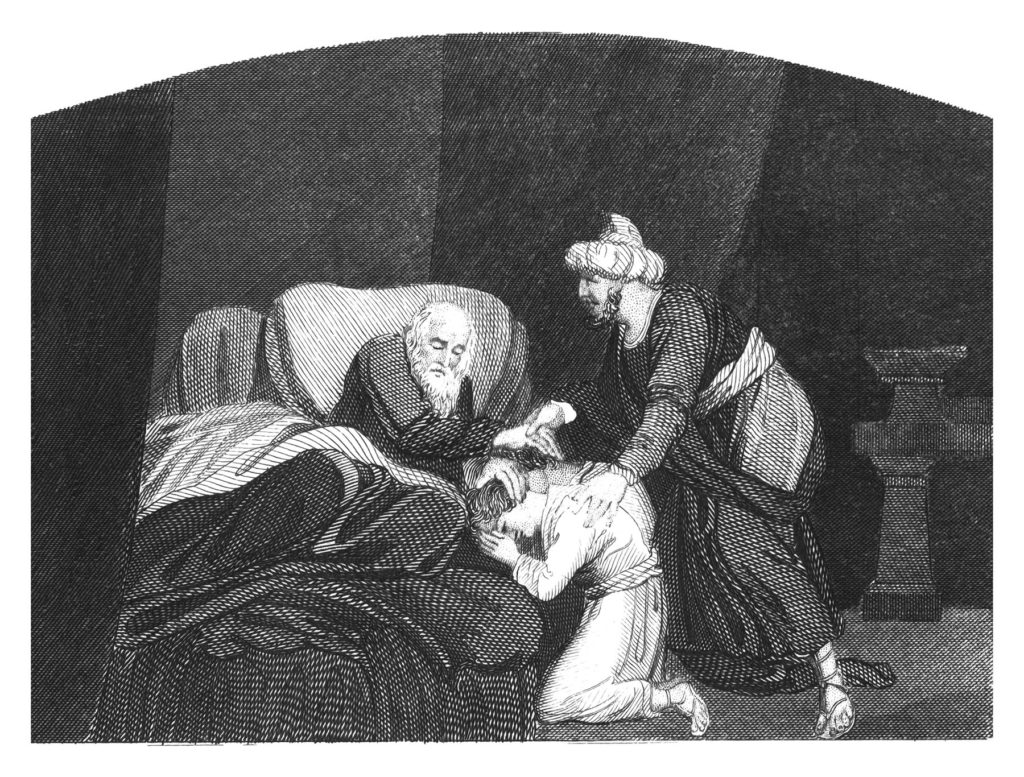
In Parashat Vayechi, Joseph, himself a younger son treated to the blessings of the elder, brings his own two sons before his father to receive their blessings. Knowing how delicate a moment this is, he places them in such a way that Jacob’s right hand, the hand of blessing, will naturally land upon the elder Menashe’s head. His left hand will fall upon the head of Ephraim, the younger.

Defying common sense, dim-eyed Jacob stretches out his arms like an X in front of him, bestowing the blessing of the firstborn on the younger and the blessing of the younger on the firstborn.

“Not so, Father,” Joseph corrects, “for the other is the first-born; place your right hand on his head” (48:18). But Jacob refuses, stating, “I know, my son, I know. He too shall become a people, and he too shall be great. Yet his younger brother shall be greater than he, and his offspring shall be plentiful enough for nations” (48:19).

It is now revealed that Jacob’s dim eyes were a red herring. He is fully aware of what he is doing. The subconscious pattern has become explicit.

It is as if, here at the very end of the book of Genesis, the characters have at last realized the nature of the story that they are in. They are not pawns in a cosmic drama. Instead, they act it out with intentionality. In Jacob’s wry “I know, my son, I know,” we hear Israel’s great wisdom. At last, he is in on God’s joke.

And so, here is the very essence of Jacob’s blessing. With arms crossed, he says: may the natural order continue to be disrupted. May history—riotous and sublime—continue to unfold. May we continue to question the authority of earthly power—be it the wicked tyranny of Pharaohs or the absurd prizing of the firstborn over all.


Matthew Schultz is the author of the essay collection “What Came Before” (2020). He is a rabbinical student at Hebrew College in Newton, Massachusetts.

Unscrolled Vayechi: Disrupting the Natural Order Read More »

THRIVE for the HoLiDaYs with Mindy Kaling & Zelle

Thank you to Zelle and Mindy Kaling for a funny upbeat chat about how to not just survive the holidays but THRIVE! How does she do it?

Zelle found that the top three stressors are: MONEY, FAMILY OBLIGATIONS and TIME.

Mindy says: The perfect gift to give is CASH using ZELLE

How do you make time for YOU?

Mindy says: “Self care will make me a better parent!” Her top priority is to get 7.5 to 8 hours of sleep so she can be the best mom for her kids.

How do you give back to the community?

Mindy is an ambassador for PANCAN the Pancreatic Cancer Action Network Her mother died from this disease and she is raising awareness to help and support other families.

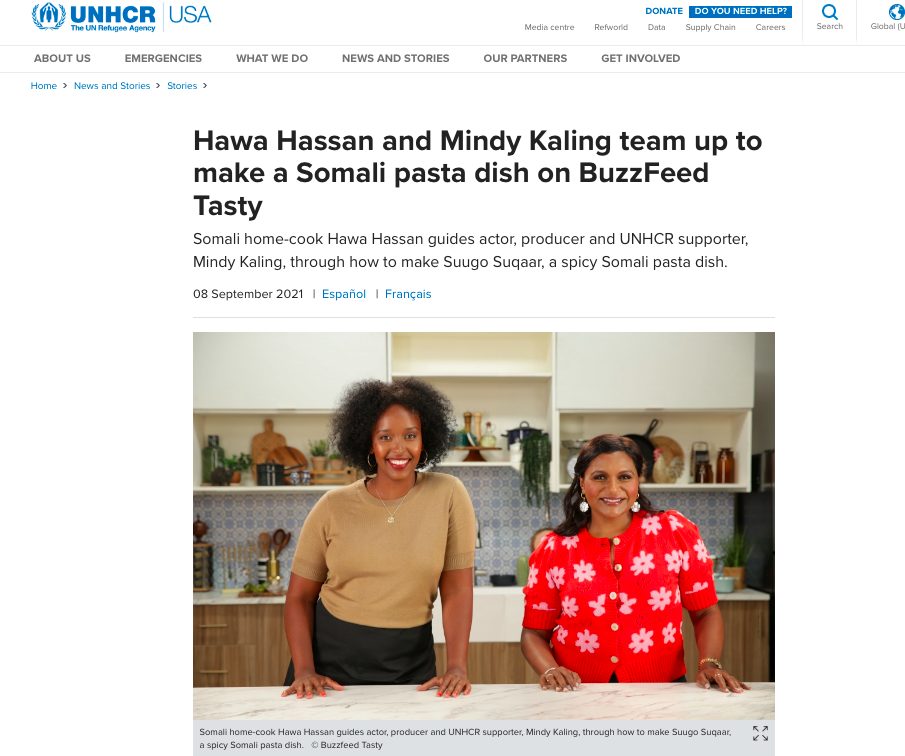
Mindy also works with UNHCR: United Nations High Commissioner for Refugees.

Mindy and Hawa Hassan make spicy Somali pasta: Stories about Food, Family, Spices and Refugees

Zelle wants you to be financially savy! To be successful, you need to be MONEY SMART! Two thirds (2/3) of American adults need more financial skills around budgeting, planning for your future and paying off their debts. Figuring out credit card bills, health care costs and mortgage payments is stressful for many people. Becoming a parent inspires many people to do a financial audit, figure out a plan and make a will.

Mindy’s TIPS for your financial future:

  1. STOP shopping online out of boredom. Only buy things you really want or need.
  2. It is important to not only save money but also to invest wisely.

Many women are uncomfortable to talk about money which is why Zelle wants to sponsor more conversations like this to normalize it!

Does Mindy make New Year’s Resolutions? YES! and Vision Boards! Read more about her process in Vogue Well Intentioned!

She talked with James Corden on The Late Late Show about her vision boards:

This year her resolution is to be more healthy! She wants to lose weight and be healthier to live a long life with her children!

ZELLE HOLIDAY Give-away of $100,000

how to enter?

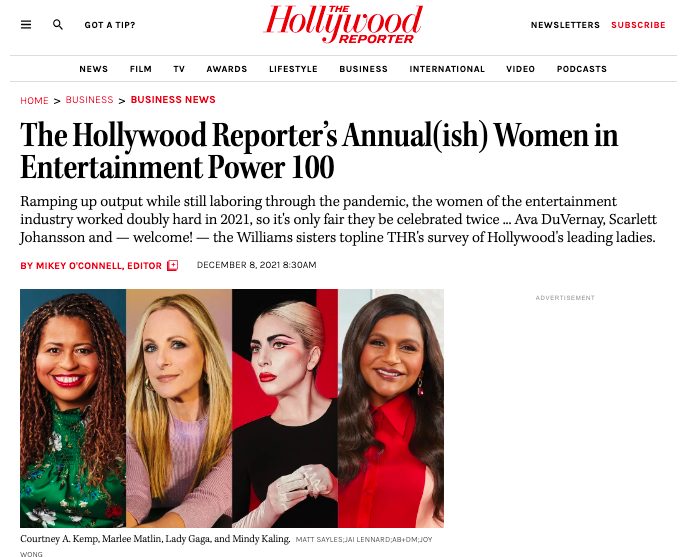
CONGRATS on being named to “The Hollywood Reporter’s Annual(ish) Women in Entertainment Power 100

CONGRATS to Mindy Kaling for her People’s Choice Award for Never Have I EverAre you watching NEVER HAVE I EVER on Netflix?


HBOMax: Sex Lives of College Girls is also Mindy Kaling’s show:


THRIVE for the HoLiDaYs with Mindy Kaling & Zelle Read More »

In Her Name: Lidia Budgor z”l

Lidia Gryngras Budgor z”l, devoted mother and grandmother, activist, balabusta, friend, Jewish communitarian, mensch, pillar & steward of Holocaust memory, died on the 8th night of Chanukah, Tevet 2 5782, December 5, 2021. She died peacefully, well loved by family, friends and beloved caregivers, in the home she built overlooking the broad and expansive views of the San Fernando Valley, after a lifetime of ingenuity, drive, and hard work at, she liked to say, ”75 cents an hour.”  For anyone who knew her life story, the idea that her extraordinary life spanned 96 remarkable years, was itself a miracle.

Lidia’s early life in Lodz, Poland was tender, loving and dignified, wrapped in Jewish wisdom, tradition and ritual. We can only imagine this early fortification strengthened her for the unfathomable brutality and heartbreak that would come next after the Nazi invasion of Poland, imprisonment in the Lodz Ghetto and ultimately deportation to Auschwitz where she lost her entire family in one day. She watched them taken away from life, taken from becoming and possibility, taken from this world. Lidia carried the image of that moment all her days and would often share the image of her precious younger sister Bluma z”l running from the line bound for death to where she stood in the line bound for work and, perhaps, survival.  She would recall with a quiet, stoic faraway gaze how her baby sister reached her little child arms out and wrapped her tiny body around her and asked “will it hurt?“  Moments later her sister was gone and Lidia knew things that no one could ever imagine surviving or knowing. What ultimate barbarism and cruelty look like up close. What innocence, vulnerability and tenderness look like in chiaroscuro. What love and loss feel like, a living wound in the heart and soul that can never be soothed.

What happened after that can be said to be nothing short of a miracle of destiny. Lidia survived, finding ways to nourish herself and her “sister” prisoners. Finding ways to fortify her emotional stamina to endure. To move forward. To become a wife and mother and businesswoman. To become a community leader. To hang photos of herself with presidents and world leaders on her breakfast room wall alongside her prized commendation from the Pope which made her radiant with pride and delight. But it was her precious son Beno ( Aaron ), his wife Kandy, and her grand-children Adam and Mindy who really made her heart sing. The family she built. Her response, born of love and resilience, to the Nazi’s failure to erase her family was to rebuild a world of love and connection and mitzvot in the place of the one that was taken.

Long time friend, Cheryl Zoller, daughter of Holocaust survivors herself, remembers when she and  Lidia attended the opening of the United States Holocaust Memorial Museum in Washington D.C.“She knew what this meant for survivors. All her years of hard work and unwavering support culminated  in the success of this moment with every head of state in attendance. We walked up the White House lawn holding hands with our heads held high and Lidia said : we really accomplished something important.

Photo Credit:Roxana Manzanares

Rabbi Michael Berenbaum, in his eulogy, wrote: “When the United States Holocaust Memorial Museum needed to be built, we turned to Lidia. When the American Gathering of Jewish Holocaust Survivors wanted to come to Los Angeles, we turned to Lidia. She was a doer. She could make things happen. Her elegant home was open to all, willing to embrace all. Her commitment to the Jewish people was boundless. Her love and pride in her family limitless.”

Randy Schoenberg , former Board Chair of The Los Angeles Museum of The Holocaust (now Holocaust Museum LA) remembers “while we were building our new museum in Pan Pacific Park, Lidia Budgor was a stalwart presence on our board.  Her poise and elegance, combined with a steadfast sense of purpose helped guide us… Her passing reminds us of our duty to carry forward the enduring legacy of all those who perished in the Holocaust.”

Eva Brettler, the sole Holocaust survivor at her funeral and graveside, knew Lidia from her tireless work with the Holocaust Survivors Advisory Committee that worked, in tandem with the Claims Conference and Jewish Family Services to meet the urgent needs of the local  survivor community as they aged. Eva, doing what she has always done since she survived, as a child, the murder of her mother and the pillage of her family and childhood, showed up and prayed for Lidia. She offered comfort to Lidia’s family, representing and standing for all survivors who, in the words of Elie Wiesel, “are no longer here to speak for themselves.”

In Lidia’s memory, may we go from strength to strength and from dreams to dreams of a world that is more humane, dignified and compassionate than any world we have ever known before. Amen.

Lidia’s 94th Birthday with the author. Photo Credit: Roxana Manzares


Samara Hutman is the former director of the Los Angeles Museum of the Holocaust under E. Randol Schoenberg and director of Remember Us and the Co-Founder/Director of The Righteous Conversations Project which is where her friendship with Lidia began but not where it ended.

In Her Name: Lidia Budgor z”l Read More »