fbpx

December 16, 2021

AIPAC Launches Two PACs, Joining the Political Campaign Finance Arena for First Time

For the first time in its existence, AIPAC plans to support financially the campaigns of pro-Israel incumbents and candidates by forming two political action committees.

AIPAC president Betsy Berns Korn announced the creation of the two PACs on Thursday, saying the current political environment necessitates the change.

“Throughout AIPAC’s history, the board of directors has consistently adjusted our political strategy to ensure we could remain successful in an ever-changing Washington. The D.C. political environment has been undergoing profound change. Hyperpartisanship, high congressional turnover and the exponential growth in the cost of campaigns now dominate the landscape,” Korn wrote in a letter. “As such, the board has decided to introduce these two new tools. The AIPAC PAC will highlight and support current pro-Israel Democratic and Republican members of Congress, as well as candidates for Congress.”

Contrary to what many of its detractors believe, AIPAC has not directly provided funding to candidates and political campaigns in its 70-year history, with the “PAC” in its name instead standing for Public Affairs Committee. Rather, it organizes its members to lobby for pro-Israel legislation.

Its PAC will be a federal political action committee that will allow it to contribute a total of $5,000 to a candidate or to their campaign committee per election. The super PAC, which has not yet been given a name, can spend unlimited amounts supporting or opposing federal election candidates but cannot directly donate or coordinate with the candidates or parties.

According to an AIPAC official who was willing to speak without attribution, the PAC will be led by Marilyn Rosenthal, while the Super PAC would be led by Rob Bassin.

The PACs’ creation is part of several new AIPAC initiatives launched over the past couple of years, including an increased social-media presence, a digital initiative and a forthcoming AIPAC app.

The official said that so far, the initiatives have significantly increased AIPAC’s membership to more than 1.5 million members.

“The creation of a PAC and a Super PAC is an opportunity to significantly deepen the involvement of the pro-Israel community in politics,” AIPAC spokesman Marshall Wittmann told JNS in an email. “The PACs will work in a bipartisan way.”

‘Significant opportunity to play an active role in American political life’

Steve Grossman, CEO of Initiative for a Competitive Inner City, who served as AIPAC president from 1992 to 1996, is a lifetime board member and former chairman of the Democratic National Committee, said he supported the move from AIPAC in this political climate.

“Having seen the changes and evolution in American politics over this past particularly dozen or so years, I’m supportive of what AIPAC has done because it will give the organization and its members an even more significant opportunity to play an active role in American political life at a time when that is essential,” he said. “To the extent, that we’ve become so polarized and politics has become so vitriolic, I think you have to constantly develop new approaches, new tools and techniques.”

AIPAC’s strength, he said was in the grassroots organizing it did on behalf of causes beneficial to the security of the United States and Israel.

The members, he said, were “citizen activists.” One of the most powerful tools, he noted, had been the national lobby day when members descended on the U.S. Capitol once a year to support legislation fitting their mission, vision and values. These include believing in a strong U.S.-Israeli relationship as “being central to democracy” and central to the security of the United States, said Grossman.

Still, AIPAC’s effect on federal races came from individuals who strongly vied for a candidate organizing on their own locally and helping to raise money on behalf of that candidate on their own.

Given the explosion of money in politics, which Grossman thinks isn’t healthy, the move was necessary.

“You can’t put your head in the sand and act like it isn’t happening,” he said. “I mean, this is a way to be more competitive, more active, more energetic and more impactful.”

Grossman said the pro-Israel cause always had strong support from Democrats and Republicans. Even if there were always a few outliers, it was virtually a consensus, he stated.

“Unfortunately, even the pro-Israel cause has become a battlefield,” he acknowledged. “So how do we have a meaningful impact and continue to support things that we believe are central to our values, and to the health and well-being of the State of Israel and the United States? As Americans, that’s what we work all the time to protect, preserve and enhance.”

AIPAC Launches Two PACs, Joining the Political Campaign Finance Arena for First Time Read More »

USC Board of Trustees Chair: “The Antisemitic Behavior We Are Witnessing Is Deeply Troubling”

USC Board of Trustees Chair Rick Caruso issued a statement on December 14 saying that “the antisemitic behavior we are witnessing is deeply troubling” in an apparent reference to tweets from a Palestinian student senator on campus.

The statement in full read: “The antisemitic behavior we are witnessing is deeply troubling and runs contrary to the values and safe environment the President and Board of Trustees are sworn to uphold. The Board of Trustees, together with President [Carol] Folt, unequivocally rejects antisemitism or religious discrimination in any form. We are committed to working with university leadership to address these challenges in our society. While we will always support free speech and expression, we must be steadfast in our commitment to ensure a campus that is safe for every individual, regardless of race, color, national or ethnic origin, ancestry, age, religion or religious creed, disability, sex or gender identity.”

Caruso’s statement amidst growing outrage of the university’s handling of Yasmeen Mashayekh, a Diversity, Equity and Inclusion (DEI) Student Senator at the USC Viterbi School of Engineering’s Viterbi Graduate Student Association (VGSA) who tweeted, “I want to kill every motherf—ing Zionist,” “LONG LIVE THE INTIFADA” and “Curse the Jews [in Arabic],” among other things. In response to a letter from more than 60 faculty members demanding that USC condemn her tweets “immediately given the continuing instances of anti-Semitism and Zionophobia on our campus,” Folt and Provost Charles Zukoski wrote that they are “disturbed” by the “hurtful impact” of the tweets and that Mashayekh was removed from a “paid mentorship” position over the summer. However, they said they could not remove her from her position as DEI senator because it’s a student-elected position and her tweets are protected speech under the First Amendment.

Social Medie Lite CEO Emily Schrader, a USC alumnus, criticized Caruso’s statement in a tweet. “Don’t ‘all lives matter’ the serious problem you have with #antisemitism on campus,” she wrote. “This isn’t the first time such an incident has occurred on campus which means you [aren’t] dealing with it. As an alum, I expect better.”

Folt also tweeted on December 13, “I understand the hurtful impact of recent anti-Jewish social media statements to those who are Jewish and to those of us who know how harmful antisemitism is when left unchecked. I have stated publicly and repeatedly that USC emphatically denounces all forms of antisemitism and anti-Jewish hatred.” In a December 15 letter, she wrote that she plans “to delve into how we can better address hateful and vile speech that wounds our community” when winter break is over in January.

Judea Pearl, Chancellor Professor of Computer Science at UCLA, National Academy of Sciences member and Daniel Pearl Foundation President, tweeted that Folt’s tweets were “an avoidance statement” because she was “speaking ‘Jewish’ and ‘antisemitism’ to 60 top faculty [members] who scream ‘Zionophobia.’ And the circus continues.”

The Los Angeles Times published an article on December 14 about Mashayekh quoting faculty members who are upset at the university’s handling of the matter. Chemistry Professor Curt Wittig told the Times that Folt and Zukoski’s response was essentially “a deflection memo” and that the response needed to be “a little more forceful.” Biological Sciences Professor Judith Hirsch also told the Times: “If a Jewish student had written the same tweets about Palestinians, we would be equally distressed.”

Mashayekh told the Times she doesn’t “feel safe on campus,” claiming that she is being subjected to “targeted harassment” and that the university has not adequately responded to her concerns. She also said she was removed from Virterbi’s website and is concerned about future employment opportunities and her loan payments. “I just really wish I didn’t have to think about what I would change. I wish people didn’t expect Palestinians to be the perfect victims.”

In an email to USC leadership, Mashayekh accused the university of “being complicit in apartheid” and that “the right-wing Zionist lobby” is subjecting her to a smear campaign and thus putting “me and my family in grave danger.” She also wrote that her tweets should be viewed in the context that under international law, “Palestinians have a right to resist occupation of their land.”

“These smear campaigns have subjected me to FBI visits, unlawful punishment by the university by stripping me of my position as a freshman academy coach, unwarranted media attention, and mental and emotional abuse,” she wrote. “This is not normal. By accepting this behavior and choosing to speak to the media rather than strategizing how to protect your Palestinian student subject to harassment by her oppressor you are complicit in supporting and profiting from apartheid and ethnic cleansing from the Palestinian people.”

Anti-Defamation League CEO Jonathan Greenblatt tweeted out a link to the Times article and wrote, “.@USC faculty are ringing the alarm because University leadership has failed to deal adequately with blatant #antisemitism on campus. Make no mistake: wishing harm against all ‘Zionists’ is a threat to *all* Jewish people and is unacceptable in any context.”


USC Board of Trustees Chair: “The Antisemitic Behavior We Are Witnessing Is Deeply Troubling” Read More »

Fatherly Advice – A poem for Parsha Vayechi

Jacob called for his sons and said, “Gather and I will
tell you what will happen to you at the end of days.
–Genesis 49:1

We’ll say anything on our death beds
Tell all the truths they didn’t want to hear.
Jacob has words for his sons –

Reuben has the restlessness of water
so make sure there are towels for him
in the final document.

Simeon and Levi are only successful
because they stole the tools that
let them do their job.

Judah will stand above the other eleven
because he knows what to do with his
hands and his enemies’ necks.

Zebulon will hang out by the ocean.
It is his way. Perhaps he has an
extra towel for Reuben.

Issachar is a bony donkey.
Holy God, how does one say that
to one’s own son?

Couldn’t Jacob have told him
to have a sandwich? He could’ve
invented the Jewish mother right here.

Dan, the avenger (before they were
in movies) is a snake in the road.
I hear he bites. Mind the horses.

I think about Jacob’s final words
to his sons every time I open my mouth
to say anything to mine.

Hopefully I’m not on my death poem
and all the phrases that pass my lips
serve as a foundation for his legs.

He should stand taller than I ever was.
My little bony donkey.
My greatest invention.


God Wrestler: a poem for every Torah Portion by Rick LupertLos Angeles poet Rick Lupert created the Poetry Super Highway (an online publication and resource for poets), and hosted the Cobalt Cafe weekly poetry reading for almost 21 years. He’s authored 25 collections of poetry, including “God Wrestler: A Poem for Every Torah Portion“, “I’m a Jew, Are You” (Jewish themed poems) and “Feeding Holy Cats” (Poetry written while a staff member on the first Birthright Israel trip), and most recently “The Tokyo-Van Nuys Express” (Poems written in Japan – Ain’t Got No Press, August 2020) and edited the anthologies “Ekphrastia Gone Wild”, “A Poet’s Haggadah”, and “The Night Goes on All Night.” He writes the daily web comic “Cat and Banana” with fellow Los Angeles poet Brendan Constantine. He’s widely published and reads his poetry wherever they let him.

Fatherly Advice – A poem for Parsha Vayechi Read More »

One Dead, Two Injured in Palestinian Terror Attack

One Israeli was killed and two more wounded in a Palestinian attack in the West Bank on December 16.

The Times of Israel (TOI) and Jerusalem Post reported that the attack took place at the Homesh Yeshiva outpost in the northern Samaria region of the West Bank. Three Palestinian terrorists reportedly shot at the three Israeli men as they were driving.

“We left Homesh, and when we came to turn left we suddenly heard a burst of gunfire,” Aviah Entman, one of the injured Israelis in the attack, told reporters, according to TOI. “I felt a strong blow on my left arm and shouted at the driver to drive fast. Someone behind me in the car shouted that he was hit in the neck.” He and the other wounded Israeli suffered light injuries.

The Israeli who was killed has been identified as Yehuda Dimentman, 25; he was a Yeshiva student living in the nearby Shavei Shomron settlement. He leaves behind his wife and toddler.

“Together with all the people of Israel, I send heartfelt condolences to the family of the person killed and a speedy recovery to the wounded,” Israeli Prime Minister Naftali Bennett said in a statement, pledging to track down the terrorists behind the attack.

Hamas, Islamic Jihad and the Popular Front for the Liberation of Palestine (PFLP) all lauded the attack, though none of them took responsibility for it. The Israel Defense Force (IDF) suspects that the terrorists are part of a larger terror cell.

“We mourn with the victim’s family and pray for the quick recovery of the wounded,” the American Jewish Committee tweeted. “We are confident that the perpetrators of this heinous attack will be brought swiftly to justice.”


One Dead, Two Injured in Palestinian Terror Attack Read More »

To Be Buried in One’s Homeland: Yoseph, Herzl, and Hadar

In his essay “Majesty and Humility,” Rav Joseph B. Soloveitchik recounts how “Occasionally, when I am at the airport, I happen to observe the loading of a double coffin containing the body of a Jew who has lived, worked, raised children, prospered or failed, in the United States. It is being shipped for burial in the land of Abraham, Isaac and Jacob.” Rav Soloveitchik finds this to be fascinating, because many of those being transported had marginal Jewish identities. He ponders why a “modern, secular Jew wants to rest in eternal peace in proximity to the site where the patriarchs found their rest.”

The Jewish desire to be buried in Israel is indeed a puzzle, one that goes back centuries. The Talmud Yerushalmi records a fascinating exchange between two 2nd-century rabbis, Rabbi Eleazer and Rabbi Barqiria, while they were observing caskets of diaspora Jews being carried into Israel for burial. Rabbi Barqiria criticized the practice, noting that these Jews had treated Israel with contempt in their lifetimes by failing to move there, and now they were making it worse by sending their impure, dead bodies into Israel for burial. Rabbi Eleazar defended the practice and asserted that burial in Israel was so important, it had sufficient merit to atone for one’s sins. (The Midrash on our Torah reading mentions a similar debate.) Rabbi Barqiria’s criticism notwithstanding, this puzzling practice clearly was popular already in the 2nd century despite the challenging logistics of long-distance burial in the ancient world.

But what motivates a Jew in the corners of exile to send his body for burial in Israel? Rav Soloveitchik explains that all humans have an instinctive desire to return to their roots at the very end of life; and for a Jew, his roots are in Israel. Rav Soloveitchik explains that “the meaning of death in the Biblical tradition” is to “return to the origin, the source.” He calls this desire “origin-consciousness.” This longing is universal; as life comes to an end, even the adventurer yearns for home. Rav Soloveitchik quotes Robert Louis Stevenson’s poem “Requiem,” as follows:

“This be the verse you grave for me:
Here he lies where he longed to be
Home is the sailor, home from sea,
And the hunter home from the hill.”

Even explorers want to return home to their final resting place.

This longing is universal; as life comes to an end, even the adventurer yearns for home.

Parshat Vayechi offers two vignettes relating to burial in Israel. Both Yaakov and Yoseph have had adventures that took them far away from home and separated them from their families. Yet both want to return home for burial; after a lifetime of wandering, they want to return to their roots. So Yaakov asks Yoseph to make sure he will be buried in the family grave in the Mearat Hamachpelah. At the end of the Torah reading, Yoseph does the same; he makes his family promise to take his bones with them when they leave Egypt.

These two requests reflect very different concerns. Yaakov wants to be buried in his kever avot, his family plot; Yoseph wants to be buried in Eretz Yisrael, in the Land of Israel. Both of these concerns are religious values, and this is reflected in halakhah as well. Generally, disinterment of a body is forbidden; one should not disturb a grave for any reason. However, there are two exceptions to the rule: if the body will be reburied in a family plot, or if it will be sent to Israel for reburial.

Yaakov reminds us of the importance of the family plot. Sefer Chasidim, the 12th-century German work, takes the mystical view that the cemetery is a portal between the worlds of the living and the dead; and the dead very much desire for their graves to be visited by family members. But even rationalists can recognize that the family plot is sacred ground, a spot that symbolically expresses connections of love that never die. In the moments when I consider where I would want to be buried, it is family considerations that loom large. Should I be buried with my parents and grandparents, or in a cemetery closer to where my children will live? It is instinctive to want to be laid to rest near family.

In the moments when I consider where I would want to be buried, it is family considerations that loom large. Should I be buried with my parents and grandparents, or in a cemetery closer to where my children will live?

Rav Soloveitchik’s essay offers a profound insight into the powerful allure of a family plot; and this is what motivates Yaakov. However, I don’t think his explanation fully explains the desire for burial in Israel; this age-old custom is far more than a return to origins, as we can see from the burial of Yoseph.

Yoseph’s burial is not about his family; he is buried alone, apart from his parents and siblings. Instead, his reburial tells the story of national redemption. Yoseph’s descent to Egypt begins a difficult chapter of exile; and when the Jews are redeemed, Yoseph’s bones return with them. Because of the national significance of Yoseph’s reburial, Moshe personally carries Yoseph’s bones. Yoseph is buried in Shechem, the very place where he is sold into slavery, and the saga of the Egyptian exile begins. Yoseph’s reburial is about redemption and the future, not about the past.

On August 17, 1949, the story of Yoseph’s bones returned to the headlines. Theodore Herzl, the father of modern Zionism, was brought to burial in Israel. Herzl had written in his will, “I wish to be buried in a metal coffin, in the cemetery plot next to my father, and I will lie there until the people of Israel transfer my body to the Land of Israel.” After his death in 1904, little was done. There were discussions in the Zionist movement about moving Herzl’s bones in 1925, and again in 1935; by then, the antisemitism that was raging in Austria rendered this project impossible.

After the establishment of the State of Israel, its leaders immediately took on the project of bringing Herzl to Israel; and this was seen as a modern version of the burial of Yoseph’s bones. Doron Bar, of The Schechter Institute of Jewish Studies, notes that within the dry language of the Knesset legislation establishing a national burial ground for Herzl, the Biblical phrase “chelkat sadeh,” “a parcel of land” is used—a reference to the words used at the end of the book of Joshua about the reburial of Yoseph. When David Ben Gurion spoke in the Knesset, he said: “Only two people in Jewish history have had the privilege of having their remains brought to Israel by their liberated nation. Yoseph from Egypt and Herzl from Vienna.” Herzl’s reburial was a modern day return of Yoseph’s bones.

The entire process played out in grand drama. In Vienna, the community gathered to offer one last farewell in a synagogue packed with Holocaust survivors, tears streaming down their faces. A special El Al plane, which bore the name “Herzl” on its nose, arrived to take the body to Israel. In a short speech before the plane took off, David Remez, the minister of transportation, said, “Past and future combine to raise up the leader’s bones. His spirit will continue to be with us and guide the Jewish people from the eternal hills of Jerusalem.”

The plane flew to Israel and entered the skies over Haifa, where it was met by four planes from the Israeli Air Force, which then accompanied Herzl’s plane. After landing, the body was taken to the Knesset in Tel Aviv, where a special session was held to honor Herzl. Following that, a procession took Herzl’s body to Jerusalem, on the same path that Herzl himself took in his 1898 visit. In Jerusalem. Herzl was buried in the newly created cemetery of Har Herzl, which would become the final resting place of Israel’s great heroes, soldiers, and leaders.

Herzl’s burial represented the opening of a new chapter in Jewish history. As Ben Gurion eloquently stated in his speech, “Herzl’s coffin is entering the mountains of Jerusalem not in a procession of mourning, but rather in a journey of triumph.” Upon entering Jerusalem, the coffin passed under an arch built for the occasion bearing the biblical verse, “I will lift you from your graves My people and bring you to the land of Israel” (Ezek. 37:12). Herzl’s return to Israel meant that the Jewish people had finally come home.

This is why I take a different view than Rav Soloveitchik of burial in Israel. While the desire to return to one’s origins is universal, the desire to be buried in Israel is much more than that. For centuries, Jews sent their bodies to Israel in order to make a statement that they believed in redemption, believed in the Jewish future, and believed that Israel would once again be the home and homeland of their descendants. Like Yoseph and Herzl, these simple Jews wanted to be a part of a future Jewish state. They were longing to be buried in Israel and their longing for redemption were one and the same.

As I write these words, my thoughts turn to my dear friends Leah and Simcha Goldin. They have been waging a lonely campaign to bring home the remains of their son Hadar Goldin along with Oron Shaul. Both were soldiers killed in 2014 during Operation Protective Edge. Since then, their bodies have been held hostage by Hamas. The Goldins continue to push forward, in the United Nation, in the U.S. Capitol, and in the Knesset. All too often, their concerns are dismissed as unimportant in the realm of diplomacy. But returning a body to the family grave is not an insignificant matter for any human being; and returning Jewish heroes to their homeland should be a priority for every Jew. Hadar and Oron must be given a dignified burial; it is time for them to come home.


Rabbi Chaim Steinmetz is the Senior Rabbi of Congregation Kehilath Jeshurun in New York.

To Be Buried in One’s Homeland: Yoseph, Herzl, and Hadar Read More »

Israel “Bombs Auschwitz”

It has often been said that if only the State of Israel had existed in the 1940s, its air force could have bombed Auschwitz, interrupting the gassing of countless innocents.

Well, now it does exist. And it turns out that it has been using its air force to interrupt a contemporary regime’s gassing of countless innocents.

The Washington Post has just revealed that two Israeli bombing raids inside Syria in 2020 and 2021, which previously had been shrouded in mystery, were in fact part of a covert campaign to stop “a nascent attempt by Syria to restart its production of deadly nerve agents.”

Syrian dictator Bashar Assad has used sarin nerve gas to slaughter thousands of civilians whom he regarded as his enemies since the outbreak of the country’s civil war in 2011. One attack alone left 1,400 dead in a Damascus suburb. Assad promised the Obama administration in 2012 that he would stop using chemical weapons and destroy his arsenal. But he secretly held on to part of his stockpile, and has carried out “more than 200 attacks” with deadly nerve agents in recent years, the Post reports.

The Israelis are well aware that Syria’s original purpose in developing the poison gas was to use it against the Jewish state—to continue, in a sense, the gassing of the Jews that began in German-occupied Poland eighty years ago this month.

Rather than wait for such an attack and then belatedly respond, the Israelis decided to preempt the attempted genocide—and in so doing, potentially interrupt the Assad regime’s ongoing use of those weapons against Syrian citizens.

On March 5, 2020, according to the Post, Israeli bombers struck a compound in the Syrian city of Homs, “a hub for Syria’s chemical-weapons production.”

The Homs facility was preparing batches of the chemical tricalcium phosphate for Syria’s top military laboratory, known as the Scientific Studies and Research Center, which oversees production of the regime’s chemical weapons. Then, in June of this year, the Israelis bombed additional chemical weapons sites near the towns of Nasiriyah and Masyaf.

Some critics have opposed the idea of Western military action against Syrian chemical weapons sites, on the grounds that bystanders might be harmed. “People already living in fear of losing their lives in unlawful attacks must not be further punished for the alleged violations of the Syrian government,” Amnesty International USA has declared. And to this day, an occasional pundit will argue that bombing Auschwitz in 1944 would have been a bad idea because some of the prisoners might have been harmed.

The critics were wrong then, and they’re wrong now.

“Bombing Auschwitz” is now a moral obligation for every generation, because every generation finds itself confronted by perpetrators of atrocities.

It’s troubling that Amnesty International seems less concerned about the actual daily murder of Syrian civilians than the theoretical risk to a small number of bystanders in the course of eliminating the murder weapons. No war can be fought without the risk of some civilian casualties. Indeed, the Israeli attack on the Homs facility left seven guards dead. But how can one compare that to the thousands of Syrians who have died agonizing deaths because of the gas produced in that laboratory—or the many Israelis who would be Assad’s next victims?

It is likewise nothing less than scandalous to argue that the possible danger of air raids harming a relatively small number of prisoners should have prevented the Allies from interrupting the certain gassing of 12,000 Jews in Auschwitz every day.

In any event, the question of civilian casualties had nothing to do with the actual discussions in 1944 about whether to bomb Auschwitz. Most of the bombing requests by Jewish groups were for strikes on the railways and bridges leading to the death camp, not the camp itself. Such attacks on the transportation routes—over which hundreds of thousands of Jews were taken to their deaths—would have involved very minimal risk to civilians.

That’s why the excuses the Roosevelt administration made for not carrying out such bombings had nothing to do with the danger of civilian casualties. U.S. officials claimed that American planes were too far from the camp. In reality, U.S. bombers regularly struck German oil factories just a few miles from the gas chambers of Auschwitz.

Today, the term “bombing Auschwitz” has become a metaphorical catchphrase for the moral test that the Allies failed during World War II—and then failed all over again during several other genocides that blighted the post-Holocaust world ever since.

“Bombing Auschwitz” is now a moral obligation for every generation, because every generation finds itself confronted by perpetrators of atrocities. The idea of using military force against mass murderers is no mere history lesson; it is a military strategy for a better world. On a few occasions, the United States and its allies have recognized this principle—as in the bombing that ended atrocities in the Balkans, pre-empted massacres in Libya, and rescued thousands of Yazidi civilians in Iraq. Israel’s bombing of Syrian chemical weapons follows that noble path.

The names Homs, Nasiriyah and Masyaf are not well known in the West. Neither was Auschwitz—or Chelmno, in German-occupied Poland, where the gassing of Jews began in December 1941. Perhaps the next generation will remember the names of those Syrian towns as the places where genocide was stopped in its tracks.


Dr. Rafael Medoff is founding director of The David S. Wyman Institute for Holocaust Studies and author of more than 20 books about Jewish history and the Holocaust.

Israel “Bombs Auschwitz” Read More »

Jewelry Maker Liza Shtromberg Creates Unique, Western-Wall Inspired Pieces

Making jewelry is in Liza Shtromberg’s blood. Growing up in the Soviet Union in the 1970s and ‘80s, she watched as her father, a stone carver, worked out of their family home in Moscow.

“He had this illegal underground business,” she said. “There were all these rough, uncut stones that we had on a shelf in our living room. I’d spend hours arranging them. My father taught me to polish amber when I was five years old.”

Shtromberg, who owns Liza Shtromberg Jewelry on Hillhurst Avenue in Los Feliz, loved Play-Doh and taking sculpting classes as a child. Her grandmother showed her how to make crafts using beads and how to knit. “It was part of my upbringing,” she said.

Photo courtesy of Liza Shtromberg

When she was nine, Shtromberg and her family made aliyah and lived in Ashdod. “That was the best time of my life,” she said. “I was in a youth movement and had really good friends and assimilated super quickly. My Hebrew was so good that within three years, people thought I was born in Israel.”

Her father opened up a gallery in Jaffa, where she would work starting when she was 12. Then, when she turned 16, she and her family moved to L.A. Her father began dealing antique and vintage jewelry and watches, and her mom moved back to Jerusalem.

Now, Shtromberg, inspired by her visits to Jerusalem to see her mother, has opened a second location of her store in the Old City. It’s called The Western Wall Gallery, and it features her signature Western Wall collection, which she introduced 10 years ago.

“I’ve always wanted to sell the Western Wall by the Western Wall.”– Liza Shtromberg

“It’s been a longtime dream,” she said. “I’ve always wanted to sell the Western Wall by the Western Wall.”

Photo courtesy of Liza Shtromberg

The way she makes her jewelry in the collection is by sculpting pieces that have the same texture as the stone of the wall.

“I always go to the wall whenever I visit Jerusalem,” she said. “I feel very connected to it and emotional about it because it’s withstood the entire time we were exiled. It mirrors the fact that the Jewish people found a way to stay a people, too.”

The designs include stars of David, a coin with chai on it, a hamsa and a tree of life. Each item comes up with a bio card that includes a few sentences about it and its significance. 

“In Judaism, there is so much wisdom for everyday life and how we conduct ourselves in the world,” she said. “There is so much value in it for people. My collection is a vehicle to enable people and encourage them to learn more about Judaism.”  

Whether someone purchases a piece in the Old City or at her Hillhurst location, she said that it can connect them to their heritage.

“What I love about these pieces is that you can keep the Western Wall close to your heart every day. It is a symbol of faith and a reminder that you are always connected to something bigger than yourself.”

Photo courtesy of Liza Shtromberg

Shtromberg opened her store in L.A. 21 years ago. Along with selling her Western Wall collection, she also does custom projects, restores family heirlooms and creates pieces for TV shows like “How to Get Away with Murder,” “The Voice” and “Crazy Ex-Girlfriend.” She makes everything from rings to earrings to necklaces. 

“My brand is all about encouraging people to be individuals and express themselves and not wear things because a celebrity wore them,” she said. “People want to be their own person. They feel like my jewelry is something they can wear all the time.”

Still, with everything she’s created, what she’s most proud of is her Western Wall collection. “The Western Wall is my big-time passion project,” she said. “I hope one day, if there’s ever anything I’m known for, it’s this.”

Jewelry Maker Liza Shtromberg Creates Unique, Western-Wall Inspired Pieces Read More »

Children’s Book “Let’s Stay Healthy” Encourages Healthy Eating and Habits

The obesity problem in the United States is affecting everyone – even children and teens. According to the latest statistics from the Centers for Disease Control and Prevention, for children and adolescents ages two to 19 years, the prevalence of obesity was 19.3% and affected around 14.4 million children and adolescents. 

One of the main culprits of childhood obesity is access to processed foods like cereal, cakes and candy. In her new children’s book “Let’s Stay Healthy” author Bracha Goetz aims to teach Jewish children about the importance of eating fruits and veggies and staying away from junk food.  

“There is a lack of content on healthy eating for children in the Jewish world, so we wanted to make this book available for our community first,” Goetz said. “But we plan to have this book become available to the wider world as well soon, as the response to it has been phenomenal.”

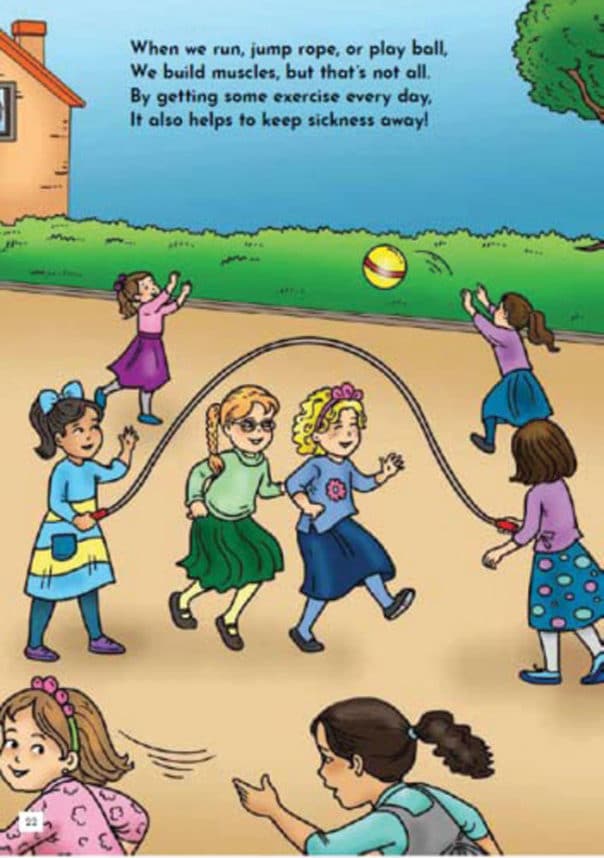
In “Let’s Stay Healthy,” children eat junk food and then discover that it causes tummy aches and cavities and makes them feel bad. Goetz uses fun rhymes and colorful pictures to tell the story and teach her lessons.

When the main character discovers healthy choices, he proclaims, “I try to eat food that comes straight from Hashem, ‘cause the vitamins and minerals I need are in them. Hashem knows exactly how to make things best. Hashem’s food is better than all the rest!”

“Let’s Stay Healthy” is Goetz’s 40th children’s book, and she wrote it because a mom she knew wanted her to create a book “that could help a child understand how to take good care of their wondrous bodies,” she said. “I loved the idea, but I wasn’t exactly sure how to do it. Then one morning a few days later, I woke up with a clear plan of how to write the book – the Almighty even sent me the title for it too.”

The book is for children ages three to six, but according to the author, older children, teens and adults are finding it transformative as well and starting Healthy Eating clubs.

For Goetz, the topic of the book is personal. When she was an undergraduate at Harvard, she took courses at Harvard Medical School and Harvard’s Graduate School of Public Health before she went on to study in medical school. While she was in school, she was secretly suffering from and eating disorder, and wrote a memoir about it called “Searching for God in the Garbage.” 

“What I discovered through compiling excerpts from my diaries, journals and letters into the book is that the food addictions developed because my soul was starving for spiritual nourishment,” she said. “When I finally learned how to fill my genuinely hungry soul, there was no longer a need for the addictive behavior.”

“’Let’s Stay Healthy’ offers a perspective I haven’t seen in books in the general market: Clearly, simply and joyfully explaining why the healthy choices are beneficial.” – Bracha Goetz

Now, Goetz is hoping to impart what she learned onto the younger generation. “’Let’s Stay Healthy’ offers a perspective I haven’t seen in books in the general market: Clearly, simply and joyfully explaining why the healthy choices are beneficial,” she said. “And this book doesn’t only help children see clearly why junk food can be harmful, it also explains why moving our bodies is valuable, why cleaning away invisible germs on our hands and gook on our teeth is essential, and why sleep is important too.”

With this newest release, along with her other books like “Let’s Stay Safe!” and “Let’s Appreciate Everyone!” — which talk about personal safety and being inclusive of children with disabilities, respectively — Goetz said her focus is to help children’s souls shine. 

“That is the goal of every single one of my books,” she said. “Basically, I try to write the kind of books that I wished I had as a child.” 

Children’s Book “Let’s Stay Healthy” Encourages Healthy Eating and Habits Read More »

Imaginary Conversations with My Eastside Grandmother

We called her “Eastside Grandmother,” which is a rather strange way to refer to one’s great-grandmother. I assume this was easier for my brother and me than saying “Great-grandmother Savetnick.” After all, she lived in the Boyle Heights neighborhood of East Los Angeles, while we lived across town, on the west side, in Beverlywood.

I wish I had been older. I wish I had been able to talk to her. She was a mystery.

We visited her often during the ’50s until she died—was killed, really—in December 1959, a month before my eleventh birthday and my brother’s bar mitzvah. I wish I had been older. I wish I had been able to talk to her. She was a mystery. My father’s family in Eastern Europe was a mystery. Eastside Grandmother Annie held all the answers, but I was too young to know I should be asking questions. Too young to make an effort to get to know her story. I think she would have liked to have been called “Grandma Annie.”

“Grandma Annie,” I wish I had been old enough to say, “tell me about your village. Tell me why you couldn’t leave Warkowicze in 1904 and sail to America.” 

“Hershel was sick,” she would have answered. “We couldn’t leave because of him.” I knew from family lore that Annie, her husband, my great-grandfather Earl Bernard, and their five children were ready to leave but Annie knew they’d be turned back at Ellis Island if they arrived with a sick child.

“I understand,” I would console her. “You did the right thing by cancelling, but sending your eldest, Harry, who became my grandfather, all by himself at age 13 on a ship across the ocean to … to where?” 

“You can’t understand. There were pogroms. We were in constant danger. I had to believe that Harry would succeed, that he would find the family in Omaha that was waiting for him.” 

Annie was strong and determined and right. I know that Harry settled in Omaha, Nebraska with Earl Bernard’s relatives. I know what happened in America. “But Annie,” I wish I could have asked, “What happened to your sick child? How did your husband, my great-grandfather, die?”

Annie was in her mid-eighties living alone on Chicago Street in a two-story building with cement stairs that were parallel to the building and went up to a landing with a wide entrance and down the other side. My brother Jay, two years my senior, and I loved to run up one side and down the other on our visits. There wasn’t much else to do anyway. Annie would wait for us and immediately push some coins in our hands. “Go. Go buy rugelach.” We’d skip off down the street by ourselves to the bakery where we pointed at more than the rugelach and returned with chocolate cookies and sweet pastries. Annie knew we’d never complain about the Sunday visits this way.

Every visit, while my brother and I were walking to and from the bakery alone, an unimaginable scenario in the Boyle Heights of later years, or while sitting quietly eating our pastries, my father “conversed” with his grandmother—in Yiddish, a language he did not know at all. 

She stood tall, had straight short white hair with a large wisp across her forehead. She was short but what I liked was her resemblance to my father. Their skin tones were more olive than my mother’s pale tones. Every visit, while my brother and I were walking to and from the bakery alone, an unimaginable scenario in the Boyle Heights of later years, or while sitting quietly eating our pastries, my father “conversed” with his grandmother—in Yiddish, a language he did not know at all. Annie talked and my father nodded his head in agreement. I suppose she threw in some English, but I do not remember any personal conversations with her. Exchanges, yes, to thank her for the money for the bakery and to get instructions on what to buy, but no intimate conversations. But the exchange should have gone this way:

“Grandma Annie,” I say, “I know Harry succeeded and nine years later your son, Sam, joined him when he was 16 or 17, before World War One, as did their sisters. But you remained in Warkowicze. Why?”

“Hershel was sickly. He could never have made the trip. Then my husband died.” Annie sighs. “And the Great War started and no one could leave. But my children were safe.” She smiles before sipping her tea or taking a bite of the rugalach. “At least I finally got here in 1923.”

Annie was alone when she arrived, but she remarried three years later in Omaha to a landsman from her childhood home in Schimsk. They moved to Los Angeles. Real pioneers. Surely they spoke only Yiddish. But she was widowed again only seven years later. She remained in Los Angeles, alone. No family members moved to Los Angeles until the mid-forties. 

“Why, Grandma Annie, did you stay so far away from your children and grandchildren?”

I wonder if she had to shut off her emotions for her children as, one by one, she pushed them out to what she hoped would be a better life. Did she get used to being without them?

I wonder if she had to shut off her emotions for her children as, one by one, she pushed them out to what she hoped would be a better life. Did she get used to being without them? In Warkowicze, she was surrounded by extended family. In Los Angeles, there was no one. Grandma Annie was more alone than she had been in Warkowicze.

“Now, Grandma Annie, forgive me for asking, but the family that stayed in Warkowicze, the ones you lived next to for over thirty years, your husband’s brothers and their families—the Mergiels. Didn’t you worry about them as Europe moved toward World War Two? 

“I sent the Mergiels packages of clothes for many years,” she’ll tell me. 

“But that’s before the World War Two. Did you exchange letters? These people were my grandfather’s aunts, uncles and cousins. Did they beg for help? Tell me, please, that someone in the family tried to save them!”  

“I heard nothing. I could only assume. Millions were slaughtered. What chance did they have in our little town? I’ve always wondered, but not really wanting detail,” she says, her face stern without tears, I’m sure. 

“Grandma Annie, do you realize that no one even mentioned them? I didn’t know that branches of the family remained in Warkowicze. I had no idea they existed. No idea where we were from until several years ago when I reconnected with my father’s cousins. Sam’s children. I didn’t know that our name was Mergiel and not Miller. Tell me if you found out their fate? If so, how did you find out? And even if not, how could a whole branch of my family be destroyed and forgotten?”

Annie just looks and listens. Should I tell her what I know? I know how they died. I pause. 

“Grandma Annie, the entire Mergiel family was in the Warkowicze ghetto and marched out one morning after the Sukkot holiday of 1942, was shot and dumped into pits. About ten years ago, Grandma Annie, I met a survivor of the massacre a few years before he died in Tel Aviv. He was born the year you left, but he remembers the Mergiel family getting the packages you sent. After the War, Mordechai drew a huge map of the village. He put in every house, every building. With names. There was Mergiel written on one house and on another across the street. Another a few houses away. Your brothers-in-law and their children and grandchildren. And one was surely yours! Or had been.” 

“Yes, if I could see the map, I would show you where I lived with your great grandfather, where your grandfather, Harry, was born. I could show you the river where we used to play with the children.” 

“Grandma Annie, I have to ask this. Did you light candles for them? For Gadalia (your brother-in-law, I saw from your immigration records), Israel and his wife Malka, Leib and his wife Batya, Pesia, Yankel, Yitzhak, Gittel, Mottel, Moshe, Frieda, Sonia, Shimon and Avrum?”

Annie doesn’t answer me now. She is silent now as she sinks into memories and, perhaps, some longing and guilt.

“Annie, did you have letters, papers, pictures? What happened to everything?”

“What happened? What did I have that anybody would want? I saved what I needed. Everything else I got rid of. Too depressing.”

When Annie was 90, hoodlums broke into her apartment demanding all her money and jewels. They tore up the floorboards but found nothing. So, they beat her up. 

When Annie was 90, hoodlums broke into her apartment demanding all her money and jewels. They tore up the floorboards but found nothing. So, they beat her up. They beat up a 90-year-old woman because she didn’t have a treasure stashed away. This I remember clearly. She was hospitalized, treated, recovered, as much as one her age can recover, and she returned to her apartment. My parents tried to get her to move into a care facility. She refused. Although she was released from the hospital, she was still suffering from the effects of her injuries. Soon after, she fell and died from a head injury. It was December 13, 1959, five weeks before my eleventh birthday. Children didn’t go to funerals in those days. Had I been older, had I asked questions, I could have given a eulogy of facts and dates. 

My great-grandmother was a heroine of her times. She had the courage to send off her eldest so at least he could have a safer, happier life and hopefully send for them. She was born in the Russian/Polish town of Schimsk in 1871, give or take a few years as the records vary. She was a devoted mother and wife, caring for her sick child and later her husband, but losing both. She survived czars, pogroms, war in Europe, tragedies. But not hooligans in East Los Angeles. But what did I know of her feelings, her loves, her losses, her husbands, her family, her hobbies? Nothing. 

I’m not even sure where Grandma Annie is buried or how many people accompanied her to her final resting place. On a visit to Los Angeles several years ago, my husband and I went to Hillside Memorial Park, got a map and the secretary marked the graves of my aunts, uncles, cousins, grandparents. One by one, my husband recited Kaddish, the Jewish prayer for the dead. How did I forget to ask if Annie Ferer Mergiel Savetnick was there, too?  

I have five grandchildren. Maybe one day, though hopefully not too soon, I will also be a great-grandmother. What haunts me the most about my great-grandmother was her verbal and physical detachment from us, from her many children and grandchildren. Language? Maybe. One answer I’ll never get. When my grandchildren were very young and ran into my arms with kisses and “I love you, Grama!” I was filled with their warmth and love that could cure anything. No running today, but the “Hi Grama” as eyes temporarily leave the iPhone screens are just as powerful. I tell them stories about my life and they listen! They may not remember everything, but they’ll have firsthand funny—and sad—stories, recipes, memories of trips, holiday celebrations, hugs and kisses. My grandchildren and those yet to be conceived great-grandchildren won’t need to search on Ancestry.com for information about my life. They will be connected to me naturally and inextricably.  And they will be with me when my time comes. That is comforting.


Galia Miller Sprung is a freelance writer and editor and retired teacher who has been living in Israel since 1970.


Imaginary Conversations with My Eastside Grandmother Read More »

A Moment in Time: Know Before Whom You Stand

Dear all,
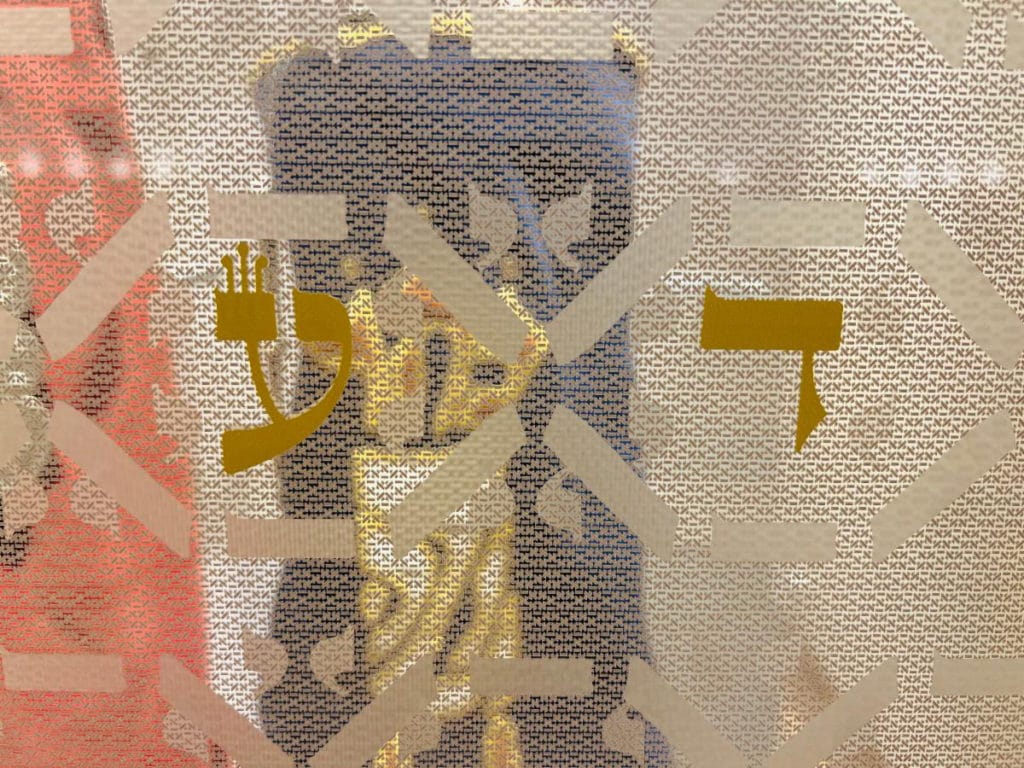
Engraved on the doors of the Ark at Temple Akiba is the Talmudic statement:
“דע לפני מי אתה עומד (Da Lifnei Mi Atah Omed)/ Know Before Whom You Stand”
(I’ve captured only the first Hebrew word: דע in this photo).

What makes this teaching so incredible is that there is no simple answer.

Take a moment in time to ask this of yourself:
Before whom am I standing when:

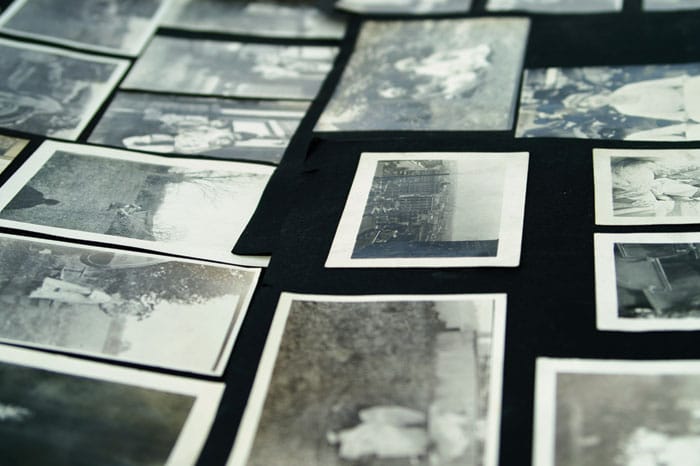
I am looking at old family photos?
I am praying?
I am looking into the eyes of my loved one?
I am at the Western Wall in Israel?
I am afraid?
I am starting a new job?
I am overjoyed?
I am angry?
I am holding a grudge?
I am doing a mitzvah?
I am passing the Torah to the next generation?
I am looking in the mirror?

Once you find your answer – ask yourself the question again. And again. Again.

With love and shalom,

Rabbi Zach Shapiro

A Moment in Time: Know Before Whom You Stand Read More »