fbpx

November 3, 2021

Jewish Muralists Brighten Up Pico-Robertson With Holy Designs

Thanks to a handful of Jewish artists, colorful and joyful paintings that depict mitzvot such as giving tzedakah, learning Torah and lighting Shabbos candles greet pedestrians and drivers around Pico-Robertson. 

On Shenandoah St. and Pico Blvd., Glatt Mart shoppers now pass two formerly gray utility boxes that have been transformed into Jewish pop art. With brushstrokes of turquoise, orange, red, purple and bright green, one utility box happily announces to passersby, “I ❤️ Kosher” and the other depicts four siddurim.

Other utility boxes in Pico feature mezuzahs, tefillin and the aleph bet — all created by Sheina Dorn, who, in the days leading up to the High Holy Days season, set out to brighten up the neighborhood.

“I am here on this Earth to make my family and my home beautiful, but I am also here to spread Jewish art.” – Sheina Dorn

“I am here on this Earth to make my family and my home beautiful, but I am also here to spread Jewish art,” said Dorn, who was raised in a Chabad house in a suburb of Montreal, where her father was a shaliach. “I grew up being proud of being a Jew: walking with my back straight, feeling, ‘I am proud to be different, and I am not shy at all about it.’ I want to share that feeling.”

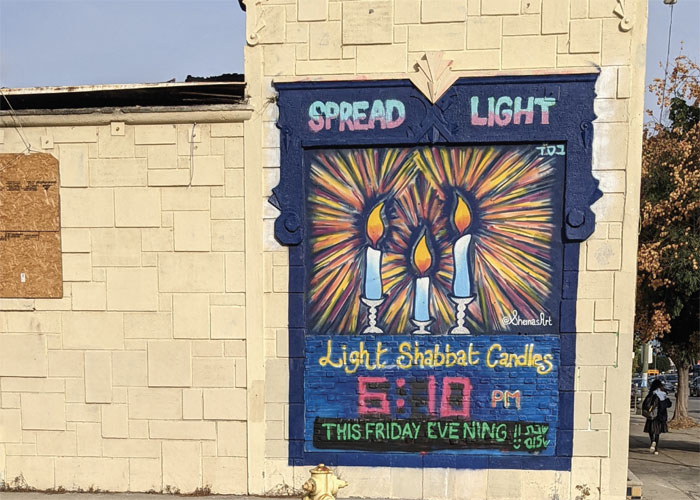
Last year, Dorn painted Shabbos candles on the wall next to Bais Chaya Mushka, and now she updates the candle lighting times every week.

Dorn said that she sought out the space because she wanted to paint the positive flames of Shabbos candles to replace the negative flames the building experienced in a fire last year. In front of Bais Bezalel Chabad, home to a children’s library, she painted kids reading atop stacks of Jewish books.
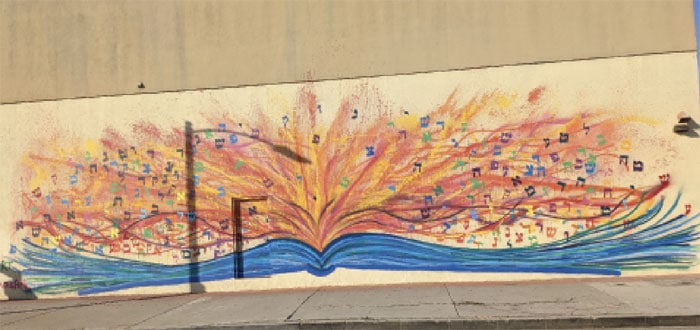
The mural on the south wall of Cheder Menachem. Photo by Yehudit Garmaise

When walking down Cashio Blvd., east of Robertson, pedestrians might spot an unusually colorful parked bus that depicts the “Na Nach Nachma Nachman M’uman” song that Breslovers, followers of Rebbe Nachman of Breslov, sing. 

The bus, which is “moveable street art,” is used by Breslovers who drive around and spread joy by playing music and starting dance parties. Pico artist Shlome J. Hayun created it, and he also manages an art collective of 27 artists whose work he promotes. 

Hayun, whose signature is a hamsa, an Israeli symbol that guards against “bad energy,” as he described it, also created the colorful menorah on Mamilla Restaurant on Pico Blvd. with Dorn. Last Chanukah, the menorah mural was one of a collection of eight menorahs that artists painted in eight different cities around the world. It was part of a non-centralized Jewish street art fair that Pico artist Hillel Smith, a muralist whose art appears on the back wall of Bibi’s Bakery and inside YULA Girls High School, created during COVID.
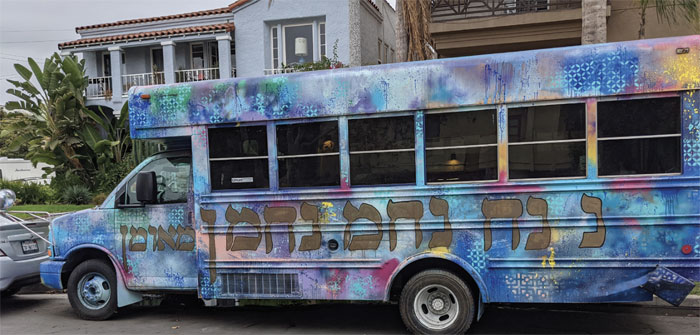
A Nachman Bus is parked on Cashio Street, waiting to transport Breslovers to lead their next outdoor dance party. Photo by Yehudit Garmaise

“We need to shine a light unto the nations, and street art is a great way to make people smile,” Hayun said.

Rabbi Yitzchok Moully, who has painted menorahs in different cities, said that Chanukah street art expresses the idea that “we don’t just light our menorahs inside, but [also] outside to spread the light.”

Along with Dorn, Moully spray-painted a wall of Cheder Menachem on La Cienega Blvd. that depicts an open, blue sefer that extends 70 feet. The letters of the aleph bet ascend from the book. 

“When we learn from a sefer, we bring those letters to life, and that is the idea of the flying aleph bet,” said Moully. “Every mitzvah we do creates this explosion of energy to transform the world.”

Dorn’s students, who go to the cheder and are in pre-1a through fourth grade, helped to create the mural, pushing the 18-foot scaffolding that supported the artists and painting in the stenciled letters of the aleph bet.

Instead of using spray paint to spread negative messages, like some other graffiti does, Dorn wanted to portray positivity.

“Let’s switch that around and instead create Jewish pride,” she said.

Moully said that he’s inspired by the idea that everyone is given a special talent, and he or she should use it accordingly. 

“Each of us has a gift: a gift that no one else has. We each have a responsibility to use those gifts to impact the world in positive and meaningful ways.”

Jewish Muralists Brighten Up Pico-Robertson With Holy Designs Read More »
Will 2021 Redistricting Bring an End to LA’s 70-Year-Old Jewish Council District?

American history shows that only white, male, Christians could vote and attain equal rights under the law for way too long. It was not until 1964 and 1965 that the Voting Rights Act was passed into law, and even today we see discrimination and voter suppression rearing its ugly head, targeting minority and underserved communities in particular.

Too many in our city and the Jewish community again are disconnected from the difficult history of the Jewish communities in Los Angeles and how it directly informs the need for us to pay attention and speak up. 

The connection between cherishing our voting rights and the long, drawn out process of reviewing the census data every 10 years to draw voting districts often goes unnoticed by the larger population. Too many in our city and the Jewish community again are disconnected from the difficult history of the Jewish communities in Los Angeles and how it directly informs the need for us to pay attention and speak up. 

Following World War II and changing societal sentiments, Council District 5 was drawn and came to represent the first LA City Council District with a majority population of practicing Jewish residents. Council District 5 has taken modifications over time, but what has remained consistent historically is that it is anchored by Pico-Robertson and the Fairfax-Hancock Park area and made whole by the communities of Beverlywood, Westwood, Century City, Cheviot Hills, Mid-Wilshire and Bel Air. To be clear, there are vibrant Jewish communities all over Los Angeles, with diverse backgrounds and policy ideas, but these neighborhoods have traditionally been the anchor, particularly for the practicing Jewish community.

In September of 2021, LA City’s appointed Redistricting Commission had map proposals come up that would have broken this historic Jewish representative voice into three different districts. Many Jewish activists spoke up and helped the commission more fully understand why those maps would have been detrimental. Now the Commission’s final map, which keeps these neighborhoods together, is undergoing scrutiny and a new drawing of lines directly by the Los Angeles City Council. Some of the suggested ways to alter the commission’s proposed map would create a division of Council District 5. Specifically, some of the proposed maps being passed around would divide the linked areas of Pico-Robertson and Beverlywood from each other and into two different districts. This takes away the collective voice and opportunity for representative leadership that has been a great privilege for the Jewish community for 70 years.

Does this matter for Jewish Angelenos?

If we believe in the saying that “those who do not learn from history are doomed to repeat it” then, yes, indeed it matters. A 2019 poll of the Jewish community taken by the Pat Brown Institute in 2019 showed that 75% of respondents said they believe rising antisemitism is a current serious problem. “I think it’s a really striking result,” said Raphael J. Sonenshein, executive director for the Pat Brown Institute. “Regardless of ideology, regardless of party, the overwhelming share of L.A. County registered Jewish voters are very, very concerned about what they perceive as rising anti-Semitism. I don’t remember a time in the years since I have started studying this when I think the temperature on this concern was so high.”

Currently anti-Jewish sentiment and hate acts have been the highest for any religion according to LAPD’s hate crime statistics. In the early 2000s, an LA Councilmember condoned trying to close down Jewish prayer services on Yom Kippur being held at a neighborhood Jewish school and to stop a neighborhood synagogue from continuing to stay open. It was thanks to the only Jewish Councilmember and his staff at that time that these awful acts were stopped. This incident happened before the outright attacks of anti-Jewish hate crimes that have recently happened on the streets of Los Angeles.

The staff within the Jewish district has also historically been the voice of positive diplomacy on behalf of the Jewish community city-wide. As Jews, we all practice differently, yet Jewish organizations and practicing individuals all need help with similar issues whether security or ritual based. The Councilmember from CD5 has historically been the keeper of this support, whether for LA’s Jewish American heritage month celebration, relaxed parking and extra security around the high holidays, unique needs for synagogues and schools when it comes to land use issues, automated crosswalks for safe crossing on the Sabbath and holidays, donations of palm fronds for Sukkot, and so much more.

The American constitution gave the states the right to decide voting rights, including voting districts, and many states denied Jews males and other minorities the rights to vote up until the early-19th century and beyond. In addition, once given the right to vote, official mandates all across Los Angeles and the United States were aimed at creating districts for which minorities, including Jews, would have difficulty gaining a collective voice and/or the ability to hold office.

The discrimination was not veiled either; in fact, “the Jew Bill” that in passing gave Jewish men the right to vote in Maryland was so contentious that it was debated for over eight years by the Maryland legislature before finally passing in 1828. Across the country, and right here in Los Angeles, land deeds had restrictive covenants against Jews and many other minorities. Los Angeles had widespread antisemitism beginning in the 1880s that continued to increase after 1900 as the Jewish population grew. Discrimination in housing, employment (insurance, banking and other professions excluded Jews), admission to universities and professional schools. Hospitals would not give admitting privileges to Jewish doctors. The Home Owners’ Loan Corporation, a Federal New Deal agency intended to increase housing and home loans, called Jews in Boyle Heights and West Adams “subversive” and described foreign-born Jewish families as “infiltrating” and so engaged in redlining. 

Obviously, CD5’s support of the Jewish community shows that Jews have come a long way from the time when restrictive land deeds in Los Angeles prevented Jews from buying property. We’ve also made tremendous strides when it comes to employment discrimination that prevented Jews from getting good jobs. But this is no time to be complacent. 

Jews represent a minority of less than 0.2% of total world population and therefore cannot ever take representative government for granted. This is why now that the LA City Council is set to divide all Los Angeles Communities into districts based on the 2021 Census data Jewish Angelenos might want to pay attention. According to Stephen Sass, the President of the Jewish Historical Society of Southern CA, “Council District 5 has represented the heart of Jewish Los Angeles, including its stable core population, synagogues and organizations, such as ours, for almost 70 years, and it is critical for the Jewish community’s and our City’s cohesiveness, continuity and equitable representation to remain.” These institutions are the infrastructure that support Jews in need, including 3000 holocaust survivors, Jews who are food and rent insecure, many of them seniors, and Jewish immigrants, many of whom are refugees from authoritarian countries that persecuted Jews.

The reality is that redistricting and voting are part of a two-step process that maximizes each one. If you believe voting matters, then having a collective voice in a district is part of that. Keeping the historic Jewish communities together does not ensure the ability to elect political leaders that will hear us and speak up for us, but it gives a fighting chance to be heard. It also maintains infrastructure to allow first-time Jewish candidates to be supported in running for office.

The LA City Council now has the ability to completely start over with a new map and need to make their decision before December. Please let them know that we are a community that needs to be held together. I hope you will join me in expressing the importance of protecting this collective voice. 

The LA City Council will hold a subcommittee on Friday November 5 to decide how to draw the districts. Email your thoughts on redistricting to Council President Nury Martinez at nury.martinez@lacity.org and  Mayor Garcetti at eric.garcetti@lacity.org. To email and call the rest of the City Council please visit: https://www.lacity.org/government/popular-information/city-directory


Adeena Bleich is an organizational management professional, civic & Jewish activist and mom who believes in the triumph of the human spirit and in empowering and educating others about local politics.

Will 2021 Redistricting Bring an End to LA’s 70-Year-Old Jewish Council District? Read More »

Democrats are Hurting Without Donald Trump

Michael Jordan hated to lose more than he loved to win. He’s a reminder that hate can be more powerful than love.

The same can hold true in politics: Lots of voters hated Donald Trump more than they loved Joe Biden, which helped give Scranton Joe his victory.

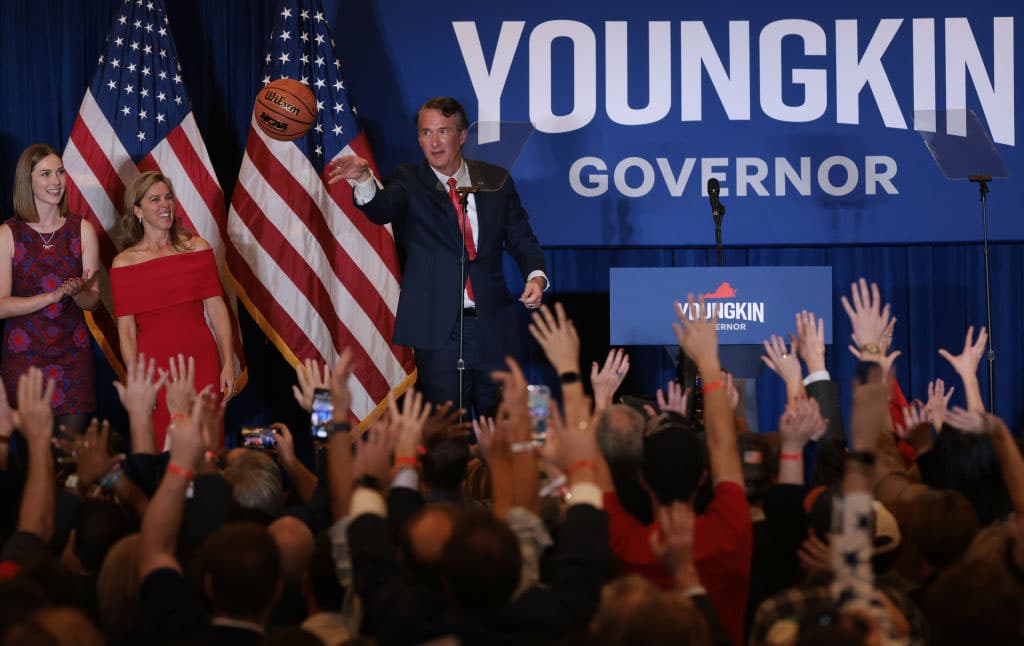
Terry McAuliffe, the Democratic nominee for governor of Virginia, tried to ride that Trump-hatred to victory in yesterday’s election. The problem is that Trump is no longer in the White House, which helps explain McAuliffe’s stunning loss to Glenn Youngkin, a Republican political newcomer. It also helps explain President Biden’s sharp decline in popularity: He can’t blame his failures on Trump.

“There’s no way to sugarcoat this: This was a shellacking on a thumping” Steve Israel, a former New York congressman said to The New York Times of Tuesday’s results for the Democratic party in New York and across the country.

Throughout the Trump years, the Democrats were spoiled by a man widely reviled who couldn’t stop spewing self-destructive missives on Twitter. They never had to be too competent or reasonable, because Trump’s divisive antics sucked up all the negative attention. Biden’s victory made them even more cocky. They forgot that it was the anti-Trump vote that gave them the power they craved.

So they overreached, and are now facing a painful reckoning.

“For five years, the party rode record-breaking turnouts to victory, fueled by voters with a passion for ousting a president they viewed as incompetent, divisive or worse,” Lisa Lerer wrote in The New York Times. “Tuesday’s results showed the limitations of such resistance politics when the object of resistance is out of power.”

Resistance is a sugar high that can make you sloppy. You feel like a revolutionary, but you lose all sense of perspective. The resistance to Trump was so deep, the haters overlooked the genuine grievances of Trump’s middle-class voters. If these people voted for Trump, they must all be racists.

Resistance is a sugar high that can make you sloppy. You feel like a revolutionary, but you lose all sense of perspective…Democrats are learning that hubris makes you lose your edge.

As Holman Jenkins wrote in The Wall Street Journal, “Virginia’s contest was a test of whether Americans like being called racists. It turns out they don’t.” It turns out millions of Americans also want a say in what their kids learn in school and aren’t crazy about defunding the police.

Democrats are learning that hubris makes you lose your edge. You can feel that hubris in Congress. The progressive wing of the Democratic party has been oblivious to its razor-thin majority in the House and its 50-50 tie in the Senate. In their view, spending $5 trillion to enact their socialist vision of America should be a slam dunk because it’s “good for America.”

But in a free democracy that values dissent, nothing is a slam dunk. If you want to get legislation enacted, you measure your leverage, you sit down, you negotiate, you compromise. Of course, you’re also free to be cocky and uncompromising, but at the risk of being punished by voters.

Yesterday, the voters sent a message to the Democrats, especially its progressive wing: Don’t be so cocky. Don’t be so sloppy. You’re not the only voices that matter in this country. There are other voices, there are other views, and we matter, too.

Regardless of which political side you’re on, there’s always something healthy about getting a dose of humility. We’re living at a time when a virus 10,000 times smaller than a grain of salt has killed more than 5 million people and has devastated a planet. One would think that would humble us. Instead, it seems to have made us angrier, more polarized, more sure of ourselves.

Regardless of which political side you’re on, there’s always something healthy about getting a dose of humility.

Luckily, fear is the deepest emotion.

If the Democrats come to realize that resistance to Trump is no longer a winning ticket, if yesterday’s stinging defeat humbles them into becoming more reasonable and cognizant of other views, it won’t be because they want to. It will be because they’re terrified of getting trounced in the 2022 midterms and the 2024 presidential elections.

That fear is democracy at work, and it’s stronger than both hate and love.

Democrats are Hurting Without Donald Trump Read More »

Brother From Another Mother

I met David Eichel in fifth grade. He was one of my oldest and dearest friends. David died this year. Some might say I lost my friend. But no, I did not lose him. He is as much with me now as he ever was. 

First a heart attack, diagnosed with lung cancer and emphysema and given only four to eight months to live, David didn’t die when he was supposed to but instead spent the next four years in hospice smoking Marlboros and playing online poker. When I’d visit him, we spoke about everything from our fifth-grade teacher to whether there was or was not a God. I said there was. He said he wasn’t sure. David was Jewish and my bar mitzvah might have been the last time he ever stepped foot inside a shul. 

David was that type of friend that if I did not see him for 15 years, when we did meet, we just picked up exactly where we left off. I think most of us have a few of those kinds of friends. Both of us were only children and both of us had tense childhoods. David was my brother from a different mother. 

There is no relationship quite like the ones from your childhood. They know you in a way that nobody else does. For about six years, I spent seven hours a day, five days a week with David in school or bolting from it. And many more hours playing together on weekends. Sometimes we rode bikes and sometimes we pitched nickels.  

There is no relationship quite like the ones from your childhood. They know you in a way that nobody else does.

Long before doctors and parents dosed their depressed or hyper kids, David and I dosed each other with a deep friendship. Growing up, when I felt down—and there were lots of those times—after hanging out with him, I always felt better. Even when he was dying of cancer, just watching him puff away and enjoying his Marlboros somehow lifted my spirits. 

When I went to visit him and, if he felt okay, we would grab lunch and then take a short drive while listening to some of his favorites like Joni Mitchell. Amazingly he could sing the lyrics to songs he had not heard in 40 years. Good friends can just sit together and say nothing. The safety of the friendship does it all. 

For his first two years in hospice, I would visit him around once a month. Then one day, for reasons I still can’t figure out, I just stopped going and calling. After a bit of time wondering where I was, he would call me. Guilty me, I would apologize for not visiting or calling more. And I meant it when I said I was sorry. David always, and I mean always, let me off the hook. No guilt, no shaming, always ending the call by telling me he loved me and when I had time, I should stop by. I made it back only once more. 

The last time I went to see David, he told me he was going to marry his hospice nurse so she could get her green card and stay in the country. This turned out to be a God shot if I ever saw one. What happened was, after taking care of him for a while, she seemed to fall for the guy. I was told she loved him. It’s true what they say: you never know where you might find love. She was the last person to sit with him when he closed his eyes. She even bought herself a space next to him for after she passes. 

It was a few weeks after his death that the mother of his only child called to give me the news. I wasn’t shocked. I expected him to die four years earlier. I am happy to hear that in his final days, he was well taken care of and loved. To some degree, knowing that relieved some of my guilt for not paying him more attention. When the road gets narrow, we all deserve to be taken care of. Perhaps as he got closer to his final days and became more helpless and childlike, his wife was able to see in him what I and many others were attracted to. That David was just one hell of a good kid. Shalom, my friend.


Mark Schiff is a comedian, actor and writer.

Brother From Another Mother Read More »

New Twitter MENA News Curator Apologizes for Past Tweets Supporting Farrakhan

Twitter’s new Middle East and North Africa (MENA) news curator has apologized for her past tweets voicing support for Nation of Islam leader Louis Farrakhan as well as for other anti-Israel tweets.

The Jewish Chronicle and Jewish News of Northern California reported Fadah Jassem––a former reporter for Al Jazeera, according to The Algemeiner––announced in a November 1 tweet that she is now Twitter’s Editorial Curation Lead for MENA. Since her announcement, various Jewish and pro-Israel groups and users unearthed some of her past tweets. Stop Antisemitism highlighted tweets from Jassem where she praised Farrakhan’s speeches as a “great example of faith transcending boundaries” and retweeted a tweet that called Jesus Christ a Palestinian and stated, “Free Palestine.”

“Is it too much to ask that @Twitter not hire employees… who promote antisemitic, homophobic bigots and erase the Jewish nation from the map?” Stop Antisemitism tweeted.

The Israel War Room Twitter account also noted that Jassem has shared several quotes from Farrakhan; another anonymous Twitter account using the name “GnasherJew” noted that in 2010, Jassem retweeted a tweet saying that Israel wasn’t “born… It was dropped like a bomb in the middle of Palestine.” Additionally, in her tweet announcing that she was joining Twitter, Jassem included several flag emojis––including the Palestinian flag––but did not include an Israeli flag.

“This is either woeful ignorance of the territory @FadahJassem is supposed to cover, or antisemitic erasure of the only Jewish state,” Israel War Room tweeted.

Associate Dean and Director of Global Social Action Agenda at the Simon Wiesenthal Center Rabbi Abraham Cooper denounced Twitter’s hire of Jassem. “A person who erases Israel from the map cannot be Twitter’s Middle East gatekeeper,” Cooper said in a statement. “What’s next? Longtime Twitter user Ayatollah Khamenei on your Board? Twitter empowers every anti-Semite by elevating this bigot to censor Middle East news.”

Author and educator Ben Freeman similarly tweeted, “Hey @Twitter, your team is in serious need of some [Diversity, Equity and Inclusion] training on Jews. I’d be happy to help.”

The Israel Advocacy Movement tweeted that they found several instances of Twitter’s MENA Moments feed portraying Israel “as an aggressor, while other MENA countries get favourable coverage,” so Jassem “will fit right in.” “This isn’t an issue with one editor… it’s systemic,” they added.

As of this writing, Jassem’s tweets have been put on a private setting, but she did reply to a tweet from HonestReporting’s Emanuel Miller acknowledging that her past tweets were “ill-informed.” “I apologize for any offence I caused by these particular tweets,” Jassem tweeted, adding that she was also sorry for “forgetting” to include the Israeli flag in her announcement tweet. Miller replied to Jassem that he was “glad to hear it.” “A number of my colleagues remain concerned, citing pro-Israel accounts being blocked and a comment with the Israeli flag being hidden. Looking forward to productive, mutually respectful interactions going forward.”

Twitter did not respond to the Journal’s request for comment.


New Twitter MENA News Curator Apologizes for Past Tweets Supporting Farrakhan Read More »

Let’s Pool it Together

As the heat of the summer begins to dissipate and the cooler weather begins to settle in, Israel will soon start to receive its seasonal and much needed rain. For a country so routinely inundated with dry weather, the much-anticipated rain will be of great help to farmers and provide a nice change of pace for those of us growing tired of this stretch of summer temperatures.

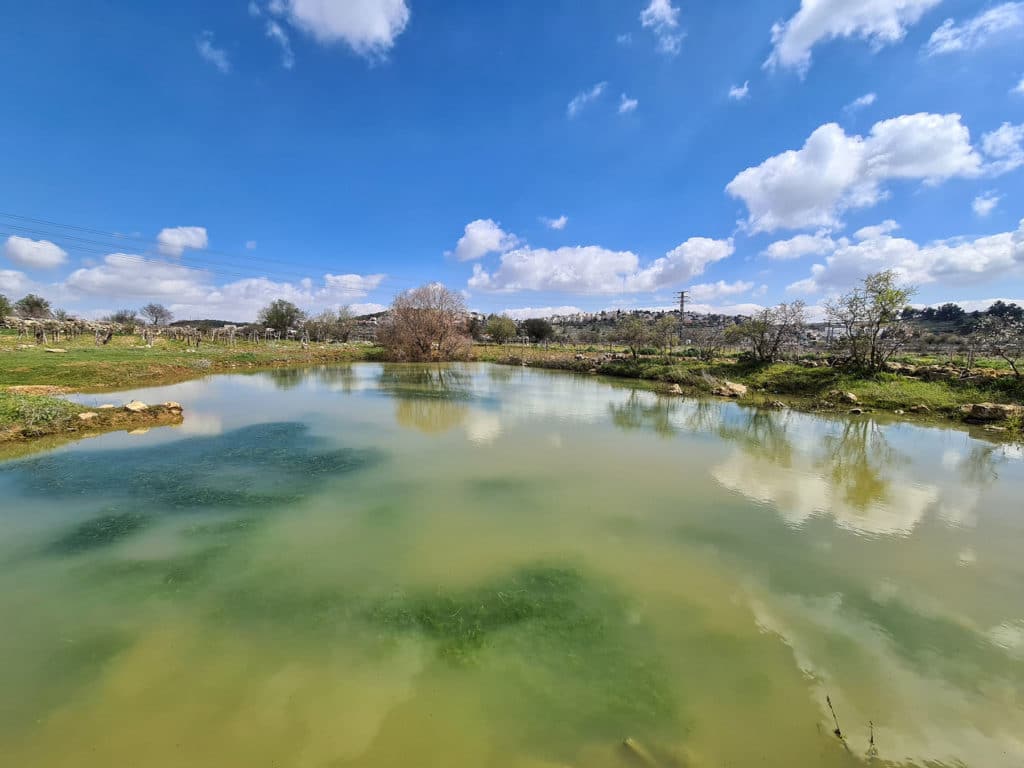
But beyond agriculture and marking a seasonal change, the fall-winter rains feed into and sustain important ecological habitats known as vernal pools, depressional wetlands that phase in and out with the change of the seasons in environments that exhibit a Mediterranean climate. When it rains, these areas fill with water, and they become lush beacons of biodiversity attracting a wide range of animals and insects, both endemic and migratory, and enabling numerous varieties of wildflowers to blossom and in an otherwise arduous environment.

But as climate change continues to put pressure on our environment, vernal pools are at risk of being a thing of the past as shifting weather patterns puts their cyclical reoccurrence in jeopardy. Already, California has lost more than 90% of its vernal pools due to the region’s characteristically relentless climate conditions. And as they disappear, so do the rare and important animal species that thrive in these habitats.

Throughout Israel’s predominately arid mainland, vernal pools provide extensive moist oasis-like ecosystems crucial for plant and animal life. However, much like California, these increasingly threatened ecosystems may soon disappear altogether from Israel’s local landscape and thus potentially deprive the country of much of its unique biodiversity.

Suffice it to say, conservation is key to preserve these vital habitats long-term. Following an extensive survey conducted in recent years thought Israel, the JNF (Jewish National Fund) has thankfully published their findings with regard to locating the country’s active vernal pools and what it will take to maintain them for the climatically worrisome years ahead.

Nature’s Pool Party

In 2018, the JNF’s Planning Division decided to conduct a large-scale general survey aimed at mapping the vernal pools located in the organization’s jurisdiction.

“As part of the survey, we visited 48 vernal pools and created an up-to-date database of them as well as their direct drainage basins,” says Dr. Eldad Elron, who co-authored the article with Dr. Yonatan Bar-Yosef.

“The duration of the water in the vernal pool is called a hydroperiod,” says Elron. “Basically, it is a habitat whose most unique feature is a seasonal body of water with two opposing periods: wet and dry.”

The wet period, as Dr. Elron explains, begins from the moment direct rain and surface runoff fill the open depression area whereas the dry period begins as the seasonal habitat starts to dehydrate via evaporation. By contrast, wet habitats like streams and lakes are permanent and therefore do not annually experience a period of absolute dryness.

According to experts, protecting the existence of vernal pools is necessary in order to preserve the unique variety of organisms that exist in Israel exclusively in this kind of habitat, which include a number of rare species and those that are considered endangered. Out of the seven species of amphibian that exist in the country, five of them are primarily found in and around Israel’s vernal pools: the European green toad (Bufotes viridis), the Levant water frog (Pelophylax bedriagae), the Middle East tree frog (Hyla savignyi), the Eastern spadefoot toad (Pelobates syriacus), and the southern banded newt (Ommatotrition/Triturus vittatus). The latter two are defined as critically endangered.

Beyond the habitat space and benefits of vernal pools, they also provide important services for us as well.

“Many of the pools are close to population centers and are accessible as nature sites allowing for leisure and recreational activities as well as sites for promoting research and education activities in schools. They can also help delay runoff that can lead to flooding,” says Dr. Elron.

Coping with the Dry Heat

As stated, vernal pools come and go according to seasonal changes, but the time between wet and dry periods can be very long and extreme, especially in Israel. Unsuitable conditions such as these coupled with persistent land development activity seriously affects the reproductive and survival strategies of the plants and animals that inhabit vernal pools.

In order to survive, species are forced to develop strategies for dealing with prolonged dry months or other manmade threats to avoiding dying out. One interesting strategy relates to the distribution of crabs to new vernal pools.

“Crab eggs can sometimes move from the pool in which they were laid to a new pond through the mud that sticks to the feet of passing animals. However, water insects are more successful than crabs in their distribution ability,” Dr. Elron notes. “Once the larvae have developed and before the winter pool dries, the adult stage of the insects can fly with the help of a pair of wings and skip to another body of water or land with more suitable growing conditions.”

Another reproductive coping strategy is exemplified by the Californian fairy shrimp (relative of crabs). Their eggs evolved a thick coating that protects the embryos against the heat and dehydration of the upcoming dry period. This protects them long enough until the next wet period arrives, at which point they are ready to hatch.

Pool of Maintenance

In the past, vernal pools used to be very common in Israel, but due to accelerated construction and the disappearance of open spaces, they are disappearing from the landscape. In fact, only less then 5% of the vernal pools that existed at the time Israel was established (1948) presently remain.

Luckily, surveys conducted over the past few years have yielded important findings regarding the challenge of conserving vernal pools. As stated, a decrease in the number and area of seasonal vernal pools causes a corresponding decrease in population counts of the species unique to them. Therefore, more efforts have been made in recent years to protect the last remaining vernal pools in Israel, and many of them have become protected nature reserves and subject to supervision by relevant nature and environment authorities.

During the surveys, the researchers saw a difference between pools located in different geographical areas and that external factors affect the existence and dimensions of them. In the first year of surveying, vernal pools in the Golan Heights were found to be larger and last longer than the those in the western Galilee, thus attracting a broader range of animals and organisms to fulfill the many ecological niches provided. This is in part due to the fact that the pools in the Golan Heights are older pools and receive greater amounts of rain.

The surveys also show that vernal pools in Israel are very sensitive to outdoor pollution.

“We’ve seen cattle herds around the pool adversely affect it,” says Dr. Elron. “Cattle defecate in the pool or its drainage basin, and as a result of the high organic load, a high concentration of nutrients are created adversely affecting the survival of organisms in the water.”

Beyond the main findings, the report includes general and individual recommendations for proper management and maintenance of each vernal pool. Among them, fencing the pools and preventing the entry of cattle herds into the immediately surrounding area are outlined. As well it is recommended to deepen the pools and plant suitable aquatic plants where needed. Management strategies also include changing any terrain route that interferes or disturbs the vernal pool ecosystem in any way.

“Fortunately, treatment began in the JNF-jurisdiction areas in the Western Galilee as early as the year following the initial 2018 survey,” Dr. Elron concludes.

ZAVIT – Science and the Environment News Agency

Let’s Pool it Together Read More »

What’s Happening at AFM

Yesterday I attended the first day of the American Film Market event, which is being held online this year from November 1 to November 5, 2021.  It’s terrific, they did a wonderful job converting this massive event to an easy to navigate site.  Usually, AFM is held in person each year in November in Santa Monica, CA.  It’s a huge event with major film and television industry impact.

This year you can attend workshops, screen dozens of films 24/7, meet up and network with other industry professionals, and further your career and have fun doing, completely online.  Tickets are available to everyone, for more information and tickets, visit americanfilmmarket.com.  You can also screen the workshops afterward at your convenience in case you didn’t get the chance to attend when it is being presented.

Yesterday the first event I covered was The Filmmakers Podcast presentation called “How to Make Your Movie.”  (One note, I discovered the online site does not work well with Chrome, but when I switched to Safari, all went swimmingly.)

In the “How to Make Your Movie” workshop, presented by four industry professionals, they offered plenty of great advice to filmmakers at all levels.  For example, the importance of developing personal relationships, how having a good treatment is vital, since not everyone has the time to spare to read your screenplay, and to try to keep in touch with contacts without being a pest.  “Just be a person.”  Also research your contacts beforehand to connect effectively.

Most of all, value your contact’s time and try to develop that personal connection so that even if things don’t work out at this juncture, perhaps sometime down the road they will remember you positively and be willing to help on your next project.  All great advice!

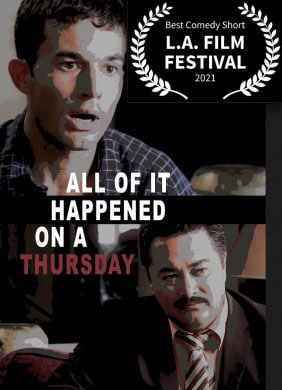
Later last night, I screened two films through the on-demand screening room, which is available 24/7.  The first film I watched was “All of it Happened on a Thursday” a short film about 20 minutes long, written and directed by Scott Vogel, and produced by Kurt Bonzell (who also edited and acted in the film). This film won the award for Best Comedy Short at the Los Angeles Film Festival in 2021.

“All of it Happened on a Thursday” is a tight, fun short that is the amusing story of Frankie, a very handsome young man, but not quite the sharpest tool in the shed.   Delightful!  The short also stars the award-winning actress and artist Sally Kirkland, who is a natural, just wonderful to watch on screen.

Sally Kirkland is a well-established long-term actress who appeared in among many other roles, including Bruce Almighty and JFK.  Note, as is often the case in short films, Producer Kurt Bonzell wears several hats here, and edited and acted in the film along with his producing responsibilities.

This short is a proof-of-concept film that is seeking funding for a feature length project.  An amusing, fresh little gem that deserves checking out.

Next, I screened the film Spotlight on German Films and Talent, which itself highlights current outstanding German films that are now making the rounds in festivals and just being released.  It is astonishing the amount of high-quality films Germany has produced.  This film included excerpts from current German cinema, along with brief interviews and explanations from the writers, directors, producers, and actors from the films.  It itself is an excellent film and really a great glimpse into the German cinema scene.

One scene that stood out was Kristen Stewart’s interview about her role in Spencer.  Spencer looks to be a fascinating psychological drama directed by Pablo Larrain that explores Diana, the Princess of Wale’s decision to end her marriage to Prince Charles in 1991.  It has received widespread critical acclaim, with critics especially noting Stewart’s outstanding performance as Diana. Note it will be released in the United States and United Kingdom this Friday, November 5, 2021.

In the film, Ms. Steward said about the role: “Never have I been on such a beautiful movie, such craft, every single detail had been just tenderly taken care of.”  She added that she loved shooting in Germany and appreciated the amazing crew.

There are about a dozen other films highlighted in this Spotlight and it demonstrates that German filmmakers are creating remarkable films at the highest level.

Then this afternoon, on day two of the festival, I attended a production conference headed by Richard Botto, Founder of Stage 32 (itself a networking and educational site for filmmaking and television professionals, visit stage32.com).  It was called “The Casting Effect: How Talent Choices Impact Every Production.”  This was an excellent overview of the importance of strong casting, with several panelists and industry experts discussing the challenges and pitfalls of casting decisions in film and television production today.  It was filled with helpful advice for filmmakers of the importance of being passionate about your project, treating colleagues with respect and consideration, and playing the long game.  They mentioned filmmaking is a long process, and it can take years to bring one project to fruition.

Finally, I popped into the Networking Pavilion where you can virtually and spontaneously meet face to face with other people attending AFM, and also arrange for other networking business meetings.  It was easy to join in and I soon met Yissendy Trinidad, of Trinidad Entertainment Group.  She is a director, producer, writer, and actress who was at the festival looking for funding for her feature films and a new TV series.

The AFM is on-going until Friday, November 5, 2021 and you can easily get tickets and find out more information at americanfilmmarket.com.  They are planning to have AFM back in person in 2022 at their regular location in Santa Monica, California.  In the meantime, the organizers have done a remarkable job transitioning this enormous event into quite a memorable online experience.

There are literally dozens and dozens of films you can screen anytime during and for a time after the festival is over, plenty of live workshops, networking opportunities, and a chance to meet with other industry professionals to advance your projects or learn more about the industry.  It’s really quite an amazing experience, and I would highly recommend it to anyone interested in the fascinating world of film and television production.

What’s Happening at AFM Read More »