fbpx

October 29, 2021

NY Comptroller Announces Divestment from Unilever Over Ben & Jerry’s Israel Decision

New York State Comptroller Thomas DiNapoli announced on October 28 that the state will be divesting from its $110 million in Unilever holdings over Ben & Jerry’s Israel decision.

Ben & Jerry’s had announced in July that they are going to cease doing business in the “Occupied Palestinian Territory”; Unilever is the parent company of Ben & Jerry’s.  Unilever CEO Alan Jope has stated that the company does not support the Boycott, Divestment and Sanctions (BDS) movement and does not plan to ever support it.

Nevertheless, DiNapoli’s office concluded that Ben & Jerry’s Israel decision amounted to “BDS activities” and will therefore be divesting its state pension funds from Unilever. New Jersey and Arizona have also announced that they will be divesting from Unilever over the matter.

Jewish groups praised DiNapoli’s decision.

“Comptroller DiNapoli has demonstrated that boycotting Israel has consequences,” American Jewish Committee Chief Legal Officer Marc Stern said in a statement. “Unilever’s failure to undo Ben & Jerry’s misguided decision to stop selling its ice cream in the West Bank contravenes state government laws across the United States.”

The Simon Wiesenthal Center tweeted praise for DiNapoli’s announcement against Ben & Jerry’s “illegal boycott of East Jerusalem and West Bank.”

Stop Antisemitism tweeted to Jope, “Boycotts work both ways.”

StandWithUs Co-Founder and CEO Roz Rothstein urged Unilever in a tweet to overrule Ben & Jerry’s Israel decision. “You can, and you should. Before this gets worse.” Rothstein had written a letter to Unilever earlier on October on behalf of StandWithUs and the Israeli-American Coalition for Action arguing that Unilever actually has the power under their contractual agreement with Ben & Jerry’s to veto them on this matter.

Former New York Democratic Assemblyman Dov Hikind, who heads the Americans Against Antisemitism watchdog, said in a video that New Yorkers are “grateful” for DiNapoli’s decision. “We are so proud of your actions and the actions of your office in doing the right thing,” he said, adding that Ben & Jerry’s Israel decision was “unacceptable.” But Hikind wanted to know why Governor Kathy Hochul, a Democrat, hasn’t addressed it yet.

“What doesn’t she get that the comptroller clearly gets?” Hikind said. “What is she waiting for? Why isn’t she doing the right thing and divesting from Unilever, Ben & Jerry’s, that the state of New York does not purchase anything from them?”

NY Comptroller Announces Divestment from Unilever Over Ben & Jerry’s Israel Decision Read More »

Torah Portion Chayyei Sarah – Life Torn and Sewn Back Together

(Introduction 2021: Our Torah portion, Chayei Sarah, is a good example of how the Bible changes its rhythm for literary purpose. The Bible is usually very laconic and moves through long periods of time with few words.  In this Torah portion, finding a bride for Abraham and Sarah’s son Isaac is described in great detail.

The focus on Rebecca foreshadows her pivotal role (in the next Torah portion) of ensuring that the blessing of leadership is removed from the first born son Esav and transferred to Jacob. We are also given some rather stunning and archetypally significant news at the end of the Torah portion – Abrahams two sons, Ishma’el and Isaac, whom Abraham indirectly or directly tried to kill, reconcile at Abraham’s death.  It seems that Isaac goes to live with Ishmael and Hagar, whom Abraham and Sarah had banished.

As we move through the Torah portions of Genesis and anticipate the crises in the stories to come, I continue to find myself in amazement of the literary, philosophic, and psychological depths presented to us. What are these readings communicating to us about the human condition? About the nature of family? As we watch these tales of painful fracture and unforeseen cohesion as arch-types of human existence, the fractures and cohesions in our lives make more sense.  Losses, grief and suffering open us up to futures of resilience, repair, and even unforeseen love. The tragic beauty is breathtaking.)

Life Torn and Sewn Together 2021 (adapted from 2020)

Human pain is the backdrop of the book of Genesis, pain that produces visions and sometimes unimaginable fulfillment. Of the many sad, heart-wrenching and ultimately beautiful stories in Genesis, one of the most distressing is that of Hagar. We meet Hagar as the maidservant of Sarai (before she becomes Sarah). When Sarai cannot conceive, Hagar is given to Avram (before he becomes Abraham) as a concubine. Hagar conceives, but Sarai feels slighted. Sarai mistreats Hagar, and Hagar flees.


An angel of God intervenes, and counsels Hagar to return to Sarai. The angel assures Hagar that her own offspring will increase beyond measure. The child of Avram whom she is carrying will be named Ishma’el, “God hears,” because God has heard her prayer. Hagar gives a name to the God who speaks to her – “The God Who Sees Me” – and she names the place where she encountered the angel “The Well of the Living One.”


We don’t know why Hagar must return to Avram and Sarai, but it seems that some great part of the plan that the God of the Bible has in mind requires that Hagar submit herself to Sarai.


Hagar returns, and bears her son Ishma’el. When Ishma’el is a teenager, Sarah bears her own son Isaac, and then insists that Hagar and her son Ishma’el be banished into the desert for some offense of Ishma’el that the Torah does not make quite clear.


Hagar is devastated; to have returned to the fold, to have submitted, and to be exiled again was too much. She suffers a spiritual collapse. Once she ran out of water in the desert, she resigned herself to the fact that she and her boy would die. An angel intervenes again, and Hagar sees a well of water, and she and her son are saved. The reader assumes that she has returned to the place – and to the well – of the first Divine intervention – The Well of the Living One Who Sees Me.


The rabbinic tradition insists that the story does not end here. In this week’s Torah portion, after Sarah dies, Abraham remarries, to a woman named Keturah – “Incense.”  In the Midrash (Genesis Rabbah 61:4), Rabbi Judah says “Keturah is Hagar.”


The brevity of this statement – “Keturah – Zo Hagar” (Keturah is Hagar) is directly disproportionate to its interpretive brilliance. In that brief utterance of Rabbi Judah, many things are brought to light.


It seems that the midrash, through Rabbi Judah, tells us that Abraham loved Hagar. The desperation of barrenness that caused Abraham and Hagar to be thrown together, however begrudgingly, produced a forlorn intimacy. Was their love simply that of two people who quietly asserted their humanity in the midst of lives thrown about in some vortex of destiny? Or had they fallen in love with each other, a love they knew was impossible to fulfill, knowing that they would never, or someday, be together? Or had Sarah’s death released a force that took each of them by surprise? We don’t know, but we are bidden to imagine.


Rabbi Judah’s assertion, in no way supported by the biblical narrative, helps shape a rabbinic theory of love and alternative lives. Rabbi Judah seems to conceive of a God who holds blessings in store that might seem sheer fantasy.


Had the Bible had its way, Hagar would have gone her way, and Abraham would have married a woman of consolation. Rabbi Judah cannot accept this. In saying, “Keturah is Hagar,” Rabbi Judah insists that loose strands of the narrative urge themselves back on each other.


Hagar’s son Ishma’el nearly died – but Ishma’el was Abraham’s son as well. Both of Abraham’s sons nearly died at his own doing. Imagine the tear and trauma in Abraham’s heart – he attempted to kill both his sons, only stopped by angelic intervention.


Might we assume that Hagar/Keturah loved her stepson Isaac like a son, in spite of what Isaac’s mother had done to her? Might we assume that Hagar/Keturah herself was stricken when she heard that Abraham had taken Isaac up to the mountain to be killed as a sacrifice to the God of the Bible? She and her son almost died at the hand of Abraham. Isaac almost dies at the hand of Abraham. Why doesn’t Hagar hate Abraham? Rabbi Judah has us ask different questions. How did she forgive him? How did their love survive?


The text does not report Abraham’s weeping when his son and concubine, Ishma’el and Hagar, were cast from his life forever. Perhaps that inconsolable heartache – and guilt – had led Abraham to take Isaac for a sacrifice. (This is indeed one of my interpretations of the Binding of Isaac – his anger at God and Sarah, his horrific acquiescence, producing unbearable guilt and shame, all caused Abraham to imagine that God wanted him to kill Isaac.)


From Rabbi Judah’s assertion, we can only infer why Hagar had to return to Sarai.  So that the love between her and Abraham could be sealed? So that Ishma’el and Isaac could forge a friendship based on their wounded father, their wounded mothers, a friendship that was to be torn but not shredded?


Life can rip us apart. Rabbi Judah wanted us, the readers of the Bible, to be able to sew fragments back together.


Hagar had almost let her son Ishma’el die due to Abraham, to Sarah and due to the will of the God of the Bible, but an angel of God intervened. Abraham had almost killed his son Isaac, due to the will of the God of the Bible but an angel of God intervened. Hagar and Abraham shared a horror, but also an angelic miracle rooted in that horror.


Sarah and Hagar’s sons’ lives were shaped by that horror. We can only imagine their trauma. Was their attending their father’s funeral together a way to face that trauma? We don’t have a record of what the two men said at their father’s funeral. We do know from the Bible that after the funeral, Isaac decided to settle at a place called “Well of the Living (God) Who Sees Me” – it seems certain he went to live with his half-brother and stepmother, Hagar/Keturah.


We must assume that Isaac took his new wife Rebecca there. We might assume that Rebecca got to know Isaac’s stepmother Hagar, and perhaps his half-brother Ishma’el, very well. The stories Rebecca heard are recounted in the yet to be written Midrash of Rebecca.


I am in awe of the genius of Rabbi Judah.


Torah Portion Chayyei Sarah – Life Torn and Sewn Back Together Read More »

A Vaccine Educator’s Personal Update

A first for me, Natalia’s school, Intiwasi, asked me to give a Zoom discussion/Q&A about COVID, and it went really well! We covered everything from boosters, to natural immunity, to the upcoming vaccine for children.

I certainly prefer my in-person teachings at the hospital to Zoom, but I’m really glad that the entire staff and many of the parents were able to be a part of it.

Oh, and while I’m on the topic, since I haven’t written anything about this for a while, here’s my personal vaccine update/tidbits:

• Out of 24 patients I’ve talked to who weren’t vaccinated, 20 got it after we spoke. I’ll take the 83% success rate, even if I wish it was unanimous.

• Numerous friends have asked me to talk to their family members, friends and coworkers who had fears of vaccination, and all but one got it or are going to shortly. (To be very clear, I never cold call anyone, and refuse to. I tell people I will talk to someone who WANTS to talk to me and have a chance to ask questions, and some people never make the call.)

• On Thursday I saw one of my favorite restaurant owners in LA, and he told me that my articles were one of the main reasons he chose to get vaccinated, because he “knows me and trusts me, and they made a lot of sense”.  This blew me away.

• I’ve met with the CNO of Saint John’s and he has guaranteed me that sometime before the end of the year we will create some sort of education clinic for me to educate the nurses in the busiest parts of the hospital. (This is purely for education purposes so they can be better nurses for their patients; they are already vaccinated.)

I say all of this not merely to pat myself on the back, but to put it out there that I continue to be here for others who have (non-trolling) questions. Even after a long day at work I’ve had hour-long conversations with strangers, with no regrets. And I want to ensure that anyone out there who has a school, hospital or company which could find it useful to give its employees, families, friends a chance to ask questions, I am happy to be that person for you.


Boaz Hepner grew up in LA in Pico/Robertson and now lives here with his wife and daughter. Thus, the neighborhood is very important to him. He helped clean up the area by adding the dozens of trash cans that can still be seen from Roxbury to La Cienega. When he is not working as a Registered Nurse in Santa Monica, he can be found with his family enjoying his passions: his multitude of friends, movies, poker and traveling.

A Vaccine Educator’s Personal Update Read More »

NY City Councilmember Censured for Shouting “Jewish Motherf—ers”

Omari Shakur, a city councilman-at-large in Newburgh, NY, was censured during an October 25 city council for shouting “Jewish motherf—ers” at a construction site.

The Times Herald-Record reported that Shakur was visiting the site to voice concerns over safety protocols, as the workers were tearing a building down yet not wearing masks or gloves and didn’t seal off the area. The landlord told Shakur to leave, prompting Shakur to yell, “You and these Jewish motherf—ers think you can come in here and take over our community. F— all y’all!”

The censure vote was unanimous; even Shakur voted to censure himself. He apologized multiple times during the meeting. “When those words came out of my mouth, I regretted them,” he said. “As a child and an activist of the ‘60s and ‘70s, the Jewish community has been allied with the Black community for the longest.”
Shakur also said that his remarks came from a place of frustration. “There was a safety issue in my community where a kid could have been hurt. Where is the compassion for that family?” he said, per the Mid Hudson News. “Where is the compassion for my community that is going through all of this after going through a pandemic, going through some of the situations that they are going through?”

The various city councilmembers all told Shakur that while his frustration was valid, it does not excuse his remarks. “This is strictly about the antisemitic remarks,” City Councilwoman Karen Mejia said. “This is a community that does not tolerate that.”

Anti-Defamation League New York / New Jersey tweeted, “This councilman’s use of #antisemitic tropes and apparent bias against the Jewish community are unacceptable. We commend the Newburgh City Council’s actions in censuring him.”


But Jewish Federation of Orange County Executive Director Wendy Cedar told Mid Hudson News that the city council needed to do more. “If he was concerned about the building codes or permits, whatever he might have been frustrated about, then he could have focused on that and not brought it down to cursing at someone for their religious or cultural background.”

Stop Antisemitism tweeted, “Was [Shakur] removed? Nope. He was censured Had a vile comment like this been made about ANY OTHER MINORITY, he would have lost his seat in .25 seconds!”

The watchdog noted in a subsequent tweet that Shakur was also censured in August for cursing at a police officer. “Shameful someone with this much hatred and disrespect is sitting in a town leadership position,” Stop Antisemitism wrote.


NY City Councilmember Censured for Shouting “Jewish Motherf—ers” Read More »

Unscrolled Chayei Sarah: A Reduction in Scale

In Parashat Chayei Sarah, we briefly forget that what we are reading is an epic, one which starts with the very creation of the universe and which details events no less lofty than the rescue of an entire people from bondage; the mass theophany of Mount Sinai; and the delivery of God’s people to the promised land.

In Chayei Sarah, the scale is reduced. This is a story about a family as it is touched by the loss of its matriarch and then expanded by the addition of a new member.

This reduction of the scale is no mere accident. Indeed, it is Sarah’s final gift to her family. This portion follows immediately after the story of the binding and near-sacrifice of her son, Isaac. The sages supposed that she had died from shock at the great tragedy that nearly befell her son.

In the story of the binding of Isaac, the story’s scale is at its grandest. Abraham doesn’t act as a father, rather he act as a loyal servant of God. Isaac is no longer the son, but an offering to the Holy One. The pair find themselves raised up, literally, on God’s mountain in Moriah. It is like a stage upon which this one central act will play out. The knife is extended – and then the angel cries out for Abraham to cease what he is doing.

Sarah’s shock and subsequent death has thus called Abraham and Isaac back to this world.

It is as if she is telling them: Be here. To Abraham, be a father. To Isaac, be a man. Live not only for progeny and destiny, but also for the needs of today, the needs of your heart and body and spirit.

And so, the father and son set about doing just that. Abraham buries Sarah and then sets about finding a wife for his son, sending his servant Eliezer out on this mission. He insists that she not be from the land of Canaan, where they are dwelling, but rather from among his own people where he grew up. Eliezer asks if it would not be simpler, then, to just move back there.

“Abraham answered him, ‘On no account must you take my son back there!’” (Genesis 24:6). Alas, the call of destiny cannot be entirely forgotten, not even now, and so Abraham insists that Isaac not be removed from the holy, promised land.

We are reminded how fraught a concept “home” is for these wandering prophets. Is home the land assigned by God, though it is full of strangers? Or is home the land they came from, though they are unable to dwell there any longer?

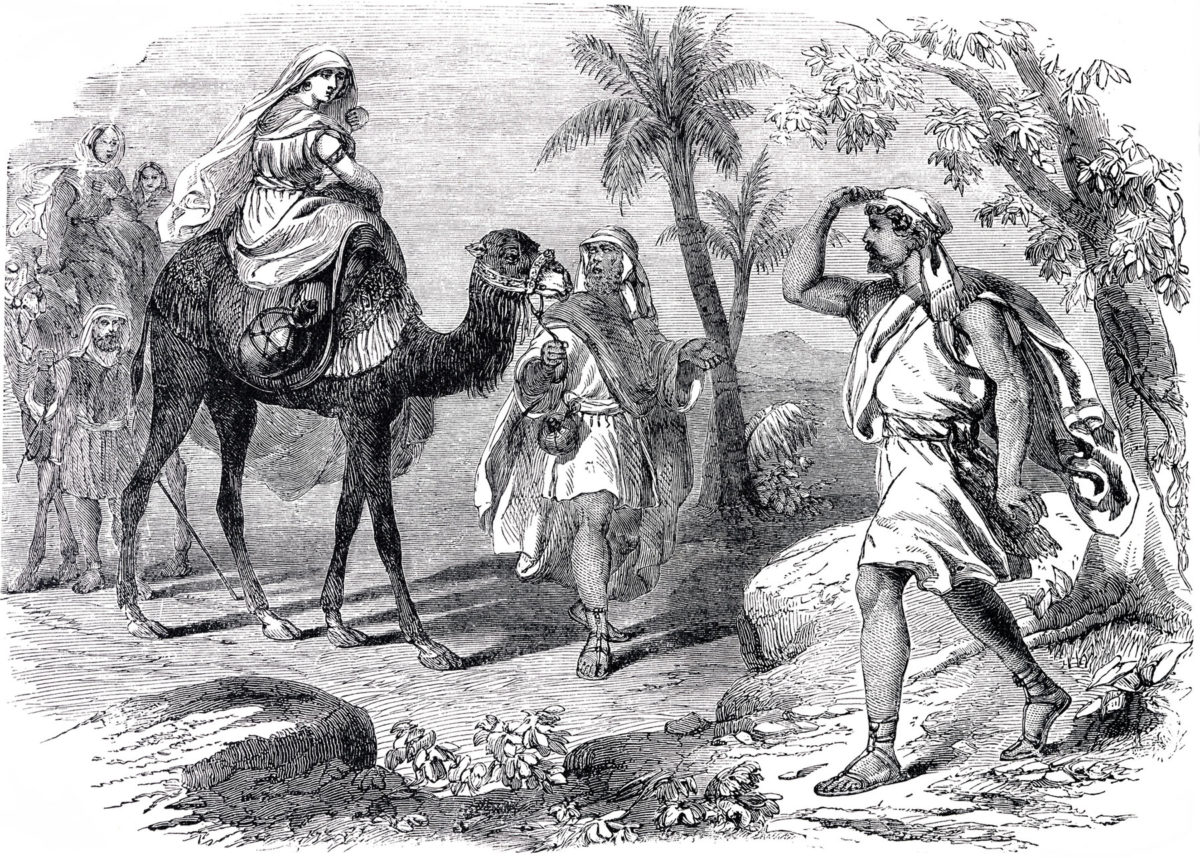
Eliezer goes out on his mission and finds Rebekah, whom he brings back to Isaac. We are told that “Isaac went out walking in the field toward evening and, looking up, he saw camels approaching.” (24:63).

“Walking in the field towards evening.” The translators, here, did the best they could, for in fact, the verb does not mean “to walk.” “Lasuach” seems to have some connection with the word “sicha” conversation. It also seems to have a botanical connotation, with “siach” meaning either “shrub/bush” or “discourse.” But with whom was Isaac conversing out there in the tall grasses of the field?

The sages tell us that he was praying. And again, here we are reminded of Sarah’s sweet gift – this momentary reduction of the story’s scale. Here, conversation with God is not portrayed by the piercing call of an angel. It is not marked with signs or portents, nor sealed in the blood of offerings.

No, it is this quiet conversing of Isaac with his creator out among the whispering grasses.

Isaac comes out to greet his new wife. They regard one another with curiosity, with attraction, with trepidation.

“Isaac then brought her into the tent of his mother Sarah, and he took Rebekah as his wife. Isaac loved her, and thus found comfort after his mother’s death.” (24:67). And so we solve the riddle of “home” from before. It is not a place – not a matter of this land or that. It is the comfort we find in one another.

And so we solve the riddle of “home” from before. It is not a place – not a matter of this land or that. It is the comfort we find in one another.

Abraham, too, finds comfort. We are told that he takes a new wife, Keturah. The sages suggest that this is none other than Hagar, his old flame, mother of Ishmael.

In next week’s portion, Isaac will become the patriarch with whom we are concerned. The spotlight will be trained on him and his adventures with God. Then will come Jacob and his wives and their many sons who will become the tribes of Israel. The scale will once again swell to epic dimensions.

But for now, we can breathe easy. Abraham and Isaac have weathered the loss of their beloved wife and mother. Their hearts have broken and healed. They have been invited by this experience to live in the present, and for now, that’s where we will leave them.


Matthew Schultz is the author of the essay collection “What Came Before” (2020). He is a rabbinical student at Hebrew College in Newton, Massachusetts.

Unscrolled Chayei Sarah: A Reduction in Scale Read More »