fbpx

October 15, 2021

Jewish Groups Call on Appeals Court to Rehear Case Involving Anti-Israel Protests Outside MI Synagogue

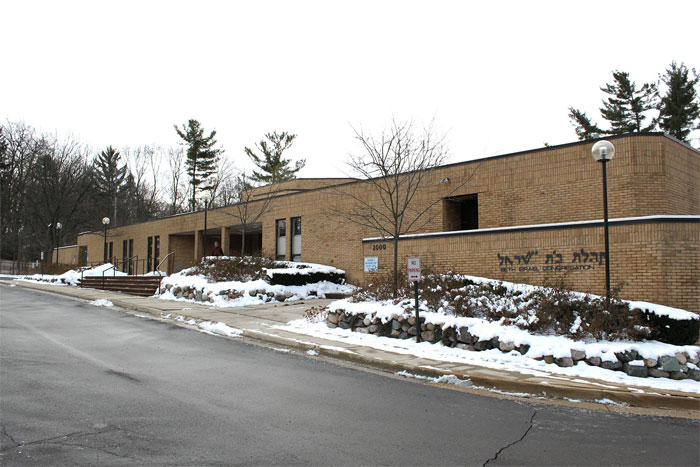
Several Jewish groups have petitioned the Sixth Circuit Court of Appeals to rehear a case against ongoing anti-Israel protests in front of a synagogue in Ann Arbor, MI.

The protests in front of Beth Israel Synagogue that have occurred every Saturday morning since 2003 reportedly featured signs stating “Resist Jewish Power,” “Jewish Power Corrupts” and “No More Holocaust Movies.” The lawsuit was filed by Marvin Gerber, a Beth Israel congregant, in 2019, arguing that the protests caused him “extreme emotional distress” and have dissuaded him from attending the synagogue, according to MLive and the City of Ann Arbor has refused to take action. In August 2020, a federal court sided with the protesters, stating that the First Amendment protects speech in a public setting. The case went to a Sixth Circuit Court of Appeals panel, which upheld the ruling in September 2021.

Agudath Israel of America, an organization that describes itself as “the arm and voice of Orthodox America Jewry,” announced in an October 15 press release that they and seven other Jewish organizations filed a petition to the Sixth Circuit to rehear the case so that all of the judges on the court hear the case. The petition argues that the protests are interfering with Beth Israel congregants’ rights to exercise their freedom of religion because the protests are targeting congregants during Shabbat morning services. They also argue that the protesters have not applied for a permit to protest in such a setting.

“The Sixth Circuit Court of Appeals panel’s opinion would set a dangerous precedent, marking open season on private individuals enjoying their First Amendment Free Exercise rights peacefully and without interference by protesters espousing epithets and non-protected fighting words, at house of worship throughout the country,” the petition reads, adding that the petitioners are “deeply concerned” that such protests could result in “potentially violent confrontations, vandalism, injuries, and murder.”

The protests were first started by a man named Henry Herskovitz, a former Beth Israel congregant. He claims that the synagogue wouldn’t allow him to speak about his experience in the Middle East and that his goal for the protests is to get Beth Israel to take down their Israeli flag and call for Palestinians to have equal rights. Herskovitz has argued to The Detroit Jewish News that the signs at the protests aren’t antisemitic because “we hate what Jews are doing in the Jewish state … but we don’t hate [Jews].”
Jewish Groups Call on Appeals Court to Rehear Case Involving Anti-Israel Protests Outside MI Synagogue Read More »

Jewish Groups Condemn Killing of British MP

Jewish groups have issued tweets denouncing the killing of British Conservative Party Member of Parliament (MP) Sir David Amess.

Amess was stabbed to death on October 15 at Belfairs Methodist Church in Essex, where he was holding what’s known as a “constituency surgery” to discuss issues with his constituents. According to the BBC, police have arrested a suspect, a 25-year-old British national of Somali heritage. Amess had been in parliament for nearly 40 years.

“From Israel, we send our deepest condolences to the family, friends and colleagues of Sir David Amess,” Israeli Foreign Minister Yair Lapid tweeted. “He always stood with the Jewish community and was a true friend of Israel. May his memory be for a blessing.”

The Anti-Defamation League tweeted that they were “shocked and devastated” at the stabbing of Amess. “Violent attacks against elected officials are an attack on democracy itself. We hold his family, friends, colleagues and constituents in our prayers. May his memory be a blessing.”

The American Jewish Committee also tweeted, “We are horrified by the murder of British MP Sir David Amess and extend our deepest condolences to his family. Violence has no place in a democracy.”

StandWithUs Israel Executive Director Michael Dickson tweeted, “Here in Israel, we share the grief of Brits at the horrific loss of David Amess MP who was stabbed at his constituency office. Among many achievements, Amess was former Hon. Secretary of Conservative Friends of Israel and a friend of the Jewish community.”

The European Leadership Network tweeted, “We are deeply saddened by the horrific loss of Sir David Amess MP who has been stabbed in his constituency. A great friend of Israel and a true ally of the Jewish community.”

Marie van der Zyl, President of the Board of Deputies of British Jews, said in a statement: “We are devastated to hear the news of the murder of Sir David Amess MP. We will never forget Sir David’s long and deep friendship to our community. Our hearts go out in profound sorrow to his wife Julia and his beloved children.”

Jewish Groups Condemn Killing of British MP Read More »

Divine Justice: A Conundrum

The question of divine justice—theodicy—poses the greatest challenge for religious people. How can we understand the suffering of innocents if God is merciful, just and good? It is ultimately a question without an answer. Religious people believe in spite of the lack of an answer and non-religious people point to the problem to justify their lack of faith.

It is not for lack of attention that the question persists. The issue is addressed in numerous Jewish sources, such as the books of Job, Jonah and Ecclesiastes. Job, the best-known, portrays a just man ostensibly treated unjustly as a test. Job remains faithful to God but sharply questions his treatment. In the end, God declares that his ways cannot be known, which many find deeply unsatisfying.

Jonah, a prophet, is instructed by God to go to the capital city of a great empire to warn them to repent of their sinful ways or they will be destroyed. The king and citizens do repent and God spares them. For reasons not revealed, Jonah despairs and God castigates him and tells him that His ways are just. Jonah cannot accept that such overwhelming evil is unpunished and, again, we have an example of God’s actions as mysterious.

The book of Ecclesiastes is attributed to King Solomon, renowned as the wisest of all people. And yet the book is entirely devoted to Ecclesiastes’ inability to fathom the meaning of life.

An encounter in the Torah prefigures these books. When Moses draws near to the burning bush that is not consumed by the fire, he discovers that he is in the presence of God. He asks to know God’s ways and God tells him to withdraw to the cleft in a nearby rock so that he can see God’s back, because one may not see God’s face and live.

Commentators have many interpretations of that encounter but one meaning is clear: God is a mystery to the human mind, incomprehensible to human reason. So how does the religious person accept this irreconcilable dilemma—a just and merciful God in a too-often cruel and suffering world?

An understanding of how literature works may be a way to approach the issue from another perspective. Literature doesn’t answer questions; it asks them. It doesn’t resolve complex issues; it explores them for examination and reflection. Charles Dickens, Mark Twain, F. Dostoyevsky, Cervantes and Flaubert portray life as they see it in its raw, searing, painful reality. We see the impact of injustice, the toll of suffering, the devastation of inhumanity.

One will not have answers to Don Quixote’s quest for truth; Dickens does not provide a remedy for the poverty and inequality of England of his time; Twain does not advocate any policy for eradicating racism. But we accompany Don Quixote on his voyage and come to understand the dignity of a quest for the good life. Dickens shows us what a mean-spirited society looks like from the ground up and makes us think about where we stand and how we should react. Twain’s Huck starts out with the prejudices of his society, but getting to know a slave whom he helps escape sensitizes him and he becomes a better and more moral person as a result.

Literature holds in balance all of the negative aspects of life along with the reality that exploring the issues, questions and dilemmas is what being human is all about. The problems raised cannot be immediately resolved. Maybe they can never be fully settled. But exposure to them, reflecting on them, confronting them is part of human experience and the meaning of life.

Literature holds in balance all of the negative aspects of life along with the reality that exploring the issues, questions and dilemmas is what being human is all about.

Perhaps applying that approach to sacred texts would help make the contradiction less daunting. The great texts of our tradition explore the thorniest of issues, including the idea of theodicy. Much of it is painful but revealing. Exposure to complex ideas and often unresolvable dilemmas makes us aware of our weaknesses and strengths. Our desire to understand the divine plan and divine justice may be unanswered, but engaging with open-endedness of many of our stories can be inspiring and make us more sensitive to the world beyond the self.

We may not know the answer to the most mysterious questions, but the process of addressing them makes us more human. It also makes us more Jewish. Jewish biblical exegesis has often focused on fleshing out the nuances of the text, revealing the paradoxes and inconsistencies rather than foreclosing them. And the methodologies of both the Talmud and midrashim underscore the importance of raising questions rather than determining answers. In many cases, theological debates remain open and unresolved.

Job did not learn the cause of his suffering, but the reader comes to understand that we can live with uncertainty as long as we believe in our own good actions and have faith in values that are eternal. The great fable of Jonah makes poor Jonah quite miserable at the end, but the reader gains insight into the meaning of repentance. Ecclesiastes never does figure out why all of his attempts to gain ultimate understanding fail, but the reader gains insight into the need for living a life examined rather than a life blissfully ignorant.

The Torah is filled with many laws, but all of the truth-seeking texts are built around stories.

The Torah is filled with many laws, but all of the truth-seeking texts are built around stories. That is because stories give us what law does not—insight into the human condition. Secular literature addresses social, political and human issues. Sacred texts focus on the human dimension in relation to the Divine. They have in common a desire to explore how we can live in the world with meaning and purpose so that life can be lived, if not with absolute certainty, at least with lucidity and sensitivity.

We are like Jacob wrestling with the angel in Genesis. Jacob’s struggle is interpreted metaphorically as grappling with his inner fears and doubts. In the process, he gains victory as he realizes his own strength and faith. Wisdom is found not in understanding, but in the struggle to understand.


Dr. Paul Socken is Distinguished Professor Emeritus and founder of the Jewish Studies programme at the University of Waterloo.


Divine Justice: A Conundrum Read More »

Unscrolled Lech Lecha: The Story of an Image

In Isaac Bashevis Singer’s 1967 short story “The Slaughterer,” a pious Jew named Yoineh Meir finds himself increasingly revolted by the gore of his work as the village’s kosher slaughterer.

At night, when the “smell of the slaughterhouse would not leave his nostrils,” he would seek respite in the study of Torah, but found that even the Torah was full of gore.

Indeed it is, especially in the story of the “Covenant of the Parts” found in Parashat Lech-Lecha.

God comes to Avram (not yet renamed Avraham) in a vision. At this moment, Avram is distraught—worried that he will leave no descendants upon the earth. God directs Avram’s glance skyward. “Look toward heaven and count the stars, if you are able to count them,” God says. “So shall your offspring be” (Genesis 15:5).

God then asks for an offering to seal this covenant.

Avram brings a three-year-old heifer, a three-year-old she-goat, a three-year-old ram, a turtledove, and a young bird. He then bisects the animals lengthwise (except for the bird) and lays their pieces side by side in a row in the soil.

Avram keeps watch over this strange configuration of body halves for long hours. When birds of prey come down to feast on the carcasses, he drives them away.

Then, just as the sun is about to set, a slumber falls upon Avram. In a dream, God speaks to him.

“Know well that your offspring shall be strangers in a land not theirs, and they shall be enslaved and oppressed four hundred years; but I will execute judgment on the nation they shall serve, and in the end, they shall go free with great wealth” (Ibid 15:13-14).

Avram then sees a smoking oven and a flaming torch passing to and fro between the divided animals as if held by phantoms.

Perhaps Yoineh Meir would turn away in disgust from the story of this strange, bloody ritual. Perhaps we, as modern readers, want to do the same. If, however, we keep our eyes on the page, we will find ourselves confronted by an image pregnant with countless unspoken meanings and associations.

If we keep our eyes on the page, we will find ourselves confronted by an image pregnant with countless unspoken meanings and associations.

In the animals, Rashi sees a foretelling of the animal sacrifices that will someday be offered in God’s Temple. Or, perhaps, these are the beastly kings of Babylonia, Persia, and Greece who will conquer and despoil Jerusalem and the children of Israel, with the unmutilated bird a symbol of the Jewish people who, though vulnerable and small, will survive each onslaught and go on to rebuild.

Life and death swirl in the vortex of this image. Past and future, like two rivers flowing in opposite directions, pool and churn in the whirlpool of the covenantal act, in which future exiles and redemptions lay coiled like DNA.

In the glowing clouds of smoke, we can see the revelation at Sinai.

In the divided animals, we can see the parted waters of the red sea.

The sight of the smoking oven evokes the pain, violence, and vulnerability of exile; while the glowing torch recalls the torches used to signal the arrival of the new moon in the land of Israel – thus signifying the triumphal ethos of return.

In other words, in the image of the covenant of the parts, we see all the thick history of the Jewish people—a history which is, like the image itself, sometimes difficult to confront, to make sense of, to make peace with.

Nevertheless, it is ours, undeniably and eternally since that dark night so many centuries ago when our forefather, hands red and brow wet, made a covenant with God under a sky full of stars.


Matthew Schultz is the author of the essay collection “What Came Before” (2020). He is a rabbinical student at Hebrew College in Newton, Massachusetts.

Unscrolled Lech Lecha: The Story of an Image Read More »

Quick Decorating Fixes When You’re Bored with Your Home

It’s bound to happen. You were once so in love, but now the thrill is gone. Your eyes start to wander. You wonder if it’s time to move out. No, I’m not talking about your love life. I’m talking about your home.

When you’ve lived in the same place for a while, it’s natural to get the blahs about your décor, especially if you’ve watched one too many home makeover shows. But the great news is that you can spice up your home with some fast, inexpensive decorating tweaks that will make you fall in love with your space all over again. 

So, how many of these ideas are you going to try this weekend?

Rearrange your bookshelves

After a good dusting, remove any clutter that may have accumulated in your bookcases. (I don’t know how receipts and bills keep ending up on top of my books.) Then arrange the contents of the shelves in attractive groupings, positioning some books vertically and some horizontally. And make use of stylish boxes that will do double duty as bookends and storage. 

Frame some pictures

A few newly framed pictures on your shelves will give any room a quick refresh. And if you already have a lot of framed pictures, change out the photos for an instant update. Move some pictures to unexpected locations, as well, like the kitchen or bathroom.  

Try a new lampshade

Lampshades don’t need to be white or beige. Up your lamp’s style quotient with a lampshade in a jazzy new color or pattern. If you’re the crafty type, you can even paint an old lampshade or glue on embellishments. 

Replace your shower curtain

When you think about the standard size of a shower curtain — 72 inches by 72 inches — you realize that is a huge piece of untapped décor potential. Beyond buying a spiffy new curtain, you might even design your own custom shower curtain on websites like cafepress.com.  

Treat yourself to flowers

A vase of fresh flowers is my favorite way to add instant color and beauty to a room. When I first bought my home and was completely broke, I would go to the store and buy just one flower, then put it in a vase on my dining table. That single stem made all the difference in the house. So pick up some flowers as you’re grocery shopping. You deserve them. 

Refresh your bedding

When I get a new duvet cover or sheets for my bedroom or guestroom, it’s a red letter day. New bedding completely transforms a room, and I love that you can change the mood from zen to boho chic to preppy, just by making the bed. 

Find old treasures in your closet

If you want some new artwork or accessories, go shopping in your own home — for free. I am always amazed when I open up a closet or cabinet and find beautiful candleholders, vases and framed posters I forgot I even had. You might get to display some rediscovered home accents while also freeing up closet space.

Spray paint something

One of my decorating go-tos for tired objects is a can of glossy spray paint. I have often saved items that clients wanted to throw out just by spray painting them. Old pieces, like framed mirrors and bedside tables with outdated wood finishes, became totally luxe with a glossy black paint job. I turned a boring ceramic elephant from Big Lots into a statement piece just by spraying it with high-gloss hot pink. And, recently, I covered a used tire with glossy orange paint to make a dog bed.      

Change the knobs

Between all your kitchen and bath cabinets, dressers and entertainment units, your home has a lot of knobs and drawer pulls. Switching out just a few of them will freshen up the furniture pieces they’re on — and breathe new life into the entire room. You can also give your old knobs a makeover by painting or decoupaging them.

Scent your room

A room’s appeal is more than visual. Scented candles, room sprays and diffusers transform a room by positively affecting your mood. A few years ago, when I designed a room for the Greystone Mansion Design Showcase, I decided to give my room a signature scent. Using a reed diffuser from West Elm, the subtle fragrance of red currant was a big hit with visitors, and I could have sold hundreds of those diffusers if I’d had them. The scent made people happy. So if you’re looking for a quick decorating fix, remember that a relaxing scent can have the sweet smell of success.


Jonathan Fong is the author of “Flowers That Wow” and “Parties That Wow,” and host of “Style With a Smile” on YouTube. You can see more of his do-it-yourself projects at jonathanfongstyle.com.

Quick Decorating Fixes When You’re Bored with Your Home Read More »

Newsom Launches Holocaust Educational Council at Museum of Tolerance

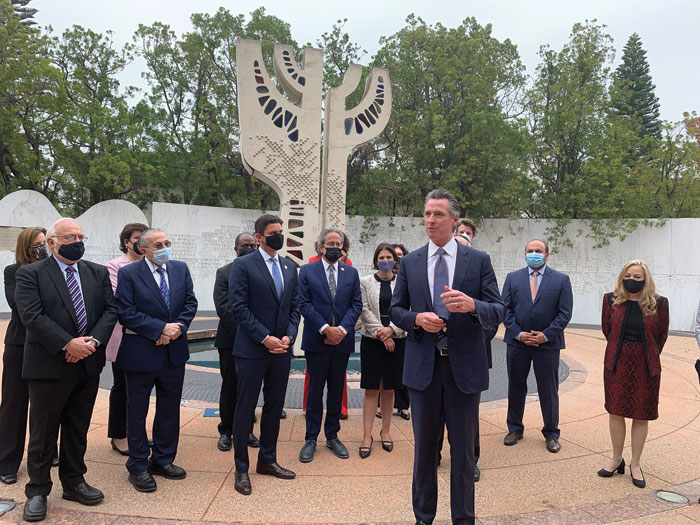
California Governor Gavin Newsom visited the Museum of Tolerance on Oct. 6 to announce the launch of the Governor’s Council on Holocaust and Genocide Education.

The council — which will be comprised of state elected officials, academics, advocates and community organizations — will be tasked with educating students about the Holocaust and other acts of genocide and equipping young people with tools to combat antisemitism and other forms of hate and bigotry.

Statewide elected officials were in attendance, including Assemblymembers Richard Bloom and Jesse Gabriel and Senator Henry Stern, who serve on the California Legislative Jewish Caucus and worked with Newsom to secure millions of dollars for Holocaust and genocide education in this year’s budget. 

Allocations in the budget include $10 million for the Museum of Tolerance to create a new exhibit on antisemitism; $2.5 million for the expansion of the Holocaust Museum Los Angeles at Pan Pacific Park; and $1 million for the renovation of the Tauber Holocaust Library and Archives, housed at the Jewish Family and Children’s Services Holocaust Center in San Francisco.

Delivering remarks in the courtyard of the museum, the governor noted that this was his first visit to the Museum of Tolerance.

“This had a much deeper impact on me than I had expected and that will carry over in profound ways and meaningful ways.”
– Governor Gavin Newsom 

“This had a much deeper impact on me than I had expected and that will carry over in profound ways and meaningful ways,” he said. 

Upon Newsom’s arrival around 9:30 a.m., Simon Wiesenthal Center Dean and Founder Rabbi Marvin Hier took Newsom on a tour and showed him an original 1919 letter written by Adolf Hitler. In it, the future Nazi Party leader expresses his desire for the legal removal of Jews from Germany. 

Afterwards, Newsom and other elected officials and community leaders offered statements about their commitment to increasing knowledge about the Holocaust among students in California schools, with Stern citing a recent study by the Claims Conference that found, the study said, “significant gaps in knowledge about the Holocaust,” particularly among millennials. 

In an interview, Newsom addressed antisemitism and anti-Zionism on college campuses, saying more needs to be done to combat the Boycott, Divestment and Sanctions movement.

“I proudly stand in strong solidarity and support with the State of Israel,” he said.

Newsom’s visit came one day after reports of vandalism at Auschwitz-Birkenau Memorial and Museum, which preserves the site of the former German Nazi Auschwitz concentration and extermination camp in Poland. According to a statement from the organization, signs of vandalism, including antisemitic spray-painted inscriptions, were discovered on nine wooden barracks at the Auschwitz II-Birkenau site.

“Such [an] incident – an offense against the Memorial Site – is, above all, an outrageous attack on the symbol of one of the greatest tragedies in human history and an extremely painful blow to the memory of all the victims of the German Nazi Auschwitz-Birkenau camp,” the statement said. 

While the vandalism of Auschwitz-Birkenau did not come up during Newsom’s visit to the Museum of Tolerance, the governor emphasized how the museum is a reminder of the need to stand up against hatred.

“Being here at this remarkable center, this remarkable Museum of Tolerance, where in some ways even tolerance doesn’t do justice to our need to celebrate, not just tolerate, our diversity, is something to me that is foundational to all the work we need to do,” he said. “And so this notion of pluralism, being a universal state, celebrating all of our interesting differences but uniting around the things that bind us together, we have a lot of work to do in that space.”

Newsom Launches Holocaust Educational Council at Museum of Tolerance Read More »

Checking In With Seniors at The Watermark During COVID-19

When COVID-19 put the world on hold, Nancy Steingard was no longer able to see her mother-in-law, Marilyn Solomon, in her senior living community. 

“She was extremely isolated and our family could not visit her,” said Steingard. “Once we were able to visit, it was only through a glass window, and meanwhile, her dementia was progressing.”

Then, five months ago, the family moved Solomon to The Watermark at Westwood Village. There, she could participate in its memory care program and go to happy hours with other members, take art classes, dance and exercise. 

“Marilyn actually leads a geography class,” said Steingard. “She is a retired teacher and enjoys being engaged and social.”

The pandemic has been especially hard on the senior population, who are most vulnerable to the disease. According to a 2018 study, people who are socially isolated are at an increased risk of cognitive decline, dementia and depression. Another study published in August 2021 in the International Journal of Psychiatry in Clinical Practice found that people who are socially isolated and lonely for prolonged periods of times have about a 49% to 60% higher risk of developing dementia. 

The main reason that 90-year-old Meyer Grabar moved to The Watermark from New York was because he felt isolated and didn’t have a support system. 

“I wanted to be closer to my family, especially my daughters,” he said. “They visit me here. I have three grandchildren, and three great-grandchildren.” 

Grabar said that COVID-19 changed his way of life. When he was in New York, his son used to live close by, in New York City, but he moved away to the countryside during the pandemic. 

“[I was not able] to go to dinners. My daughter was in Paris and she was supposed to come back home in two months, but was stuck isolating for six months in Paris due to the virus. There were no planes available. I didn’t have any family or visitors around for a long time, so I was feeling isolated.”

Now, though, he’s able to be with his family again and has access to social activities. For his 90th birthday, he went to a Dodgers/Mets game, and he regularly attends happy hours to “enjoy conversation with the other members, and we listen to the various entertainers,” he said. “I also like catching some quiet time in the sun in the courtyard. It has a great ambiance and I like spending some afternoons out there.”

The Watermark in Westwood Village has 188 residences, and most of the people living there are between the ages of 70 and 85, with about 75% of them being Jewish. Though it has many other locations throughout California and the U.S., the Westwood campus has only been open since this past May. In that time, to keep seniors safe, it has implemented screening and temperature checks for visitors and followed all federal and state laws for guidance on masking, sanitizing and social distancing.

Watermark created amazing opportunities for people to connect and stay active and engaged despite the restrictions.

“Watermark also discovered early on in the pandemic that keeping residents safe wasn’t its only challenge; it needed to keep residents well by providing outlets to keep residents engaged – sometimes through outdoor activities and also through virtual programming,” said Executive Director Patrick Raab. “The most difficult aspect of COVID restrictions was the resulting isolation of residents from each other and their families. Watermark created amazing opportunities for people to connect and stay active and engaged despite the restrictions that were imposed by state and local health departments.”

Steingard is certainly pleased with her mother-in-law’s new situation. Now, she’s just hoping that the situation improves and life can get better again for everyone. 

“I hope it becomes a manageable virus, especially for the elderly and vulnerable population,” she said. “The world needs to get vaccinated, and we need to find something treatable for the virus.”

Checking In With Seniors at The Watermark During COVID-19 Read More »

The Anti-Vaxxer Who Stole the Holidays

My wife issued an edict nixing our attendance at her family’s annual holiday gathering this year. Although proudly Jewish, I enjoy spending time with my wife’s relatives as they celebrate Christmas. We pass on pork but not on the holiday cheer. They also achieve near universal geniality, a goal unachievable in my more contentious family. 

But not this year. My relatives held a “super-spreader” Thanksgiving last November. Before they realized what happened, my mother-in-law was infected by her sister, who passed it on to my wife. Fortunately, all survived, even without the therapeutic benefit of an apology.   

Now, my wife’s cousin, the party hostess, is refusing vaccination. Why? She commented that she’s had COVID so she’s immune.  Senator Rand Paul spread this theory as energetically as he spread his own COVID case. Unfortunately, his science was off. The data suggests that individuals who vaccinate after COVID-19 reduce their risk of re-contracting it by about half. Additionally, when natural immunity fades there’s no way to predict when it becomes ineffective. Individuals who vaccinate after having COVID-19 can follow the CDC’s advice based on the experience of millions of similarly vaccinated individuals.   

Of course, like my wife’s cousin, many COVID survivors may not worry. She defended the “super-spreader Thanksgiving” by dismissing COVID as “just a cold.”  Well, not for my wife who suffered for three weeks. More importantly, what about others that may have contracted the illness from my wife, my mother-in-law or from unknown cases related to that one holiday dinner? Some may be among the 700,000 dead. Unfortunately, many Americans who decline vaccines still don’t realize that it’s not only about themselves.

Why do so many shun a vaccine that’s safe and lifesaving? Part of it is clearly political.

So, why do so many shun a vaccine that’s safe and lifesaving? Part of it is clearly political. The seven states with the lowest COVID-19 transmission rates all went blue in the 2020 presidential election. The eight highest all went red. But it’s more complicated than that, as shown by a recent interview with 23andMe CEO Anne Wojcicki. She claimed that things have changed since the 2009 H1N1 flu strain outbreak when she rushed to get the vaccine and “everyone wanted it.” 

Really? Maybe everyone in Wojcicki’s circle wanted it, but not all the patients of primary care providers (PCPs) like me. Absent disruptions like we’ve seen with COVID 19, many didn’t care. Only about 24% of Americans were vaccinated against H1N1. Wojcicki also suggested that healthcare discussions include too much medical jargon that interferes with vaccine messaging. To PCPs those are fighting words.  Most of us work to explain vaccine benefits in plain English. Or plain Spanish. To borrow from legendary car dealer Cal Worthington, we’d  “stand upon our head ‘til our ears are turning red ” to convince anyone to be vaccinated.  

After months of failed discussions (and occasional successes) I’ve realized the complexities of the opposition. Yes, Trump exacerbated a problem by first minimizing the condition and then fueling a wave of right-wing enthusiasm for under-studied pseudo-treatments like hydroxychloroquine and Ivermectin. After all that, getting vaccinated would feel like caving to liberals and CDC/government elites. But most vaccine refuseniks aren’t right-wing extremists. Many are simply “vaccine hesitant.” Others just don’t understand or respect the science, don’t trust the system, or don’t like a needle poke. They may invoke their “right” to avoid vaccination or conjure up dubious religious excuses. The underlying reality is that many of them don’t like shots and don’t like being told what to do. Their opposition to COVID vaccination may be more conspicuous than refusing H1N1 or other vaccines, but it’s not much different.  

Despite the intensity of the opposition, we PCPs will continue to test our powers of persuasion one recalcitrant patient at a time. The mandates may help by making vaccination more palatable than the alternative. Hopefully, adding children to the ranks of the vaccinated, increasing the vaccination rate among adults and slowing the relentless progression of the COVID variants in infecting the unimmunized, will contribute to our final success in achieving herd immunity and bringing an end to this horrific chapter of our collective lives. That would be like Christmas, Hannukah and Kwanzaa rolled into one.


Daniel Stone is Regional Medical Director of Cedars-Sinai Valley Network and a practicing internist and geriatrician with Cedars Sinai Medical Group. The views expressed in this column do not necessarily reflect those of Cedars-Sinai.

The Anti-Vaxxer Who Stole the Holidays Read More »