fbpx

October 11, 2021

Satirical Semite: Homecoming

Visiting the Holy Land is a special experience, and on my first few trips to Israel I stepped off the plane and kissed the tarmac. It may have been a Pope Delusion Syndrome although I was soon hailing cabs rather than hailing Marys. I recently had that first-time feeling all over again when I finally reached the other Promised Land. I stepped off a plane, cried with joy, wore a beaming smile and gazed upon the passport control customs line at LAX. I was ready to step outside, prostrate myself by the hotel shuttle bus pickup and kiss the gleaming Angeleno asphalt.

Most people in America think that the restrictions are over and that the country is completely free. Friends say things are back to normal,” but the majority of people dont realize that the U.S. still has a one-way locked entry. While Americans are free to visit foreign states like Britain, it is a non-reciprocal privilege. You can visit us, but we cant visit you. Even the majority of U.S. visa holders cant enter the country. Last month I had my passport updated with a new O1 visa—the category for an alien of unique and extraordinary ability,” but that wasnt enough to get past U.S. customs. I also had my passport stamped with a National Interest Exception for all Presidential Proclamations on Novel Coronavirus.” I can now state, with complete humility, that you are reading words written by a unique and extraordinary alien” who is exceptionally, nationally interesting.

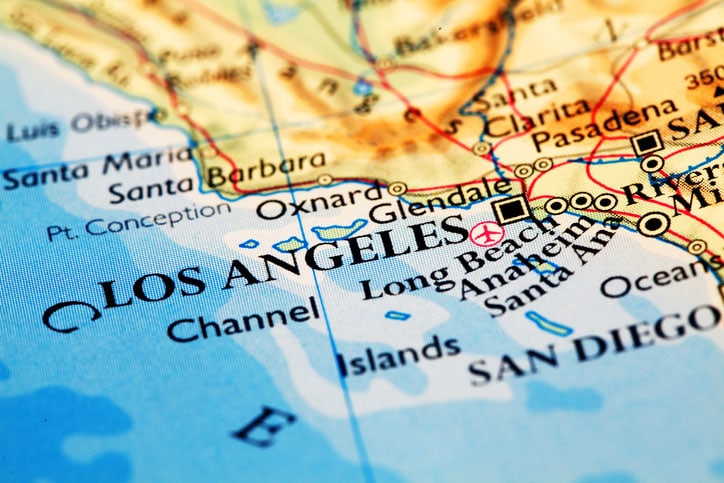
It really was a thrill to finally land back in Los Angeles. I couldnt stop smiling as I walked past customs and stepped outside. I marveled at the breeze as it shook the branch of a palm tree, and took a deep inhale to feel the Los Angeles ether enter my nostrils and fill my lungs. The sweet polluted air of home never smelled so good.

It really was a thrill to finally land back in Los Angeles. I couldn’t stop smiling as I walked past customs and stepped outside.

Having left in August 2020, this was the first time that I had set foot in Bidens America. Thomas Wolfes 1940 posthumously published novel was famously titled You Can’t Go Home Again,” and its a question as to whether we really can go back home after we have been away for a long time, and what we will find. It was a culture shock landing back in Britain mid-pandemic and walking through rural English shopping districts where there wasnt a single window that had been smashed in. The best way of smoothing the transition from Los Angeles would have been to spray some BLM graffiti on the local police station and at least it would have felt like home.

Id heard many times that Los Angeles has changed and this isnt the city you remember,” even though it had only been a year. I expected to see a war zone. Last year, the city was in a devastating state. Shops were boarded up across town, and there was graffiti everywhere. There were broken windows that gave testimony to the riots. Two blocks of Santa Monicas shopping district looked post-apocalyptic, with every storefront closed down and covered in political street art. Homelessness had spiraled out of control.

The vagrant situation had become intense by last summer and it looked like much of the city had become a national park, with camping zones springing up under every underpass and in front of stores that were closed due to the pandemic. And yet, if anything the city looks even better than it did before, since Mayor Garcettis strategy to combat homelessness has been enforced and his proposed $791 million cleanup plan is underway. Right now there are fewer tent encampments in certain areas of Los Angeles than there were last summer, although other suburbs still have some way to go. This doesnt mean that conditions have improved for the actual homeless people who have been moved elsewhere, but the social policy is underway, the streets look cleaner, and its another sunny day in Southern California.

The city looked the same from the outside, although it during Shabbat it quickly became apparent that things were different. Most synagogues were half-empty since people had not returned after the lockdowns. Various friends have relocated to other cities, and several families from synagogue recently moved en masse to Atlanta, having taken that Midnight Train to Georgia.

The difference is that Los Angeles is different from every other city. Each day there are new people who arrive in town with their hopes and dreams. Life may have changed, but its still one of the most exciting places on the planet, and Im just grateful to have that visa.


Marcus J Freed is an actor, writer and marketing consultant. www.marcusjfreed.com @marcusjfreed

Satirical Semite: Homecoming Read More »
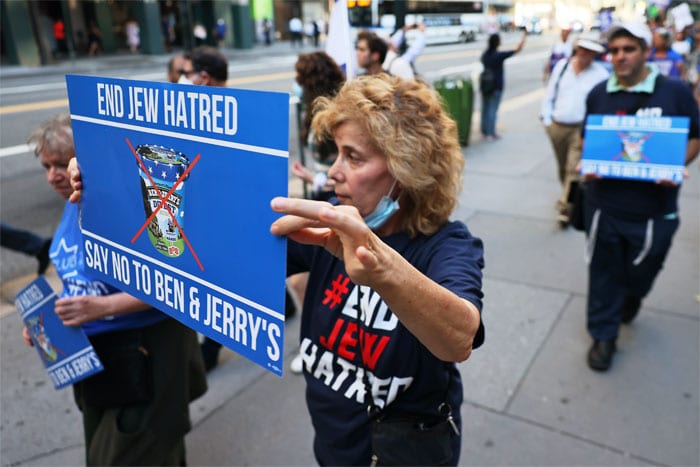
Ben & Jerry’s Co-Founders on Why They Don’t Boycott GA and TX: “I Don’t Know”

The Ben & Jerry’s co-founders said they didn’t know why they’re not going to boycott Georgia and Texas over their recent laws regarding abortion and voting rights following their July decision to stop doing business in the “Occupied Palestinian Territory.”

In an October 10 interview, Axios reporter Alexi McCammon asked the co-founders why the ice cream giant is still selling its product in Georgia and Texas; Co-Founder Ben Cohen paused, shrugged and then said, “I don’t know.” “It’s an interesting question,” he added. “I don’t know what that would accomplish. We’re working on those issues of voting rights.”

McCammon then said that it’s now “impossible” for women in Texas to get an abortion. “By that reasoning we should not sell any ice cream anywhere,” Cohen replied. “I’ve got issues with what’s being done in most every state and most every country.” Jerry Greenfield, the other Ben & Jerry’s co-founder, interjected that the difference between the Texas and Georgia laws and the Israeli occupation of the West Bank is that “what Israel is doing is considered illegal under international law.”

Earlier in the interview, the co-founders rejected accusations that their July decision regarding Israel was antisemitic.

“It’s absurd,” Cohen said. “I’m anti-Jewish? I’m a Jew! My whole family is Jewish. My friends are Jewish.” Cohen also argued that the Israeli government’s constant greenlighting of building settlements in the West Bank has impeded progress toward a two-state solution. 

Greenfield claimed that various states using anti-Boycott, Divestment and Sanctions (BDS) laws against Unilever, Ben & Jerry’s parent company, over the matter was based on “misinformation,” denying that the July decision is a boycott of Israel. Cohen said he believes in Israel’s right to exist.

Some on Twitter argued that Cohen and Greenfield’s response to the question about Texas and Georgia showed their hypocrisy on the company’s Israel decision. StandWithUs Israel Executive Director Michael Dickson tweeted that the interview was a “car crash” and that it shows “why their Israel boycott is wrong-headed, unfair and yes – discriminatory. No wonder States and customers are dropping them. @unilever ought to act to reverse this – and quickly.”

The Simon Wiesenthal Center tweeted that Cohen and Greenfield are “clueless” as to “why they launched a boycott ONLY against the Jewish state. But they forked over [money] to #Antisemitic board chief [Anuradha Mittal] who defends #Hamas + Hezbollah [and] demonizes Israel.” The Washington Free Beacon reported in July that Mittal heads The Oakland Institute think tank, which “has published articles defending Hezbollah and Hamas.” Mittal has denied being antisemitic, tweeting that she has received “vile hate” since Ben & Jerry’s announced its Israel decision.

Human rights lawyer Arsen Ostrovsky, who heads the International Legal Forum, tweeted that the interview was a “train wreck” since Cohen and Greenfield showed “the sheer hypocrisy, bigotry and double standards of their #Israel boycott. I hope @Unilever is watching this!”

Alex Gandler, Israeli Deputy Consul General to the Southeast, tweeted that the interview was “cringe worthy.” “Making statements and decisions about Israel without understanding anything about it. It’s nice to sit in your nice and green pasture in Vermont while criticizing Israel.”

Akiva van Konigsveld, an editor at Honest Reporting, tweeted out a screenshot of an article stating that the United Nations denounced Texas’ abortion law as a violation of international law. He argued in a subsequent tweet: “Israel has never forced anyone to live in the disputed territories, nor has Israel forced existing populations to leave.”

George Mason University International Law Professor Eugene Kontorovich, who is also a fellow at the Kohelet Policy Forum tweeted, “To say a policy is anti-Semitic doesn’t mean those doing it are full of subjectively experienced hate. They may even like Jews individually -but they treat them differently collectively, imposing particular harms.”

Tablet Chief Technology Officer Noam Blum tweeted, “The shrugging and legit lack of thought about this is the best part. None of this is sincere. It’s just white boomers who are terrified of young progressives and just wanna fit in.”

Ben & Jerry’s Co-Founders on Why They Don’t Boycott GA and TX: “I Don’t Know” Read More »

Israeli-American Economics Prof Wins Nobel Prize

Israeli-American Economics Professor at the Massachusetts Institute of Technology (MIT) Joshua D. Angrist won a Nobel Prize on October 11.

Angrist was one of three winners of the Sveriges Riksbank Prize in Economic Sciences; the other two were UC Berkeley Professor David Card and Stanford Graduate School of Business Professor Guido W. Imbens. The three professors won the award due to their work in the field of natural experiments, where economists study the effects of real-life events. Peter Frederiksson, chairman of the Economic Sciences Prize Committee said in a statement that the professors’ “research has substantially improved our ability to answer key causal questions, which has been of great benefit to society.” The professors will split a 10 million Swedish krona ($1.1 million) cash prize.

Prior to working at MIT, Angrist taught at Hebrew University from 1995-96 and at Harvard University from 1989-91. He also served as a paratrooper in the Israel Defense Forces and was part of a 1994 group studying Israeli-Palestinian Labor Market Relations, The Times of Israel reported.

Angrist’s research in natural experiments has focused on Israel’s education system, including how the Jewish student limits class sizes because of a theory from 12th-century scholar Moses Maimonides. Angrist found mixed results on whether class sizes correlate with academic performance.

“Classes have gotten smaller in Israel,” he told Econ Focus, the Federal Reserve Bank of Richmond’s magazine. “Maybe we’re into a zone where it doesn’t matter much anymore.”

Israeli-American Economics Prof Wins Nobel Prize Read More »

Why Jewish Artists and Entertainers Should Never Be the Last to Know

It was a revelatory week for at least two Jewish artists who, improbably, were taken by complete surprise.

Artists customarily profess to be apolitical, sealed off by imagination, guided by muses and not doctrines. Life is just an extension of a movie set, a blank canvas, a blinking cursor. Such purity, they say, often leaves them feeling blindsided by the harsher realities of, well, reality.

This was the predicament in which Jewish-American comedian Sarah Silverman and German-Jewish singer Gil Ofarim apparently found themselves.

A steadfast Israel basher, Silverman, speaking seriously on her podcast, registered genuine shock that the members of the Squad, whom she adores and regards as “kick-ass,” never have a negative word to say about the terrorist group Hamas. Worse still, the four crusading sisters of the antisemitic left were among only nine House members who opposed America replenishing Israel’s arsenal of Iron Dome.

Silverman noted that the Iron Dome protects Israeli citizens. It is categorically not a weapon. To oppose Iron Dome is to revel in dead Jews.

After years of mocking her own people, and even the Holocaust, and with a sister who is a rabbi in Israel, Silverman finally reached this late-arriving epiphany: “It just really proves … people only like Jews when they are suffering.”

Ofarim was standing in line, checking in to the Westin Hotel in Leipzig, Germany, when he realized that everyone behind him was being called to the front desk while he waited for over an hour. Finally, he stepped out, approached the desk and questioned why he was being ignored. Two staffers replied, “pack in your star,” referring to his visible Star of David, and he would then be welcome as a guest at the hotel. Later, on Instagram, holding back tears he said, “Really? Germany in 2021.”

Yes, Gil, really. Have you not been paying attention to the daily lives of Jews in France, Sweden, the United Kingdom, and yes, even among your own Jewish-German compatriots? And Sarah, how unbreakable did you envision your sisterly bonds with the Squad to be, like-minded in every way, except, of course, for their hatred of Jews—including you?

Silverman must have forgotten what happened to the two Jewish founders of the Women’s March, who abandoned the movement when other leaders blamed them for the slave trade. Other progressives took notice, and followed suit. The Dyke March in Washington, D.C. banned anything with Jewish or Israeli symbols. The Gay Pride March in Chicago disallowed any flag bearing the Star of David, even if it was an LGBT pride flag.

This past May, Jews who marched in disproportionate numbers for Black Lives Matter (“BLM”) realized that their solidarity was not reciprocated. Anti-Zionist thugs harassed and beat Jews in Los Angeles, Miami and New York, coinciding with Israel’s incursions against Hamas for launching over 4,000 rockets at Israeli civilians. BLM leaders were notably silent—the Lives of Jewish and Israeli civilians, apparently, didn’t Matter.

The BLM betrayal of Jews didn’t end there. Black actors, rappers, football and basketball players unleashed a torrent of antisemitic tropes while also lionizing Louis Farrakhan. So much for Jews controlling the entertainment industry.

Last week, one of Silverman’s fellow stand-ups, Dave Chappelle, introduced this movie plotline: Aliens who once lived on Earth, voluntarily leave the planet, are treated horribly elsewhere, then return to Earth to claim it as their own. The name of the movie: “Space Jews.” Later in his act he mentions another movie with the same title, this one about a former slave who ends up owning slaves and treating them with even greater brutality than what he had endured.

Two canards in the same bit: Jewish world domination; and Jews behaving like Nazis.

It didn’t appear as if Chappelle delivered these lines for laughs. Hardly anyone did laugh—not even nervously. Apparently, he was looking for a different kind of punchline.

It doesn’t help when Jews incorporate the same rehashed material dating back to the “The Protocols of the Elders of Zion” into their own acts. Do they not realize that among the cultural elite, antisemitism goes in and out of fashion? Nowadays it is trending ominously. Having progressive bona fides earns no Jew a pass. Showing disrespect for themselves and Jewish history makes no one exempt from a future pogrom.

Having progressive bona fides earns no Jew a pass. Showing disrespect for themselves and Jewish history makes no one exempt from a future pogrom.

Seth Rogen announced that he had been “fed a huge amount of lies about Israel while growing up in Vancouver.” Jon Stewart, when he hosted The Daily Show in 2014, mocked Israel’s existential and moral dilemma in its wars with Hamas. Natalie Portman refused to visit Israel to accept an award. She sided instead with the BDS movement, which seeks the destruction of Israel, her birthplace.

Are these celebrities all so sure that anyone would hide them should there be another roundup of Jews, like what happened to their people a mere 80 years ago? Ironically, as a teenager, Portman played Anne Frank on Broadway. Did she have no idea what the play was about?

The Holocaust is the ultimate object lesson that no Jew should be so naive as to overlook. Primo Levi wrote that “the best [among us] all died.” He specifically meant the artists and intellectuals—those either too cultivated, or possibly oblivious, to recognize what was burning in those smokestacks.

After the Holocaust, all surviving Jews, no matter where they lived, were placed on notice. You can be complacent, but never say you weren’t warned. America’s southern border is today wide open to Central Americans and Haitians. The eastern border of the United States was once impenetrable for Jews trying to avoid the Nazi slaughter.

After the Holocaust, all surviving Jews, no matter where they lived, were placed on notice. You can be complacent, but never say you weren’t warned.

Believing in the benevolence of nations and the caretaking of friends should always be a hard sell for Jews. Until the reemergence of Israel, the Jewish experience with safe havens was a dreary and rare happenstance.

Artists today can’t seem to keep quiet. Sharing opinions, especially if uninformed, is straight out of central casting. Routinely they take to Twitter to demonstrate their moral standing and political savvy. All too happy to defund the police while entrenched in fortresses in Pacific Palisades. Occasionally, Israel is accused of ethnic cleansing or libeled as an apartheid state.

Followers of the mindless, mindlessly press “Like.”

Canadian singer-songwriter Leonard Cohen was a Jewish artist. At a recent event hosted at the Forum on Life, Culture & Society, one of his songs, an avowedly political one, “Everybody Knows,” was a reminder that artists, especially Jewish ones, should never be the last to know.


Thane Rosenbaum is a novelist, essayist, law professor and Distinguished University Professor at Touro College, where he directs the Forum on Life, Culture & Society. His work has appeared in major national and global publications. He is the legal analyst for CBS News Radio and appears frequently on cable TV news programs. His most recent book is titled “Saving Free Speech … From Itself.”

Why Jewish Artists and Entertainers Should Never Be the Last to Know Read More »

A Forgotten Display of Zionist Unity

Bitter controversy has erupted over the recent visits by two leftwing Israeli delegations to the headquarters of the Palestinian Authority. Accusations and insults have been flying back and forth across the political spectrum over the mission to Ramallah by leaders of the Meretz Party earlier this month, followed four days later by leaders of the Labor Party. 

Ironically, this all-too-familiar display of Israeli disunity overshadowed the 75th anniversary of one of the most stirring displays of unity in Zionist history.

The Fight for the Negev

The Zionist movement had always expected that the Negev desert would be part of the future Jewish state. But London and Washington had other ideas. In August 1946, a joint British-American committee proposed what came to be known as the Morrison-Grady plan, which would have divided Palestine into semi-autonomous Jewish and Arab provinces under British rule. The Negev was to be controlled exclusively by the British.

In the weeks leading up to the high holidays, Zionist factions from across the political and religious spectrum united to plan the overnight creation of eleven new Jewish settlements in the Negev, to take place immediately upon the conclusion of Yom Kippur.

The Zionist leadership decided to fight the plan by establishing facts on the ground. In the weeks leading up to the high holidays, Zionist factions from across the political and religious spectrum united to plan the overnight creation of eleven new Jewish settlements in the Negev, to take place immediately upon the conclusion of Yom Kippur.

Describing one of the scenes that unfolded in the moments after the Day of Atonement ended, a young religious Zionist participant recalled a legend concerning the Baal Shem Tov, founder of hasidism, and the custom of blessing the new moon at the end of Yom Kippur. One year, he wrote, clouds obscured the moon as Yom Kippur drew to a close, which would have made it impossible to recite the blessing. The Baal Shem Tov “began to concentrate very intensely on some mystical formulas in an effort to bring out the moon,” to no avail. Meanwhile, however, his followers began their post-Yom Kippur custom of singing and dancing, and their enthusiasm drew their leader into their joyous circle. “The moon suddenly appeared and lit up the sky,” the young settler wrote. “Said the Baal Shem Tov: ‘What my intense concentration did not accomplish was brought about by the joy of the chassidim.’”

“If the Baal Shem Tov had been standing the evening after Yom Kippur in [the town of] Be’erot Yitzchak,” the account continued, “and had seen hundreds of chalutzim [pioneers], hand on shoulder, tightly interwoven, surrounding chain-wise the main vehicles loaded with provisions and dancing joyous dances before ascending to the eleven new yishuvim [settlements], he would have placed himself in the center, jumped to the very heavens and drawn the moon from behind the clouds, saying, ‘That which is not accomplished through political means, through discussions and conferences, that is accomplished by Eretz Israel chassidim (devotees) burning with the joy of creation.’”

What they created, on the “Night of the Eleven Points,” were Jewish outposts across the Negev and the adjoining Gaza region.

The settlers came from a variety of Zionist factions, but were united in purpose and passion. Some of the settlements were established by members of Labor Zionist youth movements, including the sites named Be’eri (pen name of Labor Zionist icon Berl Katznelson), Mishmar HaNegev and Urim. Three others—Shoval, Gal-On, and Nirim—were created by the members of the further-left Hashomer Hatzair movement (forerunner of today’s Meretz Party). Two, Kfar Darom and Tkuma, were set up by the religious Hapoel Hamizrachi group. 

“The map of Palestine was changed yesterday when 11 new Jewish settlements were established in a sweeping dawn-to-dusk action,” the Palestine (later Jerusalem) Post reported. “At dawn, scores of vehicles brought men and building materials” —other media accounts estimated that 300 of the 1,000 settlers were women—to the eleven chosen sites, “stretching from Gedera to Rafah, and by darkness tents and fences had been erected and the beginnings made on the construction of the first huts.”

Unity in America, Too

American Zionists were united in their support for the settlement drive. Rabbi Dr. Abba Hillel Silver, cochairman of the American Zionist Emergency Council—the umbrella for all major U.S. Zionist groups—declared that American Jews were “thrilled by the news” of the settlements, which he called “a magnificent tribute to the indefensible spirit of the Yishuv.”

The Labor Zionist journal “Furrows” hailed the settlements as “the reply of the yishuv to every attempt by the British to convert the Jewish homeland into a ghetto.”

During Israel’s War of Independence two years later, the eleven new towns played a crucial role in fighting off Egyptian advances and ensuring that the Negev would become part of the Jewish state. Today, they are thriving communities that have helped transform the region.

Except for one. 

Kfar Darom was among the Jewish towns in the Gaza region that the Israeli government dismantled in 2005, in the hope that an Israeli withdrawal would lead to peace. That has not worked out as hoped.

A CARTOONIST’S PERSPECTIVE

This political cartoon by Arie Navon—later one of the most famous cartoonists in Israeli history—appeared in the Labor Party daily newspaper Davar on October 9, 1946.

Titled “This Week in Sport,” it features two goalkeepers. One, smoking a pipe—cartoonists’ standard symbol for the British—is labeled “Anti-Zionist Regime.” There are eleven balls in his net. The other, the Jewish goalkeeper, has just one ball in his net, labeled “Rafiah.” The reference is to the Rafiah prison camp in the Negev, where the British detained thousands of Jewish political prisoners in the 1940s (note the barbed wire structure behind the Jewish goalie).

The landscape in the background features eleven towers and a flag reading “The Negev.”

The caption at the bottom, “11:1,” gives the “score.”


Dr. Medoff is the author of numerous books on Jewish and Zionist history, including the “Historical Dictionary of Zionism,” coauthored with Chaim I. Waxman.

A Forgotten Display of Zionist Unity Read More »

Top Luxury and Perfect Location at Fairmont Olympic Hotel in Seattle

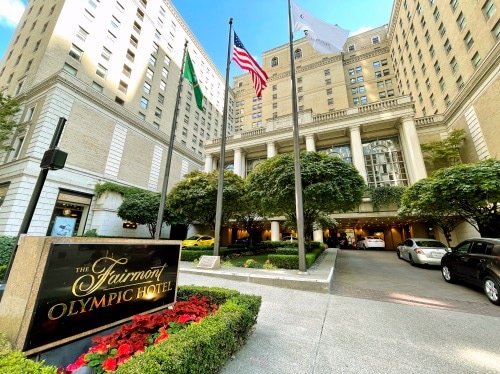
I loved my stay at Fairmont Olympic Hotel Seattle in August 2021 before my cruise on the Majestic Princess. It is located in the heart of the city and walking distance to Pike Place Market, the Art Museum and other Seattle treasures!

The hotel first opened in 1924 and during COVID, there was a $25 million dollar restoration project! The main lobby is fully renovated and the new Olympic bar is open! I loved the kinetic art installation above the Olympic Bar which was designed by Spanish design studio Lázaro Rosa-Violán (LRV) to resemble the the original historic logo of the hotel which is a ship that you can still see on the lobby elevator doors. The art installation is made up of over 400 handmade pieces, including metal poles, wooden pieces and decorative items, and it has eight motorized wheels.

There is a hidden bookcase in the main lobby which is not open yet but will be specially for spirit drinkers! I loved the all-day dining and they also have Afternoon Tea on the weekend.

The hotel’s original Italian terrazzo flooring from 1924 was lovingly restored on the staircase and staircase landings. The historic 300-pound crystal chandeliers which presided over decades of celebrations were moved crystal by crystal to the foyer of the Spanish Ballroom.

The original American oak carvings can be seen on the second floor above the lobby bar and you can also enjoy the history walk on the Mezzanine level which includes old photographs, newspaper articles, historical documents and artifacts such as the first guest registry and guest correspondence letters!

DID YOU KNOW about FAIRMONT OLYMPIC HOTEL

1. The land where Fairmont Olympic Hotel now stands was initially deeded by Arthur Denny in 1861, when it was the original site of the University of Washington.

2. After the University outgrew its original home and moved to its present location, a theater known as the Metropolitan Theater was built on a portion of the site and opened in 1911.

3. In 1921, further plans were initiated for a proposal to build a grand hotel that would wrap around the theater on three sides, encompassing an entire city block.

4. In 1922, plans for financing the hotel were formulated by a group of nearly 400 prominent citizens known as the “Community Hotel Corporation.” A bond drive was organized so that anyone could take part by investing in the venture. Public response to the proposal was tremendous, and Seattleites purchased $100 bonds and raised $2.7 million dollars for the hotel.

5. The Seattle Times held a contest with a $50 prize to whoever submitted the best name for the hotel, chosen by the board of the Community Hotel Corporation. 3,906 entries were submitted and one name, submitted in several variations, pleased the committee the most. They settled on The Olympic, for which 11 entries had been submitted and the first submitted won the prize.

6. The Olympic Hotel opened on December 6, 1924. Total cost of construction was $4,574,000. The original architect was George B. Post & Sons, New York.

7. Opened during the Roaring ‘20s, the grand hotel began its presidential history by hosting President Hoover during his term. Since then, nearly every president and most presidential candidates have checked into the hotel.

8. The Olympic Hotel was placed on the National Register of Historic Places in 1979.


9. The hotel underwent a full restoration in the mid-1980s to bring the original guest room count of 756 down to 450 rooms with nearly half of the rooms as suites.

10. Fairmont Hotels & Resorts assumed management of the hotel on August 1, 2003.

11. A $25 million renovation in 2016 by Parker-Torres Design Inc. refreshed all guest rooms and corridors.

12. The current $25 million renovation features a fully transformed lobby anchored by a new lobby bar and updated event spaces. Later this year, the project will unveil a new culinary flagship and introduce an intimate spirit drinker’s enclave. Spanish design studio Lázaro Rosa-Violán (LRV) created the interior vision and design for the hotel and worked in tandem with Parker-Torres Design Inc., who designed the meeting rooms.  

Want to know —What to DO in Seattle? see my video for all the places I went on my guided tour with Mia.

I loved my Alaskan cruise–Enjoy the videos with eagles, bears, glaciers on the Majestic Princess:

Top Luxury and Perfect Location at Fairmont Olympic Hotel in Seattle Read More »