The recall-that-wasn’t can be summed up in numbers. Eighteen months, $276 million taxpayer dollars, one last-minute visit from President Biden. Despite these impressive figures, California’s recall election was decided in less than thirty minutes. What’s more, Newsom earned roughly 63.7% of the vote—a figure higher than the 61.9% with which he initially won office in 2018, which was at the time a record high for any Democratic gubernatorial candidate in California history.
In short, California handed Newsom a decisive victory and a nominal mandate from the people. But 2022 is an election year, and a second term will prove to be an entirely different ballgame—with national implications. Was this election the blueprint for how Democrats will win in 2022 in districts and states? Will the coalition of labor, Latino voters and moderate independents remain loyal to the Democratic base? The jury is out but congress and the President are doing everything they can to play to those constituencies and working aggressively to frame the debate around issues that they care about: job security, infrastructure, immigration reform. Naturally every district and state are different, but there seems to be a trend toward higher turnout particularly with key Democratic constituencies. However, it’s not that simple; perhaps the GOP can be successful, as in 2020 when they won four congressional seats in blue California, in part by running a more ethnically diverse and ideologically expansive crop of candidates.
It’s not a stretch to think that a chunk of those who voted no on the recall did so purely to preserve political stability, given the quality of the other options. The Republicans’ favored candidate was, after all, Larry Elder, a Trump-style radio show host with no political experience. The field also included self-described billboard icon Angelyne, reality TV star and former Olympian Caitlyn Jenner, and ex-California Poultry Federation board member Leo Zacky. Meanwhile, the highest-polling Democratic alternative to Newsom was finance YouTuber Kevin Paffrath. Hardly the top talent you’d expect to see in the running to lead the country’s most populous state and the world’s fifth-largest economy. The competition in 2022, by contrast, has the potential to be serious. Newsom will face renewed Republican challengers, but in a majority-blue state, the real challenge will come from fellow Democrats.
The competition in 2022, by contrast, has the potential to be serious. Newsom will face renewed Republican challengers, but in a majority-blue state, the real challenge will come from fellow Democrats.
Newsom has roughly a year to campaign, and he knows it. If his victory speech is anything to go by, he intends to lean on a combination of pandemic recovery, identity politics and equitable policies to distinguish what’s left of his term:
“We said yes to science, we said yes to vaccines, we said yes to ending this pandemic, we said yes to people’s right to vote without fear of fake fraud or voter suppression, we said yes to a woman’s fundamental constitutional right to decide for herself what she does for her body. We said yes to diversity, we said yes to inclusion.”
The day after the recall election, Newsom signed a trio of bills aimed at tackling the housing crisis—most notably SB 9, which abolished most single-family zoning in the state. On the soft power side, he issued a proclamation renaming Hispanic Heritage Month to Latino Heritage Month, a nod to Latino communities that have long criticized the use of the former term, as it technically includes white Spaniards. If he continues in this vein, it will certainly pay off with the younger progressive crowd, including communities of color, which are crucial to victory in a majority-minority state.
The question is, will these same demographic groups actually turn out to vote in 2022. Only 7.7 million voters, or about 35% of California’s electorate, voted in this month’s recall election. The participation rate for gubernatorial elections isn’t much better.
A long-standing criticism of the Democratic party is its neglect of communities of color, confident in their support for no other reason than because the escalating racism in the GOP gives them no other choice. But these same communities might very well grow disillusioned and simply sit out the vote, or go for a third party. A generation ago, it might have been well and good for politicians to visit a taco stand or a Black church for a quick speech and some photos. Today, they have to demonstrate real commitment toward economic inclusion, police and criminal justice reform, immigration, health care, education and more.
Moreover, populations are not a monolith, as the decline in Latino support for Newsom between 2018 and 2021 clearly illustrates. Minority business owners number 1.6 million, nearly half of the state’s small businesses, and they’re hardly going to be supportive of stricter government regulations. Christianity also plays a role in conservative voting trends among communities of color, meaning that abortion remains a hot-button issue. If Newsom opts to continue down his current progressive route, he’ll have to contend with an eventual centrist Democratic challenger. If he chooses to soften his approach to suit more moderate tastes, then he’ll be facing an opponent who leans further left.
The 2022 election won’t come down to the faction that has more support; it will come down to which side can achieve a bigger turnout. And for now, it looks like Newsom intends to bet on the progressive bloc. What remains to be seen is how much he can get done before next November.
Seth Jacobson is the founder and principal of JCI Worldwide, a Los Angeles-based communications and research firm. He spent several years in the Carter and Clinton administrations in positions focused on economic development, foreign policy, and media relations. He is a frequent lecturer on policy and public affairs at Pepperdine University and UCLA.
An article in The New Yorker described it best: the cult of overwork. White collar professionals in the United States are far more likely to work longer hours than lower paid workers. A 2008 Harvard Business School survey of people in professional services (consultants, investment bankers, accountants, lawyers, IT, and the like) found that “94% of 1,000 such professionals said they put in 50 or more hours a week, with nearly half that group turning in more than 65 hours a week. That doesn’t include the 20 to 25 hours a week most of them spend monitoring their BlackBerrys while outside the office.”Another Harvard survey of “extreme workers,” who work very long hours, found that almost “two-thirds (64%) of extreme workers admit that the pressure and the pace are self-inflicted—a function of a type-A personality.”
It should be noted that overwork is ultimately impractical. After a certain point, productivity suffers and burnout is common. The Midrash says that Moses, while still in Pharaoh’s household, convincedPharaoh to allow the Jewish slaves to rest on Shabbat. Moses argued that a Sabbath would be to Pharaoh’s benefit; slaves that never stop working will die from overwork. Even a Pharaoh can grasp the practical value of the Shabbat; and in recent years, as overwork has become an HR concern, several corporations have also recognized the importance of a day of rest. Goldman Sachs, Bank of America Merrill Lynch and Credit Suisse and others have instituted rules that free junior employees from work one day a week, and require them to return home from the office. Shabbat has a practical value to it, as a day to recharge for more work.
So why is there a cult of overwork, and where does the drive for overwork come from? It begins with the reality that work is extremely meaningful.
So why is there a cult of overwork, and where does the drive for overwork come from? It begins with the reality that work is extremely meaningful. There is significant spiritual value in our labor; the Mekhilta cites the opinion of Rabbi Yehuda Hanassi that just as one is commanded to rest on Shabbat, one is also commanded to work the other six days a week. In one fascinating passage in Rabbinic literature (Avot DeRabbi Natan 11:1), it says that the divine presence does not arrive unless people are engaged in productive work, and that idleness brings death. In “The Lonely Man of Faith,” Rabbi Joseph Ber Soloveitchik writes that human dignity and majesty are found in humanity’s mastery over nature, which is achieved through productivity and progress. The six days of work fulfill a significant spiritual and existential need.
Work brings us dignity and majesty; and that is why overwork is so enticing. While taking a respite seems sensible, the idea of resting for its own sake seems strange: Why would anyone give up something as important as the ability to work? Peter Schafer, in his book “Judeophobia,” devotes an entire chapter to Roman criticisms of the Shabbat. He quotes the Roman philosopher Seneca (4 B.C.E – 65 C.E.) as saying: “Their practice of the Shabbat is inexpedient because by resting one day in every seven they lose in idleness one seventh of their life.” To the Romans, the Shabbat was absurd: How can you take a full day of rest, when you have countries to conquer and aqueducts to build? And this attitude is equally true of contemporary society. We live by Benjamin Franklin’s edict “time is money,” and wonder how we can squeeze a few more minutes out of the day. Even when we are away from our work we carry it with us, in briefcases and laptops, on Zoom conferences and email exchanges. We live in the culture of the M.B.A., where efficiency and productivity are the touchstones of meaning; in this type of value system, a day of rest is a meaningless obstacle to further growth.
Shabbat offers a radical alternative: It is not only about rest; it is about sacrificing work for more important goals.
Shabbat offers a radical alternative: It is not only about rest; it is about sacrificing work for more important goals. As important as work is, endless labor dehumanizes both masters and slaves, and reduces man to what he can produce. Shabbat declares that man is ultimately defined by his character and commitments, not his creations. Rabbi Ovadiah Seforno (Italy, 1475-1550) explains that the purpose of abstaining from work on Shabbat is to allow one to pursue spiritual experiences. Shabbat is a day to study and think, to spend with God at the synagogue and with family and friends at home. Shabbat stands as a counterweight to the other six days of the week, a reminder that we are so much more than the sum total of what we produce.
There is a mitzvah to remember the Shabbat every day of the week; its purpose is to make sure we never lose sight of the Shabbat perspective, and that we don’t define ourselves by our work. But that is difficult to do. An anecdote shared by Rabbi Efrem Goldberg epitomizes how easily we forget the lessons of Shabbat. Rabbi Goldberg was at a wedding and was seated next to someone he had never met. He writes:
“In an attempt to be friendly to the man seated next to me, I asked him, ‘What do you do?’ He sat up in his chair, turned to me and said, ‘What do I do, or how do I earn a living? I earn a living as a plumber. What I do, what I am most proud of, is that I learn Torah every morning before davening, and I spend time with my family every evening after work.’”
In a cult of overwork, life is defined by how you earn your living. That is why, as a habit of speech, we conflate “what we do” with “how we earn a living.” And sadly, endless work makes man a hostage of his own creativity. In sacrificing work in order to observe Shabbat, we learn that we are more than what we make and what we own.
Rabbi Chaim Steinmetz is the Senior Rabbi of Congregation Kehilath Jeshurun in New York.
Standing along the shore of the Sea of Galilee, I found it fitting to learn that it is the lowest freshwater lake in the world. I had recently experienced the lowest point in my life. Eight months earlier, my 14-year-old daughter Grace died after living with osteosarcoma or bone cancer for four years. As I looked out over the lake, I was grateful that Grace picked this spot. She viewed the Sea of Galilee as the most sacred body of water on the planet. Seeing it in person, touching the water, and walking along the shoreline, I now understood why. Although there was something extraordinarily remarkable about this ancient body of water, the magnificence of the landscape didn’t make our purpose for being there any easier. Grace chose to be cremated upon her death and asked for us to place her ashes into the Sea of Galilee.
As I watched Caroline, Grace’s younger sister, lovingly pour Grace’s ashes into the water, I knew at that very moment that I needed to do something to honor Grace’s life. I knew I needed to do something to honor Caroline’s profound loss. I knew I needed to do something so that other younger sisters like Caroline would not have to help carry out the last wishes of their older sisters because they died of a disease called osteosarcoma. A disease whose treatment has not changed in three decades. Three decades.
But what would that something be? Standing on the shore of the Sea of Galilee in November 2018, I had no idea. Not a clue. Fortunately, however, that something found me four months later while sitting in a lecture hall at Emory University.
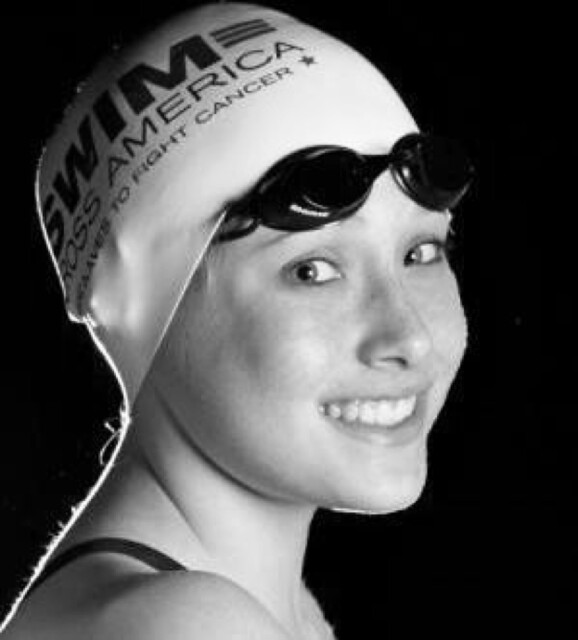
Prior to Grace’s cancer diagnosis at the age of eleven, she was an avid and energetic soccer player and runner. Following her initial 8-month cancer treatment that involved a partial-leg amputation and while waiting on her running prosthetic to be constructed, Grace turned to swimming. Although initially meant to be a means of getting back into shape to return to running, Grace fell in love with swimming.
Not only did Grace take to swimming, but swimming took to her. She constantly improved, earning times faster than many teammates who swam with both legs. Although Grace’s swimming improved, her health did not. Grace’s cancer kept returning eventually leading to a terminal prognosis. Grace was going to die. But that didn’t keep her from swimming and competing. In fact, even as she became sicker, she became faster – eventually making it onto her high school swim team and being presented with her Team USA Paralympic swim cap. Determined to live her life fully and continue to make a difference, Grace kept swimming. Even choosing to stop chemo because while taking it, she couldn’t swim. Grace had to keep swimming for the sake of giving and finding a cure.
Shortly after learning of her terminal prognosis, Grace became involved with Swim Across America, a nonprofit organization that hosts open water swimming events to raise money for cancer research. Despite tumors growing in her lungs and on her spine, Grace swam a mile at the 2017 Swim Across America – Atlanta open water event. She raised over $20,000 for cancer research earning her the distinction of top fundraiser. Following that swim, Grace set her sights on 2018. She announced that she planned not to just swim again at the Atlanta event, but she dedicated herself to being the top national fundraiser. And she was, but she didn’t get to swim. Not because she didn’t want to, rather because she died six months prior to the event on March 25th, one day before her 15th birthday.
This is an excerpt from Grace’s 2018 Swim Across America fundraising page:
Last September, I was honored to swim at Lake Lanier to raise money for my treating clinic/hospital and in honor of the people who have helped me for the past almost 4 years. They all carry fancy titles like doctor, oncologist, nurse practitioner, nurse, physical therapist and prosthetist. But they have found a special place in my heart, and as a result, they all carry a much more valuable and special title now. I simply call them my friends. They care about me, they love me, and they wish they could do something more to save my life. But they can’t. They are smart and talented and dedicated and committed, but despite being all of those things, they can’t do anything now to save my life. My cancer called osteosarcoma just does not want to cooperate with their treatments and medications. No, it has other plans. Primarily it plans to take my life. And excepting divine intervention, it will. We just don’t know when. But if our collective ‘umbrella prayers’ remain unanswered, it will happen well before the next Atlanta Swim Across America Open Water event that will take place on September 22, 2018.
But rest assured, I will definitely be at Lake Lanier come September 22nd. You just might not be able to see me. But if you are swimming in the water or cheering along the shore, I hope you will be able to feel my presence and spirit as we all continue to make waves to cure cancer. Because I am hopeful that by working together, we can change the future of other young people like myself who are diagnosed with cancer. Although the open water Atlanta Swim Across America event in September will have a finish line, guess what doesn’t? Hope. Hope has no finish line.
Hope, said Grace, has no finish line.
And neither does my commitment to honor Grace’s life and memory. Although Grace was not able to swim in the September 2018 event, guess who swam in her place? Me. Because I love swimming in lakes? No, I swam because Grace asked me to. Which was no small feat because up until the day I began training for the open water event, I had never swum a lap in my life. But I learned how, and I completed the mile swim in September 2018. At the closing ceremony of the 2018 event, I committed to swim the 5K the following September. Yet that didn’t seem like enough as I stood along the shore of the Sea of Galilee in November 2018 watching Caroline pour out Grace’s ashes from a wooden urn.
But what more could or should I do to honor Grace’s life? The answer came to me in March 2019 at a Swim Across America presentation at Emory University. While sitting in the lecture hall listening to the Swim Across America-sponsored doctors describe their research, I received a message. And this was the message: I was supposed to swim in 14 of the Swim Across America open water events to honor the 14 years that Grace lived. 14 open water events for 14 years of Grace. 14 open water events to raise money for cancer research. This endeavor became known as The Amazing Grace Swim Across America Tour.
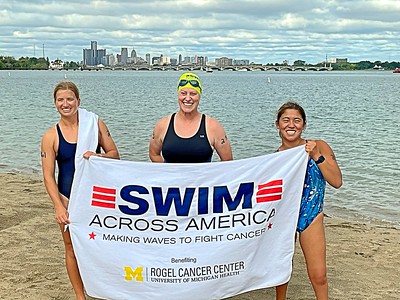
The Amazing Grace Swim Across America Tour began on Mother’s Day weekend in Tampa, Florida. At this point, I have completed 13 of the open water swims, with 1 more to go. In addition, to Tampa, I have traveled to Detroit, Nantucket, New York (2x), Connecticut, Charleston-Kiawah, Chicago, St. Louis, Denver, Seattle, Baltimore and Dallas. My 14th and final swim is in my hometown of Atlanta on October 2. Our collective team has raised over $122,000 to fund cancer research in Grace’s honor.
So why do I swim?
I swim with the hope that one day in the future when another young person who believes like Grace that the Sea of Galilee is the most sacred body of water on the planet, that they can travel to Israel with their family and stand along the shoreline as a tourist rather than as a heap of ashes in a wooden box. That is why I swim. Like Grace, I swim for hope. Hope, said Grace, has no finish line.
Mom Swimming Across America to Honor Her 14 Year Old Daughter Lost to Cancer, Finishes with 14th Swim on October 2 in Hometown
Vicki Bunke Comes Home to Atlanta for Last Swim of the Year
ATLANTA, September 22, 2021 — Vicki Bunke, the Mom who has spent this summer swimming across America in honor of her 14 year old daughter Grace, who sadly lost her battle with osteosarcoma, a rare form of bone cancer, is coming home to complete her 14th and final swim in her hometown of Atlanta on October 2, 2021. The swim will take place at the Swim Across America Atlanta open water swim, being held at Lake Lanier Olympic Park in Gainesville, Georgia. Joining Vicki for her final swim is two-time Gold and Silver Medalist at the recent Tokyo Paralympic Games, Mallory Weggemann, who is also a 15-time world champion swimmer for Team USA.
“I’m so excited to be able to join Vicki Bunke in her final swim in her hometown of Atlanta,” said Mallory. “The stars aligned and I happened to be in Atlanta for a book signing, of which Grace is one of the inspirational figures I’ve profiled. Even though Grace was only 14 years old when I met her, she was one of those individuals who leaves an indelible mark on your soul. She was wise and poised well beyond her years and inspired me with every swim and every dedicated action she made in her short life. I’m so honored to be able to share the water with her Mom Vicki.”
An avid runner as a child, Grace was diagnosed at age 11 and battled osteosarcoma for nearly four years, undergoing treatment including a partial leg amputation where the lower half of her leg was reattached backward (rotationplasty) and three lung operations. While recuperating from the surgery, swimming found Grace. She quickly excelled at swimming making her varsity high school swim team and earning her national cap for the U.S. Paralympic team in 2017. She took to open water swimming and participated in the Swim Across America Atlanta open water charity swim near her home the fall of 2017. She bravely and publicly battled cancer with the trademark name given to her by others, “Amazing Grace.”
“Grace found inspiration and hope in swimming,” noted her mom Vicki Bunke. “Participating in the Swim Across America open water swim was an accomplishment she strived for when she was sick. In fact, she came to love swimming so much that even though she continued to get sicker, she swam faster and better at every meet. In 2018, when she was too sick to swim, she asked me to swim in her place. When one of your daughter’s last requests on this earth is to swim for her when she no longer can, you honor that request. After Grace passed, I was compelled to do more. Swimming in 14 Swim Across America open water swims this year seemed a fitting tribute – a swim for each year of Grace’s life. To have Mallory and other members of my Team Amazing Grace join me at this last swim in our hometown makes it even more special. I know Grace is smiling at this and it is just another example of how ‘hope has no finish line.’”
“Vicki and Grace Bunke’s story is so compelling that we featured them in the first two episodes of this summer’s docu-series WaveMakers that featured Swim Across America athletes and inspirational stories about why we make waves to fight cancer, noted Rob Butcher, CEO of Swim Across America. “Grace’s story, even though it didn’t have the happy ending we all wanted, left a legacy of what she would have wanted for all of us left behind — to turn her loss into triumph. Team Amazing Grace and the 14 charity swims Vicki has undertaken this summer, celebrate the legacy of Grace Bunke, and importantly have raised critical funds for pediatric research.”
Funds raised this summer by Vicki Bunke in her “Amazing Grace” swim tour total more than $122,000 and climbing and will specifically support pediatric cancer research and treatments. Every 15 minutes, 50 Americans are diagnosed with cancer. And for three decades, Swim Across America has been providing grants that have led to new cures in immunotherapy and gene therapy that have given hope. To learn more about Vicki Bunke’s Amazing Grace Tour, visit swimacrossamerica.org/goto/Vicki.
About Swim Across America
Swim Across America, Inc. (SAA) is dedicated to raising money and awareness for cancer research, prevention and treatment through swimming-related charity events. Founded in 1987, Swim Across America has raised more than $100 million that has funded cancer research and clinical trials. With the help of volunteers nationwide and Olympians, Swim Across America grants have been at the forefront of leading to new treatments in immunotherapy and gene therapy. To learn more visit swimacrossamerica.org or follow on Facebook, Instagram and Twitter @SAASwim.