fbpx

September 15, 2021

Barnard College Apologizes for Asking Religious Jewish Students to Use COVID Tech During Rosh Hashanah

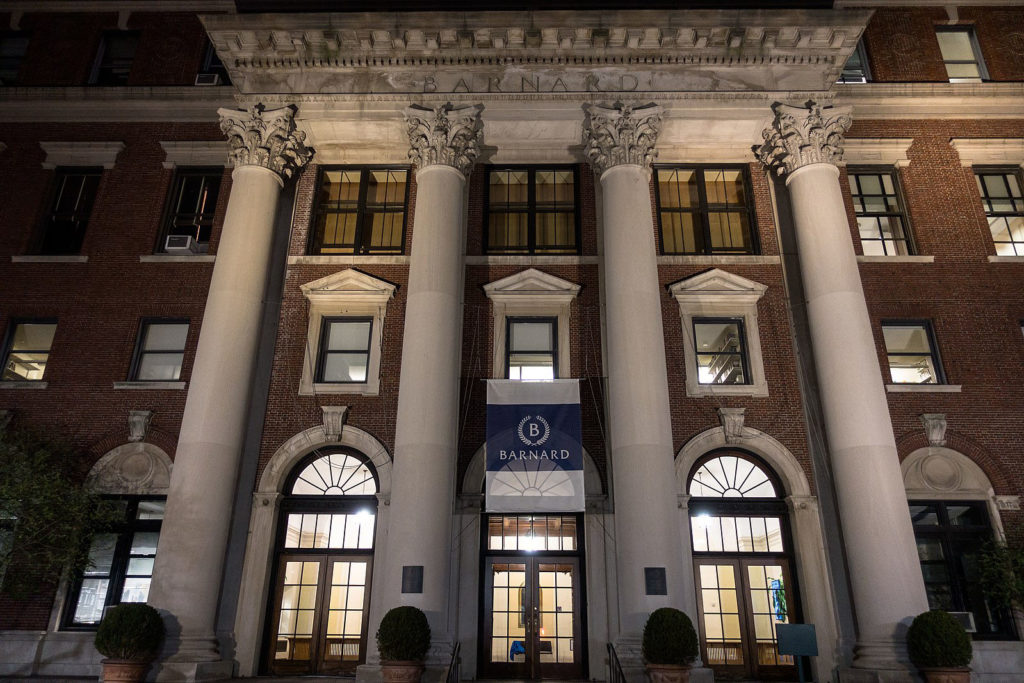
Barnard College’s Pandemic Response Team issued an apology for asking religious Jewish student to use technology during Rosh Hashanah to report any COVID-19 symptoms.

In a September 6 email obtained by the Journal, Cynthia Yang, who heads the Response Team and is the Deputy Chief of Staff to Barnard President Seilan Beilock, wrote to students that they are getting the email because they “have identified [yourselves] as a Sabbath-observer to Barnard’s Residential Life & Housing. As a Barnard student, there are policies and procedures that you must follow relating to the College’s pandemic response … you will need to utilize technology to report new symptoms, respond quickly to a test result, and actively participate in contact tracing.”

Yang added: “We recognize that how you have practiced religious traditions in the past may not align with the use of technology during the high holy days or the Sabbath, but this year it is paramount for the community’s health and safety (as well as your own) that you abide by the Barnard pledge and follow the College’s policies and procedures. The campus communities that intersect at Barnard and Columbia cannot wait until Wednesday night for students to report symptoms or respond to a notification of a positive test. The chain of transmission can only be shortened when individuals act responsively and quickly.”

About an hour and a half later, Yang sent a subsequent email apologizing for the earlier email. “It was written in haste with the goal to keep everyone as safe as possible during the high holy days and it, regrettably, was not considerate in the way it should have been of each students’ ability to practice and observe their religion how they choose.”

“I want to make clear that Barnard is here to support students however they choose to worship the high holy days or Sabbath,” she wrote. “If you develop symptoms consistent with COVID-19 during an observant period, we encourage you to utilize technology as you feel comfortable. If this is not consistent with your religious practice, please let me clarify that we are not asking you to violate any religious belief.”

Yang went onto say that the Response Team worked with Columbia-Barnard Hillel to implement a system where religious Jewish students could put a sticker on their door if they started experiencing COVID-19 symptoms to avoid violating their religious beliefs.

“We are in uncharted territory dealing with a continuing COVID-19 pandemic during a new academic year,” she wrote. “We appreciate your understanding as we work to integrate the health and safety of our community with the right of students to worship and observe their religious traditions in a way that they see fit.”

StandWithUs CEO and Co-Founder Roz Rothstein said in a statement to the Journal, “We thank Barnard for recognizing its error and immediately taking appropriate action. It is regretful however, that this came as an afterthought. This is an example to universities to recognize the importance of consulting all groups on campus, including Jews, when evaluating [and] developing new policies that will significantly impact them, especially if it violates their religious beliefs.”

Jewish on Campus similarly tweeted, “The official plan of Barnard’s pandemic response team for observant Jews was to force to them break their observance. No amount of ‘haste’ makes a complete lack of respect for Jewish religious practices acceptable.”

They added in a subsequent tweet: “It’s also important to note that this entire incident could have been avoided if Barnard had actually included and listened to any Jewish students while creating a policy specifically for Jewish students.”


A spokesperson for Barnard said in a statement to the Journal, “Barnard College deeply respects the religious traditions of our diverse community. We have and will continue to make every effort to minimize exposure to, and the spread of, COVID-19. Upon learning that a member of our community had tested positive for the virus, we sent an email suggesting immediate steps to safeguard everyone’s health by referring students to our standard health and safety protocols, which require the use of a cell phone. We have since worked closely with Columbia/Barnard Hillel to make alternative arrangements (not involving electronic devices) for any student who cannot use technology based on their religious traditions.”

Brian Cohen, Lavine Family Executive Director at Columbia-Barnard Hillel, confirmed that the Hillel had worked with Barnard on the matter and that the “new policy is now in place.”
 

Barnard College Apologizes for Asking Religious Jewish Students to Use COVID Tech During Rosh Hashanah Read More »

Brett Goldstein Feels Strong Connection With Emmy-Nominated Role on “Ted Lasso”

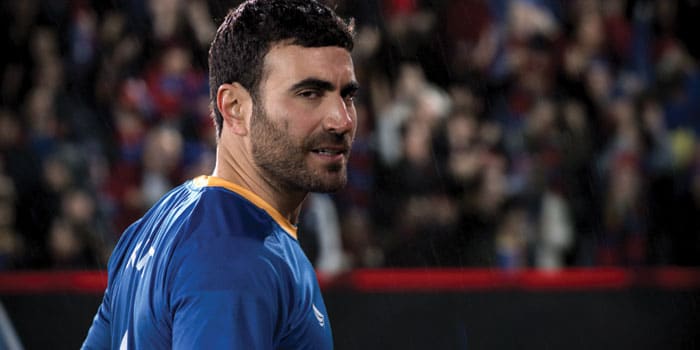
Actor Brett Goldstein knows what it takes to reach for his dreams. He’s currently living them on the Apple TV+ show “Ted Lasso” as a co-star and writer. The show is about an American football coach, Ted Lasso (played by Jason Sudeikis), who is hired to coach a professional soccer team in England, with no prior soccer experience on his resume.

The show has become a massive success and earned 20 Emmy nominations, a new record for a show in its first year of eligibility. 

Coach Lasso’s longest-tenured player is a surly, foul-mouthed veteran named Roy Kent, played by Goldstein. 

Throughout the show, now in its second season, Roy is faced with the reality that his career as a professional athlete is coming to an end. And for his performance, Goldstein is nominated for a Primetime Emmy for Supporting Actor in a Comedy Series.

While growing up in Sutton, England, Goldstein’s original dream was to become a stuntman. But he can trace his initial inspiration to spend his life acting and writing to a conversation he had with his father around age six.

“I wrote a story about a shipwreck for school,” Goldstein said on Backstage magazine’s “In the Envelope” podcast. “My dad said to me, ‘You know that’s a job, being a writer, you can do that as a job.’ I remember thinking ‘Great, that sounds fun!’” 

For many years, Goldstein, now 41, wrote and performed in plays, and eventually started doing standup comedy. Looking back at his younger years, Goldstein described himself as someone who was always “on the outside looking in.” He felt a point of view that ached to be heard and understood. And he had a career in writing and acting to keep pursuing. 

After years of auditioning and acting in various roles on stage, TV and film, Goldstein was offered a writer position for the first season of “Ted Lasso.” During the nascent days in the writers room, before the show was filmed, Goldstein felt a connection to one of the characters being created: Roy Kent. As the character of Roy developed more, Goldstein realized he needed to play him. 

“I’ve never felt as strongly about a part in my life,” he said. 

So Goldstein shot a video of five scenes of himself performing as Roy. He felt that he was breaking a taboo—being a writer attempting to insert himself into the casting process. But he took a chance.

“I sent an email and said, ‘Look, if this makes you uncomfortable or this video is rubbish, please pretend you never got it and I will never ask,’” Goldstein wrote. “‘However, I think I can play Roy.’”

Sure enough, he got the part. Even after its second season, Goldstein still sees part of himself in the character of Roy.

“I see the sadness,” Goldstein said. “You do this thing [playing soccer] that is incredible and at some point, whether you like it or not, you can’t do it anymore and that’s tragic. And I understood the tragedy of Roy in that area.”

Anger billows inside Roy as he resents the youth of his AFC Richmond teammates and the chipper attitude of Coach Lasso. Much of the humor in Goldstein’s character stems from his inability to calmly express his emotions, resulting in hair trigger outbursts of F-word variations. Goldstein describes Roy as a cauldron of feelings who lacks the ability to articulate what he’s feeling. 

Roy doesn’t blow up from a place of cruelty, but rather frustration: with his aging body, the typical locker room quarrels and the culmination of his dream as a professional soccer player.

“I am that angry,” Goldstein said. “I keep it in to get by in life, but I totally can tap into that anger very easily.” 

Roy is a complicated character who, behind the outbursts, has a whole career of triumph and failure that the viewer doesn’t get to see, but knows it’s there.

The difference between Goldstein and Roy is that Goldstein spends much time reflecting on his career and inspirations out loud. He does this by hosting a podcast with similar sentiments called Films to Be Buried With. Since 2018, Goldstein has been interviewing guests with the premise that they’re dead, and they must reflect on and discuss their life through the films that mean the most to them.

Even as he picks up numerous accolades for his performance as Roy, it doesn’t go to his head. He’s still that kid on the outside looking in.

In some ways, the podcast keeps him grounded. Even as he picks up numerous accolades for his performance as Roy, it doesn’t go to his head. He’s still that kid on the outside looking in.

“Fame, success and awards should never be the end,” he said. “The end should be, ‘Are you enjoying the making of the thing?’ Because the making of the thing, whatever level you’re at, if it’s a short film you’re making with friends or a massive Apple TV show, it’s still the same. You’re still creatively making the thing, and if that makes you happy, then you’ll be all set.”


Brian Fishbach is a music journalist in Los Angeles. 

Brett Goldstein Feels Strong Connection With Emmy-Nominated Role on “Ted Lasso” Read More »

Review of New Legal Thriller: “The Quiet Boy”

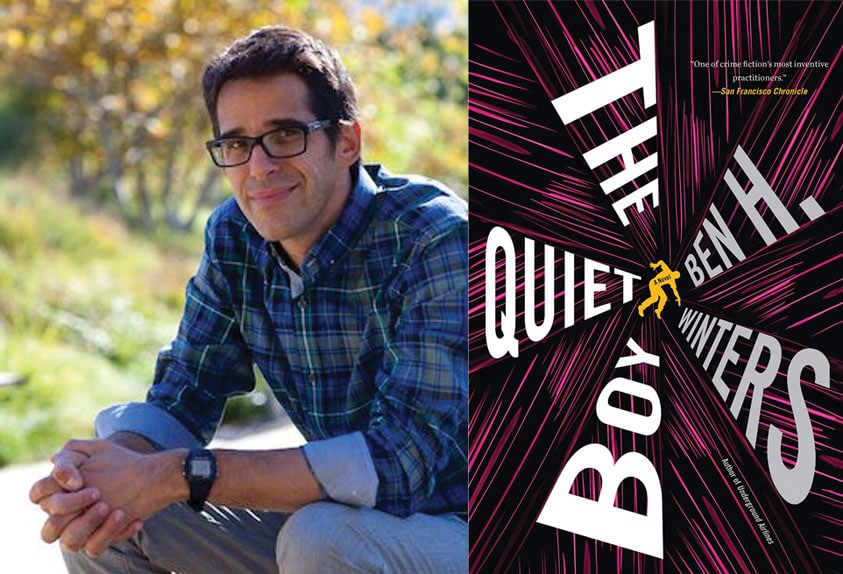
Each year we gather around the Seder table to re-enact a quest for a redeemed world while stuffing ourselves with the bread of affliction. It would be nice if our lives did not involve suffering, from matzah or other sources, but such an Edenic existence would not really be living. This same ambivalence about ease and pain is at the heart of “The Quiet Boy,” a new legal thriller novel by Ben H. Winters, a bestselling author most famous for the “Last Policeman” trilogy.

The quiet teenage boy of the title, Wesley Keener, not only does not speak, but he also does not make eye contact, eat, excrete, rest or grow. Instead, Wesley walks in a circle, managing not to run into, or interact with, anyone or anything—all the result of a surgery gone wrong. Horsing around one afternoon at school with his friends, he suffers a head injury and undergoes an operation. Other than his friend Bernie’s observation that Wesley seems to glow from within at the time of the accident, nothing seems unusual about the injury or the surgery, except for the outcome.    

A collection of unsettling characters come to regard Wesley as a vessel, one with the potential to release a better world, “below us and beneath us and all around. A good and golden world,” as described by Samir, the henchman for one group of people who have become obsessed with Wesley. They want to crack open the vessel, who is also an injured boy, the son of loving parents, a brother and a friend. The shadiness of these cultists and their intentions leads some of the other characters and the reader to question the desirability of such a breakthrough, in addition to its likelihood. What if the absence of suffering is nothing other than the absence of life that is Wesley’s new existence?

Most of the story is told from the perspective of its two main characters, Jay Shenk and his son, the Rabbi. Shenk is the lawyer representing the Keener family in its legal proceedings. The story takes place in two parts, separated by about a decade but smartly intertwined in the narrative. 

“The Quiet Boy” is a tough book to categorize; it could be stocked in either the mystery or science fiction sections.  But perhaps the category that suits it best is “a good read.”

The 2008 story focuses on the Keener family’s malpractice suit against the healthcare system that treated Wesley; the 2019 story concerns a murder trial.  In 2008, Jay is determined to find something amiss in a surgery marred by its result if not by its process. In the early stages of the case, Jay’s love for his profession and the people he encounters in his work shines through. By 2019,  the relationship between Jay and the practice of law has soured. Rich Keener, the boy’s father, has confessed to murdering an expert witness from the earlier case, and Jay is roped into defending a client who cannot pay and does not want to be defended.

Jay’s son, the Rabbi, is not a rabbi. He’s a Vietnamese Jewish vegetable chopper at a fast-casual salad place. His nickname comes from his boss in response to his request for a day off for Yom Kippur, but it fits. He has an interest in people, justice and the big questions that characterize the best rabbis, along with the melancholy and detachment that plague a good number of them. The Rabbi is also the one and only junior partner of Shenk & Partners, both as a teenager eager to assist the father he lionizes and as a struggling young adult estranged from the father who tumbles low during the malpractice case and takes his son down with him.

Through the legal proceedings, the reader meets other characters, most of whom add depth and mystery to the story. Evie, Wesley’s sister, becomes an up-and-coming indie music star. The angel wings she wears to perform on stage are a telling symbol that she has her own issues. Theresa Pileggi is the expert witness in the malpractice suit and the victim in the murder case. While preparing her for the witness stand, Jay is concerned with her likability, that club used to bludgeon professional women everywhere. Pileggi, though, remains focused on concerns more central to Wesley’s fate, and the world’s. Considering the menacing presence of Dennis, cult leader and “the night man” who haunts the Rabbi’s dark hours, it is fortunate that Pileggi is not distracted. Bernie, however, serves merely to emphasize the weirdness of his childhood friend’s stasis and to introduce the supernatural element of the glow that appeared during Wesley’s accident. Like Wesley, Bernie had a potential that was not given space to grow.

“The Quiet Boy” is a tough book to categorize; it could be stocked in either the mystery or science fiction sections. But perhaps the category that suits it best is “a good read.”


Rabbi Catharine Clark is the spiritual leader of Congregation Or Shalom in London, Ontario.  Like Jay Shenk, she was once an unhappy lawyer. 

Review of New Legal Thriller: “The Quiet Boy” Read More »

Two Canadian Parliamentary Candidates Drop Out Following Antisemitic Social Media Posts

Two Canadian parliamentary candidates have dropped out of their respective races after the Friends of the Simon Wiesenthal Center (FSWC) exposed their past social media posts.

On September 12, FSWC highlighted January 29 and February 1 tweets from Sidney Coles, who was running as New Democratic Party (NDP) candidate in the Toronto-St. Paul area, implying that Israel was the reason for why millions of COVID-19 vaccine doses went missing.

“Coles’ comments are particularly concerning given the global rise in antisemitism – including ongoing efforts to blame Israel & Jewish people for creating, exploiting or worsening the coronavirus pandemic – & escalating incidences of Jew-hate in her Toronto-St. Paul’s riding,” FSWC tweeted.

Jamie Kirzner-Roberts, FSWC Director of Policy, also tweeted a screenshot from Dan Osborne, an NDP candidate running in Nova Scotia, asking Oprah Winfrey: “Was Auschwitz a real place?”

Coles issued an apology on her Twitter account, which has since been deleted, acknowledging that the Israel-vaccine connection was “a common anti-Semitic trope” even though she didn’t intend it as such. “I should not have made this link and apologize and retract those statements,” she wrote, according to the CP24 television network. “I will continue to stand firmly against anti-Semitism, racism and discrimination in all its forms.”

Similarly, Osborne also issued an apology from his since-deleted Twitter account. “The role of Auschwitz and the history of the Holocaust is one we should never forget,” he wrote, according to The Toronto Sun. “Antisemitism should be confronted and stopped. I can’t recall posting that, I was 16 then and can honestly say I did not mean to cause any harm.”

George Soule, a spokesperson for NDP, told CP24 that both candidates have dropped out of their races and are working to learn more about antisemitism. “New Democrats stand united against discrimination of all kinds. We are committed to taking lasting and meaningful steps toward ending prejudice and hatred in all its forms.”

Kirzner-Roberts said in a statement, “We are relieved the candidates have stepped down and committed to participating in antisemitism education, and we thank NDP Leader Jagmeet Singh for his leadership in ensuring this outcome. Amid rising Jew-hatred in this country, all political parties and leaders must send a message, loud and clear, that antisemitism will not be tolerated in any shape or form.”

The Centre for Israel and Jewish Affairs (CIJA) similarly tweeted, “Elected officials — and those vying for public office — must lead by example in our collective fight against hatred towards #Jews. It was right for Dan Osborne and Sidney Coles to resign …and it is appropriate that Coles and Osborne enroll in #antisemitism training so they can learn about the serious damage antisemitism does to the fabric of our society. All #Canadians of goodwill must work together to eradicate Jew hatred from #Canada.”

Two Canadian Parliamentary Candidates Drop Out Following Antisemitic Social Media Posts Read More »

A Modest Solution to a High Priest’s Pollution

Rabbinic knotty texts relate:
that Yom Kippur they’d tie a rope
around the High Priest’s ankle, great
precaution for this Jewish Pope.

If ever the High Priest would die
in the Holiest of Holies,
they hoped to pull the rope they’d tie
around someone who might decease

in the Holy of the Holies. Never
entering it themselves, this proph-
ylactic measure, kosher-clever,
allowed the safe removal of
impurity that was the sequel
to the passing of the Highest
Priest, proof that we all are equal
in death. Though God is surely biased
to favor this Priest’s prayers, pollution,
the consequence of his sad death,
required promptly a solution
the moment that he lost his breath,
and caused the opposite of what
Jews pray for, fasting Yom Kippur,
the purity that’s likely not—
dearly departed—to endure.

In “Tzarich Iyun: The Kohen Gadol’s Rope,” Rabbi Dr. Ari Zivotofsky writes: “On Yom Kippur, when the Kohen Gadol entered the Kodesh Hakodashim (Holy of Holies) in the Beit Hamikdash (Temple), a rope was tied to his ankle so that in case he died, there would be a way to extricate his body. Fact: While there was a real concern about the Kohen Gadol’s survival, there is no reference to this practice in the Mishnah, Talmud or Midrash. The Zohar does, however, state that a gold chain was tied to the Kohen Gadol’s ankle, but other sources, both halachic and Aggadic, could cause one to question this claim.”


Gershon Hepner is a poet who has written over 25,000 poems on subjects ranging from music to literature, politics to Torah. He grew up in England and moved to Los Angeles in 1976. Using his varied interests and experiences, he has authored dozens of papers in medical and academic journals, and authored “Legal Friction: Law, Narrative, and Identity Politics in Biblical Israel.” He can be reached at gershonhepner@gmail.com.

A Modest Solution to a High Priest’s Pollution Read More »

Wiesenthal Center Commemorates 20th Anniversary of 9/11

The Simon Wiesenthal Center hosted a candle-lighting ceremony at the Museum of Tolerance’s Memorial Plaza on September 10 commemorating the 20th anniversary of the 9/11 terror attacks.

Associate Dean and Director of Global Social Action Agenda at the Simon Wiesenthal Center Rabbi Abraham Cooper began by saying that for at least eleven years, the Wiesenthal Center would put tables of candles outside and read the list of the names of the 9/11 victims. Typically, “hundreds of civilians” would stop by and pay their respects. Cooper recalled one year where the Wiesenthal Center put a name next to a candle and a woman was looking for a specific name. When Cooper asked her who she was looking for, the woman said she was a United Airlines flight attendant who was assigned to one of the planes that crashed into the World Trade Center, but she overslept and one of her colleagues took her place, and she was searching for the name of her colleague.

Wiesenthal Center Founder and Dean Rabbi Marvin Hier then spoke, saying: “9/11 will never be forgotten in the annals of world history.  We were all shocked, caught off guard by this brazen attack on freedom and democracy.” Hier recalled how that day he and his wife were on a flight to Israel to celebrate the High Holy days and they didn’t hear about the terror attacks until their plane landed in London. They had wanted to return to Los Angeles, but were told that it would be “impossible” to do so.

The immediate aftermath of the terror attacks spurred conspiracy theories scapegoating the Jews for 9/11, Hier said. “Rumors began circulating all over the world that it was the Jews that brought down the towers.” He added that Jews have similarly been scapegoated for the Spanish Flu, so much so that, in a letter obtained by the Wiesenthal Center,  Adolf Hitler promulgated the conspiracy theory. Hier posited that the antisemites would blame the Jews again if Iran develops nuclear weapons.

‘Wherever hell is, the 9/11 terrorists and all those that follow in their path are in first class. Believe it.’ —Rabbi Martin Hier

He concluded his remarks by noting that 9/11 revealed America’s “resolve” and that al-Qaeda terrorist Osama bin Laden did not know at the time that he had awakened the “sleeping giant.” “Wherever hell is, the 9/11 terrorists and all those that follow in their path are in first class. Believe it.”

Los Angeles City Councilmember Paul Koretz then spoke, comparing the “hate and contempt” of the 9/11 terrorists against America and the country’s ideals to the same “hate and contempt the Nazis held against the Jews … Both aimed to destroy and to instill fear. And both failed.” 

He also paid homage to the first responders. “Thank you for your commitment to the people, thank you for your service, thank you for your unwavering willingness to run into danger rather than away from it. You continue to be our heroes.”

Cooper announced that the Wiesenthal Center released a report documenting the various 9/11 conspiracy theories on the Internet. The report states that al-Qaeda glorifies 9/11 as pushback to “US oppression of Muslim countries.” Cooper said that the onus is on social media companies to ensure that “the historic truth is not buried with the remnants of the thousands of innocent victims of 9/11.”

Los Angeles Muslim leader Mohamed Khan sang a prayer for the victims, as did Cooper. Others in attendance included Santa Monica Fire Department  Interim Chief Wolfgang Knabe, Los Angeles Police Department Commander Ruby Flores and Inglewood Police Department Chief Mark Fronterotta.

Wiesenthal Center Commemorates 20th Anniversary of 9/11 Read More »

In Search of God

For eighteen months, we’ve struggled with isolation and disruption. We know the fear and reality of illness and loss. We’re uneasy about getting close to one another, accustomed to distancing from our loved ones, friends, and communities. We may feel distanced from God as well.

But then the invitations came. 

We’re familiar with the idea of God as a majestic, inscrutable and revered King. His is the abstract power that propels the natural order, “the force that through the green fuse drives the flower,” in Dylan Thomas’s words. The Overseer of existence, God creates and sustains, conducting the segues between seasons. He charges the world with birth and growth, then brings the inexorable degeneration and disappearance that befall everything time bound. We’re in awe of omniscient God, the mystical source of beauty and wonderment, although He is definitionally concealed from us. And yet, given the divine spark within, we never quite accept His unknowability. We yearn to serve Him with conviction even as our tradition counsels that we will never understand His ways. Like children letting go of precious balloons, we look heavenward as our prayers disappear into an infinity we can’t fathom.

But God is not solely our King. He is, first and foremost, our Father, our Parent. And we are His unique creations, members of His immediate family. 

But God is not solely our King. He is, first and foremost, our Father, our Parent. And we are His unique creations, members of His immediate family. When we say, during the month of Elul, “the King is in the field,” we mean that our own Father is coming to spend unmediated time with us. We’re in awe of God as our King but we love Him deeply as our Parent. “As the deer pants for streams of water, my soul longs for You,” we say in Tehillim. There is euphoria in knowing that we are able to engage with God in a profoundly intimate dialogue of understanding, inspiration and transformation.

On Rosh Hashanah, we receive the most sought-after invitation that can be extended: the privilege of attending the Coronation of the Holy One, Blessed is He. We displace our frustrations, vanities and sorrows to stand as honored subjects when the Sovereign arrives. The chazzan announces “The King” and each of us is called to place the crown on God’s head, as it were. A hundred shofar blasts thunder as we commemorate the unforgettable moment. We step back in awe as our King takes His seat on a shimmering sapphire throne, and turns to all of creation in judgment.

After the Coronation, God clears a full day in His calendar for us. What a privilege: to be alone with our God on Yom Kippur, to engage directly and without pretense, to put aside physical distractions. Our Father focuses attentively as we plead for health, prosperity and fulfillment, as we whisper of private worries, fears and disappointments. A day for God to listen as we acknowledge the wasted time and ill-chosen priorities, the mistakes borne of our insecurity, weakness, and small-mindedness.  A day of striving culminating in God’s great-hearted decree of forgiveness and hope. Our Parent reminds us that we are His cherished, unique children, who exist only once in all of creation. Lightheaded, restored and reassured, we stand as our beloved Father leaves; our exalted King ascending through the seven heavens.

And then, a remarkable final invite: a week-long celebration in the King’s palace. Outside, in creation, we gather in the Sukkah for that royal family reunion, rejoicing in visitors who come and go, clasping symbols of the season in choreographed praise. It is not far off, that unforgettable, joyful week in our Father’s royal palace. And where is He, the One who made us, who understands us, and who we need so close at hand? He’s there, hidden only by the thin bamboo that obscures what is infinite and timeless and true. If we look up, look within, there is time to count our blessings, bow before our King, embrace our Parent and feel the gratitude and love that no words can contain.

We’ve received the invitations but the favor of a reply is not required. It turns out we need only bring ourselves.


Pierre Gentin lives in Westchester County, New York. He gratefully acknowledges the inspiration of Rabbi Joseph B. Soloveitchik zt’l. 

In Search of God Read More »

Israeli Consulate Celebrates Anniversary of Abraham Accords

In recognition of the one-year anniversary of the U.S.-brokered Abraham Accords, Israel’s first treaties with Arab governments in a quarter-century, the Consulate General of Israel brought the Jewish celebration to the campus of Harkham Hillel Hebrew Academy on Friday, Sept. 10. About 200 middle school students attended in person, while first through fifth-graders watched on Zoom.

There were three main speakers featured: Consul General of Israel Dr. Hillel Newman, Hillel’s Head of Jewish Life and Academics Rabbi Zach Swigard and Boston Celtics center Enes Kanter. Each offered separate perspectives on the Accords: political, religious and non-Jewish.

“You are the leaders of tomorrow,” Kanter, a Turkish Muslim, told the students. 

“You are the leaders of tomorrow,” Kanter, a strongly pro-Israel Turkish Muslim, told the students. He added that students who are 12, 13 and 14 years old should be familiar with global events such as treaties. Swiss-born Kanter, active in Muslim-Jewish relations in Israel, later conducted a basketball clinic for Hillel boys and Muslim boys from Salam Muslim Day School.

Swigard explained to the Journal how the event came about. Two weeks earlier, Newman, the father of a Hillel seventh-grader, called to say, “Since we will be celebrating the anniversary of the Abraham Accords, here is a beautiful idea for the school.”  

The consul general had connected with the 29-year-old Kanter, who has an active relationship with the Consulate General of Israel in Boston. “Enes wants to do a program to promote unity, to promote togetherness, focusing on our similarities rather than our differences,” Newman told Swigard, and the program was born.

Swigard is confident the middle school students have a thorough understanding of the Accords, which were Israel’s treaties with first the United Arab Emirates, followed by Bahrain, Sudan and Morocco.

“We have a strong Israel education program, led by Dalia Golan, our Hebrew language coordinator,” he said. “Once the Accords happened last year, we taught what they were [and] their meaning, and we watched videos about it. This year, leading up to the first anniversary, we had educational components to teach to them. We stressed again the historical components. This has become part of our annual curriculum.”

Swigard told his student audience, “Today is about furthering our understanding of peace … We are proud to be welcoming our guest [Kanter] to show our shared commitment to similar values, mutual respect [and] peace.”

After three national anthems – for the U.S., Israel and the United Arab Emirates – were piped into the auditorium, Newman took the stage.

He reminded the students that it was 20 years since 9/11. “In this same week, we are marking, celebrating, the one-year anniversary of signing the Accords between Israel and the United Arab Emirates, which led to three more countries signing on,” he said. “With these two events coinciding in the same week, it shows who we are and who our enemies are.”

He said that Enes is “a symbol of peace, coexistence, building bridges to communities, bridges to peace. He is here to celebrate the values that we have taught.”

Kanter later reflected on how he sat with Newman in a kosher restaurant and told him about his idea for a basketball project.

“The question I always ask is, what can I do to bring communities and religions together?” he said. “I believe that it doesn’t matter what your religion is, what your culture is, or your skin color. Most important is to find what we have in common.”

Israeli Consulate Celebrates Anniversary of Abraham Accords Read More »

Rabbis of LA | Rabbi Bradley Shavit Artson: A Parent With a Special, Liberated Heart

Rabbi Brad Artson was in his mid-30s when he and his wife, Ilana, began to notice some behavioral anomalies in one of their twin children. 

It started with little things: At two-and-a-half-years-old, Jacob wouldn’t participate in the preschool play. He didn’t stand and sing with the other kids. He tended to wander off during storytelling. 

A perceptive congregant finally approached Artson and his wife and suggested they have Jacob tested for developmental delays. The diagnosis came back as PDD, Pervasive Development Disorder, which at the time was scientific euphemism for a more feared, bewildering and mysterious condition: Autism. 

Nearly three decades later, Artson describes the moment of that shocking realization as “a fog.”

“It was pretty devastating and pretty overwhelming,” the Vice President of American Jewish University and Dean of the Ziegler School of Rabbinic Studies said of his son’s diagnosis. “We didn’t really know what it meant.” 

In many ways, Artson has spent every moment since making sense of and deriving meaning from this shape-shifting experience. Because while no parent is immune to the challenges of child rearing, parenting a child with severe autism requires a different order of energy, patience and generosity. It requires Herculean soul. There is no corner of Artson’s life or his rabbinate that is untouched by his role as Jacob’s father; it has impacted his teachings, his self-understanding, his concept of God. 

“There was no way to believe in an all-powerful, all-knowing God who is totally in control without betraying my son,” Artson said of his theology, which is influenced by process theology, a philosophy that teaches that God is not a separate being but a process that works through human beings to make the world better. “I could never say ‘It’s all for the best.’ I couldn’t say ‘He did something terrible in a past life for which this is payment.’” 

Nor could he accept, as one religious Jew suggested, the idea that his son was a Tzaddik in a past life and therefore need only live a kind of half-life in this iteration of existence. 

“I thought, if this is the best God can do, God’s not really working hard. It forced me to give up what I thought I had to think about God and lead with my heart.”

Artson speaks in near reverential terms about Jacob, explaining how much he’s learned from his son and praising Jacob’s courage in confronting his own disappointments. He is equally praiseful of his daughter, Shira, Jacob’s twin, as well as Ilana, who have been his partners in the beautiful, taxing journey that has defined their family. But Artson does not pretend it’s all been a blessing. “I’ve gone through times of depression,” he said. “There’s no way not to.” 

He is frank about the difficulty and the emotional toll of raising a child who had to rely more heavily on the assistance of his parents in order to make his way in the world. And he said there were times he fell short of his own ideals in how he parented.

“I don’t think I was always the best parent I could be,” Artson said. “Or maybe the best parent I could be wasn’t always good enough. Sometimes my own limitations prevented me from giving Jacob what he needed and I will always be sorry for that.” 

It’s likely most parents feel that way. I ask Artson how great is the divide, really, between parenting a child with special needs and parenting a “typical” child?

“Everybody is somewhere on some spectrum,” Artson said, “and the temptation to divide the world into neurotypical and neurodiverse is just a sign of our defense against our fears. Everybody has areas of strength and areas of struggle.” 

Parenting Jacob liberated Artson from what he described as a “false consciousness” — the idea that life supplies a black-and-white binary experience. “Your best life isn’t going to be a simple transcript of your yearning,” he said. “You’re going to have to accomodate a reality that you didn’t order up. But within that reality, you can have a great time and touch lives and let lives touch yours.”

Parenting Jacob liberated Artson from what he described as a “false consciousness” — the idea that life supplies a black-and-white binary experience.

Even with all the real and wrenching challenges, Artson recounted “glorious” moments as a family that obviated any wish for an alternative reality.

“We can choose to live our lives as victims or we can live our lives as blessed and it’s a choice,” Artson said. “To not sink into the pity party victim story, that takes work; because there’s always plenty of evidence to push you in that direction. Everybody is fighting in the great struggle.”

I gather what he means by the great struggle is the struggle to be loved, to feel worthy. 

“I do think that people are saddled with a sense that they have to earn their dignity,” Artson said. Which he admitted is ironic in light of the Jewish view that every human being is created in the image of God, that the soul is pure. 

“Jewish tradition tells us that we’re loved with an everlasting love,” Artson said. “But nobody really believes that, not about themselves.” 

The genius of Torah, he said, is that the love story between God and the Jewish people is based on the simple fact of chosenness, not merit. “Torah is entirely a book about unearned love in every direction.”

Perhaps unearned love is the ultimate love: All we have to do is exist, and God loves us.


Fast Takes with Rabbi Artson

Danielle Berrin: What’s currently on your night table?

Bradley Artson: “This Is Happiness” by Niall Williams. It’s the most beautifully written novel I’ve ever read in my life.

DB: Last show you binge-watched?

BA: Well there’s the one I want to tell you, “Ted Lasso,” and then there’s the embarrassing one, “Black Lightning.”

DB: Your day off looks like…

BA: Mondays I’m home and I do scholarship, reading, writing, a workout. Sundays I often take a walk on the beach with Jacob and then Shira comes over and we barbecue. 

DB: Favorite thing to do in Israel?

BA: Every year my dear friend, Rabbi Judith Edelman-Green picks me up at the airport and we immediately go for a hike somewhere in the Judean Hills and then we go to Darna, a Moroccan restaurant in Jerusalem, and we order The Sultan’s Feast. It’s the best meal of my year. 

DB: Something about you most people don’t know?

BA: Growing up I had a pet octopus named Ichobod.

DB: Most essential Torah verse?

BA: Lo tuchal le-hitalem — you shall not remain indifferent. 

DB: Biggest challenge facing the Jewish world?

BA: We define our greatness by external standards. 

DB: Guilty pleasure?

BA: My mom is a psychoanalyst. I don’t have guilt. 

DB: Favorite Jewish food?

BA: On Pico, there’s a Persian-Chinese restaurant, Kolah Farangi. I love their chicken koobideh and zereshk polo. I’m always the only Ashkenazi person in the place. 

DB: If you weren’t a rabbi you’d be…

BA: A rabbi. One of the great things about being a rabbi is it blends so many things I love: reading, helping people, counseling people, rituals, holidays, community organizing, politics. It’s all of that. 

Rabbis of LA | Rabbi Bradley Shavit Artson: A Parent With a Special, Liberated Heart Read More »

Angelinos Mourn Moshe Alon

Family, friends and a number of dignitaries flew from Los Angeles to Israel over the past week to pay their last respects to the legendary Los Angeles-based security expert Moshe Alon, who died Sept. 9 in Haifa.  He passed away suddenly of cardiac arrest at the age of 66.

Alon was assigned responsibility for the safety of the Israeli team at the 1984 Olympic Games in Los Angeles, a key posting for a country still traumatized by the murder of 13 Israeli athletes at the 1972 Olympics in Munich.

While Alon was known for his many years of providing personal security for movie star Elizabeth Taylor, his record of service began first as an army officer in the Israeli army.  He later served in the Israeli Secret Service and then as the head security official for the municipality of Tel Aviv. Alon was assigned responsibility for the safety of the Israeli team at the 1984 Olympic Games in Los Angeles, a key posting for a country still traumatized by the murder of 13 Israeli athletes at the 1972 Olympics in Munich.

The previous year Alon founded and served as president of Professional Security Consultants (PSC) in Los Angeles, which would become one of the largest privately-owned security agencies in the country.  PSC is known to provide security for celebrities and some Fortune 500 companies, including Arm and Hammer, as well as El Al Airlines.

Alon usually stayed in the background but couldn’t avoid media attention when he commanded a large private security detail, many of them Israelis, tasked with keeping gate crashers, pesky reporters and hovering helicopters from celebrity events and from sneaking onto Michael Jackson’s 2,700-acre Neverland ranch.

As mentioned, Alon provided personal security for Elizabeth Taylor for years, both here in the United States and when she traveled around the world for appearances at international events such as the Cannes Film Festival.  

The Journal contacted long-time friends to learn more about Alon. Many were too shaken by his sudden passing to face an interview. However, one friend offered, “The thing to understand about Moshe is that he was the original Zohan.  He was larger than life and he leaves a giant-sized hole in our hearts.” 

Another close associate is Uri Gal.  In an interview, Gal drew a picture of Alon as a life-affirming, open-hearted personality and bon vivant, ready to help whoever needed it.

“If I were in any difficulty, Moshe would be the first person I would turn to,” Gal said. “He liked to meet new people and would talk to anyone he came across or met on a plane.”

Nobody mistook Alon for a shrinking violet.

Nobody mistook Alon for a shrinking violet. “Moshe was always the highlight of any party and made sure that everybody had a good time… and he loved to go out on his motorcycle to get more refreshments,” Gal recalled.

Later in life, Alon graduated to an RV and took his family on long trips. He loved Israeli music and the pop tunes of the ‘70s and ‘80s, particularly the Beatles.

While he enjoyed life and people, Alon worked hard and built a successful business. Today, PSC has employees across the United States and for some time operated a branch office in the United Kingdom.

“Moshe couldn’t stand still for a minute,” Gal observed. “He was always in the midst of a number of projects. He would also talk to anyone, even strangers on the phone.”

Moshe Alon was married twice. He is survived by his wife, Nadia Pinksi, his three children Liat, Robert and Ariele and their mother, Moshe’s first wife, Ilene Alon. 

Funeral services were held in Israel on September 14.

Angelinos Mourn Moshe Alon Read More »