fbpx

September 8, 2021

Why Springsteen and Soloveitchik Are My Two Heroes

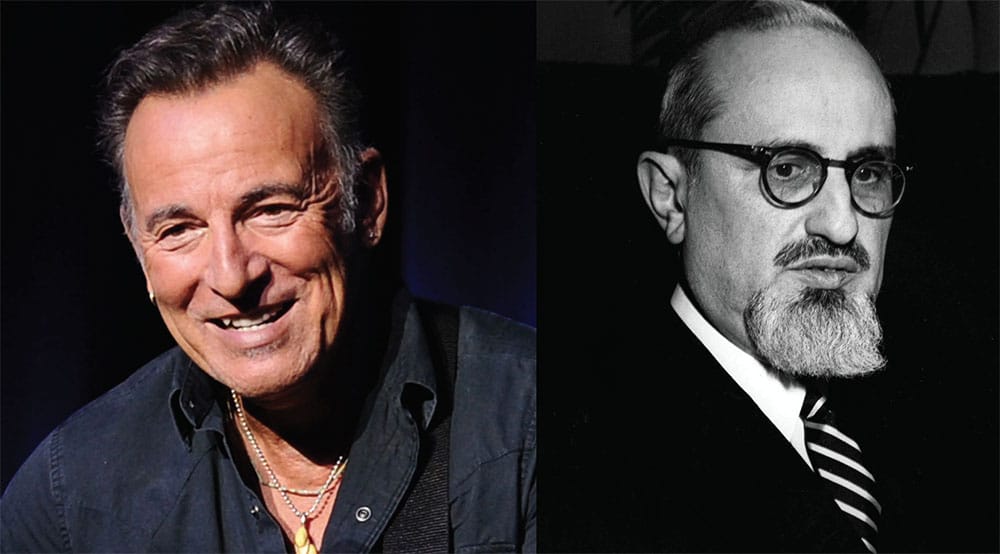
It’s a good thing to have a hero. It’s even better if you have two, which I do: Joseph Soloveitchik and Bruce Springsteen. 

Think The Rav and The Boss don’t belong together? Well, not only do they, but perhaps especially so for Jews as the Days of Awe draw close, and we yearn for renewal, of body and spirit both. 

Granted, the two men—the rabbi and the rocker—hail from about the most disparate backgrounds imaginable. One, the scion of a pre-eminent European rabbinic dynasty, the inheritor of the great Brisk Talmudic intellectual tradition, is more influential than any other rabbi of the modern age. Soloveitchik’s thorough consideration of the best of modern secular learning along with that of Jewish tradition (“Torah uMadah” is the often employed shorthand) has shaped the thinking of hundreds of his students, and the students of his students, for decades now. 

The other man, whose father was a sometime New Jersey truck driver, sometime jail guard, who regularly drifted into drink and depression, emerged from a thoroughly inauspicious Jersey Shore background to become the most renowned musical writer and performer of our age. Springsteen’s messages about hope and love and joy—born of his own aches and angst—have resonated across generations, social classes and continents for several decades now. Like Soloveitchik, Springsteen has influenced lives. 

Still, what could a rock-and-roll star, one whose most famous line might well be, “I learned more from a three minute song than I ever did in school” (by all accounts, not an exaggeration), possibly have in common with an erudite rabbi, whose intellectual range covers religion and philosophy and beyond?  

What could a rock-and-roll star possibly have in common with an erudite rabbi, whose intellectual range covers religion and philosophy and beyond?

But wait, the discrepancies grow. 

The name “Soloveitchik” has been nothing less than royalty across the Jewish world for half a dozen generations now. Meanwhile, the name “Springsteen” was hardly known beyond a few blocks in Freehold, New Jersey, until, in the early sixties,  this scraggly and rock music-obsessed teenager got his mother to empty her bank account for a $60 guitar, after which everything took off. 

These days, even in his early seventies, there just isn’t a bigger name around than Bruce Springsteen. Five years ago his memoir, “Born To Run,” was published in twenty-two languages, and nobody headlines a show like Springsteen. And who else but this soul-stirring guy would theatre impresarios have called upon to reopen COVID-closed Broadway this month? 

Need we mention that many more Jews today know one man and his work far better than the other and his? 

One more gilding of this lily, by way of a return to the respective fathers: The Rav was taught Jewish tradition—and, therefore, the world—by his father, an illustrious east-European rabbi who further expanded his son’s early horizons by arranging for the young Soloveitchik to learn from the best teachers of the day (while his mother, of equally important dynastic rabbinic lineage, introduced The Rav to the greats of Russian literature). 

And, Douglas Springsteen—how did he do in nurturing his son’s talents? Struggling toward stardom in the seventies, The Boss would ruefully observe, “When I was growing up, there were (for my father) two things unpopular in our house: one was me, the other was my guitar.” 

Two rather different men, the rabbi and the rocker. And yet. 

In fact, Soloveitchik and Springsteen are not so dissimilar, especially in regard to some defining personal characteristics. They’re (permit me to put Rabbi Soloveitchik who died in 1993 in the present) both modest men, largely unadorned and unassuming. 

Springsteen famously makes his way around his beloved New Jersey Shore, whether alone or accompanied by his wife and kids, without a retinue in tow. No bodyguards, nobody to make him seem too important to be approached. And while Soloveitchik was reportedly distant and formal, and rarely less than demanding of his students, he, too, did without a retinue. And, though he proudly bore an illustrious name, The Rav also flew weekly between Boston and New York under the name “Joe Solo.” Not to hide, but to save those who’d never be able to pronounce his name the embarrassment. 

Each possesses a discipline and restraint in personal habits. True, that would be expected of Soloveitchik who lived modestly, but what’s surprising is Springsteen’s eschewal of the ever-present drug culture from the beginning of his career. He was wise enough to know drugs would knock him off course. 

In fact, their obvious differences aside, what the two share—a deep understanding of human yearning and spiritual need—is telling: telling in general, and all the more so in regard to this moment, when the Tishrei moon will soon beckon Jews toward life renewed. 

Start with this matter of renewal, which easily gets confused with repetition, when it’s actually the opposite. Our lives often feel repetitive, far from renewed—regularly tamped down by a flattening sameness. Our spirits dull when everything inside us wants to soar—which is why renewal, best framed and driven by a religious sensibility, is so essential to human happiness. 

Who does not yearn for that? Both The Rav and The Boss teach about this common yearning, each in their own way. 

If you’ve ever been among the happy throngs at a Springsteen concert, for instance, you’ve not forgotten how full your heart was with joy, and the sense that just about anything was within reach. And, if you’ve read—read and reveled in, and read again—Soloveitchik, you’ve experienced your mind soaring and your world expanding. 

Both experiences are the very stuff of human renewal; they’re joyous, large and potent. Repetition has its virtues, but surely, these are not among them. 

Consider, for instance, how Springsteen describes the essence of his E-Street Band’s concert performances. 

“We come out every night to be at our best … when we do, it’s not to repeat the night before, but rather to renew—you and us. It’s not a repetition, it’s a renewal. It’s not one and one making two—it’s making three by creating new memories even if we sing the same songs as the night before…. Rock and roll, Art, Love is where one and one makes three, not two. That’s the magic of what we try and achieve” (2012 Australia ABC News interview). 

Renewal, then, is when one and one makes three, not two; when magic, something that jumpstarts the soul, happens. As Springsteen stomps and sings his way across the stage, it reverberates through your body. 

L’havdil, we should say about Rav Soloveitchik. He would not have associated himself with three-hour-plus rock ‘n’ roll extravaganzas! Nevertheless, there is a commonality of experience. When you read Soloveitchik, especially about the nature of God’s complex and loved creatures, Adam, Eve and their progeny, The Rav takes you to new insights; your view of the world gets rearranged some, your knowledge of Jewish tradition deepened and your understanding of God and His most complex creature sharpened. 

Once you encounter the Rav’s insights about early Genesis and our shared earliest ancestors, you have a chance to change: to renew, not to repeat. Rabbi Soloveitchik teaches that “Natural” human beings—flat, unchanging, unknowing—can grow into “Reflective” personalities: knowing, growing, giving human beings. 

Only reflective men and women are capable of renewal. And only then are we who yearn for such spiritual regeneration prepared to meet the Tishrei moment and the soul-stirring days that may follow.


John Moscowitz is rabbi emeritus, Holy Blossom Temple, Toronto, and author of “Evolution of An Unorthodox Rabbi” 

Why Springsteen and Soloveitchik Are My Two Heroes Read More »
Why the Law?

“Why the Law?” (Galatians 3:19)

So begins Pope Francis’ recent homily on the Torah—the law of Moses. It is a homily that has drawn the ire of many Jewish leaders, but the opening question is a good one. I’ve never read Galatians, but I can say as a rabbinical student at a progressive non-Orthodox seminary, that “why the Law?” is a question asked with great regularity and answered with great variety by the current and future leaders of the Jewish world. 

Before I get to that question, however, I want to address why so many Jews take issue with this homily. 

The first problem, which was articulated by Israel’s Chief Rabbinate, is that the homily implies that Christianity nullified or superseded the Jewish people’s covenant with God. After Christ, the Pope writes, those who still clung to the Law “were going backward.”

This kind of theology smacks of a Pre-Vatican II world, one in which tensions between Christendom and the Jews were generally much higher. Moreover, the idea that the Jewish religion has been invalidated by the Christian one is a bedrock trope of antisemitism. 

The second problem is the implication that God nullified the Law of the Torah because it was too exacting to feasibly live by. Quoting Acts, the Pope calls the Law “a yoke upon the neck” and a burden “which neither our fathers nor we have been able to bear” (15:10). 

This rubs Jews the wrong way for two reasons. The first is that plenty of Jews live by the Law and don’t find it too heavy a burden at all. Second, the subtext here is that God had to nullify the Law (and sacrifice his son) because the Jews were being sinful. This is our second antisemitic trope so far and we’re not done yet. 

The third problem is that the Pope states bluntly that the Law “does not give life.” 

This is our third antisemitic trope—the idea that Judaism is not a religion at all but rather a lifeless and formalistic legal code with no spiritual substance. 

How are Jews to understand all of this if not as an insult to the very heart of our shared spiritual and communal life? 

Indeed, that is what I hear in the homily as well, but what troubles me most is the sheer hypocrisy of it all. 

If Pope Francis would like to ditch the dry deserts of the Law for the lush hinterlands of the spirit, he can start in his own backyard without any reference to the Jewish Torah. 

He might, for instance, let queer people get married. 

He might also let priests get married. 

He might let people get divorced.

He might let women serve as priests. 

Catholicism is not devoid of Law. They have plenty of it, some of it which is quite clearly a burden too heavy for the people to carry. 

Pope Francis would be better off admitting that it is not truly possible to abolish the Law. Just ask a Reform Rabbi what he or she thinks about “Thou shalt not murder” and you will see that we all live within a system of “Thou Shalt” and “Thou Shalt Not.” We simply draw the boundaries differently. 

It is true that the Law is a yoke, but not in the way that Pope Francis seems to believe. Law in Judaism evolves with time. This is true for all forms of Judaism, even Orthodoxy. 

In each generation, the sages of the era interpret the Law in the light of the spiritual needs of the day. Through deep study of the Torah, our sages discover how best to understand and live its teachings. It is to this process that we are yoked, not to some monolithic, oppressive, and unfeasible legal code.

Which brings me back to the opening question, “Why the Law?” 

In a lecture at Hebrew College last week with the wonderful Rabbi Art Green, we learned of a Kabbalistic idea according to which the universe passes through consecutive 6,000-year cycles, each one ruled by a different divine attribute. In each of these cycles, the Torah is given in a new form, its pure and holy light refracted through the reigning divine attribute of the time.

It is the aspect of Judgement that gives us some of our holiest sparks. It is what makes us demand justice. It is what pushes us to fight for a world in which the rights of the stranger, the widow, and the orphan are protected. 

The 6,000-year cycle in which we currently find ourselves is ruled by the divine attribute of Judgment, Din. For this reason, our Torah appears as it does, as a book of “Thou Shalt” and “Thou Shalt Not.” 

Hearing this, the gathered rabbinical students let out a little sigh of disappointment. Wouldn’t it have been better if we had been born in the cycle of Loving-Kindness, Chesed? Or of Glory, Tiferet? What would our Torah have looked like then? 

This is, however, not worth sighing over. It is the aspect of Judgement that gives us some of our holiest sparks. It is what makes us demand justice. It is what pushes us to fight for a world in which the rights of the stranger, the widow, and the orphan are protected. 

After all, the spirit may give inspiration, but inspiration is a vague and insubstantial thing. Without an outlet, it is bound to dissipate into nothingness. Here, then, is your answer to the question, “Why the Law?” The Law is that outlet, through inspiration becomes action, and action becomes inspiration.


Matthew Schultz is the author of the essay collection “What Came Before” (2020). He is a rabbinical student at Hebrew College in Newton, Massachusetts.

Why the Law? Read More »

Recall Turns Into a Choice

“Don’t compare me to the Almighty, compare me to the alternative.”

This has been one of Joe Biden’s favorite lines for most of his political career, but it also nicely summarizes the messaging strategy that most incumbent officeholders employ when running for re-election. They want voters to think about their decision as a choice between the available options rather than an up-or-down referendum, primarily because being seen as preferable to another candidate is a much lower bar for success than being judged against an imaginary and often unrealistically idealized option.

Gavin Newsom’s challenge is that the rules for a California recall election call for a referendum — literally. The first question on the recall ballot asks voters to make a binary decision on whether Newsom should or should not be removed from office. His potential successors are not even introduced into the equation until the ballot’s second question, which makes it more difficult for Newsom’s campaign to frame the election more advantageously as a choice.

Not that this setup has kept Newsom from attempting to convince Californians to view this race comparatively. The governor won his election in 2018 by a wide margin, but large portions of the Democrats’ progressive base has never been all that enthusiastic about a leader they see as a somewhat entitled and centrist establishment politician.

There are two ways for a campaign to motivate its base: tell voters exciting and inspiring things about their candidate, or tell them frightening things about the opposition. Last spring, when it appeared that the world was beginning to emerge from our pandemic-driven shutdown, Newsom’s team tried the first approach, sending the governor around the state to announce various funding and economic recovery projects. When that didn’t move the needle, they shifted to Plan B.

Being seen as preferable to another candidate is a much lower bar for success.

Newsom’s initial tactic was to present the recall as a campaign against Donald Trump. But Trump isn’t on the ballot, so the governor’s campaign moved on to the candidates who were running. In the recall’s early stages, most of Newsom’s opponents were fairly unknown, so alerting voters about the dangers of a multi-candidate amorphous conservative Republican blob was not a sufficiently tangible threat to alarm Democratic loyalists.

But that all changed when talk show host Larry Elder entered the race and quickly moved up in the polls. Newsom now had a living, breathing, talking opponent who says and does controversial things and could therefore serve as an ideal foil about whom he could warn progressive voters. Fueled by a massive funding advantage, Newsom has turned his guns on Elder and has aimed to portray him as a threat to deep-blue California. Not coincidentally, Newsom’s poll numbers appear to have improved over the course of this onslaught.

But Newsom’s efforts to cast the recall as a choice between the available options has been even more effective when he has established a contrast between California and other states. Unlike the shutdowns of 2020 and early 2021, when the governor’s COVID-related mandates caused immense economic and societal disruption, the widespread availability of vaccines in recent months has made Newsom’s cautious approach to the pandemic more palatable to many Californians. Mask mandates and vaccine restrictions are certainly an inconvenience, but create a less onerous set of constraints than those we’d faced during earlier stages of the virus’ spread.

At the same time, Republican governors in more conservative states have moved in the opposite directions, not only avoiding state mandates but often forbidding local governments from imposing such requirements in their own communities. The result has been an increase in the number of Covid hospitalizations and deaths in those states, which has allowed Newsom to warn Californians that they could suffer a similar fate if a Republican governor took office here.

In the campaign’s closing days, Newsom is relying on a number of leading national Democrats to inspire his state’s progressive voters. Elizabeth Warren and Bernie Sanders have weighed in, and President Biden and Vice President Harris may be deployed as well. All that high-profile fire power may be enough to allow Newsom to survive, but if the recall is defeated, the governor’s first thank you cards should go to Elder and to the GOP governors of Texas and Florida, who helped California’s embattled chief executive turn this recall campaign from a referendum into a choice.


Dan Schnur is a Professor at the University of California – Berkeley, USC and Pepperdine. Join Dan for his weekly webinar “Politics in the Time of Coronavirus” (www/lawac.org) on Tuesdays at 5 PM.

Recall Turns Into a Choice Read More »

From Caesars to Cedars

Recently I performed fourteen shows on the Las Vegas Strip. In an expensive suit, shiny shoes, and polished teeth, I busted them up. Working with me, straight from brain surgery, was Avi Liberman who was so funny I thought I should get brain surgery.  On Shabbos, we had lunch in Avi’s room overlooking the Strip.  On Monday, I drove back to Los Angeles. 

Then life did what life does. It spun my world in a different direction. Shabbos afternoon, our machatunim (in law) Roz came for lunch. She told me how good I looked and how the few pounds I put on were perfect. Little did I know that this was the kiss of death. Just kidding Roz. 

Around midnight I awoke with a familiar stomach pain. This pain is like a bad relative. As much as you try to forget it or them, you can’t.  In the past, it was a bowel blockage.  I was hoping that this time it was not. In constant contact with my internist Mark Hyman, I tried to wait it out. But that afternoon, while in so much pain, I went to the emergency room. My wife drove me to Cedars Sinai, but because of Covid I went in alone. 

After a cat scan it was confirmed, I had a small bowel blockage. It took seven more hours to get me into a room. While lying in the hallway, a nurse with a clipboard asked me that, if necessary, do I want to be resuscitated?  I told her to ask my wife.  She said I had to answer this question on my own. I wanted to explain to her that I’m a Jewish husband and am not allowed to answer questions, but I mumbled yes. I called my wife and started crying. She also started crying when she realized how little life insurance I had.  Just kidding. 

No beautiful suit and shiny shoes now.  Instead, I was now draped in a Cedars Sinai hospital gown. The kind that shows everyone your flipside. These gowns make your butt feel like there is an open window somewhere. After a rough five days, no surgery but lots of intervention, my colon popped back. I was ready to go home.   

No beautiful suit and shiny shoes now.  Instead, I was now draped in a Cedars Sinai hospital gown. 

But here goes life again. Four o’clock in the morning, a few hours before my release, my atrial fibrillation (A Fib) kicked in. Instead of going home, a nurse rushed me up to the cardiac floor. A Fib is when your heart goes out of sinus rhythm. Mine was galloping at 160 beats a minute. It felt like an electric eggbeater running inside my chest. They quickly gave me a drug to slow down my heart. My cardiologist Dr. Weiner was on the phone talking me down off the wall. 

Again, life takes another turn. It’s now 8am and my heart was very much still running like an Alaskan Salmon heading upstream. I asked my wife, who spent the night, to hand me my tefillin bag. She did and I placed the tefillin on my head and left arm. I did a few of my truncated prayers. I also thanked God for all he has given me and taken from me. I even thanked him for what I was going through because I know that if I am willing to look, there is a great lesson here somewhere. Then I rattled off important names for him to keep safe. I always feel better when I remind God about the people I love. 

Fifteen minutes after putting on my tefillin, I was out of A Fib. Was it the drug they were giving me or was it something else?  I told my wife that we just got handed a miracle. She was happy and stopped xeroxing my insurance policy.  

In my mind, from beginning until the end, this was a constant series of miracles. If not, then I was just lucky. And just luck is something I can’t accept. 

Now I need to get back into my expensive suit, without an opening in the back, and make people laugh. Or I could leave an opening in the back and see how that goes. 


Mark Schiff is a comedian, actor and writer.

From Caesars to Cedars Read More »

Teshuvah in a Plague

California is on fire, the east coast is drowning, the virus isn’t done with us, and the nice lady who lives by the freeway has been joined by dozens of friends as the eviction moratorium comes to an end. Each illness, destroyed home, each death is a private calamity. Meanwhile, just about everything that was wrong before the pandemic is still wrong. For example, in the unequal devastation that the pandemic continues to wreak in communities of color, we can see that the systemic racism we were driven to protest does continue. And we are plummeting into our tradition’s deepest well of introspection, Yom Kippur.

This is a time when we get to examine our conduct over the past year, to excavate our most profound regrets and make all necessary apologies. Every year obliges us to make a complete heshbon ha nefesh, a weighing of soul, not only as individuals but as members of communities.

Some of this is healthy and necessary. What was our part in the dissolution of a friendship, a marriage? Where did we fail to carry our weight at work or school? But there can be no heshbon without enough self-respect to believe in the possibility of change. Teshuvah (repentance, literally return) is not meant to be self-abuse but self-renewal. 

It’s especially hard in a pandemic to find that balance between an honest self-appraisal and self-abuse. We ought to ask: was I careful enough? Did I get vaccinated, did I distance myself sufficiently? But it is far too easy to go over the line and start thinking things like: what have I done to deserve everything bad that is happening to me? Am I being punished?

Rebbe Nachman of Breslov teaches, about tshuvah, “You must search and search until you find some good point within you to give you new life and happiness. When you discover the good that is still inside you, you literally swing the scales from guilt to merit. This will enable you to return to God. The good you find inside you will give you new life and bring joy to your soul.”

Yes, teshuvah has to be rigorous—and for that to happen, it has to come from a place of self-respect and faith in our community and in God’s support.

Only teshuvah that comes from a place of trust in God’s forgiveness, respect for one’s own ability to change, and the renewed strength we get from accepting a friend’s love can truly transform. This is especially important in our social justice work and our efforts to unlearn racism and other categorical prejudices.

In the midst of pandemic, the life force, the yetzer ha tov, rose up out of all that death for many people and impelled a healthy national heshbon, an overdue reckoning. The losses to COVID broke our hearts. The murders of George Floyd and Brionna Taylor and Ahmaud Arbery and Elijah McClain quickened our outrage born of love and had us in the streets and on the phones.

And this month, we finally saw indictments of police officers and paramedics for the death of Elijah McClain and that of a former DA for failing to pursue justice for Arbery. We can make changes. When we make our heshbon, we have to acknowledge the positive, the places where we made a difference.

We get to ask: In the midst of all the heartbreak—didn’t we reconnect with old friends on Zoom or by phone? Didn’t we offer comfort to a mourner? Didn’t we read something transformational, a book we had put aside for when we had time? And didn’t we get on the phones and the ballots and the streets (properly masked) for what we believe in?

So here is the heart of it: yes, teshuvah has to be rigorous—and for that to happen, it has to come from a place of self-respect and faith in our community and in God’s support. If you are around to read this, congratulations. You made it this far, you are living through a dreadfully protracted period of loss and fear and sorrow and you arrived at another Yom Kippur. So have some profound tshuvah, have a great returning — you have earned it.


Rabbi Robin Podolsky serves on the Board of Governors for the Sandra Caplan Community Bet Din, writes at shondaland.com and jewishjournal.com, advises the Jewish Student Union at Occidental College and serves as writing facilitator and dramaturg for Queerwise, a spoken word and writing group. She also serves on the National Ritual Committee for Bend the Arc.

Teshuvah in a Plague Read More »

Satirical Semite: Corona Hangover

I am a fan of Chinese culture. There is the elegance of Tai Chi and the ancient Chinese energy-healing systems I learned from Taoist master Mantak Chia. Amazon shopping lists are made easier with Chinese-manufactured products, and daily life would be harder without them. It’s just that last month I received another export from China and joined the chic club of coronavirus patients. COVID is the gift that keeps on taking. It wasn’t on my wish list, and this time Amazon Prime won’t accept returns.

I was fully vaccinated months ago, patriotically receiving the AstraZeneca Oxford vaccine that was developed in England. The vaccine debate rages, from discussions about the safety of the injections to the civil liberty infringements of government-imposed vaccination. Last week Judge James Shapiro in Illinois forbade an unvaccinated mother from seeing her son, twisting a child support hearing into a politically-weaponized vaccine statement. The decision was later reversed. 

Despite immunization, I still spent six days in bed with a cough that was so intense I nearly evacuated my guts. Even now I am experiencing daily post-COVID fatigue. Fortunately I didn’t lose my sense of taste or smell, and I’ll try to keep my comments in good taste even though the alleged coronavirus cover-ups smell increasingly fishy.  

I was very careful at the beginning of the pandemic. I got shouted at by a man in a kosher market in West L.A. who asked me to step away from the cucumbers because he was within a five-feet radius of my cart. So I moved away by an extra length of two cucumbers. That’s English cucumbers, rather than Persian cucumbers, because the former are approximately three times the length of the latter, not that I’m showing off. Anyway, the angry Angeleno seemed happy with double English cucumber radial distance. 

The “I’ve had enough of social distancing” attitude was pervasive after 18 months and the “isn’t this nice we’re back in a bar without a mask?” approach was indeed nice. Until, three days later, after my first trip to a bar at my first indoor maskless event, I found myself shivering, achy, coughy and lying in bed. Several others from the party also came down with it. Nevertheless I take full responsibility for my choices and the resulting cost. Things could be worse. The ongoing post-COVID fatigue may be uncomfortable, but I didn’t end up in the hospital, and it’s still far better than being stuck outside the airport in Kabul.  

The ongoing post-COVID fatigue may be uncomfortable, but I didn’t end up in the hospital, and it’s still far better than being stuck outside the airport in Kabul.

I became so bored at home that I completed an American history home-study course, by watching “The People vs O.J. Simpson: American Crime Story” on Netflix. The parts I liked best were the helicopter shots circling the Spring Street Courthouse and seeing the getaway chase on the 405. It was an exciting distraction from the coronavirus. Whatever works. As they say, “if the glove fits, wear it,” unless of course you’re O.J. and the blood-stained gloves didn’t quite fit. 

At what point can ungloved fingers be pointed and blame be apportioned for the spread of COVID? The UK Sunday Times recently ran a feature about the great cover-up and how the World Health Organization has been corrupted by China in a long-term political power move that began in response to their embarrassment over the SARS outbreak in 2003. According to the report, in 2017 the Chinese ally Tedros Adhanom Ghebreyesus, an Ethiopian official, was installed as Director-General of the World Health Organization, and he put off declaring an international emergency at the start of pandemic so as not to embarrass China, although he could have saved many lives had he declared it earlier. 

Was the virus deliberately created in a lab or in the Wuhan wet market? Does it make a difference? The viral horse has bolted, the flu has flown the coop, and the bat’s out of the bag. 

With life after coronavirus, sometimes you’ve just got to stop and smell the roses. At least, that is, if your nose still works.


Marcus J Freed is an actor, writer and business consultant. www.marcusjfreed.com

Satirical Semite: Corona Hangover Read More »

This Yom Kippur, Let’s Add a “Good” List

The Jewish tradition is not big on patting ourselves on the back. We grow more as individuals and communities by looking at our sins and mistakes and correcting them. The days leading up to Yom Kippur are all about self-correction and self-accounting. What did we do wrong? What can we do better? How can we atone? And so on.

This year feels different to me.

We’ve been so assaulted by a relentless pandemic that keeps testing our stamina and resilience, many of us are exhausted by soul-searching through dark tunnels. No matter how hard we try, the anxiety and uncertainty of the times seem to drag us down. 

We could use a morale boost.

So, in the High Holiday spirit of self-reflection, why not add a question this year to our traditional litany of self-criticism: What have we done right?

No matter how hard we try, the darkness and uncertainty of the times seem to drag us down…So, in the High Holiday spirit of self-reflection, why not add a question this year to our traditional litany of self-criticism: What have we done right?

This occurred to me recently when a friend told me about a nightly ritual he developed during the pandemic. With all of the negativity in the air, he decided to make a list of all the good things he does every day. At first the list was short, but with time it kept growing. You see, he never stops thinking about the list as he goes through his days, which encourages him to do more and more good deeds.

Any good act, however small, counts– a phone call to a grandparent, sending a thank you card, attending a class, walking in nature, volunteering, creating something, bonding with a friend or family member, helping a neighbor, etc. 

What struck me about the ritual is that it goes beyond just changing our attitudes—which itself is immensely useful. Looking for silver linings and the many things to be grateful for help us cope by nourishing our minds. 

But my friend’s idea is less about attitude and more about action—about what we do rather than what we feel or think. It’s about the power of doing things, and the power of recording them.

There’s enough lousy news these days to fill our minds with anxiety, no matter how well we adjust our mindsets. Action, on the other hand, concentrates the mind, channeling all of that anxiety into a productive place and into a habit that crowds out the bad stuff.

This doesn’t mean, of course, that we should live in a state of denial and ignore the darkness around us. What it does mean is that we shouldn’t allow that bad news to hijack our minds. Action that is focused around goodness can liberate our anxious minds and empower our souls.

It’s worth imagining what would happen if more and more people throughout the community took on this ritual. At night, thousands of people would make a list of the good things they did that day, and every night, the list of people and good deeds would keep growing. With time, this communal activity would offer a powerful counterweight to the coronavirus, making good deeds themselves contagious.

There’s no shortage of dark news these days to occupy our minds, from the 20-year anniversary of 9/11 to the fate of women in Afghanistan to the effects of climate change to the stubborn continuation of the pandemic. Regardless of where we sit ideologically, we all have bad news to worry about. That will never change.

If we can take a time-out every night to list our good deeds for that day, over time, instead of focusing on bad news, we may look instead at the good news that we ourselves create in our own circle of life. 

But if we can take a time-out every night to list our good deeds for that day, over time, instead of focusing on bad news, we may look instead at the good news that we ourselves create in our own circle of life. 

And when we arrive at Yom Kippur to atone for all the wrong we have done, we may be surprised by how short that list has become, and by God giving us a little pat on the back. 

This Yom Kippur, Let’s Add a “Good” List Read More »