fbpx

July 28, 2021

Tamara Rosenfeld is a Foodie Filmmaker

When 13-year old Tamara Rosenfeld danced at her soccer-themed bat mitzvah party, she probably didn’t know that she would grow up to become a Guinness World Record holder for filming soccer (specifically, at the highest and lowest elevation soccer matches of all time). As an adult and filmmaker, many years later in 2017, Rosenfeld and her film crew climbed Mount Kilimanjaro for nine days to document women’s soccer matches for the film “Equal Playing Field.

“We’re hiking and filming and downloading the footage, not necessarily being able to get enough sleep, but being able to capture something—for me, it’s definitely all worth it,” explains Rosenfeld, who co-directed the film with Amirose Eisenbach. “‘Equal Playing Field’ definitely combined a lot of my passions, which was being able to tell stories of amazing, inspirational females from around the globe.”

Rosenfeld caught the directing bug in high school through a program with the San Francisco Jewish Film Festival. Since then, Rosenfeld has traveled around the world as the director and producer of the immensely popular Netflix series, “Street Food.” The Northern California native spoke about her experiences behind the camera.

You’ve traveled to 29 countries. Did you come across any antisemitism?

The one thing that I still remember—and this was a while back—I was in Hungary and there was a neo-Nazi gathering and demonstration. It was extremely uncomfortable for me. I tried to get away from all of them, so I didn’t get in the midst of it. My grandparents came from Europe. They survived the Holocaust and my great-grandparents were murdered during the Holocaust. One of my great-grandfathers was either on the train or was at Auschwitz when he passed. So, it was really tough for me to see that.

There were times where I tried not to—where I wouldn’t state [my religion]. There were definitely some countries where I didn’t want to blurt it out. But then, for example, when I was traveling in Jordan, there was a lovely Muslim woman who I was sitting next to on a bus. This was for “Equal Playing Field”—they asked me to film the lowest soccer match ever played in Jordan. I was sitting next to this woman on the bus. It came up in conversation—I forgot exactly how, but it came up in conversation that I was Jewish. She was super interested and considerate. I found most of the time, thankfully, from a lot of my travels and a lot of the people that I met want to learn more. Once you get a chance to sit down with people and talk to them—I can give them a little glimpse of my experience of being Jewish. I’ve definitely been the first Jew for different people to meet.

Once you get a chance to sit down with people and talk to them—I can give them a little glimpse of my experience of being Jewish.

What kind of sexism have you experienced in your industry?

I would say that it was earlier on when I was starting in this industry that I was doing a lot of things with the branded space and [I] would go to some events … and I would see some men around my same age who had also done similar projects [as] me being able to network with other men, with some of the brands, which were mostly men. They didn’t really see me as necessarily a director or filmmaker. There were a few times that I was inappropriately hit on or touched when I thought I was networking. Like, someone put themselves on me and I pushed them away. Luckily, they stayed away after that. It was definitely a shocking experience for me because I saw myself with all these other filmmakers, that we were all the same caliber.

Which documentary are you the proudest of as a filmmaker?

So, they’re all kind of my babies. I can’t really choose one. But, the series that I’ve been putting my heart into for the past few years, “Street Food,” is definitely one of the things I’m most proud of. I mean, I put a lot of love into “Street Food.” It makes me really happy it’s been available in 190 countries. It’s so exciting to create something that has a global audience.

“Street Food” is such an addictive documentary series. What initially drew you to food anthropology? 

So, I’ll separate those two words. First, with anthropology, I went to USC for film school and you also have to do GE classes—the General Ed classes. I was trying to figure out one other class and there was this “Anthropology Through Film” class. I had no idea what I was getting myself into, but figured, why not try it? And I absolutely loved the class. It was in that moment that I realized through documentary filmmaking and through anthropology, that you can tell really entertaining and interesting stories about unique people and cultures.

With food, specifically, I just think food is such an amazing window into a culture. When you’re sharing a meal with someone, it’s connecting and learning in a whole new way. All of your senses can be awakened and activated. And it’s also a way of bonding, connecting with people through food. That’s one thing still very unique around the globe—the cuisines. It’s one of the big traditions that gets passed down. We all eat [laughs]. People really love to share their food and I love to experience that and connect with them through food.

How do you decide which cities or restaurants to feature on “Street Food”? 

It’s tough because there’s so many cities around the world that have street food. Each episode focuses on one city. It’s a collaboration with Netflix and the executive producers and the team to figure out the best places for us to go. We’ve done “Street Food: Asia” and “Street Food: Latin America,” so far. The hope is that we get a chance to go back to other countries in Asia, other countries in Latin America, other countries around the world and be able to continue to tell these “Street Food” stories. With the street food cooks themselves, it’s a lot about their story, their dish, and their importance in the community that help us decide who to choose, but it’s definitely a lot of time and a lot of research. In certain ways, I wish we could choose a lot more people to highlight, but it’s only a thirty-minute episode.

The research part is very important, obviously, because we want to be able to represent the city from the view of locals and find … the street food cooks that represent the city and also have a story to tell and also have a dish that speaks to the city, too. So, we work with local experts and we get a really big list and we narrow it down. We scout, too … I absolutely love the people that I’ve had the opportunity to film. Their stories are stories that don’t often get shared with the world. So, I feel like we’re able to give a voice to people that don’t always get that platform and able to share their stories that hopefully inspire other people around the world.

So, I feel like we’re able to give a voice to people that don’t always get that platform and able to share their stories that hopefully inspire other people around the world.

In your opinion, which culture is the most underappreciated?

That’s really tough. I think cultures now are being more celebrated, which is fantastic. I guess there [are] two that [come] to mind. One is a culture that is actually within the U.S. During the pandemic, I went up and filmed in Artic Circle area in Alaska. I feel like the Inuit community up there has really been suffering from climate change. They really rely on their environment and they have these really small towns that are built on the water. Due to the climate change, some of these towns actually have to move. It’s part of their tradition, their culture—that’s gone back so many years. This Inuit culture and tradition is so unique and it’s a part of the U.S. … I don’t know how much awareness there is towards and how much people realize it’s important to preserve that. The Artic is definitely getting hit extremely hard with the climate change.

There’re some unique places you can go to, like La Paz, Bolivia, [seen in] that episode of “Street Food.” La Paz has cholitas, which are these women that wear these bowler hats and these big skirts. They have aguyos, which are colorful bags that they strap around their backs to carry things. It’s a very vibrant and unique city that combines the Andes and a city. [It’s] a very unique culture that cares about “Pachamama,” which is Mother Earth. I feel like that’s a place that people might be not as aware of. There [are] just so many beautiful cultures. Watching shows … gives you the opportunity to see these cultures and hopefully, we can really preserve them. I think one of the biggest steps to keep these cultures alive is to honor them and respect them.

This interview has been edited for clarity and brevity.


Eve Rotman is a writer on the West Coast. Follow her on Twitter @EveRotman

Tamara Rosenfeld is a Foodie Filmmaker Read More »

Ben & Jerry’s Co-Founders Defend Israel Decision As Being “Pro-Peace”

The co-founders of Ben & Jerry’s defended the company’s July 19 decision to remove its products from the “Occupied Palestinian Territory” as being “pro-peace” in a July 28 New York Times op-ed.

Bennett Cohen and Jerry Greenfield, the co-founders, wrote, “Israel was one of our first overseas markets. We were then, and remain today, supporters of the State of Israel. But it’s possible to support Israel and oppose some of its policies, just as we’ve opposed policies of the U.S. government. As such, we unequivocally support the decision of the company to end business in the occupied territories, which the international community, including the United Nations, has deemed an illegal occupation.”

Cohen and Greenfield no longer have any control over the company, but they argued that the company’s statement delineated between Israel proper and occupied Israeli territory and that the company didn’t express support for the Boycott, Divestment and Sanctions (BDS) movement.

“The company’s stated decision to more fully align its operations with its values is not a rejection of Israel,” they wrote. “It is a rejection of Israeli policy, which perpetuates an illegal occupation that is a barrier to peace and violates the basic human rights of the Palestinian people who live under the occupation. As Jewish supporters of the State of Israel, we fundamentally reject the notion that it is anti-Semitic to question the policies of the State of Israel.”

They concluded their op-ed by stating “that companies have a responsibility to use their power and influence to advance the wider common good.”

J Street President Jeremy Ben-Ami praised Cohen and Greenfield’s op-ed in a tweet, stating: “It’s not anti-semitic to criticize Israeli policy or to not sell ice cream in illegal settlements. It’s actually a truly pro-Israel decision.”

Others were more critical of the op-ed.

“What this op-ed doesn’t address is why always progressive @benandjerrys has been ok operating in Israel since 1987,” writer Melissa Braunstein tweeted. “Israel was in the ‘Occupied Palestinian Territory’ then too.”

Michael Elgort tweeted, “They support Israel, but oppose occupation. Also they claim to unequivocally reject BDS and they somehow missed the fact that [Ben & Jerry’s Independent Board Head Anuradha Mittal] wanted to boycott entire Israel.”

Elgort is referencing the fact that Mittal, as well as the independent board, stated that Unilever, Ben & Jerry’s parent company, had not run the part of the statement by them that the company would remain in Israel. Mittal tweeted on July 27 that the Ben & Jerry’s decision “is not anti-Semitic. I am not anti-Semitic. The vile hate that has been thrown at me does it intimidate me. [Please] work for peace – not hatred!”

Ben & Jerry’s Co-Founders Defend Israel Decision As Being “Pro-Peace” Read More »

Three Israeli Filmmakers Released from Nigerian Custody

The three Israeli filmmakers who were arrested in Nigeria on July 9, including Israeli activist Rudy Rochman, were released from custody on July 28.

The three filmmakers were making a documentary series called “We Were Never Lost” to interview lesser-known Jewish communities in various countries at the time of their arrest. The “We Were Never Lost” Instagram page posted a press release stating that Rochman, along with Andrew Noam Leibman and Eduoard David Benaym, were interviewing the Igbo community in Nigeria, who consider themselves to be one of the lost tribes of Israel. The press release accused “Nigerian bloggers” of “hijacking images” to falsely claim that Rochman, Leibman and Benaym were supporting a separatist movement within the Igbo community.

“Due to the factually incorrect and inflammatory blogs, the Nigerian government ‘suspected’ the team and took them into custody,” the press stated, adding that the three filmmakers were put into “a small cell” with “horrendous conditions” for 20 days. “They were interrogated and mistreated without ever officially being arrested or accused of anything. There were countless human and international violations that occurred.” The Chabad of Nigeria eventually provided Rochman, Leibman and Benaym with daily Kosher meals.

The three filmmakers have since been released and cleared of wrongdoing, but the Nigerian government demanded that they be sent back home immediately. The three filmmakers plan to return to Nigeria to finish their docuseries.

“Our hearts, prayers, and thought go out to the Igbo Jewish communities we met and to those we had planned to visit,” Rochman said in a statement. “We thank you for hosting us for the few days we shared and will not give up on you.”

One of the leaders of the Igbo community, Ima Lisbon, was also detained with the three filmmakers and is still incarcerated; Rochman told the Chabad of Nigeria to keep giving her food with the hope that she’ll eventually be released, according to the statement.


View this post on Instagram


A post shared by WeWereNeverLost (@wewereneverlost)

Various Jewish and pro-Israel Twitter users expressed gratitude and relief that the three filmmakers have been released.

https://twitter.com/HenMazzig/status/1420499398878973959?s=20

The first season of “We Were Never Lost” will focus on Jewish communities in Africa. The filmmakers plan to film Jewish communities in other countries like China and Afghanistan.

Three Israeli Filmmakers Released from Nigerian Custody Read More »

A Bisl Torah: Walking Together

This week, I visited one of our beloved members as she got up from shiva and walked around the block, signifying a reentry into the world. It was inspiring to see eight other synagogue members arrive for the walk, accompany her, reminding her that she is not alone. Just as we began, the rain began to drizzle and yet, the drops did not deter the group. We walked together, an image of community, noting that the rhythm of our steps provided a comforting symphony to the sounds of a shattered heart.

Walking together is a familiar concept in the Jewish faith. Rabbeinu Bahya, Torah commentator explains that when someone walks with God, they have attained a certain spiritual plane. For example, Noah is singled out as walking with God because he stood out among mortals in his morality and righteousness. Noah was attuned to God’s presence in his life; a strong enough presence to feel as if he were walking with the Master of the Universe.

It isn’t always easy to pinpoint when God is nearby. Sometimes, we feel as if God is hiding. Other times, we have trouble showing our face. But when I watched our community stand next to each other during a time of sorrow, God’s presence was as clear as day. When we walk with each other, show up and fall in step, we stand on the shoulders of angels, transforming into God’s messengers, adding holiness to a fractured world.

Shabbat shalom


Rabbi Nicole Guzik is a rabbi at Sinai Temple. She can be reached at her Facebook page at Rabbi Nicole Guzik. For more writings, visit Rabbi Guzik’s blog section from Sinai Temple’s website.

A Bisl Torah: Walking Together Read More »

Table for Five: Eikev

One verse, five voices. Edited by Salvador Litvak, the Accidental Talmudist

And the Lord, your God, will dislodge those nations before you little by little. You will not be able to destroy them quickly, lest the beasts of the field outnumber you.
 -Deut 7:22


Dr. Sheila Tuller Keiter
Judaic Studies Faculty, Shalhevet High School

Who’s afraid of the big bad wolf? This verse is troubling, especially since just a couple of chapters later, the Torah assures us that Israel will drive out the other nations and destroy them quickly (Deut. 9:3). Furthermore, Israel’s subsequent history questions the wisdom of a gradual conquest. Throughout the period of the judges and kings, Israel repeatedly fell to the temptation to worship Canaanite gods, thus incurring God’s wrath, culminating in the destruction of the first Temple and the Babylonian exile. Given the Canaanites’ deleterious influence on the Israelites, would it not have been preferable to rid the Promised Land of its idolatrous occupants immediately?

In contrast to the spiritual and cultural threat of local paganism, the alternative, wild predatory animals brought on by lack of human settlement, posed a physical threat. Anyone who has camped in bear country knows the potential perils. Ancient Israel housed lions, bears, wolves, leopards, snakes, and scorpions. Thus, Deuteronomy seems to pose an insoluble dilemma – either die spiritually or die physically.

We need not cast the conundrum in such stark terms. Threats to our existence, our safety, our way of life continuously endure. There is no such thing as perfect safety. Threats can emerge from the natural world and from other humans. Even the Promised Land is not risk-free. Danger is part and parcel of the human condition. Our verse asks us to accept this reality, to take rational precautions, and to carry on our national destiny as God’s people despite the dangers.


Rabbi Nolan Lebovitz
Adat Shalom

Why does the Torah tell us that God will “dislodge those nations” if in fact we have always had to live in the Land of Israel alongside other peoples? Each time Jews have fought for control over the land, Jewish men and women have had to fight and die for every square inch of holy inheritance – under the leadership of Joshua, David, David Ben-Gurion, and others.

At no time, did God or the Jewish People completely rid the land of other nations. So, if this never happened, it must not be what the Torah means. Perhaps the Torah intended for us to consider our partnership with God in creating a Jewish governance for the land. In this way, God helps us dislodge the control of other nations over our ancestral land.

The Torah inspires our peoplehood and that in turn causes us to demand a national home. In 1917, Lord Balfour famously recognized that “a national home for the Jewish People” was necessary. The State of Israel’s Declaration of Independence addressed the Jewish People’s right to self-determination: “This right is the natural right of the Jewish people to be masters of their own fate, like all other nations, in their own sovereign State.” Most of the world has never recognized this Jewish right as a natural right. We believe in our right because the Torah promised us self-determination in our land. We believed in that right then and we believe it now. We always will.


Kylie Ora Lobell
Contributing writer, Jewish Journal

This Torah portion is teaching us that God is watching out for us, and He is the source of all our strength. We need to rely on God and trust that with Him on our side, we will be able to prosper. Unfortunately, the Jews in the desert needed to be taught that time and time again. They did not have faith in God, and they acted accordingly.

For instance, when the manna fell and the Jews were told not to hoard it, some still did. When the Jews go into Israel – as they’re preparing to do in this parsha – they need to figure out once and for all that God is going to continue to protect them. What you can also learn from this parsha is that there must be a reason why God is destroying those nations little by little. Why doesn’t he get rid of them all at once? That would certainly make the Jews’ lives easier. However, if the Jews didn’t have any adversaries or challenges, and they were given everything at once – like, let’s say, the manna in the desert – they wouldn’t appreciate it. Instead, if it happens little by little, they’re going to be able to cherish every miracle that occurs. Every time another nation is destroyed, they can rejoice and praise God.

With every little miracle that God shows us, we need to recognize it and praise him. Faith is a muscle, and only by working hard to make it stronger will it stick.


Rabbi Yosef Kanefsky
B’nai David – Judea

This reference to “the beasts of the field,” as well as other numerous references in Tanach to lions and bears roaming the Israelite countryside, remind us that the ecology of the land has changed completely. Species once numerous, are literally gone. The mitzvah to not take a mother bird along with its chicks (or eggs) is understood by numerous commentators as a command to encounter our native species gently, i.e. taking what we need while ensuring that the species itself will persist. Within our own lifetimes, the size of the bird population across the US for example, has plummeted, and we know that the same is true for a myriad of living things once common.

We should all read Psalms 104 now and then. (It is actually part of the Rosh Chodesh liturgy.) The Psalm expresses sheer wonder at the glory of the natural world God has created, and the variety of living things that are God’s handiwork.

“The trees of the LORD drink their fill, where birds make their nests; the stork has her home in the junipers… The high mountains are for wild goats; the crags are a refuge for rock-badgers… How many are the things You have made, O LORD; You have made them all with wisdom; the earth is full of Your creations.” In numerous Psalms and by, extension, in our liturgy, the natural world serves as a text for beholding and appreciating God’s presence and beneficence. If for no other reason, let’s work to preserve it.


Cantor Michelle Bider Stone
Shalom Hartman Institute of North America

Imagine the scene. You stand on the precipice of a great reward. You have waited years for this moment, perhaps your entire life. It isn’t going to be easy. There will be challenges, but you’re ready. Now, imagine, someone comes and says, “Slow down, be patient, this won’t happen overnight.”

This is how this verse hits me. The Israelites have been waiting 40 years to enter the land of Israel. This generation has been preparing their entire lives to reach the promised land, awaiting both the challenge and the reward. They stand on the banks of the river; ready to go. Then they are told, you are not going to conquer this land quickly. It’s going to happen “little by little.” Sounds frustrating, no?

But we know that this is true with most worthwhile challenges we face in our lives. We not only need to prepare during the time spent in the “wilderness”, but once we enter the “land,” proper patience is required to be successful. It could be a tough work assignment, a physical challenge, a spiritual/emotional journey, or an interpersonal relationship that needs attention. In all these situations, it is going to take time and patience to work through the challenges and reap the reward. So, while I’m sure it was hard for the Israelites to hear at this moment, just as it can be difficult for us to hear, the Torah is sending an important psychological message for us all to internalize.

Table for Five: Eikev Read More »

Iranian Defector Dedicates Silver Medal in Judo to Israel

Judoka Saeid Mollaei, a defector from Iran, dedicated his silver medal to Israel on July 27.

Mollaei defected from Iran in 2019, saying that his coaches had told him to lose to Israeli judoka Sagi Muki in the World Judo Championship. Mollaei obtained asylum in Germany before fleeing to Mongolia and has since received Mongolian citizenship, according to Fox News. He was representing Mongolia in the 2021 Tokyo Olympics when he won the silver medal, his first Olympic medal.

“Thank you to Israel for the good energy,” Mollaei told an Israeli sports channel. “This medal is also dedicated to Israel. I hope the Israelis are happy with this win.” He concluded his speech by saying “todah,” Hebrew for “thank you.” The winner of the gold medal was Takanori Nagase from Japan.

Jewish groups praised Mollaei. The American Jewish Committee tweeted that Mollaei’s story is “inspiring” and praised him with a “bravo.”

“Thank you for this honor, Saeid Mollaei!” StandWithUs CEO and co-founder Roz Rothstein tweeted. “It means so much to all of us.”

Social media influencer Hananya Naftali called Mollaei a “hero” in a tweet.

Muki, who has remained close friends with Mollaei, said at a press conference: “I’m so happy that he succeeded in achieving his dream. He deserves it. His journey is incredibly inspiring.” Muki had lost in the quarterfinals, according to The Jerusalem Post. Israeli Prime Minister Naftali Bennett told Muki in a phone call, “What you are teaching us all is that whoever wants victories must also know how to get up from failures along the way. I want to tell you how much I appreciate you and the spirit you bring, to the public in general and to the youth in Israel in particular,” the Post reported.

On July 26, Algerian judoka athlete Fethi Nourine was suspended along with his coach for refusing to fight Israeli judoka Tohar Butbul. Sudanese judoka Mohamed Abdalrasool didn’t show up for his match against Butbul; Butbul told the Associated Press that he was told that Abdalrasool had an injured shoulder, but the Israeli team was skeptical. Butbul ultimately finished in seventh place.

Iranian Defector Dedicates Silver Medal in Judo to Israel Read More »

LA Gets Kosher Mexican Restaurant With Opening of Lenny’s Casita

For chef and entrepreneur Lenny Nourafchan, the path to the American dream begins with Israeli food and ends with Mexican cuisine.

Two years after beginning his quest for a property in the Pico-Robertson neighborhood, on July 20 Nourafchan (formerly of Charcoal Grill & Bar) opened Lenny’s Casita, a meat-vegan kosher Mexican restaurant—the only one of its kind in Los Angeles.

Tall and outgoing, the 32-year-old Nourafchan called the opening a virtually inevitable culmination of his one-step-at-a-time dream.

When Charcoal, his kosher Israeli restaurant on Beverly Boulevard, opened in the summer of 2018, Nourafchan was named head chef, and everything was fine for a year and a half, until the pandemic struck. “They laid off all of my staff,” said Nourafchan.

Eventually that setback would forge a new path to his lifelong goal.

“I had had this concept, since I was born,” he said, “of having a Mexican kosher restaurant.

“So I said to myself, ‘Every kitchen is full of Mexicans. Instead of letting them do what they do best, restaurants train them to do Japanese food, Italian food, Israeli food.’

“It’s like, everybody should be doing what they do best. The idea clicked because they were making their own staff meals. And the staff meals they were making for themselves were better than the food I was serving in the restaurant. The next step was obvious.” Nourafchan knew that he should open his own place—soon, he hoped, after scouting a Pico property, just west of Robertson and occupied at the time by Pizza Mucca.

As these ideas were roaming through Nourafchan’s mind in April 2020, he got a call from his meat supplier, Western Kosher, owned by Dovid Kagan, with whom he has a “good relationship. I told him I had a great concept, but I didn’t know when or where to start.”

Kagan told Nourafchan, “I have a big kitchen, and my staff leaves every day at 3:30, 4 o’clock. Why don’t you try to do something here in the meantime until you get something going?”

The budding restaurateur embraced the offer. “I opened on delivery ops, like DoorDash and UberEats,” he said. “So I had a restaurant with no actual location. Just to-go. Eventually I hired a staff of 10, and it worked out beautifully.”

“Now here I am. In my own hometown. It’s a miracle. I can’t believe it. The American dream.”

Things went well, but they got even better when David Zadmer, the owner of Pizza Mucca called last April, the day after Pesach, and said he had lost his kosher certification and wanted to know if Nourafchan was still interested in the property. Nourafchan’s “yes” was immediate.

Nourafchan’s growing-up story is as lively as his professional life.

“I am an L.A. boy,” he says. “My mom is from Italy and my dad is Persian. Multi-cultural upbringing. Lots of different food. Close family. We would go for summers in Italy. I moved to Israel when I was 15. In Israel, I fell in love and kept coming back and forth between here and Israel.  At 17 years old, I was a high school dropout. I was terrible in school. I was all over, Shalhevet and Beverly High among others.

“By my third year, I already had been in five high schools. I called my mom and said ‘This school thing is not for me. Let me go to culinary school, and I’ll do something I like.’

“I always was into food. My Italian grandmother (my mom’s mom) taught me how to cook. My mom, a lawyer, said ‘No way. You’re going to be a doctor, a lawyer. What is this cooking? It’s a hobby, a hobby.’

“So I listened to her. Two hundred thousand dollars of education later, I ended up coming back to the same thing. I was trying everything, selling real estate, doing sales, a bunch of things. Nothing clicked. I never was successful at the white collar thing until I decided it was time to do what I love.”

Five years ago, at age 27, Nourafchan started cooking professionally. He made a website and began cooking out of his own kitchen.

“I cooked all the time growing up,” said Nourafchan, the youngest of three brothers. “They liked to eat, but they weren’t foodies like me.”

Soon after trying it alone, Nourafchan concluded he needed real culinary experience, which he had never had.

“I said if I am going to learn, there is only one place, New York, which has the best kosher restaurants in the world. So my wife and I moved to New York. I worked for some amazing restaurants. I was a line cook, making $13, $15 an hour, just to get experience.

“I gained the experience and then had the opportunity to open Charcoal.

“They wanted a taste of Jerusalem, but I was very Mexican inclined,” he said. I wanted to put tacos on the menu. They were like ‘no way. We are an Israeli restaurant.’ So I took things into my own hands. I told the waiters, ‘put a special out tonight: Lamb shwarma tacos.’ It flew. Sold out.

“So I went to the partners and said ‘Hey, guys look at this. They said, ‘Okay, we like money. If it’s selling, it’s selling.’ The rest is history.”

What quality does Nourafchan have that makes him a successful restaurateur?

“I have no idea,” he laughed. “It’s insane.

“Now here I am. In my own hometown. It’s a miracle. I can’t believe it. The American dream.”

Nourafchan laughs and smiles a lot. In a word, his successful formula is involvement.

“I am here every day from open to close,” he said. “I answer all the phone calls. I take care of the customers. I greet every customer. I know their names. They know mine. We have a relationship. It’s like a family. That’s why this is a casita, a little house. They are coming over for dinner. It’s a whole experience.

“I love people and I love food. This was a match made in heaven.”

Nourafchan says the good news is, “I am close to home. I can run over and see the kids [Adele and Eliana] before they go to sleep.”

Lenny’s Casita, 8823 W. Pico Blvd. (310) 804-3400. Hours: 5-10 p.m. Sunday through Thursday.


LA Gets Kosher Mexican Restaurant With Opening of Lenny’s Casita Read More »

The Most Jewish Comedian Ever

“It’s no longer a question of staying healthy. It’s a question finding a sickness you like.”
—Jackie Mason

“Ladies and Gentlemen, you can’t please everyone. Take my girlfriend.  I think she’s the most remarkable woman in the world … That’s me … But to my wife…” —Jackie Mason

I am blessed to have spent time with Jackie Mason. He made me laugh as much and, at times, more than any other comedian I ever saw.

Mason was so Jewish that other Jews told him not to be so Jewish. That would be like telling an alligator not to be so alligatorish. And like the alligator, Jackie had tough skin. You need to be tough to be a standup comedian.

It’s true that Mason was a comedian, but he also never stopped being a rabbi. He was … unabashedly unafraid to be Jewish in the face of the whole world.

Mason was fearless. He said what he believed and did not shy away from other people’s opinions. Everything about him was funny. The way he walked, talked, and dressed. The sounds he made to accentuate a comedy idea were priceless. This man, in a crinkled suit with dyed hair, would have people doubled over in the aisles. If you ever had the honor of seeing him at a Broadway theatre, you noticed that not just the Jews were laughing; everyone was convulsing with laughter.

One of his greatest assets as a performer was that he made you feel like he was personally speaking to you. “Hey mister, I’m talking to you.”  What Mason could do to an audience with just words and his Jewish accent was genius.

I met Mason almost 25 years ago. I once told him I had some material for him, so we met at a diner on Wilshire Blvd. I did the material for him in the best Jackie Mason impression I could muster. He did not like any of it but that was OK because I had an hour alone with Mason.

Way back before becoming a comedian, Mason was a rabbi, and word has it, he used to cause his congregation to double over. When we met, Mason knew that I was becoming more religious. He used to say to me, “Mark, I used to be a rabbi and became a comedian. You are a comedian, and you want to be a rabbi.” He said that to me more than a few times. I came to expect it and always loved it.

Another time, after seeing Mason’s show with my wife, we took him out for dinner. The only place open was a diner called “Ships” on La Cienega Blvd in Los Angeles. “Ships” was famous for having toasters on every table. So, if you ordered toast, they would bring you the bread and you would toast it yourself. Jackie could not get over the fact that, in a restaurant, he had to do his own cooking. So, what he did was he started going from table to table asking people what they thought of the fact that they had come to a restaurant and had to make their own toast.  He got people laughing at every table he visited. “Hey mister, how come you have to make your own toast? When people come to your house for dinner, do you make them cook at your house?”

During that meal, we reminded Mason that Rosh Hashanah was coming up and that if he was in Los Angeles, he could come to us for dinner. He quickly turned us down and explained that he never goes to people’s homes to eat because he can’t leave whenever he wants to. He feels trapped at people’s houses. In a restaurant, he said he can come and go as he pleases.

A few years later, my wife and I, and another couple with a female friend of theirs, all went to see Mason in Westwood. After the show, we went backstage to say hello. After telling me I am becoming a rabbi, Mason zeroed in on the attractive single woman who was with us. He got her phone number and called her a few times. He was about 70 plus years old at the time. When he found out she was in her 50s, he said she was too old for him and never called her again. She laughs about it to this day.

A few weeks before Mason died, my wife and I and some friends took a ten-day road trip from Niagara Falls to Massachusetts and on to Newport, Rhode Island. Through the very goyish backroads of these states, we listened to Mason’s Broadway Show, “The World According to Me.”  As we passed cows, ducks and American flags, we were all laughing our heads off. We weren’t laughing because we are Jewish or because Mason was Jewish. We were laughing because he was so spot on and so flipping funny.

I wish Mason had gotten a chance to see me work. I would have loved to hear what he thought and maybe even gotten a few pointers. But I was never so lucky.

Mason’s death hits me on many levels. The fact that he is no longer here to entertain us and speak for us. The fact that we will not have more of his fabulous comedy pouring out of him.

It’s true that Mason was a comedian, but he also never stopped being a rabbi. He was an important person who was so unabashedly unafraid to be Jewish in the face of the whole world. Every word out of his mouth screamed, “I’m a Jew.” We lost a real spokesman. A goodwill ambassador for the Jewish world.

If there is a heaven, Mason is playing his biggest and best crowds ever. “Hey mister, with the beard, you look just like Moses. Oh, you are Moses. Hey Moses, forty years in the desert is a long time for Jewish women. You should have taken them to Miami to a nice, air-conditioned hotel and room service. Jewish wives don’t like hot sand, they like coffee and cake. What a shemdrik.”


Mark Schiff is a comedian, actor and writer.

The Most Jewish Comedian Ever Read More »

A Jewish Library’s Treasure Surfaced at Auction. How Did It Get There?

(JTA) — When an auction house recently unveiled a new catalog of rare Jewish books and manuscripts, Rabbi Elli Fischer was among the many who rushed to examine the goods. 

An Israeli-American university researcher, Fischer was particularly intrigued by an old handwritten journal — opening bid: $100,000. 

The journal, known as a ledger, or “pinkas,” belonged to a rabbi from the holy city of Tiberias who had toured Jewish Europe some 200 years ago to raise money for his community. Fischer was fascinated to read the names of towns and rabbis visited on the tour. He even spotted the signature of one of his own ancestors, a German rabbi. 

As Fischer looked through the digitized images of the ledger, he noticed a number stamped at the bottom of one page. The stamp, showing a faded “13723,” told Fischer that this manuscript, now being sold by an anonymous owner on the private market, had once been part of a collection, probably at a public institution. 

“There’s something really curious, perhaps even suspicious, about one of the most remarkable items on auction,” Fischer would later write in a series of tweets. 

Fischer turned on his detective’s brain, and what he would discover would soon scandalize the world of Judaica experts, help expose a controversial practice by a flagship institution of Jewish learning and raise questions about the commitment of the Jewish community to preserving its own history.  

All he had now, however, was a serial number. Fischer decided to type the number into the search bar of the catalog for the National Library of Israel — he got a hit. A description matching that of the auction noted that the manuscript was available in microfilm and digital formats on the library website. 

But the item did not belong to the National Library, nor had it ever. Instead, the manuscript was described as part of the world-renowned collection of the Jewish Theological Seminary of America in New York. 

“You read this right: A unique and valuable manuscript that was part of the [JTS library’s] magnificent collection is now on the auction block,” Fischer would later tweet. “How did it get there?”

Two matching manuscript pages side by side

The manuscript page on the right, with a serial number stamped near the bottom, was featured in the online catalog of the Genazym auction house. It matches the manuscript page on the left found in the collection of digitized manuscripts maintained by the National Library of Israel. (Genazym and Jewish Theological Seminary)

Fischer also noted that a search for the item in the library’s own catalog yielded no results, only another question: Had someone removed the entry from the catalog?

One possibility was that the manuscript had been stolen from the seminary at some point and was now resurfacing. The other possibility —even more worrying to some — was that the seminary was quietly selling the manuscript and perhaps other precious items from its celebrated collection. 

The library had sold off items in the past, doing so openly. The items were either duplicates and therefore less valuable, or works printed in Latin, a language that many other institutions better specialize in. 

This manuscript was a distinctly Jewish and Hebrew text, and since it was handwritten, by definition it was unique.

As word of Fischer’s findings spread, librarians at JTS and elsewhere grew alarmed, according to interviews with about a dozen people, all of whom spoke on condition of anonymity. 

With the library shut down since 2016 for a campus redevelopment project and the books sitting in a warehouse, rumors had been circulating. Many suspected the library used the cover of renovations to make the controversial move of selling collectibles. 

Fischer had delivered a “smoking gun,” as several Jewish book experts described his discovery that an item had been removed from the library. One person called it a “catastrophe.” Another expert said the sale of the manuscript was as if Hadassah had removed the Chagall windows from its hospital in Jerusalem. The subsequent removal from the catalog was as if Hadassah had been asked about the windows and responded, “Windows? What windows?”
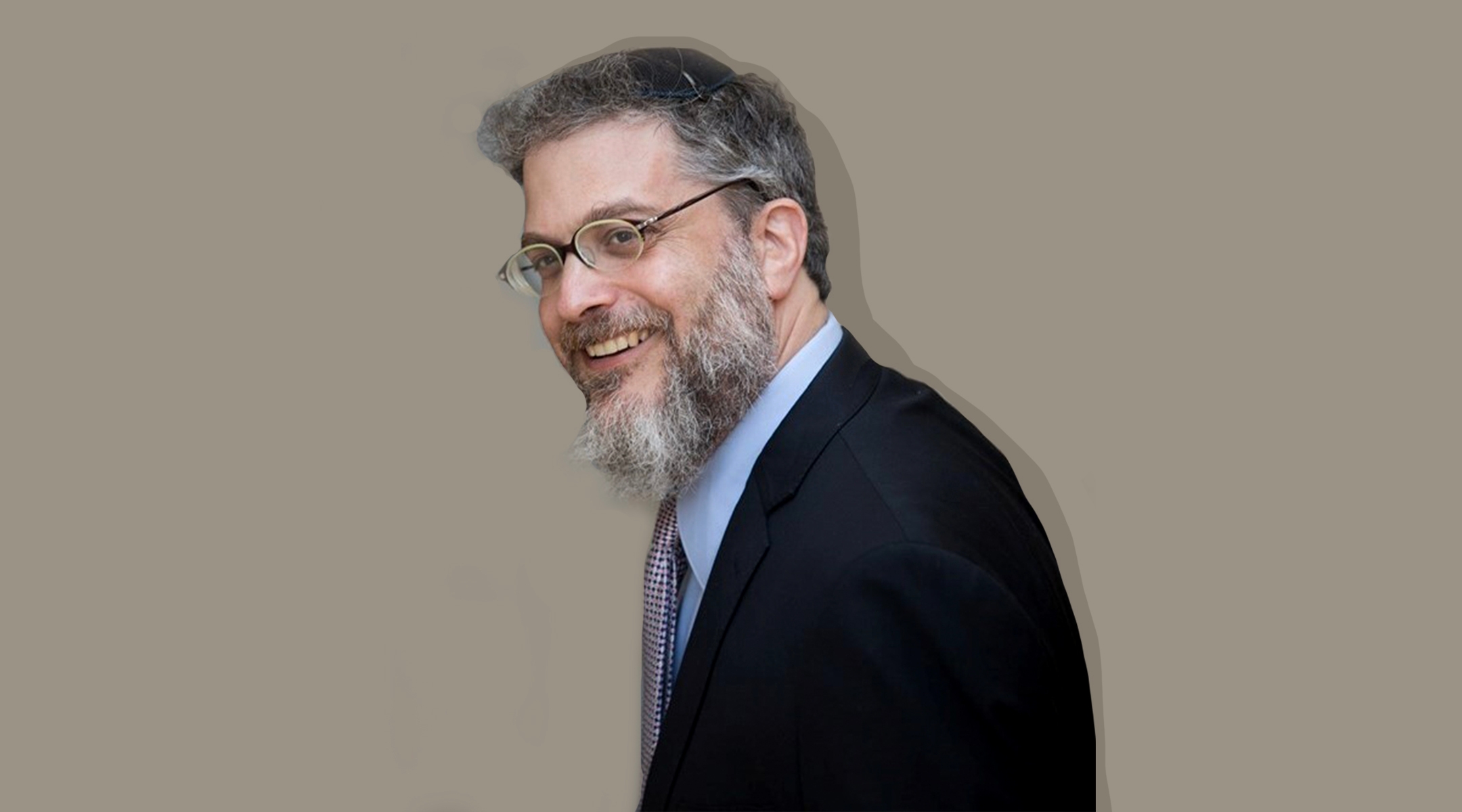
Elli Fischer

Rabbi Elli Fischer’s discovery helped expose a controversial practice by a flagship institution of Jewish learning.  (Kinneret Rifkind)

Located in Upper Manhattan near Columbia University, the Jewish Theological Seminary is the academic and spiritual heart of Conservative Judaism. Its library is arguably the most important repository of Jewish knowledge in the world, featuring some of the very first books printed in Hebrew, a letter written by Maimonides about 800 years ago, and thousands of other rare and unique texts. 

A tension between the institution’s mission of ordaining rabbis for Conservative congregations and its expensive archival responsibilities have existed for more than a hundred years, going back to the moment when rich New York Jews envisioned a ”Hebrew book museum” at the seminary to rival the collections of imperial Britain. 

“We should hold in view the purpose to make our collection as nearly complete as the resources of the world may render possible, and in so doing, we should spare neither thought nor labor nor money,” said Mayer Sulzberger at the dedication of a new building for the seminary in 1903. 

Sulzberger and the rest of the era’s mostly German Jewish donor class made good on that promise. Alexander Marx was tapped to head the library in 1903, and he embarked on a buying spree that lasted for decades. 

“Marx was the bibliographical equivalent of a kid in a candy shop,” said David Selis, a historian studying the library. “He would buy anything that has any relationship to Jews in any language.”

But as it turned out, money for a museum of the Hebrew book did not remain as readily available in the 21st century. 

In 2015, the seminary signed real estate deals that saw the library building demolished and replaced with a luxury residential tower. The proceeds, some $96 million, boosted the institution’s endowment and paid for a campus redevelopment project featuring a new library with a much smaller footprint, as well as a new dorm and auditorium. 

After having been closed for construction for years, the library is set to reopen in the coming months, COVID permitting, with only a fraction of the books available on site. The rest can be called up from a distant warehouse. 

In the world of Jewish books, the real estate deal was widely understood as a divestment by JTS from book custodianship in favor of its mandate to train rabbis. But most have refrained from saying so publicly, according to interviews, because they do not want to be seen as disparaging or undermining an institution that remains essential for serious scholarship about Judaism. 

While the seminary was tapping its real estate for cash, it also decided to cultivate another revenue stream. 

As many had suspected, and seminary officials confirmed to JTA, the library had quietly sold off rare items from its library. 

The ledger of the rabbi from Tiberias went to a private collector in 2017 and eventually wound up on the auction block, served up by a Jerusalem-based firm called Genazym. The auction takes place on Wednesday. 

“The sale of this piece was deemed to be of minimum impact to the collection and financially prudent for the institution,” JTS spokesperson Beth Mayerowitz said in an email to the Jewish Telegraphic Agency providing the first public confirmation of such a sale. 

In an interview, the seminary’s chief librarian, David Kraemer, described the instructions he had received from his superiors: The administration and the board of the seminary wanted him to sell items of his choosing in order to raise a specified amount of money. Kraemer did not disclose the dollar figure. 

“I asked, ‘What in my collection would raise that amount without harming the core mission of the institution?’” Kraemer said, recalling a conversation with a few in-house experts whom he declined to name. “It had to be an item we had digitized and that we deemed relatively low research value.”
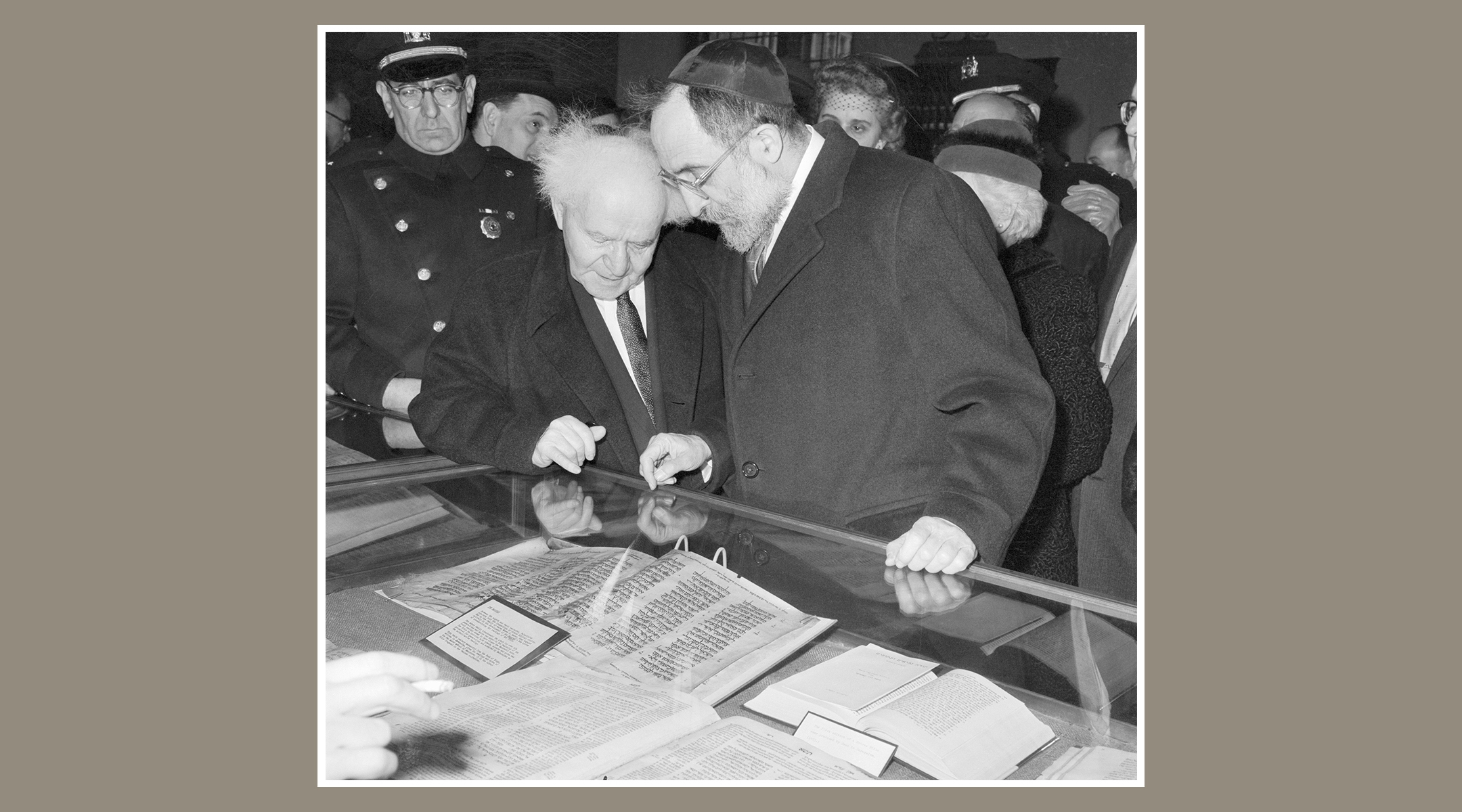
David Ben Gurion

Prime Minister David Ben-Gurion, left, of Israel views rare books and scriptures under glass in a case at the library in the Jewish Theological Seminary in New York, 1960. (Getty Images)

The task facing Kraemer was not as unusual as it might seem. Libraries and museums periodically sell items, a practice known as deaccessioning, often to raise money for the purchase of other items but sometimes under financial duress. 

Because the library at JTS was founded on almost indiscriminate buying, it had come to possess multiple copies of many books, even remarkably rare ones published at the dawn of printing.

In fact, the library had once held an extra copy of the first printed Hebrew book to be illustrated, Meshal ha-Kadmoni, or Fable of the Ancients, by Isaac ben Solomon Abi Sahula, printed in 1491 in Italy. 

In 1986, the book was sold as part of an auction through Christie’s, fetching the highest price ever paid for a printed book in Hebrew at the time. The library sold 95 items in that round and raised a total of $700,000. 

In the decades since, the library has gained a reputation for sometimes undervaluing its possessions. In 1998, for example, a copy of the first printed edition of the Torah in Hebrew that the library deaccessioned in a $50,000 deal quickly went on to sell for $310,000 at an auction. 

By 2015, when JTS was reportedly amid a financial crisis going back years, the seminary again mined its library and set up an auction, this time through Sotheby’s. But now the library wasn’t offloading duplicates.

JTS put up a series of works in Latin that are so old that they are not called books but incunabula, a designation for items printed before 1501. The sale included a 1455 edition of the Book of Esther from a Gutenberg Bible — it had been among the items showcased for donors on private tours of the library. The eight pages, “handsomely rubricated in red and blue,” sold for nearly $1 million, far beating expectations. 

Kraemer explained that books in Latin are outside of the library’s “core mission” and scholars rarely come asking for them. The money collected went to a fund to buy more relevant rare books, he added. 

An academic library like that of JTS has the legal right to sell anything it owns for any reason without publicizing it. In practice, libraries turn to deaccession only when they are facing budget shortfalls or have an opportunity to trade up, and they tend to publicly announce they are doing so. There are different views on what’s appropriate, but even those who frown upon particular deaccession decisions can accept the overall practice. 

It was the lack of transparency around the sale of the manuscript that especially riled Judaica librarians and consultants, many of whom wondered what other items might have slipped away unnoticed.

Indeed, other such private sales have taken place in recent years, according to seminary officials. 

“The sale of Pinkas Shadar of Israel Hayyim Raphael Segre (1807-1809) and several other items took place in a private sale in 2017 and was one of a few sales that occurred since 2015,” Mayerowitz said.

Among the items that went, she added, were several volumes of the Bomberg Talmud printed on blue paper and a copy of the Prague Haggadah on parchment. 

“Those of us who are book people in our blood, we see this and we get pissed off,” a former library employee said. “These books don’t belong in a private collection. If JTS had been transparent I could almost understand. But they are selling books out the back door. The seminary is using the library as a cash cow.”

Kraemer rejects the idea that the sale and subsequent removal from the online catalog were inappropriate. 

“The sale wasn’t announced because it was a private transaction,” he said. “People will interpret it how they will interpret it.”

Part of the reason why it’s hard to evaluate whether the seminary acted properly is that it doesn’t have a set policy on deaccession. The library at nearby Columbia University has a blanket policy against it, as does Yeshiva University, another Jewish institution of higher learning with a substantial albeit lesser Judaica collection.

Absent laws and mutually agreed-upon rules, each institution sets its own policy. That’s different from the related field of museums. The powerful Association of Art Museum Directors lists guidelines against deaccession, which were temporarily relaxed at the start of the coronavirus pandemic because of an anticipated budgetary shortfall. 

Some librarians would like to see a change in their field. 

“There aren’t norms and guidelines around deaccession, and that’s a problem,” said Michelle Margolis, the incoming president of the Association for Jewish Libraries. 

Margolis, a librarian at Columbia, said she’s part of a group that’s working on a solution. Common ethics would make it easier to tell apart bad actors and suss out theft.

For all their desire to obtain what’s in the public domain, thieves, as much as private collectors, need institutions to exist and thrive. By warehousing precious books, libraries create scarcity on the market, allowing the few items that do circulate to fetch high prices. 

Kraemer said he knows of no plans to sell more rare books, and the seminary says it is financially healthy. Like many institutions dependent on donations, the seminary was making emergency cuts at the start of the pandemic. But 2020 turned out to be one of its best years for fundraising in the past decade, according to Mayerowitz, the JTS spokesperson. 

A strong fundraising year would appear to come on the heels of years of consistent growth for the seminary’s endowment. Tax audits disclosed through the IRS show an increase every year for which data is available, going from $113 million in 2015 to $142 million in 2019. 

Mayerowitz also said that the seminary’s strong position is evident in its redeveloped campus with a performance space, residence hall and library, which she called “an investment in the future of not only JTS, but the entire Jewish community.”

A reminder of the cost of that investment presents itself against a slice of sky above the seminary. Where stacks of books once took up space, there are now 33 floors of luxury apartments — the towering Vandewater building is one of the tallest Manhattan buildings north of Central Park. 

The bulk of the library’s books will now forever be stored in a remote warehouse, with any item available for recall within one business day. That’s common practice for research libraries, Kraemer noted, adding that the most commonly requested books as well as the entire special collection — rare books and manuscripts — will be housed on campus. 

He said the decision to downsize the real estate and sell certain items was about being prudent and not a retreat from the 120-year-old promise to make the library the best of its kind in the world. 

“The library will never fail,” Kraemer said. “It’s so valuable that it will always find supporters. I am very optimistic about the future.”

Against the optimism projected by seminary leaders are two long-standing countertrends in American Jewish life. 

Judaism’s Conservative denomination, which counts the seminary as one of its essential institutions, was the largest Jewish denomination in the 1950s and ‘60s. It is no longer and is shrinking still. In 1990, the percentage of American Jews affiliated with the Conservative movement was estimated at 38%. A study from earlier this year pegged the number at 17%. 

Meanwhile, Jewish librarians and historians of Jewish libraries speak with reverence and affection of benefactors past. They name-drop library donors who died early in the last century, such as “Judge” Sulzberger, Jacob Schiff and Felix Warburg. Nostalgia abounds for an era when philanthropists — rich secular and liberal Jews — were committed to preserving Jewish cultural memory as a service to the Jewish people. 

“There just isn’t money for Jewish culture like there used to be,” said Selis, the historian of Jewish libraries. “A generation has passed. The culture has shifted in American Judaism.”

That a rabbi’s 200-year-old travelogue could fetch $200,000 at auction suggests demand for Jewish artifacts has not exactly dissipated as much as shifted somewhat. The marketing materials for the manuscript, published by the Jerusalem auction house Genzaym, speak to the change. 

Map of journey

A map of the journey of Israel Hayyim Raphael Segre in Europe in 1807-1809 (Getty Images)

After a nod to the ledger’s historical value — like documentation of the era’s communal fundraising system — the marketing message focuses on the “priceless and exceedingly rare collection of autographs” of great rabbis visited on the tour of Europe. These rabbis, who signed the ledger to certify their donations, are named, described and, in some cases, illustrated in the auction’s catalog. 

With its signatures, the ledger belongs to a class of books that have seen demand skyrocket, according to bookseller Israel Mizrahi of Brooklyn. 

“The market for books with provenance of important rabbinical figures, as well as anything signed or autographed by such figures, has exploded in recent years, with prices more than doubling every decade in the last few decades,” Mizrahi said. 

The increased competition for such titles is being driven by “the growing upper class” of Orthodox Jews, who see them as an investment but also as something else. 

“In the Orthodox Jewish world, many of the status-symbol purchases common in the secular world would be frowned upon, but items of religious significance are viewed in a positive light,” Mizrahi said. “There is widespread belief that owning something that was used or written by a righteous person will bring good will to its owner.”

It’s perhaps too early to tell what the rising influence of Orthodox collectors will mean for the ideal of public scholarship and communal memory in the digital era. Will more items disappear into the thicket of private vaults without notice, or will the archives persevere and somehow find new patrons?

If Orthodox Jewish researchers like Fischer have their way, the spirit of collective heritage will win. 

“These are treasures of the Jewish people, not of individuals,” Fischer said. “It’s important people have access to them.”

A Jewish Library’s Treasure Surfaced at Auction. How Did It Get There? Read More »

Making a Jewish Education Affordable at Harkham-GAON Academy

It’s no secret that for the past few decades, sending your child to a Jewish day school practically meant buying a car every year in tuition fees. Maybe not a brand-new car, but certainly close to one in price.

About ten years ago, Jewish schools started incorporating blended learning in hopes of lowering tuition costs. Of course, the idea of affordable school initially sounds great, but it also raises concerns, because as parents, we know that we absolutely cannot sacrifice quality in education.

We understand, because it is one of the very reasons StrongMind was created. When we started our journey in 2001, we were a small company with one school and a strong belief that every student deserves a great education. We wanted to provide the best online and hybrid education we could, but we ran into a problem: Quality digital curriculum was not being offered at the time.

That was when we decided to make the high caliber curriculum we simply couldn’t find! And here we are, 20 years later, a large company providing curriculum and technology services to schools across the country. At StrongMind, we offer an award-winning, immersive digital K–12 curriculum for hybrid and online schools that’s aligned and standards-based. Our lessons are built around the idea that if students are engaged, they will want to learn. Every video, graphic, story, and lesson in our curriculum is intentionally developed for the young learner, while preparing them for tests and becoming a well-rounded, college-ready citizen. The technology is user friendly and creates a seamless process so that the student can focus on learning.

Chesed Program

In Southern California alone, we have several highly populated K–12 schools with which we work, and in other states, we’re running the largest online schools available.

And yet, with all of these large, successful schools, we haven’t seen anything quite like the Harkham-GAON Academy (HGA). Originated from Rabbi Moises Benzaquen, he was concerned with the number of families who were opting out of a Jewish education, simply because they could not afford it.

Like we said before, every student deserves a great education; that includes Jewish day schools. Of course, there are still the more traditional schools that are equally important, but they don’t work for everyone.

This is why we partnered with Harkham-GAON Academy (HGA).

HGA has an effective model that drives student success. Their teachers are caring and dedicated, the athletics and electives they provide are outstanding, and the leadership is experienced and innovative. The school may be small, but it is mighty, and we don’t think it’ll be long before it becomes one of the largest Jewish hybrid schools in Southern California.

What we’ve seen since working with HGA is students thriving. Some of the colleges that Harkham-GAON graduates went on to attend includes the University of Illinois at Urbana-Champaign; University of Southern California; University of California Los Angeles; San Francisco State; California State University Northridge; King’s College, London, England; Victoria College, London; Yeshiva University; Stern College; Bar Ilan; and IDC Herzliya. Additionally, HGA graduates have had the opportunity to attend gap year programs in Israel, thanks to HGA’s assistance and encouragement.

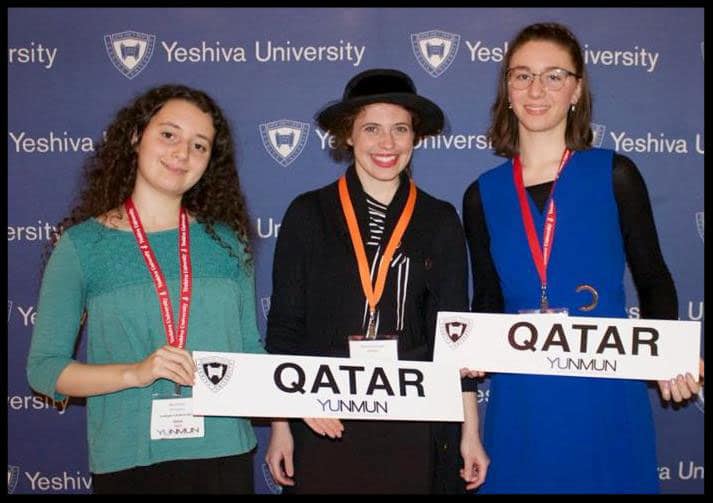
Model United Nations program

In their studies, students enjoy a rigorous college prep program of General Studies, which are taught online in a blended learning style, using our award-winning StrongMind platform; and Judaic Studies, which are taught in a traditional way by the school’s Rabbeim. College classes are offered as Dual Curriculum, giving our students the opportunity to complete one-two years of college classes while still in high school. Beyond that, HGA offers extracurricular programs such as Sports, Drama, e-sports, Model UN, and Music, for a truly rounded education.

As summer comes to a close and with school openings fast approaching, we hope you consider HGA. The school offers a truly high caliber education at a fraction of the usual cost. School starts August 18. For more information, give the school a call at 310.556.0663 or head to www.harkhamgaon.org.

Making a Jewish Education Affordable at Harkham-GAON Academy Read More »