fbpx

July 13, 2021

Poll: 25% of American Jewish Voters Believe Israel is an Apartheid State

A newly released survey has found that about a quarter of American Jewish voters view Israel as an apartheid state.

The poll, which was conducted by the Jewish Electorate Institute from June 28-July 1, asked respondents if they agreed or disagreed with the statement “Israel is an apartheid state.” Twenty-five percent answered in the affirmative; 52% disagreed, but those that disagreed were split on whether or not calling Israel an apartheid state is antisemitic––28% said it is antisemitic, while 24% said it isn’t.

Additionally, 34% agreed with the statement “Israel’s treatment of Palestinians is similar to racism in the U.S.” and 22% agreed that “Israel is committing genocide against the Palestinians”; of those that disagreed with these statements, 20% and 31% viewed them as antisemitic, respectively. Only 9% said they agreed that “Israel doesn’t have the right to exist,” and 67% of those that disagreed with the statement said that not believing in Israel’s right to exist is antisemitic. Sixty-two percent said they had an emotional attachment to Israel.

The survey also asked respondents about which groups they are most concerned when it comes to antisemitism. Sixty-one percent said they were primarily concerned about antisemitism from right-wing groups and individuals, whereas 22% said they were most concerned about antisemitism from the left, and 12% said they were concerned about antisemitism from both the left and the right.

On President Joe Biden, 80% said they approved of his performance so far as president and 74% said they approved of his handling of the Israeli-Palestinian conflict. Sixty-four percent said they preferred Biden’s handling of antisemitism to how former President Donald Trump handled it; 63% said they believe Biden is doing a better of job of handling the Israeli-Palestinian conflict than Trump did.

The Jewish Democratic Council of America (JDCA) hailed the poll as evidence of “why the past four years have only solidified the Democratic Party as the political home of Jewish Americans” in a tweet. JDCA also noted that “for the first time … Republican efforts to suppress the vote are a top political concern of Jewish voters,” a reference to how the poll found that 76% favor new laws “expanding voting rights” and 62% favor removing the Senate filibuster to get those laws implemented.

Others expressed concern about how a quarter of the respondents view Israel as an apartheid state.

“Poll finds a quarter of US Jews completely uneducated on Israel,” international human rights lawyer Arsen Ostrovsky tweeted.


The Elder of Ziyon blogger noted in a post that “the numbers are even worse for the young.” “American Jews are thoroughly ignorant about their own history, their religion, and the Jewish state. That ignorance translates into apathy and then into a willingness to believe the enthusiastic modern antisemites who pretend that they are merely anti-Israel.” The blogger added that the survey results reflect “a massive failure of American Jewish leadership, Jewish education, synagogues and the previous generation of American Jews who taught their children that Judaism and Israel aren’t priorities for them.”


H/T: Jewish Telegraphic Agency

Poll: 25% of American Jewish Voters Believe Israel is an Apartheid State Read More »

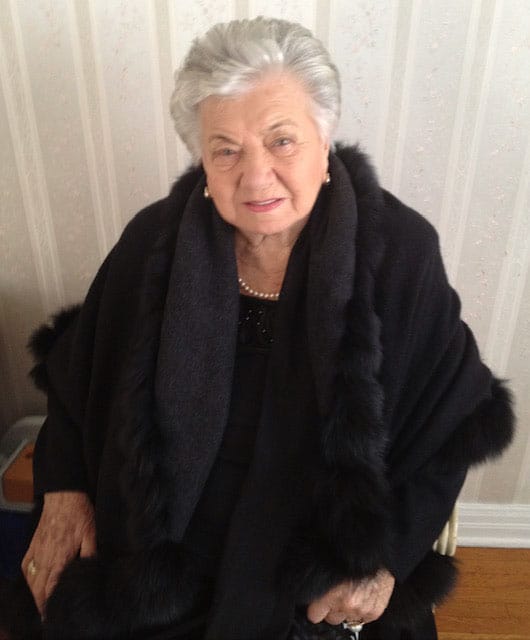
Rose Kotono, 1924-2021

The below is written in the first person but is a compilation of the eulogies recited at my grandmother, Rose Kotono’s funeral on May 10, 2021, by three of her granddaughters, Jessica Herschko, Gabriella Isenberg and Samira Miller.


I can’t believe I’m writing this about my Babie who I thought might be the first person to live until forever. It is hard to know where to start and how to properly celebrate and memorialize her beautiful and long life filled equally with great pain and great beauty, but I must try.

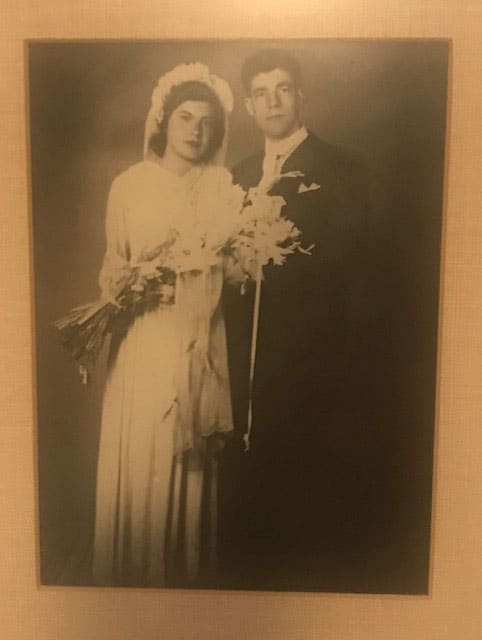
My Babie was born on January 30, 1924 in Sëilush, which was then Czechoslovakia.  She was a vibrant young girl and she used to tell me that like me, she always wanted to go and do and experience. They called her “Hoiluch Ruchel” which roughly means “Ruchel-on-the-go“ in Yiddish. Her early Life was modest but wonderful.  Her parents were religious, and she recounted that she only saw her mother’s hair when they arrived at Auschwitz. My grandmother attended Bais Yaakov school only for a short time and had to withdraw because of Governmental restrictions on religious studies.  Until recently, she would wash Negel Vasser and recite all morning prayers before she would eat breakfast.   Lighting Shabbat candles on time was extremely important to her as it now is to me.  This commitment to religion and community and spirituality was something she instilled in all of us.  It’s not about the minutiae of the rituals, but rather about a faith and the recognition in something larger than us-she was a woman of great depth.  When she was only 17, the Nazi’s tore her away from everything. She was instantly an orphan without siblings or a childhood. She endured and survived Auschwitz and returned, as most people did after they were liberated, to the town which she left, hoping to find a family member who miraculously survived. After days of waiting on the train platform to find someone who had survived, she was reunited was my Yankele Zeidy who had courted her when she was only 15 until the Nazi’s broke them apart too. As she told the story, my Zeidy proposed marriage one night while no one was around and when she asked who would witness this promise, he said that the ever-present moon will be their witness. With saddened hearts and empty pockets, they were the first couple to marry on July 22, 1945 in Vinogradov after the war and from that point on, they started to rebuild.

Among the basic tasks of starting anew, my grandmother made the time and used her energy to help others.  One of the most selfless roles she took on was being a foster mother to a baby while his mother battled Tuberculosis after the war.  She and my Zeidy could not allow his father to put him up for adoption.  Babie naturally grew very attached to this boy as she did not have any children of her own yet and was both devastated and elated when she returned him to his parents.  Another example of my grandmother and grandfather’s selflessness was allowing a stranger who knocked on their door after the war (asking for a place to sleep for the night) to stay with them for several years until he went to the army and even then, sending him care packages and after that, making his Chuppah when he married.

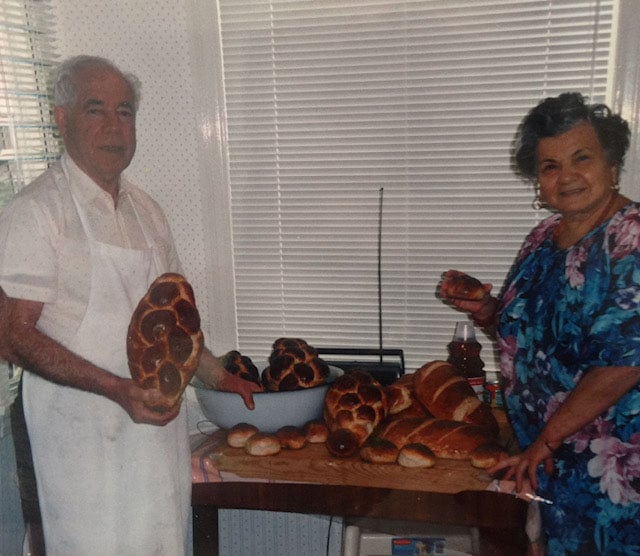
My grandmother was a doer.  I never heard her say “I can’t”. She was a matza baker, mikveh lady, and nurse to name just a few of the skills and jobs she had. She was a resourceful woman-from dividing a block of yeast using thread and distributing enough for every house to make Shabbos challah each week to making a full meal from one chicken (starting with soup and ending with helzle).  She made her wedding dress work for so many others who wore it after her regardless of their size. Many people came back to Sevlush after the war and carried lice. It was my grandmother who de-liced them. Boiling their clothes and cleaning them up-not a simple task considering she had to carry jugs of water from the well, boil the pot and repeat.

When fellow Jews were incarcerated, it was Babie who came up with the plan to buy their freedom from government officials. My grandfather executed the plan, and together, they saved families from becoming fatherless.

Babie loved the United States and the life she was able to create after immigrating here at the age of 51 in 1975 together with Zeidy. One of her happiest days was passing her citizenship test and receiving her US passport. I remember testing her on things like who the president was at the time, how many states we have and how many stars and stripes are on the flag. She beamed with pride and didn’t take her freedom lightly or for granted.  She worked hard as a private nurse in a convalescent hospital and was proud of her white uniform and hard work that, together with my grandfather’s equally hard work allowed them to buy a home which she lived in until her last day.

Needless to say, my grandparents were special people, theirs was a life and a love story for the books. The love they shared was palpable. They adored one another almost as much as they adored and lived for their family. My grandparents were the platonic form of perfect people to me. They were strong and selfless and fun and caring and nurturing and loving and classy and generous with everything they had. They appreciated everything they had, small and big, even something mundane like a piece of bread.  It was Babie’s lifeline until her last day. She was as happy receiving a loaf of bread as another would be receiving diamond jewelry. Throwing bread away was never done. She knew what it was like to be without it and yearn for a taste.  This type of appreciating for the things most of us find for granted was passed along to us and for that I want to say thank you.

Not only did I lose my grandmother and the matriarch of our family, but I also lost a friend, one of my best friends. My grandma was always up for anything. We watched shows together (she loved Seinfeld and the Golden Girls), we drew pictures together, went to the beach and the zoo and the grove and to light shows and the mall. We listened to music and played dominos together, ate “Voyosh Keńer” (buttered bread) together, laughed together and she told me so many stories from the old country as I shared about my modern life with her. My grandma was an elegant and beautiful woman with a real zest for life and always had a sarcastic and humorous voice and sharp mind.  She was a hard worker and an effective teacher. She taught me how to be a good person and how to be there for others. She told me that no matter who is hungry and asking for food to always give them food. I try to always do that.

I remember my Babie always cooking our favorite things: Shlishkelech, Kèmein Mog Levesh, Rantot Hoosh, Mai Pastetom and the list could go on for hours. I remember she sent me food to college through USPS and even just a few days ago she was caressing my arm and asking if I was hungry because her desire to care for and feed her family had no boundaries.

I could literally write a book filled with memories and thoughts about my grandmother and it’s hard to know when to stop but I’ll say, the world lost a great on Saturday.

I would be remiss if I didn’t talk about my mother, Edith Neuman for a moment. She is a woman, like my grandmother, who has sacrificed her own selfish wants. She has given us so many gifts but the biggest by far was taking care of my grandfather and grandmother until their last days and for cultivating such a beautiful home and relationship for us and for really showing us by example, what it means to be an exceptionally good daughter, mother and person.

My uncle Lipovt Kotono and my mother cared for my grandmother 24 hours a day 7 days a week to make sure she maintained her dignity, comfort and enjoyment until her last breath and for that I am eternally grateful. Thank you both from the bottom of my heart. I love you.

My Babie always loved nature and especially birds. She always doodled birds and flowers. She said that while she was in Auschwitz, she always envied the birds for their ability to fly away. Whenever I see a bird it’s all I can think about.

Shortly after Tom and I got engaged we came over to tell her the news (ever since I was 20, one of her first questions when I walked in would be “Sooo, what’s new?!” which obviously meant “Are you seriously dating anyone and are you getting married?”); she was so happy when I finally found my match in Tommy as she was also friends with his grandparents in the old country and it was truly a wonderful moment for her. When she asked Tom if he “zserets” which means “loves” me in Hungarian he answered her “ein imadom” which meant I “adore/worship her”- I’ll never forget the happiness in her face that moment.

Babie, ein imadom teidegdet es kosonnok mindenre. May you fly free as a bird and may you somewhere be reunited with all of the people you so terribly loved and missed all these years. You are the definition of holy and I will make sure my daughter will know you and Zeidy. I pray you will send me signs all the time and guide me as you always did.

My heart is broken.


Rose Kotono, 1924-2021 Read More »

Gaza Prof: “Israel Will Be Destroyed,” Some Jews “Will Be Killed, Some Will Be taken Captive, and Others Will Escape”

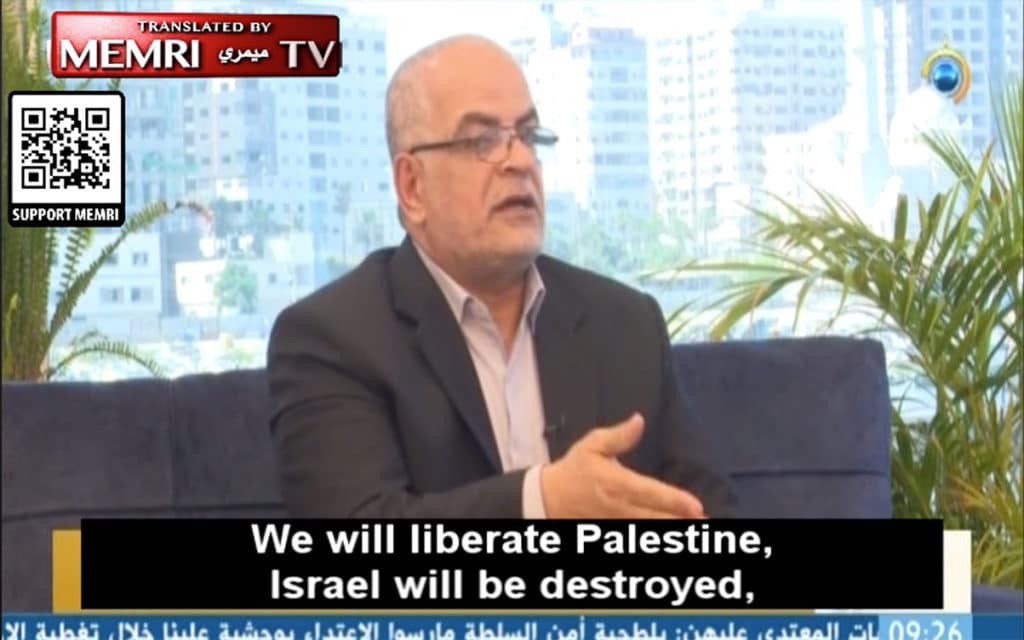
A professor in the Gaza Strip told Al-Aqsa TV on July 2 that “Israel will be destroyed” but some Jews will be able to escape.

The Middle East Media Research Institute (MEMRI) reported that Nasr Fahajan, a professor of Islamic Studies, said, “We will liberate Palestine, Israel will be destroyed, and we will establish the Islamic state. The Caliphate will be established in Jerusalem. Israel will be destroyed, and we will establish [the Islamic] state, Allah willing.”

Fahajan added that Allah will show mercy to the Jews “by allowing them to escape.” “The state [of Israel] will be destroyed, but there will be no annihilation of the Jews. … Some of them will be killed, some will be taken captive, and others will escape.” He also suggested that “maybe the Antichrist and his Jewish followers will try to flee in airplanes.”

Various Jewish and pro-Israel Twitter users denounced Fahajan’s comments.

“This is not just one man talking,” StandWithUs CEO and Co-Founder Roz Rothstein tweeted. “This is one Gaza professor reiterating an extremist ideology that promotes hatred and murder with religious justification.”

Sussex Friends of Israel similarly tweeted, “This is not a militant. Not a terrorist. Not even just an ordinary Gaza resident. This is a professor in Gaza declaring publicly and loudly his wish for the ‘annihilation’ of Jews (NOT Israelis, Jews!).”

Blake Flayton, Co-Founder of New Zionist Congress and George Washington University student, also tweeted, “They tell you what they’re fighting for. They tell you what future they desire. But western journalists, diplomats, writers, and activists will insist it’s not *really* what they mean—that we’re being unfair.”

Gaza Prof: “Israel Will Be Destroyed,” Some Jews “Will Be Killed, Some Will Be taken Captive, and Others Will Escape” Read More »

From Morocco to the San Fernando Valley: Journey of Em Habanim

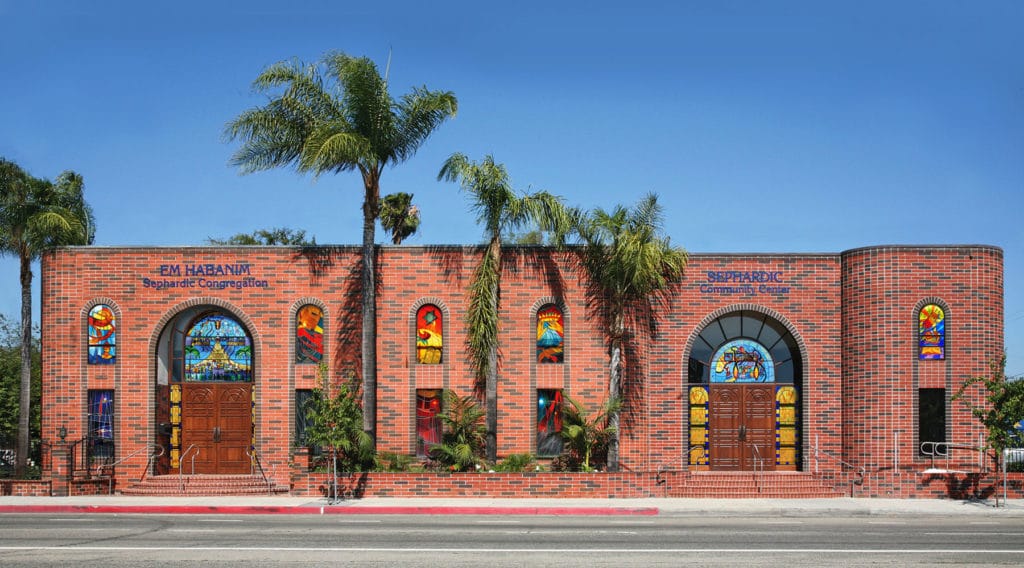
It makes sense to consider the proud Moroccan roots of the 300 member families of Em Habanim Sephardic Congregation, housed in a large, two-story brick structure in Valley Village.

Moroccan Jews are very much about roots.

You can’t walk through the grounds without noticing the artistic reminders of centuries of Moroccan Jewish history. Numerous stained-glass windows and wooden carvings are among the prominent furnishings.

Rabbi and spiritual leader Joshua Bittan, a member of the synagogue for the past 47 years, leads a visitor through the entrance off the parking lot into the Social Hall. From inside the hall, the traffic noise along Laurel Canyon Boulevard vanishes.

The first stop in the hall is a tall display case that contains various items intended to be a permanent reminder of the birth of the Em Habanim (translated as “Mother of Children”) community. One of these items is a memento donated by one of the founders: a leaflet dropped from the sky by American armed forces before the Allied invasion of French North Africa in 1942.

For the dozen men and women who, in 1974, founded the Moroccan synagogue, the date of Nov. 8, 1942, which was the start of World War II’s Operation Torch, is circled in red in their minds.

It was a difficult time for the Jewish community in Casablanca and across Morocco. The Vichy French occupied the country and were cooperating with the Nazis, Rabbi Bittan said.

On Nov. 8, American forces, on a mission intended to draw Axis forces away from the Eastern Front, showered the countryside with leaflets. Two American flags are depicted at the top of the leaflet, above messages in French and Arabic announcing that Moroccans soon will be rescued.

The leaflet preserved in the display case is both a reminder of the past and an emblem of the future of Moroccan Jewish life.

“This shul is not just a place for prayer,” said the rabbi, as he stepped from the Social Hall and headed for the Community Center, where neighboring Ashkenazi synagogues sometimes hold their simchas.

But prayer is the focus of Rabbi Bittan, who participated in the first Em Habanim minyan, and has been at the forefront ever since. For more than 20 years, he has taught a daily Daf Yomi class (one page of Talmud per day), starting at 5:15 a.m. He organized a scholarship fund at Em Habanim to help community families with grants toward covering the tuition costs of Jewish day school education.

A published author and editor of the synagogue’s weekly newsletter, Rabbi Bittan created a Talmud Torah program to convey the basics of Hebrew reading and writing, of mitzvot, and of the Jewish holidays.

While members of other synagogues may use the Community Center, the rabbi was clear that “our services definitely, definitely are very, very Moroccan traditional. We preserve our liturgy, exactly like it should be.”

Moroccan Jews were relatively small in number when Em Habanim was formed, but today there are said to be about 20,000 across Southern California.

Moroccan Jews were relatively small in number when Em Habanim was formed, but today there are said to be about 20,000 across Southern California.

There is an overriding reason Moroccan Jews are so proud of their native land: Unlike many countries where Jews have resided, relations between the royal Moroccan government and its Jewish community have been favorable for centuries.

It was Rabbi Bittan’s idea in 2019 to honor the royal family and Moroccan government for its loyalty to Moroccan Jews. He was inspired by a Jerusalem Post report that the royal Moroccan government had refurbished more than 160 Jewish cemeteries and a large number of synagogues.

On the evening of Nov. 19, 2019, Rabbi Bittan’s dream became a reality before a large crowd at the Beverly Hills Hotel. As the king’s representative, Princess Lalla Hasnaa, sister of His Majesty Mohammed VI, was a featured speaker at the gala dinner, headlined, “A Salute to Morocco, Honoring a Dynasty of Tolerance.”

“It is truly inspiring to see how strong your ties to Morocco remain,” the princess said. “Ours is a shared history, transcending all divides. The pride with which you celebrate your Moroccanness, sometimes many generations removed, is not only a source of joy but of great hope.”

On that same occasion, Sidney Chriqui, one of the Em Habanim founders and chair of the board, fondly recalled a scene from the war years. “Seventy-eight years ago in Casablanca,” he said, “His Majesty Mohammed V, of blessed memory, promptly reversed an antisemitic Vichy decision to expel Jewish students from school. I was one of them. His kind action allowed me to pursue my education. He is my hero.”

Further, he added, “we recognize the generous spirit and countless positive actions [the Moroccan government has] taken on our behalf.”

Like each of the 12 Em Habanim founders—Joseph Bouzaglou, Sidney Chriqui, Henry Elkouby, Edmond Levy, Salomon Levy, Arlette Marvin, Leon Peris, Salomon Perez, Marc Soussan, Salomon Benchetrit, Sarita Bouhadana and Albert Bouhadana—Rabbi Bittan is a native of Morocco and the author of a special story himself.

He came to America in 1973. Why? “God sent me,” Bittan said.

He is the founder and owner of Bittan Fine Art, on Ventura Boulevard; his son Moshe manages the company today.

Rabbi Bittan’s first role at the synagogue was Youth Director. Later, he held the position of President two different times for a total of 14 years. Finally, he became the pulpit rabbi.

Bittan was the acting rabbi of Em Habanim for three years before becoming the official rabbi in December of 2006 after he received his rabbinic ordination. He has fully embraced the second half of his career. His YouTube channel offers more than 2,000 videos of his brief talks on the Torah portion of the week. He plans to create many more.

For more information on Em Habanim Sephardic Congregation, visit emhabanim.com.

From Morocco to the San Fernando Valley: Journey of Em Habanim Read More »

LA’s Getty Villa Exhibits Treasures From Ancient Mesopotamia

(The Media Line) Artifacts from ancient Mesopotamia are on display at Los Angeles’ Getty Villa, and will be featured in two exhibits in coordination with the Louvre Museum in Paris and the British Museum. The importance of these works of art has increased tremendously in light of the recent destruction, by Islamic State, of many of the remaining ancient artifacts in Iraq and Syria.

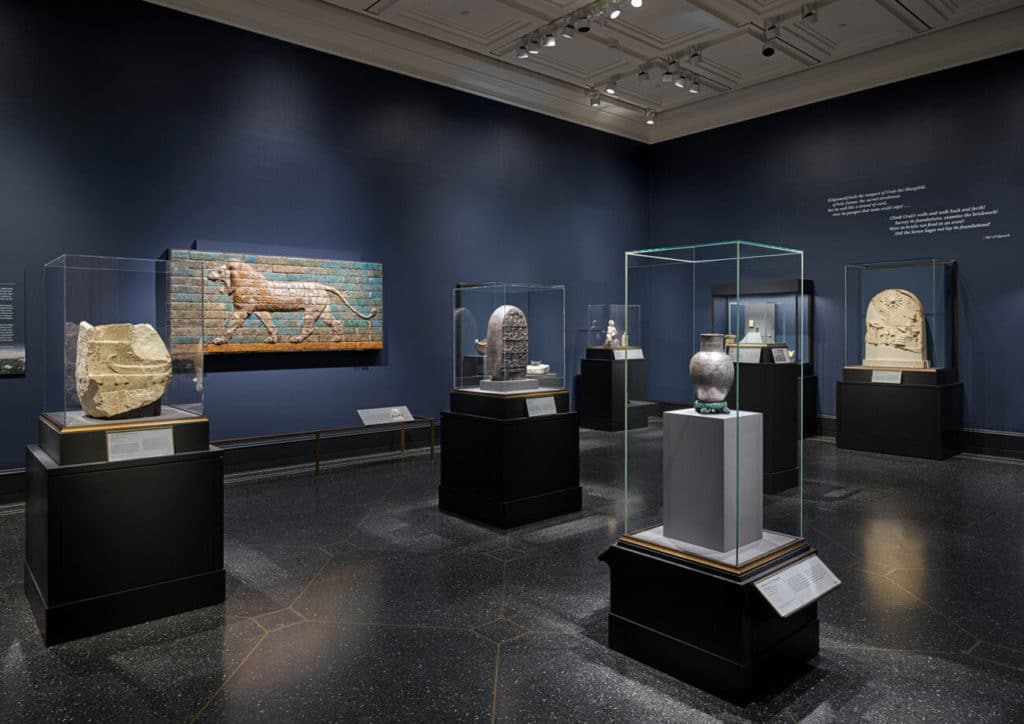
A selection of sculptures and reliefs from the ancient Near East are currently on loan from the British Museum and the Musée du Louvre to the Getty Villa, one of two locations of the J. Paul Getty Museum. These works of art have been divided between two exhibitions at the villa: Assyria: Palace Art of Ancient Iraq, an exhibition of stone reliefs from the palaces in Iraq, excavated in the 19th century, on long-term loan from the British Museum, runs through Sept. 5, 2022; Mesopotamia: Civilization Begins, drawn primarily from the Louvre’s great collection, is on display through Aug. 16, 2021.

Celebration after a Royal Bull Hunt, Assyrian, 875–860 BCE, Kalhu (Nimrud), Northwest Palace, reign of Ashurnasirpal II, gypsum. British Museum, London. (Allan Gluck/Wikimedia Commons)

The Getty’s preservation of and reverence for the Near East’s ancient treasures come at a time when the region’s antiquities are under threat of annihilation at the hands of terrorist groups, and theft by criminal organizations.

Jeffrey Spier, the senior curator of antiquities at the Getty Museum, told the Media Line that Mesopotamian artifacts have been, for decades, particularly susceptible to theft and destruction. “The Iraq war saw the damage and the looting of the Baghdad Museum and elsewhere,” he said. And more recently, the artifacts were threatened by “the deliberate destruction inflicted by ISIS, which sought to destroy many monuments in Iraq and Syria. … Sites such as Palmyra in Syria and Nineveh and Hatra in Iraq suffered terrible damage to ancient buildings and other monuments, which can never be restored,” Spier said. “Some museums, notably Mosul, were totally destroyed.”

Spier said museums had only a very limited ability to combat this destruction and the illicit trade in stolen artifacts. “There is little museums can do to prevent the sort of destruction occurring in the Middle East, aside from showing exhibitions that might make the public more aware of the importance of these ancient cultures,” he said.

Statuette of the Demon Pazuzu, Neo-Assyrian period, 934-610 BC, bronze. Musée du Louvre, Department of Near Eastern Antiquities, Paris. (PHGCOM/Wikimedia Commons)

“Although the Getty exhibitions do not focus on the recent destruction, they do mention what is happening, and I think this does impress on visitors how precious the works are.” This is especially important to Spier. “An appreciation for the skill of ancient artists and for the beauty of the works of art themselves” will lead to “a better understanding of an ancient empire that continues to impact the present,” he said.

The Getty has paid special attention to those who are directly linked to the nation in the Near East most greatly affected by the tragedy of artifact destruction and degradation. “We have reached out to, and had visits from members of, the Iraqi community,” Spier said. “Members of the Assyrian Students Association have organized visits for groups of young people on several occasions.” In addition, the Iraqi consul general in Los Angeles, Dr. Salwan Sinjaree, visited both exhibitions with consulate staff members and posted the visit on Twitter.

Head of a Bearded Man, Assyrian, 710–705 BCE, Dur-Sharrukin (Khorsabad), Royal Palace, reign of Sargon II, gypsum. British Museum, London. (Allan Gluck/Wikimedia Commons)

Souna Hashim of the Iraqi Consulate General in Los Angeles confirmed this solidarity with the Iraqi community. She told the Media Line, “The Getty Museum displayed Iraqi heritage (Assyrian era) at its best.”

Hashim said that “the government of Iraq keeps its heritage as its top priority,” and has pushed for UNESCO to “put the Citadel of Erbil on the World Heritage List, as well as the Marshes of Iraq, Uruk city, and Babylon’s Hanging Gardens.” Prioritizing Iraq’s cultural heritage sites came as a result of Islamic State’s recent occupations in the region. “Since ISIS emerged in Iraq in 2014, they deliberately destroyed cities that fell under their grasp,” she said, starting with heritage sites “under the pretext of Islam forbidding idols.”


Jacob Sagert is a student at Pepperdine University and an intern in The Media Line’s Press and Policy Student Program.

LA’s Getty Villa Exhibits Treasures From Ancient Mesopotamia Read More »

What Appointment of New Cal State LA Ethnic Studies Dean May Mean for Jewish Students

The recent appointment of Dr. Julianne Malveaux as Dean of Cal State LA’s new College of Ethnic Studies was met with outrage from the Jewish community after it was revealed that she has a history of defending Nation of Islam leader Louis Farrakhan. Despite Farrakhan’s well documented espousal and promotion of blatant antisemitism–he has argued that Jews control the media, the economy, and government and are responsible for 9/11 and the slave trade; called Judaism a “deceptive lie” and a “theological error”; and referred to Jews as “Termites,” “Satan,” and “the enemy of God”–Malveaux has denied that Farrakhan and his supporters are antisemitic. Instead, she accuses Farrakhan’s critics of racism and heaps additional opprobrium on Jews who urge leaders in the Black community to condemn Farrakhan’s antisemitism.

The Jewish community is also concerned about Malveaux’s public expression of antipathy toward Israel and Zionists. In May, during Israel’s war with Hamas, she claimed, “Israel has a lock on U.S. foreign policy, and too many Jewish people say that criticism of Israel makes you anti-Semitic.” And in a 2019 piece she effectively called for the elimination of the Jewish state and argued that BDS is a legitimate way to achieve that end.

Malveaux’s anti-Jewish and anti-Zionist views are not unique—in fact, they are shared by many others in the discipline of Ethnic Studies, including at her own institution.

Consider, for example, Melina Abdullah, a professor of Pan African Studies in the new College of Ethnic Studies. Abdullah has not only praised and partnered with Farrakhan in her role as founder and leader of Black Lives Matter LA, but she has also expressed her adulation for Farrakhan and demonized those who decry his antisemitism—in her CSULA classroom. In the final class of her semester-long course on Black Power (PAS 4400), which was live-streamed on her personal Facebook page last Fall, Abdullah praised Farrakhan’s leadership and accused his critics of malevolently conspiring to discredit him with trumped up charges of antisemitism.

Consider, too, Rabab Abdulhadi, Professor of Race and Resistance at CSU’s other College of Ethnic Studies at San Francisco State University and Director of Arab and Muslim Ethnicities and Diasporas (AMED). A founder of the U.S. Campaign for the Academic and Cultural Boycott of Israel and leader in the anti-Israel BDS movement, Abdulhadi has consistently used her classroom, AMED-sponsored events and AMED’s official Facebook page to demonize and delegitimize Israel and Zionists, and to encourage activism against them.

Since 2015, at least 50 AMED-sponsored classes and events have contained expression so blatantly anti-Zionist—including calling for and condoning anti-Israel violence and advocating for the elimination of the Jewish state—that it meets the International Holocaust Remembrance Alliance definition of antisemitism, and more than one-third of the AMED-sponsored classes and events involved the promotion of BDS. The Department’s Facebook page was frequently used by Abdulhadi to post messages vilifying Israel, promoting BDS, and denigrating Israel’s supporters, including and especially Jewish and pro-Israel students at SFSU, such as when she posted a message to the AMED Facebook page stating that “welcoming Zionists to campus … [is] a declaration of war against Arabs, Muslims, [and] Palestinians.”

Unfortunately Abdullah and Abdulhadi are not rogue Ethnic Studies professors with little influence or support from their respective colleges.

Unfortunately Abdullah and Abdulhadi are not rogue Ethnic Studies professors with little influence or support from their respective colleges. As one of a handful of faculty appointed by the former CSU Chancellor to the Task Force for the Advancement of Ethnic Studies in 2014 and a member of the Steering Committee of the university-wide Council on Ethnic Studies, Abdullah has played a major role in shaping the face of the discipline at Cal State. Abdulhadi, too, has been given free rein in implementing her vision of ethnic studies at SFSU. She has argued that using her classroom and university resources for anti-Zionist advocacy and BDS promotion are “part of my job duties … reasons why SFSU hired me in the first place,” and that such advocacy and activism are wholly consistent with “the mission and raison d’être of ethnic studies in general and the College of Ethnic Studies in particular.” Dr. Kenneth Monteiro, the Dean of SFSU’s College of Ethnic Studies who hired Abdulhadi, has backed this claim by consistently rebuffing Abdulhadi’s critics and vigorously defending her right to use her classroom and university resources to wage war against the Jewish state and its supporters.

In light of the antisemitic animus of Abdullah and Abdulhadi that has become, through their own successful efforts, institutionalized at CSU, the Jewish community must grapple with the distinct possibility that Malveaux was not hired to lead the new College of Ethnic Studies despite her anti-Jewish and anti-Zionist views, but because of them. They must also recognize what this means for Jewish students at CSU, who, as a result of the successful passage of AB 1460—a bill strenuously supported by Abdullah, Abdulhadi and Monteiro—will soon be forced to take an ethnic studies course that is likely to include the promotion of anti-Jewish and anti-Zionist ideologies and activism that can’t help but incite antisemitic hostility on their campuses.

And finally, given the outsized role that CSU’s two Colleges of Ethnic Studies will have in educating and training the next generation of K-12 ethnic studies teachers, the Jewish community must recognize the clear danger posed to Jewish children throughout the state if AB 101, the ethnic studies high school graduation requirement bill currently being considered by the California state legislature, becomes law.


Tammi Rossman-Benjamin is the director of AMCHA Initiative, a nonpartisan, nonprofit organization dedicated to combating antisemitism at colleges and universities in the United States. She was a faculty member at the University of California for 20 years.

What Appointment of New Cal State LA Ethnic Studies Dean May Mean for Jewish Students Read More »

Busy and Buzzy WeHo is Waiting for YOU!

Thank you to Curator Hotels and Resorts for inviting me to explore Summer 2021 at Chamberlain West Hollywood. I will be moderating the media panel for the Women in Travel Conference from their hotel, Le Parc Suites Hotel, on July 14, 2021.

Video: Welcome to WeHo

West Hollywood (WeHo) is busy and buzzy for summer with many new restaurants, parties and dancing all night. There is so much to do, all in a short walking distance from Chamberlain Hotel–so drop off your bags, your car and BOOK DIRECT for big summer savings.

Our suite was giant and gorgeous and even had a gas fireplace as well as a balcony! Up on the roof, you can rent the cabanas for your birthday party or other celebration. While we were there, they had drinks, balloons, cake and a Dolly Parton impersonator!

Did you miss celebrating during COVID? Make sure to get your ticket for Pool Haus Party at the rooftop pool of the Montrose West Hollywood. What a great afternoon vibe and more cabanas for birthday celebrating! We met so many lovely people and enjoyed the poolside music.

Bottega Louie recently opened – and it’s the westside outpost of the wildly popular restaurant in DTLA. While they don’t take  reservations , we only waited ten minutes for an outside table where we could people watch while drinking wine and eating perfect chicken parmigiana and salmon. Make sure to save room for their tempting treats including macaroons in every color or stop by for a morning pastry.

After dinner, it was a short stroll to the most happening spot on the street, The Abbey and The Chapel at the Abbey. Since 1991, dancers and drinkers have been enjoying this gothic-themed building with stained-glass windows and more than 14,000 square feet for watching the writhing men strut their stuff on stage! You can eat, dance, watch, drink and enjoy yourself!

In the morning, I hula-hooped by our rooftop pool and enjoyed the beautiful view. We walked by the Pacific Design Center and Jennifer proclaimed Cha Cha Matcha the best green tea outside of Japan. And after five world cruises and decades sailing the seven seas, she knows her tea!

Thank you to Jennifer Faust for filming with me!

Learn more about our DTLA adventure here!

Need more WeHo inspiration? Check out the VisitWeHo instagram page and find your next favorite hotel stay with Curator Hotels and Resorts! Great ready for my next video from Le Parc Suites Hotel.

Chamberlain West Hollywood: An intimate hideaway located in the heart of West Hollywood, The Chamberlain captivates with a collection of stunning 115 stylish suites, an exclusive guests-only restaurant and patio, and glamorous rooftop pool and terrace with 360-degree views of West Hollywood and beyond. Recently reimagined as a stylish retreat for Hollywood’s elite, the hotel’s design features sophisticated interiors that are reflective of old Hollywood glamour while integrating residential style comfort. The recently refreshed rooftop pool deck is an ideal space for play or leisure featuring posh cabanas, daybeds and lounge chairs, in addition to intimate gathering spaces to connect over cocktails. A top hotel in Los Angeles, The Chamberlain has been recognized in Condé Nast Traveler’s Readers’ Choice Awards.


Busy and Buzzy WeHo is Waiting for YOU! Read More »

Eating Away at the Planet

Nowadays, you can get anything you want whenever you want it, and that certainly applies to food. It probably comes as no surprise to most people that virtually all types of food are readily accessible year-round. This is because food today is produced in mass quantities whether its fruits, vegetables, or meat for the purposes of satisfying rising demand. But with over 7.8 billion people currently living on the planet, meeting that demand requires a proportionate space for agriculture, which our planet is running out of. Ever since the onset of the 1960s Green Revolution and its monetization of modern agriculture, developers have clung to dominant monocultural and land clearing practices to make more room for larger farm operations.

But with a population of 9.5 billion people projected for 2050, researchers expect worldwide demand for agriculture products to increase by 50% and suggest upwards of 2.1 billion additional acres of land (an area roughly the size of Brazil) would need to be cultivated and converted to agriculture. In the absence of available land, developers are tapping into forested areas for sources of arable land, prompting outlandish rates of deforestation, which the tropics have fallen prime victim to–an area that contains more than 40% of the world’s 4 billion hectares of forests. In fact, in the tropics conventional agriculture is responsible for more than 80% of deforestation, and between 1980 and 2000, over half of the new agricultural land (55%) came from intact forests while additional 28% came from disturbed forests.

Annually drastic forest and tree losses in the tropics have dismantled vitally important ecosystems, exacerbated the loss of biodiversity, and rendered the Earth less capable of sequestering carbon from the atmosphere. Combined with rising urbanization and the ongoing reliance on the fossil fuel industry, more greenhouse gases (GHGs) are disproportionately pumped into the atmosphere than are being naturally absorbed, thereby accelerating the rate of global warming and climate change.

One of these emission sources originates from the livestock sector of the agriculture industry, which is shockingly the second highest emitting source of GHGs behind the burning fossil fuels for electricity generation. Specifically, the livestock industry’s operations are responsible for 14.5% of global GHG emissions, the same amount shared by the entire transportation sector. Although small scale farms are less environmentally problematic, the bulk of meat production comes from factory farming, a system that packs large numbers of animals–notably cows–into concentrated and confined spaces. Because livestock release methane during their digestive processes, factory farms serve as concentrated sources of methane gas emissions, which are 28 times more potent than carbon dioxide over a 100-year period in the atmosphere. In the US alone, livestock methane emissions totaled the equivalent of 164.3 million metric tons of CO₂ in 2014 alone.

Plant-Based Power

By contrast, growing and eating more plant-based foods than meat products and encouraging sustainable food practices are simple ways to alleviate some of global warming stresses on the planet. Not only do plants require significantly less land than meat production, but buying and eating locally allows for food to be transported shorter distances, normally referred to as food miles. In the U.S, produce alone, on average, food travels 1,518 miles (around 2,400 kilometers) before reaching supermarkets, emitting 4-17 times more CO₂ than local transportation. Although studies show that the GHG emissions from long-distance transportation in the US dwarf in comparison to food production phases, countries that import food products such as grains, like Israel, are much farther away and often require transportation via shipping vessels, which are responsible for more than 3% of global CO₂ emissions.

Locally grown foods and its emphasis on plant-based diets have a smaller carbon footprint on the planet, and farm-to-table methods establish a direct relationship between the farmer and the buyer or restaurant, generating more awareness among consumers regarding how their food is produced.

The farm-to-table movement promotes growing and eating locally sourced food to reduce the carbon footprint that notoriously accompanies conventional food distribution chains. Not only does the environment benefit from avoiding concentrated and excessive GHG emissions, but food’s close proximity to consumers is simply more nutritious. The longer it takes for produce, for example, to get to your plate the less nutritious value it has because plant-based food essentially starts to die once it’s harvested.

Israel is proving to be an increasingly environmentally sustainable country, producing 95% of its own produce necessities, and the city of Tel Aviv is no exception. Tel Aviv hosts an abundance of sustainable food companies, a rising number of organic farming techniques and restaurants dedicated to strengthening the link between ethically grown food and its consumption. Farmers markets and community gardens usually uphold the farm-to-table culture, and there are 27 active community gardens solely in the Tel Aviv area where many restaurants and sustainable food companies have implemented their own rooftop gardens and urban farms.

Vegan Abundance

Opa, a contemporary vegan restaurant in South Tel Aviv run by chef Shirel Berger, emphasizes the importance of celebrating plant foods while also prioritizing local and seasonal ingredients and produce. She sources the restaurant’s ingredients from both their rooftop garden and local farms, exemplifying the emerging sustainable food scene blossoming in Israel.

With highlighted items such as black koji magnolia peas with nectarine liquor, smoked oranges with celery vinegar, and sourdough fermented corn bread with walnuts, the menu at Opa is unique. Not only are the dishes creative and inspiring, but also sustainably made and environmentally conscious.

“When I went to school, I started learning about the food industries and how horrible they are,” said Berger. “Then after working at ABC Kitchen in New York City and being exposed to the farm-to-table movement, I started to understand my responsibility in helping to make the world a better place as a chef, as a cook, and as a person.”

After acknowledging the environmental consequences brought on by conventional food systems, Berger emphasized the tangible changes people can make through their food choices alone to gradually alleviate such pressures.

“When we present our food to the table we explain where it came from and how the ingredients were sourced. Our restaurant is currently about 95% organic and if it’s not organic it’s at least local and the best quality we can find,” she says.

“The agriculture here in Israel is very unique and strong, and I think that we’re seeing more small organic farms emerging, but it’s certainly not mainstream yet,” Berger explained. She described how there has been a push within Tel Aviv to use what’s local, and at Opa, they attempt to optimize that message.

Another notable plant-based restaurant located in Tel Aviv is Cafe Anastasia founded by Roi Ezer and Tamar Ayalon who became vegan in 2012 after being exposed to the advantages of eating plant-based diets. Cafe Anastasia was the first vegan cafe in Tel Aviv and strays from sugars and white flours which result in more healthful and enriched food products.

Like Opa, a main goal of the vegan cafe is to show customers that food can be delicious, exciting, and reasonably priced without compromising personal and environmental health. One interesting aspect of the cafe is its vegan cheese products, all made from raw plant-based ingredients packed with high nutritional values and significantly lower carbon emissions than traditional dairy cheese. Similar to beef and other kinds of meat production, the production of dairy also prompts extensive land clearing for farm facilities as well as excessive natural resource use. Therefore, a widespread diet shift like this would drastically reduce the need for such practices and thus lessening agriculture’s impact on the environment.

Education is Key  

But what good are any of these farm business models, if the general public is not made aware of these efforts? Initiatives like farm-to-table and urban farming need the support of the public in order for them to yield significant and long-lasting impacts. Without informed exposure to the big picture problems and the solutions that are within reach, most people will default to supporting establishments that procure food through conventional means without being aware of the issues they are perpetuating.

As is the case with solving most environmental challenges, education is often the key to solidifying a solution’s place in society. Luckily, many educational initiatives are underway around the world and Tel Aviv is no stranger to such programs. Well known in Tel Aviv is Dizengoff Center’s urban green rooftop program where participants can engage in educational workshops and tours about sustainable growing techniques and the importance of modern urban farming.

With problematic food production and food waste on the rise, companies are even stepping up, building whole business models designed to holistically tackle the problem. The Soilless Magician, a boutique urban farm growing and selling microgreens using hydroponic and aeroponic techniques, is one such Israeli company providing educational services about food sustainability.

“Producing a sustainable product is important because of many reasons, but the biggest one is that our world is going to a bad place,” says Soilless Magician founder and CEO, Ofir Maoz. “By switching to a food system that disrupts the old non-sustainable ways and bringing in a fresh view with cheaper and healthier produce for better food, everybody wins.” Their microgreens are sold among different Tel Aviv farmers markets and nearby restaurants, and they promote their varieties of microgreens on social media for informative purposes.

Although these restaurants and companies are shifting Israel’s culture around food production and accessibility, this is only the first of many steps to improve food sustainability. Israel presently has a high volume of food waste issues costing the economy more than 3 billion NIS every year. Promoting farm-to-table habits and cultivating plants through sustainable methods like hydroponic and aeroponic systems may set a new standard and enable a larger behavioral shift to mitigate the pressures current agriculture places on the environment as a whole.

ZAVIT – Science and the Environment News Agency

Eating Away at the Planet Read More »

Hurry and Make Some Curry

This is just that recipe that we go back to time after time, year after year.

This is just that recipe that doesn’t require a lot of thinking. This is that recipe that is a real crowd pleaser and a recipe that has been one of our most requested.

Thai vegetable curry is a recipe that we’ve been cooking for over two decades. We both have our own take—Rachel still adds apple to hers—but we both include it on our menus all the time. Our families love it, especially the vegetarians. It’s amazing to watch the littlest kids gobble it up. And to make his curry hot, hot, hot, Sharon’s husband Alan, pours a generous amount of Sriracha Sauce into his bowl of curry.

The spices that are featured in this Thai vegetable curry—turmeric, cumin, paprika, cinnamon and ginger—are common to the Sephardic kitchen. It’s so simple to prepare but serves up complexly rich flavor. The curry spice adds a savory, earthy depth, the cinnamon and sugar add a pleasant warmth and sweetness, the coconut milk is dreamily creamy and the sautéed onions, garlic, fresh ginger, fresh basil and cherry tomatoes add brightness and pep.

This recipe is easily adaptable and very forgiving: you can add, subtract or replace the lineup of vegetables. Eggplant, cauliflower, green beans, butternut squash, zucchini, potato, broccoli, baby corn and peppers are all excellent contenders. Every combination works.

Make it anyway you like.

Serve it on a bed of fluffy white rice or nutty brown rice or even toasty quinoa.

Just make it.

Thai Vegetable Curry

1/4 cup extra virgin olive oil
2 yellow onions, finely chopped
6 cloves garlic, minced
1 inch fresh ginger, grated
4 tablespoons curry powder
1 teaspoon turmeric
1 teaspoon paprika
1/2 teaspoon coriander
1/2 teaspoon cinnamon
1 can of full fat coconut milk
2 cups of water
2 tablespoons parve chicken consommé
1 tablespoon sugar
1 teaspoon kosher salt
1/4 teaspoon pepper
14oz cherry tomatoes
1 small butternut squash, chopped in a 2 inch dice
1 cauliflower, chopped into florets
2 cups frozen green peas
1 14oz garbanzo beans, drained and washed
1/2 cup cashews
1 bunch basil, washed

In a large pot, warm oil over medium heat, then add onions and sauté until they are translucent.

Add garlic, ginger, curry powder, turmeric and  paprika and sauté for 2 to 3 minutes.

Add coconut milk and water, stir well and bring to a high simmer.

Add consommé, sugar, salt and pepper, cherry tomatoes, butternut squash and cauliflower, stir well and bring to a boil.

Lower heat and simmer for 20 to 25 minutes.

Just before serving, add peas, garbanzo beans, cashews and basil leaves and cook for 5 minutes.

Serve over jasmine or basmati rice.

Eggplant Curry (Photo by Alexandra Gomperts)

Eggplant curry

¼ cup olive oil
1 onion, finely chopped
3 cloves garlic, minced
1 inch fresh ginger, grated
4 tablespoons curry powder
2 tablespoons tomato paste
1 can full fat coconut milk or cream
1 cup water
1 tablespoon parve chicken consommé
2 medium eggplants, cubed and salted
1 cup cherry tomatoes
2 medium sweet potatoes, cubed
4 medium zucchini, sliced into ½ inch rounds
1 granny smith apple, peeled and cubed.
1 bunch lemon basil, finely chopped
Salt and pepper to taste

In a large pot, warm oil over medium heat, add onions and sauté until they start to turn golden.

Add the garlic, ginger, curry powder, and sauté for 2 minutes.

Add the tomato paste and sauté for 2 more minutes.

Add the eggplant and sauté until it turns translucent, keep stirring.

Add the rest of the vegetables and coat in spices.

Add the water and coconut milk, cover and simmer for 30 minutes.

Add the basil, salt and pepper to taste.


Rachel Sheff and Sharon Gomperts have been friends since high school. They love cooking and sharing recipes. They have collaborated on Sephardic Educational Center projects and community cooking classes. Follow them on Instagram @sephardicspicegirls and on Facebook at Sephardic Spice SEC Food.

Hurry and Make Some Curry Read More »