One verse, five voices. Edited by Salvador Litvak, the Accidental Talmudist
They said to Moses, “Your servants counted the soldiers who were in our charge, and not one man was missing from us. We therefore wish to bring an offering for the Lord. Any man who found a gold article, be it an anklet, a bracelet, a ring, an earring, or a body ornament, to atone for our souls before the Lord.
I’ve never tasted war. Never encountered the terror, ferocity and dehumanization of that experience. Fed on a diet of war images and personal accounts, I’m left with one searing question. How does any soul survive war?
How can any person thrust into an environment seething with fear and savagery, emerge a sane and emotionally stable person? Post-Traumatic Stress Disorder, PTSD, is the reasonable response of a soul exposed to a brutal experience. What’s amazing is that anyone comes back from war as a functioning human being! And yet, the protagonists of our verses did.
The war against Midian was fought against an enemy whose sole objective was to demoralize and corrupt the Jewish people. An enemy that had no compunctions prostituting their wives and daughters in their war effort. An enemy that saw goodness and holiness as a threat. “And not one man was missing” ostensibly reports that there were no casualties suffered in this war against Midian. This verse, however, can also be interpreted to convey that despite being forced to engage in the violent enterprise of war, none of the soldiers lost their humanity, their morality, their Jewish compass. None of the soldiers surrendered to the base and ugly impulses that war can unleash. No man was missing! You see, every soldier has two enemies, his adversary and himself. How he behaves in the battles of his life will determine whether he returns from war or is an ongoing casualty of it. Shabbat Shalom
Rabbi Elchanan Shoff Rabbi, Beis Knesses of Los Angeles
“Any man who found a gold article, anklet, a bracelet, a ring, an earring, or a kumaz…” offered that as an offering. Now what on earth is a kumaz? Saadia Gaon says it was a jeweled belt, Chizkuni says an arm band, Septuagint, a brooch. The Talmud (Shabbos 84a) says it was a genital shield of some kind, Rabbenu Efraim, R. David Pardo, and others explain this to mean some sort of chastity belt! According to the Jerusalem Talmud, it was a gold brassiere. There’s actually an opinion (R. Aaron Alrabi cited by Kaplan, Living Torah to Exodus 34:22) that it was a pornographic sculpture!
Now according to the interpretations that these items were sexually suggestive, are these appropriate religious donations?! The Talmud famously describes the reluctance of Moshe to accept mirrors donated by women used to beautify themselves as somehow less than appropriate, until God instructed him to accept them. Bartenura wonders, why no reluctance here? He explains: the mirrors were kept just as they were when attached to the vessel. But the kumaz was melted down and reshaped. There is no thing in the world cannot be used for holiness. Even feelings of lustfulness can be reshaped, and redirected. There is nothing about you that isn’t useful to connect to God. Nothing cannot be offered to Him. But you must reshape it. We cannot merely accept our tempers and weaknesses as they are. But we need not fear them, for if we recast them, they are the most glorious offerings possible.
Romain Hini-Szlos Photographer/www.rhsgallery.com
This verse begins with an ambiguous pronoun: “They came for Moses.” Who are “they”? The pasuk continues, “The officers appointed over the army’s thousands, the commanders of a thousand and the commanders of a hundred.”
Why did “they” feel the need to bring so many offerings to Hashem? The answer is found a few verses prior, during which the Torah uses the same language in referring to Moshe’s anger at the officers of the army, who, upon returning from the war against the Midians, brought back captives (Moshe specifically instructed that they should not take captives).
In realizing their mistake, the officers counted their army the same way that Hashem now counts His nation, to show his love and care for each one of His people. And when the officers counted and realized that no Jew who fought was missing, despite their grave mistake in taking captives, they provided offerings for the souls who fought against them. This teaches us a deeply powerful lesson: Even when we make mistakes, Hashem shows his mercy when we, as Jews, prove that we care for one another and can unite as one nation. Such unity can result in redeeming and even miraculous invincibility.
Yehudit Garmaise Journalist
After the telling b’nai Yisroel to wreak vengeance on the Midianites, who had enticed them to sin, by killing the adults and plundering their belongings, Hashem exacted a tax in which He would take 1 out of every 500 people, animals, or items taken from Midian.
In addition, without having been commanded to do so, the Jewish commanders collected 16,750 shekels worth of gold jewelry, which they also presented to Hashem.
What purpose did this extra donation of jewelry serve?
Of course, giving tzedakah, charity: whether kind words, actions, or money is the ultimate mitzvah that brings us closer to Hashem and serves as a kaporah, atonement, for our sins.
But the donation of gold also represents the war on Midian that we all must wage within ourselves every. The Lubavitcher Rebbe tells us that to enter a place, like eretz Yisroel, where Hashem is revealed, just as b’nai Israel must wage war on the forces that seek to destroy us on the outside, we must similarly wage war on our enemies within.
Like the jewelry that b’nai Yisroel took off themselves to give to Hashem, we can try to “give away” our need for affirmation that we seek to wear proudly.
Perhaps these three weeks, as we prepare for Tisha b’Av we can strive to move past our own needs for validation, and give away the “rings and bracelets” that we don’t really need.
Instead, we can remind ourselves what we say every morning in the davening: “Our souls are pure.” What other affirmation do we need?
Rabbi David Block Head of School, Shalhevet High School
After Israel’s battle with Midian, the military leaders noticed that not a single soldier had perished. As a show of gratitude to God, they decide to donate their inanimate spoils (namely, jewelry) to God. The gesture is beautiful – but also quite strange. Earlier, God instructed the people to donate living spoils (like animals) to God. But here, they choose to donate jewelry. Why?
The sensitive reader may notice that the list of donations has a fascinating resonance. “Gold objects, armlets… signet rings, earrings…” sounds quite similar to Israel’s earlier donations to the Tabernacle: “…earrings, signet rings, armlets, gold objects” (Shemos/Exodus 35:22). And perhaps that link purposeful.
The Mishkan’s construction happened right after the Golden Calf, when Israel had forgotten the Source of all they had. When they later donated to God the very materials that they had used to build the Calf (as Tosafos and others notice), they emphatically recognized that everything they had was from God. But 40 years later, as they began to move from an entirely miraculous existence towards a more natural order, that lesson was in danger of getting lost (a la Deut. 8:17-18). It would’ve been easy to attribute the victory against Midian to military prowess alone. But, when they saw that not a single soldier perished, they recognized that God’s will was incontrovertibly present. They reached back to the previous generation’s playbook. They donated gold jewelry – the very materials that, years earlier, served as a reminder that everything is from God.
Back in December 2018, I first had the pleasure of interviewing writer, director, producer and studio head Brian Volk-Weiss by phone. He was then promoting “Discontinued,” a show on The CW, which conceptually was not too far off from his Netflix docuseries “The Toys That Made Us.” The founder and current CEO of Comedy Dynamics – which has produced stand-up specials and/or comedy albums for the likes of Marc Maron, Ali Wong, Kevin Hart, Jim Gaffigan and Bob Saget, to name just a few comics – then had credits on more of the albums nominated for a “Best Comedy Album” GRAMMY Award for the prior few years than not.
Fast forward a few years and Brian Volk-Weiss is still not only heading Comedy Dynamics, creating shows for multiple outlets and directing acclaimed comedy specials, but he is also CEO of The Nacelle Company. The Nacelle Company made headlines earlier this year with the launch of 2 podcasts, including “Gates McFadden InvestiGates: Who Do You Think You Are?” And speaking of headlines made, Volk-Weiss and Dwayne Johnson have teamed for “Behind The Attraction,” which is set to premiere on Disney+ on July 16, 2021.
Simply put, few people in entertainment are not only as prolific as Brian Volk-Weiss while still quality-centric. I explored this idea and plenty more within our follow-up conversation on July 7, 2021, as embedded below for your viewing pleasure.
More on Brian Volk-Weiss can be found here, here and here.
Tisha B’Av (the ninth day of the month of Av), which we commemorate this year beginning on the evening of July 17, reminds us that over 2,600 years ago Jews failed to heed the warnings of the prophet Jeremiah about the importance of changing their ways. That failure resulted in the destruction of the first Temple in Jerusalem, one of the many tragedies experienced by Jews on that day, including the later destruction of the second Temple.
Today there are no prophets like Jeremiah to issue warnings, but we are receiving increasingly dire warnings from climate scientists that now it is not just Jerusalem, but also the entire world that is threatened by climate change and its effects. We may be met with disastrous consequences unless we immediately reduce our enormous emissions of greenhouse gases into the atmosphere.
While climate change is an existential threat, it has not received sufficient attention from most people, who are, in effect, “rearranging the deck chairs on the Titanic, as we head toward a giant iceberg.”
When I hear of children or grandchildren getting married or of a baby being born, I wonder what kind of world we are passing on to the new couples and children who will have to cope with our rapidly warming world, with its rising oceans and increasingly severe climate events. This is especially relevant to me as I write this, since my wife and I moved to Israel almost five years ago and have since happily experienced the marriages of four grandchildren and the births of two great-grandchildren.
Here are nine important reasons why we should all be very concerned about climate change:
Science academies worldwide, 97% of climate scientists, and almost all of the thousands of peer-reviewed papers on the topic in respected scientific journals document that climate change is real, is largely caused by human activities, and poses great threats to All 195 nations at the December 2015 Paris Climate Change Conference agreed that immediate steps must be taken to combat climate change.
Every decade since the 1970s has been warmer than the previous decade, and all of the 22 hottest years since temperature records were kept in 1880 have been since 1998. The year 2020 tied 2016 as the warmest year in recorded history, and as I write this, temperatures in the U.S. northwest are so high that they are considered life-threatening.
Glaciers worldwide, permafrost, and polar icecaps have been melting rapidly, faster than scientific projections. This has caused rising sea levels with the potential for major flooding of coastal, areas worldwide. Miami, Florida and other coastal cities have already experienced “sunny day flooding,” flooding due to high tides rather than storms.
There has been an alarming increase in the frequency and severity of heatwaves, droughts, wildfires, storms, floods and other climate events
California has been subjected to so many severe climate events recently that its former governor, Jerry Brown, stated that, “Humanity is on a collision course with nature.”California serves as an example of how climate change can wreak havoc and what other states can expect in the future if present trends continue.
Many climate experts believe that, due to self-reinforcing feedback loops (vicious cycles), we are close to a tipping point, when climate change will spiral out of control, with disastrous consequences, unless major positive changes soon occur.
While many climate scientists think that 350 parts per million (ppm) of atmospheric CO2 is a threshold value for climate stability, the world reached 419 ppm in 2021, and it has been increasing by 2-3 ppm per year. This makes catastrophic climate events more likely.
Climate scientists hope that temperature increases can be limited to no more than two degrees Celsius (35.6 degrees Fahrenheit), in order to avoid the worst effects of climate change. However, this possibility is rapidly vanishing, and the world is now on track for an increase of at least three degrees Celsius, which would result in great human suffering and significant threats to human civilization.
However, this possibility is rapidly vanishing, and the world is now on track for an increase of at least three degrees Celsius, which would result in great human suffering and significant threats to human civilization.[/SPEAKER-MUTE]
The Pentagon and other military groups warn that climate change will increase the potential for instability, terrorism, and war by reducing access to food and clean water and by causing tens of millions of desperate refugees to flee from droughts, wildfires, floods, storms, and other effects of climate change.
Given the above considerations, it is essential that we don’t repeat the mistake made by our ancestors who failed to heed Jeremiah’s warnings, but that we make averting a potential climate catastrophe a central focus of today’s efforts in order to leave an inhabitable world for future generations. Every aspect of life should be considered. We must shift to renewable forms of energy, improve our transportation systems, produce more efficient cars and other means of transportation, eliminate or at least significantly reduce our consumption of meat, and do everything else possible to reduce greenhouse gas emissions.
The future of humanity depends on whether we will heed the current widespread warnings and make positive changes now.
Richard H. Schwartz is a professor emeritus at College of Staten Island and author.
Whose job is it to define who I am? Is it an institution’s job or is it mine?
In all the brouhaha over Critical Race Theory (CRT), this question is rarely asked. That may be because much of the controversy over CRT has been about defining a nation and a system. CRT is a theoretical genre within the larger realm of Critical Theory that has become a mainstream movement. It teaches that the United States was founded on racism, oppression and white supremacy—and that these forces are still rooted in our society.
What gets overlooked within this movement, however, is that individual identities are being erased. This shouldn’t surprise us, given that a core idea of CRT is that racism is not merely the product of individual prejudice but something systemically embedded in legal systems and policies.
Because CRT does not encourage dissenting views, individuals feel pressured to go along with whatever box CRT puts them in.
Whether one is white, black or brown, individual identities inevitably get submerged by this systemic ethos. Further, because CRT does not encourage dissenting views, individuals feel pressured to go along with whatever box CRT puts them in.
This is highly problematic, regardless of where one stands on the overall issue. For one thing, the imposition of individual identity is a violation of a fundamental human right—the right to define ourselves as we wish.
The imposition of individual identity is a violation of a fundamental human right—the right to define ourselves as we wish.
None of us have identities that fit into neat boxes. I’m a Sephardic Jew born in an Arab Muslim country in North Africa. Some people consider me a Jew of color, although I look Caucasian. My identity is also influenced by groups to which I belong, from an Orthodox synagogue to industry groups to the passionate fan base of the Los Angeles Lakers.
My political identity is of a centrist who loves to engage with all sides. My views can change depending on new information. It’s hard to pin me down because I refuse to pin myself down. All this to say that no one has the right to define who I am, either as a Jew or as an individual.
And yet, in many ways Critical Race Theory aims to do just that—put people into neat boxes. Because CRT revolves around race and racial categories, by definition it must downplay the individual. We become defined by our skin color, a radical departure from Martin Luther King Jr.’s famous dictum that we ought to be judged by “the content of our character and not the color of our skin.”
This stereotyping is especially problematic for groups that have a long history of being put in stereotypical boxes that have led to their persecution, such as Jews. Throughout the centuries, Jew-haters have used any convenient box to attack Jews—communist, capitalist, powerful, weak, religious, secular, insular, universal, and so on. Today, one of the consequences of CRT is that Jews are put in the “ultimate white privilege” box, reinforced by an association with the powerful “white” state of Israel, a country that attracts an inordinate amount of antisemitic hostility, particularly when it defends itself.
As a result, Jews are facing a form of identity erasure, made worse by CRT’s erasure of individual choice.
As a result, Jews are facing a form of identity erasure, made worse by CRT’s erasure of individual choice.
The Jewish tradition, while valuing communal connections, values individual agency above all. We make choices as individuals, whether to serve God or our fellow humans. We sin as individuals, seek forgiveness as individuals and forgive as individuals. The major figures of the Bible, from Moses to King David, all had their individual flaws. The sages of the Talmud were in constant debate. The Jewish message is that none of us have static identities based on qualities or characteristics that can never change. Our message is always one of action and hope—each one of us is a work in progress, even kings and great leaders.
Critical Race Theory nullifies this powerful idea—that we are individuals with the power to make a difference, both in the world and in our lives.
We can and must teach in our schools the shameful and complicated racial history of the United States, and fight its lingering effects, but without ignoring the long arc of progress or the ability of individuals to think critically and strive for improvement. Even when we are part of groups—what is commonly known today as “identity politics”—it is what we bring to these groups as individuals that nourishes our lives and helps the groups succeed.
We have an obligation to teach our kids the universal truth that the sanctity of our individuality is the real source of human dignity. We might call that Critical Human Theory.
We have an obligation to teach our kids the universal truth that the sanctity of our individuality is the real source of human dignity. We might call that Critical Human Theory.
A London Jewish man was subjected to antisemitic slurs twice in the span of an hour while riding public transportation on July 3.
According to video and audio of the incident posted to Twitter by the Jewish man’s brother, a man threatened to slit the Jewish man’s throat “for Palestine” and “f—ing beat the s— out of you” while on a bus. After the bus driver called the police, the man shouted, “He’s f—ing Jewish” at the driver before eventually getting off the bus. The man proceeded to bang on the door of the bus and shout “Free Palestine” and “I’ll shank your mum.”
Later, as the Jewish man was going down an escalator at a subway station, a group of men in front of him shouted, “Kill a Jew” and “there’s a Jew behind us.”
My brother [who is visibly Jewish] was attacked on the 113 bus, heading in direction of Oxford Circus, London at 11:33PM and threatened to "slit his throat for Palestine". Will anything be done about this rampant #Antisemitism@tfl@CST_UK@antisemitismpic.twitter.com/iCKV62rA8b
The Jewish man’s brother told Sky News that he looked “obviously Jewish” at the time when he was subjected to the slurs and that he was “very shaken” after enduring the verbal abuse.
British Transport Police said in a statement to Sky News, “We take such incidents extremely seriously and are investigating. We believe everyone has the right to travel on the rail and underground without fear or intimidation.”
London Mayor Sadiq Khan condemned the incidents in a tweet, declaring that “hate crime will not be tolerated here in London” and vowed that the “perpetrators will face the full force of the law.”
Hate crime will not be tolerated here in London, and I’ve been in touch with the Met about these awful anti-Semitic attacks. The Met and BTP are investigating, and my team continue to work closely with @CST_UK . Perpetrators will face the full force of the law.
— SimonWiesenthalCntr (@simonwiesenthal) July 5, 2021
Jewish groups also denounced the incidents.
“It is absolutely intolerable that a Jewish passenger travelling on public transport should be subjected to disgusting racist threats and abuse in the UK in 2021 not once but twice on the same day,” Board of Deputies of British Jews President Marie van der Zyl said in a statement to CNN. “Those responsible should be, must be tracked down and prosecuted.”
Stop Antisemitism also tweeted, “This is life in… London for Jews in 2021.”
“Speak the speech,” says Shakespeare’s Hamlet. “Own your voice” and “speak truth to power” we hear in the streets. All sentiments ring true, but may also be taken for granted. Freedom of speech did not come about easily, and it may not be so free.
50,000 to 100,000 years ago, early humans in deserts, mountains, beachfronts, forests and farmlands established language to allow for invention, specialization, negotiation and trade.
So began speech, a social technology that is compositional. Animals bark and meow, grunt and roar, and have sophisticated non-verbal communication, but they cannot tell a story, recount the past, discuss the future, or create poetry, plays or prose.
René Descartes posited, “I think, therefore I am,” and in so doing established the philosophical principle of personal existence. Human evolution’s implicit claim, on the other hand, is “we speak, therefore we relate.”
There are some 7,000 spoken languages on our planet today, and about half as many written ones. Billions of independent human minds evidence an obviously diverse range of existence, but the concept of our individual “freedom” of speech had to be developed, enshrined, protected and nurtured.
As we shall discover, the right to speak or write one’s mind is a messy but meaningful natural right, one worth affirming rather than censoring or cancelling.
My series of columns on free speech begins with religious guidance that demands morality in our speech and then reveals a history of governmental rule that continues to punish unauthorized speech.
My series of columns on free speech begins with religious guidance that demands morality in our speech and then reveals a history of governmental rule that continues to punish unauthorized speech.
We then observe the western Enlightenment, which advocated for individual conscience and helped to influence the First Amendment to the United States Constitution and the legal jurisprudence expanding its protections.
The recent “progressive” counter-trend away from free speech principles in academia, the press, Hollywood, and other institutions has been driven by the new politics of political correctness, racial identitarianism, and the rise of what many have identified as the woke “cancel culture.”
The censorship of authors, books and opinions is now causing an equally dangerous phenomenon of self-censorship. The unique power of “Big Tech” challenges us to address private internet companies that are unilaterally and unfairly de-platforming citizens.
Fortunately, many heroes of free speech are fighting back, and they merit our attention. Innovation may help new voices emerge, as on the quickly growing app Clubhouse, a new type of social network based on voice, where people from around the world can engage in uncensored conversation in real time.
Finally, we seek to rediscover some first principles of civility in our speech. Assuming we protect our democratic right to speak freely, how can we converse and argue to our mutual benefit?
“Hear O’ Israel.” Listen with moral seriousness and an open heart. Today, public expression of views is under sustained challenge from what both Alexander Hamilton and Abraham Lincoln would have referred to as a “mobocratic spirit.” The American experiment in self-government requires nothing less than a serious contemplation of the rise, fall and potential reinvigoration of our freedom to speak and our right and duty to listen productively to one another.
Controlling Our Speech: Ethics and Authority
The Ethical Tradition: Religion and Speech
In the Jewish tradition we are called the “medaber,” creatures with the ability to form relationships through speech,which enables us to move beyond mere animal survival to philosophical inquiry and moral and ethical choice.
In the Garden of Eden, the serpent tempts Eve, and soon she and Adam verbally deceive God, as does their son Cain, who says “Am I my brother’s keeper?” (Gen 4:9). Genesis features countless family stories that reveal our collective struggle between deception and truthful expression.
Exodus (4:11) teaches, “Who gives man speech, is it not I, the Lord?” God’s covenant includes his ethical words of command—the aseret hadibrot, (Ten Commandments) — including the 9th Commandment, “Do Not Bear False Witness” (Ex 20:16).
King Solomon asserted that “life and death are in the hands of the tongue” (Proverbs 18:21). And yet, in “The Ethics of the Fathers,” a great sage says “in all my life, I have found nothing wiser than silence.” This beautiful sentiment is elegantly echoed by Rabbi David Wolpe in his book “In Speech and in Silence: The Jewish Quest for God,” where he notes that while songs, parables and prayers form a lasting culture, we make allowance with sensitivity for the injured and mute, and for non-verbal communication that reflects our tears and our fears.
Moses the lawgiver grappled with a speech impediment (“I am not a man of words…for I am of slow speech”), and yet he was chosen to speak to God. Before the plagues and the escape, Moses also spoke to Pharaoh on behalf of God, asserting “Let my people go.”
God too speaks, commanding the Jewish people to pass on their inheritance and destiny by telling their children the Passover story of liberation. “And you shall tell your child on that day, saying, ‘It is because of what the Lord did for me when I went forth from Egypt’” (Exodus 13:8).
The Torah seeks to balance the many stories of prevarication—recall the deception of Jacob, who pretended to be his brother Esau in order to steal his inheritance—with those of truth-tellers, like the righteous Noah and the suffering Job, who states with integrity “my lips will speak no wrong, nor my tongue utter deceit” (Job 27:3-5).
The religious priority for human speech then is to respect the sovereignty of God and use care not to denigrate spiritual authority. Also of great importance is the mandate to speak with care and to avoid using our words to harm others.
The religious priority for human speech then is to respect the sovereignty of God and use care not to denigrate spiritual authority.
Featured prominently in the rich Talmudic teachings are the laws of “lashon hara,” the imperative against “evil” speech, which is blamed for the destruction of the Holy Temple and seen in the punishment of Moses’ sister Miriam (Numbers 12:1-14).
We learn in the Mishnah, the first major book of Rabbinic literature, about the sages Hillel and Shammai, and their vigorous but respectful disagreements (some 300) over Jewish law, belief, and ritual practice. As a model, the house of Hillel is admired for showing humility and respect to opposing views, even verbalizing them with accuracy before presenting the counter-argument.
We are not to contradict a teacher or to speak before one who is wiser and we have an affirmative duty to speak up to protect an innocent or to prevent harm. The Chofetz Chaim, a leading rabbi at the turn of the 20th century, considered the prohibitions against unholy speech as the key to maintaining personal reputations and our spiritual relationship with God.
Reverence for God and religion is a serious principle. In Leviticus 24:10-13 the penalty for the offense of blasphemy is capital punishment (though not applied).
Christian theology adopted the Hebrew Bible’s (or the Old Testament’s) strict demand for respect in speaking about God. Jesus himself was accused of blasphemy and crucified for political offenses. His follower Stephen was stoned to death in the first century C.E. for publicly condemning the execution of Jesus, and other early Christians were killed for refusing to be silent about their beliefs.
As the Church grew powerful it sometimes enforced its objection to other faiths, and Christians whose views differed were persecuted. In the pre-Enlightenment period John Southworth, a Roman Catholic, was executed in 1654 for refusing to stop preaching. A Protestant, John Bunyan, who wrote “Pilgrim’s Progress,” was jailed in 1660 for preaching without a license.
Today, of course, many Christians profess a sincere advocacy for the ethical teachings of the Bible, including speaking up for the voiceless; not taking to heart all criticism; avoiding quarrel over opinions; refraining from turning a truth-teller into an enemy; being patient and kind in speech and quick to hear and slow to speak; and understanding that we will give an accounting for our careless words. Christians are taught that from the same mouth comes both blessings and curses. Proverbs 18:21 teaches “death and life are in the power of the tongue, and those who love it will eat its fruits.”
Many Islamic scholars observe a strict tradition of “scholarly consensus” that “abrogates” newer, alternative interpretive voices in the study of religious rulings based on Koranic law.
Upon the 1988 publication of Salman Rushdie’s novel “The Satanic Verses,” inspired in part by the life of Muhammad, violent demonstrations exploded across the Middle East and Europe. Iranian leader Ayatollah Khomeini banned the book and announced a $5 million fatwa on author Rushdie’s head. In 2004, Dutch filmmaker Theo Van Gogh directed a short film called “Submission” meant to support women’s rights in Muslim communities. He was shot and stabbed to death by an Islamic assailant.
The Sikh community reacted violently in London to the 2004 play titled “Behzti” (“Dishonor”). In 2005, Danish newspaper Jyllands-Posten published a sketch of the prophet Muhammad with a bomb in his turban. The cartoon was republished and broadcast across the Middle East, and hundreds of people were killed in protests. From Syria to Nigeria to Indonesia, Danish embassies were attacked, bombed, and burned, as were Italian and Norwegian missions. The anger continued in 2006 when a “day of rage” killed scores more.
Political cartoons labeled as disrespectful to Muhammad inspired the 2015 terror attack on the offices of the French satirical publication Charlie Hebdo.
In recent years many Christian publishers such as Necati Aydin, Ugur Yuksel, and Tilmann Geske have been murdered by Muslim Turks. Rami Ayyad, a Palestinian Christian, was found dead after receiving death threats.
The Wall Street Journal reporter Daniel Pearl was murdered in 2002 for his journalistic investigations of Al Qaeda, and the paper has since covered many instances of the criminalization of criticism of radical Islam.
Authoritarianism: Governments and Speech
This record of religious authority against unwelcome opinions has been matched in both eastern and western secular societies.
The first emperor of China, Qin Shi Huang, sought to control all political thought by executing scholars and burning all books of history and philosophy as subversive. Failure to adhere to these directives was punished by sending offenders off to hard labor to build the Great Wall of China.
In contrast, the ancient Greek word “parrhesia,” (“to speak candidly”) was favored as foundational to the pursuit of democracy. The rise of philosophers, playwrights, and poets in Athens offered early momentum for open discussion of politics and religion.
However, in 399, BC, perhaps the greatest of Greek philosophers, Socrates, was condemned to death for his independence of thought. His student Plato revealed his simple defense: “the unexamined life is not worth living.”
Skeptics, stoics and cynics who agreed on not much else all admired Socrates, the father of western philosophy, as the model proponent for questioning everything in the pursuit of truth and wisdom. Law students learn through the “Socratic method,” which sharply challenges views until clarity is found.
In Campo de’ Fiori, Rome’s famous marketplace near the place where Julius Caesar was murdered, Italian heretics were executed, such as magician and gnostic cultist Giordano Bruno, who was burned alive after 6 years of imprisonment. His final defense declared, “Perhaps your fear in passing judgment on me is greater than mine in receiving it.”
Englishman William Tyndale, translator of the first Bible printed in English, was executed, as was printer John Twyn, who published a pamphlet justifying the right to rebellion. Sir Thomas More was famously killed for exercising the freedom not to speak at all (in support of the annulment of the marriage of King Henry VIII and Catherine of Aragon.)
In the modern era, of course, totalitarian governments have targeted free speech. The Nazis banned books, pamphlets, and meetings and persecuted the famous White Rose movement of brave students at the University of Munich, led by the martyred Sophie Scholl.
In the modern era, of course, totalitarian governments have targeted free speech.
Free thinkers oppressed by the former Soviet Union included famous Soviet novelist Alexander Solzhenitsyn, nuclear physicist Andrei Sakharov, and Jewish refusenik Anatoly Sharansky among many others.
The Russian state has allegedly resorted to poisonings of political opponents and continues its oppression of independent-minded business leaders such as the noted journalist of the Chechen wars Anna Politkovskaya.
The long list of writers and activists from around the world persecuted for their speech includes South African anti-apartheid campaigner and writer Steve Biko, Lasantha Wickrematunge from Sri Lanka, Hrant Dink from Turkey and prominent Mexican journalists, including Javier Valdez Cárdenas and Jonathan Rodríguez Córdova.
Unfortunately, even the early American experience included the witch trials in the Massachusetts Bay Colony, where 19 colonial victims were killed based on a public hysteria.
Eventually, the western Enlightenment set the foundation for the expansion of freedom of religious conscience and political expression, found most prominently in the American First Amendment. As we shall discover, however, our legal path to secure freedom of speech from government regulation will still invite our analysis of those within our culture who seek to police and punish what they deem to be offensive speech.
zimmytws/Getty Images
Part 2: Free Speech and the American Way
THE ENGLISH TRADITION
If the Ark of the Covenant—that is, our modern religious views of speech—commands morality in our speech and deference to religious authority and the sovereignty of God, the arc of western legal tradition defends our natural right to speak our mind as sovereign individuals.
An important early advocate for the right of publishers to print ideas without prepublication censorship was English poet and politician John Milton. In 1644, before he went blind and later wrote his most famous poems (e.g. “Paradise Lost”) Milton anonymously wrote a pamphlet entitled “Areopagitica” (a reference to the ancient Greek hill on which orators freely debated).
Milton asserted that the Roman Catholic Church should not have ecclesiastical veto over public discussion; that readers’ exposure to a variety of opinions (good and evil) would allow for our human consciences to develop moral virtue; that censorship of the printed word would not alone ensure public morality (as song, dance, and theatre also attracted interest); and that the flourishing of the human mind through reason and rational debate rather than acceptance of authorized ideas argued against state licensing of published thought. Milton promoted the notion that public debate among intelligent minds was best without a partial umpire enforcing consensus or political unity.
Thomas Paine, English-born author of “Common Sense” (1776), was a key figure in communicating widely to the American public the necessity for revolution to advance religious liberty and to enshrine in writing our human rights to freedom of thought and conscience.
In “The Age of Reason” Paine theorized inviting, not denying, opinions with which one disagrees. “I have always strenuously supported the right of every man to his own opinion, however different that opinion might be to mine. He who denies to another this right, makes a slave of himself to his present opinion, because he precludes himself the right of changing it.”
In “The Age of Reason” Paine theorized inviting, not denying, opinions with which one disagrees.
John Stuart Mill, born in greater London, was a leading political philosopher, economist, and Member of Parliament. He was a powerful advocate for social liberty, believing “the struggle against authority is the most conspicuous feature in the portions of history.” He believed in the absolute authority of an individual as sovereign over his own person, and that government may interfere with his life only to protect society. This formed the basis for his famous “harm principle,” which approved restrictions on speech only to avoid harm to another.
In his essay “On Liberty,” Mill declared that free discourse is a necessary condition to social progress. Even false opinions are productive and may be corrected through an open exchange of ideas. “If all mankind minus one were of one opinion, and only one person were of the contrary opinion, mankind would be no more justified in silencing that one person, than he, if he had the power, would be justified in silencing mankind.”
Mill assumed good faith and responsible intentions, claiming that “unmeasured vituperation, employed on the side of prevailing opinion, really does deter people from expressing contrary opinions, and from listening to those who express them.” Debate, not dogma, forces an examination of beliefs in the quest for truth.
Similarly, British writer Evelyn Beatrice Hall penned the oft-quoted principle of many free speech champions: “I disapprove of what you say, but I will defend to the death your right to say it.”
AMERICAN LAW AND THE MARKETPLACE OF IDEAS
The First Amendment was subject to sincere debate among the Constitutional framers. The American Revolution aroused many to promote robust political expression as foundational to democratic values, though several state constitutions formally excluded “abusive” speech and suggested a duty of morality and civility as the basis for protected political speech.
The debate over ratification of the U.S. Constitution within the 13 American states was fierce, and unanimity was secured only upon the passing of the Bill of Rights, the first of whose Constitutional Amendments proclaims: “Congress shall make no law respecting an establishment of religion, or prohibiting the free exercise thereof; or abridging the freedom of speech, or of the press; or the right of the people peaceably to assemble, and to petition the government for a redress of grievances.”
Nevertheless, malicious writings seen as threats to the Federal government were prosecuted under the Alien & Sedition Act of 1789. The denial of Habeas Corpus in 1861 under President Abraham Lincoln during the Civil War also withstood constitutional challenge. During wartime, Americans tend to prioritize security even over cherished liberty.
With rare exceptions, however, the U.S. Supreme Court has moved over time to limit government “prior restraint” upon or control over the content of citizens’ speech.
In 1914, Supreme Court Justice Louis Brandeis acknowledged dismaying speech but wrote that “sunlight is the best disinfectant.” He believed that transparent airing of bankrupt or error filled views should not be hidden but exposed. In 1927, he noted that the remedy “to falsehood and fallacies….is more speech, not enforced silence.”
In 1919, Justice Oliver Wendell Holmes, Jr. affirmed the government’s prosecution of a socialist leafleteer who opposed the World War I draft, based on the standard of a “clear and present danger” to the recruitment and enlistment of troops. The Supreme Court much later narrowed this test to require proof of an “imminent lawless action” such as a public riot. However, in a famous dissent that same year, Holmes also opined that an anti-war anarchist must be allowed to compete in the “free trade in ideas.”
In 1937, Justice Benjamin Cardozo pronounced that free speech was “the matrix, the indispensable condition for nearly every other form of freedom.”
At the height of the Cold War, Judge Learned Hand affirmed the prosecution of communist speech as presenting a “clear and present danger” to the Republic. Today, this ruling is unpopular as too restrictive of political ideas, though the government’s banning of online terrorist videos promoting the overthrow of the U.S. government would likely rely on this reasoning.
In an important 5-4 opinion in Cohen v. California (1971), the Court overturned the conviction of a man who wore a T-shirt which read “F-the-Draft.” The Court limited the fighting words doctrine, rejected the application of obscenity laws to profane speech, re-asserted the protection of offensive speech, and declined the government’s argument that it could ban words it deemed unpopular. Justice Harlan summarized: “One man’s vulgarity is another man’s lyric.”
This is not to say all speech is absolutely protected. The American legal system has created numerous categories of speech that can be restricted by “time, place and manner,” or as “conduct,” or as “lower level” or “non”-speech.
Examples include restrictions on child pornography and obscenity; movie rating codes; defamatory libel and slander; incitement to imminent violence (i.e. taunting another toward suicide); true “fighting words”; threats to the President; criminal conspiracy; disruptions of courtroom, school, or library decorum; and the breach of neighborhood peace.
The Federal Communications Commission regulates the public airways, the Federal Election Commission regulates election speech, and the Securities and Exchange Commission regulates capital markets salesmanship. Various other aspects of commercial speech are also regulated to demand truth in advertising, including in the sale of food and drugs.
Some defenders of political speech have become more attracted in recent years to a perspective broadly held in Europe, which prioritizes a listener’s dignity when “harmful” speech injures or humiliates. The U.S. tort of “intentional infliction of emotional distress” is a legal path for those who have been psychologically damaged by the weaponization of words meant not to inform, educate, or even advocate, but merely to assault.
Two famous quotes by President George Washington reflect the dual concerns Americans share. First, he was very clear that “If freedom of speech is taken away, then dumb and silent we may be led, like sheep to the slaughter.”
However, in his famous letter to the Hebrew Congregation of Newport, Rhode Island, our first President captured the promise of America to all of its citizens: “Everyone will sit under their own vine and under their own fig tree, and no one will make them afraid.”
Here Washington seems to hint at the theory that a certain kind of hate speech against a fearful minority violates the democratic nature of our nation.
However, the Supreme Court has to date tended not to favor this legal reasoning and instead has repeatedly ruled across ideological lines in favor of the free speech rights of neo-Nazis upsetting Holocaust survivors in Skokie, Illinois; the Westboro Baptist Church chanters disrupting a private funeral with gay-bashing slogans; desecraters of the American flag; cross burners in front of African-Americans; robe and hood-wearing KKK marchers; and, one suspects soon, Antifa demonstrators wearing black masks.
“Sticks and stones may break my bones but words will never hurt me” is not true for many citizens. Yes, some speech will hurt, intimidate and damage — speech that is intended not to persuade but to attack.
“Sticks and stones may break my bones but words will never hurt me” is not true for many citizens.
Content moderators are busy censoring disturbing videos from appearing on your Facebook feed, such as cruelty to animals. Those who would regulate or punish “upsetting” speech argue that First Amendment protections are meant to apply only to “decent” or “civil” speech that expresses legitimate ideas.
The tension building in politically correct circles between a robust commitment to freedom of expression and the rising tide of left-wing political advocacy is best seen in the debates within the American Civil Liberties Union. Long advocative of the free speech rights of the unpopular, the ACLU began to wobble under pressure to prioritize instead a social justice agenda. In 2018, the ACLU formally announced new guidelines to prioritize progressive values in evaluating its commitment to advocate for the constitutional rights of speakers who do not meet the political litmus test of its Board and membership.
The debate is therefore joined between the European model, which champions a subjective defense of a listener’s right not to be emotionally harmed against the characteristically American idea of protecting speakers’ expressive rights to independence and individuality.
After the Danish publication of cartoons of the prophet Mohammed and the resulting wide-scale violence by Islamists, European governments essentially caved to the sensibilities of their growing minorities and initiated “hate speech” criminal prosecutions of newspapers, writers, bloggers, churches, business owners, pubic figures and average citizens in a way that continues to shock many Americans.
Compare this to the ability of American religionists to poke fun at their own dogma and culture yet remain loyal to their tradition.
The Church of Jesus Christ of Latter-day Saints earned deep admiration for its poise in responding to a decades-long mocking of their faith by putting advertisements in the “Book of Mormon” Broadway playbill. “You’ve seen the play, now come to one of our churches to see the difference!”
Our American jurists have repeatedly sided with controversial speech, upsetting speech, and politically incorrect speech. In his famous address to the Author’s Guild Council of New York in 1953, Justice William O. Douglas stated: “Restriction of free thought and free speech is the most dangerous of all subversions. It is the one un-American act that could most easily defeat us.”
As the Times Square ball drops each New Year’s eve, revelers follow up their midnight kiss, champagne toast, and signing of “Auld Lang Syne” (a Scottish poem meaning old times past) with a rousing rendition of “My Way”—the unofficial anthem of not only brash New Yorkers but also all Americans belting out hopes and determination to fulfill their dreams in the coming year
“For what is a man, what has he got, if not himself, then he has not. To say the things he truly feels, and not the words of one who kneels. The record shows I took the blows and did it my way.”
The English tradition and the American legal system have developed robust safeguards for individual expression. Political speech in particular is protected, even when it challenges cherished majoritarian ideas. While commercial speech and some other expressions can be regulated, the American way has generally favored the speaker over the listener. In recent years, sensitivities have developed to the point that, at least on college campuses, some younger citizens are increasingly attracted to a European style protection against “harmful” speech.
We must ponder whether Americans will continue to protect even deeply disturbing speech in the belief that while the cost can be very high, our freedom of expression is priceless.
Image by wildpixel/Getty Images
Part 3: Cancel Culture’s Freedom FROM Speech
A recent public policy opinion poll released by the Center for American Political Studies at Harvard University and The Harris Poll revealed that 64% of Americans believe that “cancel culture”—the bullying, boycotting, pressuring, and punishing of fellow citizens for their past and current verbal statements and written views—is a threat to their freedom. 87% agree that it is a problem of varied import.
At his 2019 Foundation Summit, former President Barack Obama decried “call out culture” and cautioned young American activists. This “idea of purity, and you’ve never compromised, and you’re always politically ‘woke’ and all that stuff…you should get over that quickly. The world is messy; there are ambiguities. People who do really good stuff have flaws…if all you’re doing is casting stones you’re not going to get that far. That’s easy to do.”
In a similar vein, former President Trump, in his 2020 Mount Rushmore Independence Day speech, stated:
“Our nation is witnessing a merciless campaign to wipe out our history, defame our heroes, erase our values, and indoctrinate our children. Angry mobs are trying to tear down statues of our Founders, deface our most sacred memorials, and unleash a wave of violent crime in our cities…One of their political weapons is ‘Cancel Culture’—driving people from their jobs, shaming dissenters, and demanding total submission from anyone who disagrees. This is the very definition of totalitarianism, and it is completely alien to our culture and our values.”
Of course, we all have the right to endorse or reject products and performers. We can “thumbs up or down” on YouTube, though we can only “like” (not “dislike”) on Facebook. We make choices with our time, money, eyeballs, hearts and minds. And it has always been the case that if enough people don’t watch a TV show, it reasonably gets “cancelled.”
Recently, however, we see the organizing of (mostly) online social media mobs to embarrass and harass, and to target and terminate. Being cancelled today often means losing one’s reputation and livelihood. Just as our country has seen a rise in political violence, from the left and the right, our culture has moved sharply into a kind of blood sport, where Twitter mobs, for example, target their victims relentlessly.
While American law continues to offer First Amendment protections against government restrictions on unpopular speech, American culture has been crushing and suppressing “offensive” words with increasing viciousness. What some call a new McCarthyism developed on American college campuses and is now a feature of the corporate entertainment world and now even parts of government as well.
ACADEMIA
In his important book promoting a true liberal education “The Closing of the American Mind: How Higher Education Has Failed Democracy and Impoverished the Souls of Today’s Students” (1987), scholar Allan Bloom noted that a society that opens itself to moral relativism while denying human nature (and fundamental math equations like 2+2=4) paradoxically closes itself off to critical thinking.
Bloom’s critique includes his concern that liberal arts students arrive to college campuses as coddled children, fragile, lacking attachment to reason, and ill-prepared to hear challenging ideas or real confrontation of thought. Once on campus, students are also not consistently being taught how to seek beauty in the arts.
It is well documented that many liberal arts faculties are ideologically imbalanced, especially in the social sciences. Consequently, the current intellectual climate of college campuses is one that essentially rejects non-conformity, preaches “value relativism,” and deconstructs the value of “free thought” and traditionally observed notions of what is good.
Even students in the physical sciences are now subjected to politically correct scholarship. While prejudice and error point our way to improvement and discovery of the truth, visceral political ideology and emotionalism are starting to substitute for substantive knowledge and wisdom.
Bloom has a worthy successor in Greg Lukianoff, (a self-described “pro-choice” liberal and atheist who has worked for environmental causes and the ACLU), who is President of the Foundation for Individual Rights in Education (FIRE) and co-author of the “Guide to Free Speech on Campus.” He is also the author of “Unlearning Liberty: Campus Censorship and the End of American Debate,” “Freedom from Speech,” and, with Jonathan Haidt, “The Coddling of the American Mind: How Good Intentions and Bad Ideas are Setting up a Generation for Failure.”
Lukianoff argues that citizens must not succumb to the idea of seeking intellectual comfort, likening it to an addiction to the pursuit of physical comforts.
His work unpacks the rise of campus cancel culture, with its political correctness, intersectional identity politics, micro-aggressions, and hate speech codes. All of this has emboldened radicals on American universities to dominate the conversation, and in many cases it has put students in a position either to write course essays that reflect the dominant identity politics discourse or to refrain from speaking up in class out of fear of ideological disapproval. Academic freedom has been replaced by the frequent selection and disinviting of speakers based on their political views. Both the literal and figurative “hecklers veto” enforces purity of speech and thought through sheer power.
The legacy of many in the American humanities professoriate is spending decades in their field engaging almost exclusively with contemporaries with whom they generally agree, rather than testing ideas and enjoying the provocative life of worthy dialogue and discourse with those who might challenge their politics. Many social science departments are stacked with like-minded political perspectives, with the rare conservative or Republican wildly outnumbered.
Students notice that “diversity” is meant to indicate everything except diversity of perspective, often experiencing indoctrination rather than education, with disproportionately biased ethnic studies courses and gender sensitivity training enforcing radical political views, now found even at high school and even elementary schools levels.
In a 2015 essay, columnist Bari Weiss, who felt so targeted by a woke mob of colleagues for her pro-Israel views that she quit the New York Times, describes the shutting down of speakers at Vermont’s Middlebury College and at U.C. Berkeley (once the famous home of the free speech movement) among many scenes of intimidation and violence throughout the country.
“These believers are transforming the campus from a citadel of intellectual freedom into a holy space—where white privilege has replaced original sin, the transgressions of class and race and gender are confessed not to priests but to ‘the community,’ victim groups are worshiped like gods, and the sinned-against are supplicated with ‘safe spaces’ and ‘trigger warnings,’” writes Weiss.
Weiss’s 2021 essay reveals the terror felt by parents who dare to question the intolerant views imposed upon their children in high school. “Real Time” TV comic Bill Maher (formerly of “Politically Incorrect” until that show lost advertisers and was suspended and then cancelled after his post-9/11 comments) called our collective situation a “climate of fear.”
In their stunning documentary about campus culture, authors and media commentators Dennis Prager and Adam Carolla plead for “No Safe Spaces” and reveal the dead end to free speech that results from allowing those who are “offended” to define what can and cannot be said in public, and by whom.
A poignant example: Ayaan Hirsi Ali is among the most impressive and dignified advocates for women’s rights in the world. A victim of female genital mutilation and various other abuses in her native Somali, she rose to election in the Netherlands parliament. An advocate for reform within Islam, she has long been threatened by Islamists and castigated by the American political left for her scholarship. When Brandeis University offered and then retracted her invitation to receive an honorary degree at its 2014 graduation ceremony, it bowed to pressure from the Council on American Islamic Relations and several student activists in an incident now widely seen as a shameful betrayal of academic freedom and pandering to ideological litmus tests.
ENTERTAINMENT
Censorship in the entertainment world used to come from traditional conservatives.
In the late 1920s and 1930s, the bawdy Mae West battled industry censors and helped to inspire government obscenity codes to regulate movies, radio and Broadway. The blacklists of the late 1940s and 1950s stalled the careers of accused communists. And in the 1960s, many stand-up comedians were arrested for obscenity, including countercultural satirist Lenny Bruce, in 1963 in West Hollywood, for the use of the word “schmuck.”
In the audience was a young George Carlin, who was also arrested for failing to present government ID. Carlin was a student of Bruce, and later famously did a bit about the “7 words you cannot say on television.” The popular television show “The Marvelous Mrs. Maisel” depicts some of these and other obstacles to freedom of speech faced by performers in the comedy world during that era.
In recent years, the Me Too movement accelerated the targeting of “bad actors” for public condemnation and firings. Many deserved their fate, including Hollywood heavyweight Harvey Weinstein, accused and convicted of multiple crimes. Once he was outed as a bully, many women came forward with stories of his abusive behavior. Hundreds of other high-powered men (and some women) also lost their reputations and positions among the industry elite, including actor Kevin Spacey and TV executive Leslie Moonves. Big name television journalists like Matt Lauer and Charlie Rose were also cancelled.
Today, however, the cancelling of celebrities and media personalities is increasingly a response to campaigns from the “woke” political left, with comedy perhaps the best example.
The great actor and renaissance man Peter Ustinov once said “comedy is simply a funny way of being serious.” If ever there should be a public forum for the free expression of offensive ideas, one would think it would be in the realm of comedy, which by its nature is seen as exaggerative and inviting to those who opt-in to hear insults and raucous opinion. Don Rickles is just one of countless famous stand-up comics who has made jokes based on racial or gender stereotypes. The Friars Club hosted popular televised “roasts” that were insult fests, a foreshadowing of Comedy Central’s Cable TV roasts, full of politically incorrect humor.
But being a funny man, or woman, now gets you no pass if you are accused of being politically incorrect.
Comedian Kevin Hart was disinvited from hosting the 2018 Academy Awards show after revelations of tweeted remarks deemed insensitive to some members of the LGBTQ community a decade earlier. Though he said he had grown in his views and had the support of Ellen DeGeneres, after his apology was deemed insincere by activists he declined to seek to be reinstated as host.
Comedian Roseanne Barr had a long and successful career marked by fairly outrageous public commentary, including Hitler jokes, and a 2018 tweet about former President Obama’s senior advisor Valerie Jarrett, which was considered racist. Barr apologized and tried to clarify she meant to be political, not racial, but her show was cancelled by ABC.
It is true that political bias and blacklisting today can cut both ways.
Kathy Griffin was turned persona non grata after a stunt in which she posted a photo of herself with a severed head, which looked like President Trump. She was fired from CNN and lost endorsement deals.
In 2021, Gina Carano, an outspoken but well-liked independent voice in Hollywood, was fired by Disney and Lucas Film, ostensibly for warning via Twitter that the Nazi-era featured neighbors turning on neighbors based on political correctness. While the Nazi comparison caused concern, she argued that her point was sympathy, not antipathy, for those targeted by totalitarian thought policing.
Noted liberal writer Jonathan Chait wrote that far worse has been said by Carano’s fellow left-wing colleagues, and likened her firing to McCarthyism.
The quick judgment of employers or sponsors who cave quickly to a perceived Twitter mob in order to halt bad publicity or a potential consumer boycott is unfortunate. Major League Baseball’s removal of the 2021 All-Star game from Atlanta is perhaps the gravest example of a public relations panic. The game will now be played in Colorado, which has voting ID laws similar to Georgia’s, not to mention a less diverse population.
But also concerning is the pre-emptive self-censorship by those not under scrutiny for past social media posts or commentary, but who are nevertheless unwilling to express their opinions in an environment policed by the most radical voices.
The thematic question of the 2015 documentary “Can we take a joke?” has been answered by Jerry Seinfeld, Chris Rock, Larry the Cable Guy, and many other comedians who have declared that they will not play for college audiences anymore because of what they might say to an audience unprepared to hear words of offense or political challenge to their left-wing orthodoxy.
GOVERNMENT
The government language control of 1984 is here.
U.S. military brass rarely speaks out publicly on contentious issues like the role of pregnant women in the military. Yet they rose up to confront Fox News opinion commentator Tucker Carlson, a frequent target of campaigns to have him fired for expressing independent views. The idea of military officials attacking a news commentator should give the entire country pause if for no other reason than, regardless of the merits of Carlson’s perspective, it is not the role of the military, a government institution, to publicly attack the speech of citizens.
U.S. Senator Tammy Duckworth (D-IL), applauded by Sen. Mazie Hirono (D-HI), asserted she would not vote to confirm any nominee of President Biden if they were white and straight. This is a level of race-based politics against which the entire civil rights community fought generations ago.
Perhaps the wokest of states, California for years has banned state employee travel to 8 “pariah” states, based not on pandemic health reasons but on opposition to different state laws on controversial social issues.
A member of the California State Assembly, Asm. Ash Kalra (D-San Jose, CA) recently introduced a bill (AB 655) to exclude from serving in law enforcement and subject to termination anyone associated with a “hate group.” But his definition includes anyone who is a member of a church or political organization that supported Proposition 8, the statewide constitutional amendment against same-sex marriage that passed with some 7 million votes in 2008. Even past membership in the Republican party or Catholic, Evangelical, LDS (Mormon) or some Orthodox religious communities would result in someone being banned from serving as a police officer.
Even liberal professors objected, and the author of the bill, Asm. Ash Kalra (D-San Jose, CA) stated he will back off and amend it to focus for now only on violent groups and not those who merely disagree with his views. But another piece of police reform legislation in California (AB 17) would subject police officers to discipline for social media posts that convey “bias.”
Cancel culture, in our education, entertainment, and the execution of rule by government leaders, is nothing less than bullying and intimidation, rather than fair play in a competition of ideas. It’s about power rather than debate. And its consequences are reduced educational excellence, the loss of our sense of humor and the shutting down of voices, and an abandonment of political discourse through sheer ideological control.
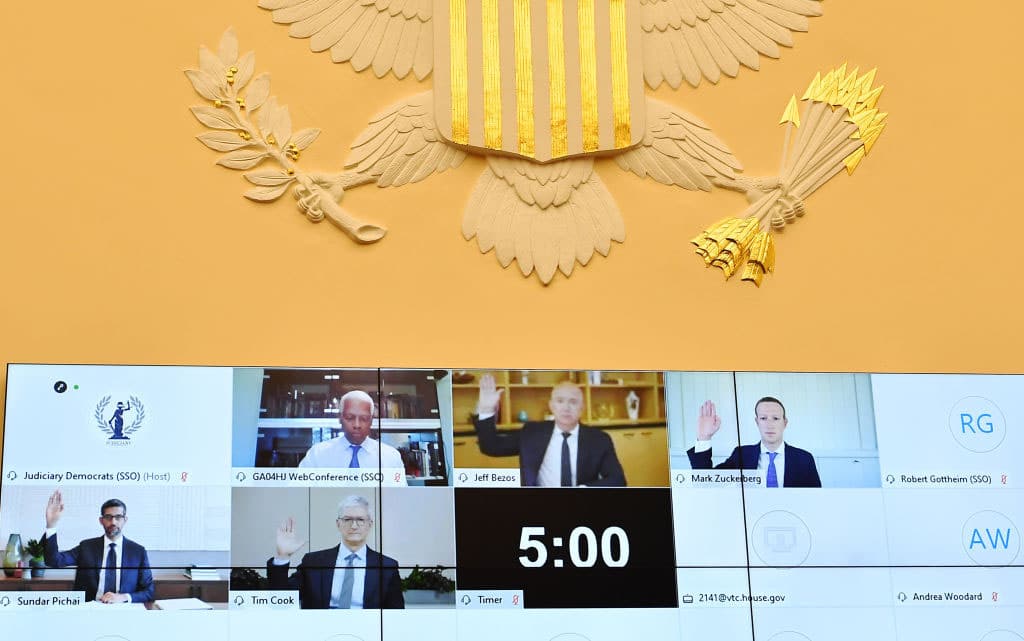
Amazon CEO Jeff Bezos (top, C), Facebook CEO Mark Zuckerberg (top, R), Google CEO Sundar Pichai (bottom, L), and Apple CEO Tim Cook are sworn-in before the House Judiciary Subcommittee on Antitrust, Commercial and Administrative Law on Online Platforms and Market Power in the Rayburn House office Building, July 29, 2020 on Capitol Hill in Washington, DC. (Photo by Mandel Ngan-Pool/Getty Images)
Part 4: Big Tech is Big Trouble
What is the difference between tyranny and totalitarianism?
Respected scholar and Hillsdale College President Larry P. Arnn clarifies that Greek philosopher Aristotle defined tyranny as the rule of one person or a small group in their own interests and according to their own will.
Totalitarianism is a modern concept that refers to the domination by those seeking not merely to know (through science) but to make (through technology). Today’s technological rulers seek to re-make our natural world and even human nature through control over our information and communication.
Arnn’s students study dystopian novels like George Orwell’s “1984,” Arthur Koestler’s “Darkness at Noon,” Aldous Huxley’s “Brave New World,” and C.S. Lewis’ “That Hideous Strength.” Unfortunately, the historical reality of the domination of individuals continues in our modern era via fascist, communist, and authoritarian regimes that continue to brutalize hundreds of millions of people with imprisonment and impoverishment, forced labor and torture, slavery and death, and continuing efforts to eliminate independent thought and human freedom.
For example, in China there are cameras nearly everywhere, recording misdeeds and punishing citizens according to their digital “social credit score” based on facial recognition and biometric data algorithms set to support the Chinese Communist Party’s (CCP) absolute rule. The CCP’s dictatorship also leads the world in environmental damage as the key player in the use of rare earth minerals, which are required for the massive industrialization of computer software, storage, and hardware.
The Big 5
In the United States, our voluntary actions and thoughts are now also increasingly recorded and anticipated not only by our government, but also by the new rulers of our information age, such as the “Big 5” technology companies (Amazon, Apple, Facebook, Google, and Microsoft).
The belief at the founding of the World Wide Web was that no one would own our data or personal websites except ourselves. But ethicists, consumer advocates, and defenders of our democracy now raise deep concerns over the dangerous power of Big Tech as social media companies collect, store, and commercialize our personal data, risking digital abuse and injustice.
Canadian social scientist Ronald J. Delbert has been among the most prolific of investigative critics of the problems and challenges arising from the internet, which relentlessly searches into our private lives. In his book, “Reset: Reclaiming the Internet for Civil Society,” Delbert asserts that human society has reached a “turning point,” and that “we risk irreversible losses of human freedom and privacy if we do not impose democratic controls on digital technologies and the companies and governments that deploy them.”
Cyber capitalism, combined with cyber surveillance by government and corporate actors, has achieved an awesome power to incite us and monitor us as consumers and as voters in ways we are just now beginning to understand.
The classic concerns around the internet include cyber bullying, doxing, consumer fraud, loss of privacy, mob shaming, vicious language, hacking and extortion, and foreign interference in domestic elections, among others. We now must add the quickly growing political bias and censorship being practiced by those in control of the modern marketplace of ideas.
Google, Facebook, Twitter, Amazon, and YouTube are the arbiters of what may or may not be searched or said on their massive platforms. Google manipulates the visibility of websites and the content it disfavors. These companies have banned politicians, medical doctors and scientific panels, opinion journalists, lawyers, comedians, parent groups, and advocates for a wide range of social causes and views. Twitter and Facebook frequently block content they don’t like, such as the New York Post’s revelations prior to the 2020 Presidential election that Hunter Biden, inter alia, was aggressively involved in leveraging for financial gain his father’s position as Vice President.
Social media companies now regularly ban or suspend accounts they deem controversial or that, they casually assert, promote “misinformation” or “hate speech.” YouTube has even restricted numerous Prager U videos discussing ethical issues such as the 10 Commandments, which led to a lawsuit won by the defendants, who argued that as private companies they have the right to censor content.
Those seeking to participate in an alternative to the current dominant social media companies have had a rough go as well. Parler, the social media company that bills itself as a free speech safe zone and competitor to Twitter, was kicked off Google Play and Apple’s ubiquitous app stores. Amazon Web Services, which controls much of the available public cloud infrastructure, removed Parler from its hosting service.
Millions of Americans have now lost their access and ability to follow organizations, commentators, and content they prefer. Accounts are locked capriciously, often with no explanation or appeal. The social media landscape has become another partisan and biased political war zone, with only one side having weapons. And free speech rights are at risk of further decline if the model of the United Kingdom, where citizens have been jailed for “grossly offensive” electronic communications even if the speaker is found not to have “intended” harm, is adopted.
A growing number of citizens now believe that Big Tech is harming our democracy, cherry-picking content to favor its partisan desires, and serving as judge, jury, and executioner in limiting the free expression of ideas. It is stifling not only free speech but also innovation as a dominant monopoly.
What can be done about the purposeful suppression of online speech by media companies that have seized control of our digital conversation? Put legally: Is this a violation of free speech by non-governmental actors? Might the use of antitrust laws help to combat censorship?
Defending Against Big Tech
Noted constitutional attorney Alan Dershowitz has argued that Big Tech companies are no longer mere platforms, but publishers who should be liable for their actions like any other media companies and disqualified from protection by the now infamous Section 230 of the 1996 Communications Decency Act, which provides legal protection to tech companies so that they are not liable for every post by millions of users.
Section 230 was meant to “clean up the internet” by empowering “carriers” to deny degrading and violent content without fear of liability for any posts they missed. And so, there is a role for content moderation to disallow the kind of obscenity, criminal activity, or terrorist advocacy and training that might cause irreparable harm to society. But as content moderation has now turned into viewpoint discrimination, the demand for the regulatory role of government is growing.
Here are six options for addressing the abuse of free speech by Big Tech companies.
a) Repeal or modify Section 230
Senator Josh Hawley (R-MO) (author of “The Tyranny of Big Tech”) has suggested this path. The tech exemption from liability as a mere neutral platform appears no longer to be valid. By choosing some content over others, Twitter, Facebook, and YouTube are now among the universe of publishers who should be subject to the same rules as other media companies. Enforcement might include large fines or breaking up companies through the precedent of antitrust laws.
Justice Louis Brandeis famously argued that big is often bad, leading to higher prices and less innovation. Today, tech isn’t driving up prices, but it is arguably harming democratic voices.
Judge Robert Bork’s antitrust precedent offers potential consumer welfare protection — is the product defective or immoral? One could argue that banning and de-platforming speakers one does not like is against the interest of consumers.
b) Company liability for viewpoint discrimination through jury trials
A plaintiff could argue that he or she was excluded from the town public square and harmed by being silenced. No one may be denied entry into a restaurant because of their skin color. Why shouldn’t a jury be able to determine the damages to one who was denied entry into a social media conversation? Preventing a citizen from joining a platform that is literally the modern town public square is a denial of equal access and violative of civil rights.
c) Enforce the Common Carrier obligation to allow various viewpoints on public issues
Scholar Richard Epstein has suggested the standard here would be to require a fair, reasonable, and non-discriminatory approach to speakers by carriers such as Facebook, Twitter, or YouTube. The Department of Justice and the Federal Communications Commission would likely be the relevant authorities to enforce equal justice under law to speak and assemble.
As well reported, Supreme Court Justice Clarence Thomas recently opined in the case Biden vs. Knight First Amendment Institute: “There is a fair argument that some digital platforms are sufficiently akin to common carriers or places of accommodation to be regulated in this manner.” Further, “[i]f the analogy between common carriers and digital platforms is correct, then an answer may arise for dissatisfied platform users who would appreciate not being blocked: laws that restrict the platform’s right to exclude.”
d) State by State regulation
If some states are now sanctuaries for illegal immigrants, couldn’t other states become sanctuaries for those denied access to social media platforms? States are already going their own way on a range of issues, from immigration laws to educational standards, and from gun control to the legalization of cannabis. 5 states have already enacted legislation to fight back against Big Tech censorship.
e) A Fairness Doctrine
This would require that private social media companies in control of the mass public square abide by basic non-discrimination and due process requirements. In the past, the telegraph, telephone, radio and TV airwaves, and cable networks were regulated to ensure they did not use their power to discriminate in favor of certain political viewpoints. If social media companies are now broadcasters, they could become subject to such revived oversight.
f) Competition
Without much government regulation, consumer choice will have to create the space for alternative voices in the social media landscape. Recall that in the Citizen’s United case, the Supreme Court allowed private companies to be considered private citizens entitled to free speech. Well then, let them compete under a libertarian model of free and open competition.
Not unlike in China, Silicon Valley’s Big Tech companies are collecting and manipulating data, favoring “authoritative” sources, and filtering internet users to assign “quality” scores to citizens based on their preferences and networks of friends. The American public is late to the game, but the good news is that most citizens across the political spectrum share deep unease at the commercial and political power of companies that are becoming far more ruthless and totalitarian than we ever suspected.
zimmytws/Getty Images
Part 5: Heroes of Free Speech
Reporters Without Borders, an organization that has been defending press freedom for more than 30 years, regularly documents the abuse of independent journalists throughout the world. In at least 200 countries, investigative reporters bravely seek to uncover government corruption, human rights abuses and anti-democratic forces that oppress citizen demands for religious liberty, free government and fair treatment under the law. That there exists an organization dedicated to the protection of journalists committed to these ends underscores the pervasiveness of the global threat to freedom of speech and press.
The Columbia Journalism Review points to the oppression of journalists in Hong Kong, for example, by Chinese censors. The Iranian regime is frequently charged with attacking journalists both domestically and throughout the Middle East region. And Turkey, Russia and many other nations with very troubling records of restrictions on press freedom have continued their censorship during the coronavirus pandemic.
The Newseum, a popular Washington, D.C. museum dedicated to the history of American journalism and the free press, was closed in 2019. The building was sold and its facade, a towering 50-ton, 74-foot outdoor tablet inscribed with the First Amendment of the U.S. Constitution, was removed in early 2021. More than a few commentators have suggested that this removal is an apt metaphor for a deteriorating media landscape in our country.
Throughout our nation’s history, abolitionists, activists and artists, along with pamphleteers, protestors and publishers have at times been confronted by either the police power of the state or the harsh condemnation of the public while defending their rights to freedom of speech, the press, assembly, petition and religious expression.
And every day regular citizens continue to make the choice to defy popular opinion by daring to write letters to the editor or speak out on talk radio; challenging a contentious or bullying professor; practicing their religious faith as a minority; or exhibiting moral courage by staying true to their sincerely held social and political beliefs.
In recent months, parent organizations have risen up to challenge the overwhelming power of teachers’ unions and government mandates that have shut children out of classroom learning and pushed heavily against the wishes of many parents on both health matters and the increasing indoctrination of students on political issues. Critical Race Theory (CRT), an ideological assertion of insurmountable systemic racism rooted in radical political beliefs, has proven to be a linchpin of many such challenges.
Our history of pushing back against suppression of speech suggests that we are a country that values viewpoint diversity. But while we citizens might unite around our theoretical commitment to such diversity, we disagree in our approaches to political correctness, campus speech codes, the regulation of workplace speech and the restricting or punishing of “hate” speech.
Recently, for example, a good faith effort by California state Senator Melissa Melendez (R-Lake Elsinore) to add political beliefs and affiliations as a protected class against discrimination in the workplace was rejected on a partisan vote.
Some find it difficult to remain protective of the voices with which they disagree. Many conservatives detest flag burning and some support the punishing of those who kneel during our national anthem. Most progressives abhor non-liberal opinions about lifestyle choices and some even endorse employer and university sanctions against “offensive” speech.
In an era of increasing intolerance and bitter contempt for those who don’t subscribe to the politically correct cultural consensus, the bravery of advocates fighting for free speech merits our respect. Some are freedom-loving conservatives, but many are principled left-of-center journalists, scholars and entertainers. Together, they share the classic liberal notion of fair play and value truth-seeking above partisan narratives.
Journalists
Much of the national broadcast media today has collapsed into “narrow-casting,” the ideological presentation of imbalanced news and information to a biased audience. Project Veritas has done some remarkable (but often unremarked upon by the mainstream media) investigative work to uncover extreme media bias and groupthink. Of particular note is CNN, whose leadership admits to directing a partisan agenda and whose officials have been caught on tape admitting to purposeful propaganda on behalf of the Black Lives Matter organization and far left-perspectives on racial and political issues.
Other mainstream media organizations have also failed the general public: ABC, which failed to report on the Jeffrey Epstein matter in a responsible way, and has admitted to the radical views of some of its reporters; CBS, whose 60 Minutes program recently conducted a widely-panned smear job on Governor Ron DeSantis (R-FL); and NBC, which, alongside its sister stations MSNBC and CNBC, is considered strongly biased to the political left.
14-time Emmy award-winning reporter Bernard Goldberg, who wrote the book “Bias” about the many failures of the mainstream media to report with integrity, has now resigned from HBO sports, which he says has also collapsed into woke politics.
But despite increasing media partisanship, several journalists today stand out as unusually independent and merit recommendation:
On the political left, Matt Taibbi, Glenn Greenwald and Bari Weiss have distinguished themselves for being willing to speak truth to the dominant progressive consensus.
Matt Taibbi is a gonzo journalist (often for Rolling Stone Magazine) who has featured those censored on the internet, cast consistent doubt on the Russiagate hoax story and challenged MSNBC host Rachel Maddow for being a “fableist.”
Glenn Greenwald, also with long roots on the political left (The Guardian, The Intercept) as an anti-war advocate, has raised suspicions about government surveillance. He is increasingly willing to criticize both political parties for hypocrisy.
Bari Weiss is a political liberal who famously resigned as a columnist with the New York Times in the face of unrelenting anti-Israel bias in its newsroom. She has been writing about the illiberal indoctrination of students and other aspects of cancel culture and academic bias.
Many other journalists merit attention for their independence of thought, including Sharyl Attkisson, the author of “Slanted: How the news media taught us to love censorship and hate journalism.” Her website focuses on non-partisan reporting of business and health news and has been tracking media mistakes during the Biden administration.
Lara Logan, who famously suffered abuse at the hands of Islamists in Egypt has been connecting with viewers on her new Fox Nation show “Lara Logan Has No Agenda.”
Other prominent media personalities who have spoken out with clarity on behalf of free speech include Dave Rubin (author of “Don’t Burn This Book”), Dennis Prager and Adam Corolla (producers of the documentary “No Safe Spaces”), commentator Andrew Sullivan, and Sam Harris, the prominent public intellectual and podcaster who has repeatedly offered intellectual honesty in critiquing both far-right and far-left politics.
Academics
The 1964 Free Speech movement at UC Berkeley has long since been replaced by illiberal indoctrination, bullying and bias. Conservative speakers are frequently harassed or disinvited. Most recently, a video of a teacher berating a student for respectfully offering a more nuanced opinion about American policing went viral.
Students have the right to express their viewpoints without being bullied or censured, and their defense has been led by the Foundation for Individual Rights in Education (FIRE). FIRE works across the nation to defend students in legal actions, support campus activists and reform restrictive policies affecting student rights.
While many institutions, organizations and universities remain committed to upholding a progressive and often censorious agenda, some have challenged the growing tendency toward suppression of viewpoint diversity. For example, to its credit, the very progressive National Coalition Against Censorship condemned Amazon for banning the book “When Harry Became Sally: Responding to the Transgender Moment” by scholar Ryan T. Anderson. Abigail Shrier, whose book “Irreversible Damage: The Transgender Craze Seducing Our Daughters” was similarly targeted last year, has written extensively on the rise of book banning.
Other prominent scholars who have spoken out about political correctness and intimidation on campus include the prominent Canadian psychologist Jordan Peterson, who has warned against the thought police for a long time; Heather MacDonald, author of “The Diversity Delusion: How Race and Gender Pandering Corrupt the University and Undermine our Culture;” black scholar John McWhorter who has criticized extreme racialism on the left; and Harvard Professor of Psychology Steven Pinker, who has cautioned against political correctness. The list of well-known intellectuals and academics who are speaking out continues to grow.
An earnest effort “to improve the quality of research and education in universities by increasing open inquiry, viewpoint diversity, and constructive disagreement” has been led by the Heterodox Academy, a group of more than 5,000 professors, administrators, K-12 educators, staff and students “who approach problems and questions from different points of view, explicitly valuing the role such diversity plays in advancing the pursuit of knowledge, discovery, growth, innovation, and the exposure of falsehoods.” The organization regularly hosts podcasts with academics and public intellectuals in addition to running a blog and offering an array of resources for professors and educators who are committed to viewpoint diversity.
Prager University is another good example of an online educational resource for scholarly discussions on academic topics. College students around the world have helped generate some 5 billion views of leading historians, professors and thinkers offering 5-minute video courses meant to balance the dominant liberal-left perspective offered by many campus faculty members.
A new journal launched in 2018 to publish peer-reviewed essays on topics widely considered to be controversial, The Journal of Controversial Ideas, is another direct response to the need to protect scholars by publishing their work anonymously, a profound statement of our times. Publications including Persuasion, Liberties, and Quillette are among other recent additions to intellectual journals of public affairs debate.
Although they seem to be in the minority, some universities are officially articulating their commitment to freedom of speech and ideas. The well-known 2014 “University of Chicago Statement” refers to the policy statement issued by the university’s Committee of Freedom of Expression. It emphasizes the importance of freedom of speech at institutions of higher learning, affirming the American Association of University Professors’ famous 1915 “Declaration of Principles” and 1940 “Statement of Principles on Academic Freedom and Tenure,” Yale University’s “Woodward Report” and the University of Chicago’s previous “Kalven Report.”
Entertainers
Robert Redford received an honorary Oscar in 2002, in the shadow of the September 11th Islamic terrorist attacks against America. In accepting his lifetime achievement award, perhaps the most popular actor of his time spoke with foresight about how Hollywood should continue to invite artistic freedom. “As we all struggle to find our way with it,” he said, “to get a grip, to make sense out of the chaos and the destruction and the tragedy, one word that emerges is the word ‘freedom’…its importance, its rarity and how fortunate we are to have it. To be able to be part of a freedom of expression that allows us as artists to tell our stories in our own way about the human condition, the complexities of life, the world around us, is a gift, and not one to be taken lightly.”
Unfortunately, much of Hollywood has become so “woke” and politically correct that millions of Americans no longer watch the seasonal awards shows.
One forceful critic of Hollywood’s lurch into radicalism is comedian and host of HBO’s weekly “Real Time,” Bill Maher, who has castigated the mob-like viciousness of the “woke,” which he says reminds him of old Hollywood blacklists and causes people to check their honest opinions at the door. Maher has also noticed that “we seem to be entering an era of re-segregation that’s coming from the Left. I mean, on many college campuses, there are separate dorms, separate black dorms, graduation ceremonies, stuff like that.”
As heirs to the long English tradition of freedom of expression, two British artists stand out. Rowan Atkinson has argued that the best way to increase society’s resistance to insulting or offensive speech is to allow a lot more of it. Ricky Gervais has gone out of his way to scold Hollywood for its political correctness and lack of ideas diversity.
And Canadian born author of “The Handmaid’s Tale,” Margaret Atwood, who received the English PEN Pinter prize, which honors writers’ rights, has noted, “There are threats that come from government, there are threats that come from the population at large and there are threats that come from political groups who are in opposition to the culture and the values of free speech.”
In 2020, at least 150 artists and writers signed onto a widely read “Harper’s Letter on Justice and Open Debate,” a profound contribution and plea for a more tolerant public conversation.
“The restriction of debate, whether by a repressive government or an intolerant society, invariably hurts those who lack power and makes everyone less capable of democratic participation. The way to defeat bad ideas is by exposure, argument, and persuasion, not by trying to silence or wish them away. We refuse any false choice between justice and freedom, which cannot exist without each other. As writers we need a culture that leaves us room for experimentation, risk taking, and even mistakes. We need to preserve the possibility of good-faith disagreement without dire professional consequences. If we won’t defend the very thing on which our work depends, we shouldn’t expect the public or the state to defend it for us.”
This effort may be contagious. Recently a “Jewish Harper’s Letter” generated support from a range of scholars, writers and community members. And Billy Crystal, the beloved comic actor and prominent liberal, has stated simply of cancel culture, “I don’t like it.”
Every time a member of the press, the academic community or the creative community stands up for freedom of expression, they support the foundation of all of our civil rights. We know we don’t all agree with every professor’s idea or every comedian’s hot take. The answer is celebrating the idea that a thousand flowers should bloom.
Image by wildpixel/Getty Images
Part 6: Can Civil Discourse Prevent Our Second Civil War?
Both the Jewish tradition and the American way reject uniformity of thought.
Our religious texts and traditions prioritize study through argument. A Talmudic disagreement may not find resolution in the text, but both sides are richer for having engaged in the dispute. Likewise, our political economy benefits from robust democratic debate, while science and invention progress through evidence-based inquiry and discovery that consistently demand fresh thinking and exploration.
We aspire to set aside ideological bias in the pursuit of truth. We work to honor context, nuance, and open-mindedness. The mind that never changes or corrects is one to which we might say “never-mind.”
Society flourishes in an environment in which mutual respect for ideological differences is an accepted norm. Without these shared values, we run the risk of a division so deep it splits the foundation.
Unfortunately, sincerely held disagreements among Americans are so prevalent that we have become increasingly polarized, cornering ourselves into a state of contempt and a level of mutual antipathy with predictable and problematic consequences.
Our Disputes Are Real
A concise list of our culture wars and ideological battles might include:
Religious Civilization vs. The Secular Ideal
Is our human nature inherently good, bad, and/or requiring of divine moral authority?
Do our natural rights come from God or is government the source of our liberty?
Are traditional distinctions (God and humankind, men and women, humanity and nature) true and relevant?
Nationalism vs. Globalism
Did the God of Genesis move us forward from family and tribe to the idea of the nation as the best organization to fulfill our destiny?
Shall the nation-state model, successful since the Treaty of Westphalia (1648) ended Europe’s religious wars, continue or give way to a new era of global governance?
Free Market Economics vs. Statism
Was Karl Marx in error to reject Jewish law, which promoted private property guided by behavioral responsibility and charity, in favor of his attempt to impose an international worker’s movement?
Does a highly taxed and regulated citizenry reduce incentives for innovation and achievement?
Security Deterrence vs. Appeasement
Must we re-learn in every generation the necessity of peace through strength? What lessons do we carry forward from the examples of two British Prime Ministers: Neville Chamberlain’s pronouncement of “peace in our time” and Winston Churchill’s proclamation that “we shall never surrender”?
Race Blind vs. Race Conscious
Does Abraham Lincoln merit our deep respect as the Great Emancipator and our nation’s final founding father, or should his statue be torn down along with other important, but flawed, historical figures?
Has Martin Luther King, Jr.’s dream of brotherhood and judging ourselves based on character rather than skin color been eclipsed by race-conscious victimhood?
Are we are a nation of equality under the law or reparations and revenge?
Justice vs. Social Justice
Is justice blind? Shall the law favor neither the rich man nor the poor man? Or does the equity imperative prioritize favored groups and, for example, the rejection of mathematics as systemically racist?
At times in our American past, our disunity has descended into insurrection, rebellion, riot, assassination, and even civil war.
Before we devolve into separation and divorce, and perhaps even more political violence, let us consider three strategies for reconciliation and re-commitment to the motto of the United States of America, e pluribus unum — out of many, one.
Stop the Name-Calling
Imagine a political culture in which politicians were not rewarded for demonizing their opponents. Both Republicans and Democrats play to their base, rushing into extremist rhetoric and partisanship through the use of war rooms, nuclear options, impeachment, and the politics of personal destruction.
President Trump’s policies may have been successful, but his popularity never rose above 50% due to his verbal assaults. He attacked the war record of John McCain, a Navy pilot who spent years under torture and captivity while remaining loyal to his shipmates and his country, by claiming “real heroes don’t get shot down.” He crudely insulted journalist Megyn Kelly, asserting “you could see there was blood coming out of her eyes, blood coming out of her wherever.”
The political and media left certainly have their way with insults, too, frequently calling their opponents deplorable, Neanderthals, white supremacists, domestic terrorists, and, that old stand-by, racists.
One commonplace rhetorical bomb used by the political class is analogizing to the Holocaust. The frequent online use of memes connecting an issue or dispute to the Holocaust is now categorized as proof of Godwin’s Law, which asserts that as a discussion on the internet grows, the likelihood of someone being compared to Hitler or the Nazis increases. Some have sought to claim that whoever sinks first into this comparison loses the debate at hand.
The use of Nazi analogies and reductio ad Hitlerum is especially vulgar because of the unspeakable human suffering perpetrated by the Nazi regime and collaborators. An insult meant to degrade a political opponent offends all Nazi victims and those who cared for them, liberated them, or remember them.
Stand by Your Principles
Disagreeing without resorting to insult requires a certain level of smarts and good faith. It does not mean one must abandon strongly-held beliefs or pretend there is agreement where none exists.
While some object to the use of “whataboutism,” (the response to a claim of wrongdoing by a political opponent by pointing out the same behavior or worse on their side) it can be a truthful and effective way to point out hypocrisy. This is consistent with the shared sentiment, across the political aisle, by all those who object to “rules for thee, not for me.”
Whataboutism is the use of comparison in the search for clarity and truth, and it can be a legitimate attempt to demand that others argue in good faith. Likewise, the casual dismissal of a challenge by comparison can be an attempt to shut down speech. If the comparison is not apt, dismissing the challenge is a fair retort. But the claim that argument by whataboutism is illegitimate per se is simply a way to end debate by suppressing examination.
Americans have a reputation for being open-minded, perhaps to a fault, given that historically we have seen the power that demagogues, seeking to exploit this collective trait, can hold over mainstream Americans. But the dominant American sensibility is more moderate than the loudest, angriest voices from far- left and right margins might demand.
Demagogues from right to left that have temporarily held sway over segments of Americans include Father Coughlin, Theodore Bilbo, Huey Long, Joseph McCarthy, George Wallace, Al Sharpton, and Louis Farrakhan among others. But over time, the American people have tended to self-correct in order to hold the middle, demanding that our politics not swing too far right or left.
The Compassion of Unknowing
Rabbi Irwin Kula is the President of CLAL, the National Jewish Center for Learning and Leadership, and Co-Founder and Co-Editor of The Wisdom Daily website. He sees our time as deeply complex and challenged by technological change. Our response to modern stresses has been to double-down on our ideologies and perspectives, blaming opponents and fiercely defending our own inherited philosophies.
Kula believes we need “an ethics of unknowing” to relieve ourselves (aggrieved conservatives and utopian progressives) of our righteousness and apocalyptic thinking. Our certainty masks our unconscious uncertainty, turning opinion into aggression. We might choose instead to model self-awareness, courage, and curiosity. Humility not hubris.
Today, some on both sides of the red-blue / right-left battles have given up on the idea of American liberal democracy. Both are increasingly suspicious of and angry at their opponents.
“Hard conservatives see fighting cultural degeneracy and some fetishized version of freedom as more important than the American liberal democracy and hard liberals see identitarian inequity and some fetishized version of justice as more important than the America liberal democracy,” says Kula, “and both sides have become aggressive and increasingly dangerous in some reaction-formation toxic dance.”
He continues:
“We need to expand our own truth horizons. But moderates have become so powerless — philosophically, conceptually, psychologically, and spiritually — that we have ceded the public culture, news media, and political discourse to the extremes. At this moment it is more threatening psychologically for moderates to grapple with the partial truth of moderates from the other side than to support or downplay or pander to extremes on their own side. Until moderate liberals and moderate conservatives are willing to risk everything from status to money, from reputation to elected office, from being cancelled to being vilified for heresy/selling out etc. nothing can get better.”
Rabbi Kula offers two rules for all conservative and liberal political and religious leaders who still have faith in The American Experiment (or The Jewish People).
First: “Only criticize extremists in your own group. In a polarized society extremes can’t hold each other accountable, rather they tend to bully the moderates in their own group and demonize those in other groups. Moderates can hold their own extremes accountable.”
And second:
“In every argument with a moderate from the other side we should start by listening very carefully and locating one insight/truth, however partial and on whatever level —factually, conceptually, psychologically — of the other side that just may be right AND one opinion, view, or fragment of thought that we have that might just be wrong. As moderates incorporate the partial truths of the other side, extremes lose their resonance. Let’s do this in the name of the American experiment and as an expression of faith in the rule of law, reason, and conversation. Let’s model this for a year — allow this method of discourse to trump our desire for power and let’s see where we are.”
Americans have recovered from disunity and civil strife in the past: the Federalists and Anti-Federalists of our founding, the North and the South in the Civil War, and the cultural conflicts of the turbulent 1960s Civil Rights and Vietnam War eras.
Today’s tensions have already spilled over into violence. Before we take up arms against our political opponents, let’s make one big push to turn political enmity into a more respectful engagement of voices.
Larry Greenfield is a Fellow of The Claremont Institute for the Study of Statesmanship & Political Philosophy.
The Speech Project is an initiative of the Jewish Journal that brings together some of the most compelling voices from across the political spectrum to address the topic of free speech. In a cultural moment where civil liberties often seem to be under siege, we encourage freedom of expression, independent thinking, and personal choice. The articles, podcasts, books, and other resources you’ll find here all challenge the growing illiberalism of our time in their pursuit of balance and authenticity.
Former Women’s March, Inc. leader Linda Sarsour announced that she’s taking a hiatus from Twitter after coming under fire over endorsing a tweet mocking the Israel Defense Force’s (IDF) efforts in helping rescue the victims of the condo collapse in Surfside, Florida.
On July 5, Rafael Shimunov, who has been involved with organizations like IfNotNow and Jews for Racial and Economic Justice, tweeted, “I really don’t understand the IDF’s involvement in rescue attempts of people tragically crushed under buildings in Miami. Their expertise is crushing buildings with people in them, not rescuing them.” Sarsour quote-tweeted Shimunov’s tweet with two finger emojis pointing downward, which has since been deleted.
Sarsour’s apparent endorsement of the tweet was criticized by Israeli Ambassador to the United Nations Danny Danon, who tweeted in response to Sarsour: “I do not expect those who worship violence and death to understand those who value life. The IDF, Israel’s army, the most moral army in the world, will always stand by our allies in times of need.”
StandWithUs Israel Executive Director Michael Dickson also tweeted that Sarsour’s tweet was “evil” and “heartless,” accusing Sarsour of “compounding the victims pain at a time when many Jewish people are still buried under rubble in #surfside, and while Israeli & American first responders work side by side to help them and their neighbors from all backgrounds.”
Shame on Linda Sarsour for this evil, heartless tweet, compounding the victims pain at a time when many Jewish people are still buried under rubble in #surfside, and while Israeli & American first responders work side by side to help them and their neighbors from all backgrounds. pic.twitter.com/ByUixfUjFX
Writer Emily Schrader similarly tweeted, “Imagine being such a small person you’re mad about people you don’t like saving lives. Linda Sarsour is mad the IDF is saving lives in #Miami. Remember that.”
Imagine being such a small person you’re mad about people you don’t like saving lives.
Linda Sarsour is mad the IDF is saving lives in #Miami.
Later on July 5, Sarsour tweeted that she’s taking a Twitter break and would be “back in a few days.” “This site is a place where those with no morals or values can take someone’s tweet & claim higher ground with no reflection or retrospection on the atrocities and injustice they support on a daily basis.”
I’ll be back in a few days. This site is a place where those with no morals or values can take someone’s tweet & claim higher ground with no reflection or retrospection on the atrocities and injustice they support on a daily basis.
Various Jewish and pro-Israel Twitter users proceeded to criticize Sarsour further. Writer Peter Fox argued that Sarsour’s “those with no morals or values” was referencing Jews. “I’m a forgiving person, but you owe (((us))) an apology, and maybe a Shabbat dinner.”
Julia Jassey, CEO of Jewish on Campus, similarly tweeted, “The least you could do is apologize for disrespecting victims to take a cheap dig at Israeli volunteers. But it’s so much easier to keep pointing fingers, right? With all due respect, you’re the one who needs reflection and retrospection, Linda.”
The least you could do is apologize for disrespecting victims to take a cheap dig at Israeli volunteers. But it’s so much easier to keep pointing fingers, right?
With all due respect, you’re the one who needs reflection and retrospection, Linda. https://t.co/CmUMIOMKO9
International human rights lawyer Arsen Ostrovsky also tweeted, “Good riddance. Hope #Sarsour and her relentless antisemitism and hatred stays away for good.”
The condo’s collapse occurred on June 24; as of this writing, at least 46 people have died from the collapse and 94 people have yet to be found, according to CNN.
Glaser Weil LLP and Sitrick And Company–two of the nation’s top law and public relations firms, respectively–have joined Arash and Benny Khorsandi of The Law Office of Arash Khorsandi and Michael Yadegaran of Avenue Law APC in representing a victim of the May 18 antisemitic attack in front of a Los Angeles restaurant pro bono.
According to a press release, the attack was perpetuated by a group of people waving Palestinian flags in front of their vehicles who then threw bottles at a group of people eating in the front of the Sushi Fumi restaurant in the Beverly Grove area. The group then attacked the diners after asking if they were Jewish. The legal team’s client, a Lebanese-Armenian Christian, defended his Jewish friends and, according to a press release, “was being beaten on the floor, and was quickly bumrushed by several members of the mob, and was also pepper sprayed. The client had to receive urgent medical care at a nearby hospital.” Two male suspects have been arrested since the attack.
“We are taking on this case pro bono to seek justice for our client who stood up against antisemitism even though he is not Jewish,” Julie Gerchik, Glaser Weil Litigation Partner, said in a statement. “We intend to send a message: The Jewish community will not be intimidated—we will stand up and stand strong, and we will use the legal system to prosecute these hate crimes and fight antisemitism wherever it raises its ugly head.”
Michael Sitrick, Founder and Chair of Sitrick and Company, said in a statement, “The past several months have seen an extremely troubling outbreak of antisemitic threats and violence across the United States. This must not and cannot be ignored.
“This rising wave of bigotry against Jews must be confronted and the perpetrators of antisemitic hate crimes—like all hate crimes—must be prosecuted.”
After the attack, the Lebanese-Armenian victim talked to Journal writer Tabby Refael, identifying himself only as “Mher.” Mher told Refael, “The way those guys approached us … throwing glasses at us … if you’re in a war zone, that’s a different story. But we were having dinner. We weren’t harming them. Why were they kicking us in the head? I had to do something.”
He added that he “told one news source that I don’t get the point of people like those attackers. If they left another country to come here, didn’t they come to Los Angeles for a chance at a brighter future? I approach people without seeing religion or color. I want peace everywhere, not only in Israel and Palestine.”
As Chair of the Foundation for Jewish Camp’s board, I have witnessed first-hand the ups and downs of the COVID-19 roller coaster and its impact on our field. We have all felt the emotional combination of uncertainty, anxiety, resilience, and exhaustion as we have navigated through the pandemic together.
Last May, I shed many tears watching each emotional video message from Camp Directors across the country, announcing the cancellation of their summer seasons. This year, I have shed tears again—this time tears of sheer joy, as camps post their opening day videos.
I am so proud of FJC’s efforts to galvanize and harness the collective energy and efforts of camp professionals, lay leaders, camper families, national funders, Federations and generous donors, all of whom stepped forward—with strength of purpose—to help weather the storm. We know the reopening of camps represents the beginning of the return to normalcy and creation of the sacred camp community.
For many, it’s not a minute too soon. Healthcare experts have documented troubling spikes in anxiety and depression among children and teens who have been cut off from their peers and routines. Camp is a remedy for this. Research has long shown the social and emotional benefits of camp to children’s healthy development, and in 2021, it’s hard to picture a time when kids are more in need of camp and the community it fosters.
Research has long shown thesocial and emotional benefits of camp to children’s healthy development, and in 2021, it’s hard to picture a time when kids are more in need of camp and the community it fosters.
It should come as no surprise that research from Foundation for Jewish Camp shows Jewish camp to be one of the most powerful forces for connecting young people to their Jewish identity. I know that as a child growing up in a largely non-Jewish community in the Midwest, Camp Ramah in California was nothing short of life-changing for me, and why I was adamant about sending my children, and now my grandchildren, there as well.
When COVID struck last spring and forced virtually all overnight camps to close, FJC acted quickly to mobilize the communal response needed to cover a massive $150 million funding gap. We aligned with clear goals and focused the field on reducing costs, borrowing funds, and raising money.
With the generous help of our donors, Federations, and Foundation partners, we secured the necessary emergency funds and loans to help stabilize and sustain camps that might have otherwise faced permanent closure. We then pivoted to address the challenge of helping camps safely and successfully welcome campers back in 2021. To meet the changing COVID-19 health protocols, camps needed more open spaces, additional staff, more equipment, and further financial resources.
By working collaboratively together—through thick and thin, through ups and downs—the field of Jewish camp is coming back. With quick and responsive actions taken during the pandemic, one by one, camps across North America have opened their gates once again, enabling tens of thousands of young people to come together to sing, dance, and laugh as a community for the first time in two years.
FJC works closely with and appreciates the deep commitment to Jewish camp from the entire Federation system. The Jewish Federations of North America (JFNA) and the local Federations in the U.S. and Canada stepped forward boldly to partner with the camping field through these challenges. In addition, FJC especially acknowledges the work of our camp professionals. Their resilience and strength have rallied their camp communities—campers, counselors, families and alumni—in powerful ways.
My eyes well up just thinking about camps once again working their unique “magic.” It’s more than the simple joys of paddling a canoe or sleeping under the stars with friends. It is the unique alchemy of kehillah, of being immersed in Jewish community, that cements our religious identity and transforms our lives. It is the remedy our children need after this once-in-a-lifetime crisis: to rekindle the youthful joy of being Jewish at Jewish summer camp.
Julie Beren Platt, Board Chair of Foundation for Jewish Camp, currently serves as the National Campaign Chair of The Jewish Federations of North America. She is the immediate past Chair of the Board of Directors of the Jewish Federation of Greater Los Angeles and former Board Chair of Camp Ramah in California.