fbpx

July 6, 2021

Michael Caspe and Nathaniel Deutsch

Michael Caspe and Nathaniel Deutsch: A fortress in Brooklyn

Shmuel Rosner, Michael Caspe and Nathaniel Deutsch discuss their book: “A Fortress in Brooklyn: Race, Real Estate, and the Making of Hasidic Williamsburg.”
Nathaniel Deutsch is professor of history at the University of California, Santa Cruz. Among his books are The Maiden of Ludmir: A Jewish Holy Woman and Her World and The Jewish Dark Continent: Life and Death in the Russian Pale of Settlement, for which he received a Guggenheim Fellowship. Michael Casper received his Ph.D. in history from UCLA and has contributed to American Jewish History and the New York Review of Books.

Follow Shmuel Rosner on Twitter.

Michael Caspe and Nathaniel Deutsch: A fortress in Brooklyn Read More »

NEA Votes Down Anti-Israel Measure

The National Education Association (NEA) voted down a measure calling for the United States to cease support for Israel during their July 3 virtual assembly.

The measure, New Business Item 29, stated that the union would “publicize its support for the Palestinian struggle for justice” and urged the U.S. to “stop arming and supporting Israel and Saudi Arabia,” according to the Cleveland Jewish News. Item 29 would have also expressed support for “refugee status” among those “who are forced to move and seek refuge for themselves and their families because of the ongoing conflict and repression.” The final vote margin was 73% against and 23% in favor out of a total 8,000 delegates.

Additionally, another measure, New Business Item 51, was tabled until 2022. This measure stated that the NEA would educate people about “the history, culture, and struggles of the Palestinians, including the detention and abuse of children in the Occupied Palestinian Territory.”

Jewish groups also praised the NEA for rejecting the measure.

“Thank you, @NEAToday, for overwhelmingly opposing a bigoted anti-Israel resolution,” the American Jewish Committee tweeted. “We thank all those in the union, especially NEA’s Jewish Affairs Caucus, who spoke out against the unfair demonization of the Jewish state.”


StandWithUs National Associate Director of High School Affairs Kate Chavez said similarly in a statement that the measure “promoted dehumanizing smears against Israel, while ignoring the crimes Hamas has committed against Israelis and Palestinians alike. We applaud the NEA for rejecting an approach that only fuels more division and hate, instead of justice and peace.”

The Simon Wiesenthal Center, on the other hand, noted in a tweet that “23% of teachers voted for a libelous lie that Israel ethnically cleanses Palestinians.”


NEA Votes Down Anti-Israel Measure Read More »

Arizona Passes Long-Delayed Holocaust Education Bill

(Jewish News of Greater Phoenix via JTA) — When Michael Beller set out three years ago to get a law passed in Arizona requiring Holocaust education in public schools, the response he got was clear.

“People told me this would never happen. They were like, ‘Not now, not ever. It will never happen in Arizona.’ And that was inside the Jewish community and out,” he said.

But on Wednesday, it happened.

After a rollercoaster ride in the State Legislature — including a debate over a controversial definition of antisemitism — the bill is now headed to Gov. Doug Ducey’s office. With the Republican’s signature, Arizona’s public schools will be required to teach about the Holocaust and other genocides at least twice between seventh and 12th grades.

According to the Phoenix Holocaust Association and Arizona State University academics, Arizona will be the 16th state to require Holocaust education by statute.

“So many people from so many different parts of the state invested countless hours over the last few years to make sure that this happens,” said Beller, who co-founded Arizona Teaching the Holocaust for the sole purpose of mandating Holocaust education in Arizona.

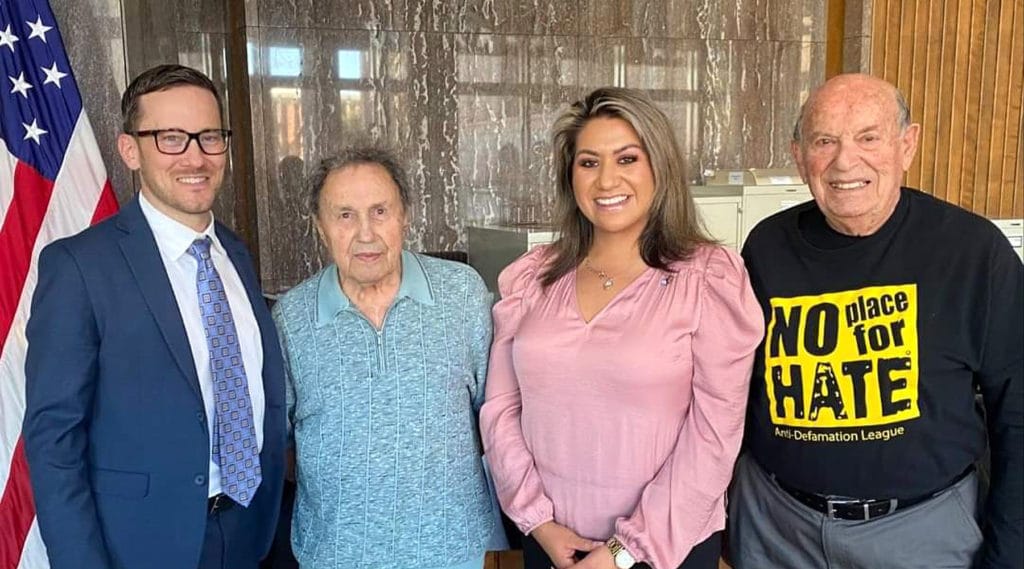
Arizona House Rep. Alma Hernandez, the Jewish Democrat who introduced the bill, called the passage a “big win for our community.”

“I have never been prouder to be an elected official and a Jew in Arizona,” she said. “Knowing that all Arizona students will learn about the Holocaust gives me hope and restores my faith in humanity because we must teach the past to ensure it never happens again.”

Alexander White, a 97-year-old Holocaust survivor who lives in Scottsdale, testified in support of the bill and has been working alongside Beller, Hernandez and other groups to see it through. Its passage means “a great deal” to him.

“The Holocaust is a prototype of man’s inhumanity to man, and young people should know about that,” he said. “If it happens once, it can happen again.”

The long-in-the-works bill had been on the verge of being derailed — ironically, by the International Holocaust Remembrance Alliance’s definition of antisemitism. The IHRA definition, which is legally non-binding but remains controversial for including some forms of anti-Israel speech among its examples of antisemitism, was a last-minute addition to the Holocaust education bill. Republican state Senator Paul Boyer had pushed for the inclusion; he wound up being one of only two dissenting Senate votes to the final version of the bill, which did not include the definition.

“Passing the bill without the IHRA definition would leave our legislative intent unfulfilled and vulnerable to exploitation,” Boyer said in April, adding that passage would “create a real possibility of seeing the Holocaust education curriculum corrupted in ways that could ironically boost contemporary antisemitism rather than combat it.”

In support of that idea, he pointed to California’s recent passage of its Ethnic Studies Model Curriculum. Jewish organizations had complained that the first draft of California’s curriculum ignored the American Jewish experience and included antisemitic language and anti-Israel sections.

“One need look no further than the unrelenting attempts to turn California’s Ethnic Studies curriculum into a vehicle for antisemitic propaganda. How long will it take for antisemitic predators to show up wishing to invert the memory of the Holocaust with their comparisons of Israel to the Nazis?” Boyer said.

During debate, even some supporters of the IHRA definition, such as Rep. Hernandez, opposed including it in the Holocaust education bill. “Proponents of the IHRA definition, of which I am one, should run separate legislation, as opposed to attempting to seize this bill,” she said at the time.

Boyer declined to comment on the bill’s passage. The state’s Senate Republican caucus plans to pass a separate Holocaust education mandate with the IHRA definition in the next legislative session, it said in a statement.

The Phoenix Holocaust Association, Christians United For Israel, the Jewish Community Relations Council of Greater Phoenix and Arizona Teaching the Holocaust all advocated for the passage of the Holocaust education bill without the IHRA language. Those organizations say they intend to work on separate IHRA legislation down the road.

Last January, Hernandez introduced a separate bill focused on antisemitism that would have codified the IHRA definition into Arizona law to be used by state officials when investigating and tracking crime and discrimination. That bill started out with strong support, but it eventually tapered off and stalled in the Senate.

Paul Rockower, executive director of the JCRC of Greater Phoenix, said the amendment had jeopardized the Holocaust education bill and made “a nonpartisan issue partisan.”

“While we do support the use of the IHRA definition in a variety of contexts, we believe there are more appropriate avenues to address the public policy in Arizona statutes in the future without causing unnecessary risk to current Holocaust education initiatives,” Rockower said.

Boyer has been a driving force behind other controversial pro-Israel legislation in the Arizona statehouse. In 2016 he was the primary sponsor on a bill which observers called “the toughest anti-BDS legislation in the U.S.,” which prohibited any part of Arizona’s government from investing in or contracting with any company that boycotts Israel. Though signed into law by the governor, the bill was later rejected by the courts; Boyer has since proposed an amended version.

In 2014, Boyer crafted a statewide resolution declaring that the West Bank was part of Israel.

Sheryl Bronkesh, president of the Phoenix Holocaust Association, worked alongside Hernandez, Beller and the JCRC on the education bill.

“I am so thrilled that at least some of the survivors who testify year after year could still be here,” she said. “In my mind, this bill’s in George Kalman’s memory and the memory of other survivors we’ve lost in the last year, and my parents.”

Kalman, a Holocaust survivor who closely followed the bill, died May 25, waiting for the education bill to pass.

Now that his work is done, Beller will wind down his organization, ATH.

“I saw an opportunity to move the mark and make a meaningful impact,” he said. “So I’ll continue to look for that next thing where I can apply myself and hopefully unite stakeholders to make a meaningful difference in people’s lives.”

Versions of this story originally ran in the Jewish News of Greater Phoenix.

Arizona Passes Long-Delayed Holocaust Education Bill Read More »

The Academy, Palestine, and the Quest for a Utopia Without Jewish Peoplehood

Palestine is a queer issue.
Palestine is a disability issue.
Palestine is a climate justice issue.
From Standing Rock to Palestine our lands are not for sale.

These are just some of the slogans popular among activists for Palestine. Each one links people, territories, and phenomena that have nothing to do with each other. For this reason, they should be rejected entirely. Yet they are not.

Why have such blatantly erroneous slogans secured such a tenacious foothold and garnered such appeal?

It would be easy to dismiss this phenomenon as a consequence of “the longest hatred”: the Jew is the eternal demon of western Christendom and the most logical target. But it is far more complicated.

While the medieval charge of ritual murder seems absurd to us today, it carried weight in earlier times because it was rooted in a Christian theology that many believed. The same is true today with the antisemitism of the left, which has been built upon an academic edifice that uses the latest trends in the humanities to center Palestinians in the social justice movement and, in turn, demonize Zionism and Israel as universal oppressors.

Academics carry tremendous weight in America and in Europe. What is taught in the classroom and articulated in academic scholarship trickles down to opinion editorials in mainstream publications and at protests around the nation.

What is taught in the classroom and articulated in academic scholarship trickles down to opinion editorials in mainstream publications and at protests around the nation.

Intersectionality—as interpreted on campus today irrespective of its original meaning—claims that all oppressions are linked; unless everyone is free, nobody is free. For this to have relevance to Israel-Palestine, Israel and its supporters must be centered as the universal oppressors. Scholar-activists—in gender studies, queer studies, disability studies, ethnic studies—have achieved this through ideologically driven frameworks that do not hold up under scrutiny. But among the left, facts do not matter; feelings are what count.

Here, I have identified some of the deceptive theories that make up today’s so-called scholarship—ideas that demonize Jews and sanctify Palestinians. Zionists are under assault, and we cannot win in the academy unless we understand the deception our opponents are practicing.

Anti-Zionists have developed a framework similar to that of the Nazis, for whom the Jews had to be global, conspiratorial, and the beneficiaries of an apocalyptic transnational war, not just “a degenerate race” in our neighborhood (as they viewed the Polish people, for instance). This justified the elimination of every Jew from the face of the earth, not just from Germany and adjacent territories.

For anti-Zionists, Zionists and Israel must be global, conspiratorial, and beneficiaries of the “global system of oppression” against which social justice activists fight if liquidating Israel is going to resonate beyond Arabs with direct ties to the region. To that end, antisemitic tropes are often anchored in scholarship that claims to reveal how “Zionism” afflicts the world and is even connected to inequity and suffering in America.

Points made consistently in academic scholarship include the following:

1) Zionism is an assault against indigenous peoples, a form of white racism against people of color, and an instance of European imperialism.

According to this logic, Israel was constructed through the same historical processes that led to the colonization of the Americas, the genocide of Native Americans, and the enslavement of Africans. Palestinians are “indigenous people of color,” and their liberation is connected directly to justice for Native Americans, Black Americans, and anyone else who is not white.

2) Jews are the beneficiaries of structural racism in America and mask this by claiming victimhood.

According to this logic, Jews enjoyed tremendous social mobility in the U.S. for an immigrant community because they were granted legal status as “white people” and not subjected to the same victimhood they experienced elsewhere. Jews succeeded only because of their complicity in white supremacy, despite their perpetual claim to victimhood because of the Holocaust and a history of discrimination that has no relevance in America.

3) Palestine is a queer issue and Israel is guilty of perpetuating homophobia.

According to this logic, Israel is “pink washing,” using its “gay liberation practices” as cover to oppress Palestinians. At the extreme it has been argued that gay Palestinians suffer for being gay because of Israeli occupation, not because Hamas and the Palestinian authority persecute gay people with alacrity.

4) Palestine is a disability issue.

The field of disability studies and Rutgers Professor Jasbir Puar in particular have done a great deal of work here, and I would argue this is as creative as it gets: Israel deliberately maims Palestinians; shoots them so they are physically disabled; tampers with their food supply so their growth is stunted; withholds medication; and experiments on Palestinian bodies and harvests their organs.

5) Palestine is a climate justice issue because Israelis deliberately poison the Palestinian landscape to render it uninhabitable.

According to this narrative, Israel has deliberately made Gaza uninhabitable in multiple ways; it has damaged its arable land through dangerous herbicides, indiscriminately dropped bombs that have ruined the soil, and polluted the water through the injection of sewage. But it is a universal issue because “the catastrophic climate crisis is fueled by global inequality and engineered by complicit governments and corporations.” And “warfare, a pillar of Israel’s economy, is one of the world’s most polluting industries.” In other words, we are living in a climate emergency from America to China, and Israel’s occupation of Palestine is decimating our planet.

These five claims come together to signify that “Zionism” is anti-native, imperialist, white supremacist, Islamophobic, homophobic, and ableist. Intersectionalist social justice cannot be achieved at the global level until those guilty of preventing it—Israel and the Jews who support it—are quashed.

Some ask: is this antisemitism?

The bigger question is: does it matter if we call it antisemitism? It does. Jews are being held to a double standard through carefully worded academic discourse. Jews are the only ethno-national community—aside from white Christian Europeans who conquered most of the globe from 1500 C.E. onward—accused of these practices.

Some also ask: is this double standard sufficient to brand anti-Zionism as antisemitism? It is, if only because the anti-Zionist left has underpinned its “intersectionalist” model with unambiguous anti-Jewish stereotypes. Such tropes include, but are not limited to the following:

1) Disloyalty/dual loyalty/Jewish money

Representative Ilhan Omar is, perhaps more than anyone else, a key player in this regard. Her “all about the Benjamins” tweet (retweeted by David Duke) and those that followed it brought the specter of Jewish disloyalty and influence through Zionist finances into public discourse. This is the most pervasive antisemitic trope of modernity that has resonated across the political spectrum from the French Revolution onward.

2) Global conspiracy to profile and murder Black Americans

In 2017, Jewish Voice for Peace refashioned the “Protocols of the Elders of Zion” through their “Deadly Exchange” campaign. It argued that Israel and “Zionist organizations abroad” are engaged in a covert program to have American police forces trained by the IDF. Why are they being trained? In order to better racially profile and murder people of color, thereby ensuring that white supremacists remain in power.

The “Deadly Exchange” has been thoroughly debunked by Professor Miriam Elman and others. But it is important to note that this accusation is identical to the so-called “white genocide” charge, mirroring the neo-Nazi slogan “Jews will not replace us,” made infamous at Charlottesville in 2017. The only difference is that the beneficiaries and victims are inverted. For neo-Nazis, people of color benefit and white people suffer. For the anti-Zionist left, it is white supremacists who benefit and people of color who suffer.

What is consistent is the identity of the intermediary: it is the Jew, who is engaged in an international plot to socially engineer the American population in order to assert power covertly from the shadows.

What is consistent is the identity of the intermediary: it is the Jew, who is engaged in an international plot to socially engineer the American population in order to assert power covertly from the shadows. The Deadly Exchange is a reconfiguring of the “Protocols” for a twenty-first-century “woke” audience.

3) Body snatching/baby killing/organ harvesting

The ideas of body snatching, baby killing, and organ harvesting were made popular by Professor Jasbir Puar, who notoriously accused Israel of harvesting organs in 2016. Such charges are now rampant in leftist circles. Denunciations of Zionist baby killers were ubiquitous during the May 2021 Israeli-Gaza fighting. Blood libel, the charge of Jewish ritual murder, first surfaced in the twelfth century. It was endorsed throughout the centuries by clergy, and even university professors such as Johann Andreas Eisenmenger at the University of Heidelberg in his book “Judaism Unmasked,” published in 1700. And it is a charge that is alive and well on the left today, refashioned using social justice-friendly discourse.

Academics—people with doctorates from prestigious institutions—propagate these tropes in the classroom and in their scholarship, and they usually do so without ever using the word “Jew,” without ever explicitly advocating for violence against Jews, and without using the language of biological race utilized by the Nazis. Instead they deploy seemingly innocuous phrases like “dismantling Zionist oppression,” “liberating Palestine from the River to the Sea,” and “decolonizing the Apartheid state.”

But the meaning is the same; there is no place for a Jewish nation in the comity of nations; it needs to be replaced by Palestine, and only when Palestine is free “from the river to the sea” will everyone else in the world be free.

The claim that academics function in a bubble with little impact on society at large is a myth. If “there was a uniquely German phenomenon that prepared the ground for Nazism, it was not the spread of antisemitism among the population in general; but its spread among the intellectual elites,” writes Yehuda Bauer in “Rethinking the Holocaust,” insisting that “without the enthusiastic support of the intelligentsia, neither war nor Holocaust would have ensued.”

Academics play a key role in the mainstream spread of antisemitic tropes.

The academy in twenty-first-century America is an incubator of Jew hatred, masked as “Palestinian advocacy.” What can be done to stop this? We need trained scholars in Jewish studies who will stand up and defend their community. But few have done so. Most have remained silent, while a very vocal minority has sided with the anti-Zionists. Why?

Perhaps because they believe that to be admitted into leftwing academic circles they need to demonstrate their commitment to ending Zionist oppression, which, in practice, means they need to sign off on leftwing antisemitism. If the Jewish experts insist that anti-Zionism is kosher, then it must be kosher.

This was made abundantly clear during the May 2021 Gaza-Israel war, when over 400 hundred self-professed Jewish experts publicly sided with the Palestinians. Natan Sharansky and Gil Troy have branded these Jewish studies professors as Un-Jews because they are undoing Jewish peoplehood. But what they are doing is far worse than that: they are signaling that Jews who participate in Zionism pose a threat to all humanity. In essence the “Un-Jews” are telling the academy that Zionists are Un-Persons.


Jarrod Tanny is an associate professor and Charles and Hannah Block Distinguished Scholar in Jewish History at the University of North Carolina, Wilmington. He is the author of “City of Rogues and Schnorrers: Russia’s Jews and the Myth of Old Odessa” (Indiana University Press).

 

The Academy, Palestine, and the Quest for a Utopia Without Jewish Peoplehood Read More »

Condemning Antisemitism No Longer Allowed

It seems you can’t condemn antisemitism anymore.

On May 26, the Chancellor and the Provost of Rutgers University New Brunswick, issued a statement condemning the precipitous rise in antisemitic incidents in the U.S.: “We are saddened by and greatly concerned about the sharp rise in hostile sentiments and anti-Semitic violence in the United States. Recent incidents of hate directed toward Jewish members of our community again remind us of what history has to teach us.”

Given the sudden rise in antisemitic rhetoric (the ADL tracked more than 17000 tweets saying “Hitler was right,” or some variation thereof, between May 7-14) and antisemitic attacks both in the United States and abroad, you would think that the Chancellor’s and the Provost’s statement would be unexceptional, even welcome—especially since many universities and colleges issues similar statements condemning ant-Black and anti-Asian violence.

But no. A day later they issued “An Apology” because “the message failed to communicate support for our Palestinian community members.” Then, Jonathan Holloway, who is the President of the entire university, replaced the original statement with this one: “Neither hatred nor bigotry has a place at Rutgers, nor should they have a place anywhere in the world. At Rutgers we believe that anti-Semitism, anti-Hinduism, Islamophobia and all forms of racism, intolerance and xenophobia are unacceptable wherever and whenever they occur.”

Odd. Why does a statement condemning antisemitism need to be broadened to include other forms of racism and bias? Maybe his was a one-time mistake by administrators over-eager to please?

But then, it happened again.

On June 10, the Society of Children’s Book Writers and Illustrators (SCBWI) published their own fervent condemnation of antisemitism: “The SCBWI unequivocally recognizes that the world’s 14.7 million Jewish people (less than 0.018% of the population) have the right to life, safety, and freedom from scapegoating and fear.” Then things got worse.

First, the Executive Director, Lin Oliver, abjectly apologized for the statement on the grounds that saying antisemitism is bad and that Jews have the right to live in peace hurts Palestinians: “I would like to apologize to everyone in the Palestinian community who felt unrepresented, silenced, or marginalized. SCBWI acknowledges the pain our actions have caused to our Muslim and Palestinian members and hope that we can heal from this moment.”

Then, the person responsible for the original statement, Chief Equity and Inclusion Officer April Powers, who happens to be both Black and Jewish, resigned, but not before delivering her own apology for neglecting “to address the rise in Islamophobia, and [I] deeply regret that omission.” (The Society has since removed both apologies from their site.)  In an interview with Kat Rosenfield published by Bari Weiss’s substack site, “Common Sense,” Powers said that her Judaism rendered her “inherently suspect.” “You’re Jewish,” her critics said, so “you can’t be in a role like this.” Inclusion and equity, it seems, means exclusion and inequity for Jews.  

Inclusion and equity, it seems, means exclusion and inequity for Jews.

This is just bizarre. How does recognizing that Jews have the right to live in peace, that Jews have the right to eat in a restaurant without being attacked, as happened recently in Los Angeles, harm anybody else? Would anybody say that protesting anti-Black violence neglects the rise in, say, anti-Asian violence? Or that protesting the rise in Islamophobia harms Black people if the statement doesn’t mention them as well? Why is antisemitism singled out for this sort of treatment?

These two incidents made national news, but this also occurs below the national radar. My institution, San Diego State University, responded to a recent spate of antisemitic incidents, ranging from swastikas inscribed on buildings to the repeated vandalizing of the local Chabad House, by organizing a task force to address antisemitism. I’m on this task force.

We soon learned that an outside group of faculty, led by a Palestinian professor, was unhappy with the task force’s membership (predominantly Jews) and focus (exclusively antisemitism). So they asked the University’s president to appoint another member they had chosen: an outspoken opponent of Israel who blamed an earlier attack on Chabad on Israel’s actions against Hamas and claimed that the University’s partnership with the ADL to fight antisemitism signaled indifference toward Arabs. In a note posted to the College of Arts and Letters listserv, the professor wrote that Arabic and Palestinian students “deserve to know that they are valued on this campus and that we want it to be a safe campus for them.”

Another chimed in, claiming that focusing on antisemitism alone resulted in an “inequity” and she hopes “our Administration [will] move to resolve this inequity whenever possible.”

In their view, condemning antisemitism must be accompanied by assurances that the university is equally concerned about Arab students, even though there has (to my knowledge) not been any attacks at SDSU on Arab students or any anti-Arab graffiti inscribed on buildings. One also wonders how condemning antisemitism without mentioning Palestinians results in “inequity,” but condemning anti-Black racism or Islamophobia without mentioning the Jews, or anybody else, does not.

By now, it’s common knowledge that antisemitism is not taken very seriously on the left. At first, this was blamed on Jews being “white” and therefore privileged. But in the wake of the war between Hamas and Israel, we see a new twist. Now, when there’s an antisemitic incident, diaspora Jews are blamed, not the person who hates Jews.

Now, when there’s an antisemitic incident, diaspora Jews are blamed, not the person who hates Jews.

We see this perfectly illustrated with my colleague, who wrote on the listserv that the attack on Chabad House was Israel’s fault because Israel’s responded to Hamas’ rockets: “It is highly disturbing that the message [condemning the Chabad House vandals] that was just sent out to the whole campus was sent without some contextualization about the current situation in Jerusalem and the 80+ jets that have just bombarded Gaza, killing 20 people, including 9 children, and toppling a 13-story building that covered a whole block.”

Never mind the 4,000 plus unguided rockets Hamas launched with precise intent and hope that they would kill Israeli civilians.

Antisemitism, in other words, cannot be condemned by itself, as can other forms of bias. Nobody, for example, sought to “contextualize” the recent murders of Asian women in Atlanta by referencing the Chinese government’s treatment of the Uighurs. In current woke discourse, you can condemn attacks on Jews only if you condemn attacks on Arabs and Palestinians as well. Which is all part of the denigration of antisemitism on the left. Not only is Jew-hatred blamed on the victim, but having the temerity to condemn hatred against Jews may cost you your job. And before you leave, you’ll have to write a Maoist self-criticism.

We know where this ends, and it’s not good.


Peter C. Herman’s books include “Unspeakable: Literature and Terrorism from the Gunpowder Plot to 9/11,” and “Critical Contexts: Terrorism and Literature.” His opinion pieces have appeared in Newsweek, Salon, Areo, Inside Higher Ed, and Times of San Diego. 


Condemning Antisemitism No Longer Allowed Read More »

In Our Family, We Say “I Love You”

In our family, we say “I love you” a lot. And I’m not referring to those perfunctory, knee-jerk, fist-bump kinds of “Luvyah bruhs” we’ve become so accustomed to sharing in our Hollywood culture. I’m talking about the full-contact, no-holds-barred, hugging-a-little-too-tight “I love you” that most people reserve for when a family member is being deployed to active duty, leaving the country indefinitely, or heading into serious surgery—except our family engages in it daily, without reservation, even when someone is just headed out to work for the day.

I imagine that you, like many of our close friends, might find our family’s parting ritual somewhat unusual, endearing or even humorous. And that’s OK. Over the years, my wife and I have become comfortable leaning into our own unique journey, and our effusive hugs and affection stem from the life lessons garnered on that journey. You see, our family has experienced its fair share of sudden loss along the way: like the loss of both of our fathers at a young age. We have also shared in the grief of many in our congregation who also experienced such life-altering losses. And we have come to know that while the pain of loss becomes more manageable over time, there is one aspect of loss that persists long after all the other aspects of grieving have begun to abate: that nagging, unanswerable, and inconsolable question of, “Did I say ‘I love you’ that last time we spoke, even just that one last time?”

These were the questions that flooded my already foggy thoughts as I was rushed to the hospital in critical condition just a couple of weeks ago.

I had traveled to Las Vegas to officiate at my niece’s wedding in what I believed was good health and spirits together with my wife and our kids. My eighty-year-old mom and sister were flying in from Pittsburgh to meet us, and our entire family would be together for the first time since before COVID. The wedding was beautiful and everyone attended, except for Rebbetzin Chava and myself.

Unbeknownst to me, as I drove to Vegas happily singing classic road trip songs like “Life Is A Highway” loudly and off-key with my kids, just like I do during services, an infection had already taken root in my heart and was quickly spreading to the rest of my body. Several hours after arriving in Vegas I became ill and too weak to walk, regulate my temperature, or make coherent decisions. When my temperature reached 105 degrees, Rebbetzin Chava rushed me to the emergency room. In doing so, my wife saved my life.

By the time we arrived at the ER, the infection had traveled throughout my bloodstream and I had developed sepsis. My other organ systems were already under attack and would soon begin to shut down. Without the immediate and immense amount of medical treatment and IV antibiotics I was blessed to receive, that poorly performed rendition of “Life is A Highway” would have been my last.

After a two-week stay at Sunrise Hospital in Vegas, and too many tests, treatments and procedures to count, I was out of critical condition, stable, and on the journey forward to health. I’ve still got a bit of a journey ahead but intend to have a full recovery. Those who know me best will tell you that while it’s not too difficult to knock me off balance, it’s almost impossible to keep me down.

During this ordeal I have come to realize that life has already far exceeded my wildest expectations. And now I’ve been given some bonus time to double down, live larger, and love even bigger.

And as to those questions that flooded my foggy thoughts during the moments I feared would be my last?

“Did I say ‘I love you’ the last time I spoke to the people who matter most to me?”

“Do they know how much I cherish them and how much their love has enhanced my life?”

“Do they know that I know beyond a shadow of a doubt exactly how much they love me? That regardless of when our last conversation was or whether they remembered to say “I love you” the last time we spoke that I know they loved me then, and I know it now?”

To my relief, with a very full but somewhat ailing heart, I exhaled deeply, knowing that without exception my last interactions with those I care about most deeply—my wife, my children, and my family—had each ended with a heartfelt, effusive, unconditional and unequivocal “I love you.

So here’s what I can share with you today.

I am feeling beyond blessed and surrounded by your heartfelt messages, prayers, care, and love. I also feel grateful, loved, strong. Well, “strong” may be a bit of an overreach, so let’s just say I’m feeling enthusiastic about feeling strong once again.

And if my story has resonated with you, I invite you to join our family in our somewhat unusual, endearing or even humorous ritual of engaging in the daily, full-contact, no-holds-barred, hugging-a-little-too-tight “I love you” with all those you care about. Trust me, one day you will be as grateful as I am for having done so.

During this ordeal I have come to realize that because of my relationships with those whom I hold near and dear, life has already far exceeded my wildest expectations. And now I’ve been given some bonus time to double down, live larger, and love even bigger.

With a big hug and an even bigger “I love you,”


Rabbi Robbie Tombosky serves as the Rabbi and spiritual leader of Beth Jacob Young Professionals in Beverly Hills, California and is the founder and managing partner of Sage Philanthropy Advisors. Rabbi Robbie is a sought after teacher and speaker and is passionate about helping families and individuals express their deepest values through meaningful self-exploration and purposeful living.

In Our Family, We Say “I Love You” Read More »

Fabian Lijtmaer’s Spiritual Jewish Art Is Something to Meditate On

Fabian Lijtmaer believes that art isn’t just something pretty for people to look at. Instead, it has the power to transform our state of mind.

“Art is a way to intentionally choose colors and pieces that resonate with your soul and empower you,” the Pico-Robertson-based artist told the Journal. “You can use them to have more simcha, to see the world differently and remind yourself who you are. Who doesn’t want to wake up and see a piece that reminds them that they are a winged lion, or a son or daughter of Avraham, or that they have the ability to cross the Sea of Reeds with Hashem’s help?”

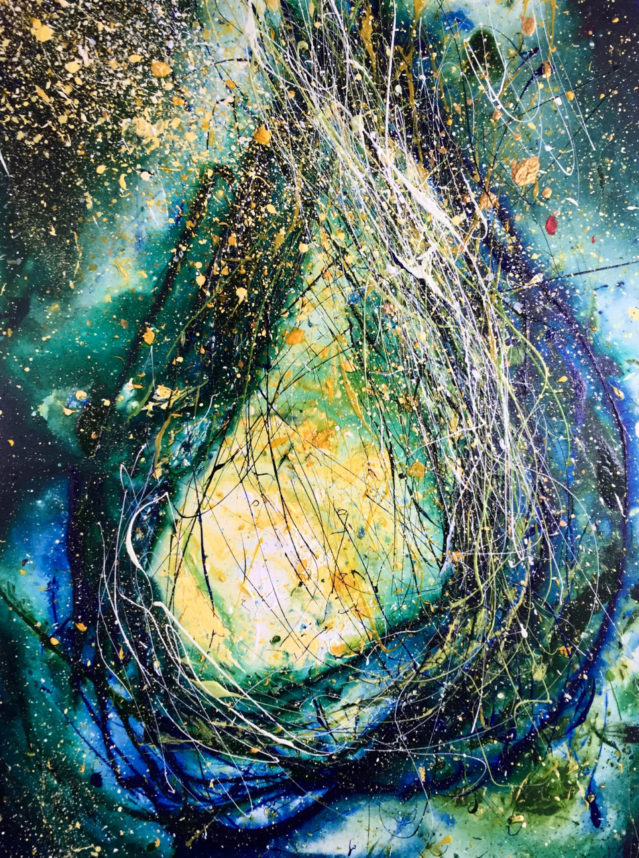
Lijtmaer is a painter who creates Jackson Pollock-inspired pieces that are meant to be spiritual and meditative. With titles like “Shabbat Dreams” and “Gan Eden Consciousness,” his pieces are colorful, chaotic and calming all at once. One of his paintings, “Purim,” contains a variety of colors, from blue to orange and green and red, that come together to evoke the exciting energy of the holiday. On the other hand, “Shabbat Dreams” is an all-blue universe that takes us right into dreamland.

Lijtmaer is a painter who creates Jackson Pollock-inspired pieces that are meant to be spiritual and meditative.

“My paintings are soul portraits to help people access higher states of consciousness. They are hopefully pieces that create an emotional, spiritual and psychological reaction in people. Almost all of them have specific intentions. Every mark is intentional. Even though it feels very flowy, they’re very intentional pieces and each one has its own frequency and vibration.”

Born in New York City, Lijtmaer, whose family is from Argentina, is of Ashkenazi Jewish descent. His family was in Europe during the Holocaust, which he thinks about constantly and on which he reflects in his work. “My mom’s mom was on the second to last transport escaping Poland, so it’s really incredible that I’m here right now,” he said. “I feel emotional when I think about the Holocaust. It’s a very challenging topic for me. I immediately feel it inside of me and it hurts a lot. I’ve explored it in my artwork. Using art as a way to transform pain is super valuable.”

Courtesy of Fabian Lijtmaer

The artist also finds inspiration in his Argentinian roots. “Something I love about the Argentinian culture is the level of passion they have for music, sports and food. Passion is such a beautiful and important component of being happy. Argentinians wear their emotions on their sleeve. I’m very influenced by that passion.”

Lijtmaer arrived in Los Angeles nine years ago to pursue a master’s degree in Leadership and Change from Antioch University, and ended up staying after falling in love with the city and his community. “My friends are beautiful and amazing. Everyone is so different and supportive of each other’s growth,” he said.

He attends Pico Shul and Happy Minyan, the former of which displays his artwork on the walls. When he’s not painting, Lijtmaer teaches at the International Children’s Academy and leads meditations with artwork and live musicians.

“We have one piece of art and I lead the meditation,” Lijtmaer said. “You can create new worlds and levels of introspection. Each person who approaches a painting will have a different perspective or viewpoint. I want everyone to get together to celebrate the arts and imagination.”

Courtesy ofFabian Lijtmaer

Lijtmaer creates his artwork in his studio in the Mid-City neighborhood of Los Angeles, 2.5 miles from Pico-Robertson. As we begin to find ourselves on the other side of the pandemic, studio visits will once again be available for people to experience his paintings. “I recommend everyone to see things in person because it’s so powerful,” he said. “It’s alive. It has three dimensionality.”

Given the craziness of our world today, Lijtmaer said he believes that meditating on art can be a healthy break for the soul.

“You can literally create a breath practice for a piece of art. Take 10 seconds of your time and envision yourself in this state of peace and tranquility and then move into your day with this consciousness. We’re fighting a lot of images and media messages and our mind is holy and sacred and it is being exploited. It’s under attack. As a Jewish person who is spiritual and wants to bring more of Hashem’s consciousness to the world, I think we need to actively be part of this movement to reprogram our minds in a healthy way. Art and education are two places to start that are really powerful.”


Kylie Ora Lobell is a writer for the Jewish Journal of Los Angeles, The Forward, Tablet Magazine, Aish, and Chabad.org and the author of the first children’s book for the children of Jewish converts, “Jewish Just Like You.”

Fabian Lijtmaer’s Spiritual Jewish Art Is Something to Meditate On Read More »

Suspected Boston Rabbi Stabber’s College Roommates Claim He Was a “Violent” Antisemite

The suspect behind the July 1 stabbing of a Chabad rabbi in Brighton, Massachusetts was allegedly violent and antisemitic toward his college roommates.

Khaled Awad, 24, was arrested on July 1 shortly after Rabbi Shlomo Noginski was stabbed eight times in the arm. Awad had allegedly pulled a gun on Noginski and told him to get in a car before stabbing him as he tried to escape.

One of Awad’s former college roommates at the University of Southern Florida told CBS Boston that Awad “was very much antisemitic. He would say like all types of Jewish jokes. I thought he was joking at first and then I started to see seriousness in his comments.” Another former roommate told CBS Boston that Awad “started becoming violent,” prompting the roommate to move elsewhere and file a restraining order against Awad.

Additionally, a spokesperson for Immigrations and Customs Enforcement (ICE) told Fox News that Awad, an Egyptian citizen, had overstayed his student visa, pointing out that Awad had initially entered the United States in August 2019. “However, he failed to stay enrolled as required by law, resulting in a loss of legal status in the U.S on May 14, 2021.”

Awad had pleaded not guilty to the stabbing and is currently being held without bail; his dangerousness hearing—where the prosecutor will argue that the defendant should be held without bail for 180 days—is scheduled for July 8.

Noginski has been released from the hospital. He told Lubavitch.com, “I am grateful to the Boston Police Department for their rapid response, and relieved that the perpetrator is in custody. I am looking forward to returning to my work as soon as possible.”

Rabbi Dan Rodkin, who heads the Shalom House Jewish Day School where Noginski works, said during a July 2 vigil, “We, Boston, are not going to sit back. We will fight back. We will bring goodness to the world. We’ll make sure that we will become better people and we will send a strong message: that evil has no place in America.”

Suspected Boston Rabbi Stabber’s College Roommates Claim He Was a “Violent” Antisemite Read More »

Rising Crime Also Needs a Reckoning

The other day, on a street in Brooklyn, in the middle of the night, a thief crawled under my Toyota Prius and sawed off the catalytic converter.

Before this, I’m quite sure I had never heard “catalytic converter” uttered in my presence. The AAA roadside mechanic roared amusingly, “They cut your cat!”

“I don’t own a cat,” I replied.

Then the car roared.

This innocuous auto part is the centerpiece of a national crime wave. Apparently, it contains precious metals such as platinum, palladium and rhodium. But when the police are instructed to stand down in fear of defunding, their patrol cars and precincts torched, and their every move scrutinized as possible war crimes, catalytic converters, understandably, become a low priority.

An anecdote about a newly noisy electric vehicle may soon come to symbolize the end of something more precious than those minerals: the faith many of us began to have in the public safety of America’s cities. More than anything else, families, local businesses and corporations will refuse to live or invest in urban areas where crime is rampant.

For people who are old enough to remember the late 1960s and into the 1980s, feeling safe in American cities was once unimaginable. New York City was widely seen as a deathtrap, a playground for muggers, drug pushers, junkies, and street gangs. The murder rate worsened each year, and public confidence deteriorated. At its worst, New York nearly went bankrupt. Teachers, transit and sanitation workers were on perpetual strike. Police corruption led to the Knapp Commission.

In response, millions of urban dwellers abandoned America’s major cities. They called it “white flight.” Today such a term would be as taboo as “black-on-black crime.” But it doesn’t matter what you call it. People will leave anyway.

Congresswoman Alexandria Ocasio-Cortez is now warning against mass hysteria in response to surging crime, which she believes should be viewed “in context.” The only relevant context is that over 70,000 left New York City last year, probably never to return. Over 80,000 abandoned Los Angeles, San Francisco and San Diego. Wall Street was hard-hit in New York, with white-collar bankers reallocating to the Sunshine State. In California, Big Tech took a beating, with Silicon Valley mainstays like HP, Oracle and Tesla high-tailing it for Texas.

The only relevant context is that over 70,000 left New York City last year, probably never to return. Over 80,000 abandoned Los Angeles, San Francisco and San Diego.

Yes, housing costs and high taxes in those cities are not inducements to stay, but soaring crime rates surely sealed the deal. According to the FBI’s crime statistics, the murder rate increased by double digits in many major cities, with violent crime up significantly as well. In New York City, NYPD data indicates murders jumped by nearly 14%, while shootings were up nearly 50%. In Los Angeles, homicides have increased 36%.

With Broadway theaters mostly shuttered, Times Square marquees are featuring the weekly shooting of tourists, and Jews being pummeled on the streets and set on fire. These spectacles are not yet blockbusters, but give it more time.

Economic collapse caused by the pandemic, and ensuing social anxieties, didn’t help matters, nor did the rioting attributable to the Black Lives Matter protests. Images of looting in Santa Monica and on Madison Avenue, with de-policing on full display, will not soon be forgotten. The immediate releasing of criminal defendants without bail, or under-punishing lawbreakers in this new era of reimagined policing, all contributed to the spike in homicides.

Regardless of how one feels racial injustice should be rectified, public safety cannot be sacrificed to the quick-fix of the cancellation culture.

Income inequality, especially from the growing billionaire class, is a difficult pill for Americans to swallow. But, so, too, will be the poison from an eroding tax base from cities emptied of their wealthiest residents who moved themselves, and their money, elsewhere. We will all miss the tax revenues that ordinarily pay the police, firefighters and teachers in public schools.

What’s more, we’ll surely notice when the cultural life of cities goes from vibrant to moribund. Culture, too, is offset by crime. Without wealthy taxpayers picking up the tab, a once pulsating metropolis is suddenly less inviting. Of course, it won’t much matter when venturing out into the great urban unknown becomes a frightening prospect.

Culture, in fact, once did a nice job of demarcating those periods of cultural decline and urban menace. Remember the films of the 1970s and 1980s when New York and Los Angeles were depicted without the swagger and glitter: “Death Wish,” “Dirty Harry,” “Mean Streets,” “Colors,” “Taxi Driver,” “The Onion Field,” “Serpico,” and “Eyes of Laura Mars.”

The Golden Age of film captured those gloomier days when a movie was the only safe place to be in the dark.

It was a time of urban menace: Son of Sam, subway vigilante Bernhard Goetz, and the Central Park Jogger. It got so bad that in order to persuade tourists to visit New York, John Lennon Frank Sinatra and others were recruited to appear in an iconic promotional ad with the tag line: “I Love New York.” T-shirts soon followed.

The city eventually recovered. It took political will to remove the homeless from the streets, apply a Broken Windows strategy to crime control, and initiate the policing practice of “stop-and-frisk,” mostly to African-American men in high crime neighborhoods.

All of that is problematic in today’s racialized political climate. White privilege is the new punishable offense. Police find themselves on the defensive. Frisking carries far too many risks. Many fear that after a nearly 30-year hiatus, we are surrendering to lawlessness and urban flight—all over again.

This dramatic shift in demographics is alarming for the urban-minded, but it is of special concern for Jews.

Historically, Jews have lived in shtetls and suburbs, but they have thrived in cities. They were drawn to them—with mutual reciprocity. Whether it was Berlin, Moscow, Paris, London, Amsterdam and New York, Jews have, in large part, shaped the cultural life of global cities. Without exaggeration, to be a cosmopolitan is to be a Jew.

And that should be a warning to city overseers: there’s much to be lost. Now is the time to get your houses in order.

Rising Crime Also Needs a Reckoning Read More »