fbpx

May 5, 2021

A Mother’s Day Letter

For me, Mother’s Day is a time to express my gratitude to beautiful women who have touched my life, making me into the woman, wife, mother, and friend I have become. This year, just as I’ve done every year for the past 35 years, I had my Mother’s Day Card to Malkah Schulweis addressed, stamped and ready to mail.

Her passing is a deep loss to me. She wasn’t my biological mother, but she was my wise, empathic, loving, mother figure. By sharing what I wrote to her when I learned she was quite ill, I am giving her another well-deserved eulogy.

When I was a teenager in Sunday school class, I learned, “Jews believe in eternal life.”  I distinctly remember wondering and questioning what this really meant. Now, as a 62-year-old woman, I find that I can be part of granting those who have touched me as profoundly as Malkah did, eternal life in my manifestation of their wisdom, love, guidance and persona. Malkah will live on in me forever and always.


Dearest Malkah,

How can I possibly find all of the right words to express my gratitude and love for you… 

35 years ago, I was mesmerized by your brilliance when you gave a talk about the relationship between Mothers and Daughters.  From that day forward, you have been in my life as a teacher, mother figure and wise guide through the many chapters we shared filled with trials and tribulations. 

You will be granted eternal life as you live on through my internal voice ringing loud and clear with your poetic lessons about life, death, love, conflict, joy, sorrow, relationships and resilience. Your voice, your wisdom is in me, and will live through me. I will replay your guidance and inspiration in my head and share your words and philosophy with others.  

I have pages and pages of Malkah notes. I could write a book called Malkah’s Wisdom!  

Through tears I write this… I will always cherish, and surely miss, our talks that would feed my soul, nourish my spirit and settle my angst.

You most certainly guided me back to center with the right words of advice. And even when we didn’t speak I would have a conversation with you in my head and I would feel whole again.  

I will always hold onto and treasure our special relationship and bond.

I give you my enduring love and deepest gratitude. I hold you in my heart and head forever and always.

With Smiles, love, devotion and gratitude,

Jodi


Jodi Stolove is the creator of Chair Dancing® Fitness.  Her personal and professional goal is to motivate and inspire people of all ages, shapes, and fitness levels, to find joy in exercise, thus reaping all the benefits- whether they exercise on their seat or on their feet.” In addition, Ms. Stolove continues to work as a dance instructor and performance coach. She particularly loves working with kids pursuing musical theatre. She also has helped countless people with their relationship to food, eating, self-concept and their body image. Ms. Stolove teaches her eating management style guiding people to a healthier relationship towards food, fun, and their self image.

A Mother’s Day Letter Read More »

Sex Therapist Dr. Ruth Has Ongoing Love Affair With Israel

(The Media Line) Although she is quickly approaching her 93rd birthday, renowned sex therapist, author and media personality Dr. Ruth Westheimer is not slowing down.

Dr. Ruth, as she is popularly known around the globe, gained worldwide fame for her frank and open discussions about sex.

Born in Germany in 1928, Westheimer’s parents were killed in the Holocaust and, at the age of 17, she decided to emigrate to British Mandatory Palestine. She later joined the Haganah – the primary precursor of the Israel Defense Forces – where she served as a sniper for the fledgling Jewish paramilitary group.

Last week, Dr. Ruth added to her long list of impressive accomplishments when she received an honorary doctorate from Ben-Gurion University of the Negev (BGU) – her first from an Israeli university. To honor the occasion, she has so far raised $125,000 for her newly-established Dr. Ruth K. Westheimer Endowed Scholarship for Psychology, which will go toward funding psychology students at BGU.

In an interview with The Media Line, Westheimer reflected on how the COVID-19 pandemic has affected couples’ relationships, her ongoing love affair with Israel and Sigmund Freud – whom she dubbed a “sexual illiterate.”

The Media Line: Dr. Ruth Westheimer, thank you for joining us. First, I would like to ask you: What have you been up to these days?

Dr. Ruth Westheimer: Hallelujah, I was very happy with the Ben-Gurion [University] honorary doctorate. I’m still smiling and I wish I had met [Former Israeli Prime Minister David] Ben-Gurion. He was short.

I was in Jerusalem on the day that he declared the State of Israel even though some people at the United Nations and others had told him not to do so.

In my living room I have a picture of Ben-Gurion and [Former Israeli Prime Minister] Golda Meir. I know everybody said they never had an affair but to me—the way he looks at her—he at least would have wanted to.

Dr. Ruth Westheimer receives an honorary doctorate from Ben-Gurion University in a virtual ceremony on April 25. (Courtesy)

I’m going to be 93 on June 4th and I hope everyone – but me – knows how to use Zoom. Zoom has been very important these days to combat loneliness, especially for people who live alone. Right now in New York it is very hopeful. People are slowly going out. I still don’t and go out only when my daughter, son, or son-in law take me.

TML: What does Israel mean to you today?

Dr. Ruth: First of all, I never thought that I would not live my life in Israel but I have no complaints. The new film that is running on Hulu called “Ask Dr. Ruth” clearly shows that I was, and still am, a Zionist.

I went to Israel in 1945. I could’ve stayed in Switzerland but I said: ‘No, I have to help build a country so that what has happened in the Shoah (Holocaust) will never happen again.’

I still do lots of fundraising for Israel and up until recently would go [visit] every single year.

TML: You mentioned that you were in Jerusalem when Ben-Gurion declared the independence of the State of Israel. What was that moment like? What were you doing?

Dr. Ruth: I remember that moment like it was yesterday. I was in Jerusalem on a truck. We danced the whole night. What is very sad is that I don’t remember with whom I danced, but I know that I danced the whole night.

I still have [Ben-Gurion’s] voice in my head when I think of it. I’m so sad that I never met him because I wasn’t ‘Dr. Ruth’ back then. He wouldn’t have met me, a little kibbutznik from Nahalal (northern Israel).

I lived in Jerusalem and got badly wounded when I was in the Haganah so I was there for a very short period of time. But I was a very good sniper. I was badly wounded in both legs [during the Israeli War of Independence] when a shell came and killed some girls next to me. There was a German-Jewish surgeon who fixed me up so well.

TML: What other projects are you working on at the moment? What else is new?

Dr. Ruth: New York University Press just issued my book “Heavenly Sex: Sexuality and the Jewish Tradition” (Nov. 2020: NYU Press) in a new edition and it’s now a classic. This means it will never be out of print. Hallelujah!

I did the book with a journalist named Jonathan Mark from the Jewish Week. I could not have done that book without him.

In the book I prove how smart the sages were. For example, they knew about different positions … In the Jewish tradition we have the best sex therapists possible.

TML: I remember your radio show many years ago. Regarding sexuality and sex therapy, how do you feel those have shifted in recent years?

Dr. Ruth: I’ll tell you what has changed. There are [fewer] women who do not have orgasms because people like myself – but I’m not the only one – have talked about it.

Sigmund Freud was sexually illiterate and ignorant. He should’ve taken a course with me. Sigmund Freud said that any woman who needs clitoral stimulation in order to have an orgasm is an [infantile] woman.

Nonsense! The clitoris is always involved and Freud was sexually ignorant. So there have definitely been changes.

TML: Over the pandemic there have been a lot of stories about how lockdowns have negatively affected relationships. What do you think of that and what kinds of tips can you give to those who are still stuck at home?

Dr. Ruth: This was a very difficult year, period. I want people to forget about it and not dwell on it. I know it is difficult to keep up a sexual relationship when you’re cooped up in your apartment all day. As soon as everyone is vaccinated and things get better, I want people to say ‘this was a difficult year, what can I do to make it better?’

Some relationships will survive, some will not survive. Fortunately, within the Jewish tradition, it is permissible to get a divorce so for those who cannot survive, get a divorce and start new relationships. But I don’t want people to get on Zoom or on the phone and to continuously say: ‘How terrible, how terrible.’ We all know how terrible.

TML: What are your plans for the near future?

Dr. Ruth: I am going to teach a course at Columbia University again next spring. I had 18 students [last time]: some were from China and I was on Zoom in New York. I got wonderful term papers! There is a Jewish tradition that you learn from your students. I learned a great deal about Chinese sex education and about the one-child [policy].

The next thing I’m doing is: As soon as the [Sag Harbor’s Bay Street Theatre] brings the “Becoming Dr. Ruth” play with actress Tovah Feldshuh to New York in June, I’ll go to the opening and go many times. In typical Ruth Westheimer fashion, I also have a good relationship with the woman who did the show before, Debra Jo Rupp. I’m also still keeping in touch with the playwright [Mark St. Germain] – he was just here this past week – and the play’s director Julianne Boyd. I’m very busy.

Sex Therapist Dr. Ruth Has Ongoing Love Affair With Israel Read More »

Former 49er, Current Dad and Doctor, Goes to Jewish Summer Camp

Some nice Jewish boys become doctors. One nice Jewish boy became a doctor while also playing in the National Football League.

When campers at Ramah Sports Academy in Cheshire, Conn., visit the infirmary this summer, they will get more than Band-Aids, throat lozenges and TLC from Dr. John Frank. They may also hear stories from the nice Jewish boy who began his medical studies while playing tight end with Joe Montana on two NFL Super Bowl San Francisco 49ers teams from 1984 to 1989. Campers may also learn that Dr. Frank was a founder of the Israel bobsled team.

Adam Benson and Graham Parker of New York City were thrilled when they learned their football-loving son, who is attending Ramah Sports Academy for the first time, would cross paths with Frank. Adam reports, “Max lives for football, and we think it is awesome that Max will be cared for by a camp doctor who is also a former NFL player.”

Camp director Rabbi Dave Levy could not be happier with Frank joining his staff this summer. “I was speaking with a pediatrician from Columbus, Ohio, whose two sons go to camp, and he said, by the way, I have a friend who might be up for coming to camp.” Frank, who splits his time between his practice in New York and his home in Columbus, is a board-certified otolaryngologist (ear, nose and throat doctor), as well as a diplomate of the American Board of Hair Restoration Surgery. He has treated more than 10,000 patients for hair loss and performed more than 2,500 hair transplants.

This summer, Frank, 59, will be attending camp along with his 12-year-old son, spending a week taking care of cuts and sprains, as well as oversee COVID-19 protocols. He will also coach flag football and share his wealth of stories about being a member of the NFL, sharing the importance of teamwork and his life as an observant Jew.

“I am excited to have him as a camp doctor and to use his football experience to create a positive experience for campers,” says Levy. “He will lead a multi-day flag-football experience and talk with the camp divisions about his NFL experiences, including what it was like being on a historic team in the 1980s and being Jewish in the NFL, and about whether it is worth the risk of playing football in its current form. I am excited to have the whole package; he is the embodiment of what our camp is about—Jewish life, sports and bringing those two things together!”
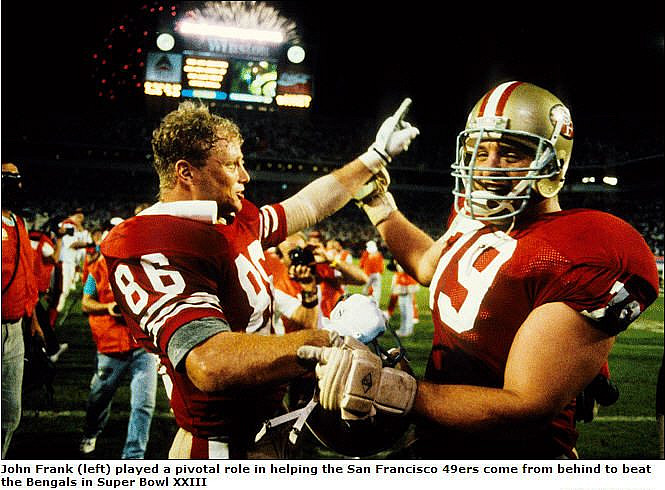
John Frank on the San Francisco 49ers. Credit: Courtesy.

‘A strong legacy to uphold’

Frank grew up in Pittsburgh, attended Hebrew school and celebrated his bar mitzvah at Beth El Congregation of the South Hills. He reports, “I was into and not into Hebrew school, but was very much into learning for the bar mitzvah.”

He refers to his father, Alan, as “a celebrated athlete and Pittsburgh Jewish sports legend,” saying he “was a fantastic basketball player in college at Carnegie Tech,” which later became Carnegie Mellon University, and “a strong legacy to uphold.”

When it came time for John to become involved with sports, his mother was lukewarm at best with his desire to play football. His parents and grandparents insisted on examining his peewee football equipment to ensure they provided adequate protection. “I think my mother was terrified by the whole experience,” he recalls.

At every stage of Frank’s sports career, he was aware of just how good an athlete his father was. He feels his father “had it” innately, while he was “only an average football player until my senior year of high school. It just seemed to click.”

Frank attended Ohio State University, majored in chemistry and published academic papers while still an undergraduate. He always planned on attending medical school, even while playing football for the prestigious Ohio State football team.

The starting tight end at Ohio State from 1981 to 83, as well as a two-time Academic All-American, he caught more passes than any other tight end in the school’s history; became the team’s most valuable player; and was selected as a member of the All-Century Ohio State Football Team and Ohio State’s Varsity Hall of Fame.

Then Frank was invited to attend “the Combine,” the NFL’s major recruiting event and tryout in 1984, but he declined so he could study for final exams. Much to his surprise, he was drafted in June 1984 in the second round of the NFL draft by the San Francisco 49ers.

‘You know you are different’

In “NFL Films Presents,” Frank recounts the funny, somewhat embarrassing story of the telephone call from the 49ers coach. “Bill Walsh drafted me in the second round. I never anticipated playing in the NFL, so I didn’t know who he was. When I was in college, I wasn’t following the NFL—I was a chemistry major on the way to medical school. When the phone rang, he said it was the head coach to say congratulations. The only Coach Welsch I knew was the coach of Army at the time [George Welch]. I said, ‘Hi, Coach Welsh. He said, ‘No John, Coach Walsh. See you when you get out here.’

When Frank arrived at training camp, he was unfamiliar with the 49ers organization and didn’t know much about players on the team, though said he “had heard [quarterback] Joe Montana’s name since he was from Western Pennsylvania where I was from.”

He caught on to the organization and the team’s playbook quickly. His first catch in the NFL was for a touchdown at the Meadowlands in New Jersey during a Monday Night Football game.

John Frank and his family. Credit: Courtesy.

Frank wasn’t the only Jewish player on the legendary 49ers team, which consisted of players from various religious backgrounds. “Harris Barton, the all-pro tackle, was the other Jew. We bonded. We had something special. We had fun on the team.”

While Frank says that he never experienced any difficulties being Jewish and notes that at the professional level, “it is a business,” and everyone is focused on the job, he observes: “When you are a Jewish athlete in the NFL, you know you are different.”

In fact, he recounts a touching story of Coach Walsh’s sensitivity. When Walsh read a story about anti-Semitic graffiti on a local San Francisco synagogue, he reached out to his player. “He pulled me aside, said he heard about the graffiti and said if you need to talk about the impact it is having, we are here. He was very sensitive,” remembers Frank.

During Frank’s first NFL season, he mostly worked as a reserve tight as the team went 18-1 and defeated the Miami Dolphins in Super Bowl XIX. He saw limited action due to an elbow injury. By his fourth season, he became the starting tight end. In his fifth and final season, he played in Super Bowl XXIII. He caught two passes, including one thrown by Montana during the winning touchdown drive. Following the game and to the surprise of many, Frank announced his retirement to devote himself full-time to medical school. During his five-year pro career, he caught 65 passes for a total of 662 yards.

Frank earned his M.D. from Ohio State in 1992 and completed his training in Chicago. He then established a plastic surgery clinic in San Francisco, specializing in cosmetic facial plastic surgery and hair transplantation. The NFL film, “Why John Frank, M.D., Choose Medicine Over a Career in the NFL” featured on Frank’s professional website shows his gentle touch and playful banter with a patient who consults with him for an ear problem. He notes that on occasion, patients learn his “back story” and ask about his NFL career.

As for his involvement with the Israel bobsled team, Frank recounts that years ago, he and a friend “were on a ski chairlift and were talking about the Jamaican bobsled team. We got the idea for an Israel bobsled team. It developed organically. It was really special.”

Frank, who also holds Israeli citizenship, notes that the bobsled team made it to the world championships in the early 2000s.

For now, he is getting prepared for and even excited about Ramah, just as campers look forward to returning after a year of too much time inside. “I am looking forward to being outdoors in the summertime, to be with my son, and to be around Jews and sports.”

Former 49er, Current Dad and Doctor, Goes to Jewish Summer Camp Read More »

Table for Five: Behar Bechukotai

One verse, five voices. Edited by Salvador Litvak, the Accidental Talmudist

But in the seventh year, the land shall have a complete rest, a Sabbath to the Lord; you shall not sow your field, nor prune your vineyard.  Lev. 25:4


Rabbi Elliot Dorff
American Jewish University

This verse is one of several in the Torah that can rightfully be cited as a demand in our tradition that we care for our environment. The Rabbis expand on the Torah’s requirements for doing this in, for example, their laws about where tanneries can be placed so as to minimize air pollution and what people upstream may and may not put into the river. The pandemic and climate change should, if anything, reinforce our awareness of the degree to which our own welfare is entangled with that of the planet on which we live and its non-human inhabitants.

The Torah’s rationale for this commandment, however, is not concern for the environment. It is rather that the seventh-year rest in planting is “a Sabbath to the Lord.” It is intended as a recognition that God, as Creator, owns the world. As such, God can and does set limits on how and when we may use it. This is one of them; the weekly Sabbath is another.

In Manhattan, 50th street between Fifth and Sixth Avenues is open to the public every day of the year except Christmas, when it is closed to reassert its ownership by the owners of Rockefeller Center. Both the seventh-year and weekly Sabbaths similarly force us to recognize that we human beings are but tenants in this world, not owners of it, and we therefore owe God to manage our lives and the earth on which we live with God’s purposes and directives in mind.


Cantor Michelle Bider Stone
Shalom Hartman Institute of North America

I love historical fiction. Give me a Ken Follet novel, let me live for a few days engrossed in medieval England, and I’m a happy camper. Now, I know nothing about agriculture. But good historical fiction gives insight into the everyday life of its time period, so I’ve learned a bit about farming from these novels. For example, excessive farming depletes minerals in the soil and reduces its efficiency. The Torah, a text seeped in agrarian society, teaches that just as humans need rest, so does the land. Every seven years, the land needs a Shabbat, a period of cessation, to rest and rejuvenate.

Even though last year wasn’t a shmitta year (the seventh year of rest for the land), our planet did have a Shabbat of sorts. As COVID slowed down life, we saw both air and water pollution levels go down in different parts of the world. It was one of the few positive effects of the pandemic.

But we didn’t give the land much time to rest. Life got busy again. The quiet of those early days gave way to increases in traffic and other polluting activities. Now we stand at the precipice of a return to normalcy. While we hope that circumstances won’t arise again to give the planet another Shabbat, it is important that we remember the benefits of this past year on the planet and strive to do our best to give our earth the rest the Torah teaches it needs to thrive.


Judy Gruen
Author, “The Skeptic and the Rabbi: Falling in Love with Faith”

In early July 2014, a group of religious Jews went to Kibbutz Sufa on the Gaza border to help farmers harvest the double crop of wheat that had been planted in preparation for the Shemita Sabbatical year, which this verse references. They found an entire field that had been sown late, in mid-January, due to highly unusual rainfall. They harvested the wheat.

Two weeks later, 13 Hamas terrorists infiltrated into Israel from a tunnel in Gaza–precisely where the men had harvested the wheat near Kibbutz Sufa. The terrorists chose that entry point because of the natural camouflage provided by the giant wheat field. When they emerged from the tunnel, they were shocked: their camouflage had completely disappeared.

Thus exposed, the terrorists were immediately spotted by IDF surveillance and eliminated. Throughout that summer’s war, which Israel dubbed Operation Protective Edge, Hamas shot 3,852 rockets into Israel; 30 landed. The vast majority were stopped by the Iron Dome, went off course, or landed in empty fields. Without minimizing the heartbreaking deaths of 72 Israelis, more than 800 injured, and immeasurable psychic trauma inflicted by the rocket barrage, no one could fail to see how many lives were saved by God’s celestial Operation Protective Edge. These were open miracles.

We are meant to follow God’s commandments for their own sakes, and we are not meant to rely on miracles to save us. Yet the pattern is clear in our history: dedication to mitzvot often merges with the miraculous.


Rabbi Aryeh Markman
Executive Director, Aish LA

If human authors were writing the Torah with the intention of passing it off as a divine document, there are certain laws that would undermine the authors’ own credibility and reveal that the true authors were not G-d, but people. Imagine we are writing the Torah and our goal is to convince the people that this is a divine document given to us by G-d. In addition to the obvious civil laws, we propose the following:

Every seventh year the nation may not work the fields. Sure the soil has an opportunity to replenish itself and with this respite, the Jews can have time to study the laws that we want them to follow. But how are people going to study our laws if they are starving to death for lack of crops? How about importing food from neighboring countries? No need! God promises that the sixth year will produce enough food for the sixth, seventh and eighth years.

Obviously, we don’t have control over how many crops the earth is going to produce. If we’re pretending to be G-d, and we promise something we know we can’t deliver, we will be exposed as frauds within 6 years. Yet, this is exactly what the Torah commands!

Why would a group of authors who want people to believe in the divinity of this book make a promise they cannot possibly fulfill and thereby destroy their own claim of divine authorship?

*Based on Yitzchak Coopersmith’s book, “The Eye of A Needle”*


Rabbi Tova Leibovic-Douglas
Speaker, spiritual counselor and educator.

I love when the wisdom of our tradition conveys a depth of knowingness that we, centuries later, are craving today. This verse reflects a truth that we have long forgotten. For anything to grow and exist in wholeness, there must be rest. This ethos of treating our land and planet as nourishers and caretakers by letting the land be, asks us to view the world differently, which begs us to view ourselves differently. This concept of rest is one that we may just be beginning to unearth through this particularly challenging year. My social media is flooded with hashtags surrounding #selfcare and #selflove, as this moment is speaking to us: individuals existing in a busy world that does not encourage rest. We are exhausted and languishing- ask any parent. Yet, we also know that one answer to our ailment is letting ourselves be.

Rest is a powerful statement of the most profound sense of spiritual care. This verse articulates this grand vision that more of us seek: a world beckoning a return to ourselves and the land. In some ways, we are demanding a return to our true birthright. Our ancestors knew that to bear the most magnificent fruit, the land needed time to restore, rejuvenate and rest. Imagine how beautiful our world would be if we channeled the wisdom, whispering that rest is not only okay, but it is part of the story.

Table for Five: Behar Bechukotai Read More »

Germany Holocaust Memorial Vandalized with BDS Graffiti

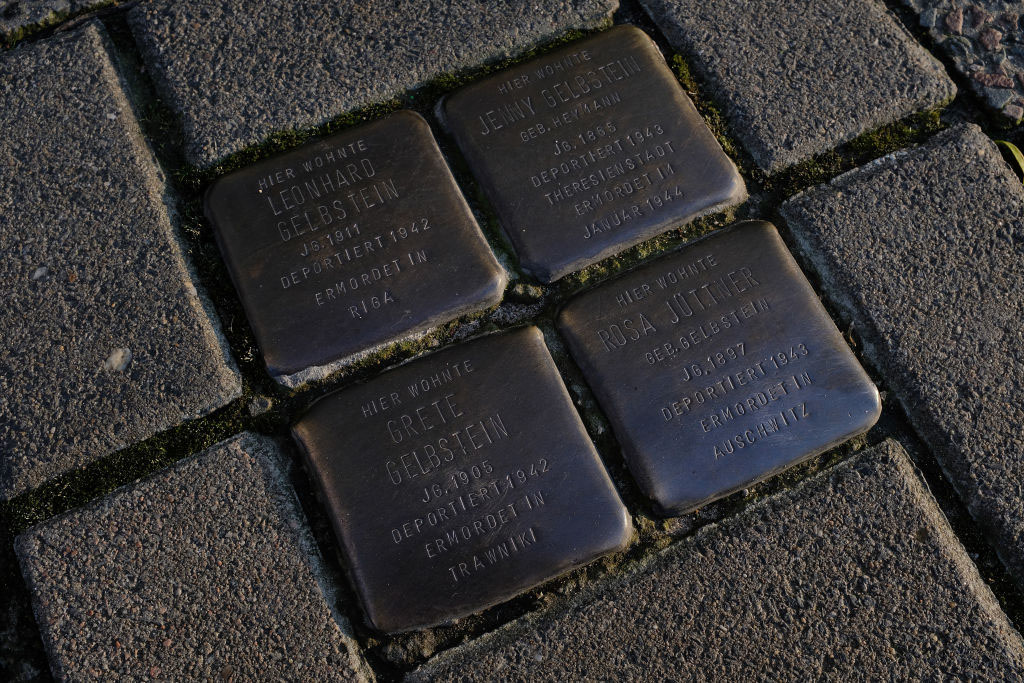
A Holocaust memorial in Cologne, Germany was vandalized with apparent Boycott, Divestment and Sanctions (BDS) graffiti on May 1.

The Algemeiner reported that the memorial consisted of stepping stones known as Stolpersteine, German for “stumbling blocks.” Similar stones are found in various European cities as part of an ongoing effort to commemorate Holocaust victims. Three stepping stones in Cologne had the letters “BDS” written on them, with one letter on each stone.

Jewish groups denounced the graffiti. “Once again we see the BDS movement having nothing to do with helping Palestinians and everything to do with the hatred of Jews,” Stop Antisemitism Director Liora Rez said in a statement to the Journal. “We are sickened to see that this time it happened to be of Jews murdered in the Holocaust.”

The European Jewish Congress similarly tweeted, “Antisemitism and antizionism are two sides of the same coin. This is why we must fight both of them.”

Germany Holocaust Memorial Vandalized with BDS Graffiti Read More »

Architect of World Trade Center Memorial to Lead Tree of Life Reconstruction

Tree of Life*Or L’Simcha Synagogue in Pittsburgh announced the selection of an architect on Tuesday to lead its reconstruction and preservation following the October 2018 mass shooting at the temple, when 11 Jewish worshippers were shot and killed by a lone gunman during Shabbat-morning services.

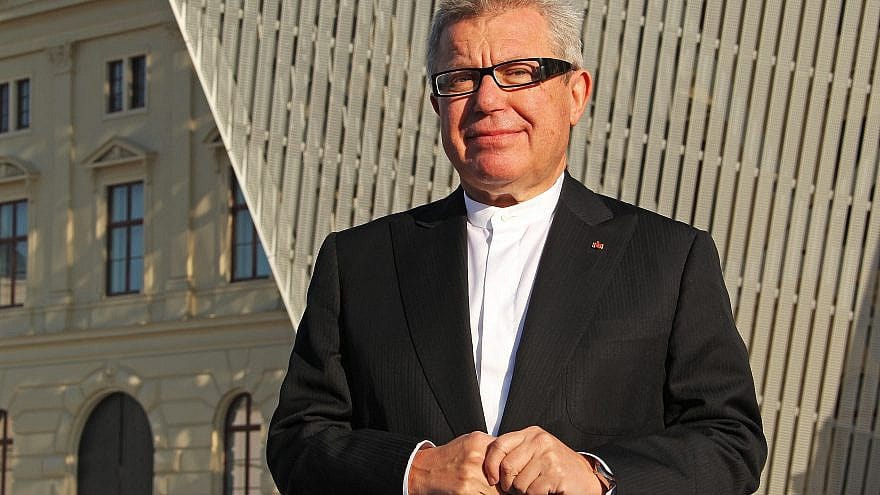
New York-based architect Daniel Libeskind will spearhead the project along with the urban-design firm Rothschild Doyno Collaborative of Pittsburgh, according to the Pittsburgh Post-Gazette. Libeskind, the son of Holocaust survivors, designed the Jewish Museum in Berlin and the World Trade Center memorial following the Sept. 11 attacks.

“It is with a great sense of urgency and meaning that I join the Tree of Life to create a new center in Pittsburgh,” Libeskind said in a statement. “Our team is committed to creating a powerful and memorable space that addresses the worst anti-Semitic attack in United States history.”

Plans include creating a home for the Holocaust Center of Pittsburgh’s exhibits and public programs; and preserving and modernizing the synagogue’s main sanctuary space so that it will serve “as a flexible space for worship, celebrations, educational programming and communal events,” said Barb Feige, executive director of the congregation.

She added that “Mr. Libeskind will also help us create a welcoming, commemorative space to reflect and remember the horrific events and lives lost on Oct. 27, 2018.”

Other parts of the building, including a smaller chapel and rooms where the attack took place, will be demolished. Stained-glass windows from both the chapel and the sanctuary that depict biblical and historical Jewish themes will be preserved, reported the Pittsburgh Post-Gazette.

Three congregations shared the building before the shooting: Tree of Life, Dor Hadash and New Light. Dor Hadash and New Light have decided not to return to the synagogue.

Architect of World Trade Center Memorial to Lead Tree of Life Reconstruction Read More »

Israel and Lebanon Resume Maritime Border Talks

(The Media Line) Israel and Lebanon resumed stalled talks over their disputed maritime border, looking to finally resolve a decades-old conflict involving potentially billions of dollars in gas exploration rights.

The third round of negotiations was kicked off on Tuesday in a United Nations facility in the southern Lebanese coastal town of Naqoura, and are brokered by United States officials.

“After about a six-month break, six hours of discussions were held today,” a spokesman for Israel’s Energy Minister Yuval Steinitz told The Media Line. “The minister was updated by the delegation and consulted with its members about the next steps in the process.”

“We don’t know how long these talks will last, we’ll see how it progresses and we’ll go from there,” another official inside the Energy Ministry told The Media Line earlier in the day.

“One day at a time. Nothing is clear at this point,” the official said.

The US State Department in a statement released over the weekend called the resumption of talks “a positive step toward a long-awaited resolution,” and added that the American team is led by career diplomat, Ambassador John Desrocher.

This is the first time the delegations have met since President Joe Biden assumed office in January, after the initial two rounds of discussions ended without making any demarcation advancements.

The hope in Beirut is that the Americans and Europeans will hand them the economic relief they so desperately need if they just negotiate with Israel.

Israel and Lebanon, still technically enemy states, both claim large swaths of the eastern Mediterranean Sea, thought to be rich with valuable gas deposits. During last year’s negotiations, Beirut surprised the Jerusalem team by producing new maps, outlining a territory nearly twice as large as Lebanon initially demanded.

While Israel has in recent years discovered and exploited three offshore reserves in its territorial waters, Lebanon has yet to strike proverbial gold.

Israel’s representative to the delineation talks, Energy Ministry Director General Udi Adiri, will try to “reach an agreement on a maritime border and find a solution that will enable the development of natural resources to the benefit of all the region’s residents,” Jerusalem’s Energy Ministry said in a statement on Monday.

Col. (ret.) Jacques Neriah, an expert on Lebanese politics at the Jerusalem Center for Public Affairs, explained why Lebanon has a new interest in reentering negotiations.

“They’ve been refusing to hold indirect talks with Israel for years, but with the country’s ongoing economic and social crises, the past year has forced them to change course, at least temporarily,” Neriah told The Media Line.

Lebanon currently is experiencing one of its worst economic downturns in its history, with the global pandemic and the deadly August explosion in Beirut only exacerbating the unprecedented collapse.

“The hope in Beirut is that the Americans and Europeans will hand them the economic relief they so desperately need if they just negotiate with Israel,” Neriah said.

The US government, as well as the EU and international monetary institutions, have pressed Beirut to agree to pass a series of political and financial reforms in order to receive millions of dollars in aid.

“They also hope the natural gas in the Mediterranean will lift them out of the crisis, which is basically an energy crisis,” added Neriah, who served as Israeli Prime Minister Yitzhak Rabin’s foreign-policy advisor and participated in several rounds of peace negotiations.

Israel and Lebanon Resume Maritime Border Talks Read More »

The Day After Netanyahu’s Mandate Expires, Every Dissident Is King

No anecdote is too miniscule to illustrate the smallness of Israel’s politics. So, I will start with an insignificant anecdote involving me and an Israeli TV show host. Since January, I have doubled as an analyst for Kan News TV, Israel’s public channel. Yesterday, as the clock was nearing midnight — the time in which Prime Minister Benjamin Netanyahu’s mandate to form a coalition would expire — I was asked to come to the studio to speak about the significance of the event.

“What are we going to talk about?” the host asked me on the phone as I made my way to the studio. I proposed a few options, and she responded to each with a sigh. “Should we cancel?” I asked (with a glimmer of hope; it was late). She then gave me the answer no man wants to hear: “It’s not you, it’s me.” Then elaborated: “I am just so tired of talking about the nuances of politics.”

Yet here we are, the day after, talking again about nuances — to be exact, the nuances of nuances. Last night, President Rivlin handed the mandate to form a coalition to Yesh Atid’s Yair Lapid — as he was expected to do. But today, a young Member of Knesset — with no political experience and no followers except close family members — might have decided the fate of the unity government planned by Lapid and Yamina’s Naftali Bennett. Yesterday, Netanyahu lost his mandate, and the ball was kicked to the court of his rivals. Lapid and Bennett had a plan — not yet finalized, but getting close to being finalized. Bennett, with just seven seats, will be prime minister. Lapid, with seventeen, will wait two years for a rotation — if the government survives long enough.

The government is supposed to include rightists from Yamina and New Hope; centrists from Blue and White, Yesh Atid and Israel Beiteinu; leftists from Labor and Meretz and Islamists from Raam. A hectic and diverse collection of parties whose main shared interest is to unseat Netanyahu and have a half-functioning government.

Enter Amichai Chikli. He is an educator — and a political nobody. This morning, Chikli sent Bennett a letter telling him that he could not support a government based on falsehoods. During the campaign, Bennett vowed not to sit with Meretz. And he must. Bennett vowed not to sit under Lapid. And he is now ready to commit to such thing. He vowed to be loyal to a right-wing agenda. But he is ready to mix it with the agenda of centrists and leftists.

Chikli was having none of it. Maybe because he is naïve and inexperienced. Maybe because he is a man of integrity. Maybe because Netanyahu, or one of his emissaries, offered him a good deal. No matter what happened, without him, Bennett only has six MKs loyal to the cause, and the Lapid-Bennett coalition now has only 61 seats — the slimmest majority possible. One more defection, and this coalition is gone. One more defection, and a fifth election becomes — once more — the most likely scenario.

One more defection, and this coalition is gone.

And even without such an additional defection, how stable can a Lapid-Bennett coalition be? The bizarre Chikli episode is a cautionary tale. Because even if Lapid and Bennett are somehow able to pull it off, their coalition will be shaky and vulnerable. That’s a situation in which Israelis would use the expression “every bastard a king,” based on a 1961 film by Uri Zohar. What does it mean? I think it is self-explanatory: every Chikli can determine whether a coalition survives; every Chikli can wake up in the morning and send Israel to a new round of elections, Every Chikli gets to decide the agenda of a government. The bastard — be it Chikli or any other MK (Chikli is hardly the worst of them) — becomes our king.


Shmuel Rosner is an Israeli columnist, editor, and researcher. He is the editor of the research and data-journalism website themadad.com and is the political editor of the Jewish Journal.

The Day After Netanyahu’s Mandate Expires, Every Dissident Is King Read More »