fbpx

April 23, 2021

VA GOP Rejects Religious Exemption to Convention Vote

The Virginia GOP State Central Committee voted down a measure on April 22 that would have allowed some Jews to vote via absentee ballot during the party’s upcoming convention. The convention takes place on May 8, a Saturday, meaning that Jews who observe Shabbat would have no way of being able to vote without an absentee ballot.

The convention will select the party’s nominees for governor, lieutenant governor and attorney general. The amendment that would have allowed the religious exemption failed to reach the 75% supermajority threshold to pass.

According to WRIC, one district committee chair argued that military personnel who serve overseas are required to show verification to obtain an absentee ballot, and another local chair argued that it wouldn’t be prudent to change the rules a couple of weeks before the convention.

Thomas Turner, who chairs the Young Republicans of Virginia and is one of the two Black members of the committee, said during the meeting that the party’s failure to pass the amendment “is why people say we are not inclusive.” “Let my brothers and sisters in the Jewish community vote. Let them vote! We talk about voter integrity, and we’re trying to suppress the vote. This is exactly what this is.”

The Republican Jewish Coalition (RJC) denounced the Virginia GOP in a tweet. “It is very disappointing to see observant Jews disenfranchised like this,” they wrote. “We hope @VA_GOP will reconsider this decision.”

Stop Antisemitism similarly tweeted, “With the turmoil happening in the GOP, discriminating against religious Jews isn’t exactly the best decision.”


According to The Washington Post, a Jewish member of the committee, Mike Ginsberg, said during the meeting that opposition to the amendment isn’t the result of anti-Semitism. “This is not bigotry. … Here we are, two weeks out, trying to deal with this. My view, it’s too late.”

VA GOP Rejects Religious Exemption to Convention Vote Read More »

“I Have Had Enough”: Zabulon Simintov, the Last-Known Jew in Afghanistan Returns to Israel

The dawn of a new era where Judaism no longer exists in Afghanistan will begin next month as Zabulon Simintov, the last-known Jew in the country heads back to his roots in Israel. Through the Soviet Invasion in the ‘80s, a horrifying civil war, and the five-year Taliban regime that ended in 2001, Simintov has survived in Afghanistan, running the last functional synagogue and hoping that someday, peace would return.

This month, he told Arab News that the impending exit of the US military from the country will result in more terror as the Taliban will immediately occupy the void.

“I have had enough and plan to leave in the next few months,” said Simintov, an Afghan-born carpet and jewelry seller. “I will watch on TV in Israel to find out what will happen in Afghanistan.”

The history of Jews in Afghanistan dates back nearly two thousand years ago before the socio-political feuds broke out. In 1933, the State of Afghanistan declared a policy to force all Jews out of the country. As of 1948, only 5,000 Jews remained following the creation of the State of Israel in May that year. A mass emigration erupted in the ‘60s and by the Soviet Invasion in 1979, fewer than 300 Jews were left in Afghanistan, mostly concentrated in the city of Herat, where the population had always been largest.

When the Taliban took over in 1996, only ten Jews were left in Kabul, and by 2004, it was just Simintov and Isaac Levy (Ishaq Levin), an 80-year-old man who passed away the next year.

Two distinct Jewish communities had previously thrived in Afghanistan. The Afghan-Jews who were born in the country, Simintov’s group, and the immigrants who came from other regions of Asia. As of 2021, nearly 10,000 Afghan Jews are now part of the community in Israel and the Jewish population is about to be completely wiped from Afghanistan as Simintov has finally lost hope in the return of peace and sanity to the region.

Enduring decades of isolation

The Jews are not the only minority group that has suffered intense hostility in Afghanistan. The Afghan Hindu and Sikh populations have also emigrated heavily in the past decades, including members of these communities that were born and raised in Afghanistan. The numbers have reduced from over 700,000 in the ‘70s to about 7,000 as of 2017. From public harassment to unlawful arrests and social abandonment to violent persecution, minorities have endured remarkable rejection in Afghanistan – a reality that leaves little hope for the future.

Life in Kabul has been extremely dangerous and difficult for Simintov in the past couple of decades. The cultural and political awkwardness of living in Afghanistan as a Jew is evident in many ways, from how Simintov slaughters his own meat (with religious permission) to how he accused the Taliban of stealing his Torah nearly 20 years ago.

Simintov is famed globally as the last-standing Jew in a country that doesn’t recognize Israel as a real state, and sympathetic Jews from all over the world send relief aids to help him survive. During the many occasions when he cannot safely step out of his home into the streets, kind Afghan Muslims offer help and assistance.

Despite the religious isolation, Simintov had persistently refused to be intimidated into shutting down the synagogue.

“I managed to protect the synagogue of Kabul like a lion of Jews here, stood against the mujahideen and the Taliban,” he said.

Founded in 1966, the Kabul Synagogue stands as the last place of Jewish worship in Afghanistan, a reputation that Simintov says will come to a sad end very soon. He remained in the city to keep the synagogue running, maintain a cemetery in the same neighborhood, and preserve the last memories of a once-thriving Jewish community.

“I stay to care for the synagogue,” he says. “If I was not there, the land would have been already sold off.”

For nearly two decades to date, Simintov has worshipped entirely on his own in the constantly empty synagogue, running a kebab restaurant on the second floor to earn maintenance funds and hide in plain sight.

Zero benefits of a turbulent state

Simintov was born and raised in Herat before moving to Kabul in 1980, shortly after the Soviet Invasion. The country suffered uncontrollable violence and more Jews fled back to Israel while many went to North America and Europe.

In 1992 Simintov went to Tajikistan for safety and partly to find a wife. He married a Jewish Turkmenistani woman and returned to his country, but the situation was no better than when he’d left. In 1998, he sent his wife to Israel and she remained in a city close to Tel Aviv with their two daughters.

Simintov said in an earlier interview that he has been left completely alone for many years.

“I went to Israel once for two months in 1998,” he recalls. “After that, I used to talk to my daughters on the phone, but now, my wife doesn’t let me talk to them anymore.”

The only semblance of a family he had in Afghanistan was Isaac Levy, an elderly man who didn’t see eye-to-eye with Simintov. The bad blood between the two men had run so deeply that they had severally turned each other over to the Taliban, and even in death, Simintov never loses a chance to call Levy out on many alleged excesses.

He was old,” Simintov says. “He was a bad person. He wanted to sell the synagogue.”

As he gears up to exit the country, Simintov affirms that every party contributing to the turbulence in Afghanistan is at fault. He admitted that the country was considerably safer during the Taliban regime, but when they return this time, things would be twice as worse.

“If the Taliban return, they are going to push us out with a slap in the face,” Simintov told Radio Free Europe.

He also doesn’t believe in the US mission in South Asia and insists the claims of the military imminently pulling out of the region are false.

“The US makes a mess of the place wherever it goes — Somalia, Iraq, and Afghanistan are good examples. It is hypocritical, pursues double policies,” he said.


Michael Peres writes for The Jewish Journal, where he covers Middle-Eastern politics, tech, entrepreneurship, and daily events.

“I Have Had Enough”: Zabulon Simintov, the Last-Known Jew in Afghanistan Returns to Israel Read More »

Free Speech and the American Way

To read Part 1 in this series, click here.

THE ENGLISH TRADITION

If the Ark of the Covenant—that is, our modern religious views of speech—commands morality in our speech and deference to religious authority and the sovereignty of God, the arc of western legal tradition defends our natural right to speak our mind as sovereign individuals.

An important early advocate for the right of publishers to print ideas without prepublication censorship was English poet and politician John Milton. In 1644, before he went blind and later wrote his most famous poems (e.g. “Paradise Lost”) Milton anonymously wrote a pamphlet entitled “Areopagitica” (a reference to the ancient Greek hill on which orators freely debated).

Milton asserted that the Roman Catholic Church should not have ecclesiastical veto over public discussion; that readers’ exposure to a variety of opinions (good and evil) would allow for our human consciences to develop moral virtue; that censorship of the printed word would not alone ensure public morality (as song, dance, and theatre also attracted interest); and that the flourishing of the human mind through reason and rational debate rather than acceptance of authorized ideas argued against state licensing of published thought. Milton promoted the notion that public debate among intelligent minds was best without a partial umpire enforcing consensus or political unity.

Thomas Paine, English-born author of “Common Sense” (1776), was a key figure in communicating widely to the American public the necessity for revolution to advance religious liberty and to enshrine in writing our human rights to freedom of thought and conscience.

In “The Age of Reason” Paine theorized inviting, not denying, opinions with which one disagrees. “I have always strenuously supported the right of every man to his own opinion, however different that opinion might be to mine. He who denies to another this right, makes a slave of himself to his present opinion, because he precludes himself the right of changing it.”  

In “The Age of Reason” Paine theorized inviting, not denying, opinions with which one disagrees.

John Stuart Mill, born in greater London, was a leading political philosopher, economist, and Member of Parliament. He was a powerful advocate for social liberty, believing “the struggle against authority is the most conspicuous feature in the portions of history.” He believed in the absolute authority of an individual as sovereign over his own person, and that government may interfere with his life only to protect society. This formed the basis for his famous “harm principle,” which approved restrictions on speech only to avoid harm to another.

In his essay “On Liberty,” Mill declared that free discourse is a necessary condition to social progress. Even false opinions are productive and may be corrected through an open exchange of ideas. “If all mankind minus one were of one opinion, and only one person were of the contrary opinion, mankind would be no more justified in silencing that one person, than he, if he had the power, would be justified in silencing mankind.”

Mill assumed good faith and responsible intentions, claiming that “unmeasured vituperation, employed on the side of prevailing opinion, really does deter people from expressing contrary opinions, and from listening to those who express them.” Debate, not dogma, forces an examination of beliefs in the quest for truth.

Similarly, British writer Evelyn Beatrice Hall penned the oft-quoted principle of many free speech champions: “I disapprove of what you say, but I will defend to the death your right to say it.”

AMERICAN LAW AND THE MARKETPLACE OF IDEAS

The First Amendment was subject to sincere debate among the Constitutional framers. The American Revolution aroused many to promote robust political expression as foundational to democratic values, though several state constitutions formally excluded “abusive” speech and suggested a duty of morality and civility as the basis for protected political speech.

The debate over ratification of the U.S. Constitution within the 13 American states was fierce, and unanimity was secured only upon the passing of the Bill of Rights, the first of whose Constitutional Amendments proclaims:  “Congress shall make no law respecting an establishment of religion, or prohibiting the free exercise thereof; or abridging the freedom of speech, or of the press; or the right of the people peaceably to assemble, and to petition the government for a redress of grievances.”

Nevertheless, malicious writings seen as threats to the Federal government were prosecuted under the Alien & Sedition Act of 1789. The denial of Habeas Corpus in 1861 under President Abraham Lincoln during the Civil War also withstood constitutional challenge. During wartime, Americans tend to prioritize security even over cherished liberty.

With rare exceptions, however, the U.S. Supreme Court has moved over time to limit government “prior restraint” upon or control over the content of citizens’ speech.

In 1914, Supreme Court Justice Louis Brandeis acknowledged dismaying speech but wrote that “sunlight is the best disinfectant.” He believed that transparent airing of bankrupt or error filled views should not be hidden but exposed. In 1927, he noted that the remedy “to falsehood and fallacies….is more speech, not enforced silence.”

In 1919, Justice Oliver Wendell Holmes, Jr. affirmed the government’s prosecution of a socialist leafleteer who opposed the World War I draft, based on the standard of a “clear and present danger” to the recruitment and enlistment of troops. The Supreme Court much later narrowed this test to require proof of an “imminent lawless action” such as a public riot. However, in a famous dissent that same year, Holmes also opined that an anti-war anarchist must be allowed to compete in the “free trade in ideas.”

In 1937, Justice Benjamin Cardozo pronounced that free speech was “the matrix, the indispensable condition for nearly every other form of freedom.”

At the height of the Cold War, Judge Learned Hand affirmed the prosecution of communist speech as presenting a “clear and present danger” to the Republic. Today, this ruling is unpopular as too restrictive of political ideas, though the government’s banning of online terrorist videos promoting the overthrow of the U.S. government would likely rely on this reasoning.

In an important 5-4 opinion in Cohen v. California (1971), the Court overturned the conviction of a man who wore a T-shirt which read “F-the-Draft.” The Court limited the fighting words doctrine, rejected the application of obscenity laws to profane speech, re-asserted the protection of offensive speech, and declined the government’s argument that it could ban words it deemed unpopular. Justice Harlan summarized: One man’s vulgarity is another man’s lyric.”

This is not to say all speech is absolutely protected. The American legal system has created numerous categories of speech that can be restricted by “time, place and manner,” or as “conduct,” or as “lower level” or “non”-speech.

Examples include restrictions on child pornography and obscenity; movie rating codes; defamatory libel and slander; incitement to imminent violence (i.e. taunting another toward suicide); true “fighting words”; threats to the President; criminal conspiracy; disruptions of courtroom, school, or library decorum; and the breach of neighborhood peace.

The Federal Communications Commission regulates the public airways, the Federal Election Commission regulates election speech, and the Securities and Exchange Commission regulates capital markets salesmanship. Various other aspects of commercial speech are also regulated to demand truth in advertising, including in the sale of food and drugs.

Some defenders of political speech have become more attracted in recent years to a perspective broadly held in Europe, which prioritizes a listener’s dignity when “harmful” speech injures or humiliates. The U.S. tort of “intentional infliction of emotional distress” is a legal path for those who have been psychologically damaged by the weaponization of words meant not to inform, educate, or even advocate, but merely to assault.

Two famous quotes by President George Washington reflect the dual concerns Americans share. First, he was very clear that “If freedom of speech is taken away, then dumb and silent we may be led, like sheep to the slaughter.”

However, in his famous letter to the Hebrew Congregation of Newport, Rhode Island, our first President captured the promise of America to all of its citizens: “Everyone will sit under their own vine and under their own fig tree, and no one will make them afraid.”

Here Washington seems to hint at the theory that a certain kind of hate speech against a fearful minority violates the democratic nature of our nation.

However, the Supreme Court has to date tended not to favor this legal reasoning and instead has repeatedly ruled across ideological lines in favor of the free speech rights of neo-Nazis upsetting Holocaust survivors in Skokie, Illinois; the Westboro Baptist Church chanters disrupting a private funeral with gay-bashing slogans; desecraters of the American flag; cross burners in front of African-Americans; robe and hood-wearing KKK marchers; and, one suspects soon, Antifa demonstrators wearing black masks.

“Sticks and stones may break my bones but words will never hurt me” is not true for many citizens. Yes, some speech will hurt, intimidate and damage — speech that is intended not to persuade but to attack.  

“Sticks and stones may break my bones but words will never hurt me” is not true for many citizens.

Content moderators are busy censoring disturbing videos from appearing on your Facebook feed, such as cruelty to animals. Those who would regulate or punish “upsetting” speech argue that First Amendment protections are meant to apply only to “decent” or “civil” speech that expresses legitimate ideas.

The tension building in politically correct circles between a robust commitment to freedom of expression and the rising tide of left-wing political advocacy is best seen in the debates within the American Civil Liberties Union. Long advocative of the free speech rights of the unpopular, the ACLU began to wobble under pressure to prioritize instead a social justice agenda. In 2018, the ACLU formally announced new guidelines to prioritize progressive values in evaluating its commitment to advocate for the constitutional rights of speakers who do not meet the political litmus test of its Board and membership.

The debate is therefore joined between the European model, which champions a subjective defense of a listener’s right not to be emotionally harmed against the characteristically American idea of protecting speakers’ expressive rights to independence and individuality.

After the Danish publication of cartoons of the prophet Mohammed and the resulting wide-scale violence by Islamists, European governments essentially caved to the sensibilities of their growing minorities and initiated “hate speech” criminal prosecutions of newspapers, writers, bloggers, churches, business owners, pubic figures and average citizens in a way that continues to shock many Americans.

Compare this to the ability of American religionists to poke fun at their own dogma and culture yet remain loyal to their tradition.

The Church of Jesus Christ of Latter-day Saints earned deep admiration for its poise in responding to a decades-long mocking of their faith by putting advertisements in the “Book of Mormon” Broadway playbill. “You’ve seen the play, now come to one of our churches to see the difference!”

Our American jurists have repeatedly sided with controversial speech, upsetting speech, and politically incorrect speech. In his famous address to the Author’s Guild Council of New York in 1953, Justice William O. Douglas stated: “Restriction of free thought and free speech is the most dangerous of all subversions. It is the one un-American act that could most easily defeat us.”

As the Times Square ball drops each New Year’s eve, revelers follow up their midnight kiss, champagne toast, and signing of “Auld Lang Syne” (a Scottish poem meaning old times past) with a rousing rendition of “My Way”—the unofficial anthem of not only brash New Yorkers but also all Americans belting out hopes and determination to fulfill their dreams in the coming year

“For what is a man, what has he got, if not himself, then he has not. To say the things he truly feels, and not the words of one who kneels. The record shows I took the blows and did it my way.”

The English tradition and the American legal system have developed robust safeguards for individual expression. Political speech in particular is protected, even when it challenges cherished majoritarian ideas. While commercial speech and some other expressions can be regulated, the American way has generally favored the speaker over the listener. In recent years, sensitivities have developed to the point that, at least on college campuses, some younger citizens are increasingly attracted to a European style protection against “harmful” speech.

We must ponder whether Americans will continue to protect even deeply disturbing speech in the belief that while the cost can be very high, our freedom of expression is priceless.


Larry Greenfield is a Fellow of The Claremont Institute for the Study of Statesmanship & Political Philosophy.


The Speech Project is an initiative of the Jewish Journal that brings together some of the most compelling voices from across the political spectrum to address the topic of free speech. In a cultural moment where civil liberties often seem to be under siege, we encourage freedom of expression, independent thinking, and personal choice. The articles, podcasts, books, and other resources you’ll find here all challenge the growing illiberalism of our time in their pursuit of balance and authenticity.

Free Speech and the American Way Read More »

The Cock that Crows in the Jewish Morn


The first thing for which Jews give thanks to God
each day is for providing them with clocks.
These aren’t the ones most use. It may sound odd,
but in the past the clocks of Jews were cocks,
which still crow loud at dawn till we’re awake,
which we must be for very many reasons,
because not being woke is a mistake,
both in the summer and the winter seasons.

The sun, not clocks, determines time, and we
can’t be time’s governors, as some try now,
determining just what the time should be
in summer and in winter. Cocks know how
to tell the time the sun has set, and this
is what Jews need to know before they pray:
a good Jew in the past thus didn’t miss
this signal, telling him the time of day.

Facts like these were once great morale boosters
for every Jew, based on God’s brilliant plan
providing early risers with loud roosters
to help each one to be halakhic man,
but nowadays few people still rely
on roosters, more reliant on our phone;
its smartness is a stronger reason why
each of us rises, called by what we own,
made smart by instruments if we aren’t smart
enough to wake without their help to pray
with all our mind and soul and Jewish heart
as soon as early light turns night to day.

Gershon Hepner
4/25/21c

Gershon Hepner is a poet who has written over 25,000 poems on subjects ranging from music to literature, politics to Torah. He grew up in England and moved to Los Angeles in 1976.  Using his varied interests and experiences, he has authored dozens of papers in medical and academic journals, and authored “Legal Friction: Law, Narrative, and Identity Politics in Biblical Israel.” He can be reached at gershonhepner@gmail.com.

The Cock that Crows in the Jewish Morn Read More »

Pomona College Student Gov’t Passes BDS Resolution

The Pomona College student government unanimously passed a pro-Boycott, Divestment and Sanctions (BDS) resolution on April 22. The Claremont Independent reported that the resolution, which was authored by Claremont Colleges Students for Justice in Palestine (SJP) and Claremont Jewish Voice for Peace (JVP), called on the Associated Students of Pomona College (ASPC) to cease funding student clubs that “invest in or purchase goods or services from companies that contribute to the settlement and occupation of Palestinian occupied territories by the UN-designated companies or the Israeli state” and to stop stores headed by the ASPC from selling such goods.

Claremont SJP celebrated the resolution’s passage as “an important first step in reducing our complicity with a country that maintains an illegal military occupation and regularly commits crimes against humanity against the indigenous Palestinian population.” JVP’s Los Angeles chapter said in a statement that student activism in favor of the resolution “supports Palestinians in their own struggle for freedom and equality, and it brings the world closer to a future defined by a just and secure peace for all in Palestine and Israel.”

However, Janie Marcus, who heads the Claremont Progressive Israel Alliance, told the Journal that Jewish students and the local Hillel were not notified about the resolution and didn’t get a chance to weigh in on it before it was passed. “It really seems more than anything else that they wanted to do this in secret.”

She added that the resolution “marginalizes Jewish students who view Israel as the Jewish homeland and directly targets these Jewish students” and pointed out that the Claremont Progressive Israel Alliance could lose funding if the resolution is enforced, as the club provides support to various Jewish organizations and Jewish companies. “I worry that our club could come under fire and lose funding just because we support Israel.”

Pomona College President G. Gabrielle Starr denounced the ASPC for holding the vote “without representation from any student opposition” and urged the ASPC to revisit the matter to ensure that all viewpoints are heard. “The resolution’s stated goal of eventually enacting requirements that all student clubs supported by ASPC — not just ASPC itself — comply with its divestment stance or lose funding is also of deep concern, as it would require all students, regardless of their views, to participate in a boycott,” Starr said. “We urge ASPC to reverse course and allow for full discussion, and we welcome an open dialogue on this matter.”

“We urge ASPC to reverse course and allow for full discussion, and we welcome an open dialogue on this matter.” — Pomona College President G. Gabrielle Starr

Marcus said that she was “thrilled” about Starr’s statement for putting pressure on the ASPC to rescind the resolution, but she won’t be satisfied until such action is taken. “I think the first step is to create some sort of dialogue and to bring Jewish students and minority voices into the discussion… I’m curious what will happen when some of these other voices are included.”

Jewish groups condemned the resolution. “The passage of this new Boycott, Divestment and Sanctions (BDS) resolution by the Associated Students of Pomona College (ASPC) is a disturbing trend we have seen in recent years on a number of the campuses in The Claremont Consortium,” Anti-Defamation League Senior Associate Regional Director Natan Pakman said in a statement to the Journal. “BDS campaigns promote a biased and simplistic approach to the complex Israeli-Palestinian conflict and present this dispute over territorial and nationalist claims as the fault of only one party — Israel. The BDS campaign does not support Israeli-Palestinian peace efforts and rejects a two-state solution to the conflict.”

StandWithUs co-founder and CEO Roz Rothstein similarly said in a statement to the Journal, “It is shameful that a Boycott, Divestment, and Sanctions (BDS) resolution was passed by Pomona College’s student government without the knowledge or input from the Jewish and Israeli community on campus. What is especially disturbing is that this resolution stated intent to deny funding to any student groups who do not support divestment. Passing this resolution without consulting important constituencies and attempting to deny funding to those who oppose efforts to demonize Israel is a blatant disregard for Pomona College ASPC’s stated values of ethics. It is appalling to see such flagrant efforts to exclude students for their Zionist identities.”

AMCHA Initiative Director Tami Rossman-Benjamin called the resolution “particularly sinister” in a statement to the Journal, noting that it would require pro-Israel student clubs “to disavow their support for Israel or lose their student government funding, effectively discriminating against and suppressing the free speech of Jewish and pro-Israel students. That is a direct violation of the First Amendment and cannot be left unaddressed. The university must not only condemn this resolution, they must immediately nullify it.”

The ASPC did not respond to the Journal’s request for comment.

Pomona College Student Gov’t Passes BDS Resolution Read More »

Temple University Speaker Calls For Israel To Be Replaced

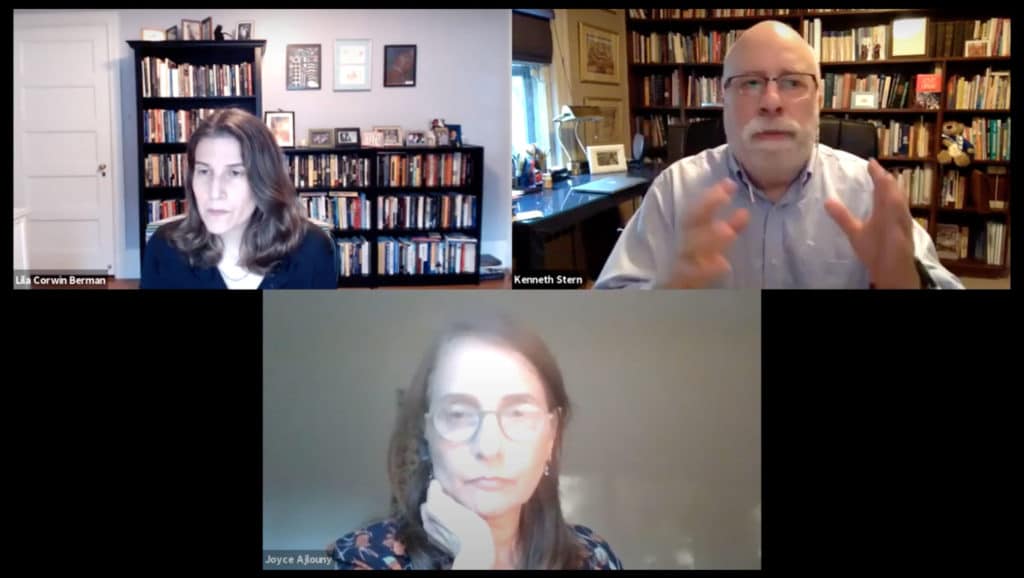
Last week, the Feinstein Center for American Jewish History and Congregation Rodeph Sholom of Philadelphia invited Joyce Ajlouny to share her hate of Israel. During the April 20 event, titled “The Weaponization of Discourse: Where is the Line Between Anti-Israel and Anti-Semitism on Campus?”, Ajlouny asserted that she favors “a secular, democratic state” — which, in plain English, means the elimination of Israel.

Why did the Feinstein Center and a prominent synagogue give Ajlouny a platform, knowing that she was almost certainly going to engage in such anti-Israel libels, since she has been saying the same things for decades? Ajlouny is, after all, executive director of the American Friends Service Committee (the foreign policy arm of the Quakers), which has repeatedly compared Israel to Nazi Germany.

In the event, Ajlouny began by accusing Israel of being “created on a false premise of a land without people, through ethnic cleansing, massacres, and forcing over 700,000 Palestinian to flee.” She said Israel governs through “an apartheid system.” She declared, unequivocally, “I am an anti-Zionist.”

Professor Kenneth Stern of Bard College, the event’s other panelist, responded by calling her rant “incredibly moving” then emphasized that Arabs and Israelis “need coexistence.” Ajlouny replied, “I would like to have coexistence in one secular democratic state, but that is a subject for another discussion.”

Ajlouny, who has lived most of her life in Ramallah and has been a public advocate for the Palestinian Arab cause for decades, knows full well that the term “one secular democratic state” is the longstanding PLO motto for eliminating Israel and replacing it with “Palestine.”

In her remarks, Ajlouny also staunchly defended the Boycott, Divestment and Sanctions (BDS) movement (which all major Jewish organizations consider to be anti-Semitic, since the goal of BDS is the elimination of Israel). “I don’t see sanctions [against Israel] as hatred,” she insisted. “I see them as a way to get my rights. It’s effective. If you’re living under an apartheid system and military rule and you are looking for ways to liberate yourself, you have to look for strategies that are effective.”

Ajlouny then praised extremist pro-BDS groups, in particular the US Campaign for Palestinian Rights, which lobbies against U.S. aid to Israel, accuses Israel of “genocide” and supports a Palestinian “right of return.” Ajlouny blamed anti-BDS efforts on the conspiracy of the “pro-Israel lobby” and its “well-oiled machine,” which she said opposes BDS as part of a plot to “silence Palestinians” and “suppress Palestinian rights.”

Ajlouny blamed anti-BDS efforts on the conspiracy of the “pro-Israel lobby” and its “well-oiled machine.”

Remarkably, Ajlouny then claimed that she is prevented from speaking on platforms — while speaking from a platform provided by a prestigious Jewish and academic center. “If I talk about my personal story, I am accused of being an anti-Semite,” she said. “‘If I speak about the daily pain I experienced growing up in an apartheid system, I am called an anti-Semite. If I speak about a soldier cocking his gun in my back, ready to shoot, I am called an anti-Semite.” She did not name a single person who has called her an anti-Semite.

“I am being silenced over and over again,” Ajlouny loudly asserted. “We are prevented, even by law, to share our story.”

The panel discussion was supposed to focus on the definition of anti-Semitism crafted by the International Holocaust Remembrance Alliance (IHRA), which has been accepted by numerous governments, including the United States. But for Ajlouny, talking about anti-Semitism is a bit of a conundrum, because she refuses to acknowledge that one of the most pernicious sources of anti-Semitism today is the Palestinian Authority. In its official media and schools, the PA constantly accuses Jews of controlling America, denies the Holocaust and cites the Protocols of the Elders of Zion as a reliable source of information.

An infamous example of such anti-Semitism was the April 2018 speech by PA leader Mahmoud Abbas, in which he asserted the Holocaust was not the result of anti-Semitism but rather was caused by the Jews’ own “social behavior, [charging] interest, and financial matters.” J Street acknowledged that the speech “featured absurd anti-Semitic tropes.” But not Joyce Ajlouny. To her, “Constant accusations against Palestinians of anti-Semitism are like the boy who cried wolf.”

This is what the Feinstein Center for American Jewish History and Congregation Rodeph Sholom gave the Jewish community this week — ninety minutes of Israel-bashing disguised as an academic discussion.


Moshe Phillips is national director of Herut North America’s U.S. division. Herut is an international movement for Zionist pride and education and its U.S. website is https://herutna.org/

Temple University Speaker Calls For Israel To Be Replaced Read More »

A Moment in Time: When Righteousness Flourishes

Dear all,
Ron and I took a day trip a few weeks ago into the mountains. On one particular road, Ron said, “Zach, turn around! I just saw an incredible tree.”
“C’mon, Ron,” I said as I continued driving.
But he insisted.
So I turned around. Lo and behold, here was a tree that found its way out from under a boulder. Indeed, it was worth the u-turn.
I was reminded of a Biblical Psalm that teaches, “The righteous (justice) shall flourish like a palm tree (and) shall thrive like the cedar.” (Ps. 92:13).
Just as it takes wherewithal for a tree to emerge from a rock, so too does it take determination for humanity to harness righteousness in a world with so many challenges.
In the face of the Derek Chauvin verdict, we recognize we have work to do to achieve racial justice.
In the face of Knesset Member, Reform Rabbi Gilad Kariv‘s opposition by the ultra-orthodox establishment, we recognize we have work to do to achieve religious justice.
In the face of a spike in mass shootings in the past month, we recognize we have work to do to achieve social justice.
No, it isn’t an easy road. But when we take a moment in time to confront these real issues, we realize that changing tomorrow often begins with a u-turn today.
With love and Shalom,
Rabbi Zach Shapiro

A Moment in Time: When Righteousness Flourishes Read More »

AIPAC Applauds Lawmakers for Backing Full US Aid to Israel, Without Conditions

AIPAC applauded the overwhelming majority of members of the House of Representatives on Thursday who signed a letter urging U.S. aid to Israel to be fully funded in the federal budget without condition, contradicting a handful of prominent Democratic Party lawmakers who spoke at a virtual national conference of the left-wing, pro-Israel group J Street over the weekend.

The letter, drafted by Rep. Ted Deutch (D-Fla.) and House Foreign Affairs Committee ranking member Rep. Michael McCaul (R-Texas), was sent to Appropriations Committee chair Rep. Rosa DeLauro (D-Conn.) and ranking member Rep. Kay Granger (R-Texas), with signatures from 331 members of Congress.

It harkened back to the guarantee that the United States made in 2016 under the Obama administration in the U.S.-Israel Memorandum of Understanding (MOU), which was later overwhelmingly passed by Congress under the 2020 U.S.-Israel Security Assistance Authorization Act and codified into law by the National Defense Authorization Act.

“As the United States meets pressing global challenges, we strongly believe that robust U.S. foreign assistance is vital to ensuring our national security interests abroad,” the letter stated.

According to the letter, the MOU guarantees $3.8 billion in security assistance to Israel each year for 10 years for a total of $38 billion. Of the annual amount, $3.3 billion is for foreign military assistance and $500 million for cooperative missile-defense programs in what will be the fourth year since the agreement.

The letter cited tensions with Iran, its terrorist proxies, an explosion on an Israeli ship in the Gulf of Oman, the launch of three anti-tank missiles at an Israeli Defense Forces’ vehicle in 2019 by Hezbollah, and Hezbollah’s estimated arsenal of 130,000 rockets and missiles as reasons the aid is needed both for Israel’s security and American interests.

“Congress is committed to maintaining Israel’s Qualitative Military Edge and its ability to defend itself, by itself, against persistent threats. Our aid to Israel is a vital and cost-effective expenditure which advances important U.S. national security interests in a highly challenging region,” the letter stated. “For decades, presidents of both parties have understood the strategic importance of providing Israel with security assistance.”

The letter also reiterated U.S. President Joe Biden’s promise of not placing conditions on aid to Israel, calling such a consideration “irresponsible” given the serious threats it faces.

“Just as foreign assistance is an investment in advancing our values and furthering our global interests, security aid to Israel is a specific investment in the peace and prosperity of the entire Middle East. U.S. support for Israel makes the region a safer place and bolsters diplomatic efforts aimed at achieving a negotiated two-state solution, resulting in peace and prosperity for both Israelis and Palestinians,” the letter concluded.

AIPAC Applauds Lawmakers for Backing Full US Aid to Israel, Without Conditions Read More »

Facebook Blocks PA-Connected Hacking Ring Targeting Journalists, Activists

(The Media Line) In a report released Wednesday, Facebook detailed its actions against two hacker groups from the Palestinian territories that made use of the Facebook platform to spy on Palestinians.

According to the report, the first group targeted journalists, human rights activists and government opposition, among others, and used malware to access phones and computers for spying. This group is connected to the Palestinian Authority’s Preventive Security Service (PSS), an intelligence agency tasked with internal security.

The second group, named Arid Viper, directed its efforts at Fatah members, PA officials and members of security forces, hinting at a possible connection to Fatah-rival Hamas. This second group employed a variety of tactics, all aimed at accessing personal information on phones and computers.

A PSS spokesperson rejected these allegations, telling Reuters that “we respect the media, we work within the law that governs our work.”

Facebook took action against these groups by blocking their accounts, as well as internet domains connected to them. The company also notified the attackers’ targets as well as “industry partners.”

If the allegations are true, the attacks are in keeping with the PA’s suppression of dissidents and critics. Both the PA and Hamas have been harshly criticized by human rights organizations for their employment of suppressive measures. A 2020 report by Amnesty International said that both Hamas, which controls the Gaza Strip, and Fatah, the organization heading the PA, arrested dozens of protesters, opposition members, activists and journalists throughout the year.

The 2020 annual report of MADA, the Palestinian Center for Development and Media Freedoms, noted a decline in the number of attacks on journalists in the Palestinian territories. Yet the report attributes the smaller numbers to lockdown measures enforced because of COVID-19, which lowered the number of interactions between journalists and potential attackers. “The state of media freedoms in Palestine has not witnessed any real positive and tangible developments that would serve to move away from the path of practices and trends that prevailed during the preceding years,” the report said.

Wake up to the Trusted Mideast News source Mideast Daily News Email

By subscribing, you agree to The Media Line terms of use and privacy policy.
The Palestinian organization recorded over 400 attacks in 2020, more than half of which it attributed to Israeli forces. Palestinian groups carried out 96 of the attacks; these included arrests, summons and interrogations by security forces. Notably, the report mentions one case of torture at the hands of the Palestinian Authority, carried out by the PSS. The victim, Ayman Faisal Qawareq, was charged with “defaming the authority” according to the report.

The rivalry between Fatah and Hamas may be a factor in the attacks. While the two organizations have taken steps toward reconciliation in recent months, tensions ahead of the Palestinian legislative and presidential elections, scheduled for May 2021 and July 2021, respectively, have not disappeared. With a elections’ postponement currently on the table – ostensibly because Israel hasn’t approved the participation of Palestinians who reside in East Jerusalem – disagreements between the sides may deepen and rise to the surface.

However, Sharif Haj-Ali, a project coordinator at MADA, told The Media Line that the organization “confirms that as of this moment, no violations or attacks on media and press freedoms directly linked to the Palestinian elections have been monitored or documented.”

MADA declined to comment on the Facebook report or the alleged attacks. The Media Line reached out to three Palestinian journalists for their comments on the subject. While all expressed their outrage at the attacks, none were willing to speak on the record for fear of retribution by the PA.

Mohammad Al-Kassim contributed to this report.

Facebook Blocks PA-Connected Hacking Ring Targeting Journalists, Activists Read More »