As we commemorate Yom HaShoah/ Holocaust Memorial Day, we think deeply on what it means to be a Jew.
I am a Jew.
I am a Jew because my soul dances when I see a Hora.
I am a Jew whose heart is moved hearing the sound of Kol Nidre.
I am a Jew when I yearn for a meal in a deli.
I am a Jew with a sacred responsibility to make the world better.
I am a Jew, called to action when those without a voice need to be heard.
I am a Jew, standing with Israel.
I am a Jew, calling upon Israel to be a pluralistic voice.
I am a Jew who believes in God.
I am a Jew who does not believe in God the same way others might,
I am a Jew because when Jews in other parts of the world suffer, I feel it.
I am a Jew because when ANYONE in ALL parts of the world suffers, I feel it.
I am a Jew.
If I ever forget, I realize that Pharaoh knew it, Haman knew it, Hitler knew it, and countless haters throughout time knew it.
And I vow, on this Yom HaShoah, to ensure that Pharaoh, Haman, and Hitler will NOT define who I am or who we are. We are Jews not because others have hated us. We are Jews because we are bound at this moment in time to define our future by what we love.
“Maman, where’s the challah?” my sister asked one Friday evening when she was a senior in high school (and I was a freshman).
“Chee?” my mother responded in Persian, asking, “What?”
“The challah!” my sister pleaded. “Where’s the challah?”
“Chee chee?”
“Maman!” my sister yelled. “My friend is coming for Shabbat dinner, and we need to put challah on the table!”
“What’s the matter?” my mother asked. “Doesn’t she eat meat?”
“She’s not a vegetarian!” my sister cried. “Challah is a type of noon (bread)! It’s a giant loaf that’s braided, and the American Jews only eat it on Shabbat!”
“Oh, so you want noon so you can say HaMotzi?” my mother asked. “Here, put this bag of pita on the table.”
I’ve previously written that I’d never heard of dreidels and latkes, nor of hamantaschen, until I came to the United States. How’s this for shocking: I never tried challah until I entered college.
Iranian Jews don’t incorporate bread into Shabbat and holiday meals as much as other Jews, especially Ashkenazim. If you’ve ever been to an Iranian Shabbat dinner, you’ll know why: whether in Iran or America, we mostly stick to the first course (fruits and nuts), the second course (fish and salad), the third course (stews, meats and rice) and then tea and dessert. There isn’t even room in our stomachs for bread, which, back in Iran, we mostly reserved for weekday breakfast with sharp cheese and fresh herbs.
But whether in Iran or America, Iranian Jews do make a big deal about saying Kiddush over wine at the start of Shabbat dinner (forget grape juice for the kids back in Iran; all we had was red wine, and we were lucky to have it). Without wine and its corresponding prayers, it’s just another dinner with 30 cousins.
We make such a big deal about saying Kiddush, in fact, that over 40 years ago, after the Islamic Revolution, the newly-formed regime of the Islamic Republic of Iran still allowed Jews to possess wine for the Sabbath and holidays. Alcohol is banned in Iran per its prohibition in Islam (and possession of it is punishable by 80 lashes; after three convictions, a fourth conviction results in death).
In fact, I can’t even remember a single Shabbat dinner at my parents’ home in America during which we put out bread of any kind — until, that is, my sister began participating in mostly Ashkenazi-led Jewish outreach programs at UCLA and taught us about big, braided fluffy loaves of bread with sesame seeds sprinkled on top.
There are, of course, many Jews in Iran and Jews of Middle Eastern descent all over the world who enjoy bread with Shabbat dinner, lunch or Seudah Shlishit (the late afternoon meal on Shabbat). That bread, however, is usually flatter than a pancake beneath an anvil.
Whether lavash, pita or barbari (all loved by Iranians); pain petri (popular in Morocco and France); mouna (Algeria); or jachnun and kubaneh (amazing Yemenite breads, which are readily available in Israel), all of these delicacies have one thing in common: nothing about them resembles the traditional, puffy breads that we see in kosher bakeries and supermarkets.
As it turns out, “challah” actually refers to any bread that’s incorporated into Jewish rituals. On Shabbat, Jews serve two loaves of bread because when the ancient Israelites were wandering in the desert after leaving Egypt, God provided them with an extra serving of manna the day before Shabbat (to be eaten on Shabbat, so they wouldn’t be lacking in food and forced to toil or bake). As the Torah states, “And it shall be on the sixth day that when they prepare what they will bring, it will be double of what they gather every day” (Exodus 16:5).
Generally, if you make more than five pounds of dough, the common practice is to recite the blessing of Hafrashat Challah and remove an egg-sized portion as an “offering” (since Jews no longer have the temple, or Beit Hamikdash in Jerusalem, where they would bring an offering to the Cohanim). As the Torah states, “The first portion of your dough, you shall separate a loaf for a gift; as in the case of the gift of the threshing floor, so shall you separate it” (Bamidbar 15:20).
When God instructed the Israelites about entering the Land of Israel, He commanded them to make bread and provide a gift offering from that bread. I wrap my offering portion in foil and burn it in the oven. On Shabbat, it’s not an obligation to eat bread whose dough was partly removed as a gift offering. It is a commandment, however, to eat two whole loaves of dough, whatever their shape. The word “challah,” simply refers to a loaf of bread (or the part that was removed as an offering).
For years in many Iranian towns, the oldest male Cohen would be privy to which Jewish households were making bread on Fridays. He would knock on doors and ask for a small piece of dough (the gift offering), which he would collect and then burn in his oven (or the oven of the local synagogue, if it had one). It was a quaint, wonderful custom.
God commanded us to make bread. Not specifically eggy, braided and puffy bread with raisins, but just bread. And since this all transpired in the Middle East, that bread was flat.
If we divided global Jewry into Ashkenazim and Sephardim/Mizrahim, over half never actually ate the puffy loaves until they were exposed to Ashkenazi challah customs, whether they were Moroccans who moved to Paris or Syrians who escaped to New York City. So why does only one dominant image (and eggy taste) come to mind when we think of challah?
Why does only one dominant image (and eggy taste) come to mind when we think of challah?
Don’t get me wrong. Everything about challah is awesome. I like it (I especially love the local pretzel challah from Got Kosher?), but I’ll take a piping-hot, giant slab of barbari bread topped with melted butter any day of the week. In Iran, I was tasked with running down to the local baker (whose bakery consisted of a stone oven and a tarp) and buying a giant loaf of barbari bread, which, when cut in half and held vertically, resembled the two tablets of the Ten Commandments. I felt like Moses — if Moses was a hijab-clad girl in Tehran.
So why do we only know about one type of challah? Because American Jewish culture is predominantly Ashkenazi and because, let’s face it, the puffy stuff is prettier, fluffier and more enticing to kids.
A few years ago, when my kids were enrolled in a Jewish daycare, they would occasionally serve as the “Shabbat Abba” on Fridays, leading the Kiddush prayer. When my child was the Shabbat Abba, it was my job to send enough bread and grape juice for every kid in the daycare program. I was happy to oblige, and it was adorable. Naturally, I always sent two loaves of challah (sometimes with chocolate chips, which is like catnip for toddlers). You know what wouldn’t have been so adorable? If I had sent two big pieces of flat lavash bread, or a big pack of powdery pita. I can just imagine the confused, whimpering children.
Given the fact that puffy challah has been the rage for centuries, someone has to defend the lonely existence of flatbreads. Enter Natalie Zangan, a Tehran-born psychotherapist and children’s activist based in Encino.
“Many centuries ago, when Jews moved to Eastern Europe, they were introduced to a uniquely European-style braided bread, which they adopted,” Zangan told the Journal. “But we have not found any textual evidence from the Torah suggesting anything specific about braided bread for Shabbat.
“The bread that we consume on Shabbat and holiday meals does not have to have a particular style or even have a particular name,” she continued. “Our only commandment is that it needs to be two complete [unbroken] loaves of bread.”
The medieval Jewish scholar, Rashi, wrote about challah in his Talmudic commentary (Beitzah 9a). “Rashi translated challah as the old French word, ‘torte,’” said Zangan’s husband, Rabbi Bijan Refael Zangan. “For thousands of years, the bread we call ‘challah’ today simply resembled a thin, round cake.”
This Friday marks the first Shabbat after Passover, and it’s an auspicious and symbolic occasion to bake bread in our own homes to celebrate the month of Iyar, when the manna was first offered to the Israelites (after the one-month supply of unleavened bread they brought out of Egypt ran out). It also symbolizes how, after 40 years of wandering in the desert, the Jews understood that it would be up to them to make their own bread (and no longer rely on God-given manna) once they entered the land of Israel.
As a symbol of how God is the key to our sustenance and livelihood, German Jews began making challah for the first Shabbat after Passover in the shape of keys (called “shlissel challah”), which initially received criticism that it was borrowed from pagan and Christian practices. Now everyone, whether a German, Polish or Algerian Jewish baker, bakes their challah for this Shabbat in the shape of a key as a segula (a protective charm) for increased livelihood. This Friday, you’ll even find a few key challahs at Got Kosher, which is owned by a Tunisian (Alain Cohen).
If I’m expected to make a key-shaped challah for this Shabbat, I’d like to propose that next Shabbat, my Ashkenazi neighbors ask me how to make cloudlike pita bread at home (the trick is to use coconut cream). Challah is delicious, but as I always say, Jewish cultural exchange should be a two-way street (with seven opinions).
As for Zangan, I’ve never met anyone so passionate about going beyond challah. “I’m on a mission to create more education and awareness about the root teachings of our different customs and to connect Jewish people back to ancient sources,” she said. “My dream is to find sponsors who will enable me to teach children about the origins of bread for Shabbat, helping them to connect mindfully [to] the Earth with their own hands.” Indeed, I’ve seen photos of her flatbread, and it looks heavenly.
Zangan currently teaches about the biblical and historical background of Jewish bread on her YouTube channel. This Purim, she even dressed up as a loaf of dough. Now that’s commitment.
Natalie Zangan dressed as a loaf of dough (called challah) this Purim. (Courtesy Natalie Zangan)
And in the past few decades, a new trend has started in Iran’s Jewish community (which ranges between 5,000-8,000 people): puffy, braided challah for Shabbat. It seems that some rabbis in the West sent videos to Iranian Jews teaching them how to make Ashkenazi challah. If only I could initiate a virtual event in which Jews in Iran teach Americans about their breads (without putting those Jews in Iran at risk of being charged as spies for America).
As for my mother, she eventually became used to challah, although she pulls out the gloriously puffy part inside and only eats the crust. “I know you like to put it on the table for the kids, but this stuff’s too doughy,” she complains. “Don’t you keep any pita or lavash in the house?”
Tabby Refael is a Los Angeles-based writer, speaker and activist. Follow her on Twitter @RefaelTabby
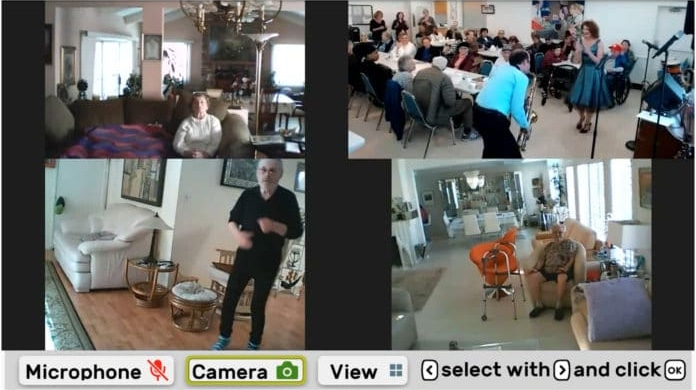
Nancy Brenner, an 89-year-old Holocaust survivor living in Los Angeles, has been isolated from friends for more than a year due to the COVID-19 pandemic. But on Yom Hashoah, the day when Jewish communities around the world remember the six million souls killed in the Holocaust, she was not alone.
Brenner joined survivors across the U.S. for a virtual commemoration, thanks to a collaboration between The Jewish Federations of North America (JFNA) and Uniper, an innovative Israeli startup. Uniper’s objective is to empower older adults to stay connected by providing them with technology that is easy for them to access and use.
The virtual event also brought together members of the second, third, and fourth generation of Holocaust survivors, along with representatives of the federal government, JFNA, and the Network of Jewish Human Service Agencies (NJHSA).
For Brenner and hundreds of fellow survivors, it was meaningful to observe Yom Hashoah as a community, with friends they have connected with during the pandemic. Throughout the year, they have been able to participate in current events discussions, group yoga, name that tune trivia games, and other virtual programming. This was made possible by a new partnership between the federal government, JFNA, and NJHSA, which has invested in virtual socialization.
According to a 2020 report of the National Academies of Sciences, Engineering, and Medicine, at least one in four older adults was already socially isolated before COVID-19, and even more – 43 percent – reported feeling lonely. Isolation and loneliness are associated with an increased risk of dementia, heart disease, and early death, and higher rates of depression, anxiety, and suicide, according to the report.
For millions of older adults, the pandemic nearly destroyed their already limited social connections. In the spring of 2020, the government issued guidance encouraging all older adults to isolate, and directing nursing homes to cancel all visitors and group activities. Holocaust survivors, already among the most vulnerable older populations in the U.S, with about 35% living in poverty, became almost completely isolated.
According to a Pew Research Center survey conducted in April 2020, only 20 percent of adults age 65 and older have had a virtual party or social gathering online, and only 8 percent have participated in an online fitness class. While many technologies aimed at keeping older adults connected require a computer, an app, or a tablet, Uniper only requires a TV, a medium most older people are already comfortable using. A special box and remote completes the set up.
The partnership between JFNA and NJHSA expanded in 2021 with a goal of bringing Uniper to nearly 900 older adult clients by 2022, most of them Holocaust survivors. As COVID-induced isolation ends, this partnership will continue to address the social isolation and loneliness that plagues homebound older adults, offering them opportunities to participate in meaningful virtual programming.
In line with the federal government’s grant to help Holocaust survivors and diverse older adults with a history of trauma, Uniper’s programming embodies the person-centered, trauma-informed approach, giving participants choice and a voice. The Yom HaShoah ceremony exemplified that approach, highlighting the voices and memories of survivors.
Brenner empowered other participants with her message, “Never forget what we went through; that has to be with us for the rest of our lives. But also remember what you accomplished since you came here.”
Mark Wilf, chairman of JFNA and the son and grandson of Holocaust survivors, participated in the Yom Hashoah event. “We have a responsibility to help Holocaust survivors live with comfort and dignity,” he said. “And in these times, keeping them connected to each other and to Jewish community is essential to their well-being. I’m proud that JFNA is investing in innovative ways to carry out this mission.”
Even as Brenner sits alone in her Los Angeles home, she reflects and dreams, “We were always a close family. We still should be. We lost too many families. We lost our aunts, uncles, and cousins. And the rest of us [survivors], you are my family.”
Sheep clouds and sandy light, white sails and motor boats
This summer escape was built in 1907
for the working class of Berlin, who could not afford the Baltic Sea
Then and now a crowded beach
young women posing in deck chairs
Pine cones, yellow flowers
soda fizzing red and green in leafy shadows
One afternoon we plowed, arms hooked, through shallow water
the ferry to Peacock Island in the distance
reed grass rustling in the sudden silence
That’s how you find a drowned body
the lifeguard explained
by marching as one long chain of humans
The loudspeaker blared
and I thought of the cheery post-war tune
sung by an eight-year old, “The Little Cornelia,”
about children riding their bikes out to Wannsee
underneath a canopy of pines and patches of blue sky
The song didn’t exist in 1942, neither did little Cornelia
and it was January
the beach across the lake closed for the season
but the view and shoreline were the same —
Did any of them let their mind wander to the summer ahead
to riding their bikes through the forest
running into the cool, soft Wannsee
lifting their daughter up into the air, water dripping from her blond curls?
A student at the Ziegler School for Rabbinic Studies, Julia Knobloch published her debut poetry collection, “Do Not Return,” with Broadstone Books and has a new chapbook forthcoming with Ben Yehuda Press.
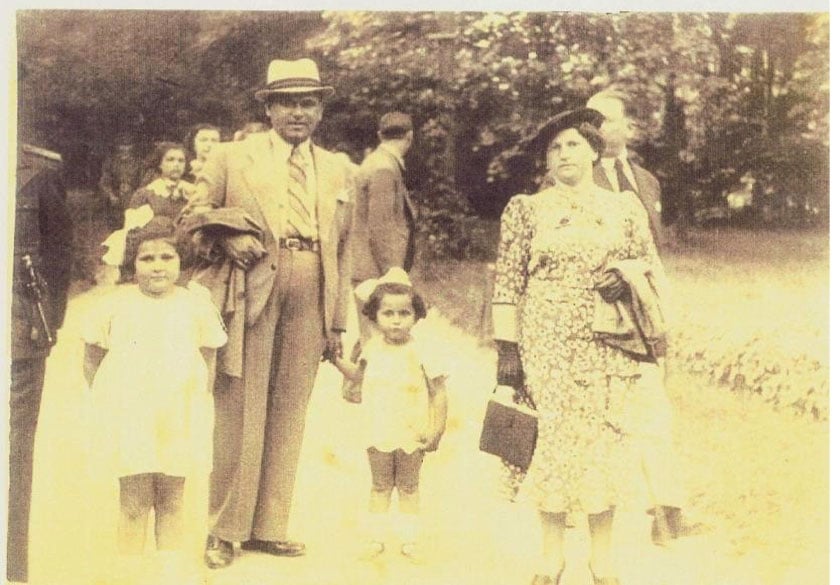
I am not, by nature, someone who spends a lot of time in the past. And for good reason: When I was seven years old, my parents, sister, and I were whisked away to the Nazi camps in Mohyliv-Podilska, Ukraine, during World War II. Miraculously, we all survived. For that reason, I like to say the past is gone, but when I look back, I am reminded how strong I became because of, and perhaps despite of it. The four years I spent in the camps made me a capable, resilient and determined child. During and after my incarceration, I willed myself to be tough for my parents and sister and discovered my yearning to be a healer and protector — all by age eleven.
Having endured the brutality and unspeakably horrifying conditions in the camps didn’t stop me from being curious and thirsty to prove my worth. But my path was not one many survivors could follow. My sister, Dita, struggled with recollections of the camp. My father had barely survived. My mother was stoic and resilient — traits I incorporated and cherish to this day. My version of resilience was not the same — I pushed the envelope and always did the unexpected.
My version of resilience was not the same — I pushed the envelope and always did the unexpected.
After being liberated from the camps by the Russians in 1944, my family and I returned to Romania, where I went to school for the first time at age twelve. As a short female Jew in a Catholic school — with a thick German accent to boot—I was unique. My happiest memories are surprisingly for the times that affirmed my uniqueness and drive to achieve what others said couldn’t be done. That belief system shaped my adult life.
I was good at math, and I was smart. “Does anyone in the class know about Newton’s theory of gravity?” the teacher asked one day. I raised my hand. After writing the correct formula on the blackboard, I knew right then that education was my future (and maybe the first hint of my eventual Ph.D.). Another memory from that school was going to a friend’s house, where her mother had just made some challah. Any whiff of freshly baked challah today will take me back to those happy days.
When the Romanian government gave us permission to leave the country in 1947, my older sister traveled with many other Holocaust survivors to Israel (then Palestine) on the ship “Exodus.” My parents and I followed her in 1949.
My next proud memory was enrolling in high school in Tel Aviv at age fifteen. I worked two jobs during the day (in a cardboard box assembly line and as a receptionist in a music school) to feed our family and then went to school at night. I was one of the few girls in the school because education was deemed less necessary for girls than for boys.
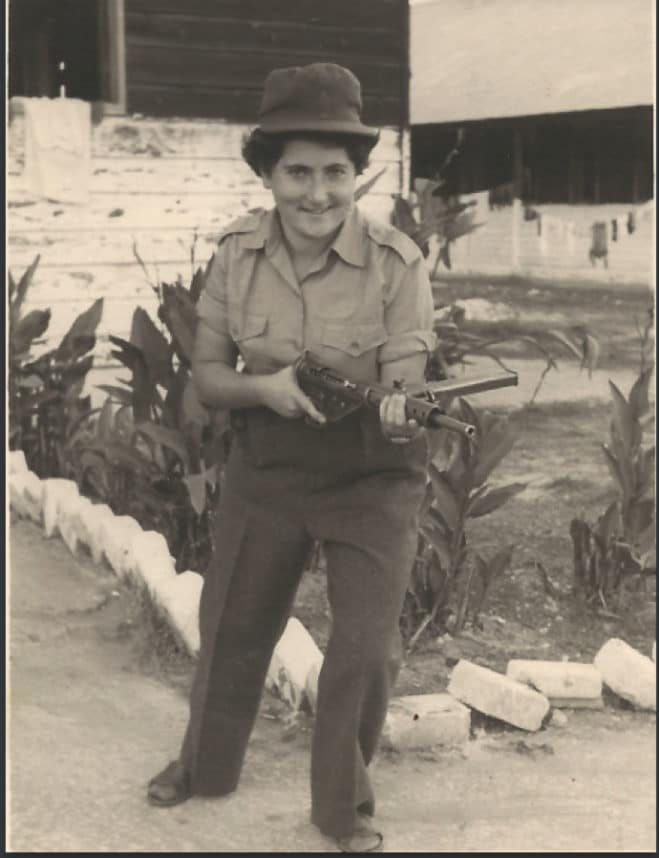
After earning a diploma, I was ready for the next step: military service — a mandatory requirement for boys and girls in Israel unless the girls were married or Orthodox. I wanted to serve my country and join the military’s most prestigious and elite branch, the Israeli Air Force. My parents didn’t support this goal because they were sure I’d never find a husband if I was too smart and independent.
Courtesy Erica Miller
I don’t remember what made me think I could get into the Air Force since they were very selective, yet I was accepted. It was exhilarating. But at the same time, it was physically and mentally challenging. We endured basic training, learned how to shoot guns, throw hand grenades (scary!), and handle Uzi submachine guns. Because of my high school diploma, the Air Force put me in charge of the inventory for the airplanes, special rations for pilots, and all the equipment they needed to function effectively. My schooling had paid off (again), and those two years in the Air Force still bring warm memories of youth, energy, excitement, and dedication to a purpose.
As a young adult, I had learned to speak Russian, Romanian, Hebrew, my native German, and some English, all of which helped me land a prestigious position as a guide in the Israeli Government Tourist Information Office (in Tel Aviv) from 1956 to 1958. Our office helped visitors with their sightseeing schedules and assured that tour companies met our high standards. Those were exciting times, and I enjoyed dressing the part and experiencing the nightlife in Tel Aviv.
Toward the end of that job, I traveled to Naples, Venice, Rome, Vienna, and London before heading to New York and then to Los Angeles in 1958 to visit my sister. My intent was only to vacation there because I believed very strongly that all Jews belonged in Israel, my homeland, to which I was fiercely loyal. But fate had different plans for me.
I soon fell in love with Los Angeles and viewed it as the land of opportunity. Finding a husband was the first step in making the commitment to stay in California. After a series of comical and off-putting matchmaker mistakes, I met Jerry Miller, and we were married on June 5, 1960. The wedding almost didn’t happen because of a (now) hilarious chain of miscommunications, not the least of which was that my groom, who waited two hours for me to arrive (my chauffeur got lost), didn’t understand one word of the ceremony, which was conducted in Hebrew and Yiddish.
These and other cultural differences made our first few years together a little rocky, but we worked it out. I went to American Jewish University and received a certificate to teach Hebrew. While it was apparently not the norm for an American wife to work at that time, it was important to me.
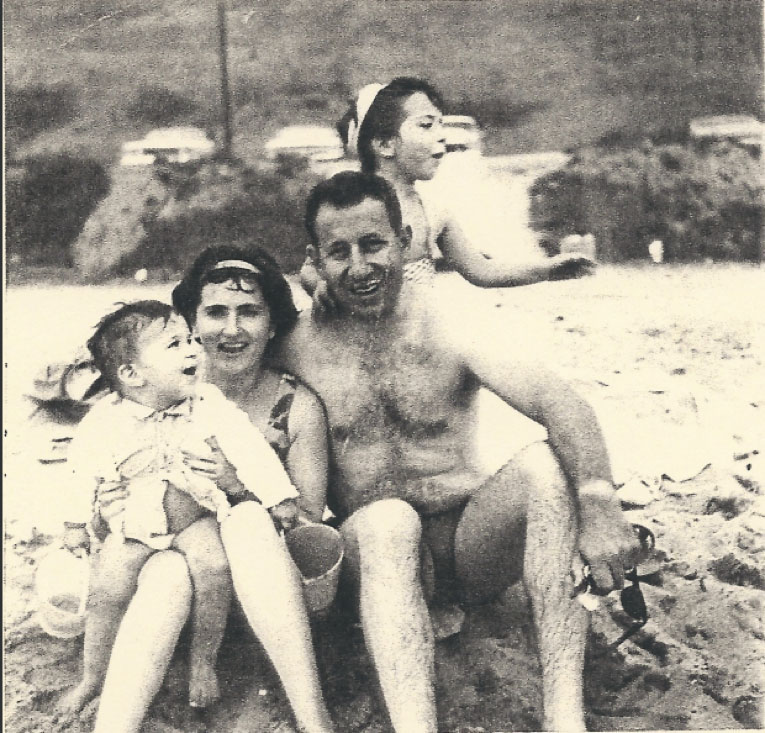
With the help of a loan from my parents in Israel, Jerry and I bought a small home. And in 1961, we convinced them to come to the United States when our daughter, Diana, was about six months old. They lived with us and took care of Diana, which allowed me to go to school to ultimately attain my Ph.D., a lifelong dream that had brought me to the United States. We eventually paid back the loan my parents made, but what they gave us was more than money. By being so close to both their daughters in the United States, they helped make us a family. And by the time my second child, Johnny, was born in 1964, we had all settled into our lives.
Courtesy Erica Miller
When I first came to the United States, I felt like a traitor to my former homeland. I used to be very judgmental toward Israelis who left for faraway places to make new and easier lives for themselves abroad. I even had nightmares and refused to become an American citizen. But my attitude finally changed with our family’s achievements, and I began to live my life with purpose and vigor, really experiencing this land where dreams came true as a place where we could all thrive. I became an American citizen in 1969.
And in 1978, I finally earned my Ph.D. It wouldn’t have been possible without my parents and my supportive husband, who stuck by me through thick and thin. And while our family was finally successful (both of my kids would go to law school), there were moments along the way that we experienced anti-Semitism. Life in the United States wasn’t perfect. Still, it was better than any other place I had been, and I am grateful for every day that I am here.
In the past, I was not much for nostalgia. But I think I’ve changed my mind. While I don’t dwell on the bygone days, looking at my life today affirms my belief that because of the good parts of our past lives, we become who we are in the process of ever evolving.