fbpx

April 8, 2021

Young Israelis Reflect on the Holocaust

With each passing year, there are fewer Holocaust survivors living among us. Now, in keeping with 60 years’ emphasis on personal narrative as the model, new technology is being used to teach the younger generation, in an effort to ensure that “never again” remains a reality.

This Holocaust Remembrance Day (Yom Hashoah in Hebrew), Israel’s annual day of commemoration that began at sundown on Wednesday, young Israelis reflect on the genocide.

Dr. Robert Rozett, senior historian at the International Institute for Holocaust Research at Yad Vashem in Jerusalem, said the majority of Holocaust education centers on personal testimony of survivors and that the majority of those who are still alive were children during the Holocaust. As time passes, the opportunity to hear survivors’ stories in person becomes rarer. As a consequence, education centering on new technology has become more and more important.

“The media is coming into play more than ever,” he told The Media Line, citing as an example a graphic art competition as one Yom Hashoah commemoration event. This activity, like other forms of new media, is “bringing in a younger generation.”

In 2019, Mati Kochavi and his daughter Maya created the Eva Stories project, based on the written testimony of Eva Heyman, a 13-year-old Hungarian Jew who, along with her grandparents, died in Auschwitz in August 1944. Through videos posted on Instagram in May 2019, Eva shares her experiences during the war as if it were happening today, with the character filming what is happening around her with her phone. Last year, the project was also put on the Snapchat platform.

“I think using technology to further Holocaust education is great. It’s a good way to make it relevant and I think it made a lot of young people understand it in a personal way and not just in a ‘boring’ historical way,” Katherine Leff, 25, told The Media Line.

Sophia Segal, 27, who asked to be identified by her middle name, said her younger cousins in America have responded to this method of teaching.

“My grandmother was a Holocaust survivor so I do not need tech to relate to the Holocaust. She died when my twin cousins were three. They do not have the same connection to the Holocaust as I do,” she told The Media Line. “They can’t sit still, so listening to a teacher in a classroom or reading a book just doesn’t work for them. The Eva Stories got their attention.”

In Israel, however, young people very much feel the presence of the Holocaust in their lives.

“I am more Zionistic because of the Holocaust,” Micha Tick, 26, told The Media Line. “I understand why the country is important and why I have to do some of the things I have to do for my country.

“The Holocaust is a scar on the Jewish people and usually you can do a few things with a scar, ignore it or accept it and learn the lesson. The lesson that the Holocaust teaches us is that the world can be cruel and sometimes we as Jews have to unite and be together so that something like this does not happen again,” Tick said.

The impact of the Holocaust is not confined to just Jewish Israelis.

“I live in a country that is very traumatized by that experience and has that national ethos of surviving and rising up against evil and rebuilding a state and independence. The Holocaust, in that sense, is very present,” Muhammad Zoabi, a 23-year-old Arab Israeli, told The Media Line.

“Another thing that most Jewish Israelis don’t get is the anxiety I get from the presence of the Holocaust and the Holocaust story. A lot of my friends growing up were descendants of Holocaust survivors. … I feel that I have a personal connection to it,” he continued. “Hearing the [survivors’] experiences about what it felt like as the Holocaust was coming makes me anxious as a minority.”

For Leff, one of her most indelible memories about the Holocaust came during a trip to Berlin, when she visited a Holocaust memorial and saw children running around and playing with their parents.

“At first I was appalled. How could they play and jump and laugh in such a terrible place, how disrespectful. The juxtaposition of life with death was too much to handle, but it was that very juxtaposition that opened my eyes to the life the Jews had before they met their untimely deaths. … The smiling kids and looming concrete sparked an intense sadness in me that made my visit incredibly powerful. Instead of letting that sadness spark rage, I simply let myself sit with it,” she said. “Instead of rage, I choose gratitude. I am grateful that I have a country to call my own and I am grateful that I have a day to reflect on that gratitude.”

As a result, Yom Hashoah serves as a reminder of how lucky she feels to be secure in Israel.

“I feel so incredibly safe in Israel. Safe to be Jewish in any way that I choose. Holocaust Remembrance Day offers us a chance to be grateful for that safety and understand its terrible cost,” she said.

Leff said that Yom Hashoah also revives an awareness that anti-Semitism is still problematic today.

“It is a reminder, that even today, anti-Semitism is still in our midst. When I travel abroad, I am often offered pieces of advice such as ‘Best not to speak Hebrew in public…’ and whether it is ‘safe’ to wear my Jewish star necklace openly,” she said.

Young Israelis Reflect on the Holocaust Read More »

A Bisl Torah — Stop Worrying

One of my supervisors at the Maple Counseling Center reminded me that the brain doesn’t distinguish between anxiety and excitement. That sometimes when we look forward to a new chapter of our journey, enthusiastic anticipation is clouded by our practiced reflex to first, worry. Is it a survival mechanism? Perhaps. But do we let worry inhibit our abilities to experience the beauty of this world? Yes, way too often.

Like many of you, I am a natural worrier. I worry about my family, my synagogue, our country. If I let myself, the worries spiral, flooding, washing, drowning. But the psychology of our faith doesn’t allow me to remain stagnant. Over and over again, I hear God nudging Moses as he stood, confused, knowing that the Egyptian army was close behind: “Moses, stop praying to me! Get moving!” In other words, don’t let your worrying stop you from leading. Don’t let your anxiety stop you from authoring the next page of your book.

Everyone wants to find the quick fix in pushing past worry and pushing towards purpose. But as most therapists will convey, healing occurs through journeying. Want to move forward? Then you can’t remain still. Want to find out what’s next? Then you have to be willing to grow.

The worrying will always be there. But the open door to the next stage of your life…that might close before you get to see what’s on the other side.

Stop worrying. Start living.

Shabbat Shalom


Rabbi Nicole Guzik is a rabbi at Sinai Temple. She can be reached at her Facebook page at Rabbi Nicole Guzik. For more writings, visit Rabbi Guzik’s blog section from Sinai Temple’s website.

A Bisl Torah — Stop Worrying Read More »

Ballad of the Bourbon Man — A poem for Torah Portion Shemini

Do not drink wine that will lead to intoxication
Leviticus 10:9

I didn’t drink, for no reason at all
for more decades than I can remember.
I think it was a reverse peer pressure thing

as I’m the kind of person who you could
tell to breathe and I would insist no, no
I get my oxygen in my own way.

So when I saw the text prohibiting
drinking wine that will lead to intoxication
I began to reconsider Judaism altogether.

My goal is never to become intoxicated, but
I’m a light-weight and I have to take a nap after
just walking near the wine shelves at Trader Joe’s.

No, I discovered the joys of the sacred beverages
in my thirties, skipping right over whatever they
do in college to get the job done.

I approach it with a yearning to know
what tastes like what, and how it was made
and why it’s better when it’s older.

Since that first Kahlúa and Cream which
broke my personal prohibition in a Las Vegas casino
for no reason at all, I moved on to beer.

I bypassed senseless years of Bud Light and found myself
in a Lambic brewery in the city of Brussels
where a cat followed us around the self-guided tour

as any self-respecting cat would if they had
any idea who I was. I moved on to wine and
eventually found myself in the Loire Valley

where I assume I had the best wine that existed.
I won’t mention my first wine-tasting experience
outside of Solvang, California when I

drank everything they put in front of me
and then found myself surrounded by miniature horses
and streets filled with giant wooden shoes.

I’m a bourbon man now. I’ve sampled it in the
holy-land of Kentucky, and its cousins
in the greenest pastures of Ireland where

the angels take their share.
This is all to say I am relieved to know
there are times to do this, and times to not.

Like Aaron’s sons who didn’t know the difference
and brought their strange fire into the Tent
intoxicated with confidence.

There are consequences to doing what
you shouldn’t. Know what they are or
the Biggest Fire will take you away.


God Wrestler: a poem for every Torah Portion by Rick LupertLos Angeles poet Rick Lupert created the Poetry Super Highway (an online publication and resource for poets), and hosted the Cobalt Cafe weekly poetry reading for almost 21 years. He’s authored 25 collections of poetry, including “God Wrestler: A Poem for Every Torah Portion“, “I’m a Jew, Are You” (Jewish themed poems) and “Feeding Holy Cats” (Poetry written while a staff member on the first Birthright Israel trip), and most recently “The Tokyo-Van Nuys Express” (Poems written in Japan – Ain’t Got No Press, August 2020) and edited the anthologies “Ekphrastia Gone Wild”, “A Poet’s Haggadah”, and “The Night Goes on All Night.” He writes the daily web comic “Cat and Banana” with fellow Los Angeles poet Brendan Constantine. He’s widely published and reads his poetry wherever they let him.

Ballad of the Bourbon Man — A poem for Torah Portion Shemini Read More »

Disney Channel Passover Program Changes “Next Year in Jerusalem” to “Next Year in the Holy Land”

A Disney Channel Passover special is being criticized for replacing the line “Next Year in Jerusalem” recited at the end of the seder to “Next Year in the Holy Land.”

HonestReporting, a pro-Israel media watchdog, tweeted a clip from the Disney Channel’s “In the Nook” mini-talk show during the week of Passover, where one of the guest stars on the program said that “Next Year in the Holy Land” is recited at end of the seder. All five of the guest stars then said, “Next Year in the Holy Land!” together.


B’nai Brith International tweeted that they are “deeply dismayed” with the Disney Channel over the matter. “This is a deliberate negation of Jerusalem as the eternal Jewish capital,” they wrote. “We call for the #disneychannel PSA to accurately depict this sacred Jewish custom related to our holiest city.”


Israellycool blogger David Lange similarly tweeted, “Note to @DisneyChannel: Do not dare try to dilute the importance of #Jerusalem to the Jewish people. Sure, you are not as blatant in your contempt for Jews and Judaism as times of old, but you are not fooling this proud Jew for one.”


George Washington University student Blake Flayton, an avowed progressive Zionist, tweeted that some Haggadahs have replaced “Next Year in Jerusalem” with phrases like “Next year in peace” and “Next year in joy.” “It’s not trivial,” Flayton wrote. “It’s a profound discomfort with the Jewish connection to Jerusalem, with Jewish national identity, with Jewish history.”


HonestReporting editor Akiva Van Koningsfeld wrote in an April 7 piece, “Israel’s historical capital is not just mentioned during Pesach, but in every prayer on every holiday, wedding and even after meals. Why is Disney Channel seemingly hiding this reality, which some may construe as diminishing the central importance of Jerusalem in Judaism and Jewish history?”

Representatives from the Disney Channel did not respond to the Journal’s requests for comment.

H/T: The Algemeiner and United With Israel


Disney Channel Passover Program Changes “Next Year in Jerusalem” to “Next Year in the Holy Land” Read More »

Our Living Seder

Facebook live, Instagram live, nowadays there is every way to go live. While we were not on screen, this year’sPassover Seder sprung alive in our home on Malcolm Ave — but in an utterly different way than expected. So why was this night different than all other nights? Or, in this case, why was this Passover different than all other Passovers?

Our family is accustomed to hosting a public Seder for our Chabad with many participants. But because of COVID-19, that was not going to be possible, and we did not anticipate having guests at our family Seder table. But the night before Pesach, Irving, a 93-year-old member of our community, gave us a call. He needed a place to go for the Seder. He explained that he was fully vaccinated and cleared by his doctor to join us. We were thrilled to host him.

From the moment Irving arrived, he asked to see our baby, who was sleeping (Irving’s face always lights up when he sees our children, and he asks them what they are learning in school and what is new for them in their little lives). He then gifted us a book. It was filled with pictures from life in Austria before the Holocaust. (Of course, I’ve learned about the Holocaust but never took the time to sit and hear the stories. I finally did!)

We then started the Seder. Kadesh, Urchatz, step by step. The kids proudly asked the Ma Nishtana and showed the beautiful Hagaddot that they had lovingly prepared at school. That part of the Seder was the same as always. But then came Shulchan Aruch, the delicious holiday meal. Together with the salad, fish and chicken soup came Irving’s stories. We had never heard them before!

Irving started sharing about his life in Austria. Out spilled the treasures of a Jew who had witnessed Jewish history in its rawest, purest and most terrifying state. Out spilled the stories of him hiding his father under material in their home and secretly driving to warn his uncle that the Nazis were out to get him next. Out spilled the stories of escaping the Nazis’ brutal regime by leaving on one of the last boats, before it was too late.

Out spilled the treasures of a Jew who had witnessed Jewish history in its rawest, purest and most terrifying state.

Irving spoke and spoke. “Can you imagine that they tried to destroy us simply for being Jewish?” he asked. He shared how time and again G-D’s Mighty and Loving Hand saved his family from the sickening pursuit of the Nazis. He spoke about the miracles he lived through and how he is ever certain that we will outlive and outsmart any physical, emotional or spiritual enemy that may rise against us.

I soaked it in like a little girl listening to her grandfather tell stories of his youth. I wanted to hear it all from the original source. I wanted to observe how a hero describes his life. I wanted to know every detail. Irving’s story touched my heart.

One of my favorite songs at the Seder is Vehi Sheamdah. It translates, “In every generation yet another nation rises to fight against us Jews and G-D saves us again.” That night we witnessed a walking, talking, living Hagaddah. Hagaddah means to speak, to speak the words of the Exodus from Egypt, of our history as a Jewish nation. Irving spoke it all. He told the story of a nation that will survive through thick and thin. For me Vehi Sheamdah will never sound the same. And Irving was right: They will never win. We will always prevail!

Then Irving’s wish came true. Our baby woke up, and my husband brought him to the Seder table. “YOU! YOU are the answer. And your sister, and your brothers,” Irving said, pointing to each of our children. “Hitler would’ve been infuriated to see the children. Yet, they are here and he is not!”

Many people say that children are our future. However, I’ve learned from the Lubavitcher Rebbe that children are the present and current focus of our people (and our future too). They are here and telling the world that Am Yisroel Chai. Yes, children, you are also the living Hagaddot.


Zeldie Cunin is a passionate teacher and writer. She is the co-director of Chabad of Westwood-Holmby.

Our Living Seder Read More »

AFT Head Says Jews Criticizing Unions Are “Part of the Ownership Class”

American Federation of Teachers (AFT) President Randi Weingarten is being criticized for saying in a recent interview that American Jews who criticize teacher unions for not wanting to go back to in-person teaching are “part of the ownership class.”

Jewish Telegraphic Agency’s (JTA) Laura E. Adkins told Weingarten in an interview published on April 1 that “some people are very skeptical of the power that they perceive teachers unions to have,” pointing to how in Los Angeles people “see this big dollar figure of aid being given for school reopening and are baffled by the perceived resistance of teachers going back to work.”

Weingarten, who is Jewish and married to a rabbi, responded that American Jews making this argument “are now part of the ownership class. Jews were immigrants from somewhere else. And they needed the right to have public education. And they needed power to have enough income and wealth for their families that they could put their kids through college and their kids could do better than they have done.”

She continued, “both economic opportunity through the labor movement and an educational opportunity through public education were key for Jews to go from the working class to the ownership class.” When asked about school reopening and unions, Weingarten said he hears “that those who are in the ownership class now want to take that ladder of opportunity away from those who do not have it. Am I saying that everything we do is right? No. Are people in Los Angeles fearful? Yes.”

She added that a February poll of AFT members found that 71% were scared about bringing COVID-19 home to their families, “so we have to meet fear with facts.” Weingarten also called the argument in favor of reopening the schools a “totally privileged argument.”

Weingarten’s remarks were met with criticism from Jewish groups and Twitter polemics.

“We work with many Jewish students and parents in Los Angeles and are extremely disappointed by Randi Weingarten’s inaccurate and dangerous generalizations about our community,” StandWithUs CEO and co-founder Roz Rothstein said in a statement to the Washington Free Beacon. “Her comments are shockingly out of touch with the actual experiences of countless Jewish families before and during the COVID-19 pandemic, give undue legitimacy to antisemitic stereotypes, and do nothing to help bring people in Los Angeles together during this difficult time.”

The Stop Antisemitism.org watchdog similarly tweeted, “We are nauseated that the head of the American Federation of Teachers Union has the audacity to help spread century old antisemitic tropes of Jewish financial control! AND she makes a six figure salary. Projecting much Nancy?” 


Newsweek Deputy Opinion Editor Batya Ungar-Sargon tweeted that Weingarten’s remarks were “blatant anti-Semitism on full display,” adding that “the decision to pander to public school teachers refusing to go back to in person learning cost poor children a year of schooling. Its repercussions on inequality will reverberate for GENERATIONS. Instead of taking responsibility, Weingarten accuses Jews of pulling up the ladder.”


George Washington University student Blake Flayton, an avowed progressive Zionist, also tweeted, “My mother is a public school teacher and a member of a union. She was desperate to resume in-person classes for the sake of her students. Little did I know, this was a result of her status as a privileged Jew in the ‘ownership class.’ Open your eyes.”


Washington Examiner commentary contributor Tiana Lowe wrote in an April 8 piece for the Examiner, “Far be it from me to impute anti-Semitic motives to Weingarten, who is Jewish. But is it not bizarre to see her adopt and deploy a trope that could easily come straight off the white nationalist Stormfront website? Even worse, she is doing this to defend a full year now of malingering by millions of teachers who resist returning to school, even though all the science has been telling us since last fall that it is perfectly safe to reopen.”

Weingarten defended her comments in a couple of tweets. “Public [education] & unions are drivers of social mobility 4 Jews & others,” she wrote. “I didn’t intend to play into hateful antisemitic tropes & am disappointed some are trying to distort my intent which was to talk about our responsibility 2 enable opportunity & dignity.”

In a subsequent tweet, she added: “Calling a rebbitzin anti-Semitic…really? my entire life is dedicated to promoting Jewish values like tikkun olam (repairing a broken world).”


Rabbi Jill Jacobs, executive director of Tr’uah, came to Weingarten’s defense, tweeting in response to Ungar-Sargon, “This is a gross distortion of what Randi said. She was talking about her disappointment when Jews don’t support unions. Randi is a proud Jew who does her work out of her deep Jewish commitments.”

Writer Matthew Yglesias similarly tweeted that Weingarten was simply addressing “her Jewish critics on the assumption that’s what the audience for the interview is.” Yglesias also highlighted a passage from the JTA interview where Weingarten talked about staying in New York City with her wife, Rabbi Sharon Kleinbaum, so she could be there for her congregants. “Does this sound to you like Weingarten is wallowing in antisemitism?”

https://twitter.com/mattyglesias/status/1379862444038848517?s=20

Jonathan Chait, a writer for New York Magazine, replied to Yglesias, “Dismissing objections because Jews collectively have a class interest that biases them is pretty bizarre. We should have public schools open for instruction.” Chait did later say that Ungar-Sargon’s characterization of Weingarten’s remarks “was pretty crude and unfair.”

AFT Head Says Jews Criticizing Unions Are “Part of the Ownership Class” Read More »

Unscrolled, Shemini: Strange Fire

In Parashat Shemini, we learn how Nadav and Avihu, the sons of Aaron, filled their firepans with incense and offered before God a strange fire that had not been commanded of them.

But what is the meaning of “strange fire?”

Perhaps, as Ibn Ezra said, the strange fire was no different than any fire one could kindle by rubbing two sticks together; the profane sort of fire that lights our candles and our stoves and burns our forests here on earth. In that case, it was only “strange” from the perspective of God, Whose fire is of a different sort than ours; capable of engulfing a bush without consuming it or descending from the sky to gulp up ritual offerings; as gentle as a caress or as deadly as a weapon.

But perhaps it was a fire unknown among the fires of the earth for it was kindled in a new spirit for the purpose of illuminating that which had not yet been seen. Perhaps it was a fire of poetry and prophecy and portent, an un-commanded offering, conjured from nothingness, stolen from the storehouses of the world to come.

We then learn that fire blazed forth from God and consumed Nadav and Avihu and that they died before God.

But what was Nadav and Avihu’s sin that they should be punished thus?

Perhaps, as the sages teach, Nadav and Avihu were cunning opportunists. Unhappy serving under their father Aaron and their uncle Moses, they would grumble to one another, “When will these old men die so that we can take their place?” If this was so, the brothers were rebels and usurpers. Their offering was no offering at all, but a mutiny disguised as piety.

But perhaps every rebel is actually a prophet, punished by the world they try to wake from its slumber — so said the Kabbalists of Korach, who the earth swallowed whole for daring to say that all souls are holy. If so, their only sin was being born when the world was yet unripe, when God was yet young, when the people were not yet ready to witness their offerings of fire or to smell the incense that they let burn in the open air for all to savor.

Perhaps every rebel is actually a prophet, punished by the world they try to wake from its slumber.

The Torah then tells us that Moses said to Aaron, “This is what the Lord meant when he said, ‘I will become holy through those who are close to me.’” And Aaron was silent.

But why did Aaron go silent?

Perhaps his silence signaled acceptance of the divine decree. Or perhaps, as Sforno has suggested, his silence signaled that he was comforted by the cryptic words of his brother. “He consoled himself with knowing that the death of his sons represented a sanctification of the name of the Lord.” Or perhaps his silence signaled unfathomable grief, as wrote Abarbanel: “His heart became like a lifeless stone, and he did not raise his voice in crying or eulogy, as would a father for his children; he also did not accept condolences from Moses. For he had no breath left in him, nor did he have any speech.”

But perhaps his silence was the silence of guilt — the guilt of a father who had never noticed that the sons trailing behind him were filled to the brim with a strange and reckless fire, ready to offer it to God in an act of wild love.


Matthew Schultz is the author of the essay collection “What Came Before” (2020). He is a rabbinical student at Hebrew College in Newton, Massachusetts.

Unscrolled, Shemini: Strange Fire Read More »

We the Children of the Second Generation

We the children of the second generation

Awake in the morning, and we know that on our arm

We inherited a tattoo, a number not to be forgotten

We the children of the second generation,

Our luck was to be born after the first generation

And to know that there will never be another second generation.

We the children of the second generation, awake in the morning and ask questions

To which we will not receive answers, we the children of the second generation,

Know that in our parents’ bedroom they sleep awake

We the children of the second generation

Every daily action like shopping in the shuk is in the shadow of the hunger

of others. Every entrance to a building means checking for an escape door.

Every nighttime act is the progeny of impulse and fear,

To love more because one must bear more children.

We the children of the second generation, eagerly seek you, the closest forest

We the children of the second generation,

have in our dictionary a different definition to words like:

Train, shower, camp, hut, chimney or work.

On the Sabbath eve, when the table is set and dressed in white,

I tell the story, second hand

I build a home and I see its ruins.

Soon I will go and take with me

The silences and my childhood

That has no second

And my adulthood created

By all of my fear.


Translation: Toby Klein Greenwald

We the Children of the Second Generation Read More »

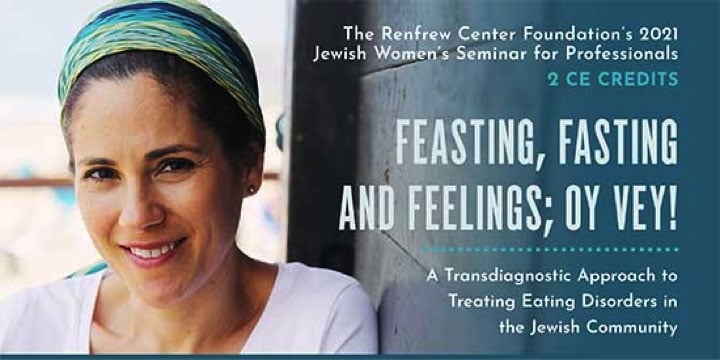
The Renfrew Center Tackles Eating Disorders in the Jewish Community

To say Jewish culture focuses a lot on food would be an understatement. There are large, festive meals every Shabbat and holiday. specifically Jewish foods like cholent, latkes, and kugel and minor and major fasts throughout the year. With all this emphasis on food — or a lack thereof — some people who have eating disorders may struggle to observe Jewish laws and customs.

That’s the focus of “Feasting, Fasting and Feelings; Oy Vey! A Transdiagnostic Approach to Treating Eating Disorders in the Jewish Community,” an online seminar the Renfrew Center of New York City is hosting on May 4 from 8:45 a.m. to 11 a.m. EST. The Renfrew Center, an eating disorder treatment center for adolescent girls and women, has sites all across the United States, including in Los Angeles on Wilshire Boulevard.

In the seminar, Jillian Hartman, LMHC and site director at the center, and Sarah Bateman, LCSW and center liaison to the Jewish community, will be presenting their teachings to viewers.

“I try to provide culturally sensitive treatment and make sure anyone who is working with people who are Jewish and have eating disorders are aware of the triggers and challenges because of the rituals and observances,” said Bateman. “I’m very careful about emphasizing that it’s not about blaming rituals or that Judaism causes eating disorders, but if people are struggling, you need to be aware of the unique challenges they have.”

One of the big challenges that Bateman works on with her patients is observing Shabbat, where Jews have two big feasts at Friday night dinner and Saturday lunch and may not be able to distract themselves with technology or other things they use during the week. “They have to sit with their feelings,” she said. “We do a lot of emotional tolerance work to try to get people to tolerate their feelings.”

She also said that fasting can bring up a slew of issues for Jews with eating disorders. “It can be triggering to observe a fast day. Depending on someone’s history of eating disorders, a rabbi might tell them they are not allowed to fast.”

It can be triggering to observe a fast day.

When Jewish women are going through matchmakers, Bateman said that sometimes men put out standards that women need to be a certain size, even if they don’t know what it means and they’re simply repeating something their mother said. “It’s challenging everyone from every perspective to see if we can confront this standard and this belief that people are so triggered by.”

The seminar, which is for clinicians, will explore the link between Judaism and eating disorders. It aims to ensure that clinicians are sensitive to triggers and can use emotional tolerance skills as a helpful part of treatment. “A lot of times people go to treatment to feel better,” Bateman said. “We help them try to get better at feeling.”

For people with eating disorders, there a lot of emotions tied up in foods. According to Bateman, they may think that if they eat healthy food, they’re good, and if they eat junk food, they’re bad. “We want to get rid of that black and white and go into the gray area,” she said. “We do the same thing with emotions, but really all emotions exist for a reason. Learning not to label feelings or food as good or bad and tolerating the gray area can get us out of unhealthy cycles.”

Thankfully, the Jewish community has stepped up to support the Renfrew Center’s work. Bateman conducted a training with a rabbi on eating disorders, and rabbis around the world could take it online.

“I’ve seen a wonderful and positive increase in awareness and education,” she said. “Every rabbi I’ve spoken to is willing to help and work together with us and really prioritize treatment and health.”

If people lean on their Judaism, then it could potentially help them with their recovery as well. “Faith can be an incredibly helpful part of treatment,” said Bateman. “Life comes first in Judaism. We have so much support for taking care of our bodies and treating our bodies well.”


Kylie Ora Lobell is a writer for the Jewish Journal of Los Angeles, The Forward, Tablet Magazine, Aish, and Chabad.org and the author of the first children’s book for the children of Jewish converts, “Jewish Just Like You.”

The Renfrew Center Tackles Eating Disorders in the Jewish Community Read More »

Gayil Talshir

Gayil Talshir: Understanding Israel’s Fourth Election Results

Shmuel Rosner and Gayil Talshir discuss the 2021 Israeli election results and the reasons why they might signal the end of Benjamin Netanyahu’s era.
Gayil Talshir is a senior lecturer in political science at the Hebrew University of Jerusalem with expertise in democratic theory, the party system, and civil society. Talshir earned a D.Phil. from the University of Oxford.

Follow Shmuel Rosner on Twitter.

Gayil Talshir: Understanding Israel’s Fourth Election Results Read More »