fbpx

April 2, 2021

Georgia On Our Minds

60 years ago, Ray Charles hit #1 on the Billboard Top 100 with a tune that became the official state song of Georgia.

Today, moral panic, virtue signaling, and political demagoguery are all peaking as well in the outlandish political and corporate response to the new Georgia state election law (SB 202) passed by the legislature and signed by Governor Brian Kemp on March 25, 2021.

Reactions have included lawsuits from civil rights groups, and a stunning declaration from President Biden that the Georgia Election Integrity Act is an “atrocity,” “sick,” “un-American,” and “Jim Crow in the 21st Century.”

Quick reaction and a rush to judgement by corporations such as Coca Cola and Delta Airlines now includes the formal decision by Major League Baseball to remove the 2021All-Star game this summer from Atlanta.

The New York Times ran a long article with its analysis here while the Washington Post gave Mr. Biden four Pinocchios for spreading his upset with the law without apparently consulting election law experts.

Georgia recently became the center of the political universe during the controversial November 3, 2020 Presidential election and again during the unusual two U.S. Senate run-off elections held on January 5, 2021. Though the law clarifies issues brought to the fore during this cycle, it actually is the product of a longer period of study meant to modernize state election law.

Playing up Georgia’s sensible reforms as racist feeds a highly partisan agenda on Capitol Hill and helps the media to continue to push for the federalizing of state election laws, which is likely unconstitutional and is the real controversy requiring serious scrutiny.

Let’s clarify seven major misconceptions and half-truths about the new bill, which opponents are using to try to rally support for a massive takeover of state election systems via the proposed federal HR.1 in Congress.

The Georgia election law does not discourage voting or suppress votes

The bill actually expands ballot access by requiring large voting precincts with lines more than an hour long to add voting machines and election personnel to reduce wait times. It does not reduce the number of total early voting days; it actually increases the mandatory days of early weekend voting.

Compared to 2020, 134 counties will now offer additional early voting hours in future elections. Election drop boxes are now required. Voters may vote by absentee ballot without any required excuse, (unlike Mr. Biden’s Delaware, or New York, which require an excuse to vote by absentee ballot).

The Georgia election does not eliminate voting on Sunday to suppress African-American votes

Georgia law did not reference Sunday early voting days until the new SB 202, and in 2020, only 16 of 159 counties offered early voting on Sundays. The new law clearly allows for the option of holding early voting on two Sundays for all localities. It increases the mandatory days of early weekend voting across the state.

The Georgia election law does not suppress the vote by requiring voter identification 

The law requires a driver’s license or free state ID number, which 97% of registered voters already have. Any person without a valid ID can easily obtain one for free. The voter ID requirement replaces the state’s much disliked signature match program that led to the disqualification of thousands of votes in 2020.

The law’s voter ID requirement for absentee ballots is overwhelmingly popular in Georgia among all ethnic groups and social classes.

The Georgia election law does not eliminate drop boxes for absentee voting

Prior to 2020, drop boxes did not exist. They were added due to the Covid-19 pandemic and now will become an official part of Georgia elections, available in all 159 counties under supervision to avoid tampering.

The Georgia election law does not allow partisan actors to throw out county votes

The state’s bipartisan State Election Board may do performance reviews of local election supervisor competency if they fail county voters (i.e. long lines or unfulfilled absentee ballot requests). The board may not overturn election results. Instead, the board may suspend election supervisors who improperly seek to influence election outcomes.

The Georgia election law does not ban drinking water for voters while waiting in line

Many states have very specific electioneering laws at polling places to reduce partisan political groups from handing out food and drinks as an incentive to vote. Poll workers may make water available to anyone who wants it.

The Georgia election law does not mandate voting from 9 AM to 5 PM

The law specifically allows counties to extend voting from 7 AM to 7 PM, and to allow for Saturday and Sunday voting.

Playing up Georgia’s sensible reforms as racist feeds a highly partisan agenda on Capitol Hill and helps the media to continue to push for the federalizing of state election laws, which is likely unconstitutional and is the real controversy requiring serious scrutiny.


Larry Greenfield is a Fellow of The Claremont Institute for the Study of Statesmanship & Political Philosophy.

Georgia On Our Minds Read More »

Seventh Day Passover – The Second Step into the Sea


Parting of the Sea of Reeds

In the Bible, Passover is a seven-day observance, with the first and last days being holidays. The middle days are called “chol ha-mo’ed” “the mundane days of the holiday,” usually translated as “the intermediate days of the festival.” The first day commemorates, as you know, the beginning of exodus from Egypt, as recounted in Exodus 12-13. While the Torah never explicitly says so, the seventh day of the Passover holiday was understood by the ancient rabbis as commemorating the passing through the Sea of Reeds, described in Exodus 14 and 15. This Shabbat is the seventh day of Passover and the Torah reading is Exodus 13:17 – 15:26. This Torah reading includes both the dramatic narrative of Israelites at the Sea of Reeds, Exodus 14, and one of the greatest poems in the Hebrew Bible – the Song of the Sea, Exodus 15.

The most well-known rabbinic interpretation of Exodus 14 (Talmud, Tractate Sotah 37a and other places) interprets Exodus 14:22, “and the Israelites went into the sea on dry land.” How could they go into the sea on dry land? The answer is: The sea only parted and a (relatively) dry seabed only appeared when they went into the sea. But who went in first? The talmudic aggadah (interpretations of biblical narratives) tells us that when the various tribes were dithering (“I’m not going in first,” “I’m also not going in first.”) Nachshon ben Amminadav of the tribe of Judah jumped in. If we go back to the Talmudic source, though, we read that the sea does not part right away. The first verses of Psalm 69 are attributed to Nachshon:

“Save me, O God, for the waters have come up to my neck. I sink in the miry depths, where there is no foothold. I have come into the deep waters; the floods engulf me.” (NIV)

It turns out, then, that the waters did not part as soon as he jumped in, according to this interpretation. Nachshon was drowning a bit first. The meaning of Nachshon’s jumping in is heroic and clear. Someone has to go first; someone has to conquer their fear and do what needs to be done. The others dithered from trepidation. They knew that God and Moses were trying to part the sea, but something was going wrong. They didn’t absolutely know the sea would part. Someone had to act. Nachshon had to jump into the unknown, be willing to risk everything. Maybe the sea would not part – but he knew he was not going back to Egypt. “Live free or die.” Nachshon is role model for courage.

So far, so good. Why does this bit of aggadah want to tell us, though, that Nachshon was drowning before the sea was parted? I think the authors of this tradition were telling us, “Not so fast.” We would love to imagine that as soon as Nachshon put his foot into the water the dry land appeared. His will and his courage were all that mattered and all that were needed. We don’t like to think of Nachshon drowning; for a long moment thinking “It didn’t work. I actually am going to die.”

It seems that the Talmud, by including the drowning prayer from Psalm 69, wanted to add a step after the step into the sea. Let’s put ourselves in the mind of the dithering other tribes. I imagine a complete silence while they watched Nachshon drowning. When he stepped into the water, they perhaps were ready to see a miracle, but not a tragedy. As they watched Nachshon drown, just for a few seconds they knew that their fears were justified. What happens in those few seconds to the dithering ones?

I’d like to add to the Nachshon story. In my extension of this bit of aggadah, something happens to that sentiment, “Live Free or Die.” The focus is now on “die.” We are taught in the Talmud to repent one day before our deaths. Always look at your life as if you have only one more day. That “next day” defines how we live.

In my extension of this aggadah, for the few seconds in which they see Nachshon drowning, that day is now. The question in the mind of the dithering ones is suddenly, “How will I die?” A captured slave runaway dying in Egypt, some years some years later? Or right now, following Nachshon to the bottom of the sea, drowned, but free. In my addition to this aggadah, the sea parts not when Nachshon puts his foot into the water, but when the next person jumps in after him.  I wonder who that was.

Seventh Day Passover – The Second Step into the Sea Read More »

Capitol Car Attack Suspect Called Himself “Follower of Farrakhan”

The suspect who rammed his car into a fence at the U.S. Capitol on April 2 called himself a “Follower of [Nation of Islam leader Louis] Farrakhan” on his Facebook page.

The attack resulted in the death of a Capitol police officer, identified as William “Billy” Evans, a veteran. Another officer was injured in the attack; that officer is “fighting for his life,” according to President Joe Biden. The suspect, identified as Noah Green, was shot dead by police after allegedly jumping out of the car with a knife and attempting to attack an officer with it.

Green’s Facebook page, which has since been taken down, reportedly featured a March 17 post stating that he had been having a “tough” time recently and seemed to be heading down the right path, but “the path has been thwarted, as Allah (God) has chosen me for other things. Throughout life I have set goals, attained them, set higher ones, and then been required to sacrifice those things.” Green had reportedly signed the post as “Brother X.”

The Stop Antisemitism.org watchdog tweeted, “We will say this again — what starts with Jews never ends with Jews. The family of the murdered officer is in our prayers and has our deepest sympathies.”


The American Jewish Committee (AJC) also tweeted, “AJC mourns the death of a U.S. Capitol Police officer today. We extend our deepest condolences to his family, and wish the second officer harmed in this attack a full recovery. These assaults against our Capitol and democracy must end.”


The Anti-Defamation League (ADL) also tweeted, “We are monitoring the car ramming and knife attack incident at the north barricade of the Capitol complex. We extend condolences to the family of the fallen Capitol police officer and wish a full recovery to the second officer.”

Capitol Car Attack Suspect Called Himself “Follower of Farrakhan” Read More »

A Jewish High School Plans a Post-COVID Hybrid Future

(JTA) — When Brooke and Scott Stein began considering where to send their children for high school, they encountered plenty of strong options in the Phoenix area, but each fell short in at least one important regard: The ideal school — coed, college preparatory, Jewish — didn’t exist where they live.

Entrepreneurial and ambitious, the couple belongs to a growing, largely Modern Orthodox synagogue that long had dreamed of opening such a school. The costs and risks were too daunting, however, until the pandemic arrived and upended conventional thinking.

With remote learning newly a fact of life, the Steins and other members of Scottsdale’s Congregation Beth Tefillah hatched a plan to partner with an existing school somewhere, anywhere. They found what they were looking for in Los Angeles — Shalhevet High School, a respected Modern Orthodox institution established in 1992.

Starting in the fall, Shalhevet Scottsdale High School, also known as Nishmat Adin, will enroll its first group of ninth- and 10th-graders. The Arizona students will connect with their Southern California teachers and classmates through video, and will gather at a site to be determined. They will be supervised there by an on-site staff.

The two sets of students will integrate with monthly visits.

The Steins, who sit on the board of Shalhevet Scottsdale, have applied for their oldest son’s admission and eventually hope to enroll all four of their children.

“We had always hoped that a Jewish high school would be available by the time our children reached high school,” Brooke Stein said. “We know that [Shalhevet Scottsdale] will begin small, yet remain hopeful that families will see its value and enrollment will increase in the coming years.”

More rests on the success of this experiment than only the hopes of Jewish parents in Scottsdale. As the first partnership of its kind, the Shalhevet Scottsdale initiative is being closely watched throughout the world of Jewish education because of its implications for small communities, as well as for established schools looking to shore up their finances.

“There are many Scottsdales around the country,” said Scott Goldberg, a professor of education at Yeshiva University whom the Scottsdale parents hired as a consultant. “These are growing communities with children learning in a Jewish context at the elementary level and finding themselves without options afterward, and the learning is not sustained.”

Communities often hire Goldberg when they are considering what to do about the falloff after eighth grade.

“Many communities have told me we are going to start a new school,” he said. “But what they don’t have is a full understanding of the costs involved, and also in terms of what you are not getting educationally because it’s a very small institution. I do a feasibility study and when the answer is a no-go, all that passion all of a sudden peters out.”

A booming Jewish population in the area fueled the Scottsdale parents’ interest in creating a new high school. A major study in 2019 about Jews in the Greater Phoenix area, which includes Scottsdale, found that the community has grown some 20% over the past two decades, reaching nearly 100,000. Most identify with the Reform or Conservative movements. The percentage of Jews marrying within the religion and raising their children Jewish has been increasing sharply.

At least 75 students graduate each year from local Jewish elementary schools, according to an analysis of Jewish federation data by Nishmat Adin board member Ariella Friedman.Afterward, families have the option of local private, public or charter schools. Orthodox families also choose from the single-sex Jewish high schools in the area, and some move or send their children out of state.

The rabbi at Congregation Beth Tefillah, Pinchas Allouche, who also serves on the board of Nishmat Adin, has sent three of his 10 children out of state to attend various Jewish high schools.

The new school, Allouche said, is not being tailored for his children.

“I wouldn’t say I am building this school for my kids or anyone specific but for the needs of the community,” he said, adding that each child, even his own, has different needs that might be best met by different educational options.

His drive to establish a new school is borne largely out of his experience as an eighth-grade teacher at Pardes Jewish Day School in Scottsdale, where students get pluralistic Jewish instruction alongside a rigorous secular curriculum.

“The story began years ago, a seed planted in my mind as we founded our Congregation Beth Tefillah and as I began to teach at Pardes,” Allouche said, “when I realized very quickly that many of my students and congregants were drifting away as soon as they hit high school age because they didn’t have a Jewish high school.”

Goldberg’s feasibility study just found enough of a pipeline to justify creating a small school, and based on the community’s character, he proposed “a halakhic and mitzvot-centered institution open to Jews of various backgrounds” — that is to say, a school that would be appealing both for Orthodox and non-Orthodox families.

Years of considering how to ensure sustainability led Goldberg to think of pooling resources with established schools.

“Can a school gain revenue streams by partnering with other communities? People had begun dabbling in collaboration, but the last year taught us that it’s possible to have students who are in a classroom — and not in a classroom — to join with a teacher to make an educational environment that is quite valuable, all without having to take a major risk of building up much new infrastructure,” he said.

Gathering at their own campus, Scottsdale students will have access to Shalhevet’s extensive Judaic and secular course offerings. Teachers are being trained to teach both sets of students at the same time using the sort of remote learning technologies that have become commonplace during the pandemic. The school also promises to integrate Scottsdale students into Shalhevet’s clubs and extracurricular activities when possible.

The Arizona students will not be without in-person adult supervision. Local staff will be hired to facilitate the virtual learning and guide students. Once a month, the Scottsdale kids will travel to Los Angeles to get to know the classmates they’d otherwise only see on their screens.

It wasn’t hard for Shalhevet to see how it could benefit from the arrangement, too.

“We got very excited internally because of our conversations with a wonderfully sincere community in Scottsdale,” said Rabbi David Block, the associate head of school at Shalhevet. “And we thought this is important for a few reasons, starting with it puts us on the forefront of education innovation. We are a very mission-driven school.”

The Scottsdale campus will charge $24,750 per student, which includes tuition and the cost of monthly travel to Los Angeles for the two campuses to gather in person. For those who cannot afford the bill, the school is hoping for subsidies through a tax credit scholarship program pioneered in Arizona.

In Los Angeles, tuition to Shalhevet is much higher, over $40,000 a year. Block said he was eager to work with the Scottsdale parents to devise a model that might allow families to access high-quality Jewish education at a lower price point.

“We were thinking about the tuition of day school education,” he said. “What can we do that’s out of the box, that’s creative? COVID gave us an opportunity to do things in a new way. It would be silly to ignore these wonderful educational technologies.”

This push to increase access to Jewish education has earned the attention of Paul Bernstein, the CEO of Prizmah, a network that represents about 300 Jewish day schools across North America serving some 90,000 students.

Bernstein said the partnership is a testament to the vitality of the schools he works with, which have largely operated in person at a time when many students across the country learned mostly from home.

“During the crisis caused by COVID, we have seen the excellent value proposition of Jewish day schools come to the forefront,” he said. “As people recognize the strength of Jewish day schools, we want to make sure we can maximize access. This partnership could help the sustainability of these schools.”

Whether a critical mass of parents in Scottsdale or elsewhere will be convinced that a mostly remote education is worth the tuition remains unknown. It will take even longer to assess whether it’s possible to teach students effectively for the long term in the hybrid arrangement the school is planning — and whether social bonds can form. And while Shalhevet’s faculty is blessed for the moment with buy-in from faculty, according to Block, teachers across the country this year reported finding hybrid classrooms difficult to manage.

The Steins, meanwhile, hope the remote learning arrangement they are focused on promoting is ultimately a temporary one.

“The idea is that as enrollment grows, so will our ability to wean off of Shalhevet L.A. and ultimately have our own brick-and-mortar school complete with faculty and administration while still maintaining the excellent Shalhevet curriculum,” Brooke Stein said.

A Jewish High School Plans a Post-COVID Hybrid Future Read More »

ADL: Nearly 10% of U.S. Jews Experienced Anti-Semitic Assaults In Past Five Years

A recent Anti-Defamation League (ADL) survey of Americans Jews found that nearly 10% have been subjected to an anti-Semitic assault in the past five years.

The survey, which was published on March 31, asked more than 500 respondents from January 7-15 if they have “been physically attacked because you are Jewish”; 9% answered in the affirmative. The survey also found that 63% of American Jews have experienced or witnessed an anti-Semitic assault, and 25% said they were targeted with anti-Semitic remarks or threats.

When it comes to online extremism, 36% of Americans Jews said they have experienced some form of anti-Semitic harassment on the Internet, and 13% have said that they don’t identify themselves as Jewish on social media.

Overall, nearly 60% of Jewish Americans said that they don’t feel as safe in the country today as they did 10 years ago, nearly 50% are scared that their synagogue will be targeted in an anti-Semitic attack, and 6% have stayed clear of synagogues and Jewish organizations due to fears of being targeted. Additionally, 33% of those who have been harassed said that they have trouble sleeping at night.

Compared to the ADL’s 2020 report, the number of American Jews who have either witnessed or experienced anti-Semitism in 2021 is incrementally higher. The percentage of Jewish Americans who took protective measures against anti-Semitism also increased from 27% in 2020 to 32% in 2021. However, the proportion of American Jews who are scared their synagogues will be targeted slightly declined from 55% in 2020 to 49% in 2021. The percentage of American Jews reporting anti-Semitic incidents online also declined from 43% in 2020 to 29% in 2021, which the ADL speculates is due to people being resigned to “tech companies’ perceived lack of responsiveness to complaints about online bigotry and hate.”

“Looking back on the past five years, which were bookended by the antisemitism in Charlottesville in 2017 and the hateful symbols on display during the breach of the U.S. Capitol on January 6, it is understandable that the level of anxiety is rising and concerns about communal safety are on everyone’s minds,” ADL CEO Jonathan Greenblatt said in a statement. “These findings reinforce the need for a whole-of-society approach to combat antisemitism. Whether it appears on social media or on a synagogue, antisemitism has no place in our communities. We need corporate and government leaders to step up to ensure that it does not gain a foothold on social media or in broader society.”

ADL: Nearly 10% of U.S. Jews Experienced Anti-Semitic Assaults In Past Five Years Read More »

Is the Fight Against Anti-Semitism the Answer To Global Well-Being?

With more than 60% of religious-based hate crimes in the United States targeting the Jewish community, fighting anti-Semitism has never been more important. And fighting anti-Semitism from the perspective of trauma— its symptoms and the possibility of healing — is key to successful interventions.

That was why I was thrilled to participate in the recent Mayors Summit Against Anti-Semitism, an event conducted by Combat Anti-Semitism, a global grassroots movement that united 32 mayors from 21 different countries, as well as senators, human rights commissioners, law enforcement officials and interfaith leaders, to identify best practices for combating anti-Semitism.

In my panel presentation, I pointed to the need to address the trauma of victims and perpetrators. Even in the aftermath of loss of life, injuries and destruction of property, victims can still produce stress hormones, such as adrenaline and cortisol, even when they are not needed anymore, causing ongoing traumatic symptoms. This stress can cause communities to develop hypervigilance and fear that violence will become contagious.

The immediate healing of the community under attack depends on the actions taken by the local authorities. When the public, officials and the media recognize and denounce the anti-Semitic attacks, victims feel supported. By contrast, they will feel more traumatized, isolated and cut-off from the rest of the population if these sectors do not show support.

Public officials and organizations should also offer short-term healing tools that incorporate self-regulation. Those that can be used by the lay public on the spot and are evidence-based may include mindful breath; EmotionAid®, which harnesses the power of the body for nervous system regulation; and Emotional Freedom Technique (EFT) and its different variations, which use tapping energy points to achieve regulation.

Instructional videos for these techniques are readily available on streaming platforms such as YouTube, which makes their incorporation into society so feasible. They can be shown in times of crisis on public TV. In normal times, they can be introduced through videos and trainings for workers in the social sectors that interface with trauma. Disseminating these tools to the lay public will help people release fear, anger and helplessness on the spot, prevent cumulative trauma and build resiliency. The mayoral summit is a great step to building local support and sharing strategies on how to bring healing tools to the public.

To properly heal anti-Semitism, however, we must look at the bigger picture, focusing on when and why it seizes the minds of the rich and the poor, far-right and far-left, majority and minorities. Collective healing is not just part of addressing the aftermath of anti-Semitism — it’s about preventing it from metastasizing in the first place.

Collective healing is not just part of addressing the aftermath of anti-Semitism — it’s about preventing it from metastasizing in the first place.

Anti-Semitism flourishes when people feel economically diminished, psychologically ignored and dispensable: When larger minority groups feel oppressed, when intellectuals and activists want to overhaul political or economic systems or when people reminisce about a past culture. They all need an easily identifiable group on whom they can project blame.

What turns this diminishment into traumatic hatred are unmet universal basic needs. When basic needs are met, people feel stable. But if, for example, physical basic needs (such as the need for economic safety) are combined with threatened psychological needs (such as competence and self-esteem) and a traumatic loss (such as the pandemic or other overwhelming changes), their nervous systems become deregulated.

Feeling alienated and disconnected, these traumatized individuals and groups (such as far-right or far-left extremists) begin to look for scapegoats. They demonize “the other,” opening the path for racial, religious or ethnic prejudice. They view violence as a self-defense against their threatened identity. That “other” may be any group that is different and makes a valuable target. But anti-Semitism is the easiest path to follow in times of trouble. It is ancient, it has strong religious underpinnings, and the Jews are geographically dispersed because of the Diaspora. Anti-Semitism has become so viral that it has metastasized as a symbol of discontent, unhappiness, dejection and revolt against oppression.

For example, a man shot and killed 11 Jewish worshipers at the Tree of Life Synagogue in Pittsburg in 2020 because the synagogue hosted activities supporting refugees. The shooter believed Jews were helping illegal immigrants enter the United States, which he determined undermined both his American culture and access to jobs. Combined with his unemployment and his difficult childhood, his traumatic reaction was to target the synagogue. Often personal traumatic history combines with collective trauma to trigger violent reactions.

Preventing anti-Semitism, then, requires addressing traumatic dysregulation on a collective level. We must combine trauma healing, resiliency building, cross-cultural understanding, conflict resolution and communication skills and spread them in the collective consciousness through different social sectors. They can be presented as part of basic training for fire departments, first responders, police, schools, hospitals, religious institutions and media, all sectors that interface with trauma and have the ability to exacerbate it or heal it.

When people learn to stabilize their nervous system and remain centered on an ongoing basis, they can contain difficult emotions without acting out. They become more open, flexible, understanding and tolerant of differences, allowing them to resolve their problems in rational and constructive ways. With these tools, people can recognize the first signs of traumatic activation and return their collective nervous systems to normal. This will help people care, cooperate and be partners for peace.

Anti-Semitic speech and acts must be denounced and stopped, but we should also analyze what went wrong and who needs listening, attention and care. Enlisting mayors worldwide to these local interventions will diminish anti-Semitism and help people meet their needs in healthy ways.

The Mayors Summit Against Anti-Semitism was just the beginning. Other summits, such as the AJC’s Mayors United Against Anti-Semitism, followed shortly after. National joint efforts will allow leaders to share what initiatives work best and will protect officials from anti-Semitic backlash. Uniting these national efforts to those of other countries will take this fight to the necessary global level. And maybe, just maybe, those hate crime statistics will drop.

Diminishing anti-Semitism begins with healing trauma. When we use this paradigm to inform our collective efforts, we are on the road to global peace.


Gina Ross, MFCT, is the Founder/President of the International Trauma-Healing Institute USA (ITI-Israel). 

Is the Fight Against Anti-Semitism the Answer To Global Well-Being? Read More »

Israeli and Palestinian Films Face Off for Oscar

In the run-up to the Academy Awards, this year delayed until April 25 thanks to Covid-19, movie buffs and the media speculate endlessly about the likely best movie, actor, actress and so forth.

This column, by contrast, is dedicated to the eternal questions “Is it good for the Jews?” and “Is the world paying enough attention to us?”

In 2021 the outlook is not too promising for pro-Semites. For example the movie “Asia,” Israel’s entry among international feature films submitted by 93 competing countries, fell by the wayside in the first cut.

However, in the less prominent category of short films (under 40 minutes), both the Israeli and Palestinian entries have placed among the five finalists, no small feat in a field of 174 competitors. Both films cast a critical eye on less laudatory aspects of Israeli society.

In a separate category, for short documentary films, a 90-year old French woman visits the Nazi concentration camp where her brother, a French resistance fighter, was killed.

All the films can now be viewed in advance at newly reopened theaters or virtually through VOD (Video on Demand).

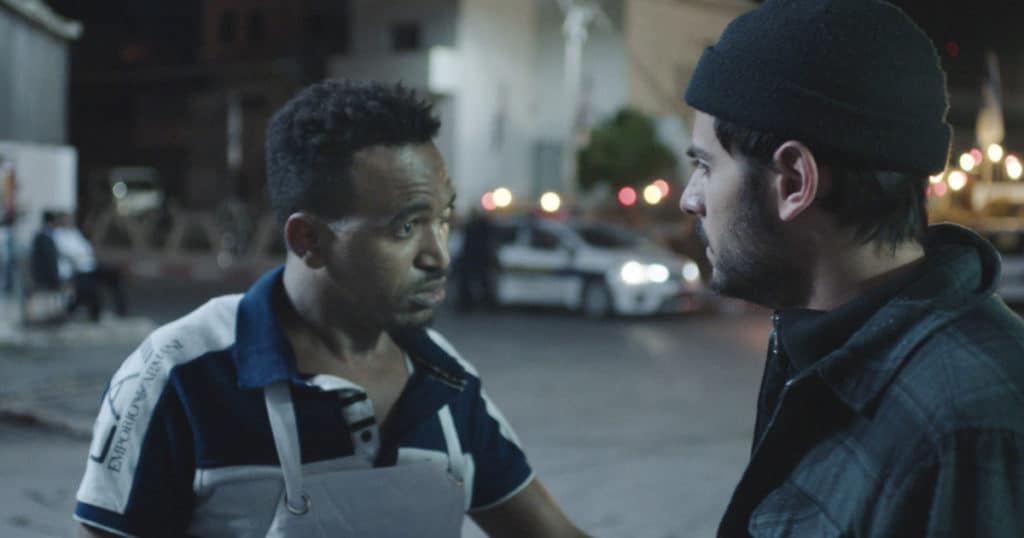
“White Eye” from 33-year old Israeli Tomer Shushan, revolves around a stolen bicycle. But basically, the film tackles an Israeli problem, only too familiar to Americans – open or subliminal prejudice against non-white inhabitants, especially immigrants.

The film’s title, Shushan told the Journal, is an allusion to “white eye” as an affliction of blind people and implies that many of his fellow Israelis are blind to the racial biases in their country.

Israelis, as represented by Palestinian extras as gruff Israeli soldiers at check points, fare hardly better in “The Present” by Palestinian director Farah Nabelsi.

On his wedding anniversary, West Bank resident Yusef (Saleh Bakri) and his cutie pie daughter Yasmine set out to buy a wedding anniversary present for his wife, in the form of a new refrigerator.

Both setting out and returning on his shopping expedition Yusef is delayed, braced and humiliated by the check point soldiers, until he loses his temper in an anguished tirade.

Nominated in the separate Documentary Short film category is “Colette,” a French-German-USA co-production which focuses on the story of 90-year old Colette Marin-Catherine, who confronts her past by visiting the Nordhausen concentration camp where her brother had been killed.

These and numerous other Oscar-nominated short films are now playing at a dozen movie theaters in the Los Angeles area and additional ones throughout California, Arizona and Nevada.

In addition, the films can be viewed on VOD (Video on Demand) channels as Direct TV, AT&T TV Now, Google Fiber and Hotwire.

For a complete listing of venues, dates and times, go to https://tickets.oscar-shorts.com/.

Israeli and Palestinian Films Face Off for Oscar Read More »

Israel Opens for Business as COVID-19 Infections Plummet

(The Media Line) Scenes of crowded restaurants, long lines at cafés, bands dotting the squares playing to passersby, children being amused by clowns and shoppers going in and out of stores had all but disappeared from the streets of Jerusalem. But with more than half the population now vaccinated, Israel has begun easing restrictions it has imposed to contain the coronavirus pandemic.

Businesses are back open, and shoppers are heeding the call to turn out. And people are taking advantage of the weeklong Passover holiday to emerge from the seemingly endless lockdowns.

With a sharp and sustained drop in coronavirus cases and a successful vaccination campaign, authorities have relaxed many of the restrictions imposed to contain the pandemic. As a result, life has nearly returned to pre-COVID times: Shops are open, eateries (those not closed due to the dietary restrictions of the holiday) are full, and even the border with Egypt has reopened, allowing hundreds of vaccinated Israelis to vacation at resorts along the Red Sea.

Vladimir Merakhovich drove from the northern city of Nof HaGalil (formerly called Upper Nazareth) with his wife for a day out in the big town. Now that restrictions have eased, and after getting vaccinated, they are going out more, and they are attending shows and concerts, he told The Media Line.

“We have a one-day vacation; we are traveling, [it’s] a nice time to breathe a little bit.”

Having restaurants and other businesses open has infused new life to what had been empty, soulless streets. For many, it is a symbol of a return to normalcy.

Israel has fully vaccinated more than half of its 9.3 million residents against the novel coronavirus, in the world’s fastest inoculation campaign.

Yitzhak Mandel said he now feels safe to go out with his children.

“Kids are excited, they are back at school. People are out and businesses are thriving. It’s great. Fun to be out,” he said.

And with spring officially here and Passover week coming to an end, it has made a believer out of Mandel.

“It really does feel like a miracle. A Passover miracle.”

Jaffa Road in the heart of Jerusalem is packed, and a woman from out of town cannot hide her excitement.

Dancing to street music, Bracha, who is visiting with her family, told The Media Line it feels like old times.

“I’m having fun, enjoying myself, having a good time. After the corona, you have to go out. Thank you, God, and bless Bibi [Prime Minister Binyamin Netanyahu] for bringing us the vaccines. And bless you, too,” she told The Media Line.

As soon as the US Food and Drug Administration approves the Pfizer vaccine for children aged 12 to 15, perhaps in May, the government will start inoculating that age group. Already at least 700 Israelis in that range, youngsters who suffer from serious risk factors, have received the jab.

The government is promising to have the entire country vaccinated and reopened by early summer.

https://youtu.be/R5Ghbmeb_rI

Israel Opens for Business as COVID-19 Infections Plummet Read More »

Elijah and the Limits of Forbearance

At a time when the theological underpinnings of Judaism were under assault, Jews surprisingly held back. As James Caroll documents in “Constantine’s Sword,” during the second century, when “the Church Fathers loudly and aggressively preached and wrote against the Jews,” the Jewish scholars compiling the Mishnah did not insert “a single passage clearly denouncing Jesus or Christianity.”

But at other points in Jewish history and liturgy, those denouncements come through.

The limits of Jewish forbearance is brought up again during Passover Seders when, after drinking the third cup of wine and opening the door for the prophet Elijah, we read the prayer Sh’foch Chamat’cha. The prayer asks God to “Pour forth Your wrath over the nations that do not recognize You, and upon the kingdoms that do not invoke Your name. For they have devoured Jacob and destroyed his habitation. Pour forth Your indignation upon them and let Your burning wrath overtake them. Pursue them with anger and destroy them from beneath the heavens of God.”

Sh’foch Chmat’cha — which is not mentioned in either the Jerusalem or Babylonian Talmud, and first appeared in the ninth century — has always been a puzzle. That it is recited right after the door is opened for Elijah may be a clue. The traditional explanation for Elijah’s participation in the Seder is that he heralds the coming of the Messiah. However, in “The Misunderstood Jew” (2006), Amy-Jill Levine points out that the custom was introduced in the middle ages because Passover, which takes place at the time of Easter, was a period fraught with danger for Jews, especially with respect to the blood libel.

The blood libel accused Jews of using the blood of Christian children to bake matzah for Passover. The first recorded blood libel occurred in England in 1144 following the murder of a Christian twelve-year-old, who was later canonized by the Catholic Church. The libel spread to other English sites, including Winchester, London and Lincoln, and throughout Europe, fueled in part by the anti-Semitism that accompanied the Crusades. Estimates indicate that over 150 blood libel episodes occurred, resulting in arrests and massacres of Jews over the centuries, the last one taking place in Kiev in 1911. While most of these took place in Europe, a number occurred in Islamic jurisdictions as well.

Levine writes that the purpose of opening the door during the Seder was to show non-Jewish neighbors that no Christian child was being harmed. (Or, as Rabbi Avi Weiss put it in a 2016 article, Jews opened their doors fearful that a Christian child would be found there.) It was then, in great anger, that the Jews made the declaration of Sh’foch Chamat’cha.

There are other examples in the Jewish liturgy of requests for the Almighty to wreak vengeance on the enemies of the Jewish people. For example, the Jewish memorial prayer Av Harachamim (Father of mercy) was added to the Ashkenazi liturgy early in the twelfth century in response to the anti-Jewish depredations of German communities that accompanied the First Crusade. Av Harachamim includes statements such as, “Let it be known among the nations in our sight that You avenge the spilled blood of Your servants.” Similar sentiments are expressed in the liturgical poem Maoz Tsur (Rock of Ages), sung on the holiday of Chanukah, while the Book of Esther’s depiction of the harsh treatment of Haman and his followers by the Jews of Persia is another example.

There are many examples in Jewish liturgy of requests for the Almighty to wreak vengeance on the enemies of the Jewish people.

Should Jews today feel embarrassed or ashamed of such violent sentiments? Should Sh’foch Chamat’cha be altered or omitted from the Seder? I agree with the answer given by Rabbi Gerald Skolnik in “Confronting Historical Anger,” a blog he wrote for The Times of Israel (2012). The answer is no, it should not be changed or omitted. To Rabbi Skolnik, Sh’foch Chamat’cha “represents the reservoir of unresolved Jewish anger over the myriad atrocities that have been perpetrated against us throughout our history… Omitting the Sh’foch Chamat’cha is, to me, like pretending that the anger isn’t there, and that is simply a lie.”

Centuries of oppression have taught Jews to keep their thoughts to themselves, keep a low profile and avoid drawing attention to themselves for fear of retaliation. The existence of the prayer Sh’foch Chamat’cha indicates that there are limits to such forbearance. And for good reason: A strategy of keeping quiet does not always work, as suggested by the interactions between the Roosevelt administration and American Jews before and during World War II, when the muted voice of American Jewish organizations helped make it possible for the U.S. government to ignore European Jews’ pleas for refuge.

This Passover season, when Jewish communities the world over are facing a resurgence of anti-Semitism from many quarters, it is important to consider the limits of forbearance. We must speak out and confront the lies and distortions that have become all too common in this age.


Jacob Sivak is a retired scientist affiliated with the University of Waterloo. His work has been published in The Jerusalem Report, The Times of Israel, Algemeiner, The Canadian Jewish News and the Forward.

Elijah and the Limits of Forbearance Read More »