fbpx

March 26, 2021

A Passover Different from All Others. Again.

Years ago, I tucked a damaged matzah-print apron into my fabric-scrap bag. My grandmother had given me another one, and I figured I’d save the damaged one for a future project. Last Passover, I thought about taking the fabric out to make a matzah-print mask. But I figured, what’s the point? I was sure I’d only be using it for one Passover.

But here we are again.

When we said “Next year off Zoom!” last year and believed it, I should have known better. One of the seder’s lessons is about balancing hopes versus expectations. The symbolic “Next year in Jerusalem!” at a seder’s end is a statement of optimism and realism. We can hope for the future, but we’ve said it so many times, it’s written down.

Ironically, given Passover’s themes of freedom and oppression, we’re still in the pandemic partially due to failure of some to understand actual freedom and oppression. The Haggadah doesn’t say, “We eat the bitter herb to symbolize the inconvenience of having to wear a mask so we don’t kill our neighbors.” So this year, let’s pour extra wine and say once again, louder for those in the back:

Let my people go to crowded bars is not a rallying cry for freedom.

So much has changed in a year. Between Purim and Passover 2020, we experienced a steep incline in new COVID-19 cases and deaths. We faced new uncertainty, first moved interactions online, and found humor in toilet paper shortages.

Still, last year’s Passover had unexpected sweetness. I wasn’t sure what to expect with a Zoom seder, as I edited my Haggadah, gave friends my charoset recipe and wrote about how Elijah wasn’t coming to Passover. But it was lovely. Along with local friends, I celebrated with my parents in New York plus old friends living miles away — including in Bangkok. We washed our hands for 20 seconds. We added new plagues, including loneliness, PPE shortages and getting the firstborn to take a nap. We asked four extra questions:

  • At all other seders, we gather and share food in person, but at this seder only via Zoom.
  • At all other seders, we find a few ways the story resonates in our lives, but this year, a recent hailstorm was the least of the similarities.
  • Before all other seders, we had to clean our whole house, but for this seder we only had to clean the parts of our house visible via Zoom.
  • At all other seders, we’re a little cramped in our reclining, but on this night we have the whole couch to recline on if we want.

Finding silver linings and humor is a survival strategy, and it helps make stories memorable across generations. That’s partly why so many of us mix a holiday about a serious topic with ten-plagues toys, go to comic lengths to hide an afikomen or build in other forms of whimsy.

Finding silver linings and humor is a survival strategy, and it helps make stories memorable across generations.

Speaking of humor, I could make a bunch of Passover puns here, but I’m not so shmura I’ll be afikomen up with any hidden ones you don’t know. Who knows one? I mean, I used to know a Pharaoh number of them, but I’ve forgotten Mosest of those. I don’t want to sound like a wine-er, but retreating to alcohol puns would be a glassed resort.

Matzah puns, however, always fall flat. Puns about tasting greens dipped in tears of our ancestors are an a-salt on the senses. Puns about Passover brands are Streit-up crumby. For Passover songs, oh my gadya’d; think could have chad a few by now, but nope. And the melodies? Man; niche tonal puns are hard — and open doors to other questions.

I’m feeling bitter about this, so I’ll stop and not make any maror. Instead, let’s think about this second year on Zoom, aka — one last dad joke — two Zoomim.

Humor’s just one way Passover reminds us of our resilience. Passover makes us practice being creative without things we usually rely on, like food ingredients. We put that creativity to use last year, and we’re doing it again now. 

But this year is different from all other years. And not just because Elijah’s age made him eligible for the vaccine early on — although I hope someone told him you’re not supposed to get super drunk a lot between doses.

As I edit my Haggadah, I’ve been thinking about how the parallels have changed during this horrible year. I’m also thinking about ways the story isn’t parallel to our own. In the Passover story, the plagues hit oppressors, although we’re taught to grieve them, too. And the Paschal marking on the doorposts — like a vaccine — keeps the Angel of Death away. But our actual pandemic strikes people who are more vulnerable, and it builds on existing oppressions and inequities. It’s important to get our vaccines to those who are most vulnerable first.

Our celebration situations are different this year, too. Many families are grieving lost loved ones they would have celebrated with. Zoom is also less novel now. I’ll probably have fewer guests than last year simply because people are tired of their screens after a year of meetings, online school, Zoom gatherings and Netflix. Not everyone’s celebrating online or with just their own household. With more people vaccinated and cautious CDC advice, some are opting for in-person seders. Some could already do that easily with their households, if they don’t live alone.

I’ve been vaccinated, due to volunteering in a mass vaccination site in Seattle. But I’m opting for online, and not just because I want to see far-away friends (and maaaaybe haven’t finished cleaning). Excluding people by moving things in-person feels counter to the idea of “Let all who are hungry come and eat.” With a Zoom seder, I don’t have the limitations of how many people I can fit in my small apartment. I don’t want to leave out someone who was looking forward to Passover.

Also, it isn’t random who gets left out by in-person seders. As with isolation inequity throughout the pandemic, single people who live alone are more likely not to get invited to something in-person. If the CDC recommends vaccinated people invite over just one household, it’s understandable to invite over a couple or another household group.

This boost of solidarity and social time matters, since we haven’t made it to the other side. Numbers are getting worse in some places. Much of the world is without vaccine doses, for which the United States bears some responsibility. Brazil is in crisis.

With multiple vaccines that are safe and highly effective, we can see a hopeful path ahead. But it comes with caveats about new strains and needing enough of the population vaccinated to achieve herd immunity.

So the other day, I got out my fabric-scrap bag. I found the damaged apron, and I made a three-layer matzah-print mask. I wore it shopping for Passover ingredients, where a few other Jews doing the same complimented it, and I got to enjoy conversations with strangers — another small delight I don’t take for granted anymore.

I’m hoping the end is in sight, locally and globally. I want to host in person next year and feed my friends at home, which I love. Still, I’m more prepared now for unexpected turns. I hope I’ll never need this adorable mask again, but — along with my other resilience-tools for safety and humor — I’m glad it’ll be here if I do.


Deborah (Debs) Gardner is a public health professional, writer and semi-snarky Jew living in Seattle, WA. Our “pundemic correspondent,” she is a multi-time winner of Pundamonium Seattle, a local pun slam.

A Passover Different from All Others. Again. Read More »

13-Year-Old Uses B’nai Mitzvah Project to Raise Over $5K for PATH

Jesus Torres, outreach specialist for People Assisting The Homeless (PATH), said it isn’t every day he meets people like 13-year-old Ethan Rosenberg.

Ethan, whose Bar Mitzvah was supposed to be in December 2020, devoted his entire B’nai Mitzvah project to raising money and amplifying awareness for the non-profit organization. In eight months, he raised over $5,000 for PATH, money that became essential for helping people on the street when the pandemic hit.

Torres, along with PATH, provides outreach services to homeless people living in Los Angeles. Torres spends his time meeting with those struggling to see what services they need. He then connects them to long-term programs and services like housing programs, food assistance and hygiene kits. When COVID-19 hit, PATH worked even harder to make sure people living on the street had what they needed because they were most vulnerable.

“[Hygiene kits are] super important because it helps us bridge the gap to say hello rather than us coming to them empty-handed,” said Torres, who has been working with PATH for six years. “It offers a leap to get the conversation going… This work, it helps you see people in a different light, with compassion and knowing how to support them.”

Shampoo, hand sanitizer, combs, toothbrushes, toothpaste, hand wipes and non-perishable food items come in the hygiene kits. Ethan was required to raise enough money to create 50 wellness kits. Instead, he raised enough for 150 wellness kits, and he kept going from there.

“We need people to support our neighbors because they don’t have a voice,” Torres said. “We need more people like [Ethan] to help give them a voice.”

When it was time for Ethan to decide what his mitzvah project would be, he didn’t know which route to take. After speaking with Temple Emanuel Rabbi Sarah Bassin about past volunteer projects, he soon found his passion and wanted to help those on Skid Row.

“[Rabbi Bassin] told me how the synagogue fundraises through the temple,” Ethan said. “I wanted to go past that and distribute them myself… I raised $5,000 through GoFundMe. My initial goal was $800. I had sent emails out to my parents’ friends and family and my friends. There was this YouTuber who donated, and he made a video and sent it to his subscribers to also make a contribution. All of the sudden, I was getting $10, $15, $20 donations from all his subscribers [that] were really awesome, [and] I didn’t really expect.”

Around the same time, Ethan met Eileen Dardick, who is on PATH’s board of directors and is congregant of Temple Emanuel. Dardick, who has worked with PATH for almost 30 years, said it’s “very seldom” to find kids like Ethan. She was surprised and impressed by his continuous efforts, especially after he told her he wanted to go to Skid Row and distribute the kits.

“He’s just an outstanding man,” she said. “[Even during the pandemic,] he took 150 invitations and distributed them in his neighborhood to people who may not have heard about PATH. During COVID, he made sure to safely get the word out. He just is so ready to give himself.”

Before COVID-19 cases skyrocketed in the United States, Ethan, his family, a few of his friends and Dardick went downtown to hand out the kits. “It was hard to see,” Ethan said. “All these people are on the streets and living in tents or on the ground… Most of these people, it’s not their fault at all. They were evicted or couldn’t pay bills… I talk to my friends about it. It’s nice knowing that I have the time, resources and ability, and I’m putting it to good use… I knew a lot of people were going to get help beyond what I was providing.”

Ethan has encouraged more friends to volunteer with PATH and break down the stigmas around homelessness. Ethan said there is still $1,200 left over from the fundraising. He and Dardick are still in touch and discussing where the money should go.

Dardick noted that in addition to having a big heart and passion for volunteering, Ethan also loves to cook. When he told her he was interested in cooking for homeless veterans at the PATH veteran facility, she couldn’t wait to take him up on his offer.

“We asked him to be on the call for one of our biggest fundraisers,” she said. “He was a star in that meeting. He was like an adult. When we asked him what he wanted to do, he said he’d do anything he can to help us.”

Even with a new Bar Mitzvah date slated for June, Ethan has already taken on the responsibilities of being an adult. Of his many takeaways, he appreciates the power of community and action anyone can do at any age.

“Eileen has always treated me like an equal despite my age. Treating me like an adult and talking to me directly has given me the encouragement and confidence to continue this work,” Ethan said. “In our greater society, at 13, I am still just a kid. However, during this work with Eileen, it has shown me that I can make just as big of a difference at 13 as someone older than me, and I want to continue to do so. Jewish adulthood can begin when you claim who you are in your own confidence, and working with other generations can be powerful. My work together with Eileen and PATH shows what multi-generation[s] can do when they work together.”

Learn more about volunteering opportunities with PATH here.

13-Year-Old Uses B’nai Mitzvah Project to Raise Over $5K for PATH Read More »

Israel’s National Library Highlights World’s Oldest, Rarest Passover Haggadot

(The Media Line) When Jewish families the world over gather around the Passover table this weekend, they will read from a text that has evolved over the centuries and has helped tell and retell the story of Passover to countless generations: the Haggadah.

The Haggadah is a text that recounts the story of the ancient Israelites’ liberation from slavery in Egypt, as told in the Book of Exodus.

For those wishing to explore its rich history and cultural significance, there is no better place to do so than the National Library of Israel in Jerusalem, which houses the largest collection of Haggadot [plural of Haggadah] in the world.

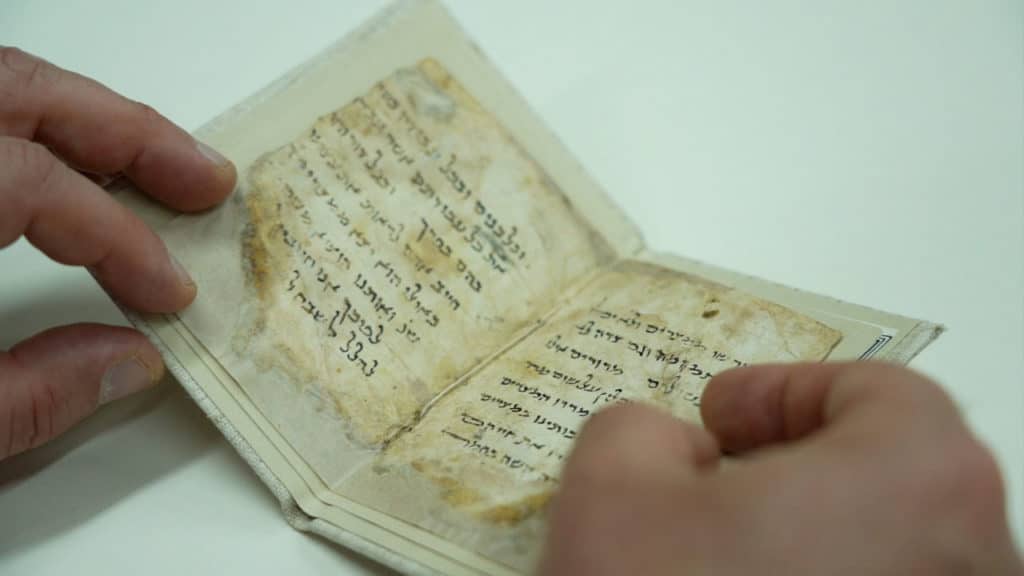
This is actually the oldest Haggadah in the collection

Among its most treasured Passover texts are the remnants of one of the oldest surviving Haggadot.

“This is actually the oldest Haggadah in the collection,” Dr. Yoel Finkelman, curator of the Haim and Hanna Salomon Judaica Collection at the National Library, told The Media Line as he gingerly opened the binding of the delicate bi-fold folio.

Dr. Yoel Finkelman, curator of the Haim and Hanna Salomon Judaica Collection at the National Library. (Raymond Crystal)

“It’s not a complete Haggadah; it came from the famed Cairo Genizah and is dated roughly to the 12th century,” Finkelman said. “It’s perfectly legible.”

One of the oldest surviving handwritten Passover texts, dating to the 12th century and found in the Cairo Genizah. (Raymond Crystal/The Media Line)

Handwritten on parchment, the precious fragments were discovered among the 400,000 pages and fragments that make up the Cairo Genizah, an astounding collection of Jewish texts that were kept in the storeroom of the Ben Ezra Synagogue in Old Cairo, Egypt.

According to Finkelman, there are roughly 8,000 traditional Haggadot in the National Library’s collection, in addition to several thousand more non-traditional editions. They come in all languages, sizes and artistic styles.

In his day-to-day, Finkelman handles some of Judaism’s greatest cultural treasures, including a wide array of fascinating Haggadot.

“The liturgy for Passover is the single most commonly printed and published work in Jewish tradition, more than a prayer book, more than a Bible,” he stressed.

Passover, or Pesach in Hebrew, is one of the most important holidays on the Jewish calendar and this year will be celebrated beginning March 27 at sundown and ending at nightfall on April 3. During the festival, observant Jews rid their pantries of all leavened breads and hold a ceremonial meal known as a Seder. It is during the Seder that the Haggadah is read.

Some of the most compelling historical Haggadot appear to be quite simple at first glance.

This is the beginning of the transition from the Haggadah as a luxury item that a family might barely be able to afford, if at all … to something that could be mass-produced more cheaply. As you can see just by glancing at it, it’s a very simple layout. It’s the beginning of [printing] technology

The 1480 Haggadah is not only the oldest printed Passover text in the world but also a one-of-a-kind copy that was created only a few decades after the invention of the printing press.

The oldest printed Haggadah in existence, dating back to 1480 from Guadalajara, Spain. (Raymond Crystal/The Media Line)

“This is the beginning of the transition from the Haggadah as a luxury item that a family might barely be able to afford, if at all … to something that could be mass-produced more cheaply,” Finkelman explained. “As you can see just by glancing at it, it’s a very simple layout. It’s the beginning of [printing] technology.”

On the other end of the aesthetic spectrum lies the Leipnik Darmstadt Haggadah, a lavishly illuminated manuscript from Germany that was written in 1733. Unlike its printed counterparts, such intricately crafted books were the purview of the wealthy.

The ornate manuscript is the handiwork of Joseph ben David of Leipnik, an influential 18th-century scribe-artist who produced an array of Haggadot for Jewish households.

The Leipnik Darmstadt Haggadah, a lavishly illuminated manuscript from Germany that was written in 1733. (National Library of Israel)

Alongside the beautifully decorated handwritten Hebrew lettering are colorful illustrations depicting biblical scenes that Leipnik in fact copied from printed editions that were fashionable in Amsterdam at the time.

“A Haggadah of this kind is a luxury item that of course only the wealthiest members of the community could possibly afford,” said Finkelman. “This is much fancier, in color, on parchment and really meant for absolutely the highest echelons of society.”

The National Library is currently in the process of digitizing rare and out-of-print items such as these, in a bid to make them more accessible to the public. In fact, all of its most valuable Haggadot are available for online viewing in high resolution.

A view of the National Library building in Jerusalem, Israel. (Assaf Pinchuk/National Library of Israel)

“The National Library of Israel has a policy and an aspiration to open access as much as possible because we believe that these belong to everyone,” Dr. Raquel Ukeles, head of collections at the library, told The Media Line. “These are great human treasures.”

Nevertheless, she added, “no matter how much digitization we do there is still no substitute to coming face-to-face with a rare treasure.”

Israel’s National Library Highlights World’s Oldest, Rarest Passover Haggadot Read More »

Shabbat HaGadol – Live Free

As we enter “the time of our freedom,” we are called on to think a bit about this idea. When we think of freedom, we usually start with thinking of liberty – freedom from government interference in our rights to life, liberty and the pursuit of happiness. We think of freedom from unreasonable coercion and restrictions. We think of being a free people, free to vote for or against our present government so that we can bring on a new government. We think of our rights – being free to express ourselves, gather in public, practice our religion (or not to).


To understand the biblical idea of freedom, we would have to imagine the time before the American Revolution – described in the longer part of the Declaration of Independence. The colonists not only wanted the freedom to govern themselves, but the freedom to set up, as much as possible, an ideal form of government. Their theories of setting up the ideal state came from various sources – the natural law/natural rights tradition and the idea of the separation of powers, for example. The idea of de-centralized state versus strong central government was fiercely debated. What fueled all the debates was the idea that a free people had an obligation to set up an ideal and just state, and while not perfect, would aim toward perfection. Those who lived in colonial America had to be free first. It took a hundred years after the ratification of Constitution in 1789 to apply those rights legally to all males, and another nearly half a century to apply them to women. Those legal steps were just a start. What exactly our rights are and how to best protect them is still being worked out, but the work is being done.


The biblical idea of freedom is similar to the original problem that the American colonists faced. Our freedom from Egypt was not so much about individual liberty as it was about Israelites being able to set up an ideal state, so fair and just that the nations roundabout would marvel in admiration. I think scholars agree:  When ancient Israelite laws are compared to legal systems roundabout, we see a stunning advance in what we would call today “human rights.”Second, political philosophers see the modern liberal state, founded on rights, justice and fairness as being rooted in ancient biblical religion. We should discuss this at our Passover gatherings and know that we are morally obligated to work for political freedom, in other words, to “establish justice throughout the land,” as much we can, at home and abroad.

The inner life tradition would have us add a focus on our own behaviors, not just the oppressive behavior of others.  From an inner life perspective, we are called on to be virtuous and to be persons of good character – not to cause harm and misery to others, especially through our words. People sometimes say, “I cannot help myself,” or “No one can be that perfect!”Our tradition sets a higher bar and permits fewer excuses than people give themselves.

Inner freedom also means struggling against the misery we cause ourselves. As I have taught in my Wisdom and Virtue classes this past year, anger at the self comes up continuously. People are afflicted by negative inner speech, addictions, depression, despair, meaninglessness, emptiness, isolation and ennui. We are politically free to do what we want, but nothing seems to help, until we search and search hard.

There is a path to inner freedom, freedom from inner misery. It is a hard, detailed and obscure path. The path to inner freedom is somewhat different for each person. After political freedom, freedom from patterns that cause misery in others and misery in ourselves is the most important use of our energy and time.

My prayer for us all is that we use this festival of freedom ahead of us to contemplate and act on the value of freedom in all of its splendor.

Shabbat HaGadol – Live Free Read More »

David Suissa Podcast Curious Times

Curious Times Episode 17: Noa Tishby on Understanding Israel

Actress, recording artist and Emmy Award-winning producer Noa Tishby discusses her acclaimed new book, “Israel: A Simple Guide to the Most Misunderstood Country on Earth.”

Enjoy the conversation.

Listen on Apple Podcasts

Listen on Spotify

Listen on Stitcher

Follow David Suissa on FacebookTwitter and Instagram

Curious Times Episode 17: Noa Tishby on Understanding Israel Read More »

Jewish Scholars Unveil New Anti-Semitism Definition Saying BDS Isn’t Anti-Semitic

More than 200 Jewish scholars released a new definition of anti-Semitism stating that the Boycott, Divestment and Sanctions (BDS) movement isn’t anti-Semitic.

The scholars, under the umbrella of a group called the Jerusalem Declaration of Antisemitism, wrote that BDS is not inherently anti-Semitic because “boycott, divestment and sanctions are commonplace, non-violent forms of political protest.” It also states that criticizing Zionism or referring to Israel as an apartheid are not expressions of anti-Semitism. However, it does state that “denying the right of Jews in the State of Israel to exist and flourish, collectively and individually” is anti-Semitic, as is holding Jews responsible for the Israeli government’s actions.

The progressive Jewish group IfNotNow told The Forward that they support the Jerusalem Declaration because “it creates more room for organizing for Palestinian rights and limits bad-faith accusations of antisemitism that have tried to derail Palestinian rights organizing and have obscured the threat of violent right-wing anti-Semitism and white nationalism.” On the other hand, Joel Rubin, who heads the American Jewish Congress, told The Forward “that delegitimization of Israel and calls to boycott, sanction, divest and isolate it without the goal of peace between a state of Israel and Palestinians are in the antisemitic lane.”

Barry Trachtenberg, Rubin Presidential Chair of Jewish History at Wake Forest University, wrote in a March 26 Jewish Currents op-ed that he signed onto the declaration because it designates “antisemitism squarely as an ideology of hatred that is equivalent to and as pernicious as racism.” This, Trachtenberg argued, “pushes back against the misguided belief about antisemitism that it is a unique and unparalleled form of hatred” which essentially “gives rise to the notion that antisemitism is a permanent, almost natural, feature of our world and thus cannot be undone.”

He added that by excluding BDS and opposition to Zionism as anti-Semitism, the declaration “opens up space for Palestinians to speak about their oppression and to confront their oppressors.”

However, Liora Rez, director of the Stop Antisemitism.org watchdog, said in a statement to the Journal that the fact that radical fringe groups” are supporting a definition that excludes “the boycotts of Jewish owned business as the Nazis did, we can’t help but laugh at its seriousness. Like dozens of countries around the world, including America, we define antisemitism according to IHRA and stand firmly by it.”

Jack Saltzberg, president and founder of the anti-BDS organization The Israel Group, similarly said in a statement to the Journal, “It is not ironic that right before Passover, a segment of Jews unleashed a declaration that essentially calls for the end of the Jewish State.” “Denying Jews the right of self-determination,” he said, “is antisemitic and the exact definition of Zionophobia.”

Judea Pearl, chancellor professor of computer science at UCLA, National Academy of Sciences member and Daniel Pearl Foundation president, said in a statement to the Journal, “History will not remember these 200 ‘scholars’ for the substance of their declaration, nor for the sophistry of their arguments. They will be remembered for undermining their students’ plight for protection on college campuses. And for handing BDS propagandists another weapon with which to assault Zionism, the heart and soul of Jewish peoplehood.

“The slippery logic of the ‘Jerusalem Declaration of Anti-Semitism’ may exonerate some Zionophobic racists from the charge of anti-Semitism, but will not exonerate its authors from the charge of thoughtlessness. ‘The thoughtless 200’ will be judged by
the jarring consequences of this ‘Declaration.’”

This article has been updated.

Jewish Scholars Unveil New Anti-Semitism Definition Saying BDS Isn’t Anti-Semitic Read More »

Why Passover is a Universal Holiday

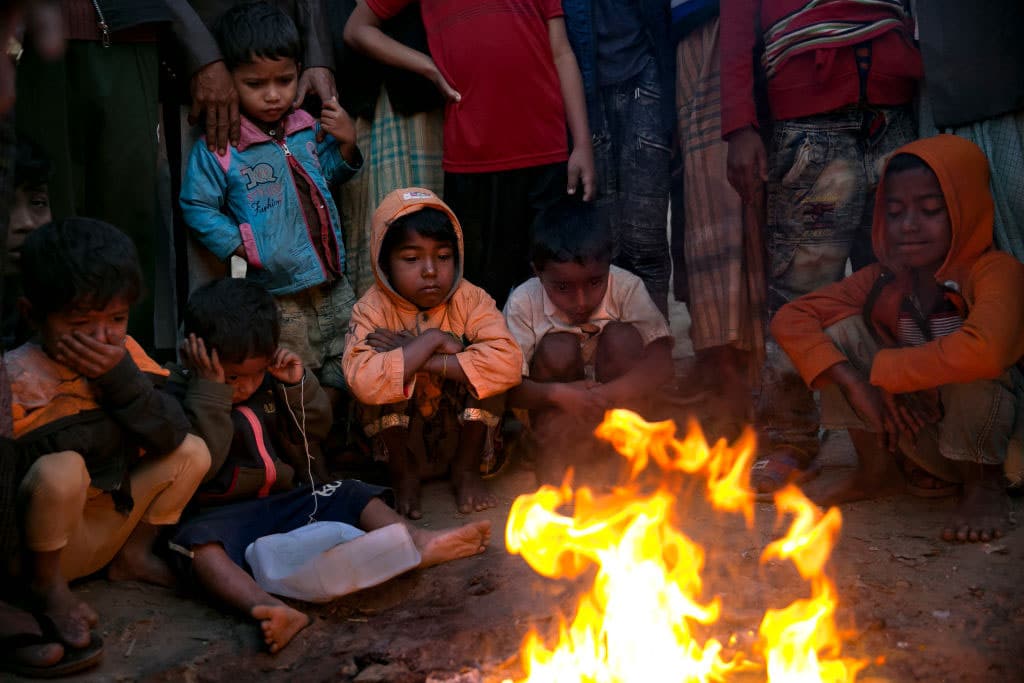
There was once a group of people who worshipped a different God than their neighbors. Their ancestors came from a different country, and they spoke a different language. The government oppressed these people, controlled their every move. They begged for their freedom, yearned to control their own destiny. But the rulers would not bend. Eventually, in desperation, they fled in the dead of night, crossing the sea into a barren land and pitching makeshift tents in the hopes of one day finding a promised land where they could worship their God in freedom and raise their children in pride and dignity.

This is the story of the Rohingya, hundreds of thousands of whom have fled Myanmar. This is also, of course, the story of Exodus and the story of Passover. The key point of Passover is to remind Jews of their history. “In each and every generation,” the Haggadah says, “a person must view himself as though he personally came forth from Egypt.” It is a story at the very heart of Jewish identity: “Once we were slaves in Egypt, but now we are free.”

Too often, however, we read the Haggadah as a story of wonders, of plagues of locusts and a parted Red Sea, of miracles and destiny. But in reality, the people living through were refugees. Like the Rohingya, they left in desperation, preferring an unknown and barren desert to oppression. They made it across the sea because there was no other choice.

Biblical sources do not give us precise details about the plight of the Jews in Egypt. We learn of their oppression and enslavement, about creating “mud bricks” for inhumane projects ordered by Egypt’s pharaoh. Archeologists believe that pharaoh was Akhenaten, who reigned from approximately 1353 to 1335 BCE and built the city of el-Amarna with forced labor. The Israelites are likely to have fled Egypt shortly after his death, during the reign of Tutankhamun, some 3,350 years ago. The Egyptians have no record of the slavery of the Israelites, nor their flight across the Red Sea. Oppressors rarely document their crimes.

The escape from Egypt was not the last of the oppression suffered by Jews, of course. There is the story of Haman, enshrined in the festival of Purim. There is the Shoah, which we will commemorate just a week after Passover. In each generation, Jews have experienced persecution, slavery and genocide. This is why the Haggadah takes its readers back in time together around the table: to explain why the Jews are the Jews. In the best form of oral tradition, elders reenact the legends of their forebears for their children. The lesson of Passover is that the Jews survived, and they continue to survive today. There is no holiday that is more fundamental to what it means to be Jewish than Passover.

What happened to the Jews can and does happen to others. The Jews are not alone.

Yet it is also a universal holiday. What happened to the Jews can and does happen to others. The Jews are not alone.

Indeed, despite the progress of the last three and half thousand years, in some ways, not much has changed. Governments still oppress minority ethnic groups, disenfranchise the economically disadvantaged, exploit the vulnerable in factories for a pittance and strip religious and civil rights from the oppressed. The Rohingya are still pitched under tarpaulins in Bangladesh, hoping for a place to call home, reliant on the United Nations and NGOs to feed and clothe them. The Uyghurs from Xinjiang, China, are treated as foreigners in their own homeland, as I have previously described, robbed of their rights and identity and subject to genocidal policies.

It is time for Passover to become a festival for everyone and about everyone. I celebrate the holiday with my Jewish wife and her family and with all our non-Jewish extended family. And each person at our Seder, Jewish or not, sees something of themselves in the Passover story. This year, as we celebrate the Passover Seder alone, or over Zoom, or in small, safe family groups, we might pause and add, “In each and every generation, each and every person must see himself or herself through the eyes of others who still suffer today, who need our help and who deserve freedom every bit as much as we do.”


Stephen D. Smith is Finci-Viterbi Executive Director Chair of the USC Shoah Foundation. He is also the UNESCO Chair on Genocide Education.

Why Passover is a Universal Holiday Read More »

Long Beach City College Board of Trustees Passes IHRA Resolution

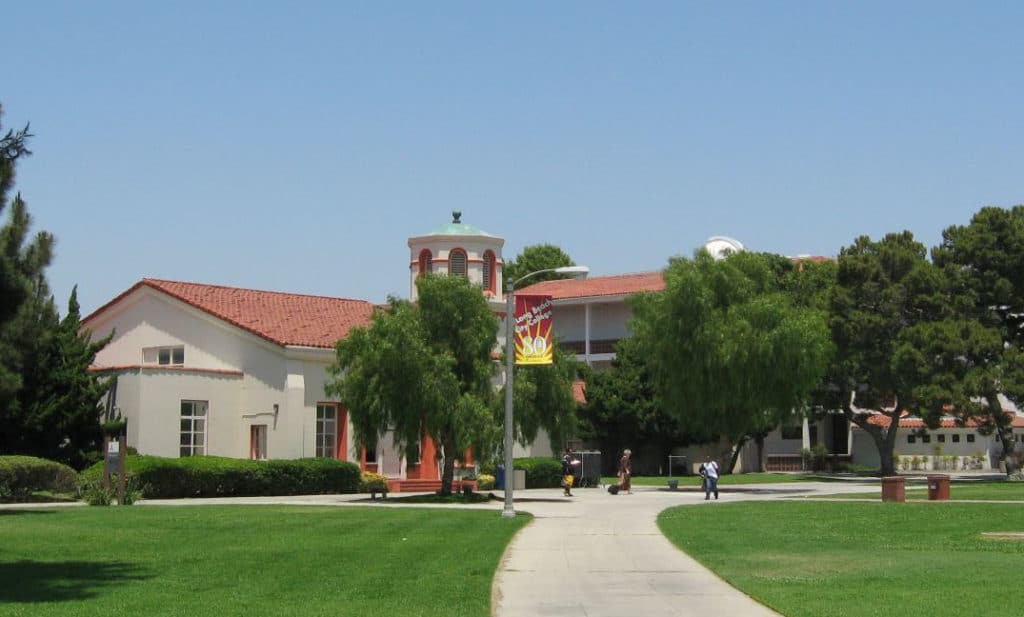
The Long Beach City College Board of Trustees passed a resolution endorsing the International Holocaust Remembrance Alliance (IHRA) definition on March 24.

The resolution, a copy of which was obtained by the Journal, states that adopting the IHRA definition is necessary because “antisemitic incidents are on the rise on American college and university campuses, evidenced in part by the defacing of Jewish facilities and institutions on campuses using antisemitic language, efforts to remove Jewish students who believe in Israel’s right to exist from positions of leadership, the questioning of Jewish students’ loyalty to the United States by faculty and fellow students, scheduling of examinations and other required degree completion benchmarks on Jewish holidays, and even acts of violence and intimidation against Jewish students and faculty.”

The resolution also notes that IHRA has been adopted by the U.S. State Department and more than 34 countries and that the definition includes illegitimate criticism of Israel. However, an amendment to the resolution that would have condemned “all antisemitic speech and actions by members of the campus community” and stressed the importance of ensuring that Jewish members of the community “are not penalized or otherwise discriminated against for observing [Jewish] holidays and traditions” failed to pass by a vote of 3-2.

Jewish groups applauded the Board of Trustees for passing the resolution.

“StandWithUs celebrates the passing of an IHRA resolution by the Long Beach College Board of Trustees,” StandWithUs co-founder and CEO Roz Rothstein said in a statement to the Journal. “Despite efforts to silence the Jewish community, we are so proud that they have voted to do the right thing and take a stand against antisemitism. We look forward to observing the positive impact such an important step will have on the Long Beach College community.”

American Jewish Committee (AJC) Los Angeles Regional Director Richard S. Hirschhaut similarly said in a statement to the Journal, “AJC roundly applauds the Long Beach Community College District for its adoption of the IHRA Working Definition of Antisemitism. Because the road leading to this decision was at times acrimonious, the process itself became a ‘teachable moment’ in illustrating the importance of the IHRA Definition as a tool for education and understanding. The Long Beach CCD has earned its place as a leader in assuring guardrails against antisemitism and hate on campus. It is an example worthy of emulation.”

Anti-Defamation League (ADL) Orange County/Long Beach Regional Director Peter Levi said in a statement in to the Journal, “ADL applauds the Board of Trustees of Long Beach Community College adopting the International Holocaust Remembrance Alliance’s Working Definition of Antisemitism. The IHRA definition is a useful tool for combating hate and antisemitism in the U.S. and around the world for combating hate and antisemitism in the U.S. and around the world. This legally non-binding working definition provides valuable guidance for elected university administrators along with officials, law enforcement, educational professionals and community leaders on what exactly is antisemitism and the many different forms it can take without infringing open everyone’s right to free speech. This includes when criticism of Israel crosses the line from fair critique of the policies of the Israeli government into the delegitimization of the Jewish State.”

Democrats for Israel California wrote in a Facebook post, “Thank you to the Long Beach City College Board of Trustees for recognizing the IHRA Working Definition of Antisemitism in its entirety as stated on the US Department of State website. Congratulations to Board Member Sunny Zia LBCCD Trustee, Area 3 for leading this effort and Board Chair Uduak-Joe Ntuk for running the meeting that got it passed.”

Thank you to the LongBeach City College Board of Trustees for recognizing the IHRA Working Definition of Antisemitism in…

Posted by Democrats for Israel – California on Wednesday, March 24, 2021

Trustee Sunny Zia also said in a statement to the Journal, “After months of trial and tribulation and call to action by our community, it makes me proud to finally pass a resolution as the first higher education institution defining antisemitism. Antisemitic incidents have been on the rise in the United States and highest in recent years, more than in any year since the Anti-Defamation League began tracking them four decades ago. I am honored to have done my part in condemning such acts of hate and educating the community at large on a chronic issue that has plagued our community on a daily basis. I hope this sends a message that Long Beach Community College District will not tolerate antisemitism as a model for other institutions to emulate.”

The board had previously been criticized for not voting on the resolution in a meeting on International Holocaust Remembrance Day.

Long Beach City College Board of Trustees Passes IHRA Resolution Read More »

My Cheshbon HaNefesh for Cowardice in the Face of Wokeness

The first time I remember hearing the term “woke” was at a gathering of Black and Jewish activists in New York City in the fall of 2016. It was also the first time I encountered Black Lives Matter activists in person. I was the head of a Jewish organization that builds bridges with other ethnic and religious communities and advocates for a more just society. And this was a moment of great turmoil in race relations. In 2014, the streets of Ferguson, Missouri erupted in response to the killing of Michael Brown at the hands of a police officer. During those protests, three women coined the hashtag #BlackLivesMatter, which spread like wildfire and sparked the civil rights movement of our time.

In August 2016, an offshoot of the loosely-knit movement, the Movement for Black Lives (M4BL), issued a platform, which, among other things, denounced Israel for committing genocide. Jewish leaders accused the authors of anti-Semitism, and Black lives activists countered by accusing Jewish leaders of “decentering” the Black experience and distracting attention from their claims (a charge I would hear over and over again). Even as we reeled in response to the rising tensions, many of us were intensely curious. Who were these unnamed Black Lives Matter activists? And could we unite behind a common cause?

When a group of Black Jews organized the meeting with Black Lives Matter activists in New York, I  jumped at the chance to join it. I was initially denied entry because of an article I had written earlier that year that was critical of intersectionality, the theory that various forms of discrimination interact in ways that create specific and compounded problems. But after lengthy discussions with a proxy for one of the organizers — in which I was told I needed to “do the work” — and me issuing a mea culpaas the price of admission, I was finally allowed in. This was the first of several compromises I made to my own liberal values and for which I now make amends.

The white Jewish leaders who attended the meeting were told in advance that they were expected to come and listen, to be seen and not heard. There would be a time to ask questions in small groups, but we were not allowed to challenge anything we heard during the main discussion. They were authentic voices of the marginalized, and we were to behold their words.

There were many firsts that evening. It was the first time I heard Black Jews say white Jews had benefited from white supremacy and needed to “shed your whiteness,” or the cultural identity that afforded whites advantage. White Jews, they told us, had taken full advantage of white privilege and their proximity to the white power structure. I later came to understand that like other privileged ethnicities, such as Asian Americans, many Jews were “white adjacent.” We were expected to acknowledge our complicity in white supremacy.

Many American Jews define white supremacists as racists who parade around with tiki torches and white hoods. For the Black activists at that meeting, however, white supremacy describes the fundamental organizing principle of America and the West, a system meant to uphold white domination. Many of us at the meeting were unfamiliar with this use of the term white supremacy. But I didn’t dare ask questions, let alone challenge what I heard.

Our role moving forward, we were told, was to acknowledge our own guilt, “make space” for and “lift up” Black voices. This was not your father or mother’s civil rights movement. It was certainly not a dialogue, and I doubt the organizers would have described it as such. We were complicit in the oppression of Black people in America and of Black Jews. We “had work to do” on ourselves and in the larger society.

At the end of the meeting, one of the organizers drew the Black participants into a circle. She preached “I was blind but now I am woke.” The participants repeated the chant and proclaimed Amen. I have always been moved by the spiritual effusiveness of the Black church. It feels to me that through gospels, hymns and professions of faith, churchgoers possess a deep, authentic connection to the divine spirit that I myself could not access. But I was initially confused when witnessing that same fervor during what was understood to be a political program.

What I later concluded was that the call to be woke was, in fact, a profession of faith. To be woke was to see the light of racial domination and all that it entailed. It felt like I was witnessing a religious revival in service of a new spiritual, political and social movement. Wokeness sees itself not merely as a social movement to end racism but as a complete worldview that supersedes the existing white supremacist order. It has its own internal logic. Its own vocabulary. Its own history, philosophy and conception of morality and law. And it carries, like all religions, a dogma that is not to be questioned.

I grew up in Columbus, Ohio, to an Iraqi Jewish mother who came directly to the United States in 1963 and to a U.S.-born, third-generation Ashkenazi father. When I was three, my grandmother came from Baghdad and moved in with us. Three years later my grandmother’s sister and her 14-year-old son moved in with us from Iraq and took my brother’s bedroom for three years. The house was bustling with high-pitched laughter and arguments laced in colorful Arabic swear words and a screeching parrot named Bibi. My father, who spoke no Arabic, often took refuge in the bedroom. I spoke to my grandmother and great aunt in a Jewish dialect of Arabic. It always struck me as odd and not a little exclusionary that American Jews thought all Judaism was Ashkenazic. Why was corned beef a “Jewish food,” I wondered, but not Kubbah, the farina dough dumplings filled with meat eaten by Iraqi Jews? Every Sunday morning, the smell of searing cumin woke me up as my grandmother made kitchry, the Jewish rice and red lentil delicacy. I appreciate the dish now more than I did then.

When I first heard about the identity category of Jews of Color that included Mizrahi Jews like me, I was puzzled. It never occurred to me to see myself as a Jew of Color. One Black Jew told me, much to my horror, about her experience in synagogue when an older lady presumed she was “the help.” It was not the first and only time it happened. Certainly nothing like that ever happened to me. We do have a responsibility to be a more inclusive and welcoming community.

Raised by an immigrant who practically worshipped the United States, I embraced the narrative of an America that is constantly striving to live up to its ideals. The America I grew up in was not racist but had racism in it. I still hold by that narrative today. The woke claim that America is white supremacist strikes me as both wrong and dangerous. For all its faults, America is the most successful experiment in pluralism in world history. Immigrants with black and brown skin still flock here, and my eccentric family was proof of the opportunity that lies at its doorsteps.

Five years after the meeting in New York, I am astonished to see how the woke faith has insinuated itself into mainstream opinion and institutions. Its appeal grows out of the profound (and rightly felt) collective guilt of white society. From what I saw, wokeness insists that only Black people have the right to enunciate their experiences and claims against society, and that everyone else must abide by their pronouncements. It asserts the same about Jews and other minorities as well. Anyone who wants to be in the good graces of the Black activists, it seemed, would have to adopt these pieties. It turns out that many progressives are eager to be in their good graces.

Five years after the meeting in New York, I am astonished to see how the woke faith has insinuated itself into mainstream opinion and institutions. Its appeal grows out of the profound (and rightly felt) collective guilt of white society.

While I was initially bewildered by the gathering in New York, I came to understand that beneath the power play was deep-seated resentment at the way some Black Jews felt about their place in the Jewish community. The Jewish community had not been nearly as inclusive of Jews of Color as we should have. We had not lived up to our moral billing. We do have cheshbon hanefesh —an accounting of the soul —to do for our lack of awareness and sensitivity.

But does such a recognition disqualify us from having an opinion on race and racism that differs from what I heard at the New York gathering? Must each of us now outsource our views on racism to those with first-hand experience?

As wokeness initially worked its way through college campuses and corporate diversity seminars, few mainstream liberals took the threat of it seriously. Wokeness seemed at worse a trifling annoyance, confined to late night dorm room discussions and occasional company retreats. Few challenged the intellectual underpinnings because… why bother? At that time, people were not getting fired for refusing to adhere to the faith.

But some fringe fads eventually escape into the mainstream. The kids graduate from college and go from being interns to professionals to managers to CEOs to elected officials. They insist that their workplaces take their woke sensibilities seriously. No one wants to look like they are against diversity, and their superiors bend to their will. Unopposed, the idea metastasizes. One day the quiet skeptic wakes up and finds that wokeness enjoys the enthusiastic support of a critical mass of progressives.

Today, much of the established Jewish community has been swept up by the woke tsunami. Jewish organizations have short circuited the usual deliberations, a hallmark of Jewish civic life. Seemingly overnight they have changed the language they use in describing the power dynamics of American society. Advantages became “privilege.” Equality became “equity.” Dominant culture became “supremacy.” Emotional hurt became “harm.” Each of these terms carries ideological connotations beyond their literal meanings.

Seemingly overnight organizations have changed the language they use in describing the power dynamics of American society.

I’m not suggesting that Jewish organizations shouldn’t use any of these terms. Rather, before adopting them, they should gain an understanding of what they mean in the context they are used and deliberate, openly, on whether they agree with those meanings. So far that hasn’t happened. All three non-Orthodox denominations have enunciated their support for critical race theory. No one bothered to ask rank and file members if they believe America today is a white supremacist state. Perhaps the leaders of these movements are scared of the answer they might receive from their own members.

At the altar of woke ideology, not only have some made a mockery of the deliberative tradition, some have even ditched their moral compass. In the name of racial justice and “Jewish values,” Jews, even rabbis, bully other Jews. These “kindly inquisitors” shame and ostracize others for daring to think differently. Some proclaim that we need “to get everyone on the same page on racial justice.” They accuse white Jews of having “privilege” for uttering non-woke perspectives. The normal laws of civility don’t apply. The activist Rabbi Michael Adam Latz informs me that “Civility is the elixir of the privileged… But while Black and Brown people continue to get shot and choked to death in alarming numbers, civility must take a back seat to justice.”

It’s not unusual to hear in spaces I recently travelled in that Jews must perform cheshbon hanefesh for their complicity in white supremacy. I recently left my position heading a national Jewish advocacy organization. And I have some cheshbon hanefesh to do, not over my complicity in our supposed white supremacist state, but for failing to stand up for my friends when they faced bullies and for my cowardice in not standing up for my own liberal principles early or decisively. I now plan on using my voice to right that wrong and defend the liberal values that have been central to the security of Jews and to a free society.


David Bernstein is the former head of Jewish advocacy organizations and currently the principal of Viewpoint Worldwide. Find him on Twitter @DavidLBernstein

My Cheshbon HaNefesh for Cowardice in the Face of Wokeness Read More »

A Moment in Time: Passover – What We Say and What We Hear

Dear all,
While helping my mom sort through old boxes, I came across this vintage microphone my father used for his (Kosher) Ham Radio conversations. I placed it next to my current AirPods. The old and the new, right?
But it made me think of Passover, which begins this Saturday evening. While the Festival is certainly about weaving an ancient story with contemporary situations, it’s about so much more…. It’s about what we say and what we hear.
Passover is about listening to the voices that came before.
And Passover is about finding our own voice.
Passover is about experiencing the world through the eyes of those who have less.
And Passover is about sharing our own struggles.
Passover is about acknowledging that oppression still exists.
And Passover is about brainstorming what we must do to confront it.
Passover is about being present for the sake of generations that came before us.
And Passover is about being present so that generations after us will exist.
Passover is an incredible moment in time, because what we say and what we hear … they matter.
May this Passover be filled with promise for all who celebrate!
With love and shalom from ZEMR (Hebrew for “Song” – but also an acronym for “Zach, Eli, Maya, Ron”)!
Rabbi Zach Shapiro

A Moment in Time: Passover – What We Say and What We Hear Read More »