fbpx

March 15, 2021

Beverly Hills City Council to Consider Resolution Against LA District Attorney

The Beverly Hills City Council will be taking up a resolution expressing no confidence against Los Angeles District Attorney George Gascón on March 16.

The resolution, which is listed on the agenda for the upcoming meeting, states that Gascón’s policies of dismissing various misdemeanor charges and eliminating sentencing enhancers “contradict state laws” and “the legislative ballot initiative process to prevent and prosecute crime and protect the general public.” Mayor Lester Friedman and Councilmember Lili Bosse requested the vote.

“The City of Beverly Hills demands Los Angeles County District Attorney George Gascón rescind every Special Directive issued since being sworn into office on December 7, 2020,” the resolution states.

On March 9, the Santa Clarita City Council unanimously passed a similar resolution expressing no confidence in Gascón over his policies. Santa Clarita City Councilman Jason Gibbs said at the time, “The only way to ensure nothing happens is to do nothing. This vote is something… to demonstrate the serious concerns we have within this community.”

Anti-Defamation League Los Angeles Regional Director Jeffrey Abrams also expressed concern in December about how Gascón’s directives would affect hate crime sentencing, stating that “eliminating hate crime enhancements in all cases could send the wrong message, causing further fractures in our community. We believe in this context, a blanket approach is not the wisest.”

The progressive Jewish group Bend the Arc: Jewish Action, on the other hand, co-signed a letter in December backing Gascón’s directives. “These sweeping reforms will enhance public safety and are well-aligned with a burgeoning national consciousness that we can no longer police and cage away the many social ills produced by inequality, racism, and poverty: the root causes of crime.”

Alex Bastian, Special Advisor to Gascón, said in a statement to the Journal, “The District Attorney is very focused on enhancing public safety, increasing equity, expanding victim services and strengthening police accountability. The policies implemented over the last few months go to furthering these core principles for all Angelenos, including Beverly Hills residents.”

Beverly Hills City Council to Consider Resolution Against LA District Attorney Read More »

How Can We Control Antibiotic-Resistant Bacteria?

The continued overuse of antibiotics in livestock feed is fueling dangerous consequences for human public health as bacteria grows ever more resistant to them. A new report from the Ministry of Health outlines recommended policy measures to curb this trend.

Neta Nissim – ZAVIT* Science and Environment News Agency

Since the monumental discovery of penicillin nearly a century ago, many more types of antibiotics have been developed with intent of saving millions of lives. However, antibiotics are by no means a “miracle drug” as their increased use can bring about serious consequences. Over the years, bacteria have been able to develop resistance to various antibiotics and thus gain immunity to their treatment. This resistance can lead to persistent infections and even infect other people with strains of resistant bacteria.

According to the latest report from the US Centers for Disease Control and Prevention (CDC) from 2019, about 700,000 people worldwide die each year after being infected with antibiotic-resistant bacteria. According to current projections, this figure is expected to skyrocket to 10 million annually by 2050. In Israel alone, 5,000 people die from resistant infections each year. Therefore, bacterial resistance to antibiotics is one of the major challenges facing both Israeli and worldwide health systems today, with the exception of the ongoing COVID-19 pandemic.

A new report from the Ministry of Health found that strengthening the regulation and supervision of veterinary preparations is an effective strategy in reducing the use of antibiotics in farm animals as well as addressing the issue of antibiotic-resistant bacteria in humans.

According to the author of the report, Dr. Tali Berman-Alport, who is currently pursuing her postdoctoral fellowship at the School of Zoology at Tel Aviv University, “Veterinary preparations include not only antibiotics, but all medicines intended for animals.”

“In Israel, the Ministry of Health is the competent authority that supervises the licensing of veterinary preparations. However, the preparations in question do not include two groups: vaccines and disinfectants for external use. The approval of these preparations is the responsibility of the Ministry of Agriculture,” she elaborates.

Livestock Issues

“The main factors for the development of bacterial resistance are the increased and unwise use of antibiotics,” says Dr. Berman-Alport. “While there is an increased use of antibiotics towards humans in hospitals, the fact is the majority of antibiotic use occurs in the treatment and feed of farm animals.”

Beyond disease treatment and prevention, antibiotics also stimulate and accelerate growth leading to 15-20% increases in animal weight. As a result, about 73% of all antibiotics sold around the worlds are used for animals intended for human consumption.

But because antibiotics are not 100% effective, the remaining resistant bacteria can multiply and persist, thus having cascading consequences for us as the consumers. Infections such as pneumonia, tuberculosis, gonorrhea, and salmonellosis become increasingly difficult to treat as the antibiotics used to treat them become less effective.

“Resistant bacteria can be transmitted from farm animals to humans through direct contact with infected animals, through the consumption of meat, and even through the consumption of agricultural produce treated with animal manure,” Dr. Berman-Alport explains.

What is Israel’s Plan?

In recent years, there has been growing evidence that the ongoing and large-scale use of antibiotics in livestock feed is responsible for escalating antibiotic resistant bacteria. According to the CDC, one in five antibiotic-resistant infections originates in bacteria from infected food or direct contact with animals. Thus, the continued spread of antibiotic-resistant bacteria in humans and animals may exacerbate the dimensions of the antibiotic-resistant bacterial infections.

Many countries, in fact, restrict the use of antibiotics in livestock feed. For example, as early as 2006, the European Union banned the addition of antibiotics to avoid the creation of “superbugs” resistant to antibiotics used in human medicine. Three years ago, the World Health Organization (WHO) published a list of guidelines on the use of antibiotics and growth catalysts in food-producing animals to preserve the effectiveness of medically important antibiotics for humans.

Israel, on the other hand, did not ban the unregulated use of growth catalysts and preventative antibiotics until 2018 despite legislation proposed four years prior. With the Animal Feed Supervision Law now in effect, alternative arrangements for animal feed production and marketing are being established to better protect public health as well as animal welfare.

However, Israel has not yet formulated a national action plan to reduce the use of antibiotics and control the proliferation of antibiotic-resistant bacteria in farm animals.

“Apart from resistant bacteria, antibiotic residues can also be found in animal food products,” says Dr. Berman-Alport. “Veterinary services, therefore, regularly inspect residues in animal products—meat of all kinds, fish, eggs, milk and honey, etc.— to identify trends of incorrect or illegal use of antibiotics and other substances, and to assess the extent of public exposure to these residues as a result of consuming animal products.”

Adopt a “One Health” Model

Many countries around the world are currently taking a holistic approach in promoting national action plans to address the development of bacterial resistance referred to as One Health—the collaboration of multiple sectors to achieve an effective balance between human, animal, and environmental health.

“These programs are mainly based on monitoring the consumption of antibiotics and resistant bacteria, limiting the use of antibiotics in livestock, improving the growing conditions of farm animals, raising public awareness and promoting intelligent use of antibiotics, strengthening regulation, supervising veterinary preparations, and promoting alternative solutions such as vaccines,” says Dr. Berman-Alport.

So far, these actions have led to impressive results. In the EU, for example, there has been a 32% drop in the sale of antibiotics intended for farm animals in recent years. Also, many studies demonstrate that awareness to the problem and setting guidelines and strict rules lead to a decrease in unnecessary use of antibiotics, and subsequently to a decrease in the development of resistant bacteria.

In addition, the report outlines policy and farm-level action recommendations, drawing attention to the importance of regulation on the supply and consumption of livestock antibiotics by both importers, manufacturers, and veterinarians who prescribe them.

Collect All the Data

“There is an urgent need to collect data on the sale and consumption of antibiotics in the Israeli livestock sector, so that a more accurate risk assessment can be performed,” says Dr. Berman-Alport. “In addition, a general system for monitoring resistant bacteria should also be established, which will increase the ability of national preparedness for this significant challenge.”

Today, the monitoring of antibiotic-resistant bacteria in farm animals is divided between several bodies: the national centers of the Public Health Laboratory in Jerusalem, the Veterinary Institute, the Poultry Industry Council, and the Dairy Council.

“One of the significant recommendations in the report is the creation of a department capable of looking at all the collected data regarding the use of antibiotics and the development of bacterial resistance in the animal industry in the country. Today this is not happening so much,” says Dr. Berman-Alport.

“Right now, each department collects its own data and the cooperation between departments is not always simple. The aim is to create a departmental system that will collect the data regarding the provision of veterinary drugs and antibiotics to farm animals so that it will be possible to issue an annual and cohesive joint report.”

“In Israel, the main problem is that there is currently no data being collected regarding the consumption and use of antibiotics in farm animals. Yes, there is important monitoring of resistant bacteria, but it is only partial. Without information on the amount and frequency of use of antibiotics in animals, it is difficult to say what the acute nature of the condition is,” Dr. Berman-Alport adds.

“It is important to strengthen the supervision around veterinary preparations, starting from the registration stage, through the supply of appropriate preparations, and at the economy level,” Berman-Alport emphasizes. “Only in this way will it be possible to reduce the use of antibiotics in farm animals, and it is time for Israel to join this campaign for the sake of public health.”

ZAVIT – Science and Environment News Agency

How Can We Control Antibiotic-Resistant Bacteria? Read More »

With Trump Gone, Anti-Trump Governors Find Life More Difficult

It’s a lot harder to be an anti-Trump politician when Donald Trump isn’t around anymore.

Trump still exists, of course. He’s ensconced in his new post-presidency Elba, toggling back and forth between time on the golf course and threatening his former allies. But although he will still play a critical role in the Republican Party’s future, he is much less relevant to the daily national conversation. Reasonable people can disagree on whether this is a good or bad thing, but for those politicians who used the last four years to successfully contrast themselves with Trump, the former president’s absence creates a new set of challenges.

Governors Andrew Cuomo and Gavin Newsom both learned that lesson this past week, when the leaders of the nation’s two largest Democratic-controlled states were forced to confront their own difficulties without the accustomed benefit of using Trump as a foil. Throughout the first several months of the pandemic, both men saw their public approval ratings skyrocket, primarily because of the very different approaches they employed to deal with the coronavirus in their states than Trump was following at the national level.

Both Cuomo and Newsom held widely-viewed daily briefings for the media and the public in which they warned of the dangers of the virus’s spread and offered exceedingly detailed summaries of the toll COVID-19 was taking and their plans for combatting it. Meanwhile, Trump was facing wide criticism for his reluctance to admit the dangers posed by the pandemic or to employ more aggressive steps to curb its spread. Over the spring and summer, when Joe Biden was keeping a low profile after securing the Democratic presidential nomination, the two governors represented the national face of the opposition to Trump’s hands-off approach. Both frequently used their platforms to lambast Trump for his inaction, and both benefited tremendously from the contrast and the criticism.

The two governors hit rough spots in the fall, but the presidential campaign and its aftermath largely overshadowed their more controversial decisions. The goodwill that Cuomo and Newsom had accumulated earlier in the year sustained them even through these more turbulent waters. But now Biden’s approach to the coronavirus is attracting a much more favorable public response than that of his predecessor, and both governors’ difficulties are attracting more attention.

Cuomo and Newsom’s difficulties are attracting more attention.

Cuomo’s problems are worse than Newsom’s. Scrutiny regarding his administration’s efforts to hide the number of deaths in New York nursing homes has exploded into a full-blown scandal. The allegations of multiple sexual improprieties that have been raised against him are likely to lead to impeachment or resignation. It’s hard to see how Cuomo will survive this maelstrom: His best outcome is probably to announce that he will not seek re-election next year and limp to the end of his term.

Newsom’s political standing is much stronger. While a recall election will almost certainly take place later this year, the odds of him surviving that vote and gaining re-election next year are decidedly in his favor. There may be some unpleasant months ahead for Newsom, but it’s difficult to see a Republican opponent unseating him in such a heavily Democratic state. The wild card is still whether a member of Newsom’s own party decides to enter the race: The greatest threat to him seems to be from the left rather than the right.

But Newsom’s long-delayed State of the State address last week underscored the added difficulty the governor will face now that Trump no longer occupies such an outsized portion of public and media attention. The governor’s exhortation to the people of California to persevere through the pandemic was somewhat flat without a convenient target in the White House against whom to rally public opinion. (Newsom was also not helped by the depressing visuals of delivering the speech in an empty Dodger Stadium, where he was swallowed up by tens of thousands of unoccupied seats.)

Biden faced similar questions when he took office, and many wondered whether being the “Un-Trump” would be a sufficient political foundation for the new president moving forward. He has already taken the first step out from Trump’s shadow by signing the popular COVID-19 relief bill, and the ambitious nature of his next policy goals will further distance himself from his predecessor. But for Newsom, Cuomo and many more of the former president’s strongest detractors, it may be time to replace that aspect of their political identities with something more current.


Dan Schnur teaches political communications at UC Berkeley, USC and Pepperdine. He hosts the weekly webinar “Politics in the Time of Coronavirus” for the Los Angeles World Affairs Council & Town Hall.

With Trump Gone, Anti-Trump Governors Find Life More Difficult Read More »

“Zionists On Campus” Initiative Aims to Protect Jewish Students

A new initiative from the Zachor Legal Institute is partnering with existing pro-Israel groups to help protect Jewish students on campus. The initiative, dubbed Zionists On Campus, is headed by Lizzy McNeill, who told the Journal in a phone interview that the initiative is talking to students to get an idea as to what they’re dealing with on campuses. It then aims “to provide resources to help them combat anti-Semitism, BDS [Boycott, Divestment and Sanctions] and aggressive anti-Israel activity on their college campus.”

As an example, she pointed to the San Francisco State University Zoom webinar featuring Popular Front for the Liberation of Palestine (PFLP) member Leila Khaled that Zoom canceled in spite of the university claiming the event was allowed under academic freedom.

“These are the types of things that we are seeing a rise in on college campuses,” McNeill said, “and they are being claimed as freedom of speech, and we think the administrations are in a way enabling intimidation and harassment toward Israel-supporting Jewish students.”

“We think the administrations are in a way enabling intimidation and harassment toward Israel-supporting Jewish students.”

Zionists On Campus also provides educational material as a way to combat anti-Israel forces on campus. For instance, when Israel Apartheid Week is held on a college campus, Zionists On Campus has a timeline on their website that features a timeline of Palestinian violence against Israelis, showing the effectiveness of the security barrier in the West Bank.

“In the future we would like to have events with students that would be a counter to these types of Israel Apartheid Weeks,” McNeill said. “We are looking to be a little bit more aggressive than the average Jewish club on campus, and that’s because we think that there is an extreme rise of anti-Semitism on college campuses.”

Marc Greendorfer, founder of the Zachor Legal Institute, told the Journal that they’re also looking into ways to take action against professors who create a hostile environment in the classroom through their support of BDS and anti-Zionism. “The only way to know for sure is to have students on campus who can report to us and tell us what’s going on to see if it’s actionable.”

He added that the initiative isn’t meant to create competition with other pro-Israel groups; it will work with them to “address those extreme circumstances where students are really left with no recourse and they need somebody to step in and tell them their legal rights and to provide them with the information they need to combat the disinformation.”

“Zionists On Campus” Initiative Aims to Protect Jewish Students Read More »

How EMDR was my Emotional Exodus

During the pandemic, my friends cleaned out their garages of stuff they no longer needed. I chose to clean out bad memories of traumas I wish I never had.

For years I’ve hid how my past enslaved me. I wanted to be free, but like Pharaoh, my heart was hardened, and I refused to seek help. But now, besides my desire to now finally do the (inner) work, I wanted to understand why I recently ended a romantic relationship that was so good, yet never felt right.

Slowly, I started my exodus to self-discovery and, ultimately, self-love.

I envisioned an archeological dig into my soul to make peace with my demons and deactivate my emotional landmines. I yearned for a different approach, so I went outside my comfort zone and had an healing session with a Shaman, who energetically opened my soul. It was an amazing start, but it felt passive. I wanted to be an active participant in the process, so I kept searching.

Then, a friend shared a book with me that led me to a transformative treatment. “The Body Keeps the Score: Brain, Mind, and Body in Healing of Trauma” by Bessel van der Kolk introduced me to Eye Movement Desensitization and Reprocessing, or EDMR.

EMDR is a remarkably simple, effective way to reprogram your brain and emotions around past traumas. You talk with the therapist about a traumatic event, then relive it in your mind quietly while you watch them move an object back and forth. The steady eye movement, while thinking about the trauma, somehow releases the triggers and allows you to let go of the horror of the memory.

I found an EMDR-certified therapist, and she asked me to list my life traumas. I made a list that felt like the 10 plagues, each seemingly worse than the next. We began tackling them one per session.

The miracle of EMDR is that it allows me to time travel to the traumatic moment and comfort myself. For example, I did EMDR for a situation when I was 10 years old, when my drug-addicted dad came to pick up my brother and me for his scheduled custody visit. My dad was high as a kite and my mom was screaming, “How dare you! You’re going to kill our children!”

I was terrified, but I still got in his car. It felt like my mom hated me for wanting him to love me, but I was a child desperate for my daddy’s love. Sadly, at the time, he was too high to care.

Through EMDR I finally saw myself as a scared little girl, long hidden away, feeling hated by her mother and rejected by her father. For the first time maybe ever, I held and comforted her. I told her, “Everything will be OK. Your mother wants to protect you. Your daddy loves you, but he cannot love you now through the cloud of drugs. This storm will pass, and his love will shine as bright as the sun.”

The trembling, terrified 10-year-old me began to relax in my 50-year-old’s embrace. She finally felt safe and believed “everything will be OK.

As my awareness came back into the room, I sat across from my therapist while she waved a green tip wand back and forth like a metronome. My tears stopped streaming down my face. I held up my hand to end the EMDR session. For the first time in a long time, I felt light and peaceful.

A few days after this EMDR therapy, the “why” I had ended my recent relationship was clear: Until now, I had never comforted my scared little girl.

Until now, I had never comforted my scared little girl.

My last boyfriend held me and made me feel safe. Although he could “fix” anything, he could not heal the scared little girl in me. Being with him made me feel safe but stuck. I kept telling him again and again “I hate how much I need you.”

I didn’t realize it at the time but I was in a codependent relationship, and I had to free myself from it. Why? Because subconsciously, I knew I was a slave to love. I wanted to stand strong on my own. I simply didn’t know how.

Now, I feel I do.

My journey has been to love myself unconditionally, be my most fierce champion and feel safe alone. When I begin to date again, I will approach a partner knowing I am loveable, whole and safe. I no longer need anyone to fill those voids.

As we approach Pesach, the story of our freedom, I am grateful that I embarked on this journey to free myself from my past and be hopeful about the future.

Rabbi Nachman of Breslov said, “The Exodus from Egypt occurs in every human being, in every era, in every year, and in every day.” I’m grateful EMDR was my Exodus. I hope you share this story with others who yearn for their emotional freedom.

(To learn more about EMDR therapy and find a certified therapist visit: https://www.emdria.org)


Audrey Jacobs is a financial adviser and has three sons. 

How EMDR was my Emotional Exodus Read More »

The Jewish highlights of the 2021 Grammys

(JTA) — When the Jewish sister act Haim took the stage at the 2021 Grammy Awards on Sunday night, Americans began googling “hime.”

That’s how host Trevor Noah pronounced the group’s name, which is the last name of the sisters and the Hebrew word for life. Though the sisters did not win in either of the categories in which they were nominated, they celebrated their friend Taylor Swift’s win backstage.

The ceremony, of course, was unusual: There was no audience, the nominees sat outdoors at socially distant tables and the awards were announced by people involved with local music venues across the country.

Yet it was still a riveting spectacle, and other awards shows held during the COVID-19 pandemic pale in comparison: By having attendees in person, viewers were treated to a mix of incredible performances and live acceptance speeches that were not streamed from a living room.

There were stand-out Jewish performers, though not many Jewish musicians took home trophies.

The performances

For Haim’s first-ever Grammy’s performance, the group chose “The Steps” from their album “Women in Music Pt. III.”

Doja Cat, making her Grammys debut, performed her hit “Say So” near the end of the show in a futuristic latex suit, including the TikTok dance that helped the song go viral. She also teased her next album, “Planet Her.”

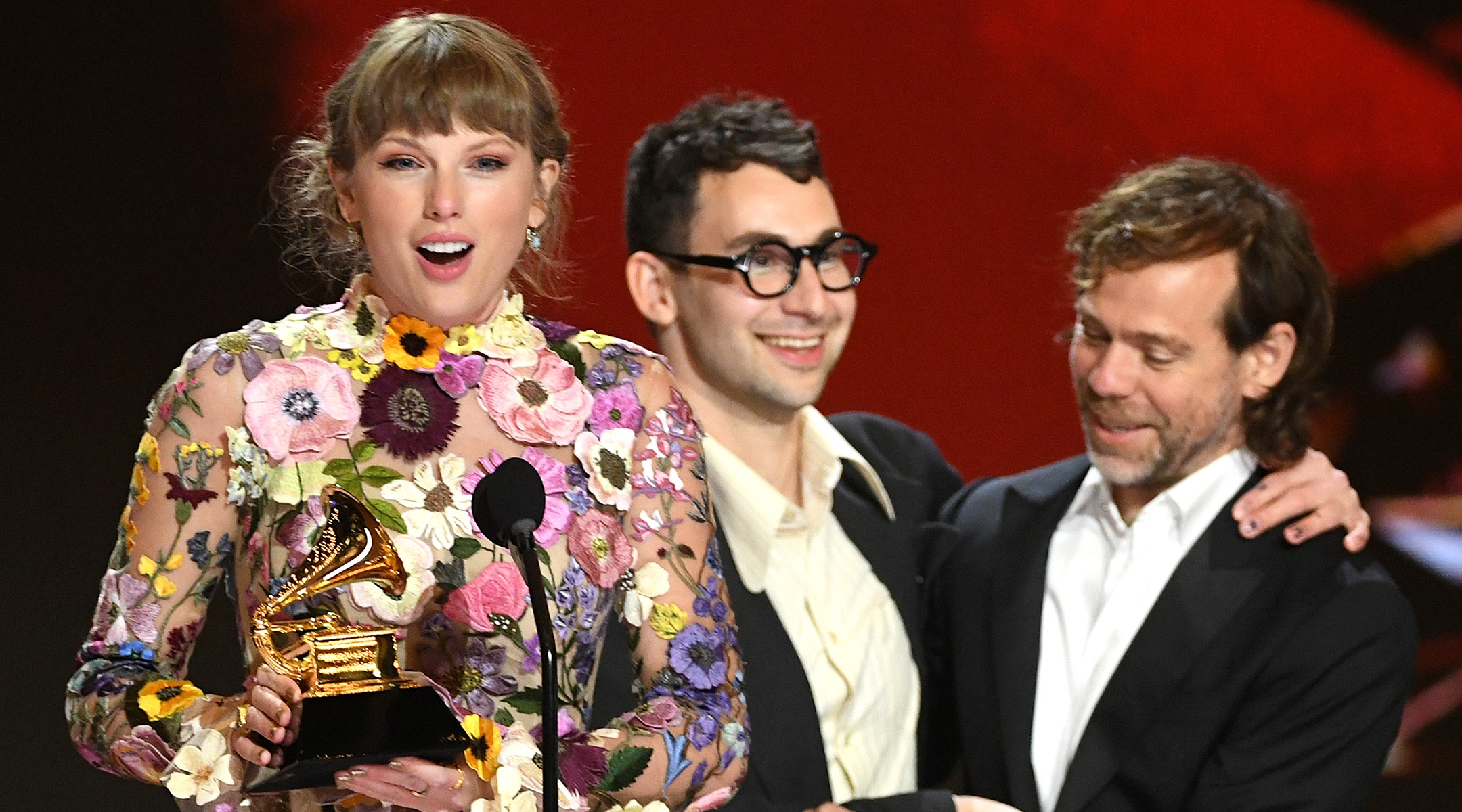
Jack Antonoff, the Jewish producer, joined Taylor Swift for her performance along with Jewish musician Aaron Dessner.

“We’ve only gotten to be together in the same room once, so this is really awesome to get to be together with them again,” Swift said of performing with Antonoff and Dessner. “We’re quarantining in the same house, we’re getting tested every day. It’s just really exciting, honestly, to play music with your collaborators. That’s something that I will never, ever take for granted again.”

The winners

taylor swift jack antonoff

Taylor Swift, Jack Antonoff and Aaron Dessner accept the Album of the Year award for “Folklore.” (Kevin Winter/Getty Images for The Recording Academy)

Though many Jewish artists were nominated — from Haim to Doja Cat — not many won. The notable Jewish winners were Antonoff and Dessner, who were key parts of Swift’s Album of the Year win for “Folklore.”

Ahead of the ceremony, comedian Tiffany Haddish won for best comedy album for her Netflix special “Black Mitzvah” released in December 2019. Haddish celebrated her bat mitzvah on the same day the Netflix special premiered.

Director, actor and writer Taika Waititi won the Grammy for best compilation soundtrack for visual media for his film “Jojo Rabbit,” much to his confusion.

“I guess they’re just giving Grammys to anyone now! I’ll take it, thank you,” the Jewish Māori filmmaker joked. “What can I say? It was so long ago, I can barely remember anything about making that movie — but it seems like it’s never going to go away, and I’m happy about that.”

Waititi was in a trailer on a movie set while he accepted the award — likely “Thor: Love and Thunder,” featuring Natalie Portman as Thor — and tweeted later that he was “happy” about the Grammy win.

Joanie Leeds, a singer-songwriter who frequently leads children’s Shabbat programming and has released albums of Jewish children’s music, won the Grammy for best children’s album for “All the Ladies,” which contains a musical ode to the late Jewish Supreme Court Justice Ruth Bader Ginsburg.

Finally, an orchestral adaptation of “The Diary of Anne Frank & Meditations On Rilke” narrated by Isabel Leonard and conducted by Michael Tilson Thomas for the San Francisco Symphony Orchestra won best classical compendium. Thomas produced the work back in 1990 with the help of Audrey Hepburn, who originally read Frank’s words in performance.

Looking ahead …

A new trailer for “In the Heights” that aired during the broadcast set the internet abuzz. With a screenplay by the Jewish Puerto Rican playwright Quiara Alegría Hudes, with music by Lin-Manuel Miranda, the musical is poised to become the film of the summer once theaters reopen.

The Jewish highlights of the 2021 Grammys Read More »

Is the US Signaling to Israel on Iran?

(The Media Line) A report accusing Israel of conducting covert maritime attacks on Iranian ships could be a signal from the Biden administration that it would like Israel to de-escalate tensions with its archnemesis.

An exclusive report by The Wall Street Journal made waves this week after it alleged that Israel had used water mines and other weapons to attack at least a dozen Iranian tankers that were smuggling oil and weapons to Syria.

Iran has continued to trade oil with Syria, in violation of US and international sanctions. Citing US and regional officials, the Wall Street Journal report said that since late 2019 Israel had been sabotaging Iranian ships in a bid to prevent them from generating hundreds of millions of dollars’ worth of sales for the Islamic regime. Israel believes this money would then be used to fund extremist groups in the region.

None of the ships that were targeted were sunk as a result of the attacks, which were carried out in international waters purportedly with the knowledge of the US; however, The Wall Street Journal said that at least two were delayed in making their oil deliveries to Syria.

[They were] trying to send a signal to Israel to stop doing these kinds of things while [they] are indirectly negotiating – maybe even directly – with Iran. The exposure was intended. … The administration doesn’t like that Israel is still continuing with its covert war with Iran.

Yossi Melman, an Israeli analyst specializing in security and intelligence affairs who also writes for Haaretz, believes that information about Israel’s clandestine maritime campaign was intentionally leaked to the press by the Biden administration.

“[They were] trying to send a signal to Israel to stop doing these kinds of things while [they] are indirectly negotiating – maybe even directly – with Iran,” Melman told The Media Line. “The exposure was intended. … The administration doesn’t like that Israel is still continuing with its covert war with Iran.”

US President Joe Biden’s administration has repeatedly stated that it would like to revive the 2015 nuclear deal, the Joint Comprehensive Plan of Action, but progress has been slow as both sides demand concessions from one another.

“It’s just a matter of who will blink first,” Melman said.

Israel has so far refused to comment on the Wall Street Journal report but senior Israeli security officials reportedly called on maritime tensions with Tehran to be de-escalated, according to Israel’s Walla news site. Tensions are particularly high in the Egyptian region of the Strait of Hormuz, which divides the Persian Gulf from the Gulf of Oman.

Israel has long carried out attacks against the Iranian regime via airstrikes in Syria as well as cyberattacks. The maritime front, taking place in the Red Sea and the Mediterranean, is an extension of that ongoing conflict, Melman noted.

Due to the widespread media coverage of the campaign, Israel will likely now pull back.

Israeli defense analyst Amir Oren echoed Melman’s statements, adding that the Wall Street Journal report is “very credible” and that the maritime campaign represents yet another front in the longstanding war between the two countries.

“What’s new is the visibility because both sides usually prefer to conduct it without much fanfare,” Oren told The Media Line.

“You haven’t seen anyone take credit either for that or for the attack on the [cargo] ship [in the Gulf of Oman],” he said, referring to the explosion that struck an Israeli-owned ship last month. Intelligence experts widely believe Tehran is behind the incident.

The London Times on Saturday reported that Israel’s clandestine maritime attacks caused at least one oil spill in the Red Sea in October 2019. It further suggested that the massive oil spill that hit Israeli and Lebanese coasts last month could be connected to these sabotage efforts.

Israeli politicians blamed a Libyan tanker carrying crude oil from Iran to Syria for the spill, which damaged some 170 kilometers (105 miles) out of 190 km (118 mi) of Israel’s beaches last month, according to the Israel Nature and Parks Authority.

Defense Minister Benny Gantz has dismissed speculation that Israel may have inadvertently caused the ecological disaster.

Neither Melman nor Oren believes that there is any connection to the two reports.

“There are many such tankers [in] the waters here and in the Red Sea,” Oren related. “It just so happens that this one was responsible for the leak, but this was not an Israeli act that went wrong.”

Melman agreed, noting that Iran relies on “lousy shipping vessels” to smuggle oil in order to evade detection. The poor quality of the ship is what led to the spill.

“It was accidental. I have no doubt about it,” he stressed.

Is the US Signaling to Israel on Iran? Read More »

I am a Finalist for NAEJ Book Critic Award!

Thank you to National Arts and Entertainment Journalism awards! I am honored to be a finalist for the NAEJ awards in the category of Book Critic!


NAEJ 2020: Category: BOOK CRITIC B5. Books

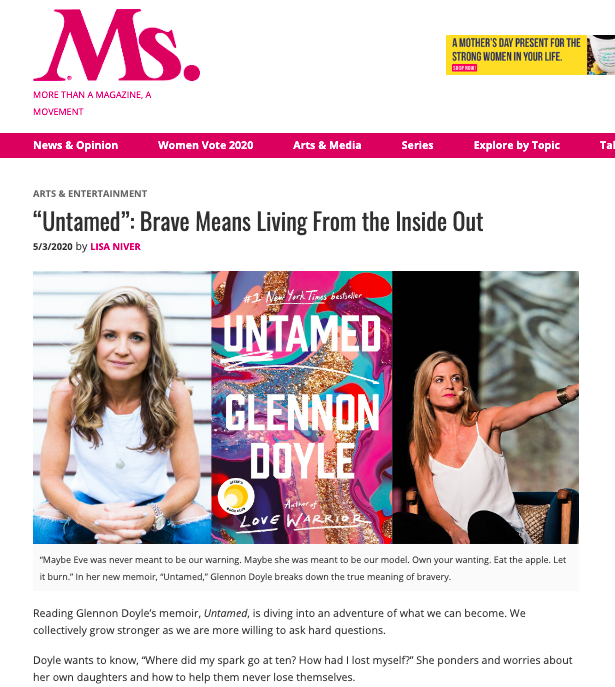
* Lisa Niver, Ms. Magazine and Wharton Magazine, “Untamed’: Brave Means Living from the Inside Out”

* Shawna Kenney, Rock the Bells, “Best Hip Hop Memoirs”

* David L. Ulin, Alta Journal, “’Joy Harjo’s Trail of Tears,’ ‘California Dreaming,’ ‘Blade Runner,’ ‘Torchbearer’”

Read all of my book reviews here!

Ms. Magazine: “Untamed”: Brave Means Living From the Inside Out

Book Review: Reading Glennon Doyle’s memoir, Untamed, is diving into an adventure of what we can become. We collectively grow stronger as we are more willing to ask hard questions. Many of us feel caged in our roles and Doyle asks us, “Will we be brave enough to unlock ourselves?” She tells us that “imagination is how personal and worldwide revolutions begin.” If we are looking for the easy way, we may miss our best lives. It might be terrifying to go after our dreams—but worth it.

Wharton Magazine: Treat Your Business Rival as Inspiration, Not Competition

Wharton Magazine by Lisa Niver about Simon Sinek

Ms. Magazine: 8 Books That Will Transport You

During COVID-19 #SafeAtHome, I shared eight books that have transported me out of quarantine and into the worlds carefully created by the authors including Alka Joshi’s The Henna Artist set in India, and Susana López Rubio’s The Price of Paradise which is set in Havana in 1947 and made me feel like I was back walking along el Malecón as well as: Wild, Eat Pray Love, The Lies That Bind, Between the Lines, An Unorthodox Match and Where’d You Go Bernadette. 

Ms. Magazine: Feminist Fiction Books to Curl Up With for the Holidays

Ms. Magazine: Eve Rodsky Wants Feminist Partners to Play Fair

Fair Play in Ms Magazine by Lisa Niver

Ms. Magazine: Lilly Singh’s Late-Night Milestone is Just Her Latest Bawse Move

Thank you to Los Angeles Press Club and National Arts and Entertainment Journalism Awards for the honor of being nominated. Please see this post for my past awards and nominations:

For all of my interviews, TV segments, videos, awards and articles, please see my portfolio site: LisaNiver.com

I am a Finalist for NAEJ Book Critic Award! Read More »

The Last Week: A Short Guide to Israel’s Coming Elections

Next Tuesday is rapidly coming, and with it, Israel’s fourth election in two years. Here are the five things to look at and remember as you prepare — anxiously or indifferently — for this crucial day of voting.

  1. Are there 61 seats for Netanyahu?

Forming an Israeli coalition is an exhausting exercise, but the basic rules are simple: 61 seats are needed for a coalition to form. Thus, the main thing all analysts and politicians will be looking for when the exit polls are publicized (next Tuesday at 10 pm Israel time) is whether Prime Minister Benjamin Netanyahu has the potential for a 61-seat coalition.

To have it, he will need Likud, Shas, United Torah Judaism, Religious Zionism and Yamina to have a combined 61 or more seats. If this happens, the prospects for Netanyahu to have a coalition are good. Another option for Netanyahu — although not as convenient — is for these parties to get close to 61 (say, 59) and for the Islamist party Raam to cross the electoral threshold. In such a case, Netanyahu could potentially form a minority government with Raam supporting it from the outside (in exchange for political goodies).

  1. What does Bennett want?

If Netanyahu has 61 seats, his main challenge will be luring Yamina into his coalition. The pressure on Yamina’s leader, Naftali Bennett, will grow, but the young(er) leader will not be an easy customer.

Bennett is sold on the idea that he is the kingmaker of this election. As the head of the only party that did not commit to a Netanyahu camp or to a never-Netanyahu camp, he can theoretically attempt to get the highest possible reward for his newfound power — becoming prime minister. Can he? The number of seats he is forecasted to have — maybe a little more than ten — suggests no. But seats are not a legal barrier to being the PM, so Bennett can say it is either PM or nothing.

But Netanyahu has already said no to Bennett becoming PM. So, Bennett’s dilemma could be as follows: go with Bibi as defense minister or maybe as a deputy PM, or go with his rivals and be the PM (That is, if they agree to let him be the PM. If they do not agree to such a proposition, his cards will suddenly seem less valuable). Most analysts agree that since Bennett believes the future to be on the right side of the political spectrum, he will probably go with Netanyahu after all.

  1. Who crosses the threshold?

The most important factor in the calculus of winners and losers next week is the electoral threshold of 3.25%. At least four parties are close to the threshold — leftist Meretz, centrist Blue and White, Islamist Raam and rightist Religious Zionism. The Labor party is also not far from the red zone. So, on the night of the election, we might be in a situation in which a number of parties are too close to call, with 15 to 25 seats on the line (out of 120). Even one of these parties can make the difference between victory and defeat.

The most important factor next week is the electoral threshold.

This situating is a fascinating test of political psychology. Voters must choose whether to go with their first choice — which could go underwater — or vote for a safer party. Put another way, Meretz voters who insist on Meretz could discover that because of them, Netanyahu kept his seat. And Religious Zionism voters could discover that because of them, Netanyahu lost his seat.

  1. What can the opposition do?

Those who do not want Netanyahu to keep his seat — representing a majority of Israeli voters but not necessarily of Knesset seats — must patiently wait for the numbers. If Netanyahu and Bennett can form a 61-member coalition, they can make Bennett an offer (being PM) and see what happens, but not much more than that. If Netanyahu and Bennett cannot form a 61-member coalition, they must still find a way to form a coalition from a variety of parties that aren’t a good fit. For example, Bennett would not sit with Meretz; Israel Beiteinu’s Avigdor Lieberman would not sit with Haredi parties; New Hope’s Gideon Saar would not sit with the Joint List.

Basically, according to current polls, there are two main options for a coalition without Netanyahu. One is a coalition based around Bennett, Lapid and Saar, with the addition of Blue and White, Israel Beiteinu and Labor. Another one is a coalition of Bennett and Saar, with the addition of the two Haredi parties and Lapid.

Why is the second coalition problematic? Because it is not at all clear that the Haredi parties will be willing to join (and ditch Likud and Netanyahu). Why is the first coalition problematic? Because both Bennett and Saar vowed to be a part of a right-tilting coalition, and in a coalition with Lapid, Lieberman, Gantz and Labor, such a claim would be unconvincing.

  1. So, what is the forecast?

It’s a very close call.

The electoral threshold makes it complicated, the relative exhaustion of the voters makes it complicated and coronavirus makes it complicated.

We don’t know. We must be patient.

The Last Week: A Short Guide to Israel’s Coming Elections Read More »

#Being Disabled Does Define Me

It may be emblematic of my age, but I really don’t understand the whole hashtag thing. I get that the purpose of the hashtag is to make an idea or opinion gain traction and go viral — that is, be seen by as many people as possible who identified with a word or phrase in the hashtag. It might also be a beacon to people who disagreed with the concept expressed in the hashtag but were nonetheless attracted to the post, if only to write something oppositional.

In other words, the hashtag is a conversation starter; it creates awareness and can unify a community.

Recently I read an article about a new Twitter hashtag started in November 2020. It was #beingdisableddoesdefineme. I started to respond to the article but was interrupted by my digital native college-age son.

“You must have gotten it wrong, Mom,” he said. “The hashtag must have read #beingdisableddoesnotdefineme.”

He wouldn’t read the article, but in an age where labeling people provokes — and in many cases, rightly so — righteous indignation, my son was ready to defend me against any perceived smirch on my persona. He’s a good boy. But he was wrong.

Being disabled does define me.

It’s not a bad thing. It is simply part of who I am. I have been blind for the last 28 years of my life and visually impaired for 28 years before that. I have also been — in no particular order of priority — a Jewish woman, a life coach, a Zionist, wife, mother, grandmother, aunt, friend, daughter, sister, disability advocate and community leader. My son accepts all these aspects of my identity as well as my blindness because that is all he has ever known. He doesn’t think of my disability any more than my being his mom, being Jewish or any other of my identities.

That’s a good thing, but his attitude made me want to explain all the more why I personally believe that being disabled unequivocally and unapologetically does define me.

As with most issues, human beings with opinions are going to come down on both sides. In the disabled community, the hashtag sparked controversy among those who felt that being defined by their disability was limiting, an insult, not a reflection of who they were.

There are others — and I include myself here — who think being defined as disabled is a good thing; it is not limiting, just descriptive.

It is not limiting, just descriptive.

This controversy is reminiscent of the “person first” language issue: Some people prefer to be referred to as a “person with a disability” (the noun comes first) rather than a “disabled person” (where the adjective comes first).

My English teacher friend tells me this is the very definition of an issue — there are two equally supportable sides, both having value and deserving of respect. Personally, I think it is a good thing to have many opinions expressed in the disabled community. Expression is empowering and helps us educate others. It is the respect angle that needs emphasis — everyone should get to decide his or her own identity and how they want to be addressed.

Sometimes, my blindness has simply served as an expedient way for me to identify myself. Recently, I contacted someone from my synagogue regarding something I possibly needed from her, and I wasn’t sure we knew each other. I could have said “you may know my sister…” or “you may know my dad,” but when I said “I am the blind woman,” it evoked instant recognition, and we were quickly able to get to the reason for my call.

Those who claim that the term “disability” is insulting because it implies limits, I think, must accept that there are some limitations on disabled people. I have been trying to think of the ways my blindness limits me in my daily life. Do I resist going out in the ice and snow because I am afraid I will fall? Yes, but not because I am blind — I resist because I am 63 years old, and I don’t want to break a bone. Do I rely on others to help me get places because I can’t drive? Yes, certainly.

But these aren’t limitations per se, just reasons for accommodation and modification. I can get places by having someone else drive me. I can read by utilizing my computer app. I still won’t walk on the snow and ice, even in expensive snow boots. There isn’t any accommodation or modification that would entice me to do that, but that’s just common sense, not blindness. In truth, there certainly are challenges I face, but it isn’t my blindness at all that limits me; it is the lack of accessibility that limits me; it is people’s attitudes and misconceptions that limit me, not my blindness.

Being blind defines me in the same way that being a Jewish woman or a mother and grandmother defines me. Why wouldn’t I want to embrace that? Frankly, for the first 28 years of my life, when I tried to deny my visual impairment and fake it in order to fit in, I was pretty miserable.

It was exhausting — this fear of being excluded, stigmatized and judged solely by misconceptions about blindness. When, at age 23, I was finally able to accept that my blindness was part of my identity, I was able to embrace that part of me, and it was so liberating! While blindness may be a disability, it is nonetheless just another intrinsic part of me. It goes along with my intelligence, my ability to empathize, my desire to help others, to give back, to be informed, to teach and to live as a responsible, contributing member of society.

It’s a package deal. Each of these pieces of me informs how I am in the world, what I read, how I act, how I think, how I vote, whom I choose to spend time with, whom I choose to avoid, what organizations I want to be involved with, what charities I support and every other choice that I make in living my life meaningfully. Each of these parts of me informed my decision to serve on the Keshet board, supporting the work they do to promote and advocate the inclusion of people with disabilities. Each part of me contributed to my decision to serve on boards of Jewish day schools and overnight camps in my community, and each part of me is why I am a board member of an organization that provides creative arts therapy.

Being disabled does define me in the same way that being resilient, assertive, empathetic and creative does. Being disabled isn’t my problem. It isn’t something broken that needs to or can be fixed. It is simply a part of me. To deny that would be like framing a completed puzzle but leaving a gaping hole for a lost piece.

I am a complete puzzle. I am the sum of all my parts. I am blind.

And so much more besides that.


Michelle Friedman is the vice chair of the board of Keshet in Chicago, a member of ADA 25Advancing Leadership and the Development chair of The Institute for Therapy Through the Arts.

#Being Disabled Does Define Me Read More »