fbpx

March 9, 2021

Israel’s Restaurant Industry Will Take ‘3 to 5 Years’ to Recover

(The Media Line) A taste of normalcy has returned to Israel following a year of on-and-off lockdowns and sweeping health restrictions.

With more than half of all Israelis having received at least one dose of the Pfizer-BioNTech vaccine, thousands of cafés and restaurants across the country reopened to diners for the first time since September.


It’s going to take a few years – our estimation is between three to five years – to get the industry back to what it was

While many cafés and restaurants welcomed eager patrons on Sunday, a leading industry expert has warned that it could take the sector years to fully recover from the COVID-19 pandemic.

“The restaurant industry is so important in Israel and plays such a big part of Israeli life and tourism so it’s just a shame,” Tomer Moore, CEO of the Restaurateurs Stronger Together Association, told The Media Line.

Tomer Moore, CEO of the Restaurateurs Stronger Together Association, March 7, 2021. (Raymond Crystal/The Media Line)

“It’s going to take a few years – our estimation is between three to five years – to get the industry back to what it was,” he said.

Nearly a third of Israel’s restaurants and cafés – 4,000 out of 14,000, to be precise – have not survived the economic hardships of the past year and will remain closed for good, Moore revealed. At the moment, 6,000 are open on a delivery or takeout basis. A further 2,000 eateries are planning to reopen only after the Passover holiday and the remaining 2,000 venues are offering partial dine-in service.

Israel is relying on COVID-19 passports – so-called green passes – to safely reopen much of its economy. The Health Ministry issues the passes only to those who are fully inoculated.

Under the new guidelines, green pass holders are allowed to sit indoors at restaurants and cafés as long as social distancing is maintained. Eating and drinking outside on terraces does not require proof of vaccination.

Patrons at a restaurant in Tel Aviv, Israel. March 7, 2021. (Raymond Crystal/The Media Line)

Since most of their staff was laid off at the start of the pandemic, restaurant owners are now struggling to find workers to fill the gap. Many, on paid government leave since the pandemic forced their workplace to close down, have decided not to go back to work for now. Government COVID-19 unemployment benefits are slated to run out at the end of June.

A lot of changes are in the pipeline for the food and hospitality industries, he added, in the form of an increased emphasis on self-service and simple grab-and-go menus.

The ever-changing restrictions and last-minute decision-making in the halls of government have also proven to be major obstacles for the industry’s recovery. Restaurant owners only received a full list of health guidelines a few hours ahead of Sunday’s nationwide reopening, for instance.

“Whoever thinks you can just snap your fingers and open a restaurant, well it doesn’t work that way,” Moore asserted. “I think the [government] kind of disrespected us.”

Aside from concerns that lockdown restrictions could be reimposed at a moment’s notice, some Israelis also remain uncomfortable with the new relaxed guidelines.

“I’d sit outside at a restaurant but it’s too soon to sit indoors,” a hospital worker named Ofir said to The Media Line.

In addition to bars and cafés, Tel Aviv, also known as the city that never sleeps, is working on resuscitating its famous nightlife.

Over the weekend the municipality hosted a series of open-air concerts at the newly renovated Bloomfield Stadium in Jaffa. Concertgoers were required to present their vaccine passports at the entrance and sit in allocated seats to ensure social distancing.

“We had two sold-out shows within 15 minutes,” Eytan Schwartz, spokesperson at the Tel Aviv-Yafo municipality, told The Media Line. “People are very eager to come and have a good time.”

Five hundred green pass holders were allowed into the 30,000-seat stadium on Sunday to watch 1980s Israeli pop icon Yardena Arazi perform. The small audience did not dampen the mood, however, as concertgoers stood up and danced to many of Arazi’s nostalgic hits.

Israeli pop icon Yardena Arazi performs in Jaffa, Israel in front of a fully inoculated audience, March 7, 2021. (Raymond Crystal/The Media Line)

“We were locked indoors and didn’t go almost anywhere,” a concertgoer named Vered told The Media Line. “Today we had the opportunity to go to a show and I’m so happy. It’s refreshing to see other people.”

Israel’s Restaurant Industry Will Take ‘3 to 5 Years’ to Recover Read More »

Israeli Eye Doctors Help Wounded Azerbaijani Soldiers

Israel and Azerbaijan are two allies in regions overwhelmed by conflict and violence, and we share in many things and weather similar storms. We are long-term partners in trade and security, allies in our shared fight against extremism, and we share values of tolerance, progress and respect for the preciousness of every human life. And in recent weeks, we have shared medical miracles, as a team of volunteer surgeons from Israel were in Baku, performing complex eye surgeries and treatments on Azerbaijani soldiers, home and badly injured from the recent war in Karabakh

The team of Israeli medical specialists, headed by Dr. Yishay Falick, CEO of Jerusalem’s Misgav Ladach Hospital, treated over 150 Azerbaijani veterans, mostly operating in the field of oculoplasty (plastic surgery for the eyes and adjacent parts) and carrying out procedures such as eye socket restoration, eyelid surgery, prosthetic eyes (at least 25 of them) and more. This humanitarian mission of Israeli volunteer doctors, including leading ophthalmologists and neurologists, was organized at the initiative of the Azerbaijani organization YASHAT, which was recently established to help the disabled war veterans as well as the families of soldiers killed in battle. The mission was supported by Azerbaijan’s renowned Zarifa Aliyeva National Ophthalmological Center and the Israeli Embassy in Baku. The delegation was supported in Israel by, among others, Health Minister Yuli Edelstein and Minister of Foreign Affairs Gabi Ashkenazi.

The Israeli doctors joined the mission on a completely voluntary basis, closing their private clinics in order to participate in this important medical humanitarian operation. 

“The young soldiers we met sustained terrible injuries – most were unable to leave the house due to facial deformities,” said Dr. Falick. According to Baltimore Jewish Life, the doctors also adjusted the prostheses to restore the soldiers’ faces, allowing them to return to a more normal routine, even in cases where it was impossible to restore their sight. In a number of cases, the doctors were able to restore sight to the injured soldiers. One notable case was that of soldier Arif Hajiyev, who lost his sight when he was wounded by an exploding shell that left him able to distinguish only between light and darkness. The surgery, which lasted several hours, included the removal of traumatic cataracts, insertion of an intraocular lens and transplant of a corneal, donated by an Israeli woman belonging to her late husband. After several days in recovery, Arif regained his ability to read. His father tweeted: “Thanks to the talented doctors during the operation they performed, my son Arif Hajiyev regained full vision.” 

Another soldier, who got an eye prosthesis, tweeted his picture with the words “My new eye has arrived”.

The Israeli team was quite impressed by Zarifa Aliyeva National Ophthalmological Center, where all surgeries and treatments were performed, and Dr. Falick described it as the largest eye center he had ever seen, with state-of-the-art equipment.  In an interview with Israeli I24 News television station, Dr. Falick shared why this medical mission is particularly special to him: “In Azerbaijan, we feel at home, we feel like a family. Everybody is warmhearted to Israel and Jews. They don’t have prejudices. There is mutual love.” 

Hikmet Hajiyev, assistant on foreign policy to Azerbaijan’s President, tweeted: “We are thankful to Israeli medical team and Embassy of Israel for providing health support in ophthalmology for our wounded soldiers/officers. It is also a sign of friendship between our countries. “Whoever saves one life, saves the world””

And Israel’s Ambassador to Azerbaijan, George Deek said: “This is the spirit of the friendship between Israel and Azerbaijan. We want to help these people to restore their health, their self-confidence, and their ability to go back and live a good, normal, and decent life in their homeland, Azerbaijan.”

As a survivor of war, I know the tragic pain that comes with enduring injuries. And I know very well what it means to begin to heal, especially when the healing is administered by the best and most caring doctors available. So it is only fitting that our injured soldiers should be healed by such a force of love as the delegation of Israeli doctors. It is a force of love that permeates between our two nations, one that is built on a deep intimacy, of shared hope and the courage that our nations are blessed with, to stand up against what is violent and join together to bring good into the world, despite the challenges and the odds.

Israeli Eye Doctors Help Wounded Azerbaijani Soldiers Read More »

Jewish LA Entrepreneurs of D’vash Organics Partner with World’s Largest Date Producers in Dubai

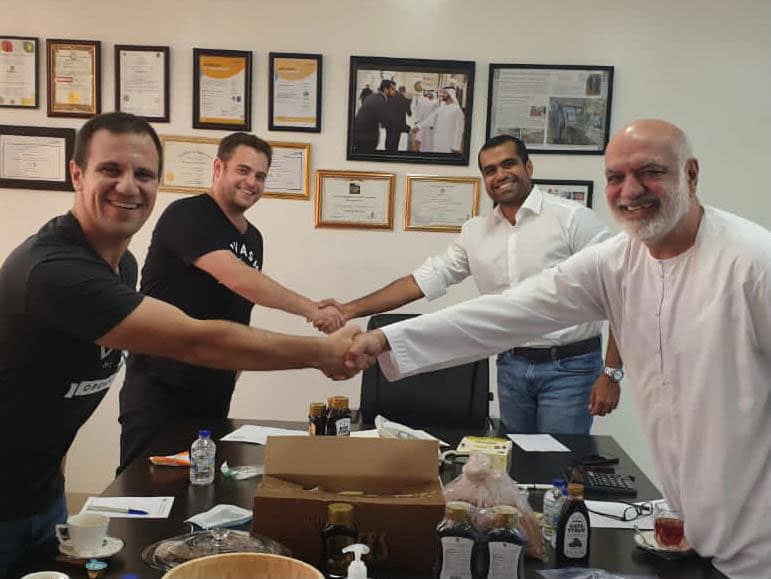
For Los Angeles businessmen Brian Finkel and David Czinn, dates are not just delicious and nutritious fruit. They are a source of spiritual connection and forming international relationships.

It’s also why they went into the date syrup business in 2013. Now, their California-based company, D’vash Organics, produces a wide variety of vegan date syrups sold in more than 5,000 stores nationwide including Costco, Whole Foods, Walmart, Sprouts, Safeway, Amazon and Meijer, to name a few. They are also taking their business to the next level by partnering with the world’s largest date manufacturer, Al Barakah Dates Factory, located in Dubai. This UAE deal is historic for the entrepreneurs to produce the world’s first date-based super brand.

“We couldn’t be more excited to partner with Al Barakah. This partnership will give us the necessary tools to create a wide range of products from syrups to snacks,” Finkel who is CEO said.

The new partnership will allow D’vash to grow their business via retail, wholesale and e-commerce, both throughout the U.S. and internationally. Their two-day meetings involved discussions on the similarities between Arabic and Hebrew, Jewish and Islamic theology, and Kosher and Halal dietary restrictions.

“The sense of genuine warmth, mutual respect, and trust was palpable throughout our negotiations,” Czinn, president of D’vash Organics, said. “Both sides [were] eager to emphasize our commonalities rather than our differences to bring the best quality date products to consumers worldwide.”


View this post on Instagram


A post shared by Date Nectar + Syrup (@dvashorganics)

Finkel and Czinn met in 2005 while studying abroad in Israel, where they developed the idea for D’vash Organics. Czinn, who lives in Pico Robertson, and Finkel said in a joint statement that Al Barakah is not only the largest manufacturer of date products in the world, they are also an end-to-end manufacturing solution.

Under the terms of the new deal, D’vash Organics can now make a wide range of products under the D’vash brand name at the Al Barakah facility. It will enable them to scale to new markets, massively expand the product line and offer the most competitive pricing in the world.

Since date sweetener can be used in a wide variety of recipes, has 25 percent less sugar than honey and is 100 percent vegan (compared to honey which is made from bees), their syrup is more inclusive for everyone in the kitchen or with a dietary restriction.


View this post on Instagram


A post shared by Date Nectar + Syrup (@dvashorganics)

“People today are becoming increasingly conscious about the food they consume,” they said in a joint statement. “The fact that our products are not only vegan but also paleo-friendly, non-GMO, kosher-certified and low-glycemic means that we are able to include a wide variety of consumers in our customer base.”

Czinn currently resides in Israel and said that the company’s Jewish and Israeli roots were no barrier to closing a deal with their new Muslim partners. Al Barakah didn’t know they were Jewish or their connection to Israel for the first two-and-a-half years they worked with them. The company reached out to the D’vash team about forming a partnership the week that the Abraham Accords were announced. The team said they met the managing director for dinner at a kosher restaurant in the Burj Khalifa, when the news broke of the company’s connection to Israel. When they went to the Al Barakah factory a few days later to negotiate a deal, Finkel and Czinn said they were warmly received.

“The recent peace agreement between Israel and the UAE, which enabled me to take a direct, three-hour flight from Tel Aviv to Dubai for these meetings, certainly played a role in making conversations like these possible,” Finkel said. “We hope that this deal will be our small contribution toward building a prosperous and peaceful future for the Middle East and the entire world.”

Jewish LA Entrepreneurs of D’vash Organics Partner with World’s Largest Date Producers in Dubai Read More »

Will Eco-Terrorism Become the New Threat to Israel?

Two weeks ago, a massive oil spill resulted in one of the worst ecological disasters in Israel’s history, spewing tar over 100 miles of shoreline (over 40% of Israel’s Mediterranean coast) and decimating sea life. The incident revealed the brutal reality of Israel’s maritime vulnerability as well as its ongoing public diplomacy challenges.

A Soft Underbelly in the Water?

Israel claims the spill was caused by a Libyan oil tanker (the Emerald), which was carrying pirated crude oil from Iran to Syria. The vessel left Iran, first sailing through the Persian Gulf and Red Sea. Before it passed through the Suez Canal, it switched its automatic identification system — a ship tracking system — on, then turned the tracking system off again just before entering the eastern Mediterranean (Israeli waters). Israel alleges the tanker dropped oil into the sea Feb. 1 or 2, resulting in nearly 1,000 tons of tar spewed since then.

Initially, Environmental Protection Minister Gila Gamliel blamed Iran for the disaster, calling it “environmental terrorism,” but Israeli intelligence sources were unable to verify the claim that Iran deliberately caused the oil spill and are currently investigating the incident.

During an interview about the oil spill on Israel’s Channel 12 news, Gamliel said, “There are people who do not look at the risks properly” (a jab at opposition leader Yair Lapid). She then added, “Only Netanyahu knows how to deal with the Iranian threat properly.”

Senior security officials immediately disputed Gamliel’s claim. Israel’s Channel 13 said it was “striking” that neither Israel intelligence nor its security apparatus were involved in forming Gamliel’s assertion.

“It doesn’t matter if it was deliberate or not,” David Yahalomi, director-general of Israel’s Environmental Protection Ministry, told the Israeli Broadcasting Corporation, Kan. “An enemy state that transfers 45 million oil barrels illegally and improperly through Israel’s economic waters is harmful.”

Yahalomi is right, and he makes a terrifying point: This incident was a test run for Iran. If it wants to, Iran can potentially cause a deliberate oil spill in Israeli waters, eluding responsibility while Israel investigates the matter (and watching as the blame falls along partisan lines in Israel). And if Iran decides to unload oil from an entire tanker, it could destroy most of Israel’s Mediterranean coastline.

Imagine that: The famous seaside port cafes of Jaffa, surrounded by tar (forget even eating the fresh fish on the menu), thousands of dead birds washing up on a blackened Tel Aviv beach that was once colored by young Israeli men and women playing matkot (padel ball) and even some of Lebanon’s beaches and sea life destroyed indefinitely due to its proximity with Israel. (By the way, Lebanon, whose Hezbollah party is also bankrolled by Iran, blamed Israel for the oil spill.) That’s why Yahalomi called the situation a “ticking bomb.”

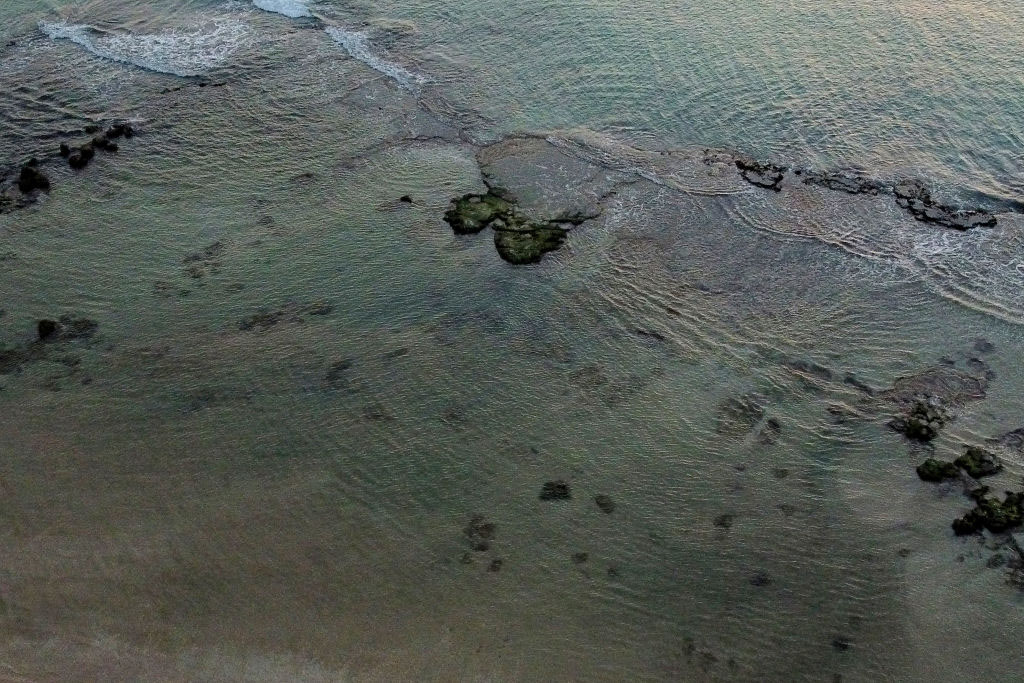
An aerial view over Israel’s coast line after an oil spill on February 22, 2021 in Hadera, Israel. (Photo by Amir Levy/Getty Images)

That also explains why Shaul Chorev, Rear Admiral (Ret.) in the Israeli Navy told The New York Times, “In Israel, we have maritime domain blindness.” Chorev, who heads the Maritime Policy and Strategy Research Center at the University of Haifa, added, “Our activities are always focused on foiling terrorists activities, but that’s not the whole picture of security in the sea.”

Chorev’s right, particularly in light of the fact that Israel’s seemingly soft maritime underbelly has been hit twice in the past few weeks: Kayhan, Iran’s leading hardliner newspaper, reported that Iran had attacked an Israeli ship off the coast of Oman last week, although it’s not clear if the explosion was caused by mines or missiles. The vessel arrived in Dubai this week, where an Israeli delegation will assess the damage (all thanks to peaceful relations between the United Arab Emirates and Israel as part of the Abraham Accords).

Silence from the Hard Left

We don’t know if Iran deliberately orchestrated the oil spill. We do know, however, that the vessel was smuggling crude oil from Iran to Syria. That, alone, should have sounded the alarm across both aisles of the American political spectrum. Iran continues to support Syrian President Bashar al-Assad, whose regime is responsible for over 400,000 Syrian deaths since 2011 (with over 5 million refugees and 6 million people displaced internally, according to the United Nations). In fact, Iran has spent between $20-$30 billion to prop up Assad and has issued a credit line to Syrian that never runs dry.

Last month, in his first military action as president, Joe Biden ordered airstrikes against Iran-backed militias in Syria as retaliation for February rocket attacks against U.S. personnel in Iraq. Left-wing leaders, including Rep. Ilhan Omar (D-MN) and Sen. Bernie Sanders (I-VT) were quick to criticize Biden, citing concerns that Biden acted without congressional approval. In a Feb. 26 statement, Sanders claimed, “I am very concerned by last night’s strike by U.S. forces in Syria…The president has the responsibility to keep Americans safe, but for too long administrations of both parties have interpreted their authorities in an extremely expansive way to continue war. This must end.”

Opponents of the air strikes also cited concerns over civilian casualties. That’s interesting, given their frequent silence in regard to Iran’s blatant support for the Syrian regime. Wouldn’t anyone who’s invested in stopping the Assad regime and bringing an end to the Syrian civil war be horrified that Iran was, more or less, caught red-handed smuggling crude oil to Syria last month? Such malicious (and frequent) acts empower both Iran and Syria. And yet, nary a peep was heard from many leaders on the left who seem to want nothing more than an end to the Syrian civil war.

For two weeks, I was waiting for an American leader from the far left to express outrage over the devastation to the environment and sea life as a result of the oil spill. I’m still waiting.

How could it be that seemingly no one said a word about all of the dead and injured sea creatures that washed ashore in Israel? On Feb. 19, a dead baby whale washed ashore on a beach in Ashdod, south of Tel Aviv. Veterinarians found black liquid inside the 55-foot-long fin whale’s lungs. The Parks Authority has yet to confirm the cause of death, although it suspects tar pollution. I was shocked that the American left, decades-long champions for environmental protection, was silent. The only expression of outrage came from the Israeli chapter of Greenpeace, and it was directed at…Israel.

How could it be that seemingly no one said a word about all of the dead and injured sea creatures that washed ashore in Israel?

Greenpeace called Gamliel’s claim of environmental terrorism “outrageous and factually baseless at this stage” because Gamliel was “minimizing the well-known and widespread phenomenon of marine pollution by ship oil spills.” Greenpeace added, “The minister’s conduct on the matter smells of electioneering and an attempt to score political points over an ecological disaster.”

Whether or not Iran was behind the oil spill, Israel has learned a valuable lesson from this incident: It’s possible that long ago, Israel lost the sympathy of the left over dead Jews who were targeted by Iran-backed terrorist groups like Hamas and Hezbollah. Now, Israel can’t even seem to garner sympathy from the left over dead sea life. If you’re a sea turtle on Israel’s side of the Mediterranean, you’re apparently also complicit in supporting the illegal Zionist regime.

Greenpeace’s reaction slammed Israel rather than Iran or Syria. But its claims, however harsh-sounding, signaled a reality with regard to messaging during an Israeli election. It’s also not far-fetched to wonder whether Gamliel’s claim was nothing more than quick finger-pointing during an Israeli election season in which Iran has never been more emboldened or menacing.

I don’t know if Iran deliberately caused the oil spill in order to pollute Israeli waters. I’ll leave that to Israeli intelligence. I am nearly certain, however, that Iran was trying to smuggle pirated cargo into Syria using a Libyan oil tanker. For Iran, that’s called a Thursday.

In the Middle East, it’s sometimes excruciatingly hard to point a definite finger at an enemy with dozens of proxies who are only too happy (and well-paid) to carry out its malicious attacks. But here’s the thing about oil spills when they involve states like Iran and Syria: Whether such incidents are deliberate or accidental, sooner or later, those sticky fingers leave enough dirty, traceable marks to offer an irrefutable sea of evidence.


Tabby Refael is a Los Angeles-based writer, speaker and activist. Follow her on Twitter @RefaelTabby

Will Eco-Terrorism Become the New Threat to Israel? Read More »

Roger Waters Calls on Stevie Wonder Not to Accept Israeli Award

Former Pink Floyd bassist Roger Waters released a video on March 9 calling on musician Stevie Wonder to refuse an award from Israel. The award, known as the Wolf Prize, is given to those who have made outstanding contributions to the arts and sciences. Israeli President Reuven Rivlin announced on February 9 that Wonder and Australian composer Olga Neuworth would be receiving the award.

Waters pointed out in his video that Wonder canceled a 2013 scheduled performance at a fundraising gala for the Friends of Israel Defense Forces (FIDF) and that he expects Wonder to do the same with the award. Wonder said at the time he was canceling because of the “very delicate situation in the Middle East”; groups like the U.S. Campaign to End the Israeli Occupation (known today as the U.S. Campaign for Palestinian rights) had been urging Wonder to cancel at the time.

“This is an apartheid regime,” Water said. “This is Israel. You will be whitewashing them beyond all belief.” He then acknowledged that he “wasn’t making much sense” and “rambling” after having nearly a full glass of wine.

Jewish and pro-Israel activists denounced Waters. “Where is Roger’s condemnation of Muslims being tortured in modern day camps in China? The famine happening in Yemen?” Liora Rez, director of Stop Antisemitism.org, said in a statement to the Journal. “This man’s obsessive condemnations are reserved only for Jews. Waters is an embarrassment to the entertainment community and for anyone to take him seriously in 2021 is laughable.”

Israellycool blogger David Lange quipped that Waters is “doing what he seems to loves [sic] most. Spreading lies against #Israel — and drinking alcohol.”

Waters has come under fire for calling the late philanthropist Sheldon Adelson the “puppet master” over his ties to the Trump administration in June 2020 — which he issued an apology over — as well as for putting a Star of David on an inflatable pig in 2013. Waters also supports the Boycott, Divestment and Sanctions (BDS) movement.

David Draiman, lead singer of the heavy metal band Disturbed, has called the 2013 incident “blatantly anti-Semitic” and has criticized Waters’ support of BDS. “The very notion that Waters and the rest of his Nazi comrades decide that this is the way to go ahead and foster change is absolute lunacy and idiocy,” Draiman told a Disturbed Facebook fan page in May 2019. “It makes no sense whatsoever. It’s only based on hatred of a culture and of a people in a society that has been demonized unjustifiably since the beginning of time.”

Waters has previously defended himself from accusations of anti-Semitism by stating that his daughter-in-law is Jewish, making his grandchildren Jewish by default. He also claimed that he has used various other symbols — including a dollar sign and a hammer and sickle — on his inflatable pigs.

Roger Waters Calls on Stevie Wonder Not to Accept Israeli Award Read More »

From Durban to The Hague: 20 Years of NGO Lawfare

The announcement by the prosecutor of the International Criminal Court (ICC) that she was opening investigations against Israel for alleged war crimes should not have been a surprise. This was the culmination of a twenty-year political campaign that began even before the ICC opened its doors in The Hague in 2002. Leaders of this effort have long prepared to use the ICC and the façade of international law to extend the soft-power targeting of Israel.

The strategy was launched during the NGO Forum of the 2001 UN Durban conference, in which 5000 delegates condemned the “Israeli systematic perpetration of racist crimes, including war crimes, acts of genocide and ethnic cleansing.” Reviving the language of the odious 1975 UN resolution that labeled Zionism as racism, the forum’s final declaration made numerous references to an entirely invented version of international law, such as a Palestinian “right of resistance” (often manifesting as terror), mixed with the language of the Rome Statute that is the foundational document of the International Criminal Court.

At the time, the Israeli government did not take this threat seriously. The powerful NGOs that played central roles in Durban were not on the Israeli Foreign Ministry’s radar. The ICC was still a vague framework, and Israel, like the United States, Russia and China, was not a member. In addition, the Palestinian Authority was not a state and, according to the Rome Statute, did not have standing to initiate a complaint.

But this network of NGOs, in cooperation with the Palestinian leadership, pursued an ICC investigation — known as lawfare — with great intensity, spending tens of millions of Euros, Pounds and Krona. Human Rights Watch played a central role from the beginning, joined by Amnesty International, numerous Palestinian NGOs with ties to the PLO and PFLP terrorist groups and a number of Israeli groups claiming to promote human rights.

European governments provided much of the NGO funding for this campaign. Four Palestinian organizations — Al-Haq, Al-Dameer, PCHR and Al-Mezan — received millions in direct funding from Switzerland, Holland, Sweden and Demark to compile allegations of Israeli violations of international law to present to the ICC. Other Palestinian and Israeli NGOs are funded for similar projects related to “support for international law” by the Netherlands, Germany, the European Union (EU), Ireland and others. (The EU, the UN and the Canadian government were also the main funders of the Durban NGO Forum.) While European officials issued statements opposing the politicization of the ICC for anti-Israel lawfare, they continued to fund the NGO leaders of this process.

It was only after the UN Human Rights Council’s 2009 Goldstone Report on Gaza repeated the NGO’s accusations and threatened a referral to the ICC that the Israeli government began paying attention to this campaign. Israel’s Foreign and Defense Ministries published rebuttals of the accusations mentioned in the report. In parallel, Goldstone was confronted with the unsubstantiated claims and inconsistencies that characterized his report. (He later acknowledged these failures, but the damage was done, and the campaign gained momentum and visibility.)

Supported by the NGO network, Palestinians gained UN General Assembly approval for calling themselves a state in 2014, despite the absence of the necessary criteria (such as a government in total control of a defined territory) and immediately used this dubious achievement to join the ICC and file complaints against Israel. In 2015, ICC prosecutor Fatou Bensouda announced that she would consider jurisdiction. The Israeli government focused on convincing her to reject the Palestinian claims to statehood and on highlighting the integrity of Israel’s legal system. In theory, this should have prevented ICC involvement according to the Rome Statute, which states that ICC is only authorized to intervene (or “complement”) national courts in situations in which the states involved lack the ability to bring suspected war criminals to trial.

In practice, Israel’s claims were insufficient in the face of the powerful political forces promoting the lawfare strategy. In December 2019, Bensouda claimed jurisdiction and “a reasonable basis” for investigating possible Israeli war crimes, and in February 2021, after two of the three judges who reviewed her claims declared their approval, she moved quickly to open a formal investigation.

Israel’s claims were insufficient in the face of the powerful political forces promoting the lawfare strategy.

Major damage in the form of demonization of Israel has already been done, but if enough counter-pressure can be applied, including by negating the power and resources of the NGOs behind this process, the ICC travesty might be stopped. The current prosecutor is finishing her term, and her successor, Karim Khan, from the United Kingdom, might be persuaded to halt the pseudo-investigations, particularly if the survival of the ICC is at stake.

In parallel, European funders of the campaign must be confronted directly and consistently. Anyone who is concerned about the abuse of the ICC for political campaigns, including Americans and Israelis, should demand to end the demonization under the façade of human rights and international law. Germany, for instance, is one of the main funders of the ICC and the largest single supporter of the NGOs leading the campaigns. The absurdity of German funding for anti-Israel NGOs has not yet received the necessary priority.

September 2021 will mark the twentieth anniversary of the UN’s anti-Semitic Durban conference and the NGO Forum, where both ICC lawfare and the BDS campaigns against Israel were launched. The best way to mark this date is to ensure that the perpetrators and their allies have nothing to celebrate.


Gerald M. Steinberg is emeritus professor of political science at Bar Ilan University in Israel, and heads the Institute for NGO Research in Jerusalem. 

From Durban to The Hague: 20 Years of NGO Lawfare Read More »

The Conditions Abbas Must Meet

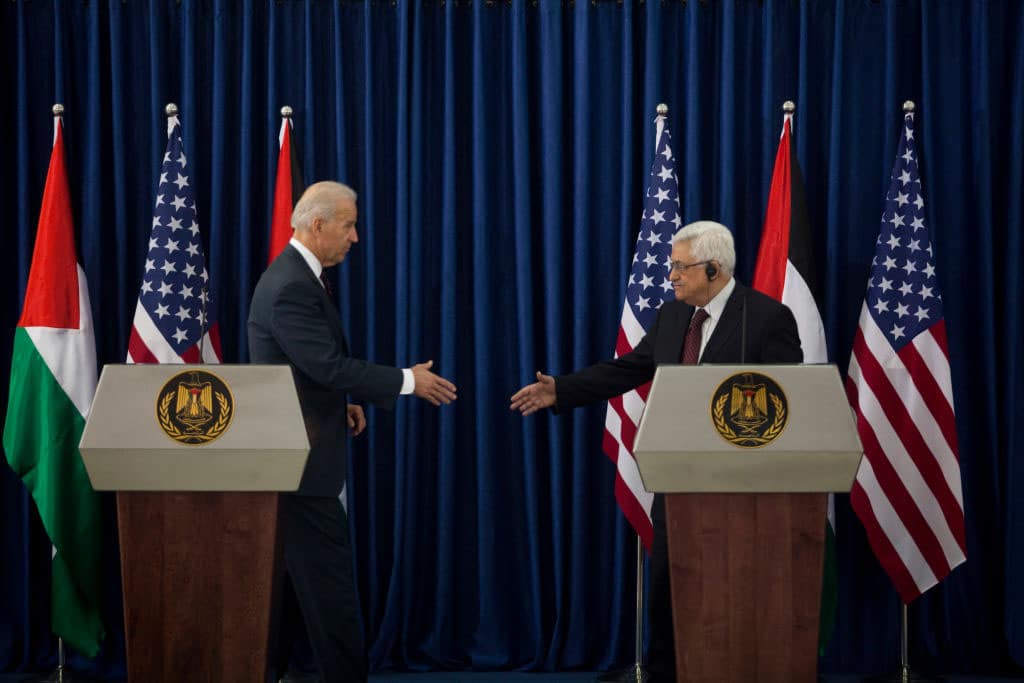
Biden administration officials have indicated that in the near future, they intend to restore some aspects of the U.S. relationship with the Palestinian Authority (PA) that the previous administration suspended. The PA is anxious for a resumption of American financial and diplomatic support. But what should Palestinian leader Mahmoud Abbas be required to do in order to merit a renewal of relations?

Although I represent a right-of-center Zionist organization, Herut North America, I don’t agree with those on the right who say that Abbas should be required to make a new commitment or gesture in order to resume relations with the United States. I think Abbas should merely be required to honor the commitments and promises he has already made in the 1993-1995 Oslo Accords. Is that really so much to ask?

Middle East policy experts constantly say there is not enough trust between Israel and the PA. They’re right. The reason most Israelis — and also most American Jews — have so little trust in the PA is because Yasser Arafat, chairman of the PA from 1994 until his death in 2004, and his deputy, Abbas, made a series of written promises in the Oslo Agreements of 1993-1995.

The American government invested its energy, prestige and substantial amounts of taxpayer money in the Oslo Accords. Among other things, the United States rewarded the Palestinian Authority with $500 million in annual aid. That came to a total of more than $1 billion before the Trump administration ended it.

Naturally, when the United States makes that kind of contribution to a peace agreement, the least it can expect is that the two sides will adhere to the terms. Israel’s major obligation was to remove its troops from the areas where 98% of the Palestinian Arabs live. It did that in 1995. And Israel was required to permit the Palestinian Arabs to create their own regime to govern their own lives. Israel did that, too.

But we’re still waiting for the PA to keep its promises. In the Oslo Accords, the PA agreed to “outlaw all organizations (or wings of organizations, as appropriate) of military, terrorist or violent character.” Yet Abbas has never outlawed PLO factions such as Fatah and the Popular Front for the Liberation of Palestine (PFLP), which still have ties to terrorism. He hasn’t even expelled them from the PLO, which he chairs.  

We’re still waiting for the PA to keep its promises.

The PA also agreed to “abstain from incitement, including hostile propaganda” against Israel. Obviously, Abbas hasn’t done that. The PA’s government-run media and government-run schools are filled with anti-Jewish and anti-Israel hate.

They agreed that if Israel requests the extradition (“transfer”) of a terrorist, then the PA “shall effect the arrest and transfer requested.” Israel has submitted dozens of such requests and the PA hasn’t honored any of them.

These are not the only obligations the PA undertook, but they are among the most important ones. They are important because they would demonstrate that the Palestinian leadership has really changed — that they sincerely want to live in peace with Israel. And wasn’t that the whole point of the Oslo Accords?

There’s no point in the United States trying to broker a new agreement until the PA has demonstrated that it is honoring the original agreement. A new agreement would be completely meaningless and unreliable unless the original commitments have been kept. That’s what the United States should require Abbas to do. No new concessions, no gestures, just keep the existing promises. I don’t think that’s too much to ask.


Moshe Phillips is national director of Herut North America’s U.S. division; Herut is an international movement for Zionist pride and education. Herut’s website is www.herutna.org

The Conditions Abbas Must Meet Read More »