fbpx

January 23, 2021

On the Same Day He Preached Unity, Biden Went the Other Way

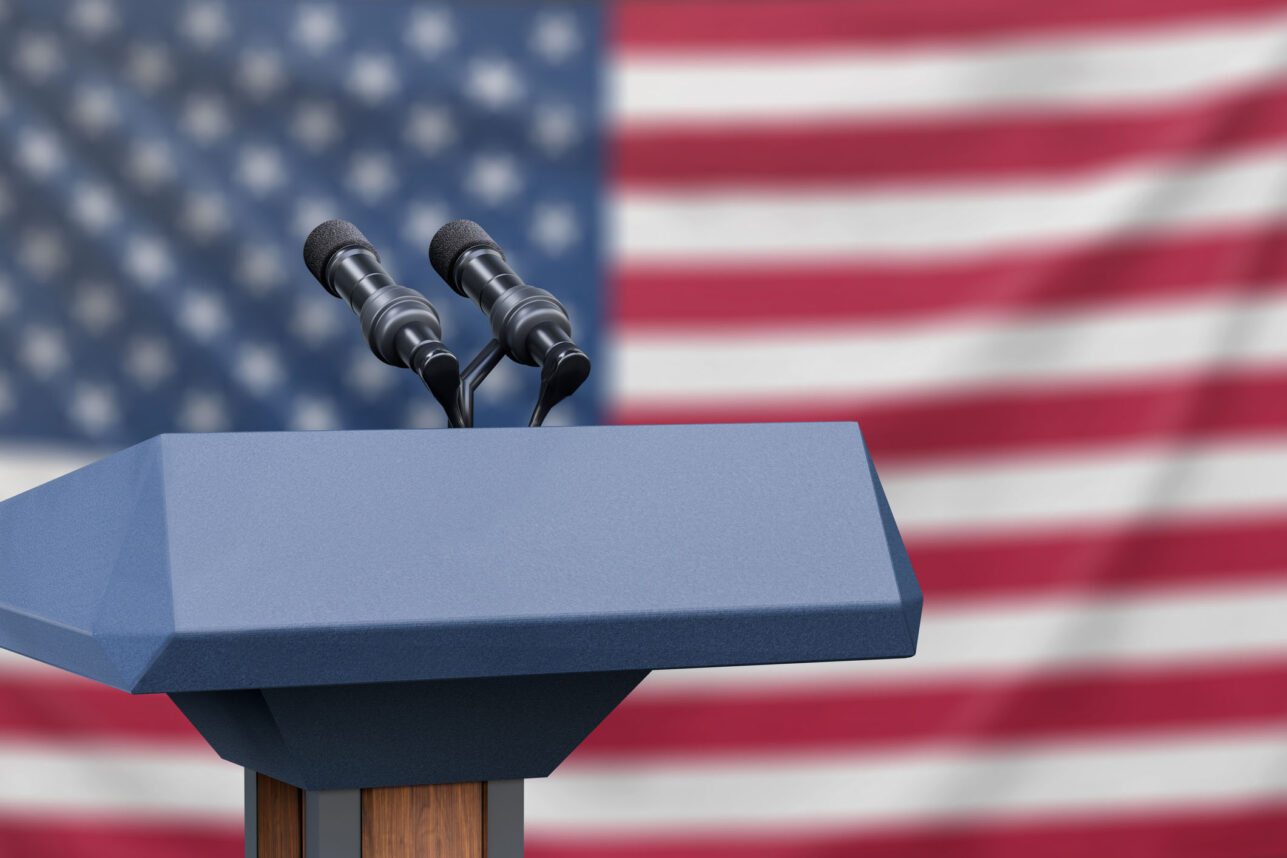
In front of a broken nation, President Joe Biden committed to being a healing force. His inaugural address on January 20 will go down as one of our country’s great tributes to the value of national unity.

“This is America’s day,” the president declared. “On this hallowed ground…we come together as one nation…the American story depends not on any one of us, not on some of us, but on all of us. On ‘We the People’ who seek a more perfect Union.”

The president recognized the immense task before him: “I know speaking of unity can sound to some like a foolish fantasy. I know the forces that divide us are deep and they are real.”

And yet, he pledged that “I will be a President for all Americans. I will fight as hard for those who did not support me as for those who did.”

His courage was inspirational: “We must end this uncivil war that pits red against blue, rural versus urban, conservative versus liberal. We can do this if we open our souls instead of hardening our hearts. If we show a little tolerance and humility.

“If we’re willing to stand in the other person’s shoes just for a moment.”

A few moments after uttering those poignant words, the president walked into the Oval Office and ignored the feelings of half of the country, or, as The New York Times reported, “began demolishing [Trump’s] legacy at breakneck speed.”

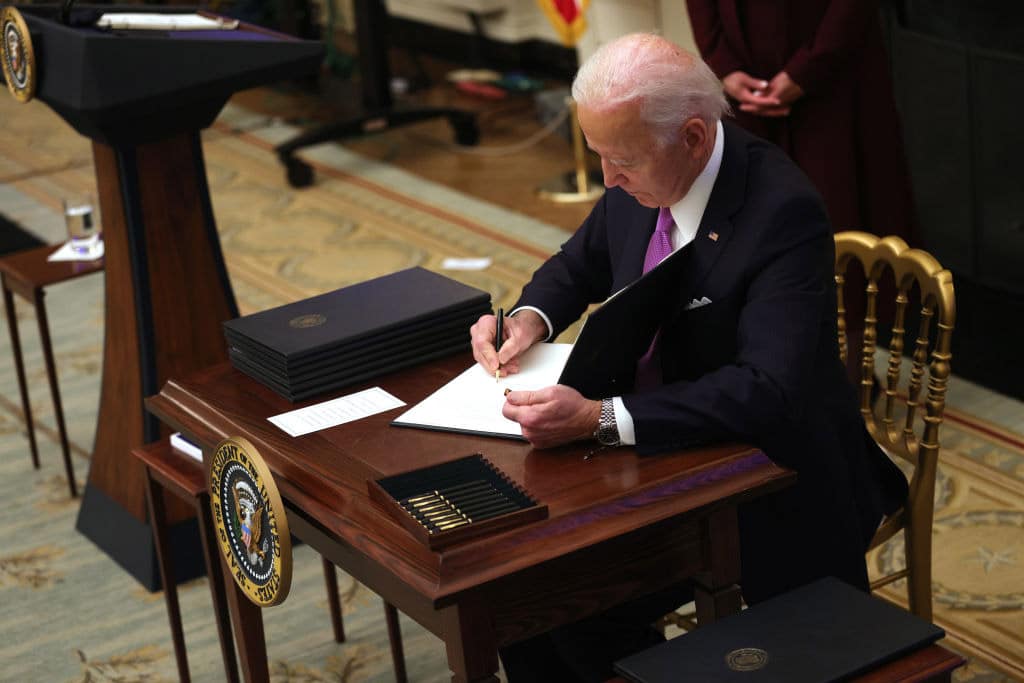
Instead of kicking off his presidency by focusing on issues that unite the country— such as the pandemic, vaccine distribution and reviving the economy—Biden signed a series of executive orders as a “means of erasing” the legacy of a man who got 74 million votes.

In his first 48 hours in office, the Times reported, “Mr. Biden cranked out about 30 executive orders, of which 14 target a broad range of Trump executive mandates.” Ironically, one of his orders was to terminate the newly formed 1776 Commission, which dealt with our nation’s founding ideals.

As commission member Victor Davis Hanson noted, “the unanimously approved conclusions focused on the Declaration of Independence, the U.S. Constitution, the historical challenges to these founding documents and the need for civic renewal. The 16-member commission was diverse in the widest sense of the familiar adjective. It included historians, lawyers, academics, scholars, authors, former elected officials and past public servants.”

In any case, whether one agrees with the orders or not, whether one hates Trump or not, the new president had every right to sign them. That’s not the point. The point is that Biden’s actions severely undermined his words. Right after promising to “bring America together” and asking “every American to join me in this cause,” he thumbed his nose at millions of Americans who didn’t vote for him.

Right after promising to “start afresh” and calling on us to “listen to one another, hear one another, see one another, show respect to one another,” he himself went the other way.

Had Biden began his first day with, say, emergency meetings dealing with pandemic relief and vaccine distribution, he would have shown us immediately that he wasn’t kidding about bringing America together.

Maybe he forgot that in politics, timing and optics are everything. If you promise to unify and your first photo-op is to divide, that is more telling than any inspirational speech.

If you promise to unify and your first photo-op is to divide, that is more telling than any inspirational speech.

The executive orders Biden signed on Jan. 20 to “demolish” his predecessor’s legacy could have been introduced gradually and with more sensitivity and consideration for the other side. Especially on his first day, they should have played second fiddle to the national crises that currently preoccupy every American.

Instead, they were signed with a “breakneck speed” that dominated the news cycle.

In his first moment of truth, in his first real test, our new leader abandoned his own pledge to heal a broken nation. He teased us with greatness, and then settled for politics as usual.

On the Same Day He Preached Unity, Biden Went the Other Way Read More »

What We Can Learn from Master Schmoozer Larry King

I could tell he had no idea who I was. I’m sure someone had whispered to him at some point my name and what I did, but that was it. He was interviewing me for the Chabad Telethon, not for his famous global show on CNN.

Within a few seconds, he sized me up and began using disarming phrases such as “tell me about,” or “how did you get connected” or “what do you think [of this or that].”

He had never met me before, had no notes in front of him, and yet was still able to improvise a breezy conversation with meaningful moments.

You can call Larry King, who passed away on Saturday at 87, one of the world’s great interviewers, and he certainly was.

But I also call him one of the world’s great schmoozers. Interviewer was too formal a title. King was more of an improviser. Quick on his feet, charming, open-minded, inquisitive—in other words, a classic schmoozer.

Interviewer was too formal a title. King was more of an improviser. Quick on his feet, charming, open-minded, inquisitive—in other words, a classic schmoozer.

“The less I know, the better,” he once shared, according to NPR. “Now that sounds strange to people. Like, if you wrote a book, I wouldn’t read the book before I interviewed you, because I would then know too much about the book. And I’m in the same boat as the audience; they haven’t read the book.”

In a tribute in The Hollywood Reporter (THR), Mike Barnes wrote that “The Peabody Award winner often boasted that he prepared as little as possible for each show, and King kept his questions short and to the point.”

“I don’t show off. I don’t use the word ‘I,’ it’s irrelevant in an interview. It’s only done to say what you’re thinking…I’m there to learn,” he said in another interview quoted in THR.

Connect all of these dots. King didn’t take himself too seriously. He wanted his guests to do most of the talking. He put himself in the shoes of his audience. He was a great listener. And, above all, he was there to learn.

I saw it with my own eyes: Even though he didn’t know me when we met at the Chabad Telethon, he seemed eager to learn from me.

Considering the viciously divisive times we’re living in, that schmoozy conversational style is not a bad legacy.

What We Can Learn from Master Schmoozer Larry King Read More »

Remembering What Larry King Wrote in “I Am Jewish”

When Wall Street Journal reporter Daniel Pearl was brutally murdered in Pakistan in 2002, many Jews were particularly touched by his last words affirming his Jewish identity. In a book edited by Judea and Ruth Pearl titled, “I Am Jewish: Personal Reflections Inspired by the Last Words of Daniel Pearl,” prominent Jews from around the word were asked to share some thoughts on their Judaism.

Here is what the legendary interviewer Larry King, who died today at 87, wrote:

First and foremost, I had nothing to do with being Jewish. Fortunately for me, my parents, Eddie and Jennie from Minsk and Pinsk in Belorussia, respectively, happened to be Jewish themselves. I say fortunately because despite many of the trials and tribulations Jews have faced over the years, I still consider it kind of a blessing to be Jewish.

Now, let’s get this straight: I am not religious. I guess you could say I am agnostic. That is, I don’t know if there is a God or not (if there is I sure have a lot of questions for him—or her). But I’m certainly culturally Jewish. I love the Jewish sense of humor. The shtick of the Jewish comedian burns in me. I love a good joke. I don’t mind jokes about Jews told by Jews. Jewish humor has become universal.

The Yiddish language has many words now in daily use in other cultures all over the world. Is there, for example, a better word than “chutzpah”? It means “gall,” but actually it’s more than gall. Here’s a good illustration of chutzpah: The Jewish women’s organization Hadassah that raises money for Israel opens a fund-raising office in Libya. See what I mean by beyond gall?

And it’s funny, even though I don’t observe all the dietary laws, certain things have stayed with me since early childhood. For instance, I cannot eat meat with a glass of milk. The very thought of it turns my stomach. Jewish dietary laws prescribe that you don’t mix the two. That is almost inbred in me. I don’t observe the Jewish holidays, but I do admit to a certain reverence on Yom Kippur and Rosh Hashanah because it gives me a chance to reflect about my late parents. They were observant Jews. (Where did I go wrong?)

My father died when I was nine and a half and he was forty-three. My mother raised my younger brother and me, never remarrying. She was the classic Jewish mother. My Jewish name is Label, and so to her I was always Labela. I could do no wrong. Everything was for her children. That is Jewish to the core. I used to say that if I blew up a bank, killing four hundred people, my mother would say, “Perhaps they made a mistake in his checking account.”

Judaism is both a religion and a race. It’s an imprint I carry with me everywhere. I was taught to hate prejudice. I was taught the values of loyalty—the values of family. Even though I was not fortunate enough to go to college, I was certainly embedded with strong Jewish values of education and learning, no matter what the form. It is said that if you call a Jewish man in the middle of the night and ask him if you woke him up, he would say no, he was reading a book. The joke on the other side is, why do Jewish women never open their eyes during intercourse? It’s because they can’t stand to see someone else having pleasure. I throw in these little trinkets because they are so Jewish. We are small in number; our impact has been incredible.

We are small in number; our impact has been incredible.

I once asked a noted author, the late Harry Golden, if he ever regretted being Jewish. And he said no because when he dies there are only four possible leaders in the afterlife. They would be Moses, Christ, Karl Marx, and Sigmund Freud. And they were all Jewish so he figured he was on the right team from the start.

I remember how proud I was on my trip to Jerusalem with my brother a few years back. Seeing all of the street signs in Hebrew, feeling a sense of identity and belonging.

One vivid memory of that trip is when I was standing by the Western Wall, known as the famous Wailing Wall, where Jews from all over the world go to pray. A rabbi standing near me was davening (the Jewish form of prayer) when he looked up and said: “What’s with Perot?” It was a funny incident, really hitting me, showing the impact of CNN all over the world. Also on that trip I had the opportunity to visit many Israeli leaders, including spending a day with Yitzhak Rabin, who was campaigning to be prime minister, a job he would eventually win.

Again, having no strong religious affiliation, I must say the trip really hit home to me. The very flavor of Jerusalem stayed with me long after I left. I liked all the people of the region, including the many Palestinians I met. I felt a sense of belonging and I thought a lot about my late parents, who would have loved to step on that soil.

I’ll close with classic Jewish humor. A Jewish grandmother takes her grandson to the beach. He goes in the water and disappears from view. His grandmother falls to the ground crying: “God save him.” Suddenly, the boy washes to shore safe, alive, and breathing. The woman looks at the heavens and says: “He had a hat.”

Remembering What Larry King Wrote in “I Am Jewish” Read More »