fbpx

December 25, 2020

Sa’ar Nabs Top Likud MK, Hitting Netanyahu Where It Hurts

Elkin could be key for potential game-changing voting bloc

The steady exodus from Binyamin Netanyahu’s Likud party continued Wednesday evening, with one of his closest confidants, Minister of Higher and Secondary Education and Water Resources Ze’ev Elkin, offering a scathing rebuke of the Israeli prime minister and his conduct on primetime television before joining the new party of his nemesis, Gideon Sa’ar.

“You’ve destroyed the party, turned it into a personality cult, a byzantine court,” Elkin accused his former patron and friend. “We’re headed for a fourth election [in less than two years] because of your desire to influence the selection of the next attorney general and state attorney,” he added, hinting at attempts by Netanyahu to interfere with his ongoing corruption trial.

For over a decade, the former Likud lawmaker served as Netanyahu’s loyal ally and political adviser, often negotiating the party’s coalition agreements, putting together governments, and representing the prime ministers in various political settings.

Yet Elkin’s significance to the Likud was not limited to the behind the scenes wheeling and dealing.

Born in Soviet-era Ukraine and immigrating to Israel in 1990, Elkin represented in the party the vast former-USSR migrant community in Israel, serving as an expert on Israel’s Russian population during the party’s various campaigns and often accompanying Netanyahu on his meetings with President Vladimir Putin as a personal translator.

His defection to the New Hope party of Sa’ar, himself also a former prominent Likud member of Knesset who decided earlier this month to form his own platform and has since nabbed four more Likud lawmakers, leaves the party without one of its most effective Russian-vote magnets.

“Elkin enjoys significant popularity; he’s been voted one of the most well-liked lawmakers in the Likud among the ex-Soviet migrant community,” Ksenia Svetlova, a Moscow-born former MK from the Zionist Union party, told The Media Line.

“Some of these people may consider moving with him to the new party, but I have a hard time seeing masses of them leaving the Likud,” said Svetlova.

In the early 1970s, more than 160,000 Soviet Jews immigrated (made aliyah) to Israel. Throughout the 1990s, over a million more left the crumbling USSR and made their home in the Jewish state.

Over the years, the largely homogenous group voted for a string of parties claiming to represent the Russian vote. Today, their electoral power is estimated at 12 seats in parliament, or 10% of the Israeli legislature.

“I believe it’s growing as time goes on,” Alex Tenzer, a former director of the National Association of Immigrants from the Former USSR in Israel, told The Media Line.

“The children of the olim [immigrants], they’ve returned to the Russian bloc in the past few years,” he adds. “You have to understand what the issues are that matter to them, to truly realize their strength and size.”

The majority of voters of Russian background have recently camped in Avigdor Liberman’s Yisrael Beitenu party, made up mostly of Russian-born lawmakers and traditionally part of the right wing in parliament.

The party with the second-highest percentage of the olim votes has traditionally been the Likud, yet Tenzer says that identifying the entire demographic as exclusively right-wing would be a mistake.

“In the ’90s, they voted for [Labor Prime Minister Yitzhak] Rabin, and then Netanyahu, then [Labor Prime Minister Ehud] Barak,” he details.

“As of now, this electorate is divided between Yisrael Beitenu, Netanyahu, and the rest, who are unaffiliated and on the fence.”

During 2019’s three election campaigns, the battle for the Russian vote, waged principally by the two parties, escalated with each cycle. In the final round alone, the Likud spent close to 1.5 million shekels (around $470,000) on Russian-language campaign material, an unprecedented sum for the party.

Svetlova, who explains she did not see herself exclusively as a representative of the Russian community while in office and did not run on the “olim ticket,” says there is still something to be said for identifying as an ambassador of the community.

“I know where I come from, and it was important for me to advance the issues that weigh on people’s minds and that I was familiar with from up close: public housing, pensions, the separation of state and religion.”

Tens of thousands of the former Soviet Union immigrants living in Israel are considered non-Jewish by the state’s religious authorities, a designation that hinders their ability to wed, receive certain benefits and be buried in Jewish cemeteries.

As a whole, the Russian-born demographic is secular, and strongly opposes the closure of business and public transportation on Shabbat and the monopoly religious bodies hold over civic issues in Israel.

“Everyone has cheated them,” Tenzer accuses. “You name the politician, I’ll tell you how they’ve conned the Russian public. So naturally, they’re disappointed.”

As to the effect the latest political maneuvering will have on the March 23 election, it remains to be seen.

“Elkin doesn’t change much. He alone is not enough,” Tenzer says, while acknowledging that interest in Sa’ar’s new party among Israeli-Russian voters has spiked.

“He has great potential, but that can be momentary. He has to prove what his candidates have done for the community, while also coping with Liberman’s highly effective Russian-language propaganda, which will annihilate [Sa’ar].”

Added Svetlova: “I wouldn’t call it an earthquake.”

Sa’ar Nabs Top Likud MK, Hitting Netanyahu Where It Hurts Read More »
“The Day After”: A Christmas Interview With the Owner of a Kosher Chinese Restaurant

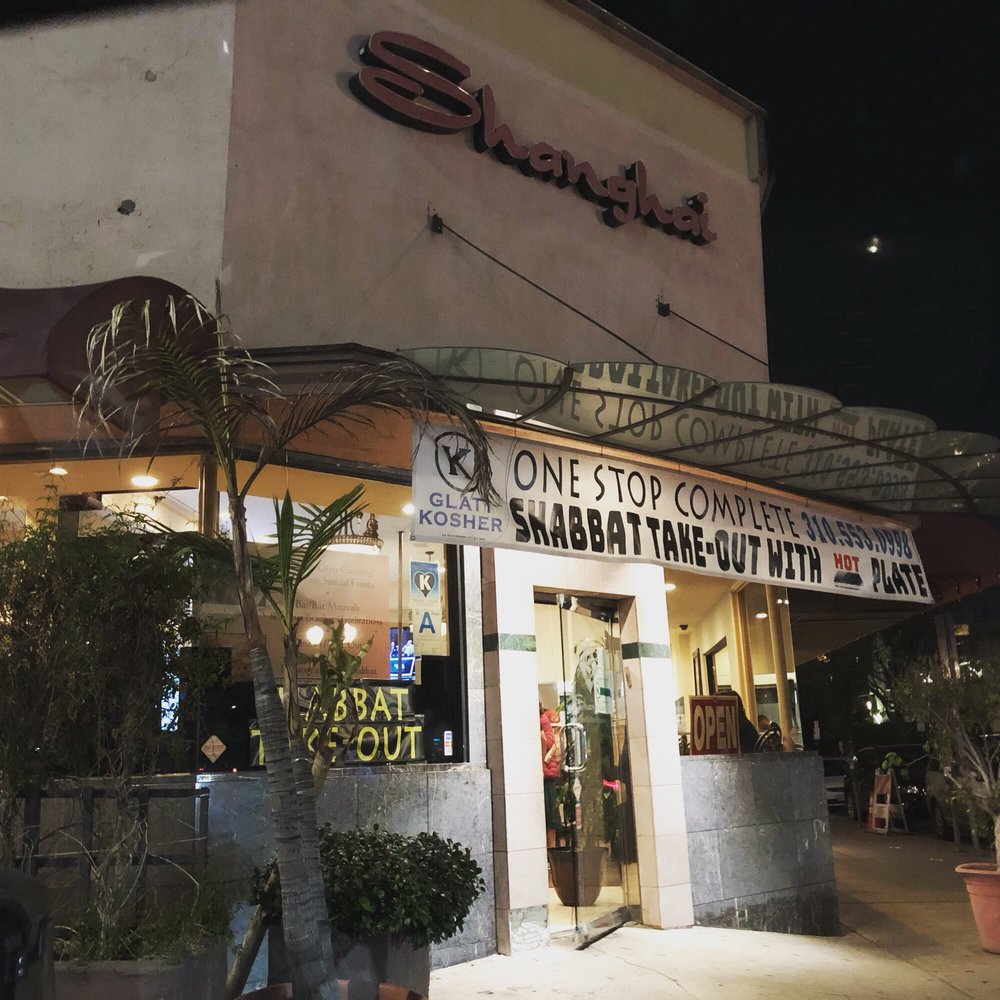
In 2005, an Iranian Jew and his partners took over a Chinese restaurant in Los Angeles’s Pico-Robertson neighborhood, made it kosher, retained the talented Chinese chefs and began selling to local Jews, most of them Ashkenazim. This could only have happened in America.

The Journal asked David Askari, co-owner of Shanghai Diamond Garden on Pico Boulevard, about the day after Christmas Eve, a mad rush in which Jews, kosher or not, famously order Chinese food, and a lot of it — so much, in fact, that Askari’s restaurant stopped taking calls for extended periods on December 24. And at some point, he lost track of how many pounds of meat, rice and noodles the restaurant served on the busiest non-Jewish Jewish holiday of the year.

Jewish Journal: What was last night (Christmas Eve) like for you and the restaurant staff?

David Askari: Due to COVID-19, it was a totally different scenario without in-house dining. It’s always chaotic because Jewish people have to have Chinese food on Christmas. The kitchen was overwhelmed. A few times throughout the day, for up to an hour or two at a time, I had to stop all the incoming calls. As fast as we worked, we couldn’t possibly make the volume that was coming in. But thank G-d, everything went smoothly. When you have in-house dining, that’s when you know you think, I need to take a Xanax before I come to work. But last night, everything was pickup and delivery. It was a whole different level of work. I put the answering machine on and boom! All the lights on the phone were on from 10 a.m. (when we opened) to 10 p.m. Before COVID-19, when customers were eating inside, they were usually there for an hour or so, which gave us time to prepare. But this year, there was no buffer zone between customers sitting down for meals. It was only pick-up and delivery.

JJ: How does Shanghai Diamond Garden prepare for the influx of orders on Christmas Eve?

DA: Normally, we have one mashgiach (a kosher supervisor). Last night, we had two, because they needed to inspect so much food and check all of the vegetables. (So many vegetables!) We normally have four chefs; last night we had five. There were four people packing all the food, seven people preparing it and then another four in the back, cleaning and washing everything, so there were about 15 people in the kitchen total yesterday.

JJ: What were some of the most popular dishes ordered?

DA: Definitely Mongolian beef, orange chicken, chicken lo mein and garlic chicken. We had to modify the menu because some dishes, like the crispy shredded beef and crispy shredded chicken as well as the fish, take too long to cook. So we didn’t even offer them.

JJ: How does the kitchen staff maintain its composure?

DA: We didn’t rush them. We let them do the cooking. They know they have to move fast, but we really have to pay attention to make sure the food quality is the best. So, no excessive rushing. I controlled the rush. If we’d answered the phone every time, we’d have too many orders. Also, we completely disabled online ordering yesterday. But we did get a lot of pre-orders, not for a few dishes, but for 10–15 and even up to 20 dishes per order. It was madness.

JJ: Given that we’re in a pandemic, were there more or less orders this year than previous years?

DA: As far as delivery and takeout, we did more orders than ever before. And this year, customers didn’t even want to come outside of their homes to get the food delivery, even a few steps away from their door. We had a lot of people waiting outside the restaurant, too. They had to social[ly] distance outside. And the street was packed with cars.

JJ: Why do you think Jews love to eat Chinese food on Christmas Eve?

DA: I guess we’re blessed. Mother’s Day is the next most hectic day for us, but honestly, I don’t want more than one Christmas a year. It’s fun for the customer, but for us, it’s a lot of strain. I think it’s a minhag (tradition) to eat Chinese food. I heard a story about how in the past, the restaurant workers were mostly Hispanic and didn’t want to work on Christmas, so the only people who would were Chinese workers, and, like them, Jews didn’t traditionally observe Christmas… so they ate out. At the restaurant, we’re happy to serve people. We enjoy all the attention, and, thank G-d, our customers are happy. Last night, we didn’t have a single complaint, given the volume, which is such a blessing.

But all I know is that somewhere, at some point, someone said that Jews have to have Chinese food on Christmas, and it stuck.

“The Day After”: A Christmas Interview With the Owner of a Kosher Chinese Restaurant Read More »

david suissa podcast curious times

Pandemic Times Episode 115: Jay Sanderson on the Jewish Future

New David Suissa Podcast Every Tuesday and Friday.

The head of the Jewish Federation of Greater L.A. discusses how the Jewish communal world can rise from the pandemic.

How do we manage our lives during the coronavirus crisis? How do we keep our sanity? How do we use this quarantine to bring out the best in ourselves? Tune in and share your stories with podcast@jewishjournal.com.

Listen on Apple Podcasts

Listen on Spotify

Listen on Stitcher

Follow David Suissa on FacebookTwitter and Instagram

Pandemic Times Episode 115: Jay Sanderson on the Jewish Future Read More »

Operation Santa and the Need for “Spontaneous Cooperation”

By Elwood Hopkins

Photo from MonoVisions

Buckminster Fuller often noted that that we have enough wealth and technological capacity for everyone in the world to live in abundance — if we would only collectively decide to it. As he put it, we have within us the capability “to make the world work for 100% of humanity, in the shortest possible time, though spontaneous cooperation.” At this historical moment, when the world has been brought to its knees by global pandemic, economic downturn, racial injustice, and political strife, such optimism seems naïve.  And yet, even without access to the vast calculations for which Fuller was famous, there remains something intuitively true about his sober conviction on this point.  Anyone who has a sense, deep down, that society could be working better, knows what I am talking about.

As an urban planner, much of my thirty-year career has been focused on the systems and infrastructure we need in society to undertake such large-scale economic distribution. I have worked with school districts, colleges, and employers on workforce initiatives; advised local government agencies and planning commissions on equitable development; and organized teams at financial institutions and supermarket operators to open branches or grocery stores in neighborhoods of concentrated poverty. All of these efforts have sought to address the economic divide by changing the systems through which basic products and services are brought to people in their everyday lives.

But as fruitful as these efforts have sometimes been, they have often felt unnecessarily laborious, grindingly slow, and deeply resisted by people who are afraid of change. That’s partly because they often depended on a few people to do the heavy lifting. And that has just never felt completely sustainable. Moreover, the inherited infrastructure on which we graft these changes is typically made up of entrenched bureaucracies. Navigating them has entailed understanding the hierarchies of leadership, the divisions of roles and responsibilities; and the organizational cultures, protocols, and practices. I have seldom seen evidence of the “spontaneous cooperation” that Buckminster Fuller envisioned.

And yet I hold with certainty to the idea that it is possible.  One reason I do involves a Christmas story that is little known to many people today. It started in 1912 in the James M. Farley building of the United States Postal Office in New York City, a grim, imposing building directly across Eighth Avenue from Penn Station. It is a building whose vast size and granite columns could not more perfectly exemplify the control and inflexibility built into modern bureaucracies. The story concerns an unlikely man, Frank Hitchcock, who some might say embodied the principles of command and control institutions. As Postmaster General he aggressively prosecuted mail fraud, and he led the development of the country’s airmail service.

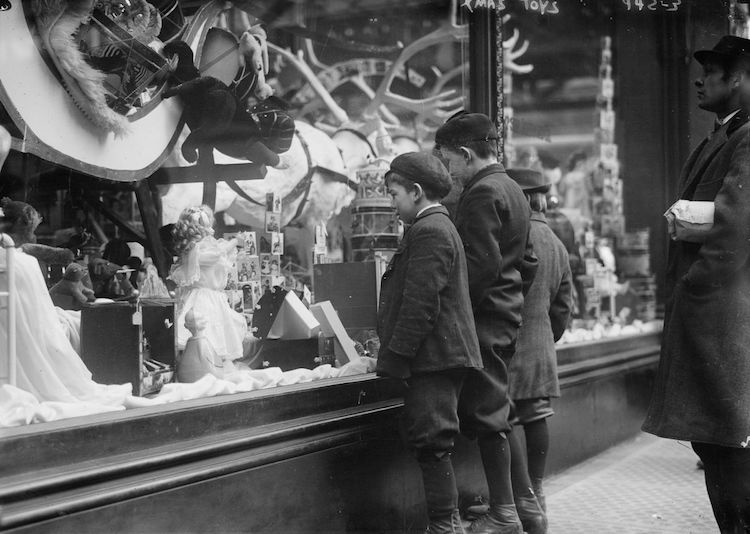
In December 1912, however, Hitchcock became aware that his postal workers were becoming preoccupied with what at first seemed to be a relatively inconsequential topic: what to do with the avalanche of letters arriving in the post office addressed to Santa Claus in the North Pole. Most letters had return addresses, which conscientious post workers recognized as tenements on the lower east side or in other poor neighborhoods across the Burroughs.  Hitchcock made a rather extraordinary executive decision, one that that ran counter to all conventional training of postal workers: he authorized them to open and read the letters.

And he didn’t stop there. Under his leadership, New York’s postal workers began creating and maintaining a vast record-keeping system. Children’s names and addresses were painstakingly noted in ledgers with details on the toys they had requested: wooden hobby horses, wagons, tricycles, model trains, tin soldiers, Teddy Bears (popularized a decade earlier by Teddy Roosevelt), Campbell Kids dolls (manufactured by the soup company starting in 1909) or the new Kewpie dolls. Lists of requested toys and quantities went out through informal associations and networks in New York’s middle class and affluent families, as well as civic and charitable societies. Toys were purchased, boxed, wrapped, and delivered to the James Farley building, where postal workers affixed the appropriate labels and handed them off to deliverers. The initiative has continued to the current day and expanded nationwide. In fact, the US Postal Service has declared that 2020 is the first year that “Operation Santa” is national.

What is significant about this strategy — and what always stays with me– is that it created opportunities for large numbers of people to participate meaningfully in a bold crystallized vision. In this case, it is a vision propelled by the archetypal ideal of Santa Clause, the principle that there is a higher intelligence in humanity that can figure out to how to give everyone what would make him or her most happy.  To be sure, such a system would not work without the bureaucratic infrastructure of the United States Postal Service as a coordinating entity and delivery apparatus.  But nor would it work through bureaucracy alone. The creativity, ingenuity, and sense of responsibility are distributed widely.

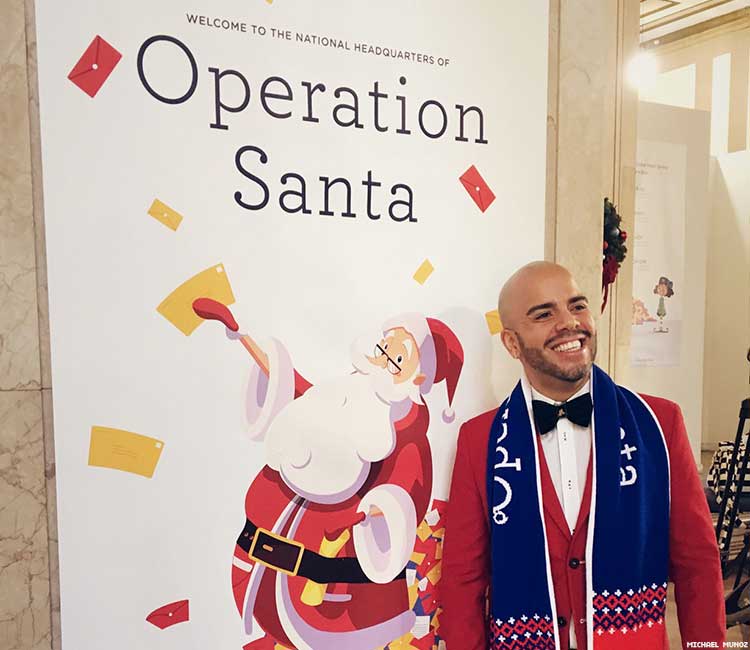
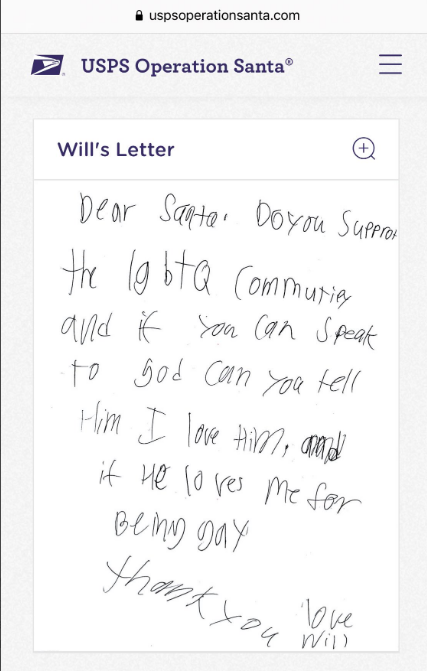
In a new documentary, “Dear Santa,” filmmaker Dana Nachman interviews an Operation Santa volunteer, Michael Munoz.  Michael, who is gay, read a letter from a little boy who had not asked Santa for a toy, but simply asked him if he loved gay children.  Michael mobilized dozens of his friends to pull together a pile of books and materials that would show the little boy how loved he was by a community he had not even met yet. As I recall childhood T.V. shows about Santa Claus, they usually depict him as an wise man who seemed to know about every child’s conduct and needs.  But I never saw one Santa depicted who could have pulled off what Michael Munoz did.

And that really was Buckminster Fuller’s point. If humanity ever decides to collectively deploy the intelligence and compassion of every person, it will be as if we have once again discovered fire.  And I, for one, think we will get there.

Pictured: Michael Muñoz from The Advocate
https://www.instagram.com/p/CIYlcthDLhc

Operation Santa and the Need for “Spontaneous Cooperation” Read More »

There Is a Second Pandemic: Misinformation

At Thanksgiving, nine family members from three households shared turkey and all the trimmings. Unfortunately, COVID-19 was also on the menu. One of the nine failed to mention their “cold symptoms.” Five days later, others had lost their sense of taste and were running fevers. My wife’s aunt attended the holiday meal. Six days later, unaware of what occurred, she took my mother-in-law for a pre-operative COVID-19 test prior to a heart procedure. So now, our family watches the days tick by to see if a potentially fatal illness will take hold.

Unfortunately, my family was not alone in this event. Millions traveled and congregated in defiance of widely circulated public health appeals. Why do people ignore public health warnings and expose vulnerable friends, family and co-workers to this virus?

The answer, in part, is the parallel pandemic of misinformation. Although our understanding of this novel malady has grown, we continue to see misinformation and ill-informed criticism that undermines public health efforts.

A relatively recent contributor to misinformation is the “Great Barrington Declaration” (GBR), a proposed alternative to mainstream public health measures. The resolution, named after Great Barrington, MA, where it was signed, advocates for “focused protection,” described as encouraging those “at minimal risk to live their lives normally…while better protecting those at highest risk.” GBR advocates opening business establishments as well as arts, music, sports and other cultural activities. It promotes the achievement of herd immunity — the threshold level of immunity in a population that prevents further viral spread — by a combination of natural immunity (infection) and immunization.

Unfortunately for truth-seeking, GBR turns a blind eye to some of public health experts’ most serious concerns. The first issue is GBR’s assumption that high- and low-risk populations can be reliably be segregated. Many low-risk individuals live or work with the elderly and others at high risk. Because those newly infected with COVID-19 become contagious before they become symptomatic, allowing increased transmission of the virus in low-risk populations will inevitably create infections among those at high risk. In addition, not all fatalities occur in those known previously known to be high risk. But GBR never adequately addresses this dilemma.

Although GBR touts herd immunity, it dodges the question of the percentage of the population needed to get there, claiming that it is “impossible to know right now.” In fact, epidemiologists estimate herd immunity for COVID 19 to be about 70% of the population. Ignoring best estimates on herd immunity allows GBR to avoid the frightening implications of that strategy: reaching herd immunity, half by vaccine and half by illness, would lead to an estimated 400,000 more deaths.

The advocacy of GBR and its allies appears rooted in a libertarian approach to public policy. Of course, their concern about the tradeoff between economic and individual well-being versus public safety deserves debate. Public health officials understand that economic shutdowns harm employees who lose jobs and create serious psychological implications on children, adults and teens. I’ve personally seen my patients, colleagues and their families struggle with these very issues. Government officials and their public health advisors must certainly heed their plight when considering such tragic trade-offs.

But opponents of lockdowns should be aware that government has long been empowered with the right and the responsibility to act on such trade-offs when lives are at risk. Although a recent 5-4 Supreme Court decision reinforced the need to treat religious practice, protests and commercial interests even-handedly when creating restrictions, it never questioned the role of government in protecting public safety.

As a doctor who cares for COVID-19 patients, however, my focus is on protecting lives and combatting misinformation. I have daily experience with the victims of the misinformation pandemic. My febrile and coughing patients, like my mother-in-law, can often identify someone that didn’t listen, wasn’t careful and put them at risk. Opponents of lockdowns and masking should turn their eyes to the countless studies, scientific reports and the experience of countries like South Korea and New Zealand that all show how compliance with science-based health advisories can make a difference.

My febrile and coughing patients can often identify someone that wasn’t careful and put them at risk.

The coming weeks will reveal the damage done by the ongoing Thanksgiving surge. Even with improved compliance, the festivities of that day may necessitate more weeks of restrictions and much death and debility. Many, like my mother-in-law, will wait anxiously for the results of their tests and wonder what the next few weeks may bring.

As we stand collectively on threshold of vaccine distribution, we should not allow ignorance nor weariness to sidetrack us. We must understand that in complying with public health directives and in protecting ourselves, we can save the lives of others we may never know, who might succumb down the line in a chain of future infections. The truest celebration of holiday spirit requires doubling down on masking, distancing and the other measures our public health authorities have outlined. With lives on the line, the choices are clear.


Daniel Stone is Regional Medical Director of Cedars-Sinai Valley Network and a practicing internist and geriatrician with Cedars Sinai Medical Group. The views expressed in this column do not necessarily reflect those of Cedars-Sinai.

There Is a Second Pandemic: Misinformation Read More »

Meet the Iranian American Jew Running for CA’s Democratic Party

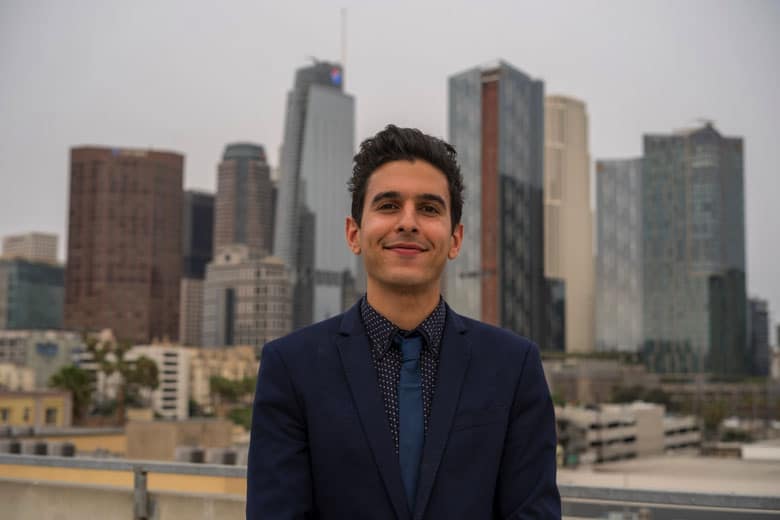
Daniel Bral, a 27-year-old Angeleno whose parents emigrated to the United States from Iran, isn’t content with being a stagnant “couch critic” during a time of both unrest and opportunity in the United States.

“I got sick and tired of seeing our elected officials display such a callous disregard for the needs and struggles of the people they claim to serve,” Bral said in an interview with the Journal. “I want to be in a position where I can make a tangible difference in other peoples’ lives and ensure that underrepresented communities — be it communities of color, people experiencing homelessness, immigrants, members of the LGBTQ community — have a true champion in their corner.”

Bral is running for a delegate seat to the California Democratic Party for Assembly District 50, which includes Agoura Hills, Bel Air, Beverly Hills, Brentwood, Hollywood, Hollywood Hills West, Malibu, Mid-City, Miracle Mile, Pacific Palisades, Santa Monica, Topanga, West Hollywood and West Los Angeles. Eligible voters must be registered Democrats residing in District 50 and will have until January 11 to register. All voting will be done by mail and ballots will be mailed to voters between January 6–18.  Ballots must be received by January 27.

“A delegate is an official member of the California Democratic Party who is responsible for drafting resolutions, endorsing local and statewide candidates and ultimately crafting the California Democratic Party’s platform,” Bral said. “It’s imperative that people vote because the California Democratic Party is the largest and most influential state party in the country. Where the California Democratic Party goes, the Democratic Party as a whole will follow.”

Bral is running as a member of the Grassroots Slate, which describes itself on its website as “a diverse and dynamic group of progressive activists committed to building the California Democratic Party from the bottom-up.” He joins 12 other candidates on the Slate, ranging from community organizers and entrepreneurs to journalists and longtime Democratic activists. The slate’s platform includes supporting an inclusive Democratic Party, promoting a Green New Deal and prioritizing universal healthcare.

As a delegate, he hopes to “meaningfully address homelessness, systemic racism and inequality, climate change, gun violence” as well as “promote a foreign policy that is centered on diplomacy and mutual respect and understanding that upholds democracy and human rights.”

Bral graduated Loyola Law School in May 2020, where he was a member of the Jewish Law Students Association. During law school, he served as an economic opportunity policy intern for Mayor Eric Garcetti, focusing primarily on homelessness initiatives and drafting the Right to Counsel motion, which offers free legal counsel to low-income tenants facing eviction. As part of his internship, Bral transformed a vacant downtown property into a shelter that now offers housing to over 40 women and children. This move was a part of Garcetti’s housing initiative known as A Bridge Home, which provides interim housing and support services for homeless populations. Bral also served as a law clerk and communications associate for Los Angeles City Attorney Mike Feuer.

Service has played an important role in Bral’s family history. In 1948, his paternal grandfather, Moossa Bral, became only the second Jewish member of the Iranian parliament, or majlis, at the age of 32. Around the same time, his maternal grandfather, then in his early twenties, gathered what little funds he had and left Iran to enlist in the Israel Defense Forces.

At the age of 16, Bral’s mother left Iran alone to study in the United States, a decision that was practically unheard of at the time. As a young Iranian woman in the United States in the early 1980s, she struggled to find a job and eventually decided to learn computer science. Bral’s father left Iran alone at the age of 18 to study in England. He immigrated to the United States in 1981.

Bral credits Jewish values with giving meaning to his pursuit of service. “Judaism is rife with life lessons, but the tenets that have most resonated with me are to lead a life of righteousness and to care for the stranger because we are all made in the image of God (“B’tselem Elohim”). To me, that means treating everyone with compassion and dignity without expecting anything in return. It means calibrating my moral compass to be guided by doing what is right, not what is easy or popular.

Daniel Bral credits Jewish values with giving meaning to his pursuit of service.

“And that,” he continued, “underscores the Jewish principle of caring for the stranger. I may not personally know the family seeking refuge in America, but I understand their desire. My parents — [and] Jews writ large, for that matter — were once considered strangers in a foreign land. My parents left their home country of Iran knowing that no matter what difficulties may lie ahead, they pale in comparison to the difficulties of the country they’ve left behind. So being Jewish is central to who I am and who I want to be.”

Bral acknowledged the challenges of support faced by Israel and the Jewish community on both sides of the political aisle. “On the one hand, some Republicans come to the table with a bad-faith political weaponization of Israel and have given [Benjamin] Netanyahu carte blanche to do as he pleases. On the other hand, a handful of Democrats and folks in progressive spaces oversimplify the Israeli-Palestinian conflict and almost reflexively place all blame on Israel’s lap. I hope to bring more nuance to the discussion.”

He has expressed support for the Joint Comprehensive Plan of Action (JCPOA), otherwise known as the Iran Deal under former President Barack Obama.

“I am an unabashed, unapologetic Israel supporter and Zionist,” said Bral, who completed a StandWithUs J.D. Fellowship, which empowers Los Angeles-based law students to become legal advocates for Israel and the Jewish community. As a part of his fellowship research project, Bral wrote an article that made the case for expanding Title VI of the Civil Rights Act of 1964 to include religion as a protected class.

“I want to see Israel flourish and live peacefully now and forever. But I am not a blind supporter, and by that I mean I don’t think Israel’s actions are beyond reproach,” he said. “I’m a supporter of J Street, Bend the Arc and Progressive Zionists of California.”

In his bid for party delegate, Bral has received support from his former boss, Feuer, who recently issued a statement saying, “I’ve had the privilege to work alongside Daniel and seen firsthand his intellect, creativity, and deep commitment to making the world more fair and more just. He will be a strong, energetic voice for progressive, sustainable change.”


Tabby Refael is a Los Angeles-based writer, speaker and activist.

Meet the Iranian American Jew Running for CA’s Democratic Party Read More »