fbpx

December 21, 2020

Tufts Student Body Condemns Israel Security Program

The student body at Tufts University voted in favor of a referendum on December 19 calling for the university to apologize for having its former police chief participate in a security training program in Israel.

Jewish News Syndicate (JNS) reported that the referendum, which was sponsored by the Tufts Students for Justice in Palestine (SJP) chapter, asked it students support the university “apologizing for sending the former Tufts police chief to an intensive week-long course led by senior commanders in the Israel National Police, experts from Israel’s intelligence and security services, and the Israeli Defense Force.” The former police chief, Kevin Maguire, had participated in the program in 2017; the Anti-Defamation League (ADL) sponsored the program.

The vote was 1,725 (68%) saying yes, 665 (26%) saying no and 161 abstaining.

Jewish groups condemned the vote.

“The referendum campaign intentionally was based on misinformation and innuendo, twisting the very important issue of police reform and using it as an opportunity to contrive facts, vilify Israel and isolate Jewish students on campus,” ADL New England Regional Director Robert Trestan said in a statement to Jewish Insider. “As past participants and chief Maguire have repeatedly stated publicly, the trip bears absolutely no resemblance to military training. The charges are absurd.”

Rena Nasar First, Executive Director of Campus Affairs at StandWithUs, also said in a statement that the pro-Israel education organization is “proud of the students” who stood up to the referendum. However, “it is deeply disappointing and frightening that the voices of Tufts students will now be used to promote classic antisemitic slurs within a campaign of hate focused on Israel and Jews,” she added.

The student group Real Reform at Tufts, which calls for police reform, similarly condemned the passage of the resolution.

“We strongly believe that voting for a referendum based on mistruths that propagates a modern-day antisemitic blood libel will not fix a broken policing system in America or get us closer to racial justice,” Real Reform at Tufts wrote in an Instagram post.

Tufts SJP, on the other hand, celebrated the resolution’s passage.

“In this vote, the student body also declared itself united in opposition to the university’s normalization of the violence of the Israeli occupation and enabling of Israeli profiteering from its oppression of Palestinians,” they wrote in a Facebook post.

The student newspaper Tufts Daily reported that the Elections Commission of the Tufts Community Union (ECOM) concluded that the resolution violated the university’s election regulations because it wasn’t “made public at least nine days before the election” and “did not have a receipt date with the Elections Commission at least seven days before the vote.” However, ECOM concluded that the result will still stand because the violations weren’t “significant enough,” and that SJP wasn’t responsible for the violations.

Patrick Collins, Executive Director for Public Communications at Tufts, said in a statement to Jewish Insider that the university won’t be apologizing, calling the resolution “misinformed.”

Tufts Student Body Condemns Israel Security Program Read More »

Suspects in French Hanukkah Attack Released from Custody

The four individuals suspected of attacking a French family on December 10 have reportedly been released from custody.

The attack, which took place in the Paris suburb Aubervilles, consisted of four people shouting “F— the Jews” at a family singing Hanukkah songs inside their car. The four people are then alleged to have started shaking the car and breaking glass bottles on it.

The radio network France Bleu reported that local prosecutors announced on December 20 that the four suspects — two adults and two minors — have been released from police custody. The prosecutors have not yet determined if they will be taking further action against the four suspects.

The Stop Antisemitism.org watchdog tweeted that the release of the suspects was “outrageous,” adding, “France is making it abundantly clear it does not care about its Jewish citizens’ safety.”

When the four suspects were arrested, French Interior Minister Gerard Darmanin tweeted that the suspects “should be punished commensurate with the gravity of these facts.”

In January, the French Interior Ministry released statistics showing that anti-Semitic incidents had increased by 27% from 2018 to 2019.

Suspects in French Hanukkah Attack Released from Custody Read More »

Don’t Smoke! The Edible Moroccan Cigar

Crispy, golden and delicious, Moroccan cigars are a traditional favorite of the Moroccan kitchen. Served as appetizers at celebrations or holiday meals, cigarim have become especially popular in Israel. They can be found on the menus of Mizrahi restaurants, freshly fried and ready for take out in the Shuk or in the freezer section of the supermarkets.

The combination of a crispy shell and a spicy, savory filling makes cigars a wonderful treat. They are most commonly filled with spicy ground beef or lamb, and occasionally mashed potatoes. The shell is a very thinly rolled Warka or brik dough, that is made of flour, water and salt. Not as thin as Phyllo pastry, the Warka dough becomes exquisitely crisp and flaky when fried. If Warka dough can’t be found at the kosher market, spring roll wrappers make a great stand in.

In North Africa, cigars also take a star turn as a dessert. The cigars are filled with almond paste sweetened with honey and scented with orange blossom water, then fried and dipped into a simple sugar syrup. This festive treat is served at weddings, hennas and engagements, as well as for Jewish holidays.

Rachel’s Turn: My mother loved to make cigars for the holidays and special occasions. Nowadays, I rarely have time for such labor-intensive recipes and for health reasons, I prefer not to fry food. But on the last night of Hanukkah, I grew nostalgic for these incredible irresistible treats from my childhood. I was inspired by the Impossible burger meat in my refrigerator to make cigars for my vegetarian brothers. I served them with a trio of dipping sauces—spicy red Harissa, sesame tahini and rich creamy hummus.

The cigars proved to be a fun treat and a real crowd pleaser.

Impossible Burger Spicy Moroccan Cigar

2 tablespoons oil
1 12oz package Impossible Burger “ground beef”
2 cloves garlic, crushed
2 teaspoons chili pepper flakes
2 teaspoons cumin
1 cup water
Salt & pepper to taste
Cigar wrappers or spring roll sheets
1 egg white, beaten

Lightly heat oil in a large pan.

Add “ground beef” and sauté for a few minutes.

Add crushed garlic and sauté for another two minutes.

Add water, then cover pan and simmer until all water evaporates.

In a colander, thoroughly drain meat until it is dry.

Place in a food processor fitted with blade attachment.

Add cumin and chili flakes.

Pulse until ingredients turn into a pate.

Add salt and pepper to taste and pulse one more time.

Cut cigar wrappers in half, forming two long rectangles.

Place a teaspoon of meat filling at bottom of wrapper, fold in sides and roll up.

Seal with egg white or water.

Heat oil and fry.

Cigars can be frozen raw and fried straight out of the freezer.


Rachel Sheff and Sharon Gomperts have been friends since high school. They love cooking and sharing recipes. They have collaborated on Sephardic Educational Center projects and community cooking classes. Follow them on Instagram @sephardicspicegirls and on Facebook at Sephardic Spice SEC Food.

Don’t Smoke! The Edible Moroccan Cigar Read More »

$2.75 Billion for Private Schools in Stimulus After Prodding by Jewish Groups

(JTA) — Following a coordinated lobbying effort by Orthodox Jewish and Roman Catholic groups, the $900 billion coronavirus stimulus includes $2.75 billion for private schools hit hard by the pandemic.

“As we all know, the COVID-19 pandemic has been terribly disruptive and costly to America’s K-12 schools — the students and families they serve, the teachers and many other staffers who work tirelessly to educate our children,” Nathan Diament, the Orthodox Union’s Washington director, whose group was among the Jewish and Catholic organizations pushing lawmakers for the funds, said Monday in a news release.

“That is why it is essential for this latest federal relief package to include a great amount of support for these schools and, among them, America’s Jewish, Catholic and other nonpublic schools.”

The nonpublic schools will have to apply for the funding.

The backing for the added funding was bipartisan, led in the Senate by senators known for their efforts to reach across the aisle: Susan Collins, a Maine Republican, and Joe Manchin, a West Virginia Democrat.

Republicans and Democrats in the Senate and the U.S. House of Representatives have agreed on the outlines of the stimulus package and are expected to finalize it by Tuesday.

$2.75 Billion for Private Schools in Stimulus After Prodding by Jewish Groups Read More »

I’m OK Waiting for a Vaccine — Are You?

It looks like I might be the last person in America to receive a coronavirus vaccine. And that is just fine.

Health care providers and nursing home residents appropriately come first, and the first doses are already reaching them. Recommendations from the Centers for Disease Control (CDC) have now established a second priority level, including grocery store workers, other essential workers and those over 75 years old, who will hopefully start getting their shots in the next few weeks. Those between the ages of 65-74, younger adults with high risk medical conditions, transportation workers, food servers and other necessary employment sectors will be next. If things go smoothly, these groups will be vaccinated by the end of February.

The rest of us might not get those injections until sometime in the spring or summer, or even next fall depending on the efficacy of this unprecedented worldwide logistical challenge. Predictably and tragically, there are already disturbing reports of wealthy individuals offering large donations to health care providers in exchange for being given the chance to skip ahead in line.

But although sooner is obviously better than later, I am willing to wait. And unless you are a member of one of those first three priority groups specifically designated by the CDC, you should be just as willing.

I understand — there are plenty of things I miss from pre-COVID-19 life, too. Although Netflix and Amazon Prime have been keeping us entertained, it would be nice to see movies in a theater again. The weight bench that my wife and I assembled is perfectly adequate, but I wouldn’t mind getting back to the gym. Like most of you, I miss seeing friends and family in person, and I’ll be very excited to be together face-to-face rather than reminding them to unmute on Zoom.

There are plenty of things I miss from pre-COVID-19 life, too.

At worst, these are mere inconveniences. For those of us who are healthy and who are able to work from home, our annoyances are insignificant compared to the existential health and economic dangers that less fortunate Americans have faced every day for the last nine months. A worker who puts her life at risk for a job that allows me to buy groceries isn’t a better or worse person than me, but her ability to feed her children is more at risk without a vaccine than my economic well-being. So she gets priority. My vaccine can wait.

To be clear, I’m far from an economic progressive. I believe lower taxes help produce economic growth and that onerous regulations discourage business start-ups and job creation. But in what the economists are calling a K-shaped recovery, it’s clear that the investor class has not only survived under COVID-19 but thrived. The growing disparity between those who do white collar work from a home computer and those whose jobs and livelihoods depend on leaving home every day has been exacerbated during the pandemic. And the health risks faced by a family forced to crowd multiple generations into a small apartment are far more hazardous than those who own a house where every child has their own bedroom.

The policy debate over income inequality will continue for the foreseeable future, with liberals and conservatives offering dramatically different solutions on how best to close that gap. But regardless of which school of economic theory to which you subscribe, we should be able to agree that some of us need to get some approximation of our old lives back sooner than others.

Throughout most of American history, we have come together in times of crisis. But not this year. We messed up testing and contact tracing. We failed at masks and social distancing. We underreacted and overreacted. We blamed others and put ourselves at risk. Depending on our political or cultural orientation, we made excuses to protest or pray, forgiving those with whom we agreed and castigating those with whom we did not.

Now, we might actually see a light emerging at the end of a long, deep, dark tunnel. Can we get the vaccination right, at the very least? Maybe. But if this is going to work, it will require a level of unity, cooperation and selflessness which our country not displayed in many, many years.

Let’s see if we’re up to it.


Dan Schnur teaches political communications at UC Berkeley, USC and Pepperdine. He hosts the weekly webinar “Politics in the Time of Coronavirus” for the Los Angeles World Affairs Council & Town Hall.

I’m OK Waiting for a Vaccine — Are You? Read More »

Local Philanthropist Giving Back to Israelis in Need

Right now, many Israelis are suffering due to COVID-19. More than 980,370 Israelis were unemployed as of this past October, which is almost one quarter of the workforce.

Families are going without food and are unable to pay for basic necessities like their rent, utilities and cars. That’s why Ruth Brandt, a Los Angeles-based philanthropist, started an urgent appeal in partnership with the Giving Group Community to raise emergency funds for families in Arad, Ashkelon and Dimona. All the fundraising is being done through the Israel Giving Bread website.

In a phone interview with the Journal, Brandt said she got involved because she’s a longtime Zionist. “I call [the funds] a breath. It’s for your washing machine or your refrigerator that breaks, or if you need to pay the dentist or the rent or a bill that’s strangling you. It lets you breathe.”

Brandt, along with other philanthropists, launched the campaign with a matching fund of $80,000. Now, they’re asking for a $360 donation per family to support over 500 families in need.

When someone logs onto the website, they can see a recipient’s first name, location, how the support will help them and how many people are in the family. They can also view information on why the family is in need. For example, Yonit’s family in Dimona needs help buying food. There are six people in the family, and the mother was temporarily laid off from a car wash facility during COVID-19.

The situation in Israel is dire, Brandt said, which is why people should consider giving. “Nobody is working. People are going through garbage cans. I don’t think Americans understand.”

“Nobody is working. People are going through garbage cans. I don’t think Americans understand.”  — Ruth Brandt

One recipient in Israel, Tova, received a donation to help her pay rent and prevent eviction. She was laid off during COVID-19 from her job at a local hotel, and she’s a single mother with two children. She said, “I never expected this kind of support. It was like an angel suddenly appeared. I am so grateful. It saved us from becoming homeless, and since [then] I found a part time job cleaning homes, which keeps us afloat. It was very heartwarming to learn it came from good people in the U.S.A. who are thinking about us here in Ashkelon.”

Miri, who also got an emergency grant, used it to fix her refrigerator. She said that when a local social worker told her she got the donation, she “was so happy. I felt like finally some unexpected, good news was received. I don’t know if I was more excited from getting the fridge [getting] repaired or knowing that people are willing to help others when things get so tough.”

The mayor of Dimona, Benny Biton, said that COVID-19 is negatively affecting the economy, health and resilience of his town. However, he also noted that, “it truly warms our hearts to know that Jews in the Diaspora see Israel as a home, and choose to provide emergency grants to families, to help them float above water. Our community is touched deeply to know that people embrace them from all over the world.”

Ruth Brandt

Brandt said that she has always supported Israel, and continues to do so now, because of her family history. “My parents were in the Shoah. My dad was 1 of 11, and he was the only survivor. On my mother’s side, she and her father were the only ones that came out of the war alive. If Israel was there we wouldn’t have had these numbers. I’m always aware it could happen again. Israel is our safety net. It keeps us safe.”

The philanthropist was a Hadassah president when she was younger, and she’s consistently given money to single working mothers to help them pay for university as well as Israel Guide Dog Center, which trains guide dogs for people in need.

“My passion is Israel,” said Brandt. ”It has to be. Who else is going to step up? If we aren’t going to do it, who is?”

For anyone interested in sponsoring a family, visit Israel Giving Bread.

Local Philanthropist Giving Back to Israelis in Need Read More »

FELNET Webinar Discusses Israel, Middle East Water Issues

The Friends of European Leadership Network (FELNET), a pro-Israel non-governmental organization, held a webinar on December 21 discussing how Israel has become a reliable source of water in the Middle East and addressing the water issues surrounding other countries in the region.

Seth Siegel, author of the 2015 book “Let There Be Water: Israel’s Solution for a Water-Starved World,” said that since the 1920s, Israel has been focused on water as one of three the most important issues that they knew would affect their destiny. Israel has various methods to cultivate water — including desalination and irrigation — and today, the Jewish state is the main source of water in the Middle East. In fact, 60% of water in the West Bank and 15% in the Gaza Strip come from Israel, according to Siegel, and Israel is one of the few countries in the world that doesn’t subsidize water.

“Israel has always focused on this,” Siegel said.

By contrast, Egypt has been struggling with its water despite having 50 times more water than Israel due to the Nile River, according to Siegel. “It’s a complete and total mess,” Siegel said, pointing out that Egypt’s groundwater is contaminated and not shepherded properly. Israel has been urging Egypt to “make use of smart Israeli technology and change their farming structure,” Siegel said.

The only other country that is more inefficient with their water than Egypt is Iran, which Siegel described as a “self-inflicted wound.” Iran’s Islamic Revolutionary Guard Corps (IRGC) has enriched itself through various engineering projects, including the diversion of rivers and runways. The IRGC has done this so they can “give the favored few access to more water for more irrigation,” Siegel said.

Additionally, Iran has been so focused on utilizing their resources toward building nuclear weapons and developing ballistic missiles that they have ignored the need for more wastewater plants in the country. Consequently, “Tehran is sitting on a river on a lake of untreated sewage,” Siegel said, adding that “people are getting sick from drinking regular tap water… Iran has deprioritized water with massive consequences for the country.”

Siegel warned that “the Islamic world is going to suffer greatly in the coming half century” since “nearly all of them are facing severe water crises.” He also warned that a dearth of water will eventually cause people to uproot their families from the sub-Saharan region in Africa and seek refuge in Europe. Siegel estimates that there could be as many as 60 million refugees from that region of Africa coming in waves to Europe in the coming decades. Given how the migration millions of refugees from Syria in 2015 sparked various populist right-wing movements, Siegel said he couldn’t even begin to “imagine how destabilizing it will be on a humanitarian level” if 60 million African refugees attempt to migrate to Europe.

“This is a crisis in the making that can be stopped today,” Siegel said, pointing out that water issues can take decades before becoming catastrophic.

“This is a crisis in the making that can be stopped today.” — Seth Siegel

Siegel also dismissed accusations that Israel steals water from the Palestinians on the call. “Throughout periods of drought, Israel has always honored its commitment to the Palestinians,” Siegel noted, adding that Israel agreed to allocate water to the Palestinians under the 1993 Oslo Accords.

Siegel also pointed out that the recent Abraham Accords all highlight water from Israel and that Israeli Prime Minister Benjamin Netanyahu gave Indian Prime Minister Narendra Modi a copy of Siegel’s book in a recent trip to Israel, which Siegel argued “was a statement of how Israel can work in harmony with many other countries on how to fix their water problems.”

“There’s going to be a significant role for Israel in helping these countries,” Siegel added, pointing out that Israel “stands now with stride in two regions as a leader in both.”

FELNET Webinar Discusses Israel, Middle East Water Issues Read More »

Jewish Healthcare Professionals Get the COVID-19 Vaccine in LA

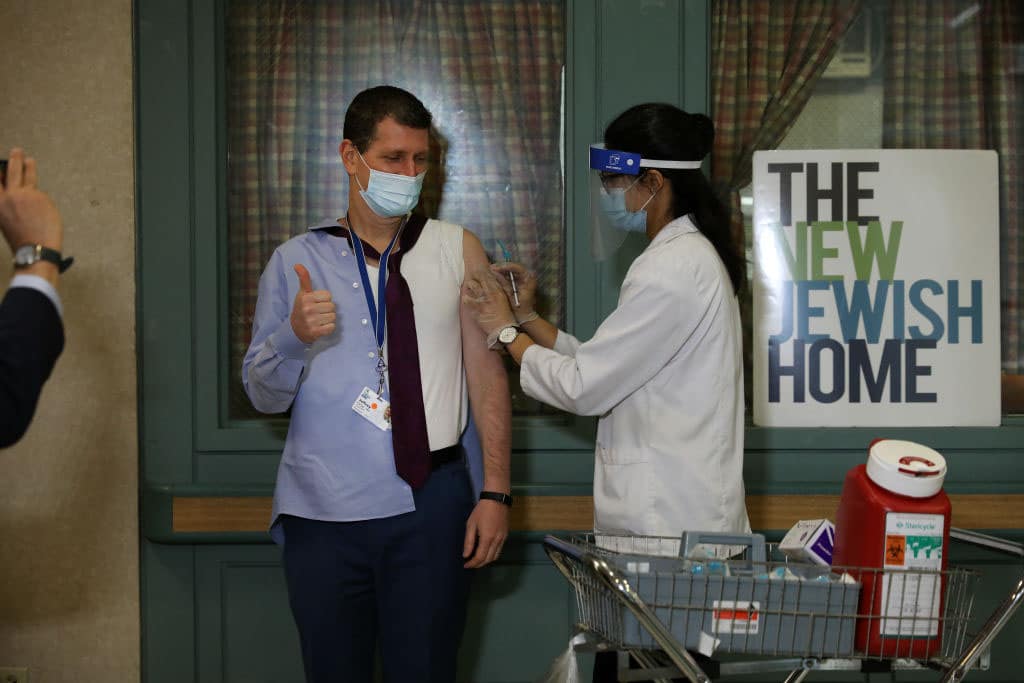
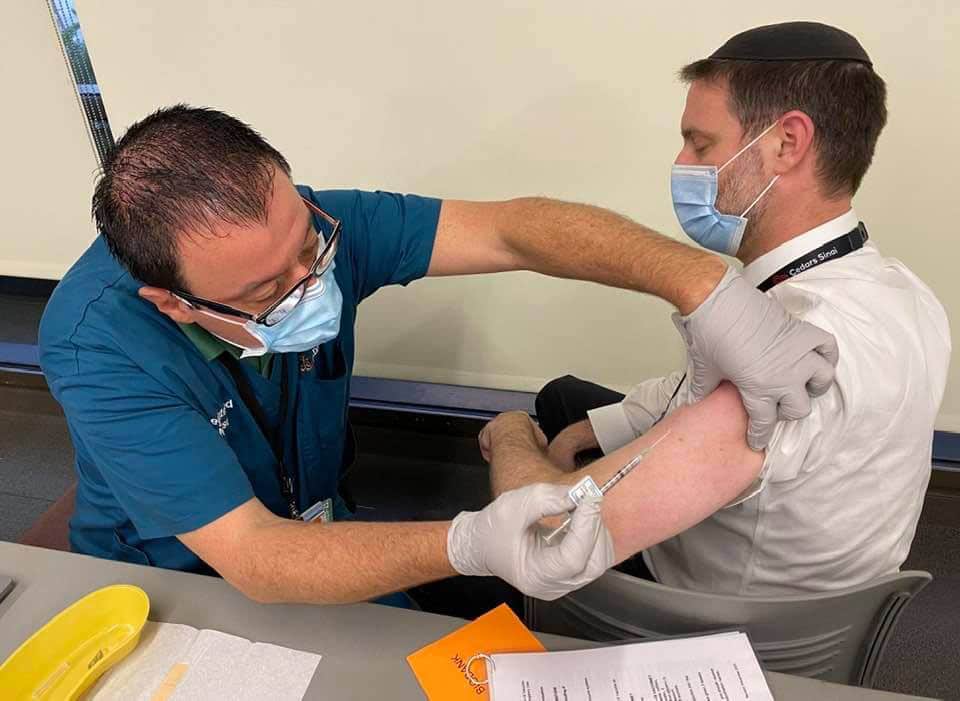
When the COVID-19 vaccinations rolled out in Los Angeles the week of December 13, Jewish healthcare workers were some of the first in line to receive it.

Rabbi Jason Weiner, senior rabbi and director of the Spiritual Care Department at Cedars-Sinai in Los Angeles and rabbi of Knesset Israel Synagogue of Beverlywood discussed his experience getting vaccinated on Facebook and posted photos of the vaccine being administered to him.

On his page, Weiner wrote, “I recited this blessing (in Hebrew) as I received the COVID vaccine today: ‘Blessed are You, Lord our God, King of the Universe, who is good and does good.’ I’m cognizant of my privileged access to the vaccine at this time, as a healthcare worker, which obligates me to show extra concern and care for those who are not as privileged. The virus is spreading horribly right now, and the situation is very severe. The emotions are thus mixed and complex, but as Chanukah draws to a close, there is finally light at the end of the tunnel.”

Later, in an interview with Journal, Weiner said that he’s seen horrible suffering, pain and death, as well as exhausted and overwhelmed healthcare providers and he’s desperate for the pandemic to be over. “The vaccine is our best hope right now. I know a lot of people are not sure if they want to receive it or not, so I want to be a role model to encourage people that it is safe and important to do. I see how this is finally giving hope and inspiration to the staff at the hospital now and I hope that it can do so for broader society as well.”

“I see how this is finally giving hope and inspiration to the staff at the hospital now and I hope that it can do so for broader society as well.” — Rabbi Jason Weiner

Weiner is not alone in wanting to stop the spread so that things can get back to normal. Dr. Zaza Atanelov, an ER doctor in Long Beach, Orange County and Encino who also got the vaccine the week of December 13 said that once healthcare providers get the vaccine and less of them contract COVID, then hopefully they won’t accidentally give it to their patients either. “When everyone gets it, my kids can see their grandma and grandpa and not feel stressed that they gave them COVID and we can live normally. I see that in the future.”

Melanie Hannah Bemel, an RN who works in the post anesthesia care unit, said that because of her job, she feels it’s a prudent decision to get vaccinated. “It makes sense to receive it. We are vaccinated against the flu, and deaths from the flu have been reduced since the development of the vaccine. It stands to reason that getting vaccinated against COVID would show similar results.”

Contributing writer to the Journal and an RN at Saint John’s Health Center in their Med/Surg unit Boaz Hepner said that once he’s back on the job after his medical leave, he’s going to get the vaccine right away. “I’m so excited and relieved that vaccines are here, and feel that every one of us has a moral responsibility to take them, as I’m confident they are safe and effective. [It’s] not enough to socially distance and [wear a] mask. The vaccines are not just helpful, they are crucial.”

While many news stories are focused on deaths from COVID-19, Scott Topiol, a registered nurse in an emergency department at a hospital who teaches CPR and first aid at CPR Ready, said that the death rate doesn’t tell the whole story. Topiol spoke to a neighbor who had COVID in April and still hasn’t gotten his sense of taste back.

“While there might be some questions about the long-term efficacy of the new vaccines, we for sure know that even those that recover from COVID don’t always return back to normal,” said Topiol. “For me, the benefits of the vaccine far outweigh the risks of COVID.”

Some of the risks may include side effects like allergic reactions, or a sore arm, like Topiol and Weiner experienced. One day after getting the vaccine, Weiner posted on Facebook that he had a sore shoulder, but three days later, he was feeling healthy and went for a 10-mile run. Topiol said that after receiving his first dose of the Pfizer vaccine, his arm was sore, but already it feel much better the next morning.

“The short-term safety of this vaccine is well established,” he said. “People will say it was developed too fast to know but the truth is that no steps were skipped in the trial and I’m 100% comfortable with the vaccine’s safety profile. Most of the delays in traditional vaccine development are due to the vaccination method and even more so the bureaucracy involved. Since the red tape was cut it allowed scientists and doctors to do their work without having to slow down for the pencil pushers.”

Even though healthcare workers are currently getting the vaccine, it may not be available to the general public for several months. In the meantime, Topiol urged everyone to stay vigilant and safe while waiting for the pandemic to come to an end. “I beg you to take this seriously, wear your masks properly and, as painful as it is, really avoid social gatherings until the storm passes,” he said. “This too shall pass.”

Jewish Healthcare Professionals Get the COVID-19 Vaccine in LA Read More »

GA Senate Candidates Write Appeal to Jewish Voters

(JTA) — Jon Ossoff, Raphael Warnock and David Perdue all responded to the Atlanta Jewish Times’ call for them to publish letters in the publication aimed directly at Georgia’s Jewish community ahead of their closely watched runoff elections for U.S. Senate seats.

Kelly Loeffler followed suit but decided not to publish hers in the Times, publishing a statement on her website by her deputy campaign manager on Saturday instead.

The two races, which take place Jan. 5 and will determine control of the Senate, have featured contentious Jewish issues, and the candidates’ statements all addressed them.

Ossoff, the lone Jewish candidate, who noted in his letter that he was “raised among relatives who survived the Shoah,” called his Republican opponent Perdue “a virulent and unrepentant anti-Semite” for elongating Ossoff’s noise in a campaign ad and not issuing a public apology.

“A U.S. senator who uses ancient anti-Semitic imagery to inflame hatred against his Jewish opponent must be crushed by Jewish voters on Election Day,” the Democrat Ossoff wrote.

Warnock, whose positions on Israel have been criticized by Republicans, wrote that while he supports the First Amendment right to protest and is “deeply concerned” about Israeli settlement expansion, he firmly opposes the boycott Israel movement and what he called its “anti-Semitic underpinnings.” He also wrote about the historic ties between his church, which is Martin Luther King, Jr.’s pulpit, and the Atlanta Jewish community.

Perdue led his letter with praise for President Trump’s Israel policy but also claimed that “fighting anti-Semitism in all forms and at all levels” has been his priority and argued that the BDS movement “has served as a catalyst to the rising frequency of attacks against Jews.”

Loeffler similarly lauded Trump’s Israel moves, such as moving the U.S. embassy from Tel Aviv to Jerusalem, but spent a large portion of her statement attacking Warnock, who she described as “the most radically liberal candidate anywhere in the country.” She said Warnock would “add yet another voice to the anti-Israel cadre in Congress,” mentioning Reps. Ilhan Omar and Rashida Tlaib, who unlike Warnock support the BDS movement.

Loeffler has been dogged by criticism that she has ties to anti-Semitic movements. She campaigned before November with Marjorie Taylor Greene, who would become the first member of Congress who has boosted the QAnon conspiracy theory. And last week a photo of Loeffler posing with a known white supremacist circulated online. She claims she did not know who the man was while posing with him.

Find links to all of the full Atlanta Jewish Times letters here.

GA Senate Candidates Write Appeal to Jewish Voters Read More »

How to Revolutionize Jewish Schools

For decades, Jewish communities, institutions and individuals have failed to fix the elephant in the room — the quality of Jewish education. Although many Jewish day schools boast excellent secular studies, Hebrew and Jewish studies have faced a tsunami of challenges, many of which have been exacerbated by the global pandemic. These include the difficulties of recruiting and retaining teachers, lack of a clear vision or suitable curricula and a lack of funds.

Many, if not most, schools are aware of these challenges. Dedicated boards, leadership teams and teachers work tirelessly to grapple with these challenges to improve their schools, bit by bit. They follow a model of incremental changes, both because it demonstrates some success and because they lack the resources to take a paradigm-shifting approach. But the problem with making change incrementally is the risk that any changes may still be subject to the existing infrastructure — which might itself be the core problem.

But the informal Jewish education sector — that is, the various educational organizations outside of the school system — has taken the opposite approach. Birthright Israel, long-term Israel programs and the Jewish camping world are just a few examples of organizations that have brought in some genuinely ground-breaking initiatives and significant educational resources over the last 20 years. Their backers and innovators realized that the “incremental change” model was no longer working.

Although these organizations did not invent new ideas, they did work out how to scale them up, improve their innovative culture and attract significant funding in the hundreds of millions of dollars. They marketed their brand so it would be easily recognizable. They also set very high safety and logistics standards and required their guides to undergo formal training, thereby turning pre-existing good programs into excellent ones.

It is time for Jewish schools to learn from the informal sector’s example and consider how to usher in dramatic changes to Hebrew and Jewish studies. And changes are sorely needed. When it comes to secular curricula, governments and other public bodies (in most countries) set standards, provide resources and train teachers — oversight that results in an outstanding quality of resources. But Jewish and Hebrew studies do not have the same guidance from a centralized government, organization or school system, often causing their curricula to suffer in comparison.

Let us be clear: it is not Jewish and Hebrew studies teachers who are the problem. They are, in most cases, desperate to succeed, feeling the burden of expectation placed upon them by Jewish history as well as leadership, parents and the wider community. But schools struggle to raise sufficient funds for training and new resources, and even when they do, there is very little evaluation or benchmarking available to help them know what works.

One solution seems simple: why not create a similar infrastructure for Jewish studies? But unlike secular studies, there is no “one size fits all” model for Hebrew and Jewish studies, as they are offered within day schools that vary in denomination, philosophy and observance. This quandary has made it increasingly clear that large, drastic changes — like those the informal education sector can provide — are necessary to “reboot” the formal Jewish educational sector to help it reclaim its status and standing.

Large, drastic changes — like those the informal education sector can provide — are necessary to “reboot” the formal Jewish educational sector.

In the work of the World Center for Jewish Education (where I am the director), we are in regular contact with hundreds of Jewish teachers across the globe. Our experience and expertise have taught us that we need a central hub — an educational start-up. Organizations like Birthright have shown us that it is possible to dramatically change education with a small, smart and creative team. Our approach is inclusivist and specialized, designed to help each school fulfill its unique vision. Because of our experience and ability to maintain continuous communication with schools, we are able to focus on identifying each school’s immediate needs and supply the necessary solutions. We help ensure that Jewish schools, wherever they are on the religious spectrum, can demonstrate that Jewish and Hebrew studies are treated with the same degree of respect and care as secular studies.

Our hub provides:

    • Educational resources — Selected curricula from the best providers around the world with outstanding training and mentoring for teachers to implement them effectively
    • Strategic planning for leadership teams to ensure that their school has the vision and strategy to suit the needs of their students and families in their community
    • Fundraising consultancy and cost-saving initiatives to assist with both resource development and access to multi-school purchasing
    • Measurement and evaluation of teaching, curricula and learning outcomes to prove impact and improve standards
    • Marketing and branding to craft a strong narrative to represent each school effectively to multiple stakeholders and assist with student recruitment

Our Hub will operate as a small, focused center that examines the suitability of various programs and makes recommendations based on individual schools’ needs. We will provide funding to other organizations to develop or improve educational resources. We will also work with schools on specially-tailored programs, ensuring that Jewish studies and Hebrew teachers are equipped with the resources and support they need so every student can emerge as proud and active members of the Jewish community. This approach will require the synchronised strategic planning of educators, philanthropists, community leaders and the Israeli government.

We brought our “Hub” idea to school heads and Jewish/Hebrew Studies programs across the world and asked for their feedback. We have carefully considered the positive and constructive criticism, and our challenge will be to meet the expectations of our supporters and to demonstrate to the thoughtful critics that we are able to meet the challenges. We will continue the dialogue with both groups.

Resolving the dilemma of evolution or revolution in our approach to Jewish education in schools is a critical challenge that we believe can be navigated by a hub. The stakes could not be higher: hundreds of thousands of children study in Jewish schools around the world, and we need to show how vital this education is for the ongoing flourishing of the Jewish people. The best chance we have of creating future generations of active, literate and caring Jews is when our schools are able to generate a culture of innovation and excellence supported by stable infrastructure and sound finances. Luckily, we at WCJE have the educational vision and know-how to make it a reality, and we invite you to be our partner in this essential and exciting endeavor.


Mickey Katzburg is the director of the World Center for Jewish Education and an educational innovator with more than 20 years of experience in Israel and abroad.

How to Revolutionize Jewish Schools Read More »