fbpx

October 21, 2020

How The First Verses of the Torah Came to be Written – A Conjecture

“How did things get this way?” is probably one of the first things that ancient human beings asked. Not most of them, for sure. Like today, most people have enough to do trying to figure out and deal with what is happening right now. There has always been some subset of people, however, that asked “how” and “why” and “what for?” How did the universe get here? Why was the universe created? For what purpose? These questions ultimately come down to: why am I here? And what is my purpose?
I imagine some ancient person sat very quietly one day, looking at the sky and the ground and sea, and all the denizens thereof, and asked a fundamental question: Has it always been this way? If not, how did this come about?
This mythical ancient human being that I have conjured up had already heard other theories: “primordial gods at war with each other” or some other complex story. That was all hearsay. No one saw it.
My original ancient philosopher had Occam’s instinct, probably before anything like a razor had been crafted. William of Occam (or Ockham, 1287-1347), you will recall, was an English philosopher and theologian. As a philosopher, he, like many others before him and after him, liked the rule of parsimony: the fewer, the better. John Punch, a later philosopher, probably said it best: “Entities should not be multiplied beyond necessity.” Some philosophers, like William of Occam and John Punch, enjoyed giving philosophical arguments a nice, close shave (hence, “Occam’s Razor”). Keep It Simple, Sunshine.
My ancient philosopher contemplated reality, considered the mythical stories, and rejected them. This philosopher concluded: It all comes from one source. Why suppose many gods when one can suppose one God as the origin of existence?
This ancient, prehistoric philosopher that I am imagining had the great fortune of having a friend, less philosophic, more mystical. The philosopher inferred a singular origin. The mystic intuited the nature of this Singular Origin of All Reality. “The Oneness permeated all,” the mystic said, “and this Oneness was alive in depths of the human being.”
The philosopher and mystic then went over to a sympathetic poet and shared their findings. This poet, fortunately, was not mesmerized by ancient myths of origins. Maybe this poet was a proto Leonard Cohen; a composer of sparse and simple lines, but somehow packed with a stunning, sinewy strength.
The philosopher, the mystic and the poet conferred for many years.
The philosopher: It all comes from One Source.
The mystic: This Source pervades all reality, and rumbles in the human soul.
The poet:
At the beginning of the Nameless One’s creating
Reality was an astonishing, wondrous, formless emptiness.
A Divine wind appeared over the liquid expanse –
And the Nameless One spoke.
I think the philosopher and the mystic were impressed and even very moved. They said, “Let’s talk some more, and then write this up.”
They wrote it up and memorized it and read it with other philosophers, mystics and poets. They formed a group and finally decided on a name: the Knowers of the Nameless One. They loved the irony: knowing that which cannot be known but must be found. They let other philosophers, mystics and poets in the group. The expanding group found the poem so beautiful that they memorized it. The philosopher, the mystic and the poet each found a suitable replacement as they faced the end of their days. The group, the Knowers (for short), expanded. The poem, in its depth, beauty and precision, grew over generations. The poem was hidden for centuries. They feared that dullards would read it and talk about it and thus ruin the exquisite experience of the Presence that was evoked when the ever-growing poem was recited.
This secret school of philosophers, mystics and poets (long before these foundational archetypes of human thought stopped working together) never claimed that this living word, with roots and branches and a wind moving through the murmuring leaves, was the spoken word of God. God did not dictate it.
The truth of the poem was not because God spoke it to them, but because the Presence brought the philosopher, the mystic and the poet together, and that Nameless One, a Presence that pervades reality, rumbles in the soul, and is the origin of speech and poetry, spoke through them.
I think the early listeners were able to infer a hidden message in the poem: The human being itself is a self-writing poem, seeking to understand itself, with the Divine as a prodding witness.
The truth of the poem lay in its power to enrapture those whose souls had something of the philosopher, the mystic and the poet knotted within.
(Later people said, “It is the revealed Word of God!” without bothering to tell anyone that the poem actually never says that.)
Shabbat Shalom,
Rabbi Mordecai Finley

How The First Verses of the Torah Came to be Written – A Conjecture Read More »

Kadima Receives Go-Ahead for In-Person Learning

Kadima Day School in West Hills announced Oct. 21 that it is one of four schools in Los Angeles County to open in-person learning. The waiver the religious school received from Los Angeles County says they can open classes for Kindergarten, first and second grades.

“We just received the news last night and we are already busy preparing the detailed plan to have our 1st and 2nd grade students return to campus as soon as possible,” Dr. Steven Lorch, head of school said in an email sent out to families. “Thank you, as always, for your patience, flexibility and support.”

According the the DPH’s website, since Los Angeles County remains in Tier 1 (Widespread Community Transmission) on the state’s Blueprint for a Safer Economy, most schools must remain closed to in-person instruction with some exceptions. The waiver opportunity allows some schools to bring back some grades upon approval by Public Health. No more than 30 schools will be granted approvals each week.

Rabbi Jacob Pressman Academy of Temple Beth Ann has also been granted a waiver.

Kadima’s statement told parents they will be notified in the upcoming days to review COVID-19 protocol, prepare students for their return and answer any remaining questions.

Kadima’s statement told parents they will be notified in the upcoming days to review COVID-19 protocol, prepare students for their return and answer any remaining questions.

Many schools closed in-person learning opportunities in March because of the pandemic. A Sept. 11 L.A. County Department of Public Health notice said some k-12 schools in the country may be eligible to reopen in-person learning with 10% enrollment. All schools wishing to be enrolled but be in compliance with the L.A. County DPH K-12 School re-opening protocol checklist.

According to an additional submission form list updated Oct. 19, more than 50 schools in the area have also applied to reopen in person for specialized services including Abraham Joshua Heschel Day School, Adat Ari El Day School, Beth Hillel Day School, Brawerman Elementary School of Wilshire Boulevard Temple-West, de Toledo High School, Sinai Akiba Academy, and Wise School.

Mark Shpall, head of school at de Toledo, told the Journal Oct. 22 that they started to bring back students last week at 10% capacity for social and emotional work. They started with their ninth graders with outdoor team building since they had never seen the campus or met fellow peers in their grade. The school can only bring back 40 students at a time with 12 people capacity in each divided group.

“There were some people that were a little bit nervous at first but the kids were so happy to see each other,” Shpall said noting that teachers even saw an improvement during classes following in-person programs. “[The services] really did what we were hoping to do on a social and emotional level.”

UPDATE: This story was updated on Oct. 22 to include information about de Toledo High School and the specialized service form.

Kadima Receives Go-Ahead for In-Person Learning Read More »

A Mother’s Coping Mechanism: “I Put the Sun in Me”

In the world of words and ideas in which I swim, occasionally I will hear or read a line that pierces through me.

I heard one yesterday.

I speak to my mother, who lives in Montreal, pretty much every day. Among our many subjects — family, food, virus, food, food, family, etc. — is, of course, the weather.

My mother loves the sun. It reminds her of growing up in beautiful, sunny Casablanca. Living through frigid Canadian winters for so long has only reinforced that love.

Invariably, during our chats I will ask her if the sun is out. Yesterday, the sun was definitely not out. So, perhaps to make me feel better and keep the conversation upbeat, she blurted out (translated from French):

“I put the sun in me.”

There was something awkward about the phrase, which is perhaps why it caught my attention. She didn’t use the cliché of “I’m grateful for life’s blessings,” which she often does. This time, she pushed the envelope and put a great big ball of warmth and light inside of her.

Maybe it was her way of saying, “Life in quarantine can get pretty lonely for an 87-year-old great grandmother. When the sun is out, it really boosts my day. But today there is no sun, and I don’t want to feel down. So I need to find another way. I will put the sun in me.”

The very act of saying that line put the “sun” inside our conversation and kept it upbeat.

The very act of saying that line put the “sun” inside our conversation and kept it upbeat. It also probably guided her day to look for “sunny” things to do and think about.

The sun shines almost every day in Los Angeles. I rarely ever need to put the “sun in me.” But I wonder: Whose sun shines brighter?

A Mother’s Coping Mechanism: “I Put the Sun in Me” Read More »

The Shepherd’s Pie Tradition

Every Friday morning, my phone would ring.

“Boker Tov!” my grandmother would greet me. “You’re coming for dinner?”

“Of course,” I would reply.

“You’re making Shepherd’s Pie?” She would ask, knowing the answer.

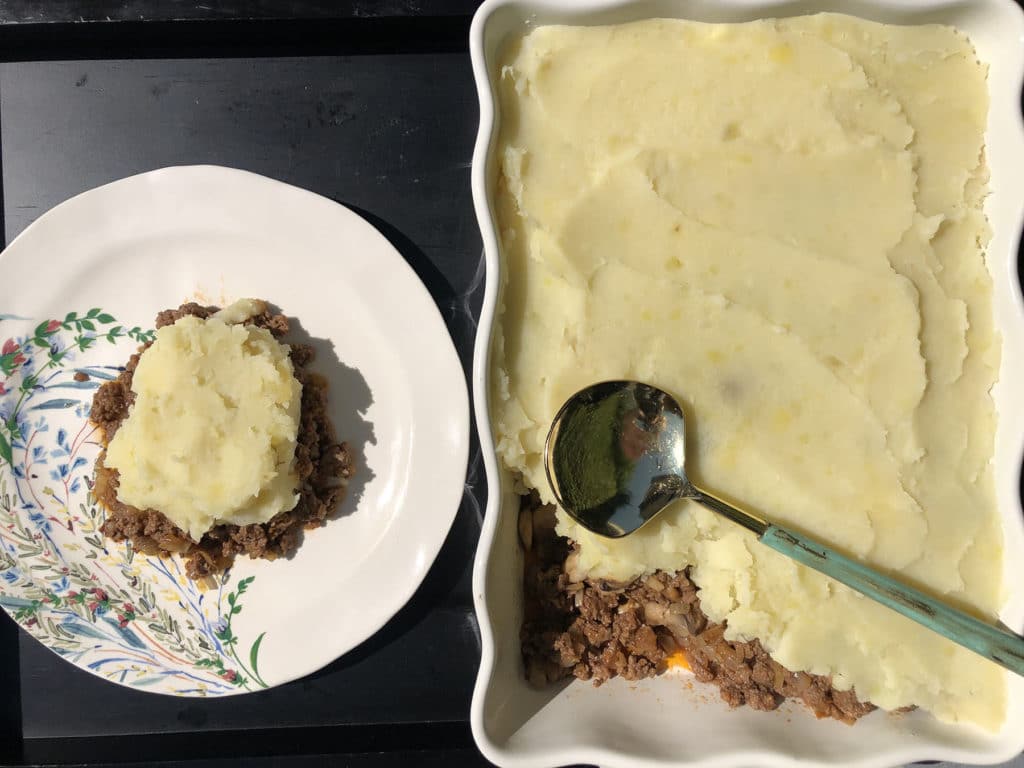
And every Friday night, I would have the honor of going to my grandparents home with my husband, my son Ariel, my three young daughters and a Shepherd’s Pie in tow.

My grandmother, Nana Aziza, was an amazing talent in the kitchen, but she never made Shepherd’s Pie. My mother and my aunt Rebecca mastered the art of the Shepherd’s Pie when my family moved to Sydney, Australia and it quickly became a family favorite.

While Shepherd’s Pie is the quintessential English dish—a perennial on the Pub menu and the ultimate meat and potatoes comfort food—it must have reminded my Iraqi grandparents of Moussaka, a casserole made of ground lamb that includes eggplant. And while Moussaka is a Greek dish it is very popular throughout the Middle East, the Levant and the Balkans.

My Sephardic Spice partner Rachel makes a truly delicious Spanish version called Pastel de Patata, layering turmeric spiced mashed potatoes with an onion and ground meat filling, topped with sliced hard boiled eggs and another layer of creamy mashed potato.

The Moroccans make pastel. The French make everything fancy and their version is called hachis Parmentier. But they include Parmesan and Gruyere cheeses and copious amounts of butter, rendering it unsuitable for the kosher kitchen. My South African in-laws call this dish Cottage Pie. My mother in law keeps it simple with a deliciously flavored ground beef and mashed potato topping.

Shepherd’s Pie is traditionally made with ground lamb and often features carrots and peas, herbs like thyme and rosemary, as well as Worcestershire sauce. Real Worcestershire sauce is flavored with fish which means kashrut wise, it can’t be used in a meat dish.

Over the years, the family Shepherd’s Pie has evolved and my current incarnation is truly a blend of East meets West. My spice profile includes an exotic blend of allspice, cinnamon, turmeric, paprika, garlic powder, cardamom and nutmeg.

Over the years, the family Shepherd’s Pie has evolved and my current incarnation is truly a blend of East meets West. My spice profile includes an exotic blend of allspice, cinnamon, turmeric, paprika, garlic powder, cardamom and nutmeg.

I caramelize lots and lots of onions. I sauté mushrooms and roast eggplant. I always use ground beef. And I slather in some Charbeque brand barbecue sauce to add a sweet, tangy mesquite flavor.

I also came up with a shortcut to making the creamiest, dreamiest mashed potatoes, which involves chopping the potatoes in small cubes, filling the pot with cold water and seasoning with salt, garlic powder and olive oil.

Of course, life always takes a twist and a turn: my son is now vegetarian, but he still craves Shepherd’s Pie, so I sometimes use Impossible meat or Beyond Beef as a substitute.

Shepherd’s Pie is a hearty delicious dish that is perfect for your Friday night table.

Make it a family tradition and hopefully, one day your granddaughter will make it for you.

Shepherd’s Pie

Beef filling

1/3 cup vegetable oil, divided

6 onions, finely chopped

1 1/2 pounds ground beef

1/2 cup Char-B-Que Barbecue Sauce

2 tablespoons tomato paste

2 tablespoons soy sauce

1/2 teaspoon allspice

1/2 teaspoon paprika

1/2 teaspoon turmeric

1/2 teaspoon garlic powder

1/2 teaspoon cinnamon

1/4 teaspoon cardamom

1/4 teaspoon nutmeg

1 large eggplant, salted, drained and diced

1 pound mushrooms, cleaned and sliced

Mashed potatoes

8 large potatoes, peeled and cubed

2 cups water (more or less)

3 tablespoons olive oil

1/2 teaspoon kosher salt

1/2 teaspoon garlic powder


Preheat oven to 350 F.

Heat small amount of oil in a large pan and sauté onions till soft and golden.

Place onions in large baking dish.

Heat small amount of oil, add beef and sauté using a wooden spoon to break into small pieces.

Add barbecue sauce, tomato paste, soy sauce and spices, stirring thoroughly.

Add meat mixture to the onions and mix well.

Arrange diced eggplant on baking sheet, drizzle with oil and roast 15-20 minutes until golden.

Layer on top of the meat.

Sauté mushrooms in oil and layer on top of roasted diced eggplant.

In large pot, place potatoes and add water until level is halfway up potatoes.

Add olive oil, salt and garlic powder.

Cover pot and bring to a boil, then turn to lowest heat and simmer until potatoes are fork tender, about 15 to 20 minutes.

Mash potatoes till soft and creamy and spread atop meat and eggplant.

Bake uncovered 1 hour.

Serves 10-12.


Rachel Sheff and Sharon Gomperts have been friends since high school. They love cooking and sharing recipes. They have collaborated on Sephardic Educational Center projects and community cooking classes. Follow them on Instagram @sephardicspicegirls and on Facebook at Sephardic Spice SEC Food.

The Shepherd’s Pie Tradition Read More »

Brooklyn Kosher Café Cited for Keeping Doors Open

A kosher café in Brooklyn was cited on October 20 for keeping its doors open.

In a video that has gone viral on social media, the owner of the Mixed Greens Kosher Café can be seen arguing with a city inspector about being given a summons.

“There’s nobody sitting in the restaurant,” the owner, who was recording the video, said. “Everything is okay. You’re giving me a ticket because my doors are open? What if my store is hot? I’m not allowed to open the door because the store is hot?”

The owner then decried the summons as unfair.

“I’m struggling here every single day,” the owner said. “It’s hard for me. And there was nobody inside the store obviously because we don’t have dine-in. We only have take-out. There was nobody in the store, and I’m only getting a ticket because my doors are open.”

The inspector then replied, “In a red zone, you’re only supposed to do pickup and delivery at the door.”

Areas are the in red zone are subjected to the toughest COVID-19 restrictions under Democratic Governor Andrew Cuomo’s metric system.

https://twitter.com/SVNewsAlerts/status/1318712788613738497?s=20

The Orthodox Jewish news site Vos Iz Neias reported that the undercover inspector had walked into the café and asked the owner, identified as Mike, if he could sit down and eat. Mike told him that the café wasn’t open for dine-in, and then the alleged inspector issued the summons for a January court date.

New York City Councilman Chaim Deutsch told Vos Iz Neias that he looked at a copy of the summons, and it stated that the café was cited for not keeping “the door closed for pedestrian traffic.” Deutsch said he asked Mayor Bill de Blasio and the city’s Department of Health; the Department of Health said they would review the regulations and get back to him. Since then, neither the department nor de Blasio have gotten back to him.

“It is unconscionable that the city and state are continuing to harass small business owners, already struggling to survive due to the COVID shutdowns,” Deutsch said. “Thousands of businesses have been forced to permanently shut their doors, and many others are on the brink. Instead of the local government directing resources to support these businesses, they are instead pursuing bogus violations and petty fines against them. Shameful and despicable behavior from local agencies.”

A spokesperson for city’s Department of Health said he would get back to the Journal on the matter; de Blasio’s office did not respond to the Journal’s requests for comment.

Deutsch tweeted out Mike’s video of the inspector issuing the summons and urged people to support the café.


City Councilman Kalman Yeger tweeted, “This is the harassment being inflicted on the law-abiding businesses in our community by the mayor and governor. There are hundreds of stories exactly like this.”

On October 20, de Blasio issued an apology for how the city has dealt with rising COVID-19 cases in Orthodox Jewish communities in the city, acknowledging that “more dialogue would have been better.”

Larry the Cable Guy, born Daniel Lawrence Whitney, also weighed in.

“Man this is ridiculous,” he tweeted. “Our elected officials are outa [sic] control.”

Deutch later tweeted that the café “has been fielding hundreds of calls from supporters across the USA. It’s heartwarming to see how Americans have banded together to offer kindness.”

UPDATE 1: A spokesperson for the Department of Health told the Journal that the man who gave the citation to Mike was not an inspector and referred the Journal to de Blasio’s office. De Blasio’s office did not respond to the Journal’s request for comment.

UPDATE 2: According to City Hall, the citation has been rescinded. Per state regulations, red zones allow bars and restaurants to continue takeout and delivery services.

Brooklyn Kosher Café Cited for Keeping Doors Open Read More »