(JTA) — Actor and comedian Sacha Baron Cohen said he will not post to his Instagram account on Wednesday in protest of parent company Facebook’s failure to fight hate.
Cohen made the announcement in support of the Week of Action organized by the Stop Hate for Profit campaign, which was spearheaded over the summer by the Anti-Defamation League, NAACP and several other civil rights groups. The groups are protesting Facebook’s unwillingness to police hate speech or monitor posts for misinformation.
The tweet posted Monday by Cohen included a photo of Facebook CEO Mark Zuckerberg wearing whiteface. The message reads: “The only thing more terrifying than Mark Zuckerberg surfing in whiteface … Is the white supremacy and lies Facebook spreads every day. This Weds Sept 16 I’m freezing my Instagram to tell Mark to #StopHateForProfit. Who’s in?!”
Cohen has been a public critic of Facebook, which he called “the greatest propaganda machine in history” last November in a speech after receiving an international leadership award from the ADL. He added that “if Facebook were around in the 1930s, it would have allowed Hitler to post 30-second ads on his ‘solution’ to the ‘Jewish problem.’”
The only thing more terrifying than Mark Zuckerberg surfing in whiteface…
Is the white supremacy and lies Facebook spreads every day.
This Weds Sept 16 I’m freezing my Instagram to tell Mark to #StopHateForProfit.
Twenty-six-year-old identical twins Adeev and Ezra Potash are renaissance men. Despite their youth, the brothers already have found success in both jazz performance and the culinary arts.
As teenagers, the brothers from Omaha, Nebraska, studied under jazz legend Wynton Marsalis and Jon Faddis, as well as at SUNY PurchaseCollegeand the Manhattan School of Music, and placed second in the Chinese version of “America’s Got Talent,” which led to performing around the world.
While in Asia, a team of cameramen followed them as they tried new and bizarre foods, which brought about a career that allowed them to merge their passions for both music and food, with three television shows already under their belts: Travel Channel’s “Southern Road Trip with The Potash Twins,” Bravo TV’s “Beats + Bites” and now Food Network’s “Takeout Twins,” which launched Sept. 2 on the Food Network Kitchen App.
“When you take a bite of food, what are the first things that come to mind? ‘Smooth,’ ‘texture,’ ‘balance,’ ‘harmony’ —these are all things that are used to describe music,” Adeev told the Journal in a joint Zoom interview with Ezra from their Palm Springs home.
Hosts Ezra and Adeev Potash play their instruments on Season 1 of Takeout Twins. Photo by Victoria Agromayor.
Growing up, the twins said they were bored with the “Midwest palate” and were curious to learn about how food is made and eaten around the globe. Raised by a mother who constantly traveled internationally for work, they learned about other cultures and food through her.
“Instead of her bringing us back souvenirs, we asked her to bring us whatever shelf stable food she could bring because we were always curious [about], ‘What do they eat where you’re going?’ ” Adeev said.
As a result, the brothers were introduced to mochi, dim sum, Indian and Vietnamese curries, and pad see ew. They also grew up eating and cooking kosher food with their grandmothers: challah, matzo ball soup and matzo brei were the first recipes they remember creating. Another was their “world famous” spicy mayo, which they packaged, bottled and distributed at Herzl Camp in Wisconsin. “Our spicy mayo was famous,” Adeev joked. “[Our] wasabi mayo had critical reception.”
From poutine and cherry pie latkes to a “gazpacho borscht with avocado crema,” (which they came up with during this interview), the twins brainstorm wherever they go.
Like music and food, they say Judaism is an extension of who they are. Their father, a former director of the Anti-Defamation League Texas and current CEO of the Jewish Federation of Omaha, ensured that they upheld Jewish rituals and included them in their lives.
“We were very, very comfortable getting up and leading the Birkat [ha-Mazon] (grace after meals),” Ezra recalled. “So it wasn’t that much of a transition for us to performing because we were already doing that.”
One of the things that makes “Takeout Twins” special to the brothers — or Potashim as their friends like to refer to them — is that they get to show people how easy it is to re-create their favorite takeout dishes. They developed the 10-episode series to see if home cooks could make a recipe “equally as good if not better than” the takeout alternative, so they selected the top 10 most ordered takeout dishes, including pizza, tacos, butter chicken and matzo ball soup.
“We would be touring [as musicians] and eating all around the world,” Ezra said. “We’d get home and we would be craving something we’d eaten abroad that we couldn’t order. What we were doing was trying to re-create those dishes at home the best we could.”
“It’s about working with what you have and being resourceful,” Adeev added. “Through our travels, we’ve learned a lot about the authenticity of these dishes. We aren’t trying to make the most authentic butter chicken. We’re making our version the way we like it with the lens of, ‘Can someone who isn’t us make this dish and also be happy?’ ”
Hosts Adeev and Ezra Potash with chef Andrew Zimmern, as seen on Takeout Twins season 1. Photo by Victoria Agromayor.
A common pastime for the brothers was watching James Beard award-winning TV personality and chef Andrew Zimmern. “My dad said, ‘That job. If you could get that job, that would be the coolest job on the planet.’ I was like ‘OK,’ ” Ezra said. And while the family kept kosher,their father told them they could eat treif only with Zimmern. So when the twins met him in 2012, Zimmern invited them to his home for Thanksgiving. “We get to his house,” Ezra recalled, and “he has so much treif.”
“It was basically the kingdom of treif on the kitchen countertops,” Adeev said. “[Zimmern] said, ‘Now this can go down one of two ways. You can either eat it in front of me and we can talk about it or I can step in the other room for plausible deniability.’ We wanted him there. This was a big moment for us. … He was kind of breeding us for what we are doing now.”
Since then, Zimmern has taken the twins around the country, introducing them to bizarre foods. He’s also an executive producer on “Takeout Twins” and they use Zimmern’s matzo ball soup recipe in Episode Two. The brothers constantly refer to him as their “food dad.”
In an email to the Journal, Zimmern said, “Right away [the twins] had something special going on. They were world-class musicians, extremely smart, very funny, loved food and had 90-year-old grandfatherly sensibilities stuffed into their then teenage bodies. … Ez and Dee are my friends, but my production company Intuitive Content gets to make TV with them, so it’s very rewarding. Seeing them have success fills me up. God knows how hard they work at it, and they deserve all the accolades. As far as being their food dad, well, not the greatest moniker in the world, but I am flattered and honored. I was hoping for food rabbi, but maybe they are saving that for later.”
Right now, Rosh Hashanah is on the twins’ minds. They say it’s their favorite holiday because it is food-heavy and packed with symbolism. “There is a real vibe that comes with leaving shul and being like, ‘We’re about to feast,’ ” Adeev said. “To this day, I don’t know if I’ll be able to re-create that feeling in anything I make.”
Round sweet challah, apples and their father’s famous dill salmon are their favorites, and the brothers are adamant that sweet kugel is the only way to go. No discussion. Joking that they are the best fasters on Yom Kippur for being big foodies, a strange tradition they have is watching cooking shows in between services.
“The second we get home from services, Food Network’s on,” Adeev said. “Little did we know we’d become the people that people would watch on Food Network when they returned from Yom Kippur services.”
The full season of “Takeout Twins” is available on the Food Network Kitchen App. For more on the Potash twins, click here. Follow the Potash twins on social media @potashtwins.
If you needed more proof that history doesn’t follow a script, look to the Sept. 15 White House ceremony, celebrating treaties between Israel and the United Arab Emirates and Israel and Bahrain.
The timing is terrible. No one in Israel or the U.S. is interested in treaties. The virus takes away all the attention, with the remainder left for the November election. At a different time and under different circumstances, these treaties would make headlines around the world. But not today.
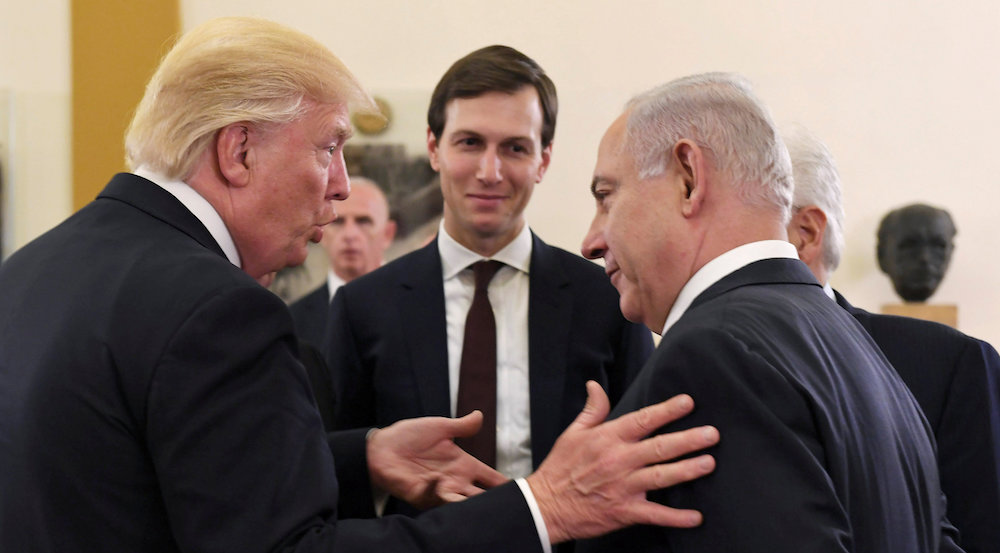
The players are also not the ones you would expect. You didn’t expect President Donald Trump or Prime Minister Benjamin Netanyahu to be peacemakers. They were supposed to play the role of enemies of peace — the anti-peacemakers. So what are they doing on the stage, signing documents? Where is the late Shimon Peres? Where is Bill Clinton? Where is the late Anwar Sadat?
And yet here they are, on stage, playing peacemakers and making speeches. This must be infuriating for their opponents. But history doesn’t follow a script. Sometimes things happen unexpectedly; initiated by unexpected players. This doesn’t make them good or bad.
For example: You receive a package. It is delivered by a rusty and noisy truck, carried by a driver who’s wearing a dirty shirt and smoking a cigarette. He’s rude and his truck drips oil on your driveway. But now the package is at your door. Do you like what’s in it? If you do, your disapproval of the delivery truck and its driver no longer matter.
This political package is a deal between Israel and two Arab countries who were not at war. So why should it be called a peace agreement? Because the basis of the Arab-Israel conflict is the notion — embraced for many years by almost all Arab countries — that Israel is an illegitimate entity in the Middle East. It is illegitimate for political reasons (Israelis are colonialists), or religious reasons (Israel is Jewish). Peace with Egypt in 1977 was so important because it put forth the idea that Israel is like all other countries in the region. You might disagree with it, you might even have a war over disagreements with it, but ultimately, when a specific dispute is resolved, you can have peace.
Jordan was the second country to accept Israel’s legitimacy and permanence. When peace with Jordan was signed in 1994, there was no real danger of war between the countries. Jordan was not seen as a military threat. And yet, signing a peace treaty signified a new state of mind — of coexistence. Like two normal countries living side by side. Like the U.S. and Mexico — not always best friends, not always in agreement, just neighbors, with all the ups and downs this entails.
Israel and the Gulf States are not neighbors. And yet, for decades, the Gulf States were members of the bloc of countries for whom Israel was considered a disruption. A thorn in need of removal. They were part of a bloc that refused see Israel as a permanent presence in the region. It was not war in any violent sense. But it was certainly not peace, and certainly not the normal relations between countries who have no shared borders but do have shared interests. Now these relations are becoming normal.
Of course, there are also many other benefits to having these normal relations. Beginning with the solidification of the coalition against Iran’s radical attempt to revolutionize the region, to having economic ties, to promoting tourism and personal ties. Normalcy is good. It is better than any fantasies conjured by the word “imagine.”
There are some observers who insist that this is not what they call a “peace” agreement (because there was no war). I think they are being petty. Their main interest is to make the achievement seem small. They do not want the rusty truck and the rude driver to get credit for delivering a worthy package.
In Israel, there are two groups who have misgivings about the agreements. The far right is upset, because peace comes with a price. In this case, a delay, or cancelation of annexation in the West Bank. The far left is upset because the peace doesn’t follow the prescribed script it was promoting for so many years. It is not focused on the Palestinians and was not delayed in an attempt to accommodate the Palestinians. In many ways it ignores the Palestinians.
Returning to the package metaphor: the rude driver delivered a package. It is a wonderful gift but not the one you expected. You can either enjoy the package you received and hope to get the other one at a later time, or you can feel miserable about getting the wrong wonderful gift.
It’s clear which path a good psychologist would recommend. But our imperfect nature makes such paths challenging. Our sages, not blind to human shortcomings, had advice for such moments. One of them, Ben Zoma, phrased it in the following way: “Who is rich? He who rejoices in his lot.”
More Jewish Journal articles on recent Middle East developments:
Rabbi Ashira Konigsburg is the chief operating officer at the Rabbinical Assembly (the international association of Conservative/Masorti rabbis). She earned an MA in Talmud and Rabbinics and was ordained by the Jewish Theological Seminary. A native of South Florida, Ashira spent her undergraduate years at the University of Maryland and has spent many summers in a variety of roles at Ramah Darom in Georgia, including directing the climbing program. She currently serves as a member of New York’s Kehilat Hadar Congregation board and steering team. She enjoys traveling, hiking and climbing.
We begin our conversation by looking at Nehemiah 8:
“On the first day of the seventh month, Ezra the priest brought the Teaching before the congregation, men and women and all who could listen with understanding. He read from it, facing the square before the Water Gate, from the first light until midday, to the men and the women and those who could understand; the ears of all the people were given to the scroll of the Teaching… Nehemiah the Tirshatha, Ezra the priest and scribe, and the Levites who were explaining to the people said to all the people, ‘This day is holy to the LORD your God: you must not mourn or weep,’ for all the people were weeping as they listened to the words of the Teaching.”