fbpx

September 1, 2020

Street Violence May Be the Issue of This Election

As we hurtle as a nation toward what promises to be the most divisive presidential election in modern history, apparently someone forgot to declare we’re in the throes of a civil war being waged on our city streets.

It is this social unrest, seemingly nationwide, with visible displays of lawlessness and disorder — burning businesses, looted stores, ransacked institutions, beheaded monuments and the killing and roughing up of fellow citizens — that may make this a single-issue presidential contest.

For a certain kind of voter aghast while watching the news, no platforms or policy planks will be necessary. Just make the images of shots fired, rampaging citizens and burning cars go away.

Last week’s Republican National Convention portrayed the United States as the set piece for a horror film. Violence was on a revolving loop. As if the optics couldn’t get worse, the fear factor was not helped by another police shooting of a Black man — on Aug. 23 in Kenosha, Wis. — followed by more protests in various cities and the killing of a white man in Portland, Ore.

For many living in red or swing states, or white suburban voters who liken cities to mugging mosh pits, “Making America Great Again” is going to need more than just a wall this time. Given today’s anxieties, greatness also will require doing something about the mayhem unleashed from and on these often-peaceful protests.

Law enforcement is at the very center of the maelstrom; indeed, its members are being blamed for it. There are daily referendums on how the police should do their jobs, or whether police officers should even have jobs. But if safe streets become the singular issue, then those calling for defunding the police are wielding the most insurmountable wedge issue of all.

If safe streets become the singular issue, then those calling for defunding the police are wielding the most insurmountable wedge issue of all.

On this, Republicans are united: The police are essential to maintaining law and order. “Make America Safe Again” soon may festoon the latest campaign cap. For those inside the Beltway, the political refrain will not be “It’s the Economy, Stupid,” but “It’s the Rioting.”

Democrats, especially their candidate for president, Joe Biden, find themselves in a quandary. When it comes to the cause and effect of these protests, Democrats are not united. Among progressives, the police are racist oppressors shooting from the hip whenever a Black man is near. The irony is that in high-crime areas where many Black people reside, Black lives mattering can’t possibly depend on the police being disarmed.

President Donald Trump, the “Great Simplifier,” found his solo campaign issue for 2020. The May 25 death of George Floyd became fodder for Trump’s longstanding marketing savvy. Blood was on the streets, but he immediately sensed blood in the water, replenished with ongoing racial unrest in such far-flung cities as Minneapolis, Seattle, New York, Los Angeles and Kenosha.

Suddenly, Trump’s chaos playbook had a new game plan — courtesy of the Democratic Party. “Socialism” no longer was whispered in polite circles. Political correctness migrated from the college campus to the public square. The killing of Michael Brown in 2014 gave birth to Black Lives Matter. Floyd’s death, however, revealed some of the Marxist politics and thuggish tactics of the movement — just in time for the presidential election.

Violence and vigilantism might hand President Trump a second term. The coronavirus, recession, surging stock market and Russian and Chinese meddling in our political and economic lives may end up as forgotten side issues.

The coronavirus, recession, surging stock market and Russian and Chinese meddling in our political and economic lives may end up as forgotten side issues.

The Democratic Party literally is playing with fire, given the number of arsonists having their way in Wisconsin last week after the police shooting of Jacob Blake. Remember the infamous Sen. Tom Cotton (R-Ark.) op-ed in the June 3 New York Times calling for military intervention to quell the violence after the Floyd killing? Polling showed that a majority of Americans endorsed that view: 58% of registered voters supported using the military to control protesters, Forbes reported on June 2, citing a Morning Consult poll. Many more might offer their assent now.

Yet, The New York Times, which officially apologized for the op-ed and underwent a housecleaning of editors who oversaw its publication, is showing no regret for stifling the debate, and is unlikely to run many editorials critical of protestors and supportive of the police.

Americans are having two separate conversations, seemingly in different languages, and with varying degrees of intensity. The voice among progressives is strident, confident and coercive, and Trump is helping to amplify it. Why not? Progressives are making his case for reelection.

The progressive case begins and ends with an indictment: The U.S. is a white-supremacist nation; bigotry infiltrates every aspect of American life; the Civil War and the Reconstruction Amendments to the United States Constitution produced nothing; the civil-rights statutes of the 1960s and Affirmative Action resulted in nothing; the two presidential terms of Barack Obama were symbolic of nothing.

Biden, Obama’s vice-president, must realize a majority of Americans never will accept these extremist, hopeless conclusions about their country. America seen through this false light is unrecognizable to all but those who wish to undermine the United States.

Unless Biden can impose discipline over the progressives, not only will he lose the election, he will have hastened the departure of moderates breaking ranks to form their own party, perhaps finding common cause with Never Trumpers, who will need some reinforcements for his second term.

If Biden doesn’t repudiate the violence — forcefully and unequivocally — he’ll own it. So far he has acknowledged and condemned the violence but assigned the blame elsewhere. Democratic voters with their eyes open and worried about violence will look elsewhere, too — and may choose Trump.  Ironically, Biden was chosen to lead his party over more inspiring candidates because he was perceived as an electable moderate who could defeat Trump. Now, he appears to be the trump card this president has been looking for all along.

Of course, progressives might secretly hope that Trump remain in office. How else to explain their self-sabotaging timing? Violence in the streets is never a selling point.

After all, Trump’s policies and practices — the reckless tweeting and occasional overtures to the alt-right — has favored them with legitimacy. All along, they have shown themselves to be far more interested in occupying Wall Street than the White House. Perhaps they fear a Biden presidency will leave them on the outside, once more looking in, but this time, without cause for upheaval.


Thane Rosenbaum is a novelist, essayist, law professor and Distinguished University Professor at Touro College, where he directs the Forum on Life, Culture & Society. He is the legal analyst for CBS News Radio. His most recent book is titled “Saving Free Speech … From Itself.”

Street Violence May Be the Issue of This Election Read More »

Man Charged With Defacing Boston Federal Building With Swastika Graffiti

A man was arrested and charged on Aug. 28 for allegedly vandalizing a federal building in Boston with swastika graffiti.

The Department of Justice (DOJ) announced in an Aug. 31 press release that a police officer saw the man, identified as Gerard Richard Lee, 70, using black spray paint on the John F. Kennedy Federal Building. Special Agent John Blake reportedly said in the affidavit that when he was called to the building to investigate the matter, he saw Lee’s hands caked with what appeared to be black spray paint.

A woman who was becoming a naturalized citizen in the JFK Federal Building told 7News that she witnessed the vandalism and subsequent arrest.

“The Constitution clearly says that we have free speech, but at the same time, there is a certain responsibility that we have to toward our communities and not be putting them down,” the woman said.

Lee is being charged with injuring or depredating government property and faces a maximum prison sentence of 10 years and fine of $250,000.

Anti-Defamation League New England tweeted, “Defacing #Boston’s public spaces with the symbols of #hate insults and offends everyone. Thank you @DMAnews1 [U.S. Attorney’s Office – District of Massachusetts] for swiftly investigating and treating this incident with the seriousness it deserves.”

Man Charged With Defacing Boston Federal Building With Swastika Graffiti Read More »

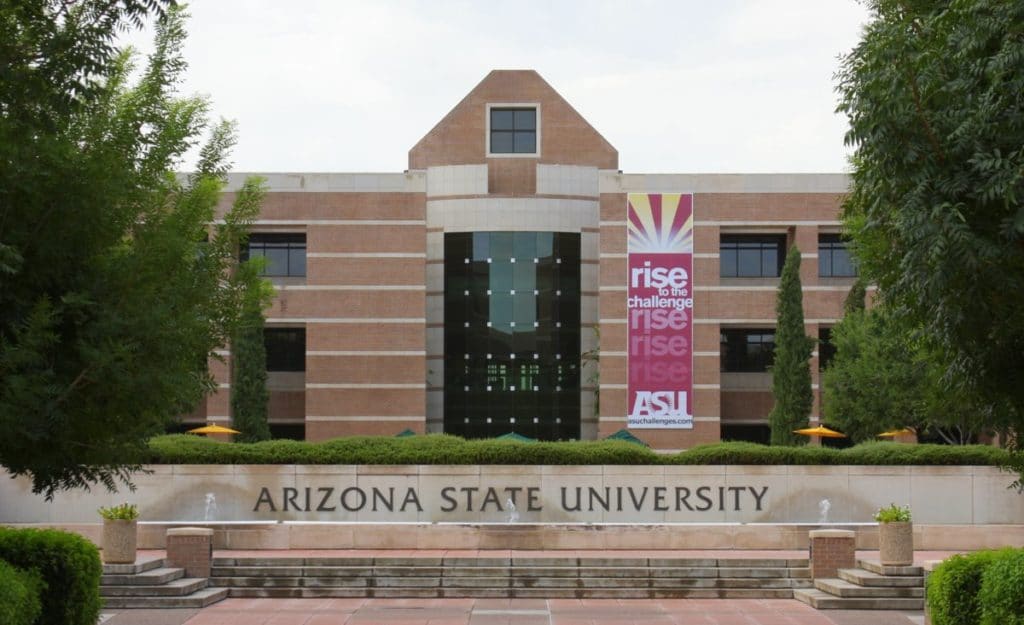
Posters Glorifying Nazism Hung at Arizona State U

(JTA) — Posters glorifying Nazism were found on the Tempe campus of Arizona State University for the second time in less than a year.

The posters, discovered on Sunday morning, read “Hitler was right,” “unity of our blood” and other comments deemed anti-Semitic, the Arizona Republic reported. Campus police removed the posters.

The university is investigating the origin of the posters, the newspaper reported, citing a statement from the university.

Similar flyers were posted around the Tempe campus in November.

The neo-Nazi organization Folksfront took credit for both sets of posters. Its website calls it “the official media source for the Folkish Resistance Movement, a National Socialist political organization based primarily out of North America.” It also said the group wants “to spread our message not only in North America but throughout the entire English-speaking world.”

Students returned to campus in mid-August.

“Ensuring the safety and security of our students is a top priority, and the university undertakes extensive efforts to ensure student safety is not compromised,” the statement said. “ASU is a community that values diversity, tolerance, respect and inclusion. We support open debate and honest disagreements, but not hateful rhetoric.”

Posters Glorifying Nazism Hung at Arizona State U Read More »

david suissa podcast curious times

Pandemic Times Episode 83: Brooke Goldstein on a Jewish Civil Rights Movement

New David Suissa Podcast Every Monday and Friday.

The founder of The Lawfare Project discusses a new initiative, “End Jew Hatred,” to rally Jewish grassroots around a common cause.

How do we manage our lives during the coronavirus crisis? How do we keep our sanity? How do we use this quarantine to bring out the best in ourselves? Tune in every day and share your stories with podcast@jewishjournal.com.

Pandemic Times Episode 83: Brooke Goldstein on a Jewish Civil Rights Movement Read More »

Jared Kushner Says in UAE That He’s ‘100%’ Sure All Arab Countries Will Normalize Ties With Israel

(JTA) — Jared Kushner says he’s “100%” sure that all the Arab countries will follow the United Arab Emirates in formalizing ties with Israel.

The White House senior adviser, an architect of the Trump administration’s Middle East peace plan, made the assertion on Tuesday in Abu Dhabi as delegations from Israel and the United States wrapped up a diplomatic meeting there.

“I think thanks to the UAE leadership there will be a much bigger coalition,” he told the local Emirates News Agency. “[There will be] what I call ‘a vocal majority’ that will be in favor of normalizing. I think the vocal minority who have been against it will be more and more isolated in the region.”

Also Tuesday, the Israeli daily Yediot Acharonot reported that Israeli Prime Minister Benjamin Netanyahu made a secret visit to the UAE two years ago to meet with its leader, laying the groundwork for the recently announced normalization agreement. The newspaper cited unnamed diplomatic sources and said Netanyahu and Crown Prince Mohammed bin Zayed have kept in touch since the meeting.

Netanyahu said at a news conference Monday that Zayed is not the only Arab leader with whom he has met.

“I meet with many many leaders in the Arab and Muslim world, more than you’d think,” Netanyahu said. “There are many things I cannot tell you about, but I do believe they will see light when the time is right. You could see the tip of the iceberg for yourselves in recent years.”

The United States, Israel and the UAE released a joint statement on Monday.

“The accord inverts traditional thinking about the way to address the region’s problems and challenges, focusing on pragmatic steps that have tangible, practical outcomes,” the statement said. “It carries with it the promise of new bridges that will serve to de-escalate existing conflicts and prevent future conflicts.

“And it comes at the right time. Over the last decade we have seen a marked increase in war, destruction, and dislocation, and a growing demographic shift towards a younger population. If we are to meet the needs of current and future generations, we must be responding actively to all these changes.”

The statement also called on the Palestinians to agree to restart peace negotiations with Israel.

Meanwhile, members of the Israeli delegation in Abu Dhabi held a morning prayer service in their hotel. Jews living in Dubai completed the minyan.

The Jewish Agency for Israel and Keren Hayesod-United Israel Appeal, an Israeli humanitarian group, announced Monday that they would begin providing services to the Jewish community in the UAE, which totals over 1,000.

Jared Kushner Says in UAE That He’s ‘100%’ Sure All Arab Countries Will Normalize Ties With Israel Read More »

Army Condemns TikTok Video of Reported Soldier Making Holocaust Joke

The Army has issued a statement condemning a reported soldier making a Holocaust joke in a since-deleted TikTok video.

Paul Szoldra, editor-in-chief of military website Task and Purpose, posted the video to Twitter on August 31. Szoldra identifies the person in the video as 2nd Lt. Nathan Freihofer. Freihofer, who has 2.9 million followers on TikTok, says in the video, “Reason one million why I’ll never be verified: dark jokes!”

He then tells the joke: “What’s a Jewish person’s favorite Pokemon character? Ash.” Ash is a reference to Pokemon protagonist Ash Ketchum and also an apparent Holocaust reference.

Freihofer concludes the video, brushing off anyone taking offense at the joke. “If you get offended, get the f— out because it’s a joke,” Freihofer said. “Don’t be a p—-.”

https://twitter.com/PaulSzoldra/status/1300460657800744960?s=20

The XVIII Airborne Corps announced in a tweet that it is reviewing the matter.

“We are investigating reports of a Soldier assigned to XVIII Airborne Corps allegedly making vile remarks on a social media video,” the tweet read. “The statement made in the video is completely inconsistent with our values. We will review all facts and take appropriate action.”

The Airborne Corps then followed up with a screenshot of tweets from Major General Antonio Aguto, commander of the 3rd Infantry Division, announcing Freihofer has been suspended.

“The statements made in the video are not indicative of the values we live by, and there is no place for racism and bigotry in our Army or our country,” Aguto wrote. “An investigation has been initiated into this matter and the Soldier has been suspended effective immediately, pending the results of the investigation.”

The American Jewish Committee tweeted, “Lt. Nathan Freihofer’s ‘joke’ is not only offensive, it dishonors the memory of hundreds of thousands of American soldiers who paid the ultimate sacrifice in the fight against Nazi tyranny. He should apologize now.”

The Jewish group also praised the army for suspending and investigating Freihofer in a subsequent tweet. “This is what a zero-tolerance approach to antisemitism looks like,” the tweet read.

The Auschwitz Memorial Museum noted in a tweet that Freihofer had written as a caption for his since-deleted video, “For legal reasons this is a joke.”

“What about moral reasons & respect?” the museum tweeted. “Would he look into the eyes of Survivors liberated by @USArmy and tell them this? Nathan, if you see this, take this lesson to learn why you hurt real people & their memory.”

CNN’s Jake Tapper also tweeted, “I admit I don’t understand how anyone, let alone a US military officer, would think it amusing that Jews were mass exterminated during the Holocaust.”

Army Condemns TikTok Video of Reported Soldier Making Holocaust Joke Read More »

NYT Bestselling Author and Holocaust Survivor Edith Eger on Her Self-Help Book ‘The Gift’

It’s never too late to become a bestselling author. Just ask 92-year-old clinical psychologist Edith Eger, who hit the New York Times bestseller list in 2017 with her memoir, “The Choice” (Scribner).

A Holocaust survivor with an extraordinary story, it seems fitting that her follow-up is a self-help book titled “The Gift: 12 Lessons to Save Your Life” (Simon & Schuster). Eger wrote “The Gift,” due to be released on Sept. 15, after she received requests from her readers for a more practical guide to healing. 

In an interview with the Journal, Eger said, “As the perfect follow-up to ‘The Choice,’ this new book is filled with empathy, advice and humor. ‘The Gift’ captures the vulnerability and common challenges we all face, providing encouragement and advice for breaking out of our personal prisons and finding the key to freedom.”

The title of the book, she said, alludes to the precious gift of life. “You can have a lifestyle and [you can have] a deathstyle. God gave us temptation so you can practice the freedom of choice. The more choices we have, the less we feel like a victim.”

And Eger understands how truly precious life is. Born in Hungary in 1928, Eger and her entire family were sent to Auschwitz in 1944 when she was 16. Her parents were sent to the gas chambers but she and her sister survived. In her memoir, she talks about how she was forced to dance for Josef Mengele for his entertainment. Some of her harrowing experience is summarized briefly on her website, where it states, “Toward the end of the war Edith and other prisoners had been moved to Austria. On May 4, 1945, a young American soldier noticed her hand moving slightly amongst a number of dead bodies. He quickly summoned medical help and brought her back from the brink of death.”

“I don’t get over it or forget it, but I don’t live [in the camps],” Eger said. “That’s what I’m all about — not to concentrate on what you lost, but on what is still here. You have yourself and that’s the only one you’re going to have for a lifetime. Self-love is self-care. It’s not narcissistic.”

 “You can have a lifestyle and [you can have] a deathstyle. God gave us temptation so you can practice the freedom of choice. The more choices we have, the less we feel like a victim.” — Edith Eger

She added that in Auschwitz she made a choice: to live in the present and practice what her ballet teacher had told her before the war — to look at life from the inside out. “I think it was really a lifesaver,” she said, “acknowledging that they could put me in a gas chamber any minute and they could beat me and torture me, but they could never really rob me of my spirit. I [had] to find my ecstasy from inside [myself], because nothing came from the outside except the gas chamber and the fire from the chimney. My God is the God who allows me to change hatred into pity and [to] not allow the enemy to get to me.”

After the war, Eger moved to Czechoslovakia, where she met her husband, Bela, and they moved to the United States in 1949. They had three children and Eger received her degree in psychology from the University of Texas at El Paso. Bela died in 1993 and today Eger lives in La Jolla, Calif., where she still runs her practice. 

She specializes in treating patients suffering from post-traumatic stress disorder (PTSD) and uses her education and personal experiences to inspire and help others overcome hurdles and redirect their lives. 

“The Gift,” Eger explained, dissects the 12 most “pervasive imprisoning beliefs,” including fear, grief, anger, secrets, stress, guilt, shame and avoidance, that were once part of Eger’s journey. “It’s an inclusive experience,” she explained. “[It’s] truly a book for anyone who is seeking positive tangible change, healing, relief or freedom in their life but is unsure where to find it.” 

“The Gift” also includes stories from her patients to help readers discover practical mechanisms to cope with and heal from challenging situations. “Suffering is going to be the part of life that makes you strong,” Eger said. “You don’t have a problem in my book — you have a challenge. You don’t have a crisis in my book — you have a transition.”

She continued, “Life is about change and if you don’t change, you don’t grow. The way you talk to yourself changes your [entire] body chemistry. [It’s so] important to have a healthy self-dialogue. None of the positive thinking will do any good unless it’s followed [by] a positive action.” 

Asked how she creates a safe environment in her office, she replied, “In my book, there is no such thing as the right feeling or the wrong feeling or the good feeling or the bad feeling. I give everyone permission to feel any feelings without being afraid that I will ever judge them. It’s called unconditional love.” 

“The Gift” is available for pre-order on Amazon and will be released on Sept. 15.


Melissa Simon is a writer in Los Angeles and a former Journal intern.

NYT Bestselling Author and Holocaust Survivor Edith Eger on Her Self-Help Book ‘The Gift’ Read More »

Twitter Users Call for Twitter to Take Action Against Ayatollah Khamenei’s Tweet

Iranian Supreme Leader Ayatollah Ali Khamenei denounced the United Arab Emirates (UAE) in a September 1 tweet for making a deal with “Zionist agents,” prompting Twitter users to call for Twitter to take action.

The tweet reads in full: “The nation of Palestine is under various, severe pressures. Then, the UAE acts in agreement with the Israelis & filthy Zionist agents of the U.S. —such as the Jewish member of Trump’s family— with utmost cruelty against the interests of the World of Islam.”

Various Twitter users condemned Khamenei’s tweet as anti-Semitic and argued that the tweet violated Twitter’s terms of service. “This anti-Semitism from a world leader would seem to violate the twitter guidelines,” CNN’s Jake Tapper tweeted.


International human rights attorney Arsen Ostrovsky also tweeted, “This is sickening and vile Antisemitism & incitement from Iran’s @khamenei_ir. @Twitter has no hesitation flagging @realDonaldTrump, but I must have missed them doing anything about this filth.”


Philanthropist Adam Milstein asked Twitter if “apparently ‘filthy Zionists’ and the ‘Jewish member of Trump’s family’ is ok with your terms of use?”

https://twitter.com/AdamMilstein/status/1300795011794112512?s=20


Twitter did not respond to the Journal’s request for comment.

In July, Ostrovsky asked head of Twitter policy for the Nordics and Israel Ylwa Pettersson in a Knesset hearing why Twitter has been flagging President Donald Trump’s tweets but not Khamenei’s. Pettersson replied, “We have an approach to our leaders that presently say that direct actions with fellow public leaders, comments on political issues of the day or foreign policy saber-rattling on military, economic issues are generally not in violation of our rules.”

Twitter Users Call for Twitter to Take Action Against Ayatollah Khamenei’s Tweet Read More »

As a Teen, Here’s Why Students Should Not Physically Go Back to School

Picture this: A loved one is in the intensive care unit with COVID-19 and has been on a ventilator for days. Not only that, but you can’t even go to the hospital to visit. The worst part? Even though the rest of your family has been carefully sheltering for months, you were the asymptomatic carrier who infected your loved one after catching the coronavirus at school.

Although this a hypothetical scenario, it is realistic and concerning.

Never in a million years would I have thought so many of us teens would miss going to school. In our very recent past, many of us often counted down the days to the weekend, winter break, spring break and summer. However, these days, most of us seem to miss the normalcy of a true schedule, hanging with friends and simply going about our lives.

As much as I would love to go back to school physically, as coronavirus cases continue to rise in record numbers, reopening schools in the coming months likely will cause even more of a surge in cases where, ultimately, schools will be forced to close again.

Kids, especially teens, can spread coronavirus just like adults. Even if temperatures are taken every morning as students arrive on campus, having a fever is not a sure way to tell if someone is carrying the virus. Since kids apparently get milder cases or often are asymptomatic, it seems logical that they will be the very people who transmit the virus to their teachers, school staff, parents and grandparents.

Recently, a group of my friends got together. One of them didn’t let anyone know his older brother had the virus. His family kept it a secret and allowed him to go about his normal life. When people found out, many panicked. I, however, was worry-free because my parents had refused to let me attend the gathering. If someone in my friend’s group kept the virus in their family a secret, how could I trust that kids at school won’t be doing the same thing?

So, let’s imagine that physical school does open in the next month or two, with the thinking that wearing masks will help stop the spread. The problem with this is that it’s very unlikely students will wear masks properly — if at all. In Southern California, the first couple of months of school are too hot for students to be wearing masks all day long. This is especially true for the outdoor portions of the day, such as physical education, sports and lunch. Even if wearing a mask was comfortable, many young children are not disciplined enough to wear them properly. Unlike the younger kids, older kids might refuse to wear masks because they care about what other people think of how they look. If just one or two “cool” kids decide to not wear a mask, many will follow.

During the California wildfires when school was open, masks were handed out at our school. My parents made me take one because the air was thick with smoke, but, honestly, when I looked around and realized very few people were wearing them, I felt pretty dumb and took mine off.

While some people say that being isolated is bad for teens’ mental health, there are several solutions to maintain a teen’s positive mindset. Teens can make responsible, physically distanced plans without being exposed to hundreds of people. Teachers also can get creative and assign partner projects where kids can work together either virtually or even in person while remaining physically distant.

As much as I would love to go back to school physically, as coronavirus cases continue to rise in record numbers, reopening schools in the coming months likely will cause even more of a surge in cases where, ultimately, schools will be forced to close again.

Quite frankly, the thought of wearing masks at school, not being able to sit with friends at lunch and being yelled at for getting too close to people doesn’t seem like a mentally healthy environment to me. Not to mention the anxiety I know I will feel when someone starts coughing.

These days, we’re lucky because we have the technology for online learning. The money school districts would have to spend on campus safety, such as installing new air ventilators, physical barriers, infrared thermometers and having to constantly sanitize, would be better spent providing remote learning devices and meals to students who can’t otherwise afford them.

With virtual learning, students can devote more time to schoolwork because no time is spent commuting. This also would give teens extra time to relax. Teaching remotely will allow the teacher to focus on the lesson rather than dealing with discipline and the constant enforcement of social distancing rules.

A dual option is offered in my school district, allowing families to choose between physical or virtual school. It sounds great in theory, but it likely will end up being more expensive, and it will spread the teachers and school resources too thin. 

Just like we’ve seen with gyms and stores, and with schools in Israel and even in recent days in Indiana, in the likely event schools open and then have to shut down again, it will be disruptive; everyone will have to scramble as distance learning is reinstated. Yes, there may have been kinks last semester as schools rushed to close, but by now, I would imagine most of those kinks have been worked out. It seems to me that schools should wait it out so they — and we — don’t have to keep going back and forth. Having one system only ensures students in a class are doing the same things at the same time.

Right now, our world is seeing something it has never dealt with before. I believe that stopping the spread of the coronavirus is the most important thing. None of the options are perfect, but the last thing you want is to be exposed to coronavirus, spread it to your teachers or bring it home to your parents, grandparents or other adults in your household.

So, picture this: Instead of your loved one being alone in intensive care, your biggest family emergency is someone embarrassingly barging into your room while you’re on your class Zoom call. Instead of worrying you might be unknowingly transmitting a potentially deadly disease to your friends, teachers or family, hopefully the most anxiety you would have to face is whether your Wi-Fi is working. 

Virtual learning certainly is not perfect, but these are imperfect times. With a well-planned virtual school, we have the opportunity to create a productive learning environment where we can all stay safe; plan small, socially distanced get-togethers with friends to keep everyone’s mental health in check; provide for students who need equipment or food; and have teens and teachers ready to return to school — healthy and more eager than ever before — when it’s safe to do so.


Riley Jackson is a high school student in Los Angeles. She is the founder of Driving With Daisy, a charity that supports underprivileged children. 

As a Teen, Here’s Why Students Should Not Physically Go Back to School Read More »

Perfecting a North African Kitchen Staple: Moroccan ‘Tortitas’

A crisp bite of Moroccan galette with a steaming cup of fresh mint tea: This is the definition of a simple pleasure, a pick me up, an exercise in mindfulness, a meditative ritual.

A staple of the North African kitchen, “tortitas” as the Spanish Moroccans affectionately call them, are thin, airy, crunchy cookies. A Moroccan host or hostess always has them on hand to serve to visitors with a steaming pot of tea with bright green spearmint leaves of “nana.”

Flavored with an intoxicating dose of arak or anise extract and fennel and sesame seeds, this recipe has been passed down through Rachel’s family from great-grandmothers to granddaughters.

“My mother is blessed with much patience and she used a hand-cranked pasta maker to roll out a thin dough. Her cookies were airy and delicate. I am less patient, so I use a rolling pin to flatten the dough on my counter.

“Occasionally, I will pull out the pasta maker to make a savory version. I omit the sugar and the anise extract and add a teaspoon of salt.

“In yet a different version, I add a cup of freshly squeezed orange juice and an extra cup of flour to the recipe. This results in a softer, chewier cookie.

“Whichever way I make them, I’m thrilled to serve them to my family. They are my father’s favorite and he always loved them with his coffee. He had to give up his coffee but the tortitas stayed.

“I have an antique tool that my mother brought with her from Morocco. A wheel with sharp spikes, you roll it over the dough to pierce it with little slits to ensure that the dough is crispy and baked through. It also creates a pretty design. If you don’t have one, a fork works equally well.”

This centuries-old recipe has become a bit of a lost art, however, there are some women who still bake them. At the opening night of the Sephardic Educational Center’s biannual Sephardic Film Festival, we sell traditional Sephardic baked goods prepared by the women of the Los Angeles Sephardic community. The galettes baked by Therese Chriqui prove that her hands are blessed: Her thin-as-paper, crispy, delicious cookies are always the first to sell out.

Tortitas are traditionally eaten with tea to break the Yom Kippur fast. At this time when we begin to plan our holiday menus, we hope you are inspired to bake these subtly sweet and aromatic treats for your family and friends.

TORTITAS

6 eggs
1 cup sugar
1 cup oil
2 teaspoons anise extract or 2 tablespoons arak liquor (optional)
1-2 tablespoons anise/fennel seed, to taste
2 tablespoons toasted sesame seeds
2 teaspoons baking powder
4 cups flour

In large bowl on stand-up mixer, mix eggs, sugar and oil until well blended.
Add the anise extract (or arak liquor), seeds and baking powder and mix.
While mixing, add flour one cup at a time and continue to mix.
Mix dough until it comes together and forms a ball.
Let dough rest for 10 minutes.
Preheat oven to 350 F.
Divide dough in tennis ball-size pieces.
Roll out dough as thinly as possible. If using pasta maker, use lasagna setting.
Pierce dough with fork or decorating tool.
Cut into squares or use cookie cutter or drinking glass and cut into circles.
Bake on parchment paper-lined cookie sheet for 15 minutes until golden.
Let cool for several hours until they’re crunchy.

Makes 40 to 50 cookies.


Rachel Sheff and Sharon Gomperts will answer cooking questions on Instagram at SephardicSpiceGirls or on Facebook at Sephardic Spice SEC Food. They have collaborated on Sephardic Educational Center projects and community cooking classes.

Perfecting a North African Kitchen Staple: Moroccan ‘Tortitas’ Read More »