fbpx

August 27, 2020

Poem: Ki Teitzei

If you are at war and find
your captives are beautiful
the laws of our people,
seventy four of which are
listed this week, tell you
this could lead to a
bonafide engagement.

If you are at war and you
find your captives are
beautiful, how does that
make you feel about
having taken them captive?

If you are at war and find
your captives are beautiful
who has captured whom?

If you are at war and find
your captives are beautiful
do you forget what it is
the war was about?

Do you forget the meaning
of the word war? Do you
get in the cage with your
captives and lose yourself
in their beauty?

If you are at war and find
your captives are beautiful
you may take them home.

That is allowed, according to the words we read this
week, and every time this week comes along in the
years past, and the ones which will pass. You may
find, after a time, your beautiful captives, in your
home, may not find you the way you find them, and
after a time, you will have to let them go to wherever
it is they wish to go.

That is the law. That is the sacred word on
the beautiful, who you’ve captured.
(Did you see they were beautiful before or after you captured them?)

Let them go. They will not
sing in your cage, these birds
of war, these human birds,
these spoils of war who
will not spoil, these captives.

You know what to do.


Rick Lupert, a poet, songleader and graphic designer, is the author of 23 books including “God Wrestler: A Poem for Every Torah Portion.”

Poem: Ki Teitzei Read More »

French Jewish Artist Assaulted While Wearing Shirt With the Word ‘Israel’

A Jewish artist reportedly was assaulted on Aug. 27 in Strasbourg, France, while wearing a shirt that had the word “Israel” emblazoned on it.

The Algemeiner reported that the graffiti artist, identified as Raphael Nisand, was wearing a shirt that had Israel listed among multiple countries and cities. According to The Jerusalem Post, a group of people started to push around Nisand. One of the assailants allegedly said to Nisand, “You are a Jew you have no place.”

The suspects told Nisand to take off his shirt; he did, but when he returned to the street, one of the individuals used Nisand’s spray paint canister to write the words “No Jews or sluts” on Leon Blum Street, according to Jewish Telegraphic Agency. The street is named after a Holocaust survivor.

Authorities are investigating the incident.

Algemeiner editor Dovid Efune noted in a tweet that in addition to Nisand’s reported assault, the past 24 hours in France also has seen a man “detained for a 2014 antisemitic rape and home invasion” and two other men being “held for another violent antisemitic assault in Paris.”

On Aug. 26, a French Algerian national was arrested in Algeria for allegedly taking part in a Paris suburb home invasion of a Jewish couple in 2014 and raping a 19-year-old woman in that home. On Aug. 27, two men were arrested in connection with an assault of a Jewish man in a Paris elevator earlier in the month; the Jewish man was knocked unconscious, authorities said.

French Jewish Artist Assaulted While Wearing Shirt With the Word ‘Israel’ Read More »

A Lesson of 2020: Virtue Signaling Is Not Action

There’s a huge difference between slapping a Black Lives Matter slogan on a website or storefront and actually investing in a Black neighborhood to improve the quality of education.

That is my general conclusion from our summer of racial unrest: we’ve seen a lot of virtue signaling and very little real action.

There are a host of ills in America. The revolting killing of George Floyd while in police custody a few months ago, and the equally revolting recent shooting of Jacob Blake, have shone a harsh light on one of those ills—police violence— as well as the larger issue of racism.

If we’re serious about progress, the real question is: How do we help cure these societal ills? Here’s how we won’t—by settling for virtue-signaling slogans or engaging in verbal combat on social media.

We’re living at a time when screaming has replaced action; anger has replaced resolve; “performing” justice has replaced real justice. Combine that with the COVID-19 crisis during an election year, and it’s clear that we’re especially unprepared right now to handle the serious issues that have triggered such rage across the nation.

We’re living at a time when screaming has replaced action; anger has replaced resolve; “performing” justice has replaced real justice.

The hard work of real justice has always been rather tedious and devoid of drama. Working in the inner cities to help individual Black lives and families, and using the instruments of government to fight for genuine reform, won’t get you another 100,000 followers on Twitter.

Ambitious activists and politicians know all too well that they’ll get a lot more attention if they paint a slogan on a street or kneel in silence wearing kente cloth. But as Arimeta Diop sharply noted on Vanity Fair, “white members of Congress wearing kente cloth can’t help but seem unnecessarily performative and, at worst, pandering.”

When I see companies express their solidarity with the Black Lives Matter movement, my cynical gene kicks in, and I wonder: What are you really doing to help Black lives beside post a slogan on your website and spend millions on commercials showing your solidarity? What if you spend that money to reform rather than perform? What if you used your expertise to roll up your sleeves and make a real difference?

When NBA players decided to boycott some games this week in their anger over the shooting of Jacob Blake, I couldn’t help but think: Why don’t you instead keep playing and donate your salary for the rest of the season to Blake’s family and the cause of police reform? Wouldn’t that make a stronger statement?

Millions of tweets have flown through the digital universe this summer expressing outrage, frustration, anger and exasperation. Has any of it helped Black lives?

I’m not saying we shouldn’t express ourselves and scream and protest. Of course we should. But if we just stop there— or worse, allow protests to disintegrate into vandalism and violence– real progress has little chance.

Progress requires real action, which requires being informed, knowing what to invest in and where you will be most effective. Virtue signaling on social media requires little knowledge or action.

Ironically enough, it is a tweet from Rabbi David Wolpe that best captures this phenomenon: “The greatest danger of social media is that people will think their virtue lies in their opinions and not their actions. You are not what you post but what you do.”

Indeed, we are what we do.

This year, more than ever, it seems that many Americans have become performers rather than reformers.

A Lesson of 2020: Virtue Signaling Is Not Action Read More »

Jared Kushner Says NBA Players Lucky to Be Rich Enough to ‘Take a Night off From Work’

(JTA) — Jared Kushner criticized NBA players for boycotting their playoff games in response to the police shooting in Kenosha, Wisconsin, of Jacob Blake, a Black man.

“Look, I think that the NBA players are very fortunate that they have the financial position where they’re able to take a night off from work without having to have the consequences to themselves financially,” Kushner, a White House senior adviser and multimillionaire real estate developer, said Thursday morning in an interview on CNBC’s “Squawk Box,” appearing to mock the players. “So they have that luxury, which is great.

“Look, I think with the NBA, there’s a lot of activism, and I think that they’ve put a lot of slogans out. But I think what we need to do is turn that from slogans and signals to actual action that’s going to solve the problem.”

Kushner made his statement the day after the Milwaukee Bucks declined to take the court for their playoff game against the Orlando Magic. In the end, the league canceled the three playoff games scheduled for Wednesday night. NBA players then threatened to sit out the rest of the season. WNBA games also were canceled.

Kushner later told Politico that he would reach out to Los Angeles Lakers superstar LeBron James, a leader of the protest, to discuss the issue.

“If LeBron James reached out to the White House, or we could reach out to him, we’re happy to talk with him and say, ‘Look, let’s both agree on what we want to accomplish and let’s come up with a common pathway to get there,’” Kushner said, adding that he would reach out to James “today.”

Thursday night’s playoff games also were canceled, but reports said the players likely would return to play over the weekend. Protests also canceled several Major League Baseball games.

Jared Kushner Says NBA Players Lucky to Be Rich Enough to ‘Take a Night off From Work’ Read More »

Auschwitz Museum Says Holocaust Victims Trend on TikTok Is ‘Educational Challenge’

(JTA) — Teens are pretending to be Holocaust victims on the social media platform TikTok.

It’s a “hurtful and offensive” trend, the Auschwitz museum says, but also “an educational challenge.”

In the Holocaust victim videos, teens wear stage makeup to look like a concentration camp inmate. They also may don striped prison garb and a yellow Jewish star and role-play various scenarios — such as God asking them why they showed up in heaven “so early,” or a Nazi grabbing their face and jerking them around. They clearly are doing this for the fame, as some of the users were found to have bought TikTok views on ExtremeLikes for their videos.

“The ‘victims’ trend on TikTok can be hurtful and offensive,” the Auschwitz-Birkenau Memorial and Museum tweeted. “Some videos are dangerously close or already beyond the border of trivialization of history. But we should discuss this not to shame & attack young people whose motivation seem very diverse. It’s an educational challenge.”

In its fuller statement, the museum said that “some of the videos “were not created to commemorate anyone, but to become part of an online trend. This is very painful. However, the motivation of some people posting the videos seems to come from the need to find some way of expressing personal memory.”

The museum added that people should “continuously raise awareness that not every social media activity can commemorate the Holocaust.”

The statement concluded that on social media, “there are far more outrageous issues, like algorithms promoting anti-Semitism or the presence of Holocaust denial that is a dangerous and hideous carrier of anti-Semitism and hatred.”

Auschwitz Museum Says Holocaust Victims Trend on TikTok Is ‘Educational Challenge’ Read More »

Something for Everyone in ‘Night Archer’ Stories

We first came to know Michael Oren as a historian and the author of best-selling history books such as “Power, Faith, and Fantasy” and “Six Days of War.” Then he reinvented himself as a diplomat, serving the State of Israel as ambassador to the United States. Now we meet Oren as a teller of tales. “The Night Archer and Other Stories” (Post Hill Press/A Wicked Son Book) is a collection of 51 short stories, each one exquisitely crafted and deeply revealing.

Oren was born in New York in 1955, made aliyah in 1979 and served as a paratrooper in the war in Lebanon in 1982. All of these waypoints in his biography are touched on in his short stories, sometimes plainly and sometimes obliquely, but always with precision and impact. “They are American in their candor,” he writes of his stories, “and Israeli in their zeal, yet always, paradoxically, Jewish.” Thus, for example, the title story in the collection introduces us to an archer from the battle of Agincourt, a figure whom the narrator conjures up every night as a comrade in arms in his struggle against insomnia.

“We’ve never met, yet you join me every night,” Oren writes. “Where most others see an in-gathering of angels or sheep, the harbinger of peace, I glimpse an army bristling with lances and blades clamoring off to war.”

Every story in the collection is told in lapidary prose, but the subject matter is dazzling in its diversity. Here are ghost stories, crime stories, science fiction stories, love stories, adventure stories, Bible stories, war stories, stories of childhood and death, suffering and redemption, even a kind of updated bubbe meise (“The Old Osifagus”). What they all have in common is Oren’s mastery of compressive narration, his ability to put the reader at the very heart of the story from the first page, even the first line. Both the here and now and the backstory snap into sharp focus.

The fact that Oren first distinguished himself in the study of history is a clue to what attracts his eye and occupies his thoughts. Even when the narrator of a story is a ghost, as in “Ruin,” the historian in Oren always asserts himself. “We don’t shriek, we don’t whimper,” the narrator observes. “We merely observe and bear witness. Ghosts, you see, aren’t scary. People are scary.” And, in the story titled “The Secret of 16/B,” the search for historical artifacts by archaeologists results in the discovery of an ancient secret and, at the same time, sparks a contemporary conflict: “The Ultra-Orthodox Jews protested the desecration of their ancestors’ bones and Palestinian Arabs demonstrated against an attempt — so they saw it — to stake an Israeli claim to their land.”

The subject matter is dazzling in its diversity. Here are ghost stories, crime stories, science fiction stories, love stories, adventure stories, Bible stories, war stories, stories of childhood and death, suffering and redemption, even a kind of updated bubbe meise.

Only rarely do the stories directly address the practices of Judaism, and when they do, the point can be darkly ironic. “Afikomen” is one example. The 13-year-old narrator is given the task of hiding the afikomen at an otherwise boring family seder, but the hiding place he seeks out is already in use by his father. What the boy finds there is not less than shattering. “I want to look longer and I don’t want to look at all, ever” the boy recalls. Yet the boy turns the moment to his profit as a kind of compensation for the pain he will surely suffer for the rest of his life.

In the same ironic spirit, Oren unabashedly offers a kind of midrash on Genesis in “Day Eight.” When God thinks he has completed his work of creation, Satan sidles up to the Almighty. “Why be hasty,” he says. “Perhaps there are other things you could do.” At his urging, God gives additional gifts to humankind — consciousness of the certainty of death, the ability to both love and hate, to hope and fear. “In short,” says Satan, “we’ll have to give them souls.” As a result, the story concludes, God hears our prayers only with difficulty. “Drowning them out was a cacophony of birds and the braying of lions, laced with satanic chuckles.”

Many of the stories are short and spare, but a few are more fully realized. “Aniksht,” for example, is a tale that begins with a little girl in a Lithuanian village during World War II. Her father is “a man of secrets,” some of which she succeeds in discovering, and she has secrets of her own. Her father is an atheist, her mother goes to shul, but she imagines herself to be Dalia, “the pagan goddess of fate.” The forest in which she seeks solace turns out to be a place where secrets are revealed. She witnesses what we have come to call a crime against humanity, but for the little girl it is a crime against her father, mother and baby brother, Emmanuel. 

“There is no more arguing,” she muses, “no more crying — even Emmanuel is still — no books or prayers, God or truth.” 

Yet the story only begins at that moment of loss. Oren carries us back and forth in time and place, taking us from Lithuania to Israel and back again. At last, a man named Dudu reconnects with the lost and forgotten souls of his dead family in the same place where Daria once witnessed their deaths. He is a prominent Israeli politician, media-savvy and worldly wise, but cannot resist the call that summons him back into the past. “Butterflies, like the hands of luminous children, beckoned,” the story ends. “ ‘Come,’ they called to him, ‘come.’ ” 

Oren reveals that writing was actually his first calling. At the age of 12, he was inspired to compose a poem titled “Who cries for the soul of the pigeon?” Significantly, young Oren came to understand that writing is essentially an exercise in imposing order on one’s thoughts and experiences. In the introduction to “The Night Archer,” he allows us to understand that his approach to writing and his approach to politics are essentially the same. “Overly fettered freedom is tyranny,” he concedes, but he also insists that “untethered freedom is chaos.” 

His literary credo helps to explain why Oren is rooted in the center-right of Israeli politics, but he claims that it embodies a higher truth: “[F]reedom through confinement was more than just a method,” Oren declares. “Rather, like monotheism and universal morality, it was eminently a Jewish idea.” Where to find a balance between freedom and confinement remains open to debate, of course, but we can all find something to admire, savor and enjoy in “The Night Archer.”


Jonathan Kirsch, author and publishing attorney, is the book editor of the Jewish Journal.

Something for Everyone in ‘Night Archer’ Stories Read More »

That’s Not Your Ass: A Poem for Torah Portion Ki Teitzei

You shall not see your brother’s ox or sheep straying, and ignore them.
[Rather,] you shall return them to your brother.

I’ve been dreaming of oxen on the freeway
blocking my exit, making me late to the thing
I was going to, which I can’t go to anyway
because of the COVID.

I’ve been dreaming of sheep straying
from my brother’s flock. My brother in 2020
may not be aware he has sheep
and their return will be a surprise.

I plan on returning all the things I find
the sheep, the oxen, the wallets.
The local lost and found will get to
know me by sight.

Rest assured if your donkey wanders
into my neighborhood, I will do everything
in my power to make sure your ass
gets back where it belongs.

Can we all agree to do the same?
Can we acknowledge we’re in this together?
Finders keepers is so 2016-2020.
Let 2021 be the beginning of the us.

Before the world burns away.
Before the virus takes us all.
Before our dedication to ourself
makes us forget about everyone else.


God Wrestler: a poem for every Torah Portion by Rick LupertLos Angeles poet Rick Lupert created the Poetry Super Highway (an online publication and resource for poets), and hosted the Cobalt Cafe weekly poetry reading for almost 21 years. He’s authored 23 collections of poetry, including “God Wrestler: A Poem for Every Torah Portion“, “I’m a Jew, Are You” (Jewish themed poems) and “Feeding Holy Cats” (Poetry written while a staff member on the first Birthright Israel trip), and most recently “The Tokyo-Van Nuys Express” (Poems written in Japan – Ain’t Got No Press, August 2020) and edited the anthologies “Ekphrastia Gone Wild”, “A Poet’s Haggadah”, and “The Night Goes on All Night.” He writes the daily web comic “Cat and Banana” with fellow Los Angeles poet Brendan Constantine. He’s widely published and reads his poetry wherever they let him.

That’s Not Your Ass: A Poem for Torah Portion Ki Teitzei Read More »

High Holy Days 5781: Celebration of the Human Spirit

My daughter tells me a rabbi’s job is to announce pages. My interpretation: A rabbi produces a sacred script. The words of the machzor must be transcribed onto the hearts of the modern Jew.

While we will speak about this year’s High Holy Days for generations to come, this transformative moment calls for the same simple task. However, this time, the words from the machzor will uplift our souls through the magic of the screen.

Whom do you call when this has never been achieved before? When replicating an empty sanctuary is not acceptable, leaning in to readily available technology must be the solution.

Sinai Temple is fortunate to partner with the GracieVision production. The clergy and leadership team work hand in hand with GracieVision as we craft live services; engage congregants across the broad demographic spectrum; and create virtual honors and choirs, along with interactive sermons and conversations. Our community has two goals: serve our dedicated members of our synagogue and share our message with the larger Jewish world.

There has been a true blessing in this process. While the clergy learn about television production, our team of producers has felt the impact the Sinai community has on the Jewish world and their own lives. Our meetings consist not only of page numbers and prayer names, but study of what those prayers mean to our congregation and the greater Jewish world.

This is another moment in Jewish history when the results of coming together must not only be to survive, but to thrive.

One of those producers is Ariana Berlin. An aspiring Olympic gymnast in her youth, Berlin was severely injured as a teen in a horrific car accident. Her determination to recover led her to UCLA, where she earned a scholarship, became a four-time All-American and one of the greatest-ever UCLA gymnasts. Her story inspired the Netflix film “Full Out.” After Berlin’s successful athletic career, she transitioned to production, landing a career with Fox Sports, working with Kareem Abdul-Jabbar and Kevin Durant. But today, Berlin has added a line to her resume: Sinai Temple High Holy Days 5781.

Berlin, 32, learned the history of Sinai Temple — its melodies, stories, leaders and traditions. And we began to learn Berlin’s story, too.

Her grandparents were Holocaust survivors who met in a concentration camp and together fought for survival and for love. They were resilient and persevered, survived the war and moved to the United States, where they created a good life for their family. Berlin explained these same traits allowed her family to band together during the recovery of her own debilitating accident, with multiple surgeries and emotional trauma. They did not know how the story would end, but they knew they would be stronger together.

Berlin never put aside her Judaism. With a Jewish day school education, she took Hebrew at UCLA and with her now husband, she traveled to Israel on Birthright. Judaism is not something of her past; through these unique High Holy Days, it has become her present and future.

Sinai Temple’s motto is Ldor Vador, “from generation to generation.” The Torah sculpture adorning our building is flanked by these words. When the cantor sings this prayer, our families wrap their arms around one another, demonstrating the strong bond community forms.

During those dark days of the Holocaust, could Berlin’s grandparents have imagined that their future granddaughter in Southern California would one day produce the High Holy Days on TV for the 21st century? Services that will be broadcast both through our Sinai Temple social media platforms and nationally on the Jewish Broadcasting Service?

We sound the shofar each day leading up to Rosh Hashanah. The piercing sound must wake us up to renew our lives. We must build the community we do not want to lose. This is another moment in Jewish history when the results of coming together must not only be to survive, but to thrive. Berlin’s story allows us to tell our story.

Now, it is up to us to be a part of that cast. Pick up your machzor and read the script. Cast yourself in a leading role. Stay for the credits. Together, let us write the future today and celebrate the Jewish spirit we all know.


Rabbi Erez Sherman is a rabbi at Sinai Temple.

High Holy Days 5781: Celebration of the Human Spirit Read More »

UAE and the Loss of Patience With Palestinians

The clock may have finally run out on the Palestinians. The risk they took was playing Russian roulette with time; they were never in a hurry to build a state, and were far more interested in destroying the Jewish one next door.

The Palestinians made a bet with their future. Such high-stakes wagers always are mistakes. They counted on the world never tiring of its eternal hatred of Jews. That certainty made them perpetual victims of a Jewish state. The convenience of anti-Semitism enabled them to localize and leverage the world’s oldest prejudice.

So they rejected several peace offers, launched intifadas, fired rockets, stabbed Jews and tourists, stalled negotiations and placed their future on permanent pause until the land between the Jordan River and the Mediterranean Sea would, finally, be Jew-free.

Well, time finally may be up. The world’s everlasting romance with anti-Semitism has not abated — except, perhaps ironically, in the Persian Gulf. The United Arab Emirates (UAE) and Israel, with the mediating assistance of the United States, recently announced they have agreed to normalize relations, exchange ambassadors, open embassies and welcome tourists between the two countries.

Bahrain and Oman may become the next Gulf states to establish diplomatic ties with Israel, Reuters reported on Aug. 16, citing Israel’s intelligence minister. Saudi Arabia may follow, Newsweek reported on Aug. 16, citing National Security Advisor Robert O’Brien’s comment on “Meet the Press.” Qatar, always conflicted between its financial interest and its fealty to the Muslim Brotherhood, eventually may come around to the Emirates’ way of thinking.

For decades, Egypt and Jordan have maintained enduring peace treaties with Israel. In fact, the blockade that Hamas charges Israel has imposed on Gaza, to the extent that it is even true, is maintained by Egypt on Gaza’s southern border. Both Egypt and Israel have a mutual interest in quelling terrorism — and in the case of Egypt, even if it means thwarting fellow Arabs.

Palestinians assumed borrowed time could be made infinite. Now, they have nothing to show for their rejectionism.

The Gulf states, however, are motivated by a different set of strategic calculations. Yes, Iran’s nuclear ambitions and regional mischief-making makes Israel a natural ally, with the gumption and firepower to deter the ayatollahs. Meanwhile, conflicts among Muslims have gotten worse. Civil wars in Lebanon, Syria and Yemen, longstanding Shiite-Sunni enmities and Islamist entanglements have reached the point where Jews are starting to look more like an Arab’s best friend.

Simply surreal.

But it’s more dire than that. Arab states might no longer see any value in hitching their destinies to the fate of the Palestinians. And for good reason. Palestinians have been moving backward while Gulf countries, inspired by the resourcefulness and innovations of Israel, are enticed by the future, even with the Islamists among them longing for the medieval caliphates. Strategic partnerships with Israel are good for business, combining the financial centers of the Arab world with Israel’s can-do, high-tech, startup culture.

Palestinians have been fighting the bad fight ever since they created the terrorist infrastructure to eliminate the only country in the region with the ingenuity to adopt clean-energy alternatives, turn sand into arable land, desalinate water and harness the entrepreneurial spirit in the guise of companies that Google would eventually gobble. 

Shortly after the Six-Day War, the Arab League met in Khartoum, Sudan, and responded to Israel’s peace offerings with its infamous “Three No’s”: No peace, no recognition and no negotiation with Israel. 

That tune has changed. Decades later, such firm obstinacy now has the ring of one euphoric “Yes!” 

It is true that the Arab street may have a different view of the UAE’s embrace of the Jewish state. Pumping up the populace with anti-Israel hostility has long been the balm for failed domestic policies. Hateful habits die hard. Recognizing the benefits of détente with Israel might take longer for the general public. Neither the Egyptian nor Jordanian people, for instance, are all that chummy with Israelis, notwithstanding the successful peace treaties between their governments.

President Donald Trump’s administration framed its “Ultimate Deal” as “Prosperity to Peace,” which included billions of dollars in infrastructure and business projects invested in the West Bank, Gaza, Egypt and Jordan. It was a nice touch to include Egypt and Jordan. The problem, however, is that Palestinians have never been motivated by economic incentives. Other than bringing an end to Israel, nothing seems to incentivize the Palestinians — and that includes statehood.

For the majority of them, everything, not just nation building, can wait — seemingly forever. Waiting has become a national virtue. Settlements, borders, the right of return, Jerusalem — all are distractions that never deviate from the endgame of outlasting the Zionist experiment. Palestinians are acting as if seven decades of Israeli existence is as ephemeral as an out-of-town tryout.

The Arab world may have finally lost patience. Palestinians assumed borrowed time could be made infinite. Now, they have nothing to show for their rejectionism. Their national aspirations look more like a stunt than a genuine longing.

Palestinians never outgrew terrorism as a political strategy. Meanwhile, the entire world was submerged in acts of terrorism. Those who religiously practiced the dark arts would lose goodwill. And the fecklessness, corruption and cronyism of Palestinian leaders never improved from the fiendish days of Yasser Arafat.

With the warring frictions between the Palestinian Authority and Hamas, and the barbaric use of children as human shields and hospitals as command centers for launching rockets, there were plenty of reasons to stop rooting for the Palestinians — at least among Arab nations with commerce on their minds. It was time to let them go their own way.

Israel long maintained it didn’t have a partner in peace. Arab states might be coming around to that same conclusion. Perhaps that’s why the UAE has quietly forgotten the “land for peace” exchange that once seemed inevitable to achieve a comprehensive resolution. Today, it’s possible to view Israel as a sovereign neighbor without talking about disbanding settlements. The significance of that  change in first principles cannot be overstated.

Airlines are planning to fly from Tel Aviv to Abu Dhabi. Meanwhile, Gazans are still toying with incendiary balloons.

Enough said.

Surely, Palestinians are feeling betrayed by their fellow Arabs. They shouldn’t. There comes a point when playing the long game goes on much too long. Other games materialize. And fan support disappears.


Thane Rosenbaum is a novelist, essayist, law professor and Distinguished University Professor at Touro College, where he directs the Forum on Life, Culture & Society. He is the legal analyst for CBS News Radio. His most recent book is titled “Saving Free Speech … From Itself.”

UAE and the Loss of Patience With Palestinians Read More »

Keep Your Gear Handy with DIY Earbud Holder

Someone is not a fan of Zoom conferences: my dog Fosse. Every time I’m chatting with people on my computer, she freaks out because she does not know where those voices are coming from. Mind you, she has no problems with voices coming from the television or radio, or even from YouTube videos. But people on Zoom? They are worse than cats, mail carriers and squirrels combined. 

I did discover a simple way to calm her down, though. I realized she was not bothered when I had my earbuds on during the Zoom sessions. Earbuds do have a habit of getting lost on my desk or tangled with my other cords, so I made this earbud holder to keep them organized and at hand. Those working from home, or students doing distance learning, really will appreciate the convenience.

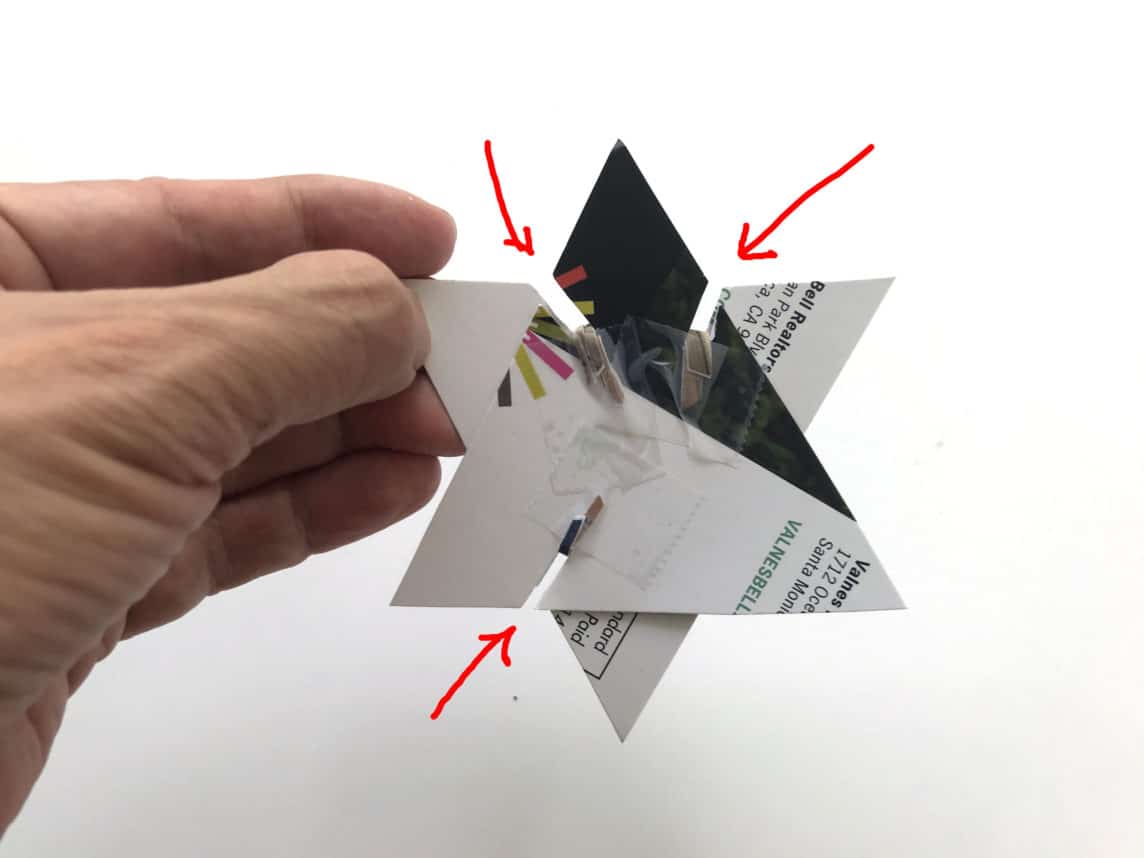
The earbud holder I made here is in the shape of a Star of David. The corners in the star were perfect for wrapping the wire, so the star shape works a lot better than just a regular rectangle. For cardstock, I actually used a direct mail postcard from a real estate agent. Those who follow my projects know I save junk mail for crafting purposes because the paper quality is so sturdy. I have to keep this away from my other dog Gershwin, however. He loves eating mail. 

What you’ll need:
Thick cardstock or junk mail postcard
Scissors
Tape


1. Cut two triangles with 3 1/2-inch sides. It helps if they are equilateral, but I just eyeballed them.


2. Stack the two triangles on top of each other to form the Star of David.


3. Flip over the star and cut two notches on the top corners of the star and one of the bottom corners, as indicated in the photo. Bend back the flap where the notch is and tape it in place.


4. Slide the earbuds into the notches on top, wrap the wire around the middle, and slide the plug into the notch at the bottom.

Keep Your Gear Handy with DIY Earbud Holder Read More »