fbpx

August 19, 2020

Parshat Shoftim with Rabbi Eytan Kenter

Rabbi Eytan Kenter of Kehillat Beth Israel in Ottawa was born and raised in Westchester, NY. As an undergraduate in the joint program with the Jewish Theological Seminary and Columbia University, Kenter majored in American Studies and Midrash. In 2006, he graduated from the Davidson School of Jewish Education with honors in the informal/communal education program.

This week’s Torah Portion – Parashat Shoftim (Deuteronomy 16:18-21:9) – begins with instructions concerning the appointment of judges and law enforcement officers. Moses commands the people of Israel to pursue justice and to avoid corruption and favoritism. The portion also includes prohibitions of sorcery and idolatry; rules concerning the appointment and the behavior of kings; and many laws of war, including the demand to offer terms of peace before going to war.

https://www.youtube.com/watch?v=1GdxA0mfAKI&feature=youtu.be


Previous Torah Talks on Shoftim

Rabbi George Gittleman

Rabbi Elaine Zecher

Rabbi Rachel Kahn Troster

Rabbi Joshua Hammerman

Rabbi Jeffrey Kamins

Rabbi Lester Bronstein

Rabbi Howard Voss-Altman

Parshat Shoftim with Rabbi Eytan Kenter Read More »

Congressman Calls on Education Dept. to Investigate UC Berkeley Center for Middle East Studies for ‘Bias Against Israel’

Rep. Doug Lamborn (R-Colo.) called on the Department of Education to investigate UC Berkeley’s Center for Middle East Studies (CMES) over the institution’s alleged “bias against Israel.”

Tikvah: Students for Israel, a pro-Israel student group at UC Berkeley, shared Lamborn’s June 16 letter to the department in an Aug. 17 Facebook post. Lamborn’s letter argued that UC Berkeley students have been subjected to a “false and distorted narrative” about the Israel-Palestinian conflict. He pointed to Tikvah’s March 2019 complaint against CMES as an example.

“In a statement published online in March, Tikvah noted that the center had hosted more than 24 anti-Israel related events since 2016 and that each one ‘has maliciously attempted to portray the democracy of Israel in a negative light,’ ” Lamborn wrote. “CMES, despite being focused on the Middle East, refused to co-host an event featuring Israeli MK [Member of the Knesset] and Ambassador Danny Ayalon.”

The congressman also alleged that since 2012, the CMES has received $24 million from Saudi Arabia and that a campus newspaper reported in 2003 that two of the CMES’ Saudi funders had ties to al-Qaeda; the CMES has denied this allegation and has said that the Saudis don’t influence its curriculum.

“The Department of Education should investigate if Title VI [of the Civil Rights Act] are being utilized in conjunction with Saudi Arabia,” Lamborn wrote. “While the United States and Saudi Arabia share some strategic goals, their interests and values differ greatly, and the wishes of the Saudi government or government-connected businessmen should not drive American national security education.”

Additionally, Lamborn argued that the CMES has featured several professors who are “highly politicized.” He cited Berkeley Comparative Ethnic Studies associate professor and CMES research scholar Keith Feldman as an example, noting that Feldman has called Zionism “racism settler colonialism” and signed a Jewish Voice for Peace (JVP) statement urging the University of California (UC) system to not adopt the 2016 Statements of Principles Against Intolerance because it condemned “anti-Semitic forms of anti-Zionism.”

Lamborn also cited CMES senior research scholar and Middle East and North African Jewry (MENA-J) Program Director Emily Gottriech, who served as the CMES chair from 2015-20 and is currently an adjunct professor of Global Studies in UC Berkeley’s Department of History. Gottreich, who has worked at UC Berkeley since 2002, also signed the JVP statement as well as a 2009 letter urging the UC system to end its study abroad program in Israel, according the letter. Gottreich also said the reporter who alleged in 2003 that the CMES has two funders connected to al-Qaeda of promulgating “the most extreme form of right-wing Zionism,” the letter states.

“While professors can teach and write as they wish, this kind of scholarship is not what Congress intended when it passed Title VI legislation and should not be supported by Title VI funds,” Lamborn wrote. “An investigation into how Title VI funds are used should follow to ensure funds appropriated by Congress for U.S. national security interests are spent accordingly, not on politicized scholarship aimed mostly at one of America’s closest allies.”

Tikvah wrote in a Facebook post that the student group applauds Lamborn’s letter to the Department of Education.

“For years, the CMES has abused their academic platform to indoctrinate students against Israel and has repeatedly exulted Jewish and Zionist students,” the post stated. “As [C]ongressman Lamborn cited in his letter, we have been documenting the overt bias that these campus departments exhibit against Israel and Jewish Students, through their course work, public events and the conduct of their faculty.”

Tikvah also alleged that when is has brought its complaints to the UC Berkeley administration, the complaints have fallen on deaf ears.

“Having gone unchecked for years, the UC Berkeley Administration has allowed a culture of anti-Semitism to permeate its campus,” the post stated. “We saw firsthand the manifestation of this hateful culture and the effects that years of antisemitic and anti-Israel indoctrination in the classroom has on the student body.

“This past semester Jewish Students were harassed and threatened with violence on multiple occasions in the ASUC [Associated Students of the University of California],” the post added. “It has become ok on our campus to put up photos of murderers and hold moments of silence for Islamic Jihad terrorists, whose stated goal is genocide against Jewish people. This is the result of the failure of leadership to deal with antisemitism and antizionism happening in the classroom.”

In February, the ASUC had debated a resolution condemning a Bears for Palestine (BFP) display from December; the resolution alleged that the display glorified “violent terrorists, including but not limited to Rasmea Odeh, Fatima Bernawi, and Leila Khaled,” all of whom were members of the Popular Front for the Liberation of Palestine (PFLP). Jewish students walked out of the meeting as pro-Palestinian students chanted “Free Palestine!” The Jewish students said that pro-Palestinian students were harassing and threatening them during the meeting; pro-Palestinian students also said that pro-Israel students harassed them. The resolution failed.

Additionally, in November, BFP held a moment of silence for Palestinians killed in Israeli airstrikes; many of those Palestinians were members of the Islamic Jihad terror group, according to The Algemeiner.

“In this time of reflection regarding racism and discrimination, we hope that the DoE helps us fight this culture of antisemitism that sadly exists today on many college campuses, starting with UC Berkeley,” Tikvah’s post concluded.

https://www.facebook.com/tikvah.berkeley/posts/3461939280503383


The CMES did not respond to the Journal’s requests for comment. Gottriech declined to comment.

Dan Mogulof, UC Berkeley’s assistant vice chancellor, said in a statement to the Journal that while the CMES isn’t under the purview of the UC Berkeley administration, the university rejects allegations that it has ignored anti-Semitism on campus.

“You don’t have to take my word for it,” Mogulof said. “San Francisco’s Jewish Community Relations Council awarded Berkeley’s chancellor, Carol Christ, with the organization’s Courageous Leadership Award for her strong, consistent words and actions against anti-Semitism on the Berkeley campus.”

He added: “Last year, The Forward ranked UC Berkeley as the second-best place in the country for students who wish to engage with Israel. We are home to the most ambitious Israel Studies program in the United States: the Berkeley Institute for Jewish Law and Israel Studies. UC Berkeley is one of a dozen universities in the country with a permanent faculty position dedicated to studying Israel: the Helen Diller Family Chair in Israel Studies. Berkeley is home to the country’s only program in Jewish law, thought and identity. The Berkeley Hillel, which recently underwent a $10 million renovation, welcomes 750 students during the High Holidays last year. We established a working group, the Chancellor’s Advisory Committee on Jewish Life, headed by the former president of the University of California system, Mark Yudof. Its members include students and faculty, but also community members.

“As they say, everyone is entitled to their own opinion, but facts are facts.”

Ethan Katz, a Jewish Studies professor at UC Berkeley, told the Journal that he has been leading the university’s Antisemitism Education Initiative.

“This has included an extensive and well-attended speaker series; trainings that have been conducted by myself and Berkeley Hillel Rabbi Adam Naftalin-Kelman for staff and students; a [P]ower[P]oint module we created that is now part of new student orientation; other multimedia components that are in the works; and op-eds that have been written by Berkeley faculty in major national publications,” Katz said. “This has been heartily supported from the chancellor on down. To help us take our efforts to another level, we just received a $25,000 grant for this to be rolled out as a national pilot program that can be a model and support for other campuses, from the Academic Engagement Network (AEN).”

He added that the initiative “dramatically undercuts the claims made on social media by these students,” stating that he, Mogulof and other faculty members “have spent extensive time communicating directly with those students about our efforts in the above areas, which makes their decision to write what they did all the more disappointing.”

Congressman Calls on Education Dept. to Investigate UC Berkeley Center for Middle East Studies for ‘Bias Against Israel’ Read More »

Facebook Restricts Thousands of Groups and Pages Tied to QAnon Conspiracy Theory

(JTA) — Facebook has restricted thousands of groups and pages with ties to the pro-Trump QAnon conspiracy theory.

The social media site said Wednesday that it had removed 790 Facebook groups and was restricting thousands of groups, accounts and pages on Facebook and its company Instagram, The New York Times reported.

QAnon followers believe in a complex narrative about a group of powerful people working to bring down President Donald Trump who also run an international child sex trafficking ring. Critics say its focus on Jewish figures, especially the billionaire political donor George Soros and the wealthy Rothschild family, is anti-Semitic.

The movement has grown in recent months and last week Marjorie Taylor Greene, a congressional candidate who has promoted QAnon, won a Republican primary in Georgia.

Jewish Insider uncovered a 2018 posting on a QAnon website signed by a Marjorie Greene that accused Soros and the Rothschild family of being involved in the conspiracy.

Greene’s primary win in a heavily Republican district almost assures victory in November. Her closest opponent also was a right-wing Republican, but Greene received Trump’s backing.

“We have seen growing movements that, while not directly organizing violence, have celebrated violent acts, shown that they have weapons and suggest they will use them, or have individual followers with patterns of violent behavior,” Facebook said Wednesday, according to The Times.

The social media site is also blocking hashtags related to QAnon and removing hundreds of groups tied to the far-left antifa movement, The Times reported.

Twitter said last month that it was removing thousands of accounts tied to QAnon.

Facebook Restricts Thousands of Groups and Pages Tied to QAnon Conspiracy Theory Read More »

The End of Jewish Yemen Is Imminent

A precarious existence for the country’s last 100 Jews

Yemen’s Iran-backed Houthi rebels have ordered at least some of the country’s remaining Jews to leave, according to sources in the Amran Governorate, north of the capital Sanaa, who spoke recently with The Media Line.

According to Ali Qudair, a tribal chief in the governorate, soldiers surrounded a village in mid-July to question members of at least one Jewish family living there about its contacts with people abroad.

“A group of military vehicles arrived in the area, taking up positions at the entrances to the village and establishing checkpoints,” Qudair told The Media Line.

“The soldiers entered the house of a Jewish family in the village and questioned members about their correspondence with the State of Israel, their property in the village and other areas, and whether or not they were in contact with relatives residing in other countries.

Qudair added that some of those questioned were taken to an unknown location and held for 48 hours.

“During the past few years,” he said, “the Jews have been denied many of their rights. They no longer can travel except with prior permission from the Houthi-appointed area supervisor.”

Qudair’s version of events was corroborated by Saeed Ahmad (not his real name), a resident of the nearby town of Kharef who says he enjoys strong friendships with many Jews in the area.

“On July 12, the Houthis arrested seven individuals from the Jewish community after questioning them and searching some of their homes,” he told The Media Line.

Ahmad adds that the Shi’ite Houthis, who have taken over most of Yemen’s main population centers, ordered these Jews to leave the country, imposing certain conditions on them regarding their property, most notably that they could sell it only to residents of the area or to the state – meaning to the Houthis themselves.

Ahmad said Houthi authorities were now arranging for their exit from Yemen, giving them a specific mechanism for traveling, communicating and conducting business.

Yemen’s Jewish community is estimated to have reached about 200,000 before members began leaving early in the last century, the exodus reaching a pinnacle in 1949 and 1950 with Operation Magic Carpet, a mission of the Israeli government, which brought some 50,000 people from Yemen to the Jewish state. Scores more were flown to Israel, reportedly in 2013 and 2016, in two flights that were kept secret for fear of disrupting sensitive channels of movement.

In 2011, Felice Friedson, president and CEO of The Media Line, flew to Sanaa, where she interviewed the community’s chief rabbi.

In light of the latest developments, a source in Yemen’s Ministry of Social Affairs and Labor expressed concern to The Media Line, explaining the way the Houthis view the Jews.

“The group sentenced the Jews to death with its slogan,” the source said, referring to “God is great, death to America, death to Israel, a curse on the Jews, victory to Islam,” an oft-repeated refrain.

“It then started, in fact, killing, jailing and deporting many of the Jews in the governorates of Saada and Amran,” the source continued, although the source was able to cite only one killing, that of a man was stabbed to death after being accused of sorcery.

“The remaining Jews in Yemen do not exceed 22 families, most of them living in Amran Governorate,” the source continued. “Others live in the Sanaa and Saada governorates.

The source mentioned unconfirmed reports about Jews who have been languishing in prison for the past three years, with the Houthis using them as a bargaining chip to effect the departure of the community without causing an international outcry.

“We don’t have accurate statistics about the number of Jews and rabbis in Yemen,” the source stated, “especially since the issue of the Jews has changed from one of demographics to one of security, meaning that researching it would get someone in trouble.”


From available information and the testimony of members of the community who already left, the current number of Jews in Yemen could be 43 people in Sanaa and more than 60 in Amran Governorate.

A source in the Ministry of Interior told The Media Line that “higher authorities” in Yemen had an interest in keeping matters about Jews secret.

“Decisions regarding deportations, investigations or any action against the Jews come from intelligence officials under the Houthis’ command,” the source stated, adding that security forces are then “directed to take certain actions.”

The ministry has reportedly been under orders that came four years ago to ban Jews from traveling between governorates and main cities, and limiting their work to simple trading and farming. They are also barred from performing religious rituals in public.

The same source informed The Media Line that deportations of Jews from Yemen might take place in the coming months, claiming that there had been intervention by “superpowers” and the UN special envoy, as well as information about Yemen’s Jews leaving for the United Arab Emirates and Jordan.

On August 8, the WAM news agency in the UAE reported that the country had been instrumental in reuniting a Jewish family, having flown the parents in from Yemen and the others from London.

EDITOR’S NOTE: Due to the extreme sensitivity of this report, most identities have been withheld though all sources have been vetted.


The End of Jewish Yemen Is Imminent Read More »

Newsom Signs CSU Ethnic Studies Curriculum Into Law Despite Opposition From Jewish Groups

California Gov. Gavin Newsom, a Democrat, signed a bill on Aug. 17 mandating Cal State University (CSU) schools to implement ethnic studies courses as a requirement for graduation.

The Los Angeles Times reported that the bill, AB 1460, requires the ethnic studies courses to “focus on African Americans, Asian Americans, Latino/a Americans and Native Americans.” The bill requires undergraduate students at CSU schools to take a minimum three-unit course on the subject and will go into effect during the 2024-25 academic year.

The California Faculty Association praised Newsom for signing the bill into law, arguing that the California governor “has demonstrated his understanding of the power of a true Ethnic Studies graduation requirement to change people’s lives and to change the racial trajectory this state and country are on.”

The Times noted that the Cal State University system is the birthplace of ethnic studies, and that Latino, Black and Asian American students are the majority.

Jewish groups, on the other hand, expressed concern about the development.

“The California State University alternative proposal would have helped safeguard against antisemitism as students would have had access to courses about Jewish studies, as well as classes about genocide, immigration, and social justice,” American Jewish Committee (AJC) Los Angeles Director Richard Hirschhaut said in a statement. “All students would have the opportunity to gain broader understandings of diverse dimensions of racism and bigotry. By neglecting the experience of American Jews, this law makes it even more challenging to address campus antisemitism.”

The alternative proposal would have involved “a more inclusive range of courses to fulfill a broader ethnic studies and social justice graduation requirement,” according to the AJC; the Times reported that the alternate proposal would have included Jewish studies as an ethnic studies course option. Democratic Assemblymember Shirley Weber, chair of the California Legislative Black Caucus who authored the bill, criticized the alternate proposal in the Times for being developed without consulting with ethnic studies experts, arguing that it was “an effort to dilute and to not deal with the real issue of, is ethnic studies required at the CSU.”

AJC Director of Combating Anti-Semitism Holly Huffnagle similarly tweeted, “As someone who went through the CA public school system, this is a tough pill to swallow. If combating antisemitism starts with education, then keeping Jewish life, history, and contribution to society out of the classroom does not bode well for this fight.”

StandWithUs CEO and co-founder Roz Rothstein told Jewish News Syndicate (JNS) it was “unfortunate” that Newsom signed the bill into law, noting that there would have been an ethnic studies requirement regardless of the bill.

“It is now even more imperative that CSU ensures the requirement is implemented in a way that uplifts students and combats hate, rather than reproducing the anti-Israel and anti-Semitic bias of some prominent ethnic studies faculty members,” Rothstein said.

On Aug. 13, 90 Jewish and pro-Israel organizations signed a letter to Newsom spearheaded by the AMCHA Initiative urging him to veto the ethnic studies bill.

“We fear that the anti-Zionist orientation of Critical Ethnic Studies — the version of ethnic studies likely to be taught in response to AB 1460 — coupled with the willingness of many ethnic studies faculty to bring anti-Zionist advocacy and activism into their professional spaces, will foster a toxic climate for Jewish and pro-Israel students and foment harm against them,” the letter stated. “Unlike the University of California, whose Regents Policy on Course Content prohibits ‘political indoctrination’ in the classroom, CSU does not have a policy that would prevent instructors in Ethnic Studies colleges and programs from using their classrooms for politically motivated and directed advocacy and activism, including the promotion of anti-Zionism and the anti-Israel Boycott, Divestment, Sanctions (BDS) movement.”

The letter argued that the bill opens the door for ethnic studies courses to teach Zionism as a “system of oppression” that needs to be countered with the BDS movement.

“The 2011 conference that launched the Critical Ethnic Studies Association (CESA) and each of the three subsequent CESA conferences included numerous panels, talks and workshops devoted to the demonization and delegitimization of Israel and Zionism and the promotion of BDS [boycott, divestment and sanctions],” the letter stated. “In 2014, the full CESA membership passed a ‘Resolution on Academic Boycott of Israeli Academic Institutions,’ and similar resolutions were passed by the academic associations of three of the four core groups covered in Critical Ethnic Studies classes — Association for Asian American Studies (December, 2013), National Association of Chicano and Chicana Studies (April, 2015) and Native American and Indigenous Studies Association (December 2013).”

The letter also argued that Critical Ethnic Studies faculty are more likely to support academic boycotts of Israel than other faculty members, noting that more than one-third of faculty members who support such boycotts are involved with an ethnic studies program.

“While faculty have every right to engage in political advocacy and activism outside the university, recent studies suggest that many Critical Ethnic Studies faculty are bringing their extramural support for BDS and their anti-Zionist politics into their conference halls and classrooms: departments with faculty who support BDS are five to twelve times more likely to sponsor events with one-sided, anti-Zionist content and BDS promotion, and BDS-supporting faculty are four times more likely to include readings by anti-Zionist, BDS-supporting authors in the syllabi of Israel-related courses they teach,” the letter stated.

CSU Chancellor Timothy White, the CSU Board of Trustees and the Academic Senate had opposed the bill, arguing that it was a “legislative intrusion” and that the CSU alternative proposal provided students with more choices. A spokesperson for White’s office told the Times that the CSU system “will begin work to implement the requirements of the new legislation.”

Newsom Signs CSU Ethnic Studies Curriculum Into Law Despite Opposition From Jewish Groups Read More »

Neighbor of Paris Synagogue Smashes Its Mezuzah to ‘Restore Religious Neutrality’

(JTA) — A mezuzah was torn off the doorframe of a Paris synagogue in a suspected anti-Semitic incident.

Meanwhile, in Lyon, France, graffiti praising Adolf Hitler and featuring the word “Jews” was painted on a wall.

In the Paris incident, Marc Dayan, the president of the Yismah Moché Synagogue in the 18th district, discovered the vandalism on Aug. 14 after returning from a vacation, according to a statement by the National Bureau for Vigilance Against Anti-Semitism, or BNVCA.

Dayan asked a neighbor if he had seen anything, the neighbor, whom BNVCA did not identity, said he had done it to “restore religious neutrality” to the building. The mezuzah had been affixed to the doorframe for decades, Dayan said.

He filed a complaint for an anti-Semitic hate crime with police. BNVCA said the incident was “an act of anti-Jewish hatred.”

In Lyon, a graffiti reading “Heil Hitler” and “Juden,” the German-language word for Jews, was discovered Tuesday on a wall on a street. Police are investigating the incident in eastern France as a case of anti-Semitic hate speech, BFMTV reported.

Neighbor of Paris Synagogue Smashes Its Mezuzah to ‘Restore Religious Neutrality’ Read More »

It’s Time We Talk About Iranian Jews and California’s Ethnic Studies Curriculum

As a longtime professor of religious studies and Middle Eastern history as well as an Iranian Jew, I wasn’t surprised certain Middle Eastern ethnicities are completely absent from the draft California Ethnic Studies Model Curriculum.

The many courses I took about the Middle East and North Africa (MENA) throughout my undergraduate and graduate studies ignored the histories, culture and traditions of Jews and other religious minorities in the Middle East. It was as if we did not exist outside of an Islamic focus of academia.

Jews lived in ancient Iran before the advent of Islam for 2,700 years, making it the oldest community in the Jewish Diaspora. With the Arab-Muslim conquest of Iran in 642 C.E., Jews became defined as a religious minority, and so had to pay a poll tax and accept an inferior status as second-class citizens.

By the early 16th century, the country’s religious minorities — Christians, Zoroastrians and Jews — faced greater discrimination, prohibitions and hostility. Despite periods of greater tolerance and a relatively high degree of physical and legal protection in the Ottoman Empire, Jews living in Iran experienced systematic persecution, forced conversions to Islam, pogroms and continuously were subjugated in all aspects of their lives.

Despite other flaws, the secular reigns of Reza Shah (1925-41) and his son Muhammad Reza Shah (1941-79) brought new educational, social and economic opportunities, physical security and the legal protection of citizenship. But the 1979 Islamic Revolution ushered in a dramatic reversal for Jews, who were accused of distorting Islam and the Quran, and denounced as imperialist spies. Once a 100,000-strong community, Jews were executed, exiled or fled. Today, only a fraction remain in Iran.

I was born in Tehran, and my family fled before the 1979 Islamic Revolution, along with 70,000 Iranian Jews who flocked to Los Angeles. The matriarchs in my family shared stories of life in Iran under the Islamic regime. Jews were relegated to living in ghettos, and experienced frequent episodes of violence toward them or the entire Jewish community.

Iranian Jews have become major players in the economic, social and political lives of Angelenos, and comprise one of the most well-established immigrant communities in Los Angeles. While life is notably better here, anti-Semitism persists. Last December, Nessah Synagogue, the largest of its kind for Persian exiles, was vandalized on Shabbat, our day of rest.

Although the revised draft curriculum directs that the Asian section of ethnic studies courses include “the unique experiences of Arabs and other Middle Easterners,” it still ignores Iranian religious communities — Jews, Christians, Zoroastrians and Bahais — integral to the Los Angeles population.

Hate crimes against Jews have risen 71% since 2016 in this state, and Jews continue to be the primary targets of religiously motivated hate crimes in California. Eighty-eight percent of Jews polled in a groundbreaking American Jewish Committee (AJC) survey see anti-Semitism as a problem in the United States today.

Laudably, the purpose of the California Ethnic Studies model curriculum is to empower students to learn about and combat racism and discrimination. The introductory chapter explains, “In the pursuit of justice and equality, ethnic studies should help students comprehend the various manifestations of racism and other forms of ethnic bigotry, discrimination, and marginalization.”

The model curriculum focuses on four core groups: African American; Chicana/o and Latina/o; Native American and Indigenous; and Asian Americans. The “broadly defined umbrella of Asian studies” includes Hmong, Chinese, Filipino and Arab Americans — but Japanese, Koreans, and Hindu and Sikh Indians are left out.

Although the revised draft curriculum directs that the Asian section of ethnic studies courses include “the unique experiences of Arabs and other Middle Easterners,” it still ignores Iranian religious communities — Jews, Christians, Zoroastrians and Bahais — integral to the Los Angeles population. Leaving our histories and our voices out of the curriculum not only is ahistorical and faulty scholarship, it projects a revisionist and an Arab Muslim-centric understanding of a diverse region.

I now teach courses and write books on Iranian Jews and Jews from the Middle East. My courses and others offered on religious minorities in the Middle East are highly attended and celebrated because for the first time in California, a wider range of Middle Eastern students are learning about their own histories, their cultures and their traditions. They are seeing themselves represented in their college curriculum.

The California State Board of Education must do the same for high school students. The law that mandated the creation of a California ethnic studies model curriculum — AB 2016 — stated the objective of “preparing pupils to be global citizens with an appreciation for the contributions of multiple cultures.” My community, and all California students, deserve a more nuanced, inclusive and demographically accurate portrayal of our ethnically diverse state.


Saba Soomekh is the associate director of American Jewish Committee (AJC) Los Angeles, and a lecturer at the Academy of Jewish Religion-CA. She is the author of “From the Shahs to Los Angeles: Three Generations of Iranian Jewish Women Between Religion and Culture.”

It’s Time We Talk About Iranian Jews and California’s Ethnic Studies Curriculum Read More »

The Accidental Peace: How Big Is the UAE Deal?

Many people know very little about the United Arab Emirates (UAE), and can hardly remember where it is located, let alone a more detailed account of its main strengths and deficiencies — unless you are an expert or a very well-traveled American. Maybe you became curious when you heard the big news: On Aug. 13, Israel and the Emirates announced they agreed to normalize relations. Perhaps you wondered, “Is this really big news?”

Dubai is the United Arab Emirates’ largest city. The capital is Abu Dhabi. A little more than 10% of its population are citizens; the rest are foreign workers from India, Egypt, Pakistan and other countries. It is a very wealthy area. It is a monarchy with no border and no real dispute with Israel — except for the concern, real or manufactured, about Palestinians. It does have disputes with its closer neighbor, Iran, across the Persian Gulf. This is the key to this historic pact.

Peace agreements often come as surprises. Israelis were not expecting the 1977 historic visit by Egypt’s Anwar Sadat. It materialized quickly and without much warning. The beginnings of the Oslo Accords between Israel and the Palestinian leadership in the early 1990s was no less surprising. The talks were secretive; the public didn’t know much about them.

When Israel negotiated peace with Jordan, it was less of a surprise. But even then, clandestine talks preceded public announcements. In the fall of 1993, then-Israeli Prime Minister Yitzhak Rabin crossed the border from Eilat, Israel, to Aqaba, Jordan, to address Jordanian King Hussein’s concerns about Israel’s dealings with the Palestinians. The meeting was arranged by Efraim Halevy, then deputy director of Mossad, Israel’s intelligence service.

Yossi Cohen, the current director of Mossad, was instrumental in bringing about the agreement with the Emiratis. Mossad is the organization that handles many of Israel’s delicate relations with the Gulf states. In some ways, this agreement was the easiest; the UAE has no real reason not to have peace with Israel. In some ways, it was the most unexpected; the UAE has no immediate reason to have peace with Israel. There is no shared border. There is no dispute. Relations between the countries had been warming up over the past decade, and almost everybody knew they were in an unofficial state of peace. Cohen is a frequent visitor to the UAE, in Oman and in Saudi Arabia. His work preceded current Israeli Prime Minister Benjamin Netanyahu’s visit to Oman in 2018. In the past year, Cohen made several trips to the UAE.

It was what one would call an “open secret.” Then, it no longer was a secret. A grain of luck, a speck of shrewdness, suddenly made the agreement possible. And the credit goes to the man who vowed to make the “deal of the century.” Presidents before him wanted to make peace. Donald Trump succeeded, although there already was de facto peace between the two countries. 

Netanyahu met with the UAE’s de facto leader, Abu Dhabi Crown Prince Mohammed bin Zayed al Nahyan. As part of the agreement, Israel would suspend its plans to annex parts of the West Bank. Direct flights between the two countries would begin and reciprocal embassies would be created. The countries already have long-established commercial links. The Palestinians, however, saw the pact as a blow to gaining statehood because maintaining a unified Arab bloc has long been an important bargaining tool with Israel. 

Trump’s success didn’t come out of nowhere. It is a culmination of a long process of disillusionment with the old formulas for advancing peace. President Bill Clinton deserves credit for pointing an accusatory finger at the Palestinian leadership — Yasser Arafat in particular — when the 2000 Camp David summit failed. It was important for someone to acknowledge that peace would come only when the Palestinians agreed to compromise. In 2004, President George W. Bush recognized “facts on the ground” and essentially accepted Israel’s position that the 1967 line is no longer a practicable reference point for peace. During his eight years in office, former President Barack Obama futilely tried to negotiate peace between Israel and the Palestinians. That proved that not even a president who made a peaceful settlement between Israel and the Palestinians a priority of his administration can square the circle of Middle East realities.

It is somewhat sad and somewhat predictable to realize an agreement to normalize relations is about to be signed between Israel and an Arab country, yet no one is truly jubilant.

In the meantime, most players in the Middle East recognized there had been a shift of regional fault lines from the Israeli-Arab conflict to the Arab-Iranian conflict. Thus, Trump could bring a long process to its logical conclusion.

Trump acknowledged that Jerusalem is Israel’s capital. He engineered a peace plan, released in January, that didn’t ignore the facts on the ground. He emphasized the need to stop Iran and its allies from being the primary destabilizers of the region. He communicated his impatience toward Palestinian rejectionism. He declined to do the one thing that repeatedly failed: pressure Israel to foster peace.

The initial reaction to the peace plan was skepticism and condemnation. German Foreign Minister Heiko Maas stated that “only a negotiated two-state solution, acceptable to both sides, can lead to a lasting peace between Israelis and Palestinians.” A letter signed by 12 U.S. senators expressed a “profound concern regarding your decision to release a one-sided Israeli-Palestinian peace plan forged without any Palestinian involvement or support.”

Yet, the ultimate result is peace — not between Israel and the Palestinians. That is going to have to wait for another round. No wonder the Palestinians feel betrayed. The Palestinian Authority called the agreement between Israel and the UAE an “aggression against the Palestinian people,” and recalled its ambassador from the Emirates.

But the so-called Israel-UAE “Abraham Accord” is historic, nonetheless. An agreement that, had it not been brokered by Trump, the world would celebrate as a great achievement; an agreement after more than 25 years since the last such accord; an agreement that may be followed by more pacts with more countries. The response ought to be elation but instead, it is subdued, perhaps because it’s overshadowed by the pandemic. Or because it’s not peace between the Israelis and the Palestinians. Maybe it’s because it caught the world off guard. Maybe it’s because of Trump’s unpopularity.

It is somewhat sad and somewhat predictable to realize an agreement to normalize relations is about to be signed between Israel and an Arab country, yet no one is truly jubilant. The first peace, with Egypt, was tantalizing. Israelis were exuberant as they witnessed this process toward the end of hostilities with their most dangerous enemy.

Later, they were less certain about the Palestinians. Some of them were hopeful and imagined a new Middle East. Others already were more skeptical. Then came peace with Jordan. No one opposed it, but many Israelis quickly realized that how Jordan defines peace is similar to how Egypt defines peace. It means a peace between governments, not people. It means peace in the realpolitik sense, not in an emotional sense.

The idea of peace with Egypt was exhilarating; the actuality less so. The idea of peace with the Palestinians was intriguing; the reality disastrous. The idea of peace with Jordan was agreeable; the practicality uninspiring. So when Israelis received the good news about a forthcoming agreement, it was not hard to understand why they appreciated the achievement, then nodded, then moved on. They never saw the UAE as an enemy, and hesitated to think of it as a friend.

A look at available data would magnify their lukewarm reaction. According to several public opinion polls, most of the UAE public is not eager to have strong, friendly relations with Israel. Just one-fifth wishes to “work with Israel” on issues “like technology, counter-terrorism, and containing Iran.” That’s the same percentage found in other Arab countries. About twice as many — close to 40%  — have a favorable view of Hamas. The only factor that could change this public sentiment is renewed and robust peace talks between Israel and the Palestinians. Of course, talks are desirable but they’re also a long shot. 

Israelis will not expect too much from peace — unless reality proves them wrong. Shany Mor, former director for foreign policy of Israel’s National Security Council, believes that such proof might be in the offing. “What’s notable about the UAE gesture,” he wrote in an Aug. 13 opinion piece in The Forward, “is that it used the word ‘normalization’ and seems to mean it. If this agreement is carried through, we may actually see Emiratis do what Jordanians and Egyptians have not done: Come to Israel. Check out its beaches, see its holy sites, argue with its waiters, get stuck in its traffic, make patronizing comments about its food.”

Most players in the Middle East recognized there had been a shift of regional fault lines from the Israeli-Arab conflict to the Arab-Iranian conflict. Thus, Trump could bring a long process to its logical conclusion.

The alternative view is that the UAE agreement is going to be more in line with other peace accords: The country will work with the government when necessary, but recall the ambassador when things get messy. It will be a peace of shared interests, not one of the heart.

It still is better to have an inaudible, uninspiring peace than a state of hostility. Israel still benefits from this move forward. It legitimizes it in the region, it provides Israel with a business partner and it gives Israel some diplomatic leverage.

When Israel thinks about the way forward, it can realistically hope more Arab states soon will have official dealings with Israel. It also may hope this new coalition puts pressure on the rest of the world to tamp down Iran’s quest for power. Israel may hope this coalition will counter Turkey’s growing assertiveness. It might even hope — cautiously — that this development alters Palestinian policies toward a more conciliatory approach. In fact, the leaders of the Emirates have their own vision of a Palestinian future and their own candidates for leading the Palestinian cause when the current leadership begins to fade away.

Still, we did not see Israelis dancing in the streets after the announcement — and it wasn’t just because of the pandemic regulations. It was because establishing full diplomatic relations with our neighbors no longer is an emotional shock to the system.

There also is the Netanyahu factor. An agreement prompted by Trump and implemented by Netanyahu is not one the so-called “peace camp” imagined. Netanyahu is the hard-nosed rejectionist; the man who rarely says yes; the man who rebuffed Obama’s efforts and made sure no peace initiative was fulfilled. How can anyone tolerate a peace plan implemented by Netanyahu?

This past weekend, center-left Israelis gathered in the thousands to protest. They want Netanyahu out. But what about peace? It doesn’t matter to them. It doesn’t buy the prime minister much goodwill. Say what you want about Netanyahu and his tendency to consider politics first and country second, in the case of the UAE, he took the high road and the country won.

Politically speaking, however, the agreement could hurt him. His opponents don’t see this achievement as significant enough to cut him some slack — and many of his proponents are disappointed with his decision to suspend West Bank annexation plans, at least temporarily. The settlers, the leader of right-wing Yamina, even some members of Likud criticized the prime minister. In polls taken this week, Likud didn’t gain much but rightist Yamina did. If polls are to be believed, this pro-annexation party is becoming the second- or third-largest party in Israel.

When Israel thinks about the way forward, it can realistically hope more Arab states soon will have official dealings with Israel.

Right-wing Member of Knesset Bezalel Smotrich said it was time for the right to “present an alternative leadership to that of Netanyahu.” Likud Minister Yuli Edelstein said annexation “is no less important” than peace with the UAE. Naftali Bennett of Yamina said “it’s tragic” that Netanyahu did not “muster the courage to apply sovereignty to even an inch of the Land of Israel ….” 

For those critics, the old, good peace of the brave suddenly sounds like the peace of a coward.

As we ponder the sequence of events that led to the agreement, we must study luck and unintended consequences. Trump proposed a peace plan with the Palestinians. Nothing happened. Israel decided to act unilaterally and annex parts of the West Bank. Again, nothing happened. The Trump plan doesn’t explicitly call for immediate unilateral annexation but seems to make such a move an acceptable possibility. Yet, Trump hesitated. His son-in-law and adviser, Jared Kushner, the principle author of the peace plan, was against immediate annexation. He did not see a great benefit to the U.S. nor to Israel in making such a move. The leaders of Israel’s Blue and White Party urged caution. Many Israelis felt this was not the right time to even think about such dramatic moves.

Netanyahu, because of political calculations and maybe because of his belief that annexation does more good than harm, kept pushing for it. Trump and his team kept rebuffing and delaying the coveted green light. Their hesitation opened the door to an opportunity: Israel will postpone annexation; the UAE will come out of the closet of secret relations with Israel and make the ties official. It’s a triple win: Trump gets his peace of the century — or at least the peace of a decade; Netanyahu gets to show Israel can normalize its relations with the Arabs without resolving the Palestinian issue; the UAE gets an excuse with which to justify its move toward normalization. Hopefully, it also gets to be the forerunner in a new trend. Looks like a home run.

Except, Israel did give up on its coveted goal of annexation — at least for the foreseeable future. This raises a philosophical and psychological question: Can one lose something that wasn’t theirs to begin with? In more concrete terms: Can we call the discarding of the annexation plan a loss? Many decades of studying behavioral economics taught us something about humans’ greater fear of loss and lesser appreciation of gain.

For those Israelis who yearned for annexation, they see loss. But for the many more who yearn for peace and a brighter future, the “accidental” UAE deal is, indeed, a big deal.


Shmuel Rosner is senior political editor.

The Accidental Peace: How Big Is the UAE Deal? Read More »

Natural Immersion: Accessible Mikveh for Converts During COVID-19

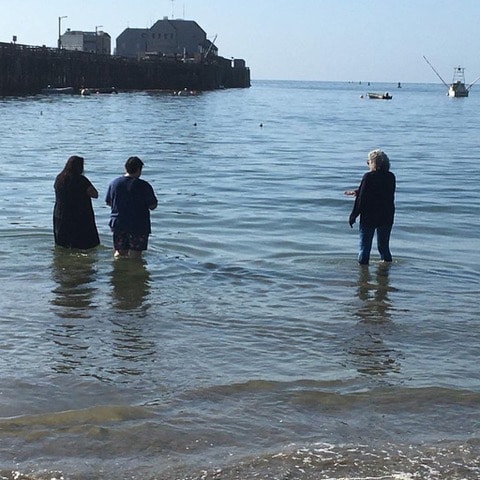
The process of converting to Judaism is an intense journey that includes deep study and taking on Jewish customs and traditions. At the end of that preparation, candidates go before a beit din, a group of three rabbis who assess the candidate. Then comes what is, for many, the most emotional part of the process: immersion in a mikveh — a ritual bath that adheres to certain rabbinic requirements. But due to safety concerns regarding COVID-19, today’s conversion candidates have a natural immersion option: using a natural body of water as a mikveh.

To ask how the ocean fits the requirements for mikveh is “looking at it backward,” said Rabbi Stephen Einstein, founding rabbi emeritus of Congregation B’nai Tzedek in Fountain Valley, who also is on the governing board of the Sandra Caplan Community Bet Din (SCCBD). 

“In the days of the Bible, immersion was used as a form of ritual purification,” Einstein said in a joint Zoom interview with Muriel Dance, the SCCBD’s executive director. “People went into a natural body of water. The mikveh was created for people who didn’t have access to natural water, or where waters were very cold. We have had [mikvehs] going back thousands of years,” he said, “but as a replacement for the natural. [Now] we’re going back to the sources.” 

Because most oceans and seas are considered to be mikveh-worthy in that they are naturally occurring water, the SCCBD is guiding conversion candidates to natural tevilah (immersion) in Newport Beach and San Luis Obispo. 

“Ocean tevilah is a different experience by the very nature of it,” Rabbi Janice Mehring of Congregation Ohr Tzafon in Atascadero told the Journal in an email interview. “We have to consider tide, wind, wave and swell size in order for the tevilah to be safe.” 

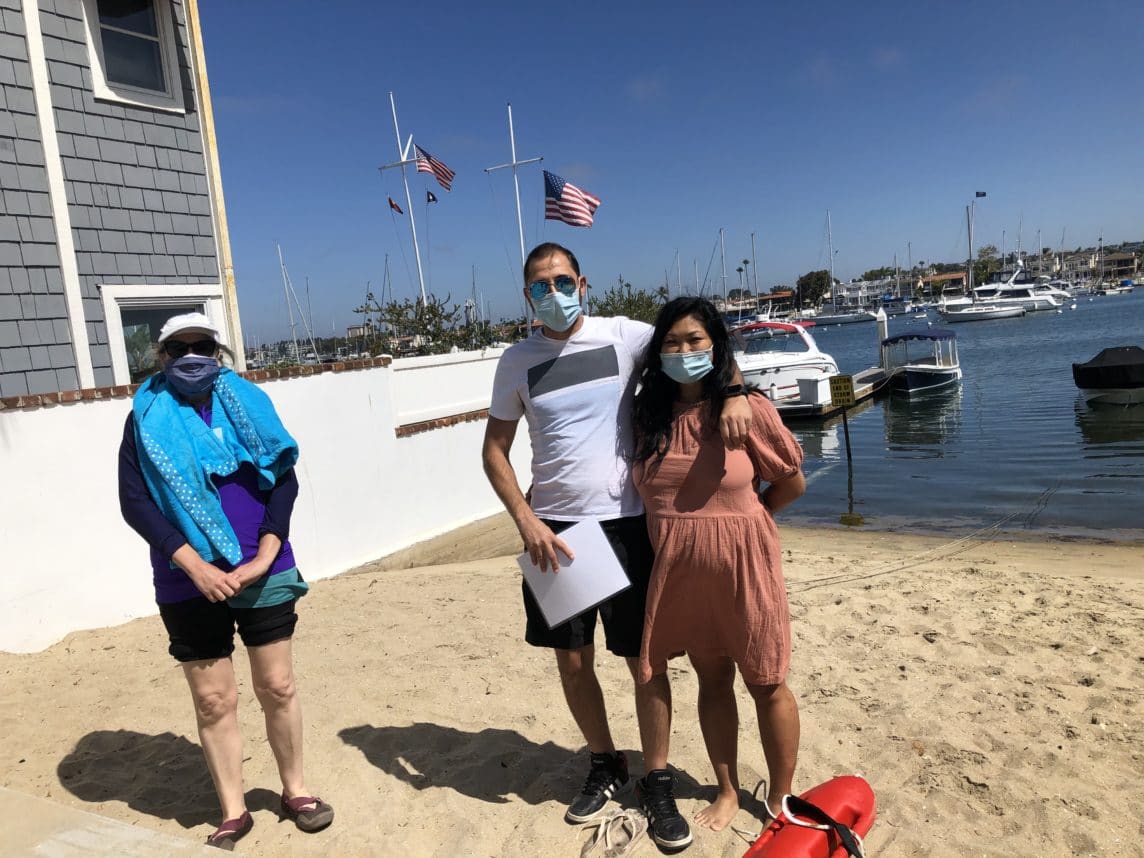
Einstein said he discovered the Newport Bay location as a natural tevilah spot “before the former UJ (University of Judaism, now the American Jewish University, or AJU) built their mikveh,” and because “those of us who didn’t have a mikveh available outside the Orthodox world had to use a natural body of water.” The spot is private, on the bay side and “very calm,” he said.

During natural tevilah, Einstein and Dance explained, candidates are naked under a one-piece garment that is removed in the water. As with all mikveh experiences, the candidates have showered and removed everything else — rings, piercings, nail polish and shoes — before they immerse. A family member is present to hold the garment during the immersion and to wrap them in a towel after they’re done. And two witnesses, required by Jewish law, are at a 6- to 10-foot distance and wearing masks. 

Jeannette Cohen (Yafa her Hebrew name) with her husband Amram (buoy nearby) and one of her witnesses, Rabbi Marcia Tilchin. Courtesy of Sandra Caplan Community Bet Din

The SCCBD is assessing additional beaches in the South Bay as potential future immersion locations, Dance said, and approving “tevilah sponsors” — people who have gone through their training protocol and would be there to witness immersions, including Einstein and Rabbi Marcia Tilchin in Newport Beach and Mehring in San Luis Obispo.

Jan Souk, who immersed in Newport Bay, called her experience “wonderful. After a few dips, the water became very warm. The rabbis are the sweetest people I have met. They made me feel safe and welcome. When they began to sing to me, I teared up … it was one of the most beautiful experiences of my life,” she told the Journal in an email.

“I just wanted to do whatever would be halachic and possible as soon as possible,” said Hadley Sorsby-Jones, who immersed in Newport Bay last week, with her sponsoring rabbi, Susan Goldberg, and Sorsby-Jones’ partner as witnesses. The other members of her virtual beit din were present at a distance, she told the Journal. 

“It was a really positive experience,” Sorsby-Jones said. “Rabbi Susan driving all the way from Los Angeles added a lot to the ceremony. I enjoyed the natural water, and it was celebratory to be finally Jewish.”

“Ocean tevilah (immersion) is a different experience by the very nature of it. We have to consider tide, wind, wave and swell size in order for the tevilah to be safe.” — Rabbi Janice Mehring

“It was a beautiful experience to walk into the living waters of the Pacific Ocean with Hadley,” Goldberg, founder of Nefesh, told the Journal. “In these ever-changing times, to enter into the water with ancient blessings and to witness the open-hearted commitment to becoming a Jew was breathtaking. I was honored to be alongside her even in the chilly waters.”

Although many candidates may choose to use the AJU community mikveh after COVID-19 restrictions are lifted, natural tevilah may remain an option for future conversion candidates, Einstein said. 

“We all agree that the mikveh is better, the first choice by far,” he said. “But until that is feasible, we need an alternative because people have been waiting a long time, have weddings or babies coming up. It’s a time issue; we had to move forward.”

“Logistics, time and cost all factor in but the overarching reason for the choice is that candidates want to immerse in the natural waters of the ocean as part of their conversion experience,” Mehring said. “I grew up in San Diego spending nearly every summer day in the ocean, so natural tevilah feels like a perfect place for me to be a witness. The water is cold but the experience is joyful and invigorating enough so that we often don’t want to get out when we are done.” 

Mehring is a presiding rabbi at the Atascadero branch of the SCCBD, the only standing pluralistic community beit din in the United States. The SCCBD also has branches in Newport Beach and Ventura, with 132 rabbis across its three branches who hail from all liberal streams of Judaism as dayanim (judges). Dance said that the beit din has, to date, completed 630 conversions. The SCCBD also transitioned to a virtual beit din over Zoom, which Einstein called “a pretty good idea and avoids a lot of time on the freeway. We tried it and it worked out great.

“When someone becomes Jewish, they might choose to affiliate with any synagogue … that’s the choice of any Jew,” he added. “But they’re not converting to Conservative or Reform Judaism; they’re becoming part of am Yisra’el. We all stood at Sinai, and to have a beit din that represents that to the best of our ability is a wonderful idea,” he said, crediting the late Rabbi Richard Levy and Rabbi Elliot Dorff for their roles in founding the SCCBD. 

Said Einstein, “We’re saying to each person, ‘You’re part of the entire Jewish people.’ That’s our philosophy.” 

Natural Immersion: Accessible Mikveh for Converts During COVID-19 Read More »

Author Sue Eisenfeld on ‘Wandering Dixie: Dispatches from the Lost Jewish South’

How did Jews living in the Confederacy reconcile celebrating Passover while owning slaves and fighting for the South in the Civil War? As she geared up to research her new book, author Sue Eisenfeld confessed she was puzzled by that seeming contradiction. 

“That’s the million-dollar question that started my whole journey,” Eisenfeld told a Zoom audience on Aug. 12 during her author talk co-sponsored by the Center for Jewish History and the National Museum of American Jewish History. “When I first saw that cemetery in Richmond, Virginia, in 2006, I asked myself, ‘How could the Jews have fought for the South when they still celebrate their freedom every year at Passover?’ ” 

Eisenfeld traversed the South researching her travel memoir, “Wandering Dixie: Dispatches from the Lost Jewish South.” A native of Philadelphia who now lives in Arlington, Va., Eisenfeld journeyed across Arkansas, Mississippi, Louisiana, Alabama and South Carolina conducting interviews, collecting stories and visiting the temples and graveyards of Jewish communities, many of which no longer exist. Through her book, she tracked Jews who settled in the South, prospered financially and fought for the Confederacy during the Civil War. And as she explored the complexities of Southern Jewish history, Eisenfeld investigated how and where that history intersected with the experiences of African Americans. 

Eisenfeld began her research two months after the 2015 shooting at the AME church in Charleston, S.C. Her work continued through the 2016 election and through the notorious 2017 Unite the Right rally in Charlottesville, Va. “Wandering Dixie” was published in April just before George Floyd died while in police custody in Minneapolis, which spurred nationwide protests, civil unrest and calls for racial justice.

Despite widespread discussion over Southern racism and intolerance, most Southern Jews, Eisenfeld learned, did not experience the same types of prejudice as Blacks. Because they were white, Jews avoided persecution and some were themselves slave owners. Others advanced politically, most notably Louisiana Sen. Judah Benjamin (1811-1884), who was appointed attorney general of the Confederacy. While some Jews felt a moral obligation to free their slaves, Eisenfeld said that others grew up singing Confederate songs and bought into the lost-cause mythology that glorified the South and reinterpreted the Civil War as being a conflict born of the need not to preserve slavery but to “beat back the northern aggressor.”

“When I first saw that cemetery in Richmond, Virginia, in 2006, I asked myself, ‘How could the Jews have fought for the South when they still celebrate their freedom every year at Passover?’ ” — Sue Eisenfeld

She highlighted the statue of Thomas Jefferson at the University of Virginia that was a congregating spot for the Unite the Right protesters, who chanted “Jews will not replace us!” The statue was designed by Confederate soldier Moses Ezekial, the first Jewish solider at the Virginia Military Academy. 

“There are good people and bad people in any kind of people, and I think Jews are no exception,” Eisenfeld said. “It’s easy to say, ‘Look at the northern Jews and all the good things they did,’ which is true, but I think there was definitely an interest in doing good things in the South, too. This is one of the issues that doesn’t have an easy answer.” 

Eisenfeld’s talk included a slide show of photos she took at Jewish cemeteries and temples in “lost communities” throughout the South, with many of the sites no longer home to congregations or in serious disrepair. Temple Mishkan Israel in Selma, Ala., for example, had 140 Jewish families in the 1920s but was down to four when Eisenfeld visited. The temple, built in 1899, is in need of rehabilitation. Where once there were 467 Jews in Vicksburg, Miss., in 1927, when Eisenfeld visited she reported “they were basically closing down.” No children had attended the religious school in more than 25 years and both the Anshe Chesed temple and cemetery have been taken over by the National Park Service because they sat adjacent to the Vicksburg Military Park. “Which is a great ending,” Eisenfeld said, “because now it will be preserved.”

The tzedakah page on Eisenfeld’s website (sueeisenfeld.com) contains links to several of the lost communities in the South where fundraising for restoration, preservation and rehabilitation efforts are in place. Organizations like the Institute of Southern Jewish Life and the Jewish Community Legacy Project are helping to spearhead some of these efforts. Eisenfeld, who is related to slain Civil Rights worker Andrew Goodman, also supports the foundation that bears Goodman’s name, which promotes youth leadership development, voting accessibility and social justice initiatives on campuses.

“I hope readers have their own journey of understanding,” Eisenfeld said. “The lost Jewish communities became dear to me. I’m hoping readers will help save them.”

As for the troubling question of how slave-owning, Confederacy-loving Jews could reconcile their beliefs with the celebration of Passover, Eisenfeld conceded, “It hurts your brain to think about it. The Jews fought for the Confederacy because the South was home to them. They were free to live as they wish, practice their religion and advance in business. Life was good in the South if they happened to settle in the South, and they were willing to fight for that.”

Author Sue Eisenfeld on ‘Wandering Dixie: Dispatches from the Lost Jewish South’ Read More »