fbpx

August 13, 2020

Jewish Series’ Successes Stave Off Complete Jew-Hatred

If you’re searching for a consistent rhyme or reason behind anti-Semitism in the year 2020 — good luck. The breadth of violent incidents has been notably conspicuous. At the same time, Jews in popular culture have, arguably, never been this widely appreciated.

Go figure.


Television — mostly produced by the streaming services — has incubated a bounty of Jewish-themed programming, such as dramas “Unorthodox,” “Shtisel,” “The Plot Against America,” “Fauda” and “When Heroes Fly”; situation comedies including “The Marvelous Mrs. Maisel,” “The Kominsky Method,” “Schitt’s Creek” and “Curb Your Enthusiasm”; and stand-up comedy in Tiffany Haddish’s “Black Mitzvah.”

While sheltering at home, millions have used this pandemic as an opportunity, perhaps for the first time, to observe Jewish life not stereotypically, but as authentic plot conceits. Who would have believed that Jews on TV would take so many minds off COVID-19?
“Unorthodox” and “Shtisel” concern ultra-Orthodox Jews living in Brooklyn, Jerusalem and Berlin. “Fauda” and “When Heroes Fly” depict elite Israeli commando units. The situation comedies are so unmistakably tribal, the actual Borsht Belt looks positively Episcopalian by comparison. “Maisel,” in fact, re-created the storied summer hotels and bungalow colonies where Jews once escaped the sweltering heat — but not one another.

A number of these shows dominated this year’s Emmy nominations—emmis!

Photo by Ohad Romano

Jews have always found success on the large and small screens but rarely, if ever, by playing Jews. Hollywood implicitly demanded Anglicized names and concealed ethnic identities.

Jews thrived playing gangsters, including did Edward G. Robinson and John Garfield; gladiators (Kirk Douglas and Tony Curtis); space travelers (Harrison Ford, William Shatner and Leonard Nimoy); cowboys (two of the four Cartwrights on “Bonanza” and half of “Butch Cassidy and the Sundance Kid”); and screen temptresses (Hedy Lamarr and Lauren Bacall).

The Dodgers’ Sandy Koufax may have refused to pitch on Yom Kippur, but no A-list Jewish actor dared to delay production on a feature film, no matter how much repentance he or she owed before the Book of Life got sealed.

Movies with Jewish themes, including “The Jazz Singer” and “Fiddler on the Roof,” ended happily — but only if you believed Jews should abandon their traditions. There’s a reason the “The Jazz Singer” wasn’t titled “The Cantor”; he wanted to swing in jazz clubs rather than sway at shul. And Jewish girls will invariably disappoint their fathers by marrying non-Jewish boys. Such are the concessions to modern life.

Nowadays, television has outed the once-undercover existence of authentic Jewish stories. The lives of Jews, acting as Jews, and even more provocatively, as Israelis, is officially binge-watchable. 

But how to reconcile all this adulation for Hollywood fiction when actual Jews are feeling more and more vulnerable while walking the streets where they live? It’s a paradox, but isn’t anti-Semitism the mother of all mind-boggling mysteries? After all, Jew-hatred always has been malleable, appropriate for any occasion — even if logically incoherent. Adolf Hitler spoke of Jews as if they were spellbindingly powerful, while at the same time reassuring Germany that they were lowly vermin.

Centuries of Christian anti-Semitism depicted Jews as conniving their ways into the mainstream, undetected. Quite a trick, since many believed Jews sported horns, tails, massive noses and mouths dripping with Christian blood. The powers of Christian detection are, apparently, very poor.

Some Muslims allege Jews or the Mossad (probably both) staged the 9/11 carnage, even as they celebrate that day as a momentous victory, bringing them one giant step closer to a caliphate.

What’s a conspiracy theory without Jews? At least one Southern pastor, Rick Wiles, believes the coronavirus was sweeping through synagogues across America as a punishment from God for “false religions.” One Jewish actress believes Israel had the vaccine all along, and is simply waiting until the infection rate will guarantee massive profits. 

Jews surely can’t feel safe these days. Instability comes from many directions. European Jewry experienced hideous acts of overt anti-SemitismChasidic Jews in America were targeted with violence. Synagogues in Los Angeles and Richmond, Va., were vandalized during some of the Black Lives Matter protests. Several Black sports and entertainment figures, and Jewish actress Chelsea Handler, favorably tweeted support for anti-Semitic cleric Louis Farrakhan.

Comedian-actor Seth Rogen’s solidarity with his people imploded when he pronounced that a Jewish state wasn’t such a great idea after all because Arabs have lived on the same land — a truth he claims was hidden. And just to prove that it isn’t just a poorly educated Jewish actor who believes Israel-bashing might be a beneficial career move, journalist and commentator Peter Beinart finally said what was really on his mind: It is time for Israel to call it quits as a Jewish state. Fortunately, he is able to reassure Israelis that Arabs will abandon their genocidal fantasies in joining a democratic binational state.

Apparently, the Middle East conflict finally has been solved from the Situation Room in Beinart’s apartment on the Upper West Side of Manhattan.

Given all this anti-Semitic violence, scapegoating and backstabbing, how do we account for this golden age of Jews on television? These shows could have reinforced stereotypes about Jews and Israelis. Instead, they seem to be the only thing standing in the way of complete Jew-hating bedlam. The TV audience doesn’t need Netflix or Amazon as an excuse to hate Jews. Anti-Semitism, after all, goes way back — even before cable.

The cast of the “Marvelous Mrs. Maisel” at the 26th Annual SAG Awards. Terence Patrick/Getty Images

For those self-appointed deputies working incognito for the intersectional police, please don’t make a fuss that Rachel Brosnahan, who stars in “Maisel” as the Jewish nightclub comic, and John Turturro, who headlined “Plot” as a genteel Southern rabbi, are not Jewish. Jews do not regard such casting as cultural appropriation. Actors are free to act. And Jews are more than happy to have the night off.

They also know that “wokeness” cares little for offenses against Jews.


Thane Rosenbaum is a novelist, essayist, law professor and Distinguished University Professor at Touro College, where he directs the Forum on Life, Culture & SocietyHe is the legal analyst for CBS News Radio. His most recent book is titled “Saving Free Speech … From Itself.”

Jewish Series’ Successes Stave Off Complete Jew-Hatred Read More »

‘Unorthodox’ Secrets Revealed

With the Emmy Awards less than six weeks away, the Variety Streaming Room presented an exclusive virtual interview celebrating the Netflix limited series “Unorthodox” after a screening of the premiere episode. 

Lead actress Shira Haas (Esty Shapiro), director Maria Schrader, writer and creator Anna Winger, casting director Esther Kling and costume designer Justine Seymour — all Emmy nominees — logged in from their homes around the world to discuss their reactions to the show’s eight nominations and share highlights from their “Unorthodox” experience. 

Kling said she made a concerted effort to cast the Jewish roles with Jewish actors, preferably those familiar with ultra-Orthodox Judaism. “You can do loads of research but it’s easier for a showrunner or director to work with people who are well acquainted with the community,” she explained. But according to Winger, that “limited our choices in Germany,” the location of the shoot. Ultimately, they found their leads in Israel: Haas, Amit Rahav (Yanky Shapiro) and Jeff Wilbusch (Moishe Lefkovitch), who grew up in the Satmar community in Jerusalem. Although Etsy and Yanky have a doomed marriage, in real life Haas and Shapiro have been great friends for 10 years and are now neighbors. “If I shouted right now he could hear me through the walls,” Haas said. “Doing this with him was really magical.”

“Unorthodox’s” designers also turned to the Charedi community in the name of verisimilitude. After reading Deborah Feldman’s memoir, the series’ inspiration, Seymour researched on her own and watched every film about Jewish communities she could find. Then, with Eli Rosen — the series’ Yiddish adviser (who also plays the rabbi) as a guide — she, Schrader, and the other department heads went to Williamsburg in Brooklyn, N.Y., last year. “We walked around, ate at delis, and went to clothing shops, taking photographs,” Seymour said. “I managed to get a few people to talk to me on the street. I got a young lady to tell me how the head scarfs were tied. We got a really fantastic insight from the ground up.”

“From a writing standpoint, weaving the two parts of the story together was the greatest challenge, also because it’s a genre mix,” Winger said. “It’s a romantic tragedy on one side and also has a thriller engine.”

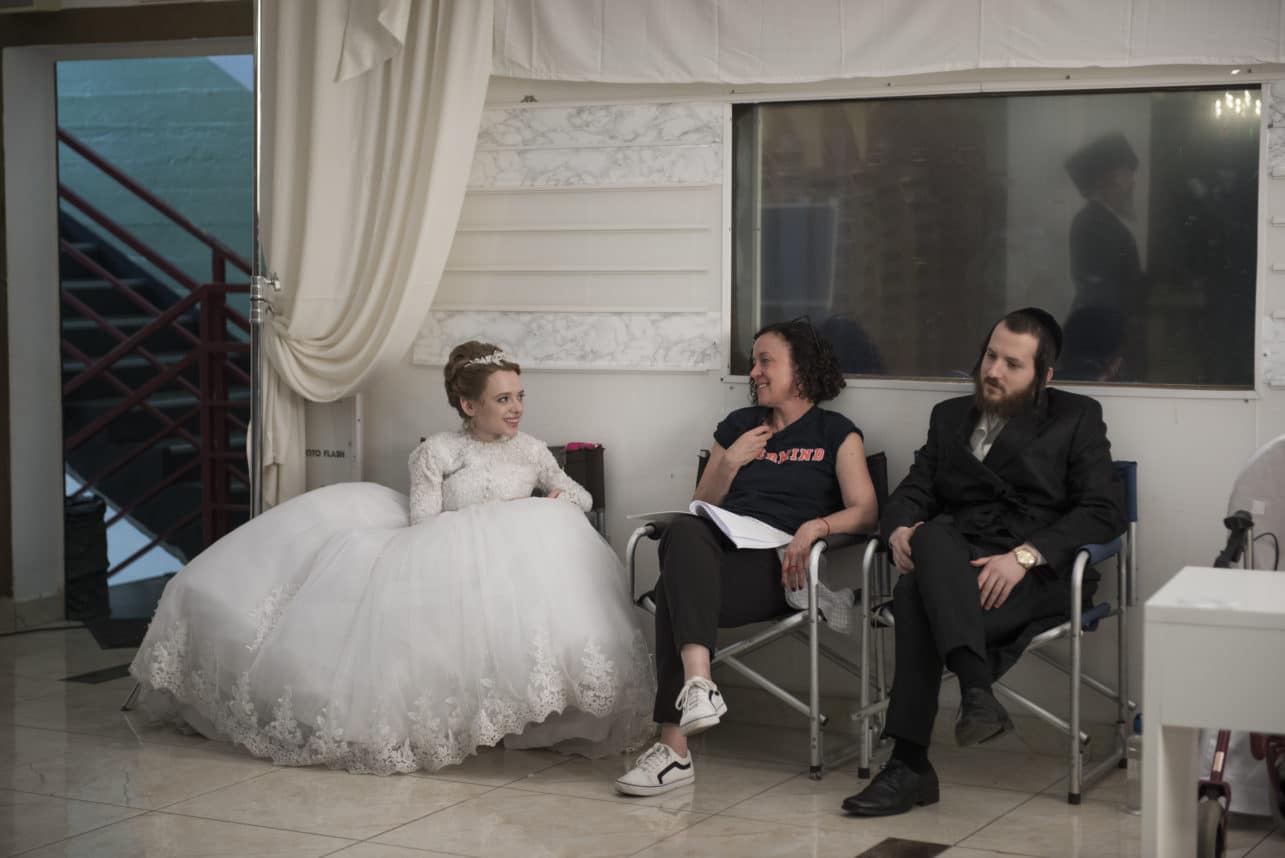
For Schrader, the challenge was the wedding scene, which involved wrangling hundreds of actors and extras. “It was the most expensive part of the shoot and we did a lot of rehearsal before,” she said. “When the room is filled with 300 people, that puts a lot of pressure on a director.” And, added Winger, “It was really, really hot.”

The wedding also provided Seymour with her greatest challenge. She wanted a gown that was “something really sumptuous and crazy and huge and fantastic,” for Etsy, “something that a young bride would think a princess would have,” she said. “I couldn’t actually afford that so I went on eBay and looked at 10 different dresses. I found one and took Shira to do a fitting, but it was too long. It was huge. It drowned her. But it was the right price and I knew that we could make it into what we wanted. I bought it and we cut it up and rebuilt it. Hopefully it wasn’t too painful for Shira because it was a very heavy dress.” 

“It’s almost a sculpture, more than a beautiful wedding dress,” Haas commented. “It echoes the festive event and the burden at the same time —it serves the narrative.” Her greatest challenge was not the one-take scene in which her head was shaved before the wedding, shot on the first day of shooting, but the climactic audition scene at the end of the series.

“It’s a story about a woman finding her voice and in that scene, she’s literally finding it,” Haas said. “She even surprises herself with what comes out of her. It was a huge responsibility for me. There were a lot of people in the audience and no one but Maria knew what would come out of me so it was almost like a real audition. I love to sing and singing is also acting, the way I see it. It was a really emotional shooting day for me.”

Asked about her thoughts on the series’ success, Haas noted that since its premiere in March, “People have reached out and said this is their story; they could really relate to it. The place Esty is coming from is really different from me, but when I read it, I saw myself in Esty. It’s about finding yourself, finding your voice and the value of freedom. It’s a very universal thing and I hope people feel the way I felt about it.”

‘Unorthodox’ Secrets Revealed Read More »

Ari Axelrod on His ‘Celebration of Jewish Broadway’ Cabaret

Quoting cabaret pianist and composer Dick Gallagher, Ari Axelrod believes “cabaret is the art of being yourself on purpose.” The 26-year-old has combined his passion for musical theater and cabaret, and last month took his cabaret “A Celebration of Jewish Broadway” to Zoom.  

The Journal spoke with Axelrod via Zoom about his four-week masterclass “Bridging the Gap,” which focuses on connecting cabaret and musical theater performance, and the importance of sharing intimate art with the world.

Jewish Journal: Do you remember the first song you ever performed?

Ari Axelrod: Oh, my God, no, I don’t. I think it was probably “Somewhere Over the Rainbow” at a middle school talent show. 

JJ: What drew you to musical theater?

AA: I was bullied a lot in my high school. I really didn’t like going, so I started skipping school. Instead, [I] was driving around town [in] Ann Arbor [Mich.] in my Honda Odyssey 2002 minivan and I would play the Broadway satellite radio station [on] SiriusXM for hours. … It was one of the first times, and frankly one of the only times, I felt I was understood, and there were people that saw me.

JJ: And cabaret?

AA: I had brain surgery the summer after my junior year of college [at Webster Conservatory] and I recovered much faster than anyone anticipated, so I had all this free time. One of my faculty members [mentioned] the St. Louis Cabaret Conference. I didn’t know what cabaret was. I thought it was like Joel Grey and Liza Minnelli, Cher and Christina Aguilera. I thought it was Burlesque. I was surrounded by titans of the industry and those 10 days completely changed my life.

JJ: Is that what inspired you to start “Bridging the Gap”?  

AA: Yeah. I saw it as an opportunity to really step into yourself and use all of this musical theater stuff and other genres of music and really make it my own. It was beautiful, it was selfless, it was generous, it was a gift to the audience. I realized there is nowhere in New York specifically for young professional theater actors to learn what cabaret is. I started this company [to bridge] the gap between musical theater and cabaret and also bridge the gap between the singer and the song because there’s no character. That gap is really hard and scary if you don’t have the tools to do it and you don’t feel empowered to do it. [In] two years, I’ve had more than 50 clients and done showcases at 54 Below and Birdland [Jazz Club.]

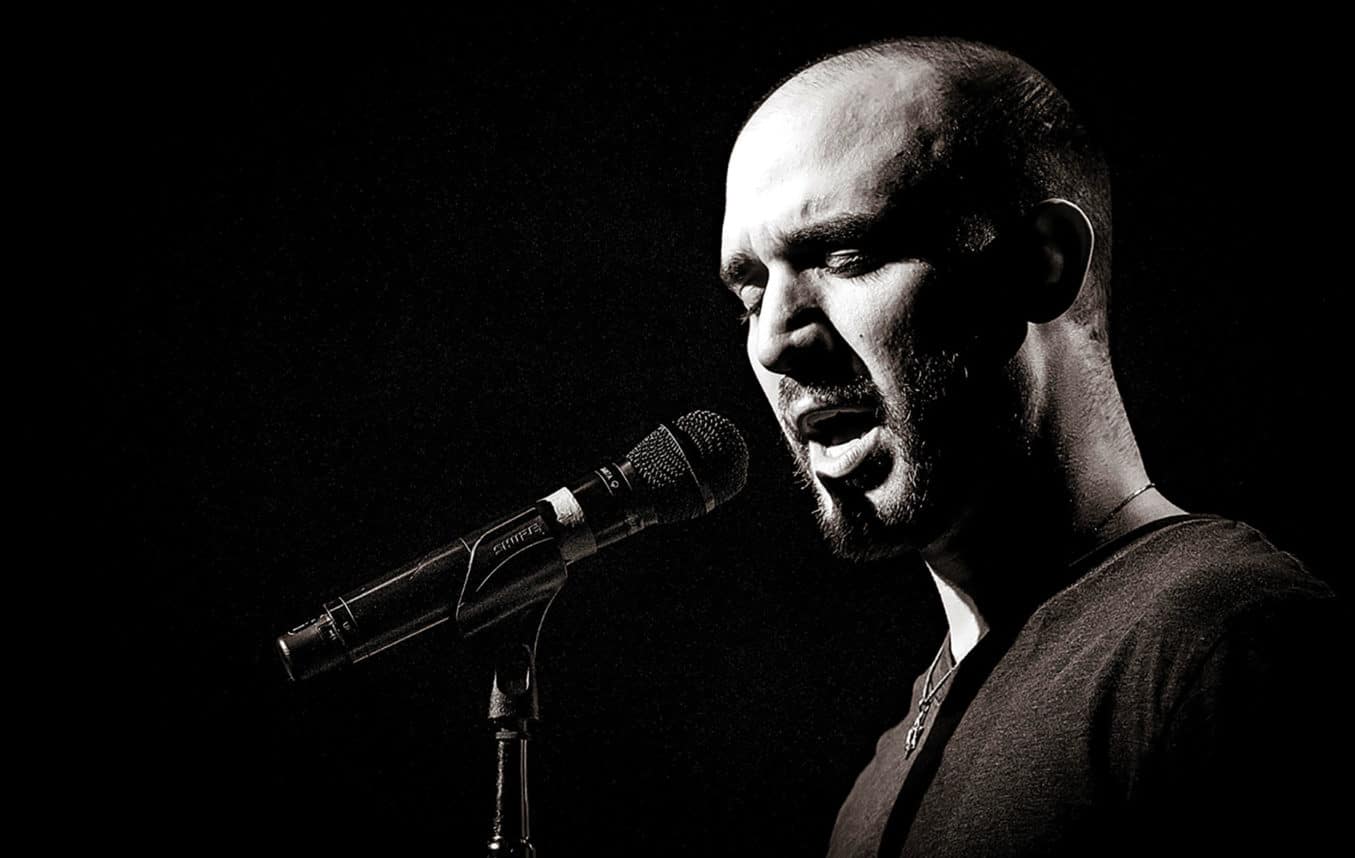
Ari Axelrod; Photo by Diana Bush

JJ: How did “A Celebration of Jewish Broadway” come about?

AA: I had already done a solo cabaret and taken it around the country. Then Marty Shichtman, the [director of the Center for] Jewish Studies at Eastern Michigan [University], came to New York with a group of students [studying] Judaism and theater. He said, “You know, you should do a show about Jewish influence on musical theater,” and I said, “No one’s going to come!” 

He said to come to Eastern Michigan in October [2018] and we’ll do a show about Jewish influence in musical theater. Two hundred and fifty people came. The next day, I sent an email to the manager at Birdland in New York, and he said, “Yeah, let’s do it.” I did it three times at Birdland, sold out each time. The last time, I had Tovah Feldshuh as a guest performer. Then it really picked up, so I brought it to Chicago twice, St. Louis twice, Boca [Raton, Fla.] twice. It still shocks me when it is received so positively. I’m not used to that.

JJ: Why is it important to showcase these Jewish contributions?

AA: Anti-Semitism is on the rise. At the same time in the world of musical theater, people are saying New York musicals are by a bunch of old white men. Yes, they were white, but to completely negate that they were Jews — many of whom were Jewish immigrants or children of Jewish immigrants — feels like revisionist history and also erasure. 

I looked at the curriculum that I had in college and I realized there was no talk about the Jewish influence, which doesn’t make sense. What better way to combat anti-Semitism than by showcasing the contributions that Jews have [made], not only [to] the American musical, but I talk about how Carole King was Jewish. I talk about how “God Bless America” was inspired by the Amidah. Any anti-Semite who gets up and sings “God Bless America,” that is a song written by a Russian Jewish immigrant.
JJ: What is it like performing “Jewish Broadway” virtually?

AA: People have been saying that cabaret has been dying for decades. What an amazing time to think about what it would look like in today’s current climate. I could literally see and talk to people [on Zoom], and the only thing that was really bizarre was that there was no applause. But I could still see people [waving their hands]. What was really cool was being able to do the show for people all over the world at the same time. 

https://www.youtube.com/watch?v=Oojc2tmIq54

JJ: Is that why you think it’s so important to share art right now?

AA: I heard a lot of people say that now is not the time for artists. Now is the time for us to sit back and it’s actually time for essential workers. Yes, it is their time, but it is also our time. To the people who are fighting to survive right now from COVID in hospitals, if we stopped creating, what world would they have to fight to come back to? What would their lives be in a world with no new art? 

Also, with the social injustice [and] Black Lives Matter movement right now, I’ve seen artists who benefit from white privilege open up their platforms to BIPOC (black, indigenous and people of color), and Black artists sharing their art. It’s a great opportunity to pass on the mic and create equity in this industry. To quote Leonard Bernstein, “This will be our reply to violence: to make music more intensely, more beautifully, more devotedly than ever before.”

Learn more about Ari Alexrod here.

Ari Axelrod on His ‘Celebration of Jewish Broadway’ Cabaret Read More »

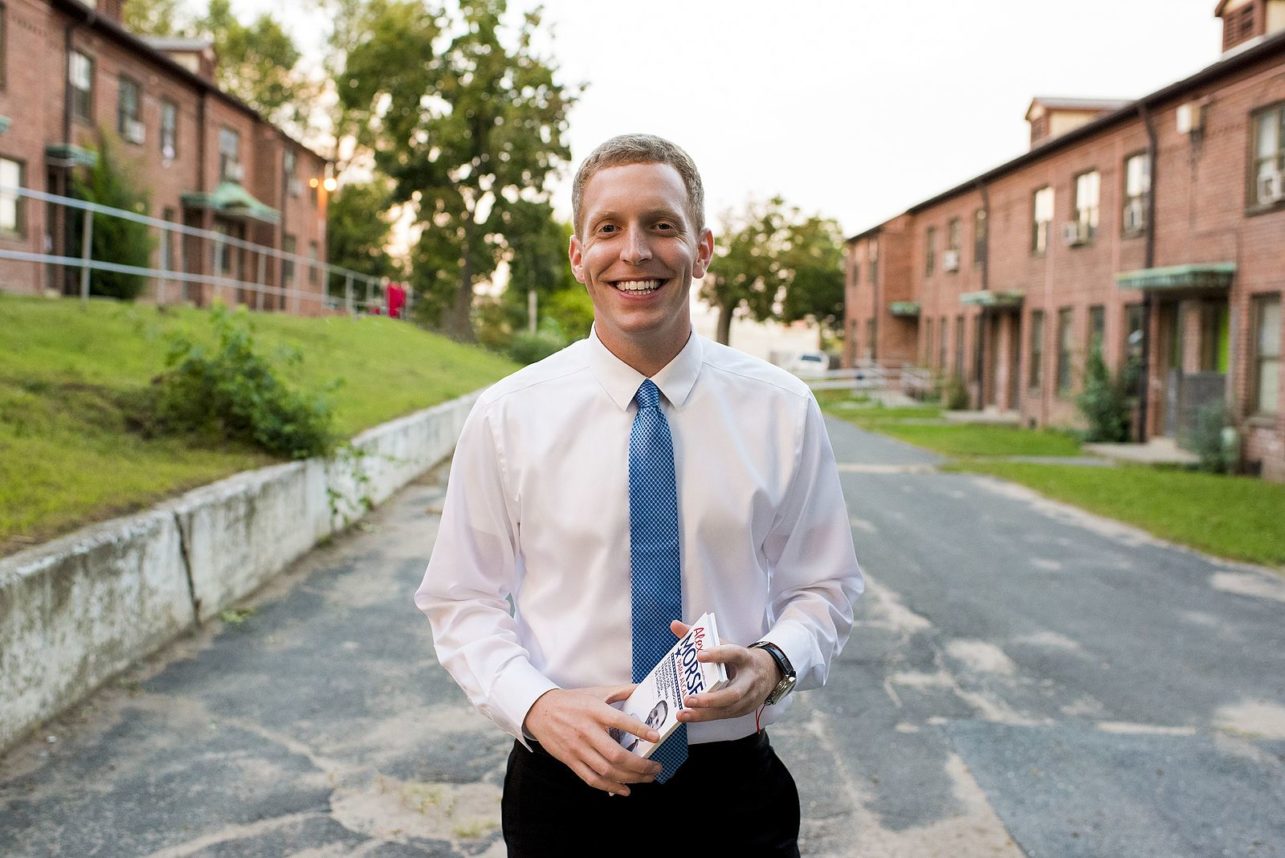
New Report Suggests Allegations Against Congressional Candidate Alex Morse Were Concocted to Benefit His Opponent

(JTA) — In a bizarre turn of events, a new report casts doubt on allegations that Massachusetts congressional hopeful Alex Morse had inappropriate relationships with college students.

Morse, a 31-year-old gay, Jewish progressive Democrat running to unseat a longtime incumbent, was accused last week by the College Democrats of Massachusetts of having used “his position of power for romantic or sexual gain” in relationships with college students. Morse has been the mayor of Holyoke, a city of 40,000 near Springfield, for nearly a decade.

The allegations, revealed in an article in The Massachusetts Daily Collegian, claimed that Morse had matched with college students on dating apps, attempted to contact students he met through campus events and had inappropriate relationships with students at UMass Amherst, where he taught a course on urban government. In that article, Morse said he had relationships with college students but they were consensual.

But on Wednesday, an article in The Intercept said that College Democrats had been discussing a plan to attack Morse since last year. The article said that leaders of the group discussed finding Morse’s dating profiles in an attempt to get him to say something inappropriate to damage his campaign. The group’s chief strategist, Timothy Ennis, allegedly claimed in group chats that he was attempting to secure an internship with Rep. Richard Neal, the centrist Democrat whom Morse is seeking to unseat. The Neal campaign has denied any collaboration with the students.

Politico reported today that the Massachusetts Democratic Party plans to investigate the college Democrats who accused Morse of misconduct — but not until after the Sept. 1 primary.

Morse was elected mayor of Holyoke, his hometown, at 22, becoming the youngest and first openly gay person to lead the city. He has aligned himself with “the Squad,” a quartet of progressive congresswomen of color. In an interview with the Jewish Telegraphic Agency last month, he defended the four representatives against accusations that their criticism of Israel veered into anti-Semitism.

New Report Suggests Allegations Against Congressional Candidate Alex Morse Were Concocted to Benefit His Opponent Read More »

David Arquette on ‘Spree,’ Getting Bar Mitzvahed at 40 and the Influence of Andy Kaufman

It has been almost 30 years since David Arquette made his on-screen debut as an actor, and not a year has gone by in which Arquette hasn’t worked in some form. A successful screenwriter, director and producer outside of his acting work, Arquette has forged such a successful career within entertainment that many have forgotten about his famous lineage and also-notable siblings.

The latest film project for David Arquette is 2020’s “Spree.” In “Spree,” main character Kurt —played by Joe Keery — dreams of sitting atop a social media empire, but for now he drives for the rideshare company Spree. Fortunately, Kurt has come up with the perfect way to go viral: #TheLesson. He’s decked out his car with cameras for a nonstop livestream full of killer entertainment, murdering his passengers. In the middle of all this madness, a stand-up comedian (played by former “SNL” cast member Sasheer Zamata) with her own viral agenda crosses Kurt’s path and becomes the only hope to put an end to his misguided carnage. “Spree” hits theaters and VOD/digital outlets on August 14, 2020, also starring Mischa Barton, Lala Kent, Frankie Grande and Kyle Mooney.

Also new and related to David Arquette is the documentary “You Cannot Kill David Arquette.” This doc is a fascinating look at Arquette’s world, recapping his life as a quickly rising actor in the 1990’s — once on the cover of Vanity Fair with Leonardo DiCaprio, Benicio del Toro, Will Smith and Matthew McConaughey — to becoming a struggling actor after the “Scream” franchise and having to audition, unsuccessfully, for over a decade. Viewers are introduced to David’s true life passion, professional wrestling, as he tries to become a respected member within the wrestling community after being shunned in 2000 due to a related publicity stunt. The film features insight from Courteney Cox, siblings Patricia and Rosanna Arquette, wrestling icon (turned DDPY founder) Diamond Dallas Page and other famous faces, who all try to understand this seemingly-absurd dream of Arquette’s.

When speaking with David Arquette by phone on August 12, 2020 about “Spree” and “You Cannot Kill David Arquette,” I asked him if he had ever been bar mitzvahed. Arquette opened up about the experience of having a bar mitzvah at the Wailing Wall at the age of 40. Also on the end of Judaism, he also opened up about the influence of comedy icon Andy Kaufman on his wrestling path and latest film altogether.

More on David Arquette and “Spree” can be found here, here and here.

David Arquette on ‘Spree,’ Getting Bar Mitzvahed at 40 and the Influence of Andy Kaufman Read More »

Jewish Groups Celebrate Israel-UAE Agreement

Jewish groups praised the agreement announced on Aug. 13 that normalizes relations between Israel and the United Arab Emirates (UAE).

According to a joint statement from Israel, the UAE and the United States, which helped broker the deal, the agreement will establish economic and diplomatic relations as well as security cooperation between the two countries. The two countries also will collaborate on a COVID-19 vaccine.

As part of the agreement, Israel will suspend its plans to annex parts of the West Bank.

Jewish groups called the agreement historic.

“AJC celebrates today’s historic peace agreement between Israel and the United Arab Emirates,” the American Jewish Committee (AJC) tweeted. “Having engaged with states in the Arabian Gulf and throughout the Arab world for decades, we hope this opens the door to further agreements between Israel and her Arab neighbors.”

Simon Wiesenthal Center (SWC) Founder and Dean Rabbi Marvin Hier and Associate Dean Rabbi Abraham Cooper said in a statement, “Today is a historic day — two allies of the US now become open strategic partners in the region to thwart Iran and other Jihadists. It also signals further dramatic normalization between Arabs and Jews in the region, a goal the SWC has contributed to for over 15 years.

They added that they hoped Bahrain will soon follow and argued that the agreement is “is sending a message to the Palestinian people. The peace train has left the station. Peace with Israel is within reach but only if Palestinians have leaders who are prepared to forever foreswear violence and terrorism. Today, the Palestinian Authority no longer has veto power over regional relations between Arab and the Jewish nations.

“It’s time for the Palestinians to come to the peace table and directly negotiate with Jerusalem,” Hier and Cooper said.

StandWithUs CEO and co-founder Roz Rothstein said in a statement, “We celebrate this historic breakthrough, which follows a long period of increased cooperation between the UAE and Israel. While the two governments work out the details of this peace agreement, we encourage more Arab states to follow their lead. In our outreach to the Arab world on social media, we have seen trends that give us hope for a more peaceful and prosperous future in the region.”
The European Leadership Network (ELNET) similarly tweeted, “ELNET hails the historic agreement normalizing ties between the #UAE and #Israel. As the momentum for change gathers force in the region, ELNET will continue to highlight the importance of supporting regional dialogue and cooperation.”

The Stop Antisemitism.org watchdog tweeted, “Antisemitism in the Arab world is one of the leading challenges for not only #Jews in Israel, but from those of us in the diaspora. By normalizing relations with now another Arab/Muslim country, we slowly move towards peace in the Middle East!”

Christians United for Israel (CUFI) founder and chairman Pastor John Hagee said in a statement, “We consistently pray for the peace of Jerusalem, and today those prayers were answered in a big way. In the context of the discussion about extending Israeli sovereignty to portions of Judea and Samaria, we made clear in late June that this is precisely what the Gulf states should do, and we hope other Arab nations will follow the UAE’s lead. CUFI backs the decisions of the democratically elected Government of Israel, including the decision to suspend sovereignty extension plans in this context.

“This proves yet again that when Israel’s Arab neighbors are prepared to make peace with the Jewish state, Israel will always be there to meet them.”

Jewish Groups Celebrate Israel-UAE Agreement Read More »

Singing a Little Differently

Singing is different now.

Like, really, really different.

I gave a concert on Friday took under an ancient Provençal oak tree, in a garden which is straight out of a Midsummer Nights Dream.

I’m serious. I kept expecting Titania and her faery friends to leap out of the branches.

Hosted by my beautiful friends and neighbors Elaine and TG, here in Les Baux, the first half was a poetry reading, second half, music by yours truly and my cellist friend, Ruth.

Afterwards, homemade Indian food for everyone.

It was the kind of musical evening I rarely had in the Before Times, back when I was living out of a suitcase in sterile Ibis hotels, living in airports and on airplanes and seeing lots of new cities but usually only the flourescent-lit dressing room of the theater and the inside of one restaraunt.

But it was *exactly* the kind of evening I used to have as a student in Berlin, when a bunch of us would gather in someone’s flat, the house all golden and candle-lit, and someone would cook a big pot of soup, and everyone got up to offer a song or a poem and we’d listen sitting on pillows on the floor in sock-feet.

It was the kind of evening I stopped having once I started having “a career.”

Friday in my neighbors garden was about poetry and music but it was really about community and neighbors and friends sharing beauty, and sharing love, and holding each other up in these times when we cannot physically hold each other.

Under the oak tree, there were no theater acoustics, no costumes, no light-director, no orchestra, no sound technicians, no make-up artists.

I sang things like O Mio Babbino Caro,  La Vie en Rose and Somewhere Over The Rainbow.

The wind blew noisily and a motorcycle vroomed  by AGAIN and the crickets almost upstaged us.

But it felt like exactly the medicine we all needed.

The neighbors all came. Masks were worn by virtually all.

Lovely Marie who brought me bread and marmalade, and Gerard who came with jumper cables when my car battery died. Marie-France and Rejan who taught this city-slicker how to care for her mint and basil plants came. Jacques entire human family came. Little Tia put on her nice party dress. Her mom even let her wear lipstick and before the concert started, I saw Jacques and noticed the white fur on his face was covered in pink lipstick kisses where she had kissed him.

And I felt safe and at home.

I always knew this was true, but one of the best and most healing things in life is to make music with friends, for friends.

It’s very painful not to have our musical homes open for us now and nothing is the same but we still have this.

Singing a Little Differently Read More »

BDS Activist Convicted of Assault in Berlin Court

A boycott, divestment and sanctions (BDS) activist was convicted in a German court of assault that authorities said was committed while protesting a 2017 event at Humboldt University in the German capital.

The Jerusalem Post reported that the incident occurred at a speaking event featuring Israeli Knesset Member Aliza Lavie and Israeli Holocaust survivor Deborah Weinstein, who were talking about life in Israeli. The activist, Stavit Sinai, and two other BDS activists disrupted the event.

The court convicted Sinai of banging on a door at the event, which resulted in injuries to two people. Sinai has to either pay a fine of 450 euros ($530.39) or serve a 30-day prison sentence.

Sinai, who calls herself an Israeli dissident in her Twitter bio, argued in a tweet that she was punched in the face at the event; accompanying the tweet was an image containing a statement that she didn’t regret her conduct and that she won’t be paying the fine.

“There’s no punishment that can silence me from speaking about the crimes of apartheid,” the statement read. “I am confident that one day the apartheid criminals would be sitting here instead of me.”


Sinai and the two other activists also faced charges of criminal trespassing; those were dismissed.

Frankfurt Mayor Uwe Becker, who is also the Hesse commissioner to combat anti-Semitism, praised the court’s decision as “an important success against the violent character of BDS and its supporters.”

“It unmasks the violent character of the BDS movement, because it shows that even Holocaust survivors are attacked by BDS when they speak out for the Jewish state,” Becker told the Post. “So it makes clear that the aim of BDS is not about peaceful protest against political decisions in Israel but the aim is the destruction and delegitimization of the Jewish state by all means.”

He added that the decision also shows that the BDS movement aims to silence views that oppose its narrative.

“It makes clear that BDS is lying about their history when they want to present themselves as a Palestinian human rights movement,” Becker said. “They are lying about their aims, when they proclaim the borders of 1967 as their major goal, and they are lying about their means when they want to present themselves as a peaceful movement.”

Ronnie Barkan, one of the other activists who was charged with disrupting the 2017 event, argued in an Aug. 3 Medium post that Sinai was banging on the doors because she was trying “to find out the details of the person who had just punched her in the face. Thanks to one of the Zionist witnesses who inadvertently showed the judge a video that he had never published before — the punching was clearly visible — giving immense credibility to Stavit’s testimony while discrediting each and every Zionist witness that testified against us.”

He also wrote that the trespassing charges were dismissed “on the basis of formality flaws by the prosecution” and said it was a win for them to be able to promote “an unapologetic discourse of resistance to the criminal Israeli apartheid regime in Berlin — the last standing bastion for Zionism.”

BDS Activist Convicted of Assault in Berlin Court Read More »

Spread Kindness by Leaving Art Around Your Neighborhood

I’ve always believed that creativity makes the world a better place. Creation is the opposite of destruction, and when we make something — whether it’s art, music, poetry, jewelry, food, whatever — it counteracts all the forces of negativity beating down on us. 

That’s why it’s so important to share what we create. In doing so, we spread love and kindness. 

People often ask me what I do with all the craft projects I create. The fact is, I give almost all of them away. I don’t have room for everything and, more importantly, other people seem to enjoy receiving the completed projects more than I enjoy keeping them. 

One very fun way to share something I make is to pass it out anonymously, and surreptitiously, around my neighborhood. This is a practice many of my fellow crafters enjoy engaging in, and we call it art abandonment. By leaving art all around, we hope that someone else will find it and find some joy in the discovery. Art abandonment has become quite a movement, and there’s even a Facebook group dedicated to it.

To get started, you can create any art you wish. One of the most popular projects people have been sharing are painted rocks with positive affirmations on them, but you can make something as simple as a bookmark or as extravagant as jewelry. Paint a miniature canvas. Bundle some dried flowers. Write and print out a poem. Anything you create is a treasure waiting to be found.

You’ll want to print out a note so whoever finds your art piece will know it was placed there on purpose and meant to be picked up. You can create an email address so the recipient can let you know they found the object, or encourage them to post about it on social media with a hashtag like #Ifoundsomehappiness. It also helps to package the art and accompanying note in a clear ziplock bag to keep it all together. Ideal places to drop off your art include parking lots, ATMs, bus benches and store shelves.

So, are you ready to be your neighborhood’s secret art giver? You’ll soon agree that the only thing better than creating something is sharing it — unconditionally and with a happy heart.


Jonathan Fong is the author of “Flowers That Wow” and “Parties That Wow” and host of “Style With a Smile” on YouTube. You can see more of his do-it-yourself projects here.

Spread Kindness by Leaving Art Around Your Neighborhood Read More »

In a Diplomatic Breakthrough, Israel Normalizes Ties With United Arab Emirates and Suspends West Bank Annexation

(JTA) — In a diplomatic breakthrough, Israel and the United Arab Emirates are normalizing ties.

As part of a peace deal brokered by President Donald Trump, Israel will pause its plans to annex areas of the West Bank, according to a joint statement released by the White House.

“Israel will suspend declaring sovereignty over areas outlined in the President’s Vision for Peace and focus its efforts now on expanding ties with other countries in the Arab and Muslim world. The United States, Israel and the United Arab Emirates are confident that added diplomatic breakthroughs with other nations are possible, and will work together to achieve this goal,” the statement read.

The statement, which referred to the two countries as “two of America’s most reliable and capable regional partners,” said that Israel and the UAE will sign agreements in the coming weeks related to investment, tourism, air travel, security, opening embassies and more. The two nations also will work together on developing a vaccine for the coronavirus, it said.

The Gulf states have been growing closer with Israel in recent years, but the UAE is the first to establish formal ties with the Jewish state. The countries share a goal of countering Iranian influence in the Middle East.

Most Arab countries do not recognize Israel’s existence. The Jewish state currently has ties only with Egypt and Jordan.

In a Diplomatic Breakthrough, Israel Normalizes Ties With United Arab Emirates and Suspends West Bank Annexation Read More »