fbpx

August 6, 2020

The Failure of USC Leaders to Condemn Jew-Hatred Allows a Virus to Spread

The resignation of Undergraduate Student Government Vice President Rose Ritch on Wednesday is a scandal in its own right.

In her letter of resignation, Ritch wrote that she was “harassed and pressured for weeks by my fellow students because they opposed one of my identities,” namely, that she openly identifies as a Zionist and is a supporter of Israel’s right to exist as a Jewish state.

Because of this identity, Ritch wrote, she was “accused by a group of students of being unsuitable as a student leader.”

But wait, it gets worse.

“I have been told that my support for Israel has made me complicit in racism, and that, by association, I am racist.”

Arguably the worst insult in America today—“racist”—is being weaponized against Jews who have the nerve to support the existence of a Jewish state. Apparently, the repudiation at the United Nations in 1991 of the “Zionism is Racism” trope is now in jeopardy, at least among some students on the USC campus.

Arguably the worst insult in America today—“racist”—is being weaponized against Jews who have the nerve to support the existence of a Jewish state.

And what kind of Jewish state does Ritch support? A multicultural Jewish state where the Muslim-Arab minority has more rights, freedoms and opportunities than they would have in other Arab states.

But never mind that inconvenient detail. What matters today is narrative, and the narrative that has been spreading in recent years on many college campuses is that being pro-Israel is an irredeemable sin.

This is not a microaggression against Jewish students — it is a macroaggression.

This is not a microaggression against Jewish students —  it is a macroaggression.

According to the Daily Trojan, the fact that Ritch chose not to respond to Instagram posts accusing her of “racial misconduct” demonstrated her “complicity.” The student behind the drive to impeach Ritch, Abeer Tijani, believes “it is important to acknowledge the dissatisfaction of Palestinian students and amplify their voices on campus,” which she considers a “bigger issue that is greater than Rose [Ritch] and her personal affiliations.”

In other words, it’s a zero sum game. One cause must supersede the other.

Criticism of Israeli policies, of course, is more than fair game, and God knows the Jewish community indulges in plenty of it. But these attacks on Jewish students are not criticism of policies that can lead to constructive engagement.

No, they are punitive efforts meant to “cancel” Jewish students who don’t toe the party line. As Rabbi David Wolpe tweeted in the aftermath of Ritch’s resignation, “being a Zionist” is the “one impermissible identity for students.”

As much as I hold responsible Ritch’s fellow students for this discriminatory bullying, the leaders of USC are most responsible. That is the real scandal. The leaders should know better.

USC President Carol Folt and USC Chairman Rick Caruso have had ample opportunities to do the right thing. They have failed each time.

I’ve been told privately that President Folt has expressed an interest in “denouncing” the anti-Semitism.

As I write this, it hasn’t happened yet.

In coordination with supportive USC groups such as Hillel, Chabad, HUC, Casden Institute and the USC Shoah Foundation, I urge both Folt and Caruso to release a statement condemning the virus of anti-Semitism—especially the strain that hides behind anti-Zionism–before it gets out of hand.

I urge both Folt and Caruso to release a statement condemning the virus of anti-Semitism—especially the strain that hides behind anti-Zionism–before it gets out of hand.

They might take a page from the March 11, 2015 statement from UC President Janet Napolitano and UC Board of Regents Chairman Bruce D. Varner:

“Recent instances of anti-Semitism at University of California campuses compel us to speak out against bigotry and hate, wherever it might occur and whoever might be targeted,” they wrote.

“Anti-Semitic incidents such as these, as well as bigotry directed against any members of the UC community because of their faith, ethnicity, gender or sexual orientation, will not be tolerated. They deserve our condemnation. We applaud the UCLA and UC Berkeley student governments for unanimously passing resolutions condemning anti-Semitism.”

In her letter of resignation, Ritch wrote that she was “elected to represent all USC students. In fact, the values of social justice I ran on and hold dear are born out of my Judaism and Zionist beliefs. Through the teachings of ​Kavod Bariot,​ dignity for all, I understand we have an obligation to stand with our fellow humans to ensure an end to all injustices throughout our campuses and our communities.”

She never had a chance to fulfill her mandate.

For the sake of future students with similar aspirations, and for the sake of a safe environment for all students, USC leaders must no longer remain silent.


The Failure of USC Leaders to Condemn Jew-Hatred Allows a Virus to Spread Read More »

How and Why Sweden Bucked the European-Lockdown Trend: A Swedish-Jewish Perspective

While most L.A. parents were figuring out how to educate, entertain and, yes, even enjoy their children while locked inside their homes at the peak of coronavirus regulations, Petra Kahn-Nord, the head of information for the Stockholm Jewish Community, sent her kids to school as usual.

A mother of four children ages 2 to 15, Kahn-Nord could not have imagined life any other way. “From a strictly personal point of view, Sweden’s strategy kept me sane,” she said. “I know it would’ve been a trauma for me and my family if we had to be at home.”

Sweden has drawn international criticism and admiration for requiring students through junior high school to pack their backpacks, and for not forcing shops, businesses and restaurants to close. Kahn-Nord tried a home office for a month, as a recommended precaution, but she became irritable. “The first day I came back from the office, my 12-year-old daughter said, ‘My nice, happy mom is back.’ ”

Kahn-Nord spoke from her family’s country home outside of Stockholm. Many city dwellers have a summer tradition of retreating to the country, but that’s not why Stockholm was empty in mid-July, when I risked going into quarantine upon my return to Berlin. Sweden had been placed on a risk list because of an infection rate of more than 50 cases per 1 million people.

As of mid-July, I was tour guide and journalist David Stavrou Kay’s only client. Normally, he would be working around the clock at this time, catering mostly to Baltic cruises, with a specialty in Jewish issues. An Israeli of British roots, he reports on Swedish policy for the Israeli daily Ha’aretz, and lives in Stockholm with his wife (whom he met at an Israeli kibbutz 25 years ago) and their four kids. Despite a more open coronavirus society, Stavrou Kay said Swedish life is not “business as usual.” The country that has given the world IKEA, Volvo, H&M and, of course, ABBA, relies on the global economy and travel for its GDP.

The forlorn Jewish Museum in the Old Town, which opened only after the first wave seemed to pass, reflected the approximately 75 percent downturn in Stockholm tourism compared to last summer. Converted from a synagogue founded in 1774 by German merchant Aaron Isaak, the Jewish Museum used to host hundreds of visitors a day. On a good day, it now gets about a dozen.

(Video below is available in German and English. Click closed caption for English subtitles.)

 “Sweden has a very, very powerful civil service and a lot of professional decisions, certainly in issues like public health, are taken on a professional and non-political level,” explained Stavrou Kay. “So, the face of the Swedish strategy when it comes to coronavirus is not the prime minister or health minister, but the state epidemiologist.”

That person is Anders Tegnell, whose team went with “the cure can’t be worse than the disease” reasoning. When Sweden was placed on a risk list, Tegnell argued that case numbers rose from increased testing. By the time I came back to Berlin, numbers dropped, and Germany lifted the quarantine requirement for arrivals from Sweden.

“Sweden is known as a society that has a very high trust both in government and a high trust of people in one another,” Stavrou Kay said. “So the Swedish government would be very reluctant to make people take certain steps by law, and would be much more happy to make recommendations.”

Indeed, “keep a distance” signs were omnipresent throughout Stockholm, but masks were not required and barely seen in any public space.

While Sweden’s approach may have benefited the younger generation, especially school-aged kids (and their parents), the older generation took a hard hit. About 5,700 people died, mostly elderly in nursing homes, including the Jewish nursing home. About 20 members of Stockholm’s Jewish population died of coronavirus, most in their 80s and 90s, with one man in his 60s. Several of Kahn Nord’s Jewish peers contracted the virus, but their symptoms passed like a flu. As far as she knows, no one contracted the coronavirus from schoolkids.

Sweden’s relatively high death rate has prompted a commission into Sweden’s approach, but nursing-home caregiver Tanja Domsnkewitz, a native Swede who lives in northern Sweden with her native Israeli husband and their four children, believes she can pinpoint the cause: Sweden’s liberal mask policy, which it has since corrected for nursing homes and hospitals. Given its causalities, the Jewish community in particular took great pains to import masks, given a shortage in Sweden.

“We thought from the beginning already that we are going to wear masks, first to protect our elderly people, but they said there are no possibilities to get these masks because we don’t have them,” Domnskewitz said at a café in Stockholm.

Most of the Jewish fatalities were Holocaust survivors who, along with their descendants, account for most of Sweden’s Jewish population, which unofficially number between 15,000 to 20,000 thousand. After Sweden developed its signature welfare system in the 1930s under the Social-Democratic Party (now the ruling party), it prided itself on accepting immigrants, including Holocaust survivors, and most controversially, Muslims from Arab countries, including more than 100,000 Syrian asylum seekers in the last 10 years − an immigration policy just as criticized and praised as Sweden’s coronavirus strategy. 

According to Aron Verständig, president of Stockholm’s Jewish community, these migrants have imported anti-Semitic notions from their homeland, but concerns over anti-Semitism also extend to the radical left and right. Malmo often is cited as a flashpoint for Islamic anti-Jewish activity, where visibly “Jewish” Jews risk being harassed and targeted with anti-Semitic taunts. Kahn-Nord was born in Malmo, but her parents, both children of Holocaust survivors, now are moving out.

What is the source of more fear in Sweden: the coronavirus or anti-Semitism?

“I think, of course, anti-Semitism, if it’s directed toward specific individuals, can be very dangerous, but assimilation and the fact that synagogues have been closed now for quote ‘a while’ — we’ll open in August — those things are more of a threat to the community as such,” Verständig said from his family’s country home.

Tomer Hen, an Israeli designer living in Stockholm for 17 years, wasn’t too surprised by Sweden’s novel coronavirus approach. He recalled how a normally non-confrontational Sweden bucked the European trend during World War II by remaining neutral, enabling the country to dispatch, under U.S. auspices, the famous rescuer of Hungarian Jews, Raoul Wallenberg. His memorial is a stone’s throw away from the now-closed community synagogue in the heart of the city. Hen generally is approving of the coronavirus policy, despite a downturn in work, and is not sure what to fear more − the virus or Jew-hatred.

“It’s a hard question,” Hen said. “I would say more the fact that I’m a Jew and Israeli. You feel safe and you don’t feel safe. I can openly speak Hebrew in the city and can be myself, but sometimes, I need to be careful.”

How and Why Sweden Bucked the European-Lockdown Trend: A Swedish-Jewish Perspective Read More »

What Happens When a Baker Gets a COVID-19 Test

This one is a bit difficult. I had my first test for COVID-19 earlier this week. I’m happy to say the test was negative, so spoiler alert – no suspense there. But I will say that it was more than a concerning number of hours. You see for as much as life has changed over the past few months, my daily routine has in most ways remained very much the same.  Basically, I work six days a week, like I’ve been doing – with the exception of one week off for Passover and a few days off for Jewish Holidays – nonstop for the past nine years. The summer for me never involves two weeks in Cabo or a road trip cross-country or a week in the mountains. I’m not proud of this I definitely need to do a better job of carving out time for my family and mental well-being, but it is the way that it’s been. And so, for the past number of months even though our hours have been shortened and the business has contracted, I’ve still gone to work every day. Running a bakery is not something you can do via Zoom. 

Sunday afternoon it became clear that I had been in contact with someone who had tested positive for the virus. I didn’t have any symptoms, though this person didn’t either. They appropriately had been tested after someone in their house had a positive test result. So I did the prudent thing and I reached out to my doctor. He agreed with me that the best course of action would be simply to get tested. The testing experience was not a big deal. It was a drive through test site. I showed up and I was the only car in line. 

The nurse checked me in, reviewed my insurance and I drove around the corner to get a swab in the throat and one in each nostril. That was it. This was midday Monday and my doctor estimated that we would get the results sometime Wednesday. Monday night my wife and I took a walk and had a chat about what would possibly happen If my results were positive. The fact that I needed to have a test almost seemed inevitable. For as much as I wear a mask and wash my hands and use copious amounts of hand sanitizer I do interact with people.  I’m out and about shopping for the store, running errands, doing deliveries etc. The idea that I wasn’t coming into contact with someone who probably had the virus at some point is silly. On our walk we talked about the ramifications of me having to quarantine at home for 2 weeks at minimum. Now it may not be the sign of the strongest business structure but my small business, like so many others, relies a lot on me personally. Ordering supplies, doing the books, soliciting new business, running social media, doing other marketing are all things that I’m proud to say I do. And for the most part all of these things that would be a challenge from my bedroom. There’s no clear plan if I ever get sidelined. There’s no easy insurance that kicks in. And while I have a great team of staff supporting the business, it would be difficult to maintain the same level of service if I were out of commission. We talked about what might possibly happen, and though I can’t say that we had a particularly good plan or really any plan… we at least accepted that we would have to do something. 

I woke up early the next morning and saw that I had received an email from the hospital with the test results. I was quite happy that I wasn’t going to have to wait the 48 hours that we were expecting, but I was also concerned as I clicked open.  As I mentioned at the top, the test was negative, I let out an enormous sigh of relief.

My first couple of entries talked about changes and challenges and ways that I was trying to pivot the business. Now as we are months into this ordeal without any real sign of an end, we’re moving on to another stage of challenges – the virus doldrums. Sales have leveled out and while we’re still not where I think we would have been without a virus, we’re at a place that seems for the time being sustainable. This episode with the test reminded me of all the what ifs that still exist.  I doubt that will be my last test for the virus. If the country gets its act together, we will probably all be tested quite frequently until there’s a vaccine and even after. And it’s also not impossible that one day that test will not come back negative. It’s going to take a few more walks to figure out what will happen then – but I will say this: whatever does happen I will do my best to keep the business running , my employees paid, and my customers fed. Of this I am glad to say I’m positive.

What Happens When a Baker Gets a COVID-19 Test Read More »

In Times of COVID-19, Science Must Count

Racheli Wacks, ZAVIT* Environment and Science News Agency

Informed decision-making depends on reliable data – but there seems to be a shortage of such information in Israel. Experts explain what is missing in the decision-making process during the corona crisis.

There is no doubt that modern science has advanced the field of medicine more than any other factor. The development of drugs, vaccines, and effective treatments for diseases and their prevention has saved countless people’s lives and changed the course of human history fundamentally.

Today, in the face of the novel coronavirus (SARS-CoV-2) that has been disrupting our lives for already six months, doctors make newspaper headlines, and “epidemiology” is no longer a bad word. However, often it seems that science does not occupy an important enough place in political decision-making, and the rationale behind some of the new measures is questioned even by professionals.

What are the Israeli government’s decisions concerning the policy of dealing with COVID-19 based on?

“This is a great question, the answer to which is completely unclear,” says Dr. Uri Lerner, the Professional Director of the non-profit association Midaat – For Informed Health. “There is not much connection between the decisions that are made and what we see in the world.”

“It is not clear where government members get the information they rely on to make decisions,” says Dr. Ori Sharon, Deputy Director of the Israeli Society of Ecology and Environmental Sciences, and Lecturer in Law and Environmental Policy at the Faculty of Law at Bar Ilan University.

A name that often comes up as a source of information on the subject is the National Security Headquarters (National Security Council). “This is a body whose role is to build the strategic security policy of the State of Israel. It is a security council and not a medical one. Its people have no certification to deal with medical problems – But the security council is in the prime minister’s office. Hence, the prime minister has full control over it, “says Sharon.

300,000 people, one epidemiologist

“No data is published about the locations of infections,” says Lerner.

“The Ministry of Health publishes some data that includes the distribution of morbidity by age and locality, but there are no details on how many infections occur in different places like schools and restaurants, for example. There is no segmentation of the data that makes it possible to obtain any epidemiological insight.”

Recently, the Ministry of Health submitted to the Corona Committee of the Knesset certain data on the infection locations, indicating that the most significant source of infection is actually in the home. According to Sharon, these data are also unsatisfactory.

“One should pay attention to the number of participants in the research group: 2,227,” he says. “That’s almost the number of people infected in one day. How can you deduce something from that?”

According to Lerner, these data, according to which 67 percent of patients became infected at home, are fundamentally insufficient. “Infections at home are not important information,” he says. “To illustrate, let’s say there is a meeting at work, and one person is sick and infects four more, and each of these workers infects four family members. Now you have 20 infected, four of them at work and 16 at home, but there is an intrinsic bias here – you have to understand where the infection is. This is the way to stop the infection.”

A primary reason for the lack of data is the low number of epidemiological researchers in Israel compared to other countries. According to a report published by the Israel Defense Forces, one researcher worked in Israel per 300,000 people (1: 10,000 after the recent reinforcement, compared to 1 in 4,000 in Germany, 1 in 6,200 in New York and 1 in 2,200 in England. 4,000 in Germany, 1 in 6,200 in New York and 1 in 2,200 in England). “In other countries, where the number of epidemiological researchers is very high, they are able to identify centers of infection and set rules for them quickly,” says Sharon.

According to a position paper sent by the Association of Public Health Physicians to the Corona Committee in the Knesset, the raw data and the results of the epidemiological investigations, as they exist, are not adequately communicated to the public and other relevant parties. “We have repeatedly demanded that the raw data and the results of epidemiological investigations be made available to the public and provided to epidemiologists in Israel so that morbidity trends and risk factors can be analyzed,” the position paper says. “To date, this data has not been provided.”

According to Lerner, in other countries, access to public information is much better than in Israel. “Singapore, for example, has created a very detailed infection map, where the public can see the chain of infections, and understand exactly where people were infected and which sites had more infections than others,” he says.

“Half arbitrary, half political”

“One of the problems in Israel is that it is not the professional echelon that conducts the professional discourse, but the political echelon,” says Sharon.

“As long as the information about the Corona infection does not exist properly, the decisions are half-arbitrary and half-political,” Lerner says. “The big delay in the decision to close the synagogues was political. It also took a long time until those who came from the United States were forced into quarantine – it is also political.”

No epidemiological justification

The new restrictions announced by the Government, which include the closure of restaurants, have provoked objections among public health professionals.

“No appearances, explanations, opinions or data were provided that specifically support these measures and prove their usefulness,” the position paper sent by the Association of Public Health Physicians read.

“It seems that some of the measures chosen may even increase the risk of infection.” It was further stated that “it appears that the Government’s decision was made in haste, without sufficient consultation and appropriate care, without regular staff work, without transparency and not based on data. From an epidemiological point of view, we do not see any justification for a hasty and unfounded decision-making process.”

“There is indeed a lot of scientific uncertainty about the routes of infection, but we do have information on the main routes, information that can form the basis for more informed policy,” says Dr. Maya Negev, Head of Health Systems Policy and Administration Program University of Haifa.

“There is no logic in banning the use of open spaces like beaches, for instance. The chances of contracting the disease outside are very low if maintaining a distance of 2 meters, “she says. “The ban on public open spaces harms physical health and mental health, to which a visit to a nature surrounding contributes greatly – especially in a period of social and economic distress.”

Transparency is key

“We need a professional body that will manage the corona issues, that will include all relevant scientists, and gets enough resources,” Sharon stresses.

Will Prof. Gabi Barbash, recently appointed COVID-19 task force chief, fulfill this position? “Only if they give him all the powers and subordinate all the bodies under him,” says Sharon. 

“Relevant information must be properly collected and documented in a way that allows accurate inferences about where people got infected,” says Lerner.

“This will make it possible to define and specify necessary adjustments for places like businesses, workplaces, and public transportation – not to determine what percentage of employees will come to the workplace, but to understand how much personal space is needed for each employee to reduce the infection risk optimally.

With such guidelines, it will be possible to allow businesses to survive and stimulate the economy – without increasing the risk of exposure,” he adds. 

According to Lerner, decision-making based on data and transparency is the way to achieve public cooperation. “This is a well-known insight even regardless of the Coronavirus: when the public does not understand why a particular decision was made, they will not listen to it,” he concludes.

ZAVIT* Environment and Science News Agency

In Times of COVID-19, Science Must Count Read More »

‘A League of Their Own’ Gets TV Remake Starring Abbi Jacobson, D’Arcy Carden

Director Penny Marshall’s beloved 1992 movie about a women’s professional baseball team is getting a TV remake. Amazon Studios is turning “A League of Their Own” into an hour-long series from creator and star Abbi Jacobson (“Broad City”), who will executive produce with Will Graham. The cast also includes MOTs D’Arcy Carden (“The Good Place”) and recurring guest stars Molly Ephraim (“Last Man Standing”) and stand-up comic Kate Berlant. 

According to Amazon, the updated series will take a deeper look at race and sexuality, following the journey of a whole new ensemble of characters as they carve their own paths towards the field, both in the League and outside of it.

“28 years ago, Penny Marshall told us a story about women playing professional baseball that up until then had been largely overlooked. We grew up obsessed with the film, like everyone else. Three years ago, we approached Sony with the idea of telling a new, still overlooked set of those stories. With the help of an enormously talented team of collaborators, an amazing cast, and the devoted support of Amazon to this project, we feel beyond lucky and excited to get to bring these characters to life,” Graham and Jacobson said in a statement. “It took grit, fire, authenticity, wild imagination and a crackling sense of humor for these players to achieve their dreams. We’re hoping to bring audiences a story with all of those qualities.”

“There’s no crying in baseball, or at Prime Video,” Vernon Sanders, Co-Head of Television, Amazon Studios said. “Will and Abbi have taken a classic movie, reimagining it for a new generation with new characters and their own fresh, modern vision on a timeless story of big dreams, friendship, love, and, of course, baseball. We’re so excited to partner with Sony to bring this emotional, exciting new series to our Prime Video customers around the world.”

‘A League of Their Own’ Gets TV Remake Starring Abbi Jacobson, D’Arcy Carden Read More »

USC Student VP Resigns, Says She Was Bullied for Being a Zionist

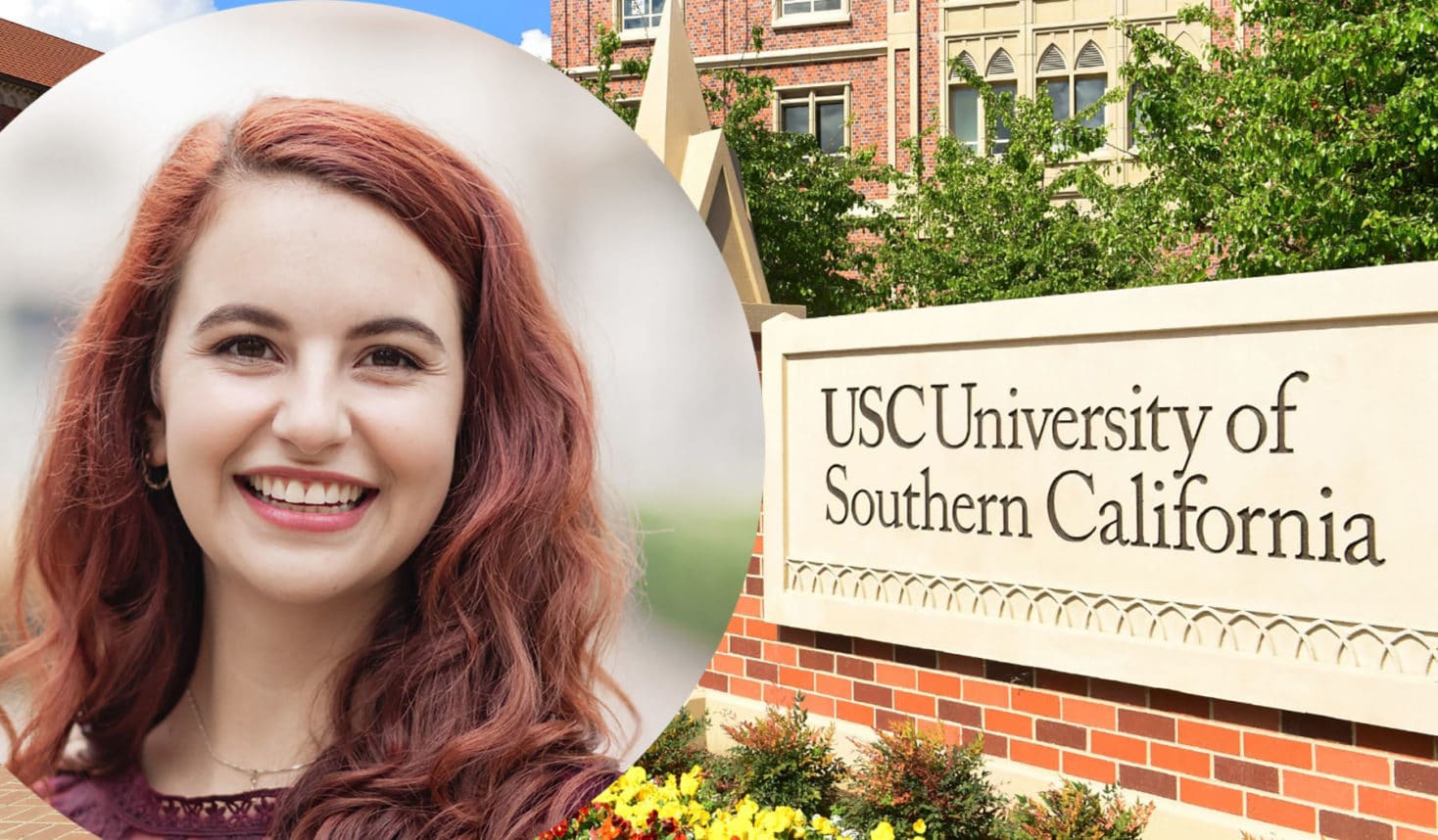
USC’s Undergraduate Student Government (USG) Student Vice President Rose Ritch announced that she is resigning from her position on Aug. 5, saying that she was bullied for a being a supporter of Israel.

Ritch’s resignation letter, which she posted to Facebook, stated that various USC students have been pressuring and harassing her over the past few weeks because of her Zionist identity, not because of her queer identity.

“I have been told that my support for Israel has made me complicit in racism, and that, by association, I am racist,” she wrote. “Students launched an aggressive social media campaign to ‘impeach [my] Zionist a–.’ This is anti-Semitism, and cannot be tolerated at a University that proclaims to ‘nurture an environment of mutual respect and tolerance.’”

She added that her identity as a Jew and a Zionist are intertwined.

“Nearly 95% of American Jews support Israel as the Jewish state, inherently connected to our religious history and communal peoplehood,” Ritch wrote. “An attack on my Zionist identity is an attack on my Jewish identity. The suggestion that my support for a Jewish homeland would make me unfit for office or would justify my impeachment plays into the oldest stereotypes of Jews, including accusations of dual loyalty and holding all Jews responsible for the actions of the Israeli government.”

Ritch thanked the university for intervening against impeachment proceedings against her, but argued that the university needs to do more to protect Jewish students on campus. She proceeded to decry cancel culture on college campuses.

“Our campuses have shifted from authentic, in-person conversations to comments and retweets, and we ‘cancel’ anyone with whom we disagree on any issue,” she wrote. “There is a disturbing lack of nuance or willingness to grapple with the messy complexities of an issue, and there is no longer any room for change or growth. Students made presumptions about my Zionist identity and leapt to unfair conclusions. No one asked me to explain my passion for Israel. No one asked to learn together, to try to understand and build connections. Instead, the people with whom I have shared a campus with for years, the people whom I desperately want to serve, have tried to make me feel ashamed, invalidated, and dehumanized because of who I am.”

She added that her experience is not uncommon for Jewish and pro-Israel students on college campuses and that both the USG and the university have failed to create an inclusive space on campus.

“I deeply hope that this new chapter creates a space where all students feel included, safe, and valued,” Ritch concluded. “It will be a long road, but I am confident that you, the student body, will hold USG and its leaders accountable to the highest standards. Meaningful and productive change is just over the horizon.”

https://www.facebook.com/100000335851878/posts/3529165573771270/?d=n

Jewish groups expressed support for Ritch.

“Shame on the @USC students who relentlessly harassed an elected student leader over her Jewish identity,” the American Jewish Committee tweeted.

StandWithUs CEO and co-founder Roz Rothstein said in a statement to the Journal, “It is absolutely outrageous that a Jewish student leader at USC felt compelled to resign from student government due to such anti-Semitic hostility. Zionism is a central component of Jewish identity for most Jewish students. Efforts to deny equal opportunities, such as serving in student government, based on a component of an individual’s identity are dangerous and unacceptable. We call on USC to take strong action to ensure Jewish students are offered the same protections and safety that all communities on campus deserve.”

Simon Wiesenthal Center Founder and Dean Rabbi Marvin Hier and Associate Dean Rabbi Abraham Cooper sent a letter to USC President Carol Folt on Aug. 6 urging her to publicly condemn the harassment that Ritch received on social media and make it clear that Zionist students are protected on campus.

“We are not claiming that all criticisms of Israel are anti-Semitic, that is absurd on its face,” Hier and Cooper wrote. “But denying the legitimacy of the lone Jewish state of Israel among nations in the world, is an attack on the legitimacy of the Jewish people, its faith and its historic homeland. Campaigners for Palestinian rights and a Palestinian state have every right to promote their views but not when it includes the demise of another people. USC must never allow any part of its institution to be a staging ground for anti-Semites and those who seek to end Israel.”

USC Hillel Executive Director Dave Cohn said in a statement to the Journal that USC Hillel has been working with Ritch over the past few months to get the university to address her concerns.

“It is shameful that Rose faced this situation and not reflective of the campus we aspire to be,” Cohn said. “We cannot, as a university community built upon values of acceptance, inclusion, and open dialogue, permit the targeting or harassment of students solely based on their identification as Zionist. We must closely and constantly guard the boundary between respectful disagreement and hostile anti-Semitic discrimination.

“We expect our university’s leadership to recognize and speak to this distinction and to openly name the anti-Semitism in our midst,” he added. “We remain eager partners in a sustained effort toward combatting hate in our community in all its forms.”

AMCHA Initiative Director Tammi Rossman-Benjamin also said in a statement to the Journal, “For a student who volunteers to take a leadership role in her school to be bullied and harassed for her pro-Israel views is reprehensible. And what’s even more reprehensible is, from what we have gathered, the university has said and done nothing about this abuse.”

She added: “The harassment and discrimination against students for their support of Israel must stop.  Unfortunately university administrators cavalierly write it off as political and do not step in to protect students as they must. What happened to Rose is extreme, but Jewish and pro-Israel students are regularly left unprotected and vulnerable. We strongly recommend schools develop fair and consistent policies, protocols and procedures for handling such harassment.”

The university did not respond to the Journal’s request for comment.

The USC Annenberg Media website reported in June that senior Abeer Tijani emailed USG requesting USG Student President Truman Fritz resign after anonymous posts on Instagram described alleged racist behavior. The website reported, “The accusations addressed Fritz’s alleged insensitive language while campaigning for his presidential election, specifically, his tendency to place students of color into one category. Fritz was also accused of seeming unconcerned with issues pertaining to Black students and of making students uncomfortable with ‘jokes and the use of certain names.’ ”

Tijani created a petition calling for Fritz’s impeachment. Fritz later apologized in a statement.

Tijani also accused Ritch of being silent on Fritz’s alleged racial remarks, stating this is reason for her to either be impeached or resign. She said in an Instagram post that although Ritch should not be impeached for supporting Israel, “it is important to acknowledge the dissatisfaction of Palestinian students and amplify their voices on campus — a ‘bigger issue that is greater than Rose and her personal affiliations,’ ” according to The Daily Trojan. Tijani also said that it would be anti-Semitic to blame Ritch for the Israeli government’s policies.

The Annenberg website also reported: “This is not the first backlash Fritz has received since his election. He and Ritch were found guilty of violating the Elections Code by the Elections Commission in February, as well as being forced to review and amend bylaws that increased Fritz and Ritch’s salary by eliminating stipends for assistant directions.”

Fritz resigned on July 7.

USG Senator Isabel Washington, a Black Israeli American, also resigned from her position on July 1 after she was accused of making insensitive statements toward Palestinians and other groups. She said in a statement at the time that she has “a complete understanding of the pain, hurt and anguish I have caused.”

UPDATE: Tijani said in an Aug. 6 statement posted to Instagram that she did not call for Ritch to be impeached or to resign over her Zionist views, but because she thought Ritch was silent on Fritz’s alleged racial remarks.

“What I did say – and what I now regret not thinking more carefully about before I said it – was that Rose was ‘outspoken on issues that alienate Palestinian Trojans, and has failed to provide a check on the responsibilities and actions of the President when a voice of reason has been crucially needed,’” Tijani wrote. “I should never have conflated the issues in such a way to suggest that Rose’s ‘support for Israel has made [her] complicit in racism, and that by association, [she is] racist,’ in her words.”

She added: “That was not my intention, and I want to offer my deepest apologies to Rose, and the greater Jewish community, for all the damage to her reputation, mental health, and well-being that resulted from my irresponsible wording.”

https://www.instagram.com/p/CDk6bGcDPC-/?igshid=13qytzxvf8gr5

USC Student VP Resigns, Says She Was Bullied for Being a Zionist Read More »

5 Budget-Friendly Decorating Necessities for At-Home Schooling

Well, it looks as if most schools won’t be reopening this fall for in-class learning. So, if you’ve got kids at home, you’re going to have to continue the home-schooling route for a little while longer. And because I’ve always been teacher’s pet and want to make your life easier, here are some great décor additions that will make your online classroom setup more efficient — and even fun.

 

Rolling supply cart
This handy cart can hold and organize all of your kids’ school supplies in one place, and the wheels make it easy to travel to whatever room they’re working in.
Available at Michaels, $49.99


Drop-leaf desk
If you want to provide a separate workspace for your at-home student that’s separate from the kitchen table or other family space, this drop-leaf table takes up very little room and goes up in a second.
Available at Ikea, $39


Bulletin board room divider
A room divider helps keep kids more focused on their learning and less distracted by other things going on in the house. This one has the added benefit of being a bulletin board, so they can put up assignments, notes and artwork.
Available at Home Depot, $139.99 


Reading nook chair
You don’t have to confine little readers to the table. Let them sink back in a comfy chair in their own reading nook. Just plop this beanbag chair in the corner of a room by some natural light.
Available at Target, $60


Planning wall calendar
The days and months seem to merge when we’re stuck at home, so a prominently displayed wall-mounted calendar will help keep track of the time and remind everyone of due dates. There’s also something satisfying about crossing off dates every day.
Available at Wayfair, $24.99


Jonathan Fong is the author of “Flowers That Wow” and “Parties That Wow,” and host of “Style With a Smile” on YouTube. You can see more of his do-it-yourself projects here.

5 Budget-Friendly Decorating Necessities for At-Home Schooling Read More »

Israeli Research Institution to Launch Human Trials of Coronavirus Vaccine

JERUSALEM (JTA) — An Israeli national research institute will begin human trials of a coronavirus vaccine after the High Holiday season ends in October.

Israeli Defense Minister Benny Gantz made the announcement Thursday after visiting the Defense Ministry’s Institute for Biological Research in central Israel, about 13 miles from Tel Aviv.

The vaccine has already been tested successfully on animals.

The human trials will be undertaken “in coordination with the Ministry of Health and in line with medical safety protocol,” Gantz said in a statement following his visit to the institute.

In June, Israel signed a deal with the American biotech company Moderna for a potential COVID-19 vaccine.

Also Thursday, Israel’s so-called coronavirus czar, Ronni Gamzu, told reporters that Israel has the highest per-capita morbidity rate in the world, though it is not clear if he was referring to the number of Israel’s cases overall or over the past several weeks, when the number of new cases per day has skyrocketed.

Gamzu criticized a wedding held the day before in Jerusalem in the Belz Hasidic community in which thousands of people participated, calling it a kind of Russian roulette.

“What we saw at the wedding yesterday is the potential for mass infection,” he said. “It drives me crazy; it makes me angry.”

Israeli Research Institution to Launch Human Trials of Coronavirus Vaccine Read More »

‘Nazi Menace’ Serves as Timely History Lesson

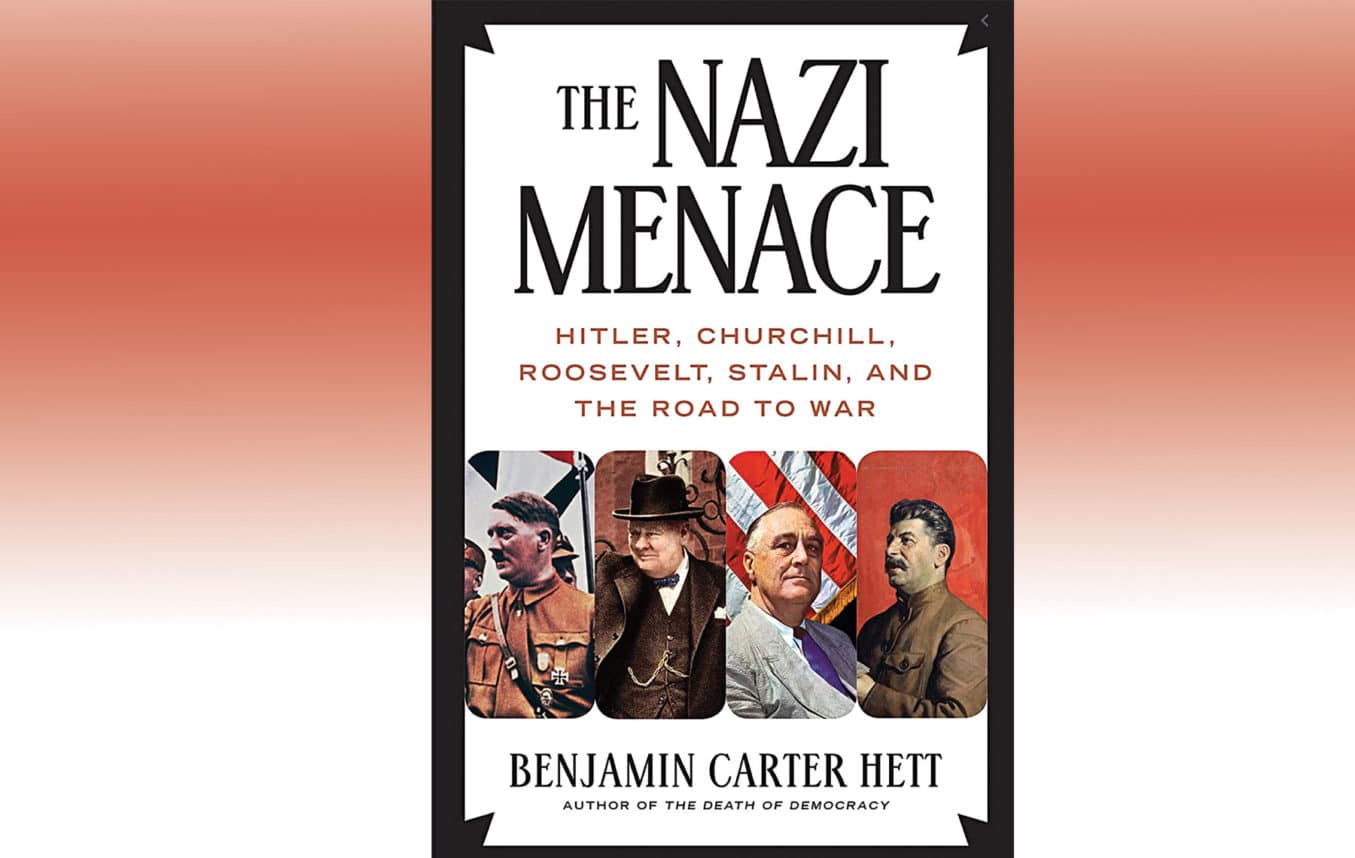
“The Death of Democracy” is the title of Benjamin Carter Hett’s account of Weimar Germany, a time and place to which America today has been frequently compared. Like the second decade of the third millennium, the 1920s and early ’30s inaugurated a “shocking new world,” and democracy failed not only in Germany but elsewhere in Europe.

Now Hett shows exactly what happened next in his new book, “The Nazi Menace: Hitler, Churchill, Roosevelt, Stalin, and the Road to War” (Henry Holt & Co.), a lucid, vigorous and highly readable account of one of the great turning points of history. The cast of characters and the crucial events may be familiar to many (if not all) readers, but Hett usefully observes that “[w]e often fail to realize how contingent and unpredictable these developments were.” That turns out to be good news. By studying history, perhaps we are not condemned to repeat it.

Hett is a professor of history at Hunter College and the Graduate Center of the City University of New York. He holds both a doctorate in history from Harvard University and a law degree from the University of Toronto. As evidenced in his previous books, including “Burning the Reichstag,” “Crossing Hitler” and “Death in the Tiergarten,” he is adept at extracting the colorful and telling details from the historical record and weaving them into a vast tapestry.

Franklin D. Roosevelt and Winston Churchill, he points out, “started the 1930s a long way from where they ended.” Notoriously, the Western democracies worked harder to appease Hitler than to oppose him until he went to war against them. When Hitler, a private in World War I, first met with “his” generals in 1933, he finds himself in the company of “powerful and accomplished senior commanders who need not, and do not, feel in any way inferior to the new arrival.” Perhaps, the author suggests, “they don’t think this chancellor will last long enough for his ideas to matter much — after all, he is the fourteenth person to hold this office since 1919.”

The traditional centers of power in Germany, including the army, the bureaucracy and the corporations, tended to underestimate the chancellor who quickly reinvented himself as the Fuehrer. He made decisions impulsively and was convinced that he knew more than the generals. “For him, desks were mere pieces of decoration,” one of his subordinates recalled, and he “disliked reading files.” Yet those who might have opposed him were cowed by him. Hitler demanded — and received — a solemn oath of personal loyalty from even the most distinguished generals.

Hitler represented an existential threat the democracies of the world. “Was the world to be organized along liberal internationalist lines, with democratic systems everywhere, free trade, and rights for all, anchored in law?” writes Hett. “Or was the international system to be one of race and nation, with dominant groups owing nothing to minorities and closing off their economic space to the outer world as much as possible?” Yet the democracies, too, refused to stand up to Nazi Germany and its allies. When Hitler put his new military technology in service of fascist rebels in Spain, for example, The Times of London editorialized against intervention: “It may be that the system of parliamentary Government which suits Great Britain suits few other countries besides.”

Roosevelt understood the threat to Western civilization that Hitler represented, but he “seemed to float helplessly on the floodtide of isolationism,” as one of his biographers puts it. Then, as now, “the fight between those favoring international engagement and those preferring isolation was extraordinarily bitter,” as Hett points out. Under these political pressures, Roosevelt felt compelled to sign a Neutrality Act even as Germany and Japan were demonstrating their willingness to use the force of arms far beyond their own borders. But he warned that isolationism was not effective against an aggressive enemy.

“It seems to be unfortunately true that the epidemic of world lawlessness is spreading,” Roosevelt declared. “And mark this well: When an epidemic of physical disease starts to spread, the community approves and joins in a quarantine of the patients in order to protect the health of the community against the spread of disease.” But, FDR insisted, “we cannot have complete protection in a world of disorder in which confidence and security have broken down.”

Benjamin Carter Hett clearly wants us to compare our own plight to the circumstances that allowed authoritarians to come to power and then go to war.

“The Nazi Menace” is about far more than the tensions between democracy and fascism that eventually exploded into war. Hett shows us the inner workings of totalitarianism as it was practiced by Stalin with the same color and detail. And he explains how the Western democracies and the Soviet Union viewed each other with such profound distrust that a united front against fascism was far beyond reach. Neville Chamberlin, the British prime minister, “disliked the Soviet Union, its ideology, and its leaders at least as much as he disliked Nazi Germany.” When France and England consented to Hitler’s dismemberment of Czechoslovakia, Stalin concluded that “[h]e, too, must pick a side: with the democracies or with Germany.” Only days after German and the Soviet Union entered into a nonaggression pact, Hitler invaded Poland and World War II began.

Only then, of course, were Roosevelt and Churchill able to lead their countries into open conflict with fascism. But Hett’s premise throughout “The Nazi Menace” is that “there was nothing inevitable” about how it all turned out. “[W]ith different leaders, or with chancy political, technological, or military events going a different way,” Hett insists, the Allied victory over totalitarianism “might not have come at all.”

Hett clearly wants us to compare our own plight to the circumstances that allowed authoritarians to come to power and then go to war. “How should democracies respond to a security threat posed by a vicious regime?” he asks. “For what goals should a democracy go to war, and how should it fight? What do you do when your own democratically elected politicians serve as mouthpieces for the propaganda of a hostile foreign state?”

That’s exactly why “The Nazi Menace” is such an important and timely book. By looking back nearly a century, we find ourselves in a place that looks very much like the here and now.


Jonathan Kirsch, author and publishing attorney, is the book editor of the Jewish Journal.

‘Nazi Menace’ Serves as Timely History Lesson Read More »

‘Umbrella Academy’ Co-Creator Says Accusation of Anti-Semitism on Netflix Show Is ‘Factually Incorrect’

(JTA) — The co-creator of the Netflix superhero series “The Umbrella Academy” pushed back against criticism that the show features anti-Semitic stereotypes.

Based on a comic book series of the same name, the show includes an underground society of lizard people who secretly control the world and their handler — who speaks Yiddish in at least one scene.

“The accusation of anti-Semitism in ‘The Umbrella Academy’ is hurtful and, more importantly, factually incorrect,” Steve Blackman said in a statement. “I wrote these episodes, created the character, and am myself Jewish. While I understand audiences sometimes receive things in a different way than creators intend, The Handler was not created as an anti-Semitic character.

“The Handler speaks every language, including Swedish, Mandarin, Yiddish, and English as we saw this season, and The Commission is not an evil organization; they do not control finances, governments, or the media. The only thing they control – and more importantly, protect – is the timeline of our fictional Umbrella Academy universe.”

Critics, including on social media, have said that an organization dedicated to controlling the world headed by someone who speaks Yiddish plays into anti-Semitic conspiracy theories.

The Board of Deputies of British Jews published an open letter criticizing the show following the first season.

“The use of a Yiddish saying by the evil boss of an organization which controls the world’s timeline is clearly an anti-Semitic trope,” the group’s vice president, Amanda Bowman, told the Sun, a British tabloid, after the open letter was published. “Whether intentional or not, this makes for very uncomfortable viewing. Netflix should take action to remove the racism from this scene.”

‘Umbrella Academy’ Co-Creator Says Accusation of Anti-Semitism on Netflix Show Is ‘Factually Incorrect’ Read More »