fbpx

August 1, 2020

Nick Cannon Read Bari Weiss’ Book on Anti-Semitism During Tisha B’Av, Calls it ‘Powerful’

Actor Nick Cannon said in a July 30 Instagram post that he read former New York Times Opinion Editor Bari Weiss’ “How to Fight Anti-Semitism” book during Tisha b’Av, calling it a “powerful read.”

Cannon began the post saying that he had engaged in “a full day of fasting, meditation, study and prayer” for Tisha b’Av. He then launched into his review of Weiss’ book.

“The words that stood out to me were ‘Anti-Semitism is fueled by the malicious but often feeds on the ignorance of the well-intention,’” Cannon wrote. “[I’m] asking myself, is she talking about me? Knowing that my intentions have never been hateful but recently I had fallen into the same category that the author despises and writes about like Henry Ford, Charles Coughlin, and more recently the abhorrent American Terrorist Robert Bowers, who on Oct. 27, 2018 murdered 11 worshippers at the Tree of Life Synagogue in the author’s home neighborhood in Pittsburgh, which ultimately inspired her to write this book.”

He acknowledged that reading the book that made him realize that he was not “fully educated in the space of the trigger words and coded conversation” regarding anti-Semitic and anti-Zionist conspiracy theories. The “Masked Singer” host said that Weiss’ examples in the book, which included terrorists beheading Wall Street Journal journalist Daniel Pearl in Pakistan in 2002 and the lynching of Jewish worker Leo Frank in 1915, show “why the baseless hate for an entire community must end and that any reminding rhetoric deserves a sincere apology.”

Cannon then turned to discuss Weiss’ July 14 letter to The New York Times announcing her resignation.

“In her recent resignation letter to the New York Times she discusses ‘intellectual curiosity’ now becoming a liability in society and the challenges of ‘free exchange of ideas in a democratic society,’ could this book be skewed or reviewed as ‘one-sided’ in a much-needed discussion, perhaps?” he wrote. “I would love to have the open dialogue with Ms. Weiss on my academic podcast ‘Cannon’s Class,’ like I recently engaged with another fellow friend and ‘tweeter’ Rabbi Abraham Cooper from the Simon Wiesenthal Human Rights Center.”

Cannon concluded with a call to eradicate anti-Semitism.

“Today is a new day of improving our own words and actions towards clarity and compassion,” Cannon wrote. “All in all, this book was truly an insightful and powerful read.”

Weiss responded in a Twitter thread noting the concept of teshuvah, which is the “return to one’s higher self, to one’s ideals, to the good, to righteousness.”

“I thought of all of this as I read your thoughtful post about my book, ‘How to Fight Anti-Semitism,’” she added in a subsequent post. “It moves me that you took the time to read it and to reflect on it. I welcome your invitation to continue the conversation.”

Cannon responded to Weiss a tweet that read,Thank you for your warm and compassionate response. I have been learning a lot about Teshuva and Atonement in the recent days. Education and growth is a process, thank you for accompanying me. Shabbat Shalom.”

On July 23, Cannon had Cooper on his podcast to discuss anti-Semitism; Cannon has issued apologies about his 2019 remarks about Zionists and the Rothschilds having “too much power.”
Nick Cannon Read Bari Weiss’ Book on Anti-Semitism During Tisha B’Av, Calls it ‘Powerful’ Read More »

A Bipartisan Protest Movement is Rocking Israel and Growing by the Week

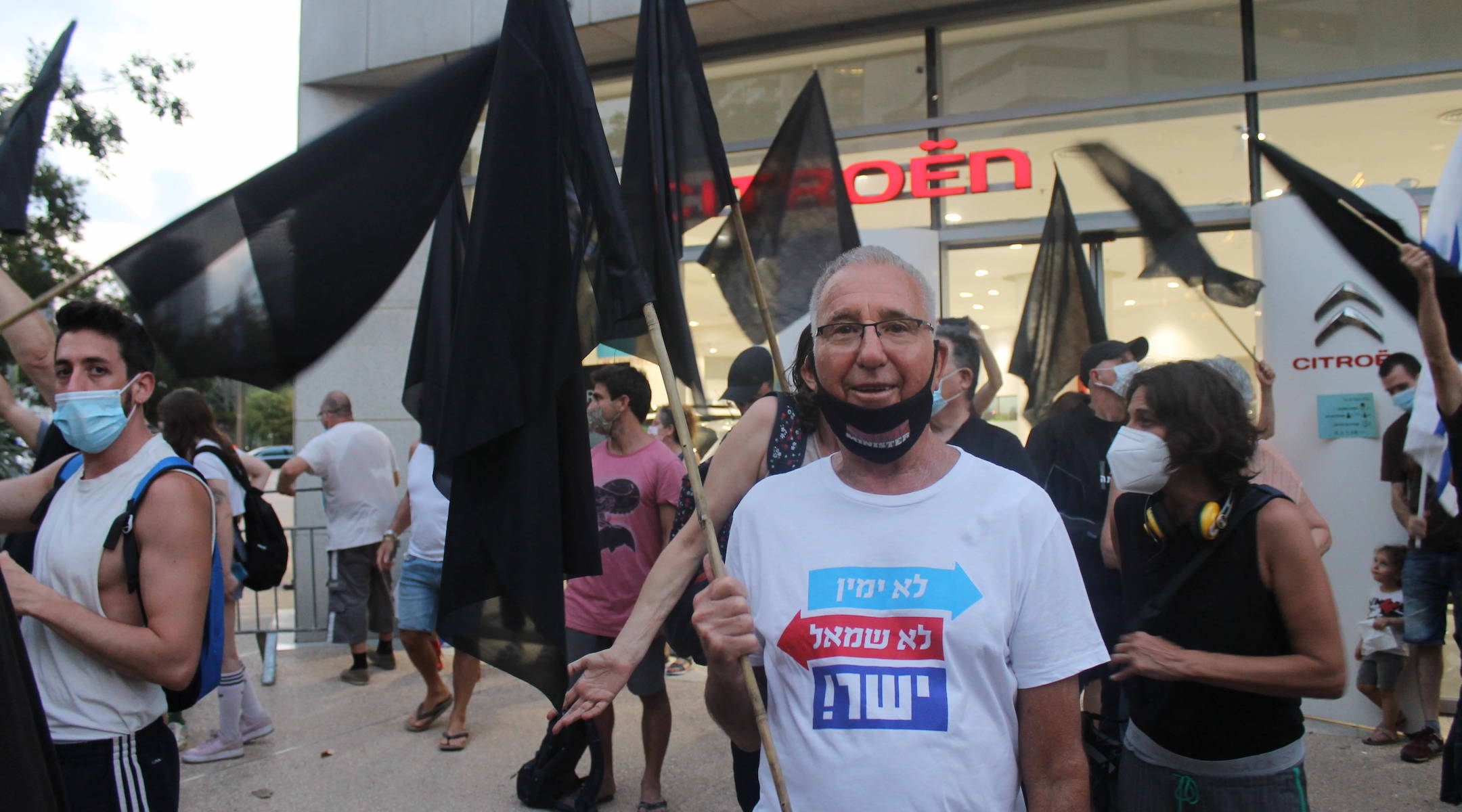
TEL AVIV (JTA) — Noam Ofer might have been an unlikely candidate to join Israel’s burgeoning protest movement. At 76, he is older than most of the people who have taken to the streets in recent weeks to protest the government’s handling of the coronavirus crisis. He also doesn’t share the political views of many of the protesters.

But Ofer was there anyway on Tuesday evening marching outside the Tel Aviv home of Israel’s internal security minister in charge of law enforcement, Amir Ohana, who was caught on tape pressuring a senior police official to ban demonstrations against Prime Minister Benjamin Netanyahu.

“He’s trying to illegally shut down protests,” Ofer said. “I came because the minister said that we’re all on the left. I’m on the right. He said we are anarchists, but the only ones creating anarchy are the ones around Netanyahu.”

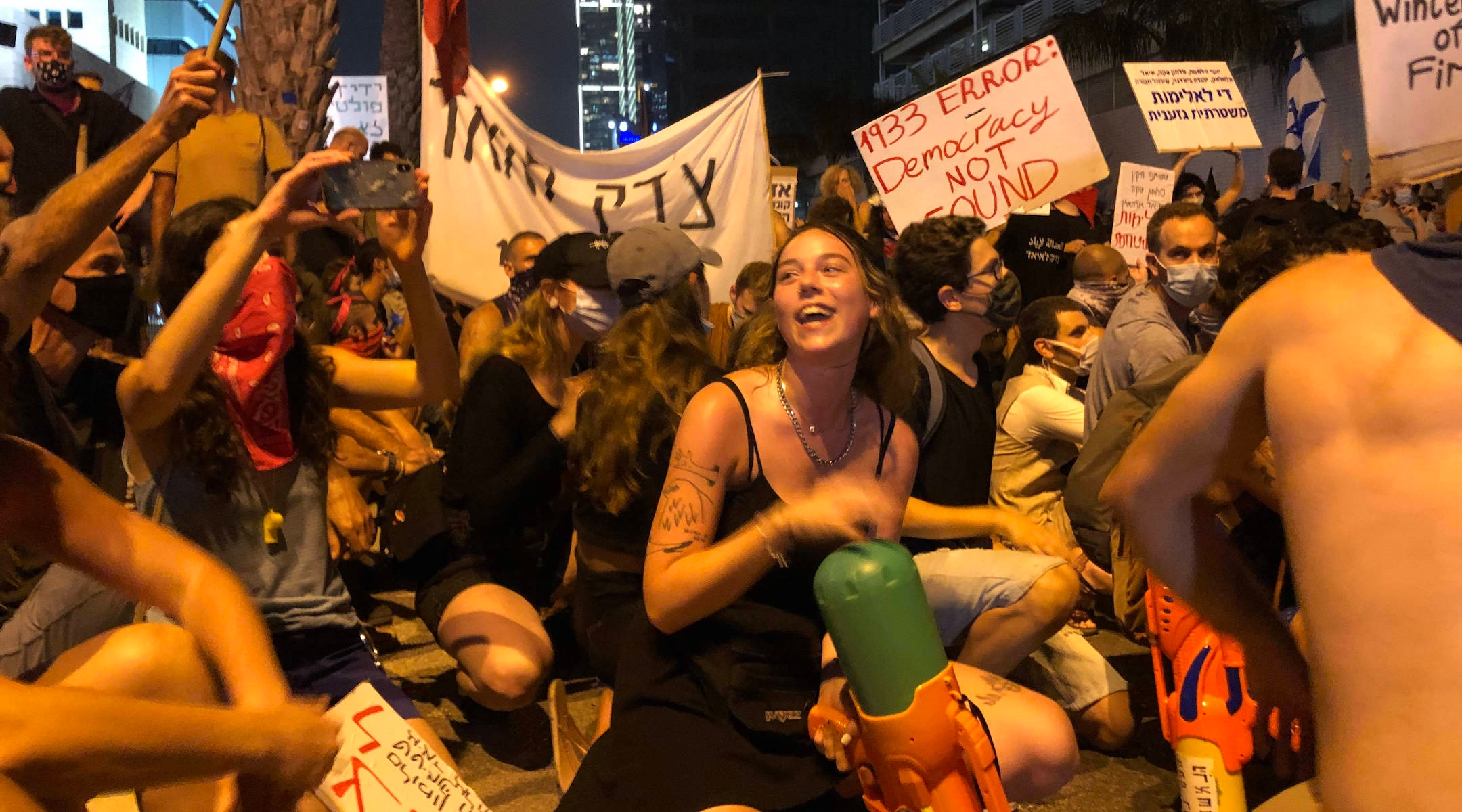
Ofer’s perspective reflects the deep and bipartisan frustration that many Israelis are feeling about the country’s leadership nearly six months since Israel recorded its first coronavirus case. Thousands of Israelis have been staging loud protests for weeks, mostly outside the prime minister’s residence in Jerusalem, but also in Tel Aviv and other spots across the country. Some commentators have called it the country’s largest grassroots movement since 2011, when hundreds of thousands of Israelis protested the cost of living.

Noam Ofer, 76, at the Black Flag protest, July 28, 2020. (Sam Sokol)

After drawing international praise for how he efficiently imposed a strict and effective lockdown, Netanyahu acknowledged earlier this month to reopening Israel too soon. Cases have risen sharply, restrictions have been reimposed and unemployment is near its all-time high. Stimulus checks from the government have fallen short of their promised amount.

Meanwhile, Netanyahu’s trial on three corruption charges has been delayed for a second time — after Ohana, in his previous stint as justice minister, shut down courts amid the pandemic in March, effectively postponing legal proceedings against the prime minister. The demonstrations have reenergized those who have been calling out Netanyahu in recent years over his legal problems and what they perceive as his goal to weaken democratic institutions like the judiciary.

The result is a movement made up of Israelis across the political spectrum, whose numbers seem to be growing every week. Police were bracing for large rallies Thursday night with the end of the Tisha B’Av observance.

As the protests have widened in focus, demonstrators have faced harsh crackdowns by police, who have drawn criticism for using water cannons and tear gas.

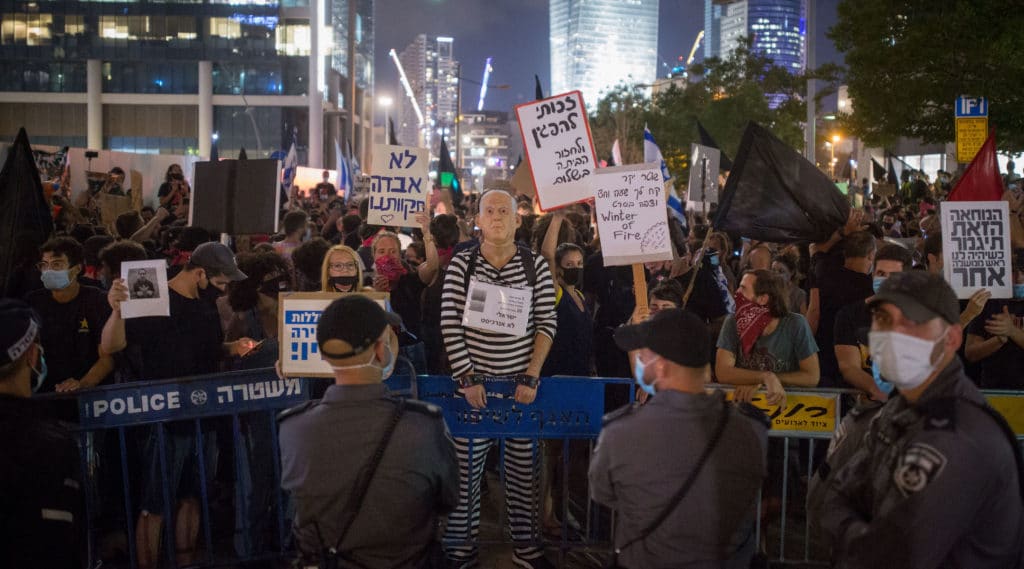
Many at Tuesday evening’s protests, which was organized by the anti-Netanyahu Black Flag movement, said they were incensed by Ohana’s statement to Doron Yadid, the commander of the Jerusalem police district — a recording of which was leaked in the media — that he didn’t “understand why we don’t ban” anti-Netanyahu protests.

“I want to challenge the ruling of the court,” Ohana said, referring to a recent ruling allowing the protests to go ahead, generating widespread anger and prompting President Reuven Rivlin to issue a public statement declaring that the right to protest “must not be harmed.”

Some protesters brought water guns to Tel Aviv, July 28, 2020. (Sam Sokol)

Ohana is “trying to cancel protests and circumvent the law,” complained Maor, a 25-year-old law student from the coastal city of Ashdod who said he had attended a number of demonstrations outside the prime minister’s residence and had been “subject to police violence” for engaging in civil disobedience.

“It was brutal, they used a water cannon against me,” he said, describing how he was shot with a high pressure water jet while participating in a sit-in. “I bruised my ankle. I couldn’t work for two days.”

Another protester, Eliana Barbel, showed off a large bruise on the back of her leg as she described her experience at a protest last week that ended in violent clashes with police.

“I was arrested on Thursday. I was hit and arrested and spent the night in jail for protesting,” Barbel said. “When I was arrested, the cops were very violent. I was sitting on the ground and three riot policemen picked me up and took me.

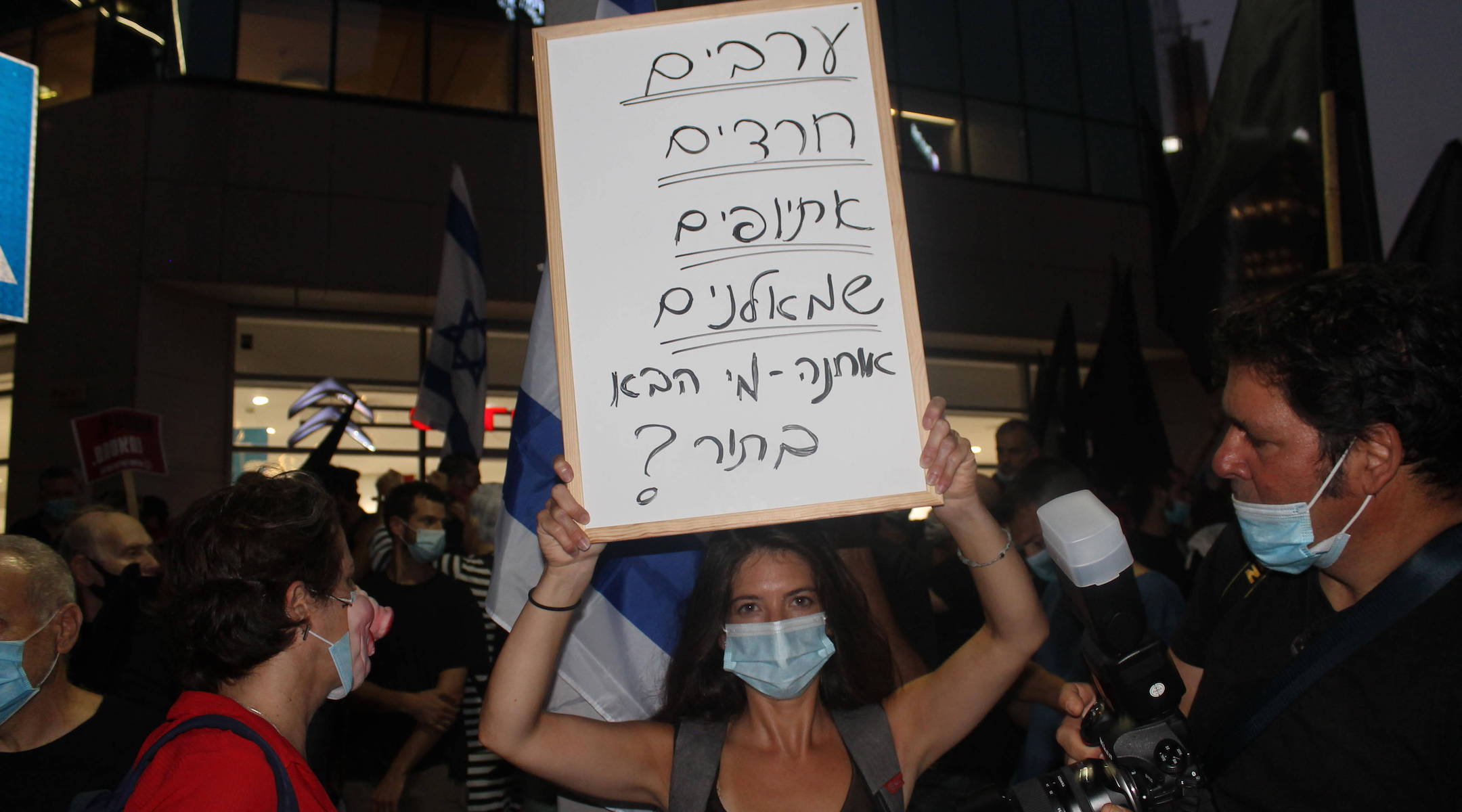
“They want to scare us, but this will only bring more people out,” she added, holding up a sign decrying violence against Arabs, haredi Orthodox, Ethiopians and leftists, and promising to continue to protest even “if I’m arrested 10 times.”

Eliana Barbel at the protest in Tel Aviv holding a sign that reads: “Arabs, haredim, Ethiopians, lefties. Ohana, who is next in line?” (Sam Sokol)

Echoing a theme that has emerged in recent American Black Lives Matter protests that have faced police crackdowns, Efrat Safran, a 57-year-old dual American-Israeli citizen from Ramat Hasharon, carried a sign bearing the slogan “Mothers Against Police Violence.”

Safran said she was ready to protect younger protesters from the police with her own body.

“We’re trying to save democracy,” she said.

While the crowd protesting near Ohana’s apartment was overwhelmingly secular, Pinchas, 30, a haredi attorney from Bnei Brak, a largely ultra-Orthodox city, said he decided to come out because “government corruption is dangerous to all of us, including the haredim.”

Tuesday night’s protest was marked by tense but not violent exchanges with police. (Five protesters reportedly were hospitalized after being attacked, the Black Flag movement said, by individuals not associated with the police.) After several hours, the protesters drifted away from the zone marked out for them by law enforcement and began marching down a nearby road, stopping traffic and eventually running into a line of policemen backed up by mounted officers.

Large groups of protesters eventually began making their way back, trying to circumvent the police and reach Ohana’s apartment building, leading to several clashes during which officers shoved several people, leading to renewed chants of “no to violence.”

As police and protesters faced off, the mounted officers repeatedly rode up to the edge of the crowd trying to force its members back.

Most of the marchers began to walk through the city, snarling traffic as they made their way through a series of Tel Aviv landmarks, including the square in front of the Habima Theater and the popular Dizengoff Center shopping mall.

A Bipartisan Protest Movement is Rocking Israel and Growing by the Week Read More »

Oregon’s Attorney General Ellen Rosenblum Says She Won’t Stand for Authoritarianism in Portland

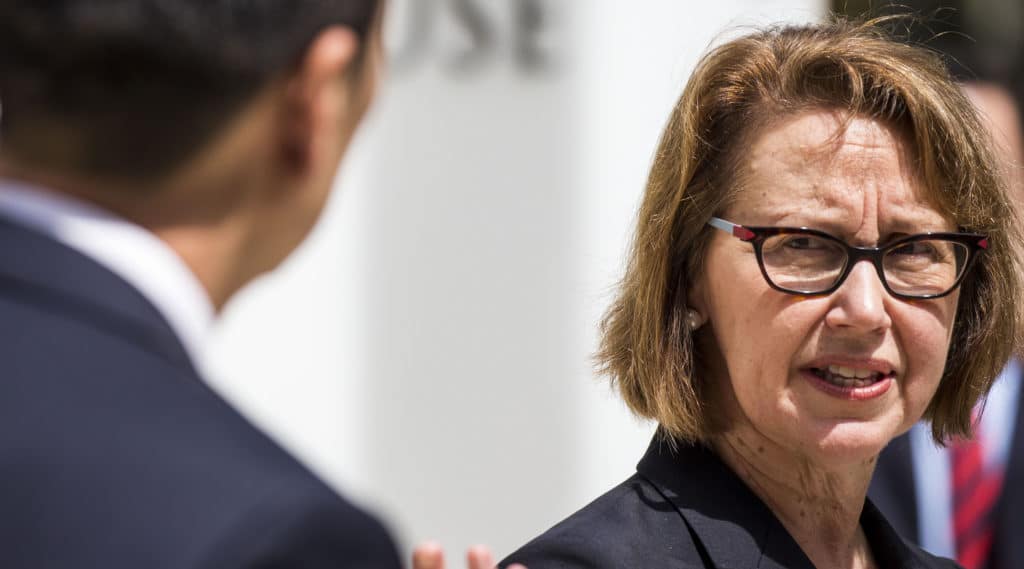
(JTA) — When reports emerged two weeks ago about federal agents seizing protesters from the streets of Portland and putting them in unmarked vans, Oregon Attorney General Ellen Rosenblum sued to get federal officers off the street.

A judge rejected Rosenblum’s request for a preliminary restraining order against the agents last week. But the lawsuit is ongoing, as is a criminal investigation Rosenblum opened into federal agents who injured a protester. On Wednesday, the Trump administration made an agreement with local officials to withdraw the federal forces — though the timing is unclear.

Rosenblum, who was elected to her post in 2012, is a former board member of her Portland synagogue, Congregation Beth Israel, as well as the founder of its book club and a former member of its choir.

The Jewish Telegraphic Agency spoke with Rosenblum Wednesday about her next steps and how she sees her role as the state attorney general and a Jewish elected official.

This interview has been edited for length and clarity. 

JTA: What do you see as your role, and your goal, during this period? 

Rosenblum: I am the people’s attorney. I look out for the most vulnerable in our state. I look out for those who most need the support of the legal establishment, if you will, to make sure that their rights are protected.

In terms of actually taking legal actions, I don’t go there unless I feel that there are harms to Oregonians. In this case, there was no question that we had to do something, because it appeared that the situation was getting worse rather than improving with this influx of federal agents uninvited to our city.

We started hearing these really frightening stories that appeared to be clear violations of the civil rights and liberties of Oregonians, and in particular Portlanders, who were attempting to and continue to be protesting against very serious abuses — police brutality, in support of Black Lives Matter, in support of racial justice. And it appeared that the conduct, the tactics that were being engaged in on the streets of our city, were not only really frighteningly dangerous, they could harm people, but they were infringing on the rights — the First Amendment rights, the Fourth Amendment rights, the Fifth Amendment rights of our citizens.

Now that federal agents appear to be leaving Portland, what are your next steps?

Let’s get them out of town as quickly as possible and regroup. I hope the city, the mayor, the governor, the advocacy community and the protesters will sit down and will hammer out a plan so that protests can continue if that is the desired route, and I believe it will be.

They need to be allowed to continue under circumstances that do not infringe on civil liberties and without the personal endangerment that has occurred when the feds were here.

Given your experience filing a lawsuit against the federal agents, what advice would you give other attorneys general facing the same issue?

Well, first of all, I don’t consider that we did not succeed. We lost a motion for temporary restraining order, but that is the first part of a potentially successful lawsuit, or an unsuccessful lawsuit, so I’m not quite conceding that we lost. I will say that the judge did not agree that we had standing to pursue the matter at this level with the amount of evidence that we had … so we’re looking at different options.

There’s numerous lawsuits that are still pending. And I’m not sure that anyone is just going to drop their lawsuit at this point, because these are all issues that could come back. You know, we don’t have any assurance that they’re not going to return. These are all federal lawsuits, and special court rulings could serve as at least guidance, if not precedent, in other locales.

We’re very hopeful that their leaving Portland doesn’t mean they’re going somewhere else. We want them back to their agencies doing the jobs that they apparently were trained in. They’re not trained to go anywhere to de-escalate conflict, clearly.

I talk to my Democratic attorney general colleagues all the time. We meet by phone once a week as a group and we share all of what we’re doing to the extent we can. We join with each other in lawsuits, we help each other out, we file amicus briefs.

So if they find themselves similarly situated we provide them full access to our lawsuit pleadings and we’re also more than happy to meet with them to discuss some potential strategies.

What concerned you most about what you saw happening on the streets of Portland with the federal agents?

They really appeared to be schooled in escalating the aspects of the protests that were not safe. So, for example, if there was somebody who threw something at them they would throw something back, maybe even something that was more dangerous than what had been thrown in the first instance. So what we saw was an escalation of the situation, not a deescalation. They came in allegedly to protect their buildings, allegedly to quell the violence, and they did just the opposite.

That was certainly very concerning because there’s a chilling effect, what we call a restraint upon an individual’s or a group’s First Amendment right to protest. Shortly after they arrived there was one extremely serious incident that is the subject of our criminal investigation, where an individual was shot at in the face with some sort of a projectile and has been back in the hospital now, apparently has suffered serious facial and, I think, brain injuries.

There have been reports of some violence emanating from the protests. If you feel the federal response made it worse, what do you think should be done in response?

It appears that a large number of the people who have come out, having engaged in whatever misconduct or violent conduct they’ve engaged in, have been largely provoked by the presence, not just the presence, but the actions, of the feds. They need to leave, and once they leave I think there will be an opportunity to resolve what is left of any violent conduct that might continue. I hope it does not. Obviously if it does we have to deal with it immediately.

I’m not going to say that there was no violent conduct before the feds arrived, OK? But what I’m saying is that it’s not going to stop until the feds leave, it would appear, so that’s the first step toward negotiation, toward resolution. But for the most part these protests were peaceful protests. They were not violent protests until the feds arrived.

I want to switch gears and ask you about your Jewish life. You led the synagogue book club for a long time. What kind of books did you like to read? And what did you enjoy singing in the synagogue choir? 

I started the book club about 25 years ago and led it for many years, but “led” is mostly that I brought the food. I brought the bagels and coffee.

We had a whole series of books that were really about different countries, different ethnicities. We read books by Jewish authors. I remember we read a lot of books by Amos Oz and books by American fictional authors that are very famous, by [Philip] Roth and others.

We loved reading books about the Orthodox Jewish community in New York. When I watched the [Netflix] series recently, “Unorthodox,” I was thinking about the books that we had read and how those books had grown my understanding of the Orthodox community.

I loved singing at the different holidays. I loved singing for the Hanukkah celebration because I love Hanukkah songs. I think they’re kind of, you know, underappreciated.

Probably my favorite thing to do was to join an African-American church group of [gospel] singers, who join with us for the Martin Luther King Day celebration, the Shabbat service that we do in January every year, and that is a really wonderful event to get to join.

You’ve called the federal action in Portland “authoritarian overreach.” Does a turn toward authoritarianism concern you as a Jewish official?

Absolutely. I grew up in Reform Judaism. It was not so much religious-based in the sense of really studying the Old Testament or the Talmud, but here’s something I have in my kitchen: this is a quote that I wrote on a little whiteboard and it’s from the Talmud. It says, “The day is short, the task is difficult, it is not our duty to finish it, but we are forbidden not to try.”

I went to the social action committee with my dad monthly at the synagogue, and I just understood that that was what being Jewish was about, making sure that we were protecting people’s rights.

It’s really scary. I don’t want to exaggerate anything. I don’t like to be a catastrophist. But I’ve been very worried when it hits home like this, when things that I worry about — with the president of the United States and some of the ways in which he conducts himself, the people who have been harmed by policies that have really been mean spirited and cruel, frankly — hit Portland in this way. It’s shocking, and I’m not going to stand for it.

Oregon’s Attorney General Ellen Rosenblum Says She Won’t Stand for Authoritarianism in Portland Read More »

The Pandemic’s First High Holy Days Season Has Synagogues Wondering: Will People Pay Dues?

(JTA) — Like many synagogues, Temple B’nai Hayim used to rely on the High Holy Days season to survive financially.

The small Conservative synagogue in Southern California would receive the lion’s share of its revenue in the run-up to the holidays: Members sent in their annual dues, which included entry to High Holiday services, and non-members purchased tickets just for the High Holidays.

But with the option of holding regular in-person High Holy Days services off the table due to the coronavirus, the synagogue is anticipating a decline in revenue this year and responding by reimagining its financial model from the ground up. Going forward, as long as congregants give any contribution, they get access to everything the synagogue offers: High Holy Days services, a bar/bat mitzvah ceremony, even religious school — virtually for now, someday in person. Annual membership dues, which once cost $2,000 per two-parent household, will be abolished.

“We know a lot of people are hurting, and even if they give us a penny, we know they are a true friend,” said Rabbi Jason van Leeuwen, the synagogue’s cantor. He added: “We should be worried, and I don’t think we should reasonably expect this new model to cover all of our expenses.”

Across the country, synagogues are bracing for a significant reduction in revenues. Though many are seeing increased attendance at virtual services, without the annual cash infusion that in-person High Holiday services bring, and with community members under financial pressure, congregations across the denominational spectrum aren’t sure how they’ll make ends meet this year.

“They’re expecting that their revenue will be down, in some ways, for the next year,” said Amy Asin, the Union for Reform Judaism’s vice president for strengthening congregations.

“Congregations are places, now more than they have been in the past, where people want to belong,” she said. “That doesn’t mean that they’re in a financial position to pay what they’ve paid in the past.”

Adas Israel, a 1,700-member Conservative synagogue in Washington, D.C., is expecting a 20% drop in revenue this year even as it has seen a spike in attendance at its online services. One recent Friday evening service had about 1,600 screens tuned in — or nearly one for each member household.

To keep congregants comfortable, the synagogue is not planning to increase its annual dues this year, which can run to more than $3,000. And it’s also hoping to save on expenses it no longer has, like food for kiddush after services. But whether Adas Israel can avoid any layoffs among its 170 employees as the synagogue moves into an unprecedented future remains unclear.

“My crystal ball broke a long time ago,” said Laurie Aladjem, the congregation’s president. “I believe that many of our members join and affiliate with Adas Israel not just for the High Holidays. We have a really robust education department both for children and adults. We have a preschool. We have a religious school that is bursting at the seams. We have really robust adult education programming.”

For many U.S. synagogues, a fixed yearly membership payment has usually included a High Holiday ticket, with nonmembers paying for a seat for the Rosh Hashanah and Yom Kippur services. (Discounts on fees are often reduced based on need, and few synagogues actively turn away those who want to attend services.) Because so many people generally pack the sanctuary on those days, the holidays are often the driver of synagogue revenue.

That’s true across denominations, though it’s especially pronounced in non-Orthodox congregations. Congregation Rodeph Shalom, a large Reform synagogue in Philadelphia, would get 150 or 200 people at its Friday night service — and 10 times that number on the night of Yom Kippur. Beth Jacob Congregation, an Orthodox synagogue in Beverly Hills, California, sees as many as four times its normal Shabbat attendance on the Day of Atonement.

“We hope people understand that when they are buying a High Holiday ticket, what they’re really doing is supporting the synagogue in its ability to exist throughout the year,” said Rabbi Jacob Blumenthal, CEO of the United Synagogue of Conservative Judaism and the Conservative Rabbinical Assembly.

On the whole, High Holiday revenue is less critical to synagogues than it used to be, according to Rabbi Daniel Judson, one of the authors of a 2016 UJA-Federation study which found that 57 synagogues nationwide had eliminated annual dues entirely and now just ask for donations. As more synagogues are making their High Holiday services free, they are less dependent on the revenue they once generated.

Judson said, however, that those who donate to synagogues around this time of year do so regardless of the fee structure, and this year will likely be tough going. Historically, he said, for a medium-size synagogue, 60% of annual revenue comes from annual dues.

“I think synagogues are less dependent on High Holiday revenue than they’ve ever been before,” said Judson, dean of graduate leadership programs at Hebrew College near Boston. “But it’s still part of the regular calendar that people pay their dues so that they’re ready for the High Holidays.”

Orthodox synagogues may have an advantage, as surveys show that Orthodox Jews are more likely to attend synagogue regularly rather than just for the High Holidays. Still, Orthodox synagogues may see a drop in revenue, said Rabbi Adir Posy, the Orthodox Union’s director of synagogue and community services. That issue, he said, could be particularly pronounced in large cities with big Orthodox communities, where families may bounce between synagogues and not feel a particular connection to one congregation.

“A larger percentage of our membership have robust connections to communal activity through the shuls throughout the whole year, so it’s a conversation that is not waking up for the weeks before the High Holidays,” Posy, an associate rabbi at Beth Jacob in Beverly Hills, said in discussing Orthodox synagogues in general. “That being said, we are seeing synagogues that are getting a lot more membership forms mailed back with associate memberships or limited things.”

Rodeph Shalom, the Reform synagogue in Philadelphia, has three membership tiers for its 1,000 members, and also allows for reductions if needed. It’s maintaining that system, but plans to make its livestream High Holiday services open to the public for free.

Senior Rabbi Jill Maderer said she isn’t sure what the lack of High Holiday tickets will mean for the synagogue’s bottom line, but believes that opening the prayers to the public is the right choice this year.

“We feel this is an opportunity to recognize people’s spiritual needs across the community, and to open our tent to the broader community,” she said. “I am concerned, and I am also extremely curious, as to whether people will show the commitment without that stick hanging over them. And I’m not afraid. I really believe in the community.”

The Pandemic’s First High Holy Days Season Has Synagogues Wondering: Will People Pay Dues? Read More »