(JTA) – Shootings are up in New York City. So are anti-Semitic incidents. And federal law enforcement is recasting itself as an adversary, not an ally, to local authorities.
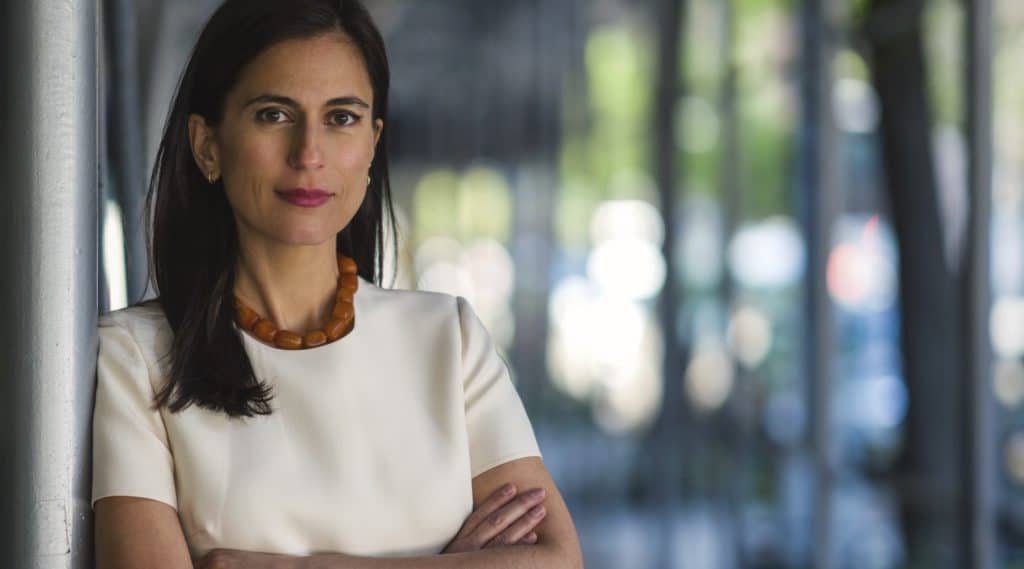
That is the climate in which Tali Farhadian Weinstein seeks to become Manhattan’s top prosecutor.
Farhadian Weinstein, 44, stepped into the city’s crowded district attorney’s race last week with a vision for “progressive prosecution” — or what she says is applying the office as a lever to both improve public safety and increase equity.
“Pursuing cases that don’t advance public safety and that might actually perpetuate injustice instead, like racial disparities or criminalized poverty, those are things that we should stand down from,” Farhadian Weinstein told the Jewish Telegraphic Agency.
A former general counsel to the Brooklyn district attorney, Farhadian Weinstein came to the United States as a child from Iran, via Israel, after the Iranian revolution and now lives on the Upper East Side with her husband, hedge fund founder Boaz Weinstein, and their three children. A Rhodes Scholar, her resume includes clerkships with U.S. Supreme Court Justice Sandra Day O’Connor and others. Former U.S. Attorney General Eric Holder, with whom Farhadian Weinstein worked at the Department of Justice, narrated a video announcing her campaign. The election is next year.
Farhadian Weinstein said the Trump administration’s move to crack down on unrest in cities presents a vexing inversion of the role that that federal law enforcement has traditionally played.
“I think it’s important to remember why the founders thought that the police power and law enforcement of this kind should belong to the states,” she said. “I think that was so that people themselves could decide in their own communities what laws do we enforce and in what circumstances and I think that’s at the heart of what it means to be a progressive prosecutor.”
We spoke with Farhadian Weinstein about her vision for the role, what she might do as district attorney to combat anti-Semitism and her very Jewish thesis topic.
This interview has been edited for length and clarity.
JTA: You’ve called yourself a progressive prosecutor. What does that mean to you?
Farhadian Weinstein: It’s two things, one is to make sure that at every step of the way we’re being fair to everybody with whom we’re interacting, whether they are the defendant or the witness or the victim. And second, and I think this is the more expansive idea, we, progressive prosecutors, have a more meaningful understanding of what public safety is and we have to check ourselves that everything we do advances public safety rather than takes away from it.
It means understanding that incarceration should be a last resort and only used when it advances public safety. Pursuing cases that don’t advance public safety and that might actually perpetuate injustice instead, like racial disparities or criminalized poverty, those are things that we should stand down from. And instead we should be using our resources to actually bring the cases that matter and to protect vulnerable people, which is why we’re in this job to begin with.
What would you say are the cases that matter?
I think that gun violence is obviously on a lot of people’s minds because of what we’re seeing around New York City. (The city has recorded a spike in shootings, including several of children, in recent weeks.) I think that gender-based violence, which is often really just violence against women, is something we should be investigating and prosecuting more vigorously than we have, and by that I mean sexual assault and domestic violence. The Manhattan district attorney’s office has a tradition that goes back to Bob Morgenthau of prosecuting from the streets to the suites, so the cheating and stealing that affects the lives of the people who live here.
Yesterday, Donald Trump spoke with New York Gov. Andrew Cuomo and the two reportedly agreed that federal troops would not be sent to New York City. How would you approach the idea of federal troops being sent to New York City as district attorney?
There’s still a lot about this that is unknown and developing and also unprecedented so I think a lot of people are trying to figure out, is this legal? That has to be the first question, and for me, is it advisable, is it good policy, even if it is legal? And I think why it’s challenging is that it’s an inversion of how we usually think about why federal forces would go into a city to confront a situation that’s being run by state or local officers. This is very much not Little Rock in 1957 or integrating the University of Alabama in 1963 where the feds are the good guys.
I think this is all new, we’re processing this idea, in blue states in particular, that we now have to push back at the idea that the federal government is bringing justice rather than state and local governments.
When I think about what am I trying to do as a local prosecutor, as Manhattan district attorney, I think it’s important to remember why the founders thought that the police power and law enforcement of this kind should belong to the states. I think that was so that people themselves could decide in their own communities what laws do we enforce and in what circumstances and I think that’s at the heart of what it means to be a progressive prosecutor. Around New York, local prosecutors don’t really prosecute misdemeanor simple marijuana possession even though that law is on the books. There’s a reason for the constitutional order that we have.
At the very moment that people are saying we don’t have enough trust in law enforcement and there isn’t enough accountability when police officers break the law, you’re making both of those things worse. And it’s bad for public safety when people don’t trust law enforcement. It’s also bad for public safety to pull these people [federal officers] away from their mission.
Where do you come down on the conversation about defunding or reforming the New York Police Department?
I’ve said before that I don’t particularly care for the word “defund the police” because I find it inflammatory and not solution-oriented. But I do think it’s great that we are engaged in the conversation about what we want from law enforcement and how we think the police should be doing what I just described about progressive prosecution to make sure that everything that happens is to further public safety and nothing else.
It’s interesting to me because some of the themes that are now being talked about in the context of police reform are things that we’ve been working on all of these years on the side of prosecution. Minimizing contacts between law enforcement and people and understanding that those are traumatic and should be a last resort, bringing other competencies into the work. In local district attorneys’ offices, we have social workers, counselors. You don’t learn everything you need in order to do that job of delivering public safety to communities from going to law school. And likewise now, we’re really having this conversation now of who should really respond with the police, instead of the police, whatever the case may be. So I think that the conversation is great and I’m quite hopeful about it.
What do you think you can do in furthering that conversation about reform from the perch of the district attorney’s office?
Some of that has to come from within — the police do not report to the DA; it’s the mayor’s responsibility. But we work alongside the police, obviously the police make arrests and we process them. You could use different words to describe that relationship depending on the issue – there’s negotiation, there’s cooperation, there’s consultation. So there are pushes and pulls that happen between us in deciding what are the cases we should be bringing and what are the cases we should not be bringing. I also think that DAs in any area of legislation having to do with criminal justice are an important voice and so, for example, a number of the district attorneys in the state and in the city were longtime advocates for repealing 50-a. I was in favor of repeal and I’m glad that it happened. (Section 50-a was a rule that kept personnel files for police officers confidential. It was repealed last month by the New York State Legislature.)
Our job is to prosecute everybody without fear or favor, no matter who they are, no matter what uniform they wear. So when police officers break the law, they have to be held accountable just like everybody else. And in Brooklyn, I started our standalone law enforcement accountability bureau and I supervised it. We investigated and prosecuted police officers.
How would you use the role of Manhattan district attorney to fight anti-Semitism in New York City?
It requires a multifaceted response of which law enforcement is one very important part. We have a hate crime statute and I would enforce it vigorously. I was just on the New York State Bar task force on domestic terrorism and hate crimes. We thought about this a lot because there has obviously been such a horrible surge in anti-Semitism in New York City and around the state over the past year.
The statute at this point makes it possible to sentence somebody to some kind of education program as well, and I think that’s something that we need to look at a little more closely, whether we could be doing more of that. Because you need to respond to the crime when it happens and you need to also think about what is the root cause, why is this happening, why are people so hateful towards each other, and I think we need to come at it from both ends. District attorneys’ offices have traditionally taken a role, and I think this is terrific, in going out into communities and talking about the law and the underlying reasons for the law. So there’s an education component, too.
Do you have some thoughts about why there’s been this uptick in anti-Semitic incidents in New York City in recent years?
One thing that we have seen in law enforcement is that the internet definitely makes things worse because people can find like minded haters for whatever the target of your hate is and it can fester and foment. That’s something to think about that I think needs a law enforcement response. Why anti-Semitism in particular? it’s important to say that other kinds of hate have also been on the rise. We’ve seen terrible hate towards Asian Americans, particularly tied to COVID, hate crimes against LGBTQ people and hate against African-Americans, all of these things sort of come together, I think.
How do you think about balancing calls for bail reform with the difficulties that has posed in preventing incidents of anti-Semitism in New York City?
The thing about bail reform is it’s about balancing different values and different concerns. I have largely been an advocate for bail reform, because I think the fundamental goals of bail reform have been right. So I think, first of all, we should always be really careful when we’re taking somebody’s liberty away before trial, before they’ve been convicted of anything and in our system they’re presumed innocent, as they should be. I also think it’s undeniable that over time in New York, Black and brown people in particular and poor people were incarcerated pre-trial at astonishing, shocking and really unacceptable rates. And I should say, in Brooklyn, we had managed to really bring those numbers down before the law changed. And I also find cash bail deeply troubling, the idea that there’s a connection between a person’s liberty and how much money they have and that there should be a price on liberty at all.
It continues to concern me that New York is the only state that does not allow for dangerousness to be a consideration in deciding what should happen to people before trial. Taking that off the table makes it harder to achieve the kind of balance that you’re asking me about, to make sure that in every single case are we putting public safety into that equation.
Do you think the bail reform that was passed in New York State went too far?
The bail reform in both of its iterations is not the ideal situation that I’ve described in which you would have eliminated cash bail completely, we still have cash bail for qualifying offenses, but on the other hand allowed for a small number of people to be detained because of dangerousness before trial. I think conceptually, it’s not the approach I would have taken though it accomplished what it set out to accomplish in part, which is to reduce the number of people held before trial and which I think is a good goal.
What is something about you that people might find surprising?
I’ve spent a lot of time in Israel: I have a ton of family there, because many of the Jews of Iran went to Israel at various points and wound up staying. I’ve taken my girls to Israel I think three times, and I spent a lot of time in high school when I went on the Bronfman Youth fellowship.
I ended up doing my thesis at Oxford about a certain strand of Israeli literature, the literature of Jews from the Arab world, like A.B. Yehoshua and Sami Michael. Where I grew up was a predominantly Ashkenazi community. Where I went to school, we were among very few families that were not Ashkenazi. My husband’s mother was born in the Warsaw Ghetto but she grew up in Israel. So some of it was personal because I was trying to understand the coming together of Ashkenazi and Mizrahi Jews in different places around the world. I’d been studying Arabic for some time, and I was interested in the politics of that literature because they were describing a different origin story and a different experience of what it meant to be Israeli.
How does your own story of coming to this country as an immigrant inform the way you would approach the job of district attorney?
Being an immigrant has affected me, it’s an outlook that stays with you forever and in my case, I think, has helped me do this work because it’s helped me bring a kind of empathy to this work. It’s the commonality of the experience of having been vulnerable, of having come here with an ambition to be free and to live in safety and to understand in a really visceral and personal way what it means to yearn for those things. And those are the very things we are supposed to be delivering in a job like this one, fairness and safety — privileges that in other parts of the world, people don’t get to experience.
You’re talking about immigrants who are coming here from Central America and South America and who are waiting right now at our borders. I see myself in them.
What do you think about when you hear Donald Trump speaking negatively about immigration and Iran, two different things that you know personally on a different level?
I feel pretty much horrified by anything and everything that he says, the fomenting of hate, the attempts to divide. I think the commonality that I just described is I think very different from the way he’s described America coming together.
I think that’s also a very Jewish idea to hold onto the fact that all of us were strangers in a strange land at some point and even when you’re past that, as I am in many ways now, I think our tradition tells us to remember that because it is a source of empathy and ultimately, justice, to see that in others and to draw on that collective experience even if it was not a personal experience.