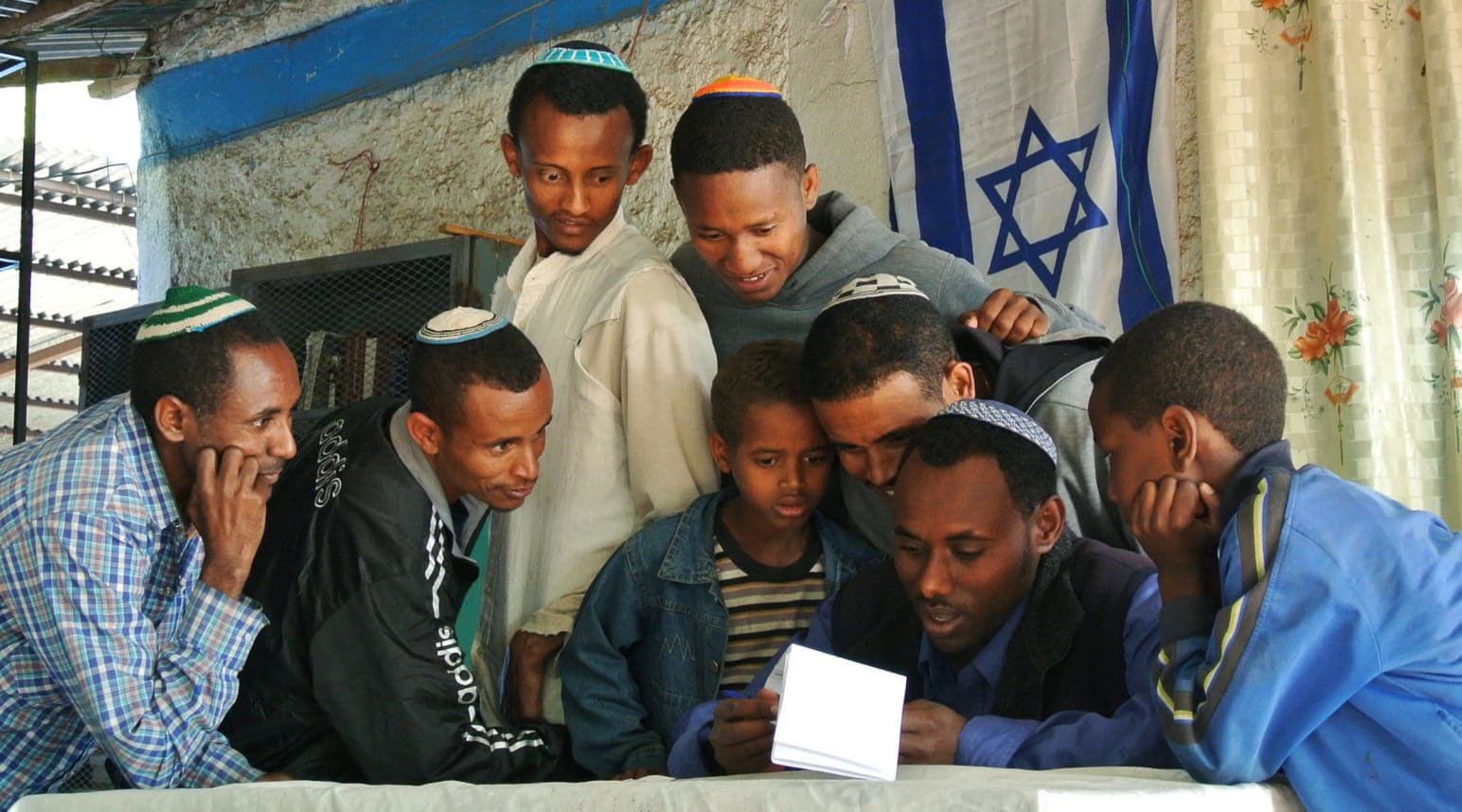
JERUSALEM (JTA) — Some 34 immigrants from Ethiopia arrived in Israel, bringing to 269 the total of Ethiopians to make aliyah since the start of the coronavirus pandemic.
The new olim who arrived early Thursday morning were immediately placed in isolation as a requirement to prevent the spread of COVID-19, Haaretz reported.
They are among 400 Ethiopians who claim Jewish heritage who were approved for immigration three weeks before Israel’s March 2 election.
Meanwhile, 73 Ethiopian immigrants arrived on a flight at the end of March. And another group of 119 arrived in mid-May.
The potential immigrants are part of the Falash Mura community, who claim links to descendants of Jews who converted to Christianity generations ago under duress but now seek a return to Judaism. Some 8,000 Falash Mura in Ethiopia are awaiting permission to immigrate to Israel, most of whom have some family members in Israel.
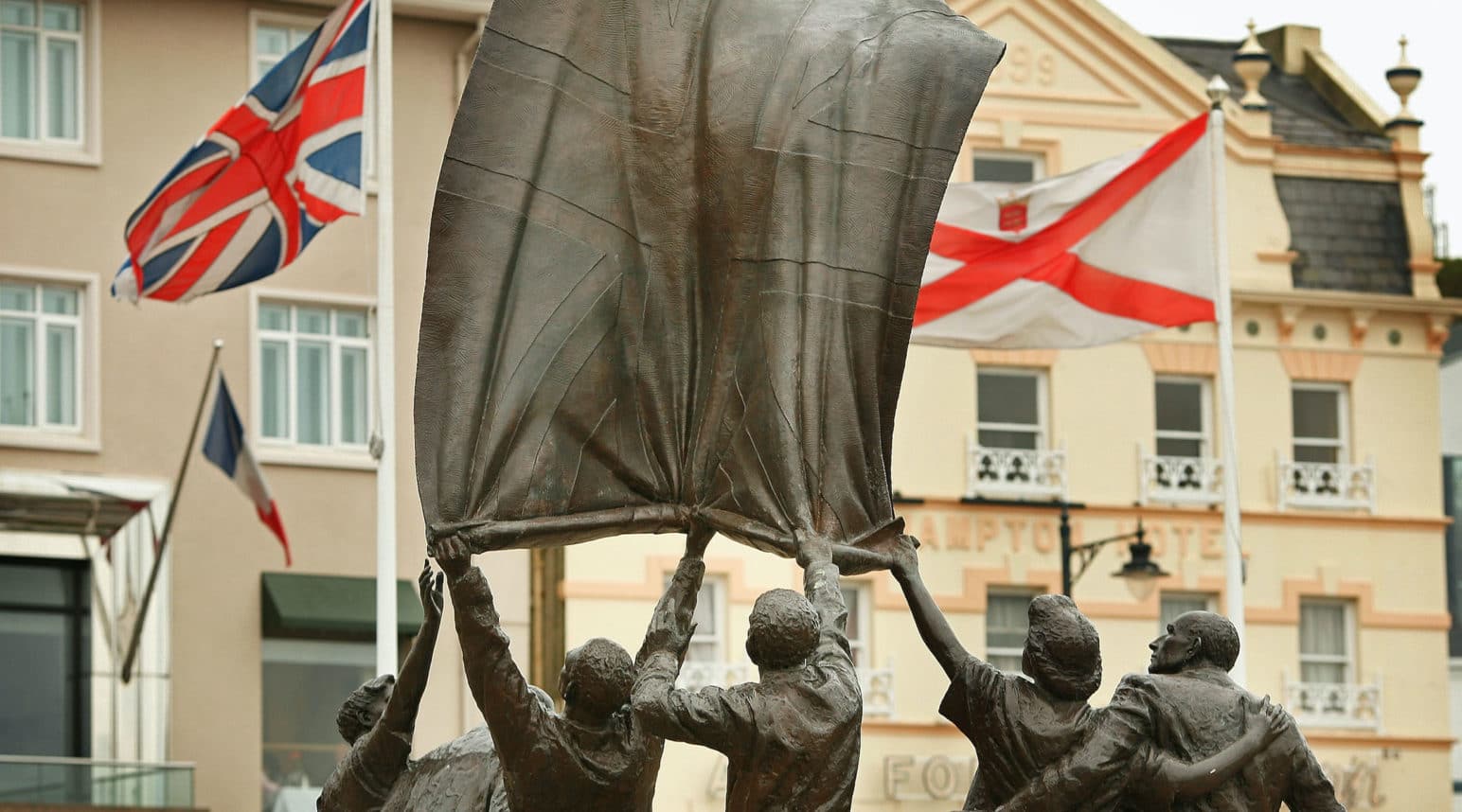
Jersey is one of Britain’s most unusual places — an autonomous island closer to France than to mainland England, a tax haven for London’s superrich and the last remnant of the English crown’s Norman domains.
But Jersey is also home to a rare non-urban British Jewish community with a unique history forged in the face of the Nazi occupation during World War II — the only German occupation of any U.K. territory.
These days, though, the community, with a formal membership of only 49 and an average age of over 70, has had to negotiate the coronavirus crisis as its membership continues to shrink.
In May, Jersey’s Jewish Congregation, which operates in a small converted Methodist schoolhouse on the southwest corner of the craggy island, for three weeks held the unlikely title of the only legally operating Shabbat service in Britain. Synagogues were shut down across Britain in mid-March, and the reopening process began only five months later. But Jersey contained the virus so well that it was allowed to open houses of worship — with limits on how many could attend at a time — earlier than the rest of the country.
The community held its first full service since March — with a minyan of twelve men — in mid May, as the congregation’s more vulnerable members emerged from self-isolation. Face masks and gloves were ordered beforehand, chairs were placed yards apart and prayer books, once touched, were quarantined for a week after use.
The Jersey synagogue socially distanced its chairs for its first Shabbat service since the start of the pandemic. (Courtesy of the Jersey Jewish Congregation)
No London-accented melodies filled the hall of the building, built in the 1970s — singing was strictly prohibited.
“If this is the new normal, then it didn’t feel very normal,” said one attendee of the Shabbat service who did not want to be named.
An ‘honest’ community comes to terms with its decline
During the pandemic, the community’s isolation has been brought into focus. A few more observant members live on the roads surrounding the synagogue in the town of St. Brelade, but most live a drive away on the small island.
The Channel Islands have been inaccessible from the mainland since March, when the islands went into strict lockdown. Unable to travel, the island’s kosher food stocks — especially of meat — and links to the wider British Jewish community were severed.
In normal times, many community members traveled back and forth regularly, either to visit family members or attend synagogue or to pick up holiday supplies. Only a few congregation members keep fully kosher at home, and most will eat non-kosher when out, but they still import kosher food and subscribe to some of the basics of Jewish observance.
Britain’s Chief Rabbi Ephraim Mirvis, center, visits the Jersey Jewish Congregation in 2017. (Courtesy of Jersey Jewish Congregation)
Malcolm Weisman, a non-ordained rabbi called a reverend by British Jews, leads High Holiday services and the occasional Shabbat service. Weisman has ventured to remote Jewish communities like the one in Jersey for decades. A Jewish Telegraphic Agency article from 1976 reported that he visited as many as 50 a year.
“There is a saying in Yiddish – ‘it is hard to be a Jew’ – but it isn’t hard to be a Jew,” said Stephen Regal, the congregation’s president. “You just have to arrange your life to be one. That is how we operate here on Jersey, and that’s how we’ve got on with it the past few weeks.”
He added: “If you have no alternative, you make do with what you’ve got.”
Jersey’s problems are not unique. Since the 1970s – Jersey’s heyday – dozens of small, regional Jewish communities across the U.K. have vanished as Jews concentrated in London and Manchester.
Anita Regal, who moved to Jersey at age 16 in 1960 (and is Stephen Regal’s sister-in-law), has seen the Jersey community’s rise and gradual decline.
“Lots and lots of people came to live here in the 1960s,” she said over a crackly phone line.
Middle-class Jews came to the Channel Islands during the 1960s and 70s to service the booming trade as an offshore tax haven. They were a pragmatic, honest and street-smart bunch — several were accountants and lawyers and other types of everyday professionals. Estimates place the peak Jewish population between 80 and 120. A little less than 100,000 people live on the island overall.
A view of the beach and seafront in St. Helier, the Jersey capital, in 2017. (Oli Scarff/AFP via Getty Images)
“People have died, and people have left. There isn’t much replacement – my own children have left,” said Anita Regal, who was Jersey’s first female lawyer. “It is amazing that we are still going to be honest … we stagger on as best we can.”
Stephen Regal says it’s hard for him to envision the community surviving.
“I am an optimist by nature, but I am also a pragmatist,” Stephen said. “And I see the community struggling going forward to maintain numbers and the skill sets that we need to remain viable as a community.
“There are very few of us over here that can read Hebrew fluently for example,” he added. “When I go, and when some of the others do, who will replace us?”
A much darker time
The Channel Islands are better known among British Jews for another painful period.
Germany’s occupation of the islands from 1940 to May 1945 is often referred to as a “footnote” in the British history of World War II. But the tiny Jewish population that remained on the islands when the Germans arrived, estimated at around 30, were subjected to a string of anti-Semitic laws imposed by occupying forces and administered by British civil servants.
A German Luftwaffe officer, left, speaks with a British policeman in St. Helier, the capital of Jersey, during the German occupation of the Channel Islands. (PA Images via Getty Images)
In Alderney, a smaller, even more remote islet a few miles from Jersey, a stone bearing inscriptions in English, French, Hebrew and Russian hints at this history. Labor camps were set up there, and thousands of slave laborers, including hundreds of French Jews, were forced to work — many to death — building Hitler’s Atlantic Wall, which was designed to make an invasion of Europe all but impossible. Steel skeletons and concrete remains of bunkers and gun emplacements dot the islands’ coasts.
On Holocaust Memorial Day, the island remembers the 22 non-Jewish resistance fighters who were deported from the island and murdered during the occupation. The group includes those arrested for covertly spreading news gathered from illegal BBC-tuned radios, and a clergyman deported after speaking out against the Germans from his pulpit.
A debate over memory
During the war, three Jewish women arrived on the neighboring island of Guernsey as refugees from Austria and Germany, but were deported to France in April 1942. From there, they were sent to Auschwitz.
Jersey has been quicker at reckoning with its wartime past than Guernsey, which celebrated its first Holocaust Memorial Day in 2015. Its small plaque to the three Jewish women murdered in the Holocaust was erected in 2001 and has been repeatedly vandalized. A small lighthouse memorial stands on Jersey for the three Guernsey deportees.
After the war, rather than seeking to punish those who facilitated the German occupation, as postwar collaboration trials did across Europe, the British government quietly let the matter slip. Honors were bestowed on the islands’ rulers as a token of gratitude for their “protection” of the islands’ populations.
“During the occupation, the bailiff of Guernsey was a man called Victor Carey,” explained Gilly Carr, a historian at Cambridge University. “And the Carey family are recognized as an important family that have often held positions of authority on the island.”
The Carey family is still influential on the island. Victor Carey’s grandson, De Vic Carey, served as Guernsey’s bailiff — or the chief justice of the local court and ceremonial head of the island — between 1999 and 2005.
“[Guernsians] have been much slower” in coming to terms with their past, Anita Regal said.
Martha Bernstein, the secretary of Jersey’s Jewish Congregation, who also runs Jewish education programs in Jersey’s schools, says that while the historical debate has been had in Jersey, there is still a way to go.
“The extent of collaboration on the Channel Islands, I feel, is still something that is not talked about,” she said. “When people try and push at the Pandora’s box, and lift the lid a little, people become edgy.”
Thoughts on the Sabbath Before the 9th of Av (Parshat Devarim)
Well-being is within your reach. We’ve all had moments of joy, connectedness, and purpose, where life felt as it was supposed to feel. We long to recreate those moments, to make them last. This is the good news.
For some of us, however, for some period of our lives, well-being seems unattainable. For some period of our lives we might feel unfulfilled, unnourished, lost, alone, confused.
In my Wednesday night Wisdom Work classes I have a list of 21 major and common disruptions of the ego-self, ego-states within that cause us pain and misery, or ego-states that have us try to inflict misery and pain on others. A relative newcomer asked, “Why 21? Some magical number?” I answered, “It began at 10. The more I teach and counsel, the list just keeps agglutinating.” Since last Wednesday night, the list has grown to 25.
The misery, or the need in inflict misery, is inevitable. Sometimes misery comes from tragedy – despite the good will of people, things unravel badly. We are shaped by our genetic inheritance, our early childhoods, everything since, and our history of decisions, conscious and unconscious. Our ego selves have developed unconscious habits of problem solving. Some of those habits are just terrible. Even when we think we are choosing, the ego-self’s habits do most of the choosing for us. This is the bad news.
The good news is that if you are reading this, you are alive and conscious today. If you decide to, you can learn a teaching, and make use of it.
Here is the teaching for this period of time in the Jewish calendar. Let me start with an image. You are sitting among ruins, wind whistling through burnt out buildings. Or you are in a forest of trees blackened by a raging fire. You decide to put one brick on top of another. Or you go searching for a surviving sprout and start to nurture it.
Or you have lost your way, your ego-self having insisted on the always unique but well-travelled road to perdition. However, it’s today – you can take the road less traveled, the high road. How far? It does not matter. You are no longer on the road back to Egypt. You are heading elsewhere.
We are in the time in our calendar, between the 17th Day of Tammuz and the 9th of Av, when we study two narratives, out of their regular place in our yearly cycle of Torah readings. For reasons I can explain Shabbat morning, we study the Sin of the Molten Calf and the Sin of the Spies.
“Sin” not just meaning a moral transgression, though it includes that. “Sin,” more existentially, means acting against our authentic nature – our authentic goodness as human beings. The Sin of the Calf can be understood as the rejection of a divine teaching that would commit us to transform ourselves – actualizing the well-being that is within our reach. The Calf is the fixed place that justifies where we are now – that what we think, feel and say is true just because we think so. The Calf, as an ego-state, refuses any external criteria for truth. When we worship the calf, we can’t be wrong. We argue; we don’t process. The Calf is an act of ego-self worship.
The Spies, as a concept, is the refusal to accept a reality, moral or otherwise, that does not match our feelings. The Sin the Spies goes even further – they create a new reality. Conquering Canaan is a fearsome task, so it can’t be done. Any claim to the contrary is greeted with hysteria. Egypt was redefined (in a follow-up rebellion to the Sin of the Spies) as a land “flowing with milk and honey” (Numbers 16:13). The Israelites had pleaded with God to bring them out of Egypt; then they say that God brought them into the wilderness to kill them (also Numbers 16:13).
The Sin of the Calf is the rejecting of a teaching of truth so that we can worship our ego-self. The Sin of Spies is the sin of creating a new reality, a false history, to justify our current emotional state. It is gratifying in the moment to reject the truth and replace it with a reality of our contrivance, but those contrivances all eventually lead to misery.
So, what is the truth? This is actually the right question. True – our inner lives are subjective; we experience the world through our own subjective lenses. It is also true that there actually is an objective world; there are other people and there are facts. We assemble the truth through our engagement with other subjective human beings. We try to figure things out. Truth is assembled as a project, often with people with whom we disagree. Deep well-being is connected to living a life of truth. Misery is lies – those we tell ourselves, or those that other people are foisting on us. (This is why I try to begin all relationship counseling with a “police report” – just the facts – to help people disconnect from the narratives that blind our vision.)
The official meaning of the Fast of the 9th of Av (this coming Thursday night and Friday) is the commemoration of the destruction of the First and Second Temples. The ancient rabbis, however, connected this time in our calendar to the Sin of the Calf and the Sin of the Spies (for reasons that I will explain on Shabbat morning).
The city of ruins, the blackened forest, the journey to perdition are all the result of rejecting truth – the laborious, lifetime and humbling project of assembling truth with other Seekers of Truth.
During this week, we contemplate the ruins or the possibility of ruins – and we commit ourselves to our yearly, lifetime, humbling, laborious project of building and planting truth, as we journey towards the Days of Awe, toward deep and sustained well-being.