fbpx

July 15, 2020

Kareem Abdul-Jabbar Condemns Anti-Semitism in Sports, Hollywood

Former Los Angeles Laker star Kareem Abdul-Jabbar wrote in a July 14 op-ed for The Hollywood Reporter that he was disturbed by recent anti-Semitic remarks from pro athletes and celebrities as well as the lack of outrage over such remarks.

Abdul-Jabbar pointed to the recent statements and tweets from rapper-actor Ice Cube, Philadelphia Eagles receiver DeSean Jackson and ESPN analyst Stephen Jackson (no relation) as examples, as well as comedian-actor Chelsea Handler posting on Instagram that she found a video from Nation of Islam leader Louis Farrakhan to be “powerful.”

“These famous, outspoken people share the same scapegoat logic as all oppressive groups from Nazis to the KKK [Ku Klux Klan]: all our troubles are because of bad-apple groups that worship wrong, have the wrong complexion, come from the wrong country, are the wrong gender or love the wrong gender,” Abdul-Jabbar wrote. “It’s so disheartening to see people from groups that have been violently marginalized do the same thing to others without realizing that perpetuating this kind of bad logic is what perpetuates racism.”

He acknowledged that Handler, DeSean Jackson and Stephen Jackson all apologized, although Abdul-Jabbar pointed out that Stephen Jackson was “angry and belligerent” when CNN journalist and anchor Don Lemon called him out during a July 8 interview.

“Celebrities have a responsibility to get the words right,” Abdul-Jabbar wrote. “It’s not enough to have good intentions, because it’s the actual deeds — and words — which have the real impact.”

The Lakers legend concluded with the call for all forms of injustice to be condemned.

“If we’re going to be outraged by injustice, let’s be outraged by injustice against anyone,” he wrote.

Jewish groups praised Abdul-Jabbar’s piece.

“Thank you @kaj33 for standing up for what is right,” Anti-Defamation League CEO Jonathan Greenblatt tweeted. “As we continue to fight for racial justice, we cannot allow #antisemitism or any form of hate to go unchecked.”

The American Jewish Committee (AJC) similarly tweeted, “Thank you @kaj33
for your powerful piece against anti-Semitism!”


StandWithUs also tweeted, “When one of the greatest-ever basketball players speaks out on antisemitic hate in sports and culture, it matters. Thank you Kareem Abdul-Jabbar for raising your voice loudly and leading on this issue.”

On the other hand, Ice Cube, born O’Shea Jackson, was not happy with Abdul-Jabbar’s piece.


“Shame on the Hollywood Reporter who obviously gave my brother Kareem 30 pieces of silver to cut us down without even a phone call,” he tweeted.


The AJC condemned Ice Cube’s tweet on Abdul-Jabbar as anti-Semitic.

“Employing an anti-Semitic reference — the age-old canard that Jews are treacherous and money-grubbing — to denounce @KAJ33 for denouncing antisemitism is a new low,” the Jewish group tweeted. “@IceCube, we see your hate.”

Kareem Abdul-Jabbar Condemns Anti-Semitism in Sports, Hollywood Read More »

Rose Parade Canceled Due to Coronavirus Concerns

The 2021 Rose Parade has been canceled because of the ongoing COVID-19 pandemic, marking the first time in 75 years the New Year’s Day tradition won’t be held.

The Pasadena Tournament of Roses Association said in a statement that the association wanted to be completely sure that the state’s restrictions would prevent it from holding the parade.

David Eads, the CEO of the Tournament of Roses, told KTLA, “We just felt that there was no way that we’d be able to host a Rose Parade this year …. It’s really the safety of the general public and all of our members, our partners that has to be a priority.”

He also told the Orange County Register that 12 marching bands already had pulled out of the parade, as did seven of the float participants. Construction hadn’t yet begun on the floats.

The association plans to stage an alternative to the Rose Parade for New Year’s Day; it’s not yet clear what that would be.

This is only the fourth time the Rose Parade has been canceled in its 132-year history. The last time it was canceled was 1944 because of World War II.

The Rose Bowl game still will be played if a college football season is held.

Rose Parade Canceled Due to Coronavirus Concerns Read More »

July 17, 2020

CLICK HERE FOR FULLSCREEN VERSION

July 17, 2020 Read More »

ViacomCBS Drops Nick Cannon Over ‘Anti-Semitic Conspiracy Theories’

ViacomCBS announced on July 14 that it is ceasing its relationship with actor Nick Cannon for spreading “anti-Semitic conspiracy theories.”

In its statement, Viacom said they had spoken with Cannon about an episode of his podcast “Cannon’s Class” that “promoted hateful speech and spread anti-Semitic conspiracy theories.

“While we support ongoing education and dialogue in the fight against bigotry, we are deeply troubled that Nick has failed to acknowledge or apologize for perpetuating anti-Semitism, and we are terminating our relationship with him,” the statement read.


Cannon had hosted the show “Wild N’Out” on MTV and VH1; Viacom owns both networks.

Jewish groups praised Viacom for dropping Cannon.

“Good for @ViacomCBS for holding Nick Cannon accountable for not apologizing or retracting his anti-Semitic statements,” Anti-Defamation League CEO Jonathan Greenblatt tweeted. “Our airwaves — just like the internet — must be #noplaceforhate.”


The American Jewish Committee similarly tweeted, “Bravo, @ViacomCBS, for taking a stand against all hate and for treating anti-Semitism with the seriousness that you treat other forms of bigotry. We cannot be selective in our condemnation of hate!”


Former Democratic New York State Assemblyman Dov Hikind, who also heads the Americans Against Anti-Semitism watchdog, tweeted, “Thank you @ViacomCBS for doing the right thing! Now @FOXTV, it’s your turn to take appropriate action!”


The Stop Anti-Semitism.org watchdog similarly tweeted, “#NickCannon IS #cancelled … we’re waiting @FOXTV.”

Cannon, who also hosts “The Masked Singer” on Fox, responded to Viacom’s decision in a July 15 Facebook post.

“I am deeply saddened in a moment so close to reconciliation that the powers that be, misused an important moment for us to all grow closer together and learn more about one another,” Cannon wrote. “Instead the moment was stolen and highjacked to make an example of an outspoken black man. I will not be bullied, silenced, or continuously oppressed by any organization, group, or corporation.”

He did issue an apology to the Jewish community and said he would be going to Israel.

“I must apologize to my Jewish Brothers and Sisters for putting them in such a painful position, which was never my intention, but I know this whole situation has hurt many people and together we will make it right,” Cannon wrote.

https://www.facebook.com/NickCannon/posts/4326941627323521

The actor has come under fire over a 2019 video that went viral over the weekend where he said that people are “giving too much power to the ‘they’ — and then the ‘they’ turns into the Illuminati, the Zionists, the Rothschilds.” He also called Nation of Islam leader Louis Farrakhan’s speeches “powerful” and “uplifting” and lamented that “for whatever reason, [Farrakhan’s] been demonized.”

On July 13, Cannon issued a series of tweets stating that he was not a hateful person and the Black and Jewish communities should work together against racism and anti-Semitism.

“I hold myself accountable for this moment and take full responsibility because My intentions are only to show that as a beautiful human species we have way more commonalities than differences,” he wrote.

However, he told the business magazine Fast Company later in the day that he doesn’t think apologies are productive.

“Are you forcing me to say the words ‘I’m sorry’?” he said. “Are you making me bow down, ’cause then again, that would be perpetuating that same rhetoric that we’re trying to get away from.”

He added, “What we need is healing. What we need is discussion.”

Regarding his praise for Farrakhan, Cannon said, “I can’t be responsible for however long Minister Farrakhan has been ministering and things that he said, That is his voice and his fight. I can only be held accountable for what I’ve seen and what I’ve heard.”

This article has been updated.

ViacomCBS Drops Nick Cannon Over ‘Anti-Semitic Conspiracy Theories’ Read More »

How Do You Put on a Play in a Pandemic? These Creatives Found a Way

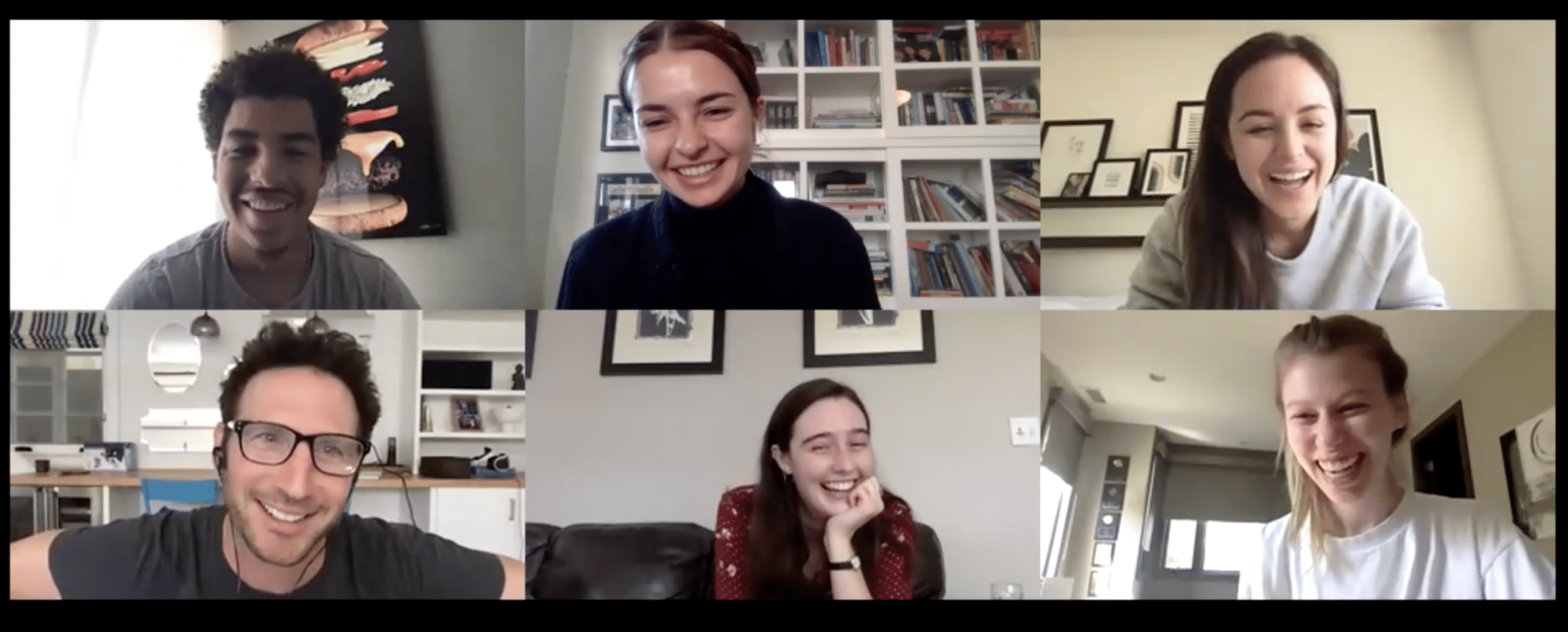
Talia Light Rake was preparing her senior drama thesis at Kenyon College in Ohio when COVID-19 canceled her plans. Stuck in quarantine in Los Angeles, Light Rake, 22, decided she would find a new way to keep art alive. So, she formed Playdate Theatre. 

“I felt very lost without that theater community, and for Playdate, I just understood we could receive a play, we could provide feedback, and we didn’t necessarily need to be in the same room together in order to create art,” Light Rake told the Journal.

Her father, Jeff Rake, is the showrunner for NBC’s “Manifest”; her mother, Paulette Light, is executive director of the Charles Bronfman Prize; and her aunt is IKAR Rabbi Sharon Brous. Using what she learned at school, from her Jewish community and her family, Light Rake developed a conference that brings writers, directors, actors and designers together virtually during the pandemic.

“I am so lucky to have grown up with such a strong Jewish family and community,” she said. “There was always tons of singing and storytelling, big family events and lots of love. With many rabbis in the family, Judaism was ingrained in everything we did.”

The cast and crew of “Hangups” in a virtual rehearsal. From left: Marcus Scribner, Talia Light Rake, Hayley Orrantia, Mark Feuerstein, Sarah Groustra, and Samara Handelsman. Photo courtesy of Playdate

More than 70 up-and-coming screenwriters and playwrights signed up and submitted pieces to the newly formed initiative; writers then were selected for the festival. To help create the festival, Light Rake reached out to her network in the theater, film and television communities. Among those who joined the production team was actor, director and family friend Mark Feuerstein, whom she met at IKAR.

“She’s a pure menschkayt, so when she asked me to act or direct in this project and maybe even produce for this online theater festival, I didn’t even blink,” the “West Wing” and “Baby-Sitters Club” actor told the Journal. “Here she is at 22 … and in her spare time, she organizes a festival … all on her own gumption. She is both inspiring others and me, and filling me with hope for the next generation to find a way to be creative in all situations.”

“I was excited by the fact that we had new and emerging artists who wanted to write. All of our themes explore different relationships that occur in quarantine and isolation.” — Talia Light Rake

With Feuerstein’s help, Light Rake selected six “Screen-Plays” to produce and perform in what is now Playdate’s first virtual theater festival “Find a Way or Make One.” The festival, which begins on July 26, features many seasoned professional actors. Caroline Aaron (“The Marvelous Mrs. Maisel”); Michaela Watkins (“Transparent,” “Saturday Night Live”); Marcus Scribner (“Black-ish”); Wonza Johnson (“Hamilton”); Melinda Page Hamilton (“Mad Men,” “How to Get Away With Murder”); and Ed Weeks (“The Mindy Project”) donated their time to act in the Screen-Plays.

Light Rake also said they reached out to schools and programs around the country, accepting submissions from graduates and current college students so younger playwrights could participate. She said most of the directors and writers are in their 20s. She also wanted a wide range of voices represented, which meant having a cast and crew diverse in race, gender and sexual orientation.

“I was excited by the fact that we had new and emerging artists who wanted to write for Screen-Plays,” she said. “All of our themes explore different relationships that occur in quarantine and isolation. It’s our job to work with each other and create a new, virtual landscape. It’s a very collaborative process.”

“Are You Still?” “Waze,” “Hangups,” “Aut Viam Inveniam Aut Facium,” “You and Me and the Space Between” and “Today I Saw I Bird and Watched You Fly Away With It” are the six selected plays that will be showcased at the festival this summer. All proceeds benefit YWCA’S COVID-19 Relief Fund and Color of Change.

Director of Artistic Operations Samara Handelsman worked with Light Rake at Kenyon and acts as her “right-hand woman,” overseeing logistical decisions during production meetings and rehearsals.

“I’ve done producing before, but this is a whole other level,” the 21-year-old Handelsman said. “This is the first time I’ve ever been in the professional world; I’m still a rising senior at Kenyon. That’s been really interesting, figuring out how to communicate with people older, with more experience than you. It’s very reassuring to know that all the skills I’ve been working on in college, it’s the same thing in the real world. The learning curve is just how to expand it.”

Feuerstein said he has been blown away by the level of talent, drive and professionalism from the younger members, including his director on “You and Me and the Space Between,” Ryan Dobrin.

“He’s so excellent. He just graduated college and he has no problem laying into us with notes and ideas that were really great. He had total confidence,” Feuerstein said. “I was really impressed with him. I think he will go on to do great things.”

The cast of “Today I Saw A Bird and Watched You Fly Away With It” during a virtual rehearsal. From left: Wonza Johnson, Talia Light Rake, Owen Thiele, Ben Kaye, Jenna Rossman, Samara Handelsman and Miles Shebar.
Photo courtesy of Playdate

Feuerstein, who is acting, directing and producing in this festival, notes this “film meets theater concept” feels in touch with this moment, where everyone is using Zoom but is new for almost everyone involved. Zoom also allows opportunities for graphic, technical, costume and set designers to experiment with limited objects, spaces, costumes and basic stage tools for each play — for better or for worse.

“Today I Saw a Bird” director Jenna Rossman, 27, said seeing theater in New York come to a complete halt made her think, “People who have established careers, they’re going to be fine … because they have the name that will sell tickets. “[Programs like] fellowships are getting slashed and won’t be the first to get brought back.”

It’s this, she said, that inspired her to be a part of Playdate. “I still have complicated thoughts about Zoom theater but … what is most exciting is that these plays were written for [this] technological platform. The artists that will excel post-coronavirus will be able to be nimble. It felt like a new set of skills versus ‘How do I make “The Merchant of Venice” work on Zoom?’”

Rossman, who directed her first play at age 18, added, “I want to make theater that makes people feel less alone. Props to Talia for having faith in Zoom theater. Talia saw a need to bring people together and she did so really wonderfully.”

Visit the festival website to view performance times. The festival dates are July 26, Aug. 2 and Aug. 9.

CORRECTION: Paulette Light is the Executive Director of the Charles Bronfman Prize not an executive of the Foundation.

How Do You Put on a Play in a Pandemic? These Creatives Found a Way Read More »

Ripple Effect: Intentions

On my late-night Facebook scrolling, I came across cufflink bracelets.

They were silver with inspirational sentences on the inside.
It seemed to me that this would be a beautiful present to get for my daughters. I would think of something cool to get inscribed and give it to them. It would be a reminder of how much I love them. Lately, we have been struggling to figure out how to love each other when we are spending so much more time together than we are used to–with no end in sight.

When looking a little deeper at the website I found that I didn’t really have the option of writing my own inscription. I had to choose from the ones that they offered. I spent a ridiculous amount of time deliberating about which sentence to have inscribed so that my kids would like it and think it was sweet and funny.

My intention was to give them something touching.
My intention was to remind them how much I do care about them even though some of my recent outbursts don’t always show it.
My intention was to get something for them that will be a reminder of their Mom.

The reality could not have been farther from my intention.

When I gave my gift to my children, their reactions were hysterical laughter.

They thought it was the cheesiest, most absurd, silly present they ever got.

The sentence that I had carved in the bracelet seemed ridiculous to them.

My oldest actually said out loud, “I always wondered who the idiot was who would buy the crap that’s advertised on Facebook.”
She had no intention of hurting my feelings or sounding the way she did in that particular moment. I actually kind of agreed and thought it was funny.

I realized that my midnight shopping wasn’t as moving or meaningful in the daylight as I had intended.

I truly believe that some of the really, really bad things that I’ve heard that my students have done, or their friends have done, and that they have shared with me did not come from bad intentions.

On the contrary, I don’t think there were any intentions at all.

When you have grown up surrounded by poverty, lacking the basic necessities and suffering traumatic encounters basically from birth, I’m not sure that intentions, good intentions or your moral existence, are anything but defensive acting out and aggressive behavior.

When you have been hurt and you’re angry, you don’t think that much about your actions or care that your actions might hurt someone.

Actually, when you’re trying to survive, you really don’t have intentions at all. You basically have instincts. When you add into the cocktail substances of any kind, intentions exit the room. 

In my class a person shared a horrific story about a carjacking. The story ended with a young girl being pushed out of the car, hitting her head on a fire hydrant and dying. The people who hijacked the car were “loaded” as my students say, meaning heavily under the influence of crystal meth or whatever drug of the hour was available.

The person telling the story shared how in her neighborhood at this particular moment in time there was a surge of substance and drug abuse. There were also many carjackings. People come, at gunpoint, push people out of the car, and steal the car, even just for a joy ride. She shared how the whole community was shocked by the death of this girl who is the daughter of a beloved, churchgoing family, who give back to the community. 

When the person shared this story, she was very emotional and crying. She was sad not only about the loss of this child, but also because of the loss of the life of the person driving the car. In her anguish she shared that she believes there was no intention to kill anyone. They shouldn’t have been stealing the car and they shouldn’t have pushed the girl out of the car.

 “But I really do believe that they did not intend to kill anyone,” she said again. “They didn’t know what they were doing. They were drugged out. People who do drugs do stupid shit. When I used to do drugs, I had no compassion. I didn’t care. I didn’t think about the effect of what I do. I didn’t think of the effect of everything, the effect of our drug use and the effect of our violence. When you’re in it, you don’t think that way. Now that I’m sober, now that I have learned compassion, now that I have learned love, I am so sad for the young people who did this because I know their life will be ruined.”

Her statements took my breath away.

We talk more about living life with intention.

I talk to my students endlessly about having focus and intention about what you want and paying attention to the way you talk and ask for things, because that is the key to getting them.

My children and I had a big laugh over my silly, although loving, intention of buying the bracelets for them. This will be a joke on me for a long time. In the end it was an endearing, funny mother-daughter episode.

I was lucky I made a choice to go with the silly.

This is not always the case

Sometimes, if not most of the time we have an intention, we really mean it to be good, but it is overlooked or not acknowledged by the other person.

Then, we feel small. Unseen. We feel silly. We feel bad because our intention was not met with acceptance.

Many times, that is when anger will fester.

There are horrible things that happen because people weren’t thinking, because people were under the influence, because people do not allow positive intention in their life, because they do not have compassion.

I believe that intention and compassion are married.

To have good intentions, you need to have compassion.

To have compassion, you need to seriously work on your demons.

All of this is incredibly important and part of the essence of restorative justice. By teaching this and trying to practice this, we can start to change the endless cycle of violence. 

My heart aches for the girl who lost her life in such a senseless crime.

But listening to the wisdom of my homies who have learned compassion and now have the most amazing intentions, I am, at the same time, cautiously optimistic.

Ripple Effect: Intentions Read More »

Los Angeles Needs Safe Spaces for Jewish Foster Children 

The following notice circulated on Facebook groups on July 7: “URGENT! Four Jewish children urgently need FOSTER CARE, ages 1, 3, 5 and 8 and shomer kosher/Shabbat — within California. Ideally to remain together, otherwise at risk of separation into culturally/religiously foster/adoptive care and separation.”

We currently are going through incredibly difficult times. Most of us aren’t thinking about foster children but at a time when we’re supposed to move beyond what are seen as divisive and exclusionary religious, ethnic and cultural barriers, a notice like this one comes along to remind us that there’s a real pain to being exposed to the culturally and religiously unknown when you’re already traumatized.

Jewish children are sometimes temporarily placed with non-Jewish foster parents in local neighborhoods. Some might think of this as an opportunity for learning and multicultural appreciation, but despite the kindness offered by many foster parents, a non-Jewish setting might add more stress for some children.

Some people may wonder why Jewish kids need to be temporarily separated from parents because there is a myth that traditionally Jewish Persian parents could never be negligent or substance abusers, just as there is a myth that no domestic violence could occur in an Orthodox home where, every week, the Shabbat table is set like a Norman Rockwell painting.

A decade ago, Los Angeles-based psychologist Natalie Zangan and her husband, Rabbi Bijan Refael Zangan (no relation to the writer), began advocating for Los Angeles-area Jewish children, regardless of their families’ religious observance, so they could be placed with Jewish foster parents.

While in her 20s, Natalie Zangan learned about the 1993 murder of Rita Parizer, a 36-year-old Hancock Park Orthodox wife and mother whose strangled body was found in a garage owned by her husband, Shalom. (In 1994, he was convicted of second-degree murder and sentenced to 15 years to life in prison.) Zangan learned that before her death, Parizer  reportedly declined to press rape charges against her husband because she feared her children would be placed in non-Jewish foster homes.

“So many Jewish parents who face crises worry about losing their kids to the government foster care system, so they stay silent. We really wanted to help,” Natalie Zangan told me.

Several years ago, the Zangans heard about a local Persian Jewish family whose children were detained by Child Protective Services. Despite having 4-year-old twins of their own, the couple applied to be foster parents. Although they found themselves suddenly having to care for five kids, they felt grateful to be able to provide a Jewish setting for the children.

“Fostering those children in a home with values that were familiar to them was extremely life-changing for us. We realized how much there is a need for this in the community,” she said.

In 2019, the Zangans founded the nonprofit Children’s Village Advocacy, a volunteer organization that works with government agencies including the Los Angeles County Department of Children and Family Services (DCFS) to help place Jewish children with Jewish foster families.

While working with DCFS, the Zangans said they heard stories about many Jewish children in non-Jewish foster homes being hungry but not wanting to eat the nonkosher food that a foster parent unknowingly served, wondering why no one was lighting Shabbat candles on Friday nights and not having anyone help them say the Shema at bedtime.

Natalie said most parents who reach out to her and her husband aren’t Orthodox. Some practice very few Jewish customs at homes, but it’s that one practice — whether making a grandmother’s chicken soup with their kids or lighting a menorah during Hanukkah — that they desperately want to retain for their kids, even in a foster home.

Natalie cited the story of visiting an 8-year-old Jewish girl at a DCFS office and offering her a bag of Bamba (the kosher Israeli peanut butter snack). “She recognized me as a Jewish mother, much like her own or her friends’ mommies. I could immediately see I had brought her some comfort,” she said.

Children’s Village Advocacy is desperate to find Jewish certified foster parents, she said.

The Zangans run WhatsApp groups to offer support to families. Parents also can request that DCFS officers reach out to Children’s Village Advocacy. To date, the couple has helped children from nearly 30 families be placed into Jewish foster homes.

“We believe that as important as it is to have a synagogue, a Jewish school or a mikveh in a Jewish community, it’s also extremely important to have a Jewish safe home,” Natalie  said. “In Los Angeles, the community has programs for seniors or kids with disabilities and helps support vulnerable Jews. It’s time for an organized and community-funded system for kids that need temporary Jewish care.”

I, too, think it’s time for a Jewish safe home. Maybe one day, an abused mother will be able to walk into a safe space where she can have access to kosher food and recite Shema to her kids in their temporary bunk beds. How amazing it would be if atop the building were the words, “Rita Parizer Memorial Jewish Safe Home.”

For more information, visit jewishfamilyhelp.com, email childrenvillage26@gmail.com or call the resource line at (818) 527-2434.


Tabby Refael is a Los Angeles-based writer, speaker and activist. 

Los Angeles Needs Safe Spaces for Jewish Foster Children  Read More »

Combatting Anti-Semitism Requires Help From Everyone

All week, I was excited to write a scathing column about DeSean Jackson. Then Howard Dean got in the way.

For those of you who limit your news intake to pandemics and presidential politics, let me take a moment to catch you up. Jackson seems to be a fairly silly man who is paid a great deal of money to play professional football. Earlier this month, he highlighted a quote some attribute to Adolf Hitler and praised Nation of Islam leader Louis Farrakhan on his Instagram account. A few days, later Jackson posted somewhat of an apology, explaining, “My post was definitely not intended for anybody of any race to feel any type of way — especially the Jewish community. What I posted … I definitely didn’t mean it to the extent that you guys took it.”

We don’t know yet whether Jackson’s commentary was an example of reflexive social media positioning or premediated bigotry (or both). But his thoughtless behavior reminds us of the deep and widening breach between American Jews and other racial and ethnic communities that is becoming even more important in the context of the current national conversation about racial justice and the role of the Jewish community.

Less predictable and more puzzling is the conduct of Dean, an equally silly man who was once the governor of Vermont and a candidate for the Democratic presidential nomination in 2004. Dean resurfaced recently when he chose to attack the American Jewish Committee (AJC) for its perceived sin of naming a Christian woman to serve as that organization’s director for combating anti-Semitism.

This is the tweet Dean sent: “Unfortunately Christians don’t have much a reputation for anything but hate these days thanks to Franklin Graham and Jerry Falwell and other Trump friends. AJC gets no points for this.”

https://twitter.com/GovHowardDean/status/1282013403238871040?s=20

The woman in question, Holly Huffnagle, is a friend of mine. I met her a few years ago, after I had concluded my brief tenure as director of the AJC’s Los Angeles region, and I advocated strongly for her to be hired. When we first met, she explained to me that her Christian religious beliefs had motivated her to join the fight against anti-Semitism; she persuasively argued that defeating this threat would require a cooperative effort between people of different faiths and ethnic origins.

 If we accept help only from those who agree with us on every other topic, we are needlessly isolating ourselves and undermining our efforts to succeed.

I did not ask her about her positions on issues such as abortion rights and marriage equality, nor did I ask if she knew Franklin Graham or Jerry Falwell. To this day, I do not know the answers to those questions, nor do I care. The fight against anti-Semitism requires support from across the religious, racial and political landscape. If we accept help only from those who agree with us on every other topic, we are needlessly isolating ourselves and undermining our efforts to succeed.

The progressive Jewish advocacy group IfNotNow, which promotes an Israeli withdrawal from the West Bank, takes a different perspective. “We welcome allies in the fight for Jewish safety — but it should be obvious that white Christians should not be leading [a] Jewish organization’s advocacy against anti-Semitism,” IfNotNow tweeted. “The AJC continues to show how out of touch it is with American Jews.”

There may be a conversation to be had about whether or not the AJC is out of touch with American Jews. But let’s save that one for another day. In the meantime, it is bewildering that both Dean and IfNotNow would castigate the organization for asking a Christian woman to lead a multireligious, multiethnic, multi-partisan fight against anti-Jewish hatred.

Some other time, we can discuss why IfNotNow specifically focused its dismay on “white Christians” and whether it would find a Christian of color more acceptable in this role. For now, let us simply regret that the polarization of American politics has become so intense that domestic partisan divisions now can undermine our community’s fight against anti-Semitism.

How unfortunate, how ironic, and how counterproductive. And how utterly, completely and overwhelmingly sad.


Dan Schnur teaches political communications at UC Berkeley, USC and Pepperdine. He hosts the weekly webinar “Politics in the Time of Coronavirus” for the Los Angeles World Affairs Council & Town Hall.

Combatting Anti-Semitism Requires Help From Everyone Read More »

Dutch Government Threatens to Fine Store Selling Wine From Hebron Labeled as Made in Israel

AMSTERDAM (JTA) — Dutch government inspectors said they would fine a store selling wine from the West Bank city of Hebron that is labeled as made in Israel.

The warning came during a July 10 inspection of the Israel Products Center, an importer and retail outfit run by the pro-Israel group Christians for Israel.

In a statement, the center said that two agents from the Netherlands Food and Consumer Product Safety Authority did not confiscate any products but warned that the center could face fines for violating labeling requirements. The center said it would not comply.

In 2015, the European Commission adopted regulations barring the labeling of products from areas it considers occupied by Israel as made in Israel, a decision it described as driven by a desire to give shoppers accurate information about product provenance.

The regulations are binding, but the European Commission has limited recourse against violators. The Dutch government has so far not fined anyone for labeling violations.

Dutch Chief Rabbi Binyomin Jacobs accused the ministry of pursuing a double standard.

“Why inspect Israeli products but none from China, which occupies Tibet, or goods from Morocco, which occupies Western Sahara, or Turkey (northern Cyprus), Russia (Crimea)?” Jacobs said in a statement.

Dutch Government Threatens to Fine Store Selling Wine From Hebron Labeled as Made in Israel Read More »

Chabad of Poway Rabbi Pleads Guilty to Tax Fraud

Rabbi Yisroel Goldstein, who was shot during the Chabad of Poway attack in 2019, pleaded guilty on July 14 to what federal authorities called an “elaborate, long-term” tax fraud scheme.

According to prosecutors, the scheme involved Goldstein, who retired from the Chabad of Poway in November, accepting money from donors, and then returning 90% of the fraudulent donation to the donor while keeping the remaining 10%. Goldstein would then give the fraudulent donors bogus receipts that could be used for a charitable contribution tax write-off for the Internal Revenue Service (IRS). This scheme had been ongoing since the 1980s, prosecutors allege.

Additionally, the federal complaint states that Goldstein and others had been engaged in a corporate defrauding scheme, in which a donor would give money to one of Goldstein’s fake nonprofits, and a corporation would match that donation to the nonprofit. Goldstein would return the donation to the fraudulent donor while pocketing the corporate donation. Companies involved didn’t know they were being defrauded, according to the prosecutors.

In total, Goldstein accepted $6.2 million in fraudulent donations, causing the IRS to lose at least $1.5 million in revenue, the federal complaint states. Additionally, Goldstein helped at least 18 taxpayers to “fraudulently lower their tax liabilities,” according to the complaint.

The complaint also states that Goldstein defrauded $185,537 from the Federal Emergency Management Agency (FEMA) and the California Governor’s Office of Emergency Services (OES) through false claims of damage to the Chabad of Poway.

Goldstein was informed in October 2018 that he was under investigation for the scheme and he proceeded to warn others of the investigation. At least five other people have pleaded guilty to the scheme.

U.S. Attorney Robert Brewer said in a statement, “This case has brought us all a great deal of anguish because of the attack on Chabad of Poway. But whatever a defendant’s dire personal circumstances, or stature in the community, we will always seek justice, first and foremost.”

Goldstein, 58, could face up to five years of prison but Brewer’s office has said it will recommend probation for Goldstein. He will be sentenced in October.

Goldstein lost a finger in the April 2019 Chabad of Poway shooting, which resulted in one congregant dead. Goldstein subsequently met with President Donald Trump and warned of rising anti-Semitism at the United Nations.

Chabad of Poway Rabbi Pleads Guilty to Tax Fraud Read More »