
fbpx

July 6, 2020

Drummer and Best-Selling Author Kenny Aronoff on His Multi-Faceted Career

Voted one of the top 100 drummers of all time by Rolling Stone, I have no doubt that you have heard the drumming of Kenny Aronoff. For starters, Aronoff played on all of John Mellencamp’s hits from the 1980s through 1990s. Beyond the title track of the film “That Thing You Do!” – which was nominated for an Oscar – Aronoff’s touring and/or studio credits include a “who’s who” of pop and rock. This includes Paul McCartney, Smashing Pumpkins, Jon Bon Jovi, Meat Loaf, Celine Dion, Avril Lavigne, Bob Dylan, Mick Jagger, The Killers’ Brandon Flowers, Stevie Nicks, Joe Cocker, John Fogerty and Brian Wilson. And that’s really just a small portion of the big names the Los Angeles-based Aronoff has worked with.

While long associated with mainstream music, Kenny Aronoff is actually classically-trained. An alumnus of the prestiguous Indiana University School Of Music, he was a performance major in classical music. This led to a summer at the also-prestiguous Tanglewood at which he worked with conductors Leonard Bernstein, Aaron Copland and Arthur Fiedler. This acclaimed led to a job offer with the Jerusalem Symphony Orchestra, which Aronoff turned down.

Beyond finding success as a top-tier drummer, Kenny Aronoff is also a best-selling author, thanks to 2016’s “Sex, Drums, Rock ‘N’ Roll! The Hardest Hitting Man In Show Business” memoir; its foreword was written by Rush drummer Neal Peart. And that book would ultimately lead Aronoff – who is still drumming regularly for recording projects via his home studio in the midst of the current COVID-19 pandemic – into becoming an in-demand motivational speaker.

Kenny Aronoff with Jim Keltner and Ringo Starr. Photo courtesy of Aronoff

I had the pleasure of speaking with Kenny Aronoff – a man who happens to be simultaneously talented, witty, patient and menschy – via Zoom on July 2, 2020 about his multi-faceted career, his Jewish roots and plenty more. The full chat is embedded below for your viewing and/or listening pleasure.

More on Kenny Aronoff can be found here and here.

Drummer and Best-Selling Author Kenny Aronoff on His Multi-Faceted Career Read More »

3 Rockets Fired From Gaza on Southern Israel

JERUSALEM (JTA) — Three rockets were fired into southern Israel from Gaza on Sunday afternoon, sounding the Code Red alert system but causing no injuries or damage, according to the Israel Defense Forces.

The rockets landed in open fields. No group in Gaza claimed responsibility, though Israel generally hold  Hamas, which controls the coastal strip, responsible for such attacks.

The IDF responded later on Sunday night, launching airstrikes on Hamas military targets in Gaza.

3 Rockets Fired From Gaza on Southern Israel Read More »

Annexation Will Not End the World

This week’s cliffhanger won’t be about the coronavirus making a fool of cocky states or the domino effect of toppling statues that righteously started with Confederate slaveholders, then journeyed to Christopher Columbus, and now has Abraham Lincoln cowering behind his marble chair on the Mall.

No, this week, for many people, the suspense rests with Israeli Prime Minister Benjamin Netanyahu’s presumed annexation of settlements in the West Bank and the Jordan Valley. Playing the role of Hamlet in the Holy Land, Netanyahu’s weight-of-the world decision has Israelis, Palestinians and American Jews in a moral panic.

Meanwhile, the Palestinian Authority and Hamas generated their own news. A rapprochement is being considered. If the prospect of annexation has reunited these warring factions, and the European Union firmly has cautioned the Jewish state against making such a move, perhaps Netanyahu should reconsider.

However, I’m not so sure. This cliffhanger might achieve a softer landing than what experts predict. Annexation won’t bring about the end of the world, and I don’t believe the Middle East will be the worse for it.

To annex or not to annex is not the question. The question is: Will anyone besides   Palestinians, Jewish settlers and liberal American Jews, care enough to make Netanyahu regret the decision?

Israel bashers need no excuse to hate Jews. The PLO was created three years before Israel recaptured the West Bank, before there was anything to annex. There were no settlements. Not a single Jew lived in the West Bank or Gaza. And yet, plans were being made to rid the region of Israel. The very existence of Jews, and not the actions they take to defend themselves, is all the enticement an anti-Semite needs.

The United States’ recognition of Jerusalem as Israel’s capital was supposed to have unleashed the wrath of the world. So, too, the extension of Israel’s sovereignty over the Golan Heights. The decertification of the Iran nuclear deal, with its re-imposition of sanctions, anticipated a conflict not seen since Sparta and Persia squared off at Thermopylae.

“Don’t ask where world Jewry would live if once more unwelcome everywhere.”

And after all that … nothing happened. Israel’s relationship with Arab states actually improved. A strategic alliance with the “Startup Nation” was to its advantage, especially as a bulwark against Iran. Zionism is becoming more tolerable than radical Shiite Islam. Sure, these countries pay lip service to the Palestinians but they likely have grown weary of the petulance that is intrinsic to the Palestinian cause.

Is the annexation of settlements more galling than the United States moving its embassy in Israel from Tel Aviv to Jerusalem? 

Throughout the negotiations of the Oslo Accords, with stops in Camp David, Md., and Taba, Egypt, it was always understood Israel would annex the large settlements in Area C, subject to land swaps. Isn’t that what Netanyahu is contemplating now, backed by a new peace plan?

The Oslo agreements never were complete successes. Israel has waited for the Palestinians to finally renounce violence and demonstrate a commitment to nation-building. Palestinian President Mahmoud Abbas has refused to meet with Israel without preconditions. At former President Barack Obama’s urging, Israel agreed to a moratorium on housing expansion to bring about such a meeting — but to no avail.

A view over houses in the Jewish settlement of Har Hemed near Nablus on June 26, 2020 in Har Hemed, West Bank. While Prime Minister Netanyahu favors a more aggressive plan for unilateral annexation, his coalition partner Benny Gantz, and Foreign Minister Gabi Ashkenazi, have struck a more reticent note. (Photo by Amir Levy/Getty Images)

The solution involving two states for two peoples makes perfect sense to the world but, regrettably, not to most Palestinians. They repeatedly have rejected peace offers because in each instance, they would have to share a border with Israel.

It is true President Donald Trump’s “Peace to Prosperity” plan includes more annexable land than what was contemplated before. But does that really matter, given that the Palestinians are avowedly more interested in reclaiming Haifa than Nablus? Palestinian self-determination, put simply, means eliminating the presence of Jews from the Jordan River to the Mediterranean Sea.

Moreover, the land swaps would be made without the benefit of a map of an actual country once called Palestine — because no such Arab country ever existed. The land that comprises the West Bank has been disputed since 1947, which means the creation of a Palestinian state always was going to be done from scratch — improvisational geography to achieve peace.

While immediate statehood was not included in the Trump plan, instant prosperity was. The Palestinians would become Trump’s newest “Apprentices,” the beneficiaries of $50 billion in new investment.

That, too, however, holds no interest for them.

A Joe Biden administration is looking more likely each day. “The Squad” and its increasing number of fellow-travelers will be griping about Israel not from the cheap seats, but from house seats inside the Oval Office. Bipartisan support for Israel may become a forgotten memory. American centrists are disappearing. The nation’s political spectrum has narrowed to shrieking extremists.

Demonstrators wear masks of Israeli Prime Minister Benjamin Netanyahu, and Defense Minister Benny Gantz as they protest against the Israeli goverment’s plan to annex parts of the West Bank on June 23, 2020 in Tel Aviv, Israel. Defense Minister Benny Gantz, who formed a coalition government with Prime Minister Benjamin Netanyahu to break an electoral stalemate, has signaled he will not oppose the prime minister’s unilateral move. (Photo by Amir Levy/Getty Images)

Historically, Jews have never done well when surrounded by mobs.

Neo-Nazis chant, “Jews will not replace us!” The leaders of Black Lives Matter see racial justice as entwined with Palestinian victimhood. They might be all too happy to replace Israel with a Palestinian state.

Don’t ask where world Jewry would live if once more unwelcome everywhere.

The European Union is no lifeline. It is too afraid of its growing Muslim populations to apply any moral clarity to the Middle East. Democratic socialists in America may soon make their true intentions known, and only liberal Jews will be surprised.

Given the forces arrayed against them, now is not the time for Israel to leave any uncashed checks lying around. There will surely be fewer rainchecks for Israel in America’s future.

And I write that as a liberal Democrat.

Would a two-state solution with defensible borders have been preferable? Of course. But nation-building also is better than suicide-bombing. What is Israel to do when that simple logic is not widely shared by all of its neighbors?

Waiting for a miracle, even in the Holy Land, is a mistake. Time has been passing by the Palestinians for decades. There is no reason why Israel must remain suspended in time, too.


Thane Rosenbaum is a novelist, essayist, law professor and Distinguished University Professor at Touro College, where he directs the Forum on Life, Culture & Society. His most recent book is titled “Saving Free Speech … From Itself.

Annexation Will Not End the World Read More »

‘Israel Story’ Podcast Premieres Human Interest Tales for Pandemic Times

How are ordinary Israelis handling life in lockdown? For four seasons, the popular English-language podcast “Israel Story” has entertained and enlightened worldwide audiences with slice-of-life tales and universal human-interest appeal. Kicking off its fifth season, which officially will launch this fall, “Israel Story” presents a series of biweekly episodes called “Alone, Together” that reflect the COVID-19 pandemic experience. 

The first episode involves celebrations that were derailed by the coronavirus — a bris, a wedding and a birthday — and the second episode is about Israel’s first patient to recover from it. Future COVID-19 stories involve quarantine hotels and the ultra-Orthodox community. Along with the 50 episodes from previous seasons, they’re available to stream and download at Israelstory.org and most other streaming apps. Printed transcripts also are available.

“Some stories grab you more than others, have more of a dramatic turn of events,” co-founder and host Mishy Harman told the Journal. “Some are funny, others are more emotional. Others are more mundane and are just about life. They all portray some sort of interaction or romance or dilemma, with the characters making choices that the listener will be able to identify with. It’s a wide range.”

Subjects have included the doctor who anesthetized Adolf Eichmann after his capture, a woman who adopts babies with Down syndrome and a former paratrooper searching for the baby he delivered during the Six-Day War. Researchers and producers typically work on each episode for months, and multiple episodes concurrently.

Some episodes are tied to Jewish holidays. A Shavuot story explored a woman’s bond with the mother of her murdered fiancé, à la the biblical Ruth and Naomi. It will get a sequel this season. A story about a “very dramatic moment in the Yom Kippur War” and a Hanukkah episode are also on the schedule, Harman said. “We try to peg things to what’s going on but we also try to make our episodes as evergreen as possible so people can enjoy them whenever they hear them.”

Politics is covered only tangentially. “There’s enough political content out there about the Israeli-Palestinian conflict,” Harman said. “If we do touch on it, it’s from a human-interest angle.” Subjects include Muslims, Christians and Jews from all communities. “You live within these social bubbles, and that’s what you know. By eliminating the visual element, we take away the judgment and assumptions that people have, and allow them to listen to stories about people they would never meet in real life,” he added. “Everyone has a story to tell, and we benefit from listening to each other attentively and with compassion and empathy. Our show is very relatable and allows us to see the humanity in people even if we disagree with them.”

“Everyone has a story to tell, and we benefit from listening to each other attentively and with compassion and empathy. Our show is very relatable and allows us to see the humanity in people even if we disagree with them.” — Mishy Harman

Jerusalem-born Harman got the idea for “Israel Story” a decade ago. After his Israeli army service, he studied history at Harvard, archeology in England at Cambridge and, before returning to Israel to get his doctorate at Hebrew University, he embarked on a solo road trip across the United States. His traveling companion: episodes of the podcast “This American Life,” a gift from a friend.

“I didn’t realize it then but it was going to transform my life,” Harman said. In 2011, he got together three friends to create an Israeli version. “We had no experience with media or journalism. It was a passion project, something we did late at night while doing other things.” It was an immediate hit. 

They produced four seasons in Hebrew before launching the English version in 2014, and they’ve taken “Israel Story” on tour with live shows, speaking engagements and workshops. Since those aren’t possible during COVID-19, they’ve been replaced by virtual events revisiting and updating popular stories on Facebook Live and IsraPalooza, a 12-hour Zoom broadcast on Yom HaAtzmaut featuring such celebrities as Itzhak Perlman and Amar’e Stoudemire. Right now, Harman is working from his home in Somerville, Mass., unable to visit Israel because of pandemic-mandated travel restrictions.

Born in Jerusalem to an American mother and a Sabra father who met in graduate school at Harvard, Harman is the grandson of Polish grandparents whose families perished in the Holocaust on his maternal side and the descendant of Israeli luminaries in his paternal line. His grandfather, Avraham Harman, served as Israel’s ambassador to the United States from 1959-68. His grandmother Zina and aunt Naomi were elected to the Knesset.

“My family was loosely associated with the Conservative movement. We had a traditional kosher home, went to synagogue every Shabbat,” Harman said. These days, “I wouldn’t say that I’m observant, but Jewish culture and tradition are very important to me.” His wife, Federica, is Italian-Catholic, but future children, he said, would be raised Jewish.

Reflecting on what he’s learned from “Israel Story,” Harman shared that it has made clear “how little I know about my own country and its society. This project enabled me for the first time to step out of my little bubble and to experience what life is like if you’re a Bedouin girl or an ultra-Orthodox man or a Russian immigrant,” he said. “I have a greater understanding now of what Israeli society is like, and how complicated it is.”

Aware that Israel can be a divisive and polarizing topic for some, Harman is optimistic that “Israel Story” will continue to expand people’s perceptions. “I hope that through our show we can show listeners that Israel is a country with people of all kinds like any other place, not some idea,” he said. “The Israel that people love and the Israel people hate are both imaginary entities. Neither one exists. We try to show pieces of the real Israel.”

“Israel Story” episodes are available to stream and download at their website and apps including Apple Podcasts, Spotify, Pandora, Google Podcasts and Stitcher.

‘Israel Story’ Podcast Premieres Human Interest Tales for Pandemic Times Read More »

The Jewish – And Black Lives Matter – Case for Medicare for All

From where is it derived that one who sees another drowning in a river, or being dragged away by a wild animal, or attacked by bandits, is obligated to save them? The Torah states: “You shall not stand over the blood of another.” Talmud Bavli Sandhedrin 73a

After several visits to the ER, an uninsured woman is diagnosed with COVID -19. The cost to her for treatment: $34,927.43. In the absence of a national health care system, local and state governments find themselves in competition with one another to secure vital supplies such as ventilators and personal protective equipment. The research to understand and defeat COVID-19 is hampered by the lack of a national strategy to coordinate private and public efforts.

The plague of systemic racism also sickens our country. In the wake of multiple killings of people of color by police or vigilantes, Jewish voices have risen to join those who declare that Black Lives Matter. We who believe that the human was created b’tselem Elohim, in the Divine image, have been called to witness. Jews of Color, such as those of Be’Chol Lashon, TribeHerald, and multiracial Jewish groups such as Bend the Arc, have taken leadership.

The CDC has reported that the percentage of Black Americans with COVID-19 is almost twice their percentage of the population. Black people who are infected are dying at much higher rates — sometimes four times as high — as whites. Centuries of inequality in housing, employment and health care access have rendered the bodies of people of color and poor people more likely to be weakened by environmental pollution or lack of access to health care and, therefore, to be affected by COVID-19.

The COVID-19 pandemic has heightened every racial and economic inequality that ruptures our country, along with the chaotic and fractured nature of our health care delivery, and brought urgency and clarity to our election-year conversation about “Medicare for All.” Would a national health plan create changes we need? And how could our Jewish tradition help us think about it?

What is ‘Medicare for All’?

Medicare for all, or single-payer health care, would be a substantial improvement on the Medicare system we now have. The Medicare program currently available to senior citizens would be expanded to cover every resident of the United States. Each person would receive comprehensive coverage for medical, dental and mental health expenses. No one would lose coverage because of job loss—which we  now are experiencing on a massive scale — or because of a preexisting condition. 

This would mean that, while health care providers would continue as they are now, either nonprofit or profit-making, they would be reimbursed through a national system. This would promote healthy competition, because patients would be able to choose the provider that best suits them. Every doctor, clinic and private practitioner would be “on the list.”

Medicare for All would be paid for by premiums assessed on a sliding scale. The very wealthy would pay more, the very poor would be covered for free, as they are now under Medicaid (MediCal) or other existing programs that would be folded into the system. All out-of-pocket co-pays would be eliminated, as would deductibles, co-insurance and other costs. This means that most working class and middle-class people would pay much less annually for medical coverage and care than they are paying now. (This is why the question of taxes is a red herring. Medical expenses for most people would plummet, and no one of any class would ever face bankruptcy because of a medical emergency.)

The national plan would act as a buying group to purchase durable medical equipment, such as hearing aids — and masks and ventilators. There would be no shortage of such equipment because its development and stockpiling would be planned on the national and regional levels. This means that in an emergency such as the COVID-19 pandemic, resources could be mobilized and distributed quickly.

The very wealthy would pay more, the very poor would be covered for free, as they are now under Medicaid (MediCal).

We need our Jewish tradition to understand this issue

We read in our Tanakh, “You will not stand over the blood of your fellow.” (Leviticus 19:16). Our Talmud, the lens through which we read Biblical texts, interprets the text this way, “From where is it derived that one who sees another drowning in a river, or being dragged away by a wild animal, or being attacked by bandits, is obligated to save them? The Torah states: “You shall not stand over the blood of another.” (Sandhedrin 73a)

From this teaching, the Rambam (Maimonides) derives an even stricter law: “Anyone who can save and does not save transgresses ‘do not stand over the blood of your fellow.’ Thus, one who sees another drowning in the sea, or attacked by bandits or attacked by a wild animal and is able to save that person or able to hire others to rescue but does not rescue.” (Mishnah Torah Hilchot Rotzeach v’Shmirat Nefesh Ch.1, hil. 14, emphasis added)

“Could hire others to rescue,” goes beyond the obligation to act during an emergency; it obliges us to intervene in another person’s slow, predictable death. This obliges us to prevent kilings of Black people at the hands of police, but also to craft new health care policy.

The Jewish world has, for centuries, extended the lifesaving obligation beyond the individual. Rabbis Elliot Dorff and Aaron L. Mackler, in their 1998 teshuvah, “Responsibilities for the Provision of Healthcare,” remind us that, among the 10 necessities a city must make available for it to be a fit residence for Torah scholars is the presence of a working doctor, and they teach that “the community shares this responsibility together with the physician.”

Josef Caro, the great early modern halachist, ruled that, “The Torah gave the physician permission to heal, this is a religious obligation and is included in the category of saving life, and if the physician withholds services, it is considered as shedding blood.”(Shulchan Arech Yoreh De’ah 336:1)

But can a physician accept payment for fulfilling a mitzvah? Yoreh De’ah next explains (336:2) that a doctor (like a rabbi) is compensated for the time and effort he or she has put into learning their craft and for the time in which their holy work keeps them from more remunerative activities. If the doctor is not allowed to withhold, and the community is not allowed to compel him or her to work for free, then the community must pay the doctor. And communities  are permitted to establish reasonable fees.

As we learn in Bava Batra 8b, “townspeople may make rules for measures and prices and wages and may fine those who violate the norms.” This can apply to a single-payer health care system in which reimbursement for caregivers and hospitals is determined equitably by public servants, not by whatever providers can extract from the market or what pittance would be profitable for private insurers.

A national health plan is not a favoring of the “weak over the strong.” As Jews, we understand that, as breakable, mortal creatures, we are all “the weak.” None of us is “self-made.” We were created by One who made us responsible for one another and all creation. For us, there is no shame in compassion and no honor in being ruthless.

These principles should inform all our decisions, not only as private individuals but as citizens and actors in the public square. Our current lack of a national health plan puts persons of color and low-income people at particular risk. Just as we are obligated to raise our voices when Black lives are lost to chokeholds, this pandemic, in which lives are needlessly being lost because of an inadequate health care safety net, comes to teach us that Medicare for All is an urgent necessity. Those of us who are not allowed to stand idly over our neighbor’s blood must intervene.


Rabbi Robin Podolsky serves on the Board of Governors for the Sandra Caplan Community Bet Din and advises the Jewish Student Union at Occidental College.

The Jewish – And Black Lives Matter – Case for Medicare for All Read More »

Kansas GOP County Chairman Apologizes for Cartoon Comparing Mask Mandate With Holocaust

The chairman of the Republican Party in Anderson County, Kansas, apologized for publishing an editorial cartoon in his weekly newspaper on July 3 that compared the statewide mandatory mask order with the Holocaust.

The cartoon, which was published in the Anderson County Review, depicts Kansas Gov. Laura Kelly, a Democrat, wearing a mask with a Star of David on it. Below the image are the words: “Lockdown Laura says: Put on a mask … and step onto the cattle car.” In the background is a stylized photo of people climbing into a cattle car during the Holocaust.

Jewish groups condemned the cartoon.

“To compare COVID-19 rules to the slaughter of millions in the Holocaust is disgusting, wrong and has no place in our society,” Anti-Defamation League CEO Jonathan Greenblatt tweeted. “We call on the Anderson County Review to rescind this post immediately and apologize.”

The American Jewish Committee similarly tweeted, “This despicable cartoon that compares @GovLauraKelly’s mask order to the murder of six million Jews is highly offensive and trivializes the horrors of the Holocaust. It should be removed immediately.”


The Simon Wiesenthal Center also tweeted, “This Holocaust misappropriation during pandemic is morally wrong, poisons public debates, demonizes elected officials. Cattle cars took millions of Jews their deaths. Masks trying to save lives.”


Dane Hicks, the owner and publisher of the paper, defended the cartoon at first, arguing that the cartoon was nothing more than an over exaggeration of “government overreach.” He also derided critics of the cartoon as “liberal Marxist parasites.”

However, Hicks eventually backtracked and issued an apology for the cartoon on July 5.

“After some heartfelt and educational conversations with Jewish leaders in the U.S. and abroad, I can acknowledge the imagery in my recent editorial cartoon describing state government overreach in Kansas with images in the Holocaust was deeply hurtful to members of a culture who’ve dealt with plenty of hurt throughout history — people to whom I never desired to be hurtful in the illustration of my point,” Hicks wrote in a statement posted to his Facebook page.

He acknowledged that his cartoon should have invoked a less offensive image to convey his argument warning of government overreach.

“To that end, I am removing the cartoon with my apologies to those directly affected,” Hicks wrote. “I appreciate the patience and understanding of those who convinced me to do so, and their commitment to civil discourse as a means of resolution rather than mob noise.”

Liora Rez, director of the Stop Anti-Semitism.org watchdog, said in a statement to the Journal, “We find it appalling and just plain wrong anytime a Holocaust comparison is made to justify someone’s grievance. That being said, we appreciate Dane Hick’s thorough apology and removal of the cartoon.”

Kelly had signed an executive order on July 2 mandating that masks be worn indoors and outdoors when social distancing guidelines can’t be adhered to. As of this writing, there are 16,358 confirmed COVID-19 cases in Kansas.


Kansas GOP County Chairman Apologizes for Cartoon Comparing Mask Mandate With Holocaust Read More »

Russell Crowe Asked Jared Kushner for Advice on How to Portray Former Fox News CEO Roger Ailes

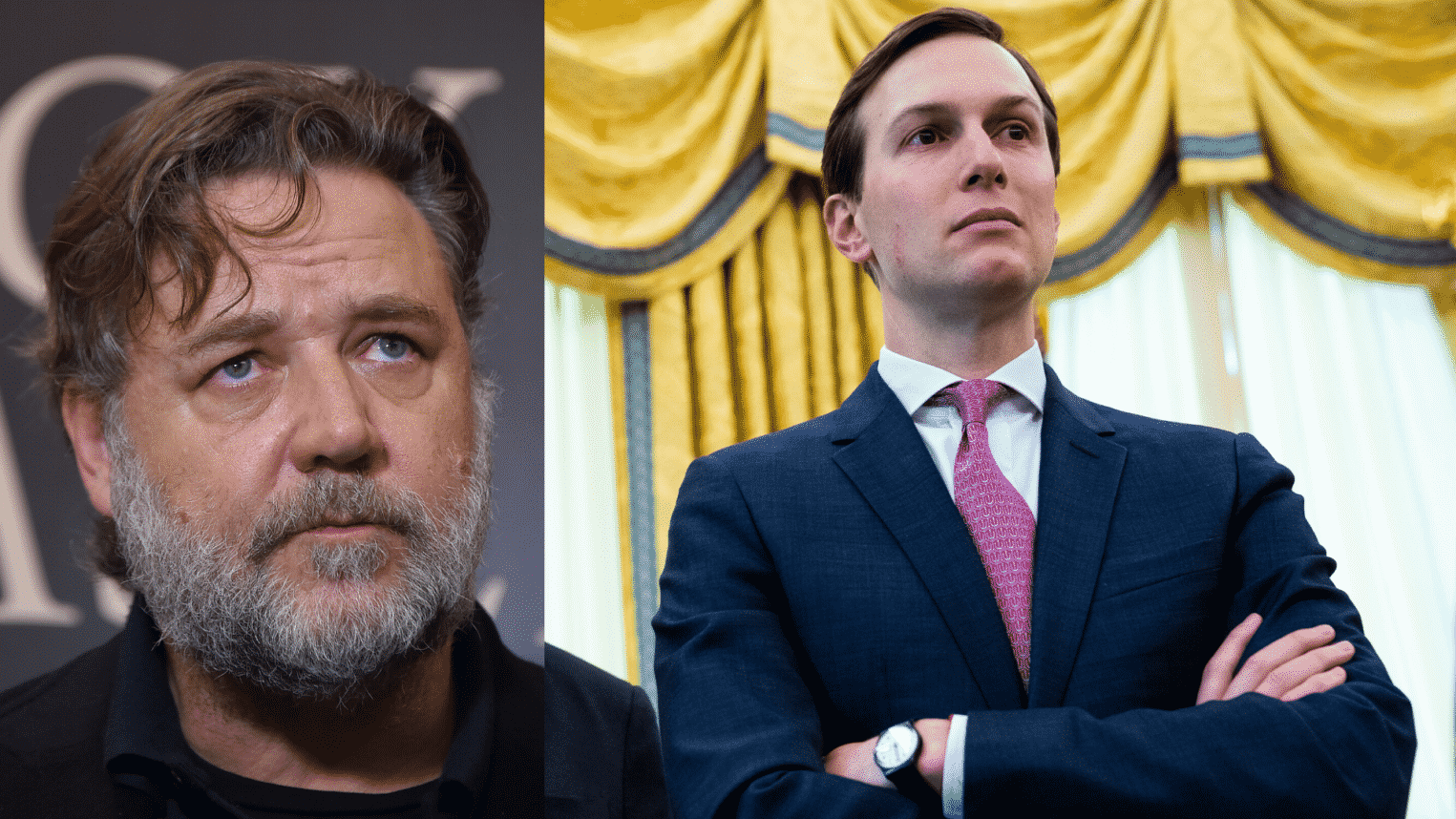
Russell Crowe asked White House advisor Jared Kushner for advice on how to portray former Fox News CEO Roger Ailes for a role in a Showtime series, the actor revealed in a Variety interview.

Crowe said he asked Kushner for the advice at Hugh Jackman’s 50th birthday party in 2018 in New York, since Kushner worked with Ailes when he served as an advisor on President Trump’s 2016 presidential campaign. Kushner attended the party with his wife Ivanka Trump.

The Showtimes miniseries “The Loudest Voice,” which aired last year, was based on the book of the same name by reporter Gabriel Sherman.

Kushner “had a very direct relationship with Roger over their presidential campaign. Phone calls every Sunday. So it gave me that contemporary insight that the book could not give me,” Crowe said.

Crowe was interviewed by actress Nicole Kidman for Variety’s Actors on Actors issue. Crowe, a New Zealander who lives in Australia, and Kidman, a native Australian, are old friends, according to the magazine.

Russell Crowe Asked Jared Kushner for Advice on How to Portray Former Fox News CEO Roger Ailes Read More »

Auschwitz Museum Says Preserved Historic Site Is Different From Statues Honoring Controversial Figures

The Auschwitz Memorial and Museum waded into the current debate over tearing down statues of historical figures, noting that there’s a difference between preserving a historic site and statues meant to honor historic figures.

“We can see a lot of ‘Auschwitz’ mentions recently,” the museum tweeted on Sunday. “Remember that a preserved historic site does not equal a statue erected to honor a person. The two have entirely different roles, contexts, messages & meanings. Drawing a simple comparison here is incorrect.”

The tweet appeared to be in response to Republican pollster and consultant Frank Luntz, who on Saturday tweeted a photo of a quote found on the walls of Auschwitz: “Those who do not remember the past are condemned to repeat it.”

“Leaving most monuments in place while stating the inhumanities associated with them is a better lesson for future generations than tearing them down indiscriminately in anger,” he tweeteed.

Luntz later clarified that he was not referring to the statues of Confederate leaders: “I’m seeing lots of backlash so I’ll clarify: I said most monuments should stay, not all of them. Confederate statues shouldn’t be in public squares; statues of George Washington, Thomas Jefferson and Abe Lincoln should. But the latter are being targeted too, which is absurd.”

Critics pointed out that Nazi camps are maintained to show their horror, while statues of Confederate leaders exist to glorify them. One commenter noted that the Holocaust is remembered in schools, books, museums and storytelling and that slavery and the Civil War should be remembered in the same way. Others noted that there are no statues of Adolf Hitler in Germany.

Auschwitz Museum Says Preserved Historic Site Is Different From Statues Honoring Controversial Figures Read More »

Israel Successfully Launches New Spy Satellite

JERUSALEM (JTA) — Israel successfully launched the new Ofek 16 reconnaissance satellite.

The spy satellite was blasted into space early Sunday morning from a launch site in central Israel, the Ministry of Defense said in a statement. Following the launch, the satellite began to orbit around earth and transmit data, in accordance with original launch plans.

Ofek 16 is an electro-optical reconnaissance satellite with advanced capabilities, according to the statement. It was developed and produced by Israel Aerospace Industries, led by the Defense Ministry’s Space Administration. The last satellite in the Ofek series was launched three years ago.

“The successful launch of the Ofek 16 satellite overnight is yet another extraordinary achievement for the defense establishment, for the defense industries as a whole, and for Israel Aerospace Industries in particular,” Defense Minister Benny Gantz said. “Technological superiority and intelligence capabilities are essential to the security of the State of Israel. The fact that Israel is one of the 13 countries in the world with satellite launching capabilities is not a given, and was made possible by the people who have been investing in these systems and advancing breakthrough capabilities over the years.”

The satellite is expected to send its first images next week.

Israel Successfully Launches New Spy Satellite Read More »

Meet the Law Professor Laying Out the Facts on Annexation

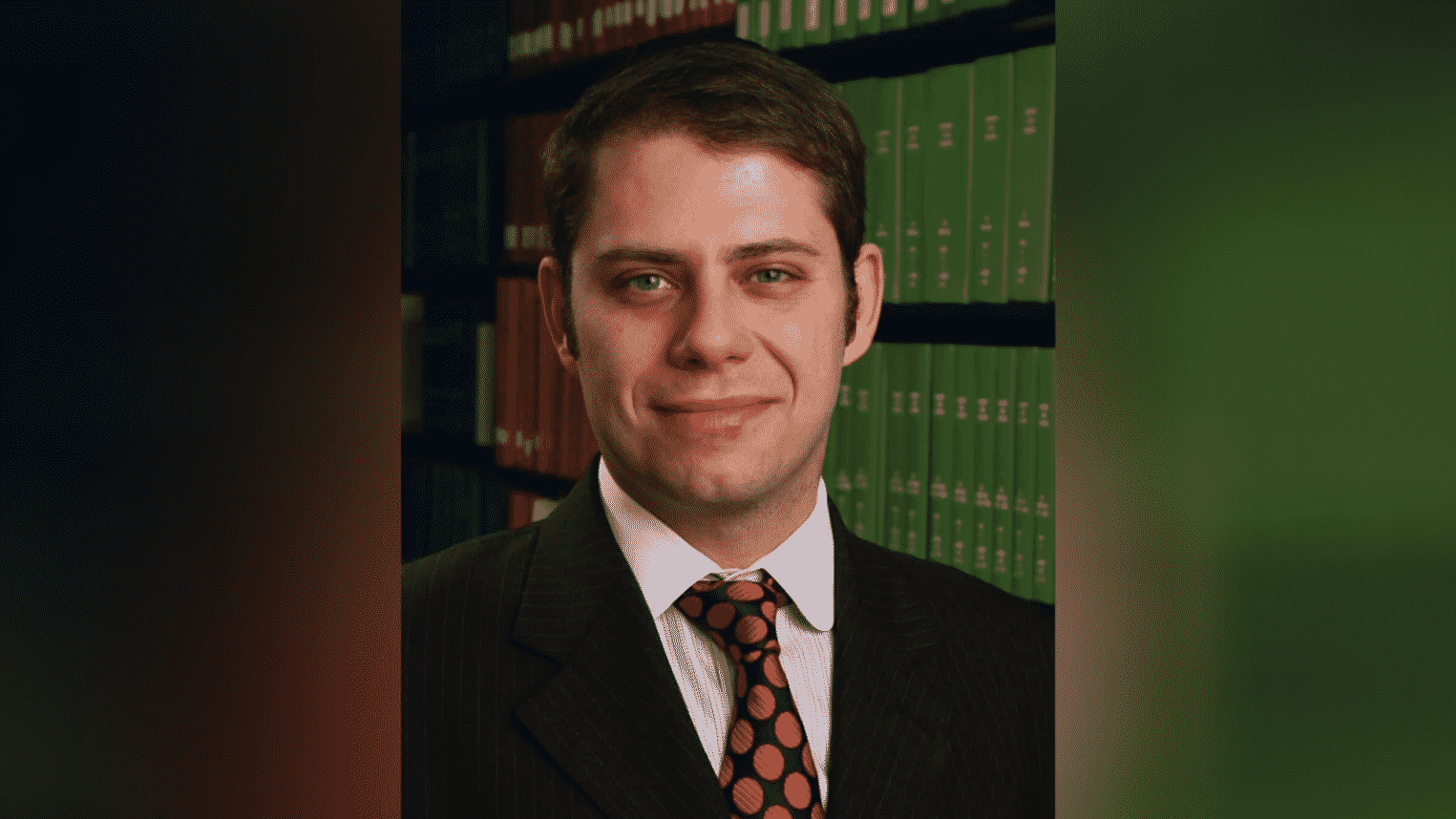
Scan any news story from the past two years relating to Israel’s legal rights and you’re likely to come across professor Eugene Kontorovich’s name. Whether it was drafting the Pompeo Doctrine, where the U.S. secretary of state disavowed a 1978 policy deeming settlements illegal, or the passage of anti-boycott, divestment and sanctions (BDS) laws, or the reversal of Airbnb’s policy of removing Israeli settlement listings from its site, Kontorovich played a key role in facilitating these legal wins. 

As director of the Center for the Middle East and International Law at George Mason University Scalia Law School in Virginia as well as the director of the Kohelet Forum, Kontorovich said the Airbnb episode is one of his “big successes. They didn’t call it a policy of Israelis and Jews because that would be very, very racist,” he said, “but guess how many disputed territories they found around the world? They were very shocked to find out that there were in fact many other such territories and that if they were to apply the policy to all of them, it would mess up their business globally.”

Kontorovich’s latest battle is destroying the myths surrounding the Israeli government’s plans to apply sovereignty over (aka annexation of) Judea and Samaria. The term annexation in international law refers to the forced appropriation of one state’s territory by another state, Kontorovich said, explaining that in this case, applying Israeli law to those areas — some 30% of the land as delineated in President Donald Trump’s administration’s peace proposal — is simply a realization of a long-held right. 

Close to 500,000 Israeli Jews living in the settlements are governed by a mish-mash of military rule and archaic Ottoman laws that makes implementing any changes to the area — such as building roads, schools and basic infrastructure — a bureaucratic nightmare that takes at least twice as long as anywhere else in Israel, Kontorovich said.

The reason that it is still this way decades on, he explained, is because of Palestinian intransigence. He added that in 1967, when Israel captured the area from Jordan occupation in a war of self-defense, the belief was that a final status solution would be hashed out quickly with the Palestinians. “This was supposed to be temporary until the Palestinians quickly came to the table, which didn’t happen,” he said. “But in the Middle East, nothing is as permanent as the temporary.”

According to Kontorovich, several offers of Palestinian statehood have been proposed but not one has been accepted. For the past 53 years, he said, settlers “have been held hostage to Palestinian rejectionism,” and every peace agreement before Trump’s was based on the notion that there would be population transfers of Jews living in those areas. 

“Israel is not going to play along with this game, and neither will America,” he said, “that the Palestinians should only get a state that was pre-cleansed of Jews.” That idea, he noted, is “morally repugnant.”

Applying Israeli law now “underscores that Israel is not going to accept a situation in which it has indefensible borders [as well as] the notion that Jewish presence there is illegal and is so reprehensible that it needs to be reversed. The communities there are a reality,” Kontorovich said, “and they’re not going anywhere.” 

Meet the Law Professor Laying Out the Facts on Annexation Read More »